
Firehole Canyon Swimming Area
Madison Junction, Teton County, Wyoming. Swimming Area.
Details

- Where
- Firehole Canyon Rd, Yellowstone National Park, Madison Junction, WY 82190. Directions
- When
- Swimming only permitted during designated hours; closed at night.
- Season
- Closed until mid-summer due to high water; estimated opening date no earlier than late summer or early fall; may remain closed the entire season in high-snowpack years.
- Fees
- Standard entrance pass $20.00–$35.00.
- Access
- Two vault toilets are the only facilities; no lifeguards; closed until mid-summer in most years for high water and strong currents; swimming only during designated hours, closed at night.
- Walk-in or reserve
- An entrance pass is required; vehicle reservations are not needed.
- Phone
- 307-344-7381
- Website
- nps.gov
- Managed by
- Yellowstone National Park.
- Coordinates
- 44.6053, -110.8605.
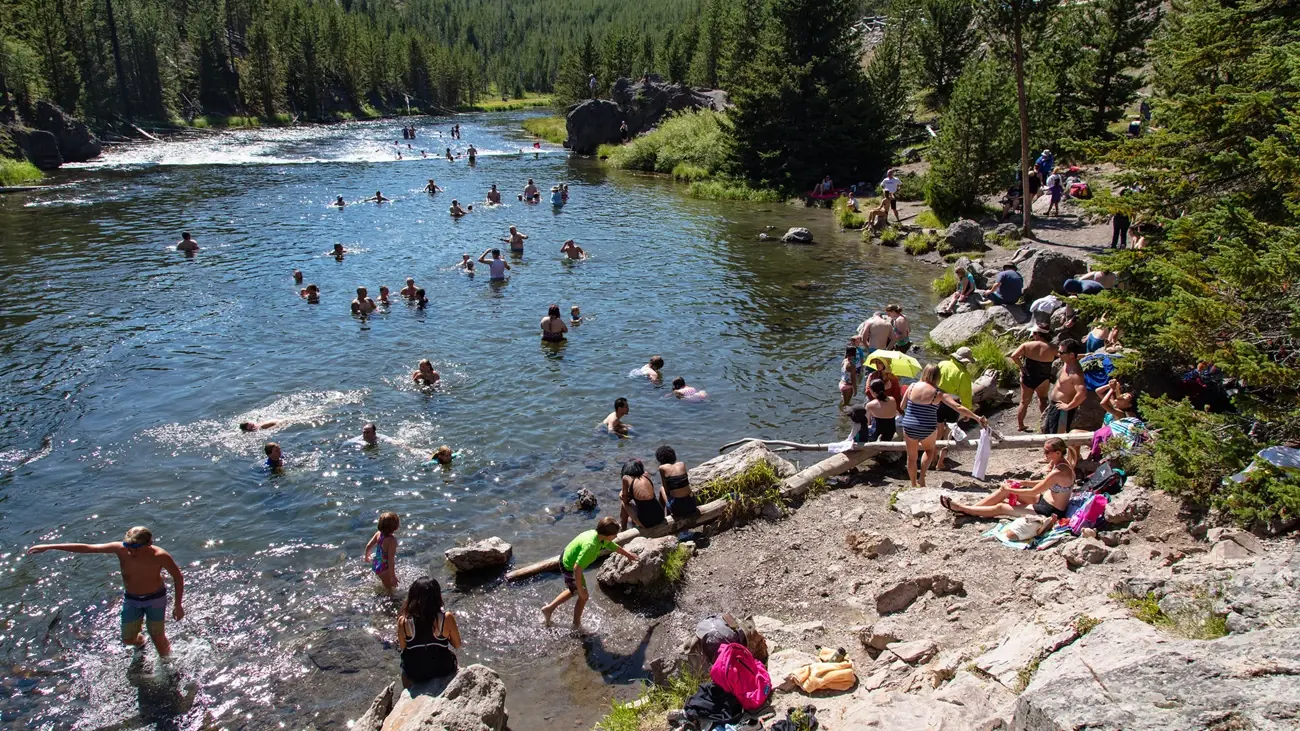
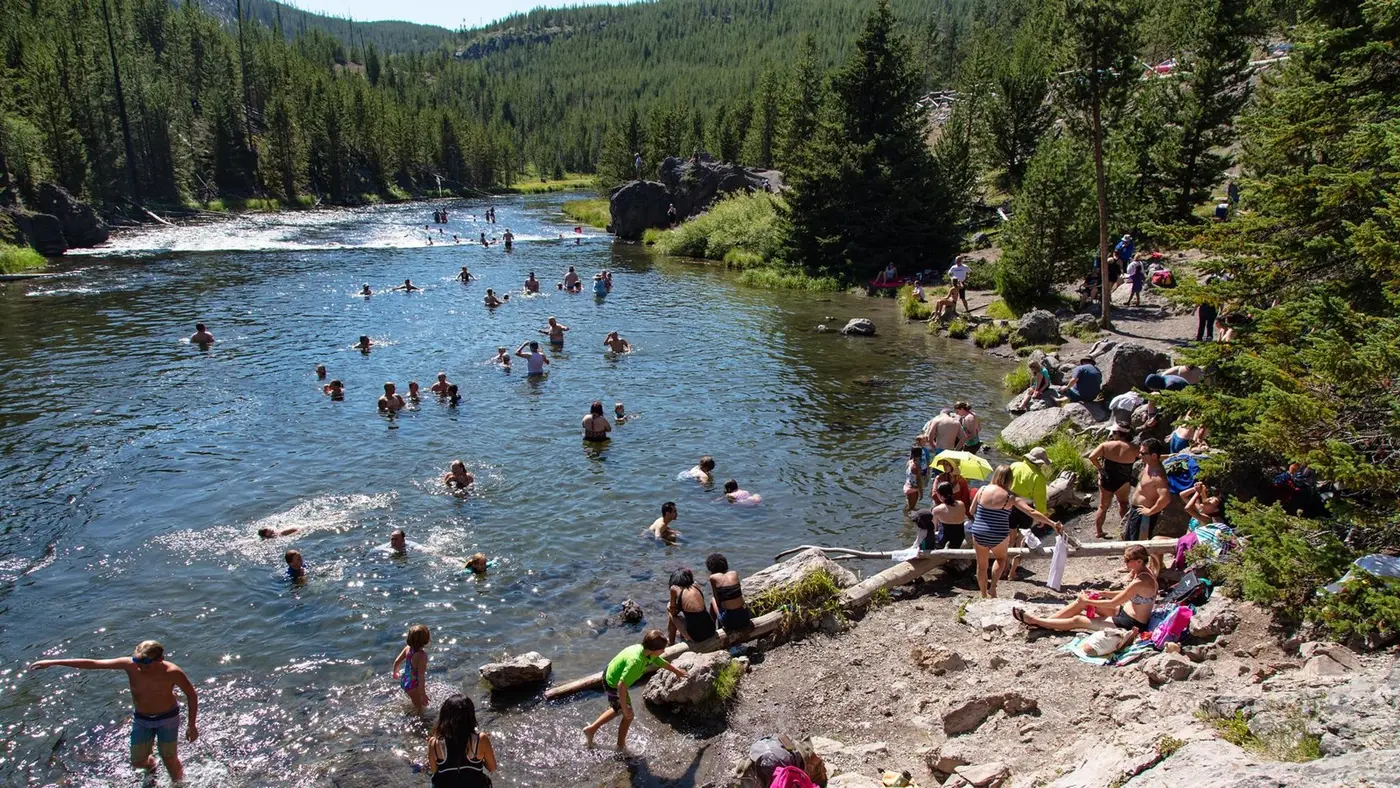
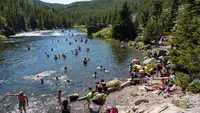
From the shoulder of Firehole Canyon Drive, two miles south of Madison Junction, wooden stairs go down to the Firehole River. There is no parking lot. Cars pull off along the one-way road, and the park notes that the limited parking “is often full and overflowing.” At the bottom of the stairs, between steep walls of volcanic rock, the river runs through a calmer stretch where swimming is allowed. It is one of only two swim areas the park has designated. The other, Boiling River near Mammoth Hot Springs, has been closed to swimming since the 2022 floods.
Hot Springs Guides gives the water temperature as up to about 86 degrees Fahrenheit, and says many visitors compare it to an unheated outdoor pool. That site credits the warmth to runoff from hot springs and geysers upstream in the Upper Geyser Basin, cooled a good deal by the time it reaches the canyon. The park describes the water as “influenced by thermal activity below the surface.” The Firehole begins south of Old Faithful and flows north through the park’s major hydrothermal basins to Madison Junction. There it meets the Gibbon River, and the two form the Madison. Anglers know the Firehole for its brown, brook, and rainbow trout.
Water wings, no floats
The park’s rules for the swim area are short and specific. Bathing suits are required. Water wings are allowed and life jackets are recommended. Rafts, tubes, noodles, pool floats, and similar toys are prohibited. Food, drink, and alcohol are not allowed, and neither are cans, bottles, or plastic containers. Soap, shampoo, and conditioner are banned “even if it’s biodegradable.”
Climbing, diving, or jumping from the cliffs or from trees is forbidden. The park says climbing the cliffs erodes the thin topsoil and damages habitat, and that jumping from them is very dangerous. No lifeguard is posted. Two vault toilets are the only facilities. Swimming is permitted only during designated hours, and the area is closed at night.
Hot Springs Guides adds several cautions. The riverbed is rocky and slippery, so it recommends water shoes. An eddy in the swim area has historically trapped swimmers and caused drownings. There is no cell service in the canyon.
A gate that opens late
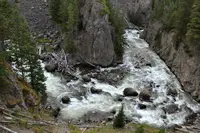
Snowmelt keeps the river high and the current strong into summer, and the park usually keeps the area closed until mid-summer. Hot Springs Guides puts the usual opening at around mid-July. In years of heavy snowpack the area may stay closed all season, and Hot Springs Guides reports that it did so for the whole of 2025.
On August 3, 2026, the park’s page for the swim area read “CLOSED” and estimated an opening no earlier than late summer or early fall. The park’s current-conditions page, updated September 29, 2026, still listed the Firehole River Swim Area as closed. In winter the drive itself closes to cars. From mid-December to mid-March, most park roads are open only to limited snowmobile and snowcoach travel.
Brecciated rhyolite along the drive
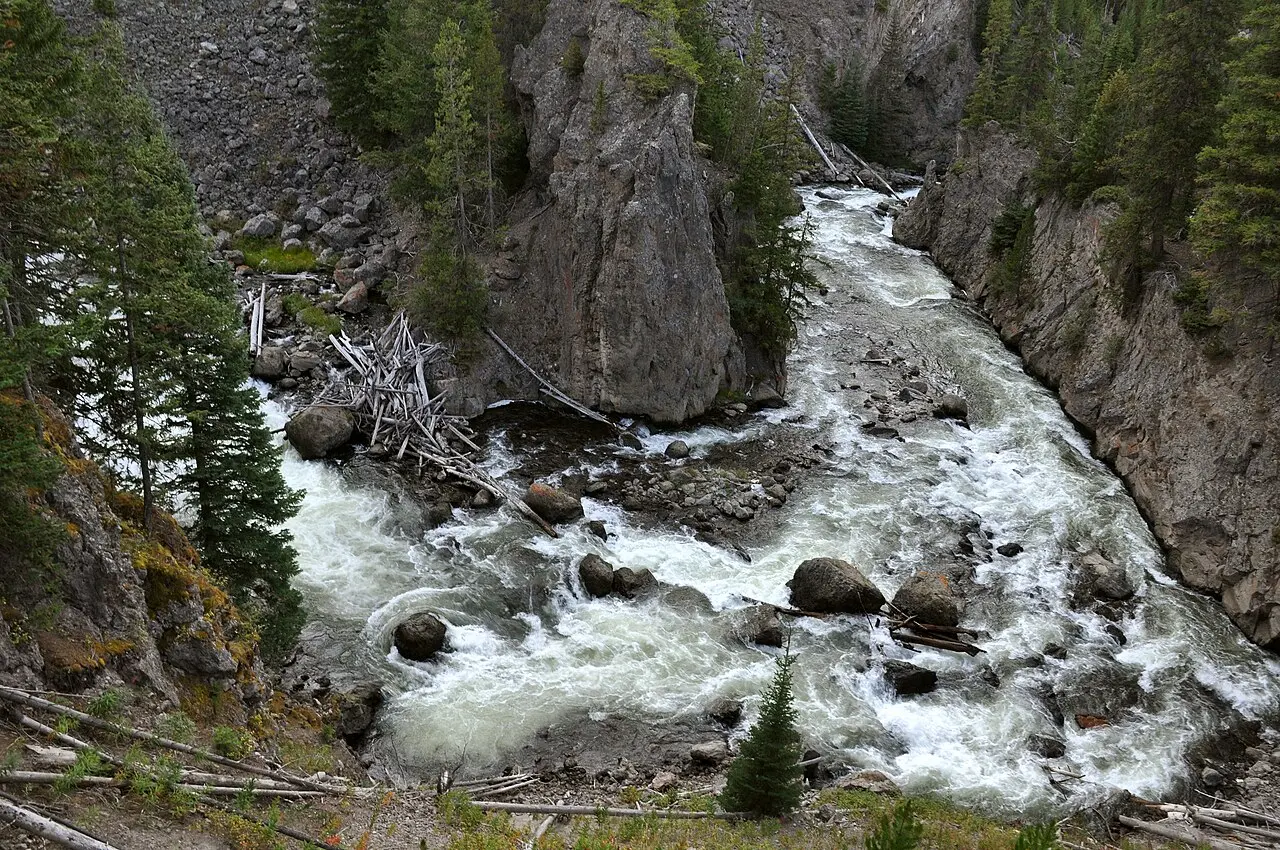
Firehole Canyon Drive follows the river upstream from Madison Junction to just above the Cascades of the Firehole. It passes lava flows 800 feet thick and reaches a viewing area at Firehole Falls, which drops 40 feet. The park lists Firehole Canyon among the places in Yellowstone to see lava. The flows meet the road about one mile south of the junction.
Geological Survey Bulletin 1347 identifies the rock as rhyolite of the Plateau Rhyolite. These lava flows poured across the floor of the Yellowstone caldera after it collapsed. The bulletin dates the collapse to 600,000 years ago; the park’s own figure for the caldera is about 631,000 years. As each flow moved outward, its surface chilled into a crust. The still-molten interior kept moving, broke that crust into angular blocks, and tumbled them along until the whole mass hardened. The bulletin names the lavas along the Firehole Canyon drive as a good place to see the coarse brecciated texture this left behind. On the west bank of the river, a thick rhyolite flow shows banding. Its dark bands are mostly volcanic glass, and its light bands are tiny crystals of feldspar and quartz.
A road the Army gave up
Superintendent Philetus Norris was building the park’s first roads in 1879. That year he wrote of the Gibbon, Firehole, and Madison rivers: “Few of the anomalous features of the LAND OF WONDERS are of greater scientific interest or of more practical value than the placid, uniform water-flow in its hot spring and geyser-fed rivulets and streams.” Instead of bridging some of these streams, he cut slopes through their turf banks and made fords.
Army engineers later built the first road along the Firehole through the narrow canyon. In 1910 that road was abandoned because of its construction costs and the heavy character of the work. National Park Service day-labor crews resumed construction on the canyon section in 1925. The Bureau of Public Roads surfaced it in 1931.
Downstream at Madison Junction, the Madison Information Station tells a legend that explorers camping there in 1870 decided Yellowstone should become a national park. The park says plainly, “It is a wonderful story, but it isn’t true.” The explorers did camp at the junction, but apparently did not discuss the idea. The place they chose had been a campsite for a long time already. Archeologists have found campfire remnants, obsidian flakes, and bone fragments there dating back at least 10,000 years.
Notable Events
- 1910The old road along the Firehole River through a narrow canyon, first constructed by the Army engineers, was abandoned because of construction costs and the very heavy character of the work. npshistory.com
- 1925National Park Service day labor forces resumed construction on the canyon road section. npshistory.com
- 1931The canyon road section was surfaced by the Bureau of Public Roads. npshistory.com