Finn Creek Farm & U-Pick
Boulder, Jefferson County, Montana. Farm.
Details

- Where
- 218 Amazon Rd, Boulder, MT 59632. Directions
- When
- Friday, July 24, 2026, 6:30 PM MDT.
- Season
- U-Pick open for the season (announced on the farm's Facebook page).
- Getting there
- 218 Amazon Road, 5 miles outside of Boulder.
- Fees
- $20/vehicle; carpooling encouraged.
- Access
- Bring your own camp chairs; seating is limited.
- Walk-in or reserve
- Open to the public for You-Pick appointments.
- Phone
- (406) 438-0027
- Website
- finncreekfarm.com
- Managed by
- Brent Sarchet runs the farm near Boulder with his wife Andrea.
- Established
- 2014.
At 218 Amazon Road, five miles from Boulder in Jefferson County, Montana, Finn Creek Farm & U-Pick keeps a farmstand on 40 acres. The farm grows honeyberries, strawberries, raspberries and apples, along with herbs and a long run of vegetables: arugula, broccoli, cabbage, carrots, celery, cucumbers, green beans, onions, parsnips, peppers, potatoes and salad greens. Laying hens, pigs, bees and Columbia sheep supply eggs, honey, pork and lamb for sale. The farm holds a Montana nursery license and sells mainly potted honeyberry plants and apple trees. Its listing with Abundant Montana also places it at the Boulder Farmers Market. Brent and Andrea Sarchet own and run it.
Honeyberries by appointment
Picking is by appointment. A visitor messages the farm to set a time, then picks as many strawberries, honeyberries and vegetables as wanted and pays by the pound. The farm announced the 2026 U-Pick open in early July, after cleaning and reorganizing the farmstand. Strawberries were then “still a couple weeks out,” the farm posted, “but we have tons of honeyberries and a few other veggies and herbs.” In mid-July it took one weekend off from U-Pick and asked pickers to come the following week.
The honeyberry, also called the haskap, belongs to the honeysuckle family, comes from Canada and Japan, and looks like an elongated blueberry. Andrea Sarchet says the taste reminds her of a cross between grapes and kiwi, and she adds it to yogurt and ice cream. In July 2026 one returning picker brought the farm a honeyberry vodka she had made herself. “The bad news is, I won’t be sharing it,” the farm posted, “but the good news is we are open this weekend.”
“Watching kids walk out of here with berry stained fingers just makes me happy,” Andrea told The Monitor that month.
Race nights on Amazon Road
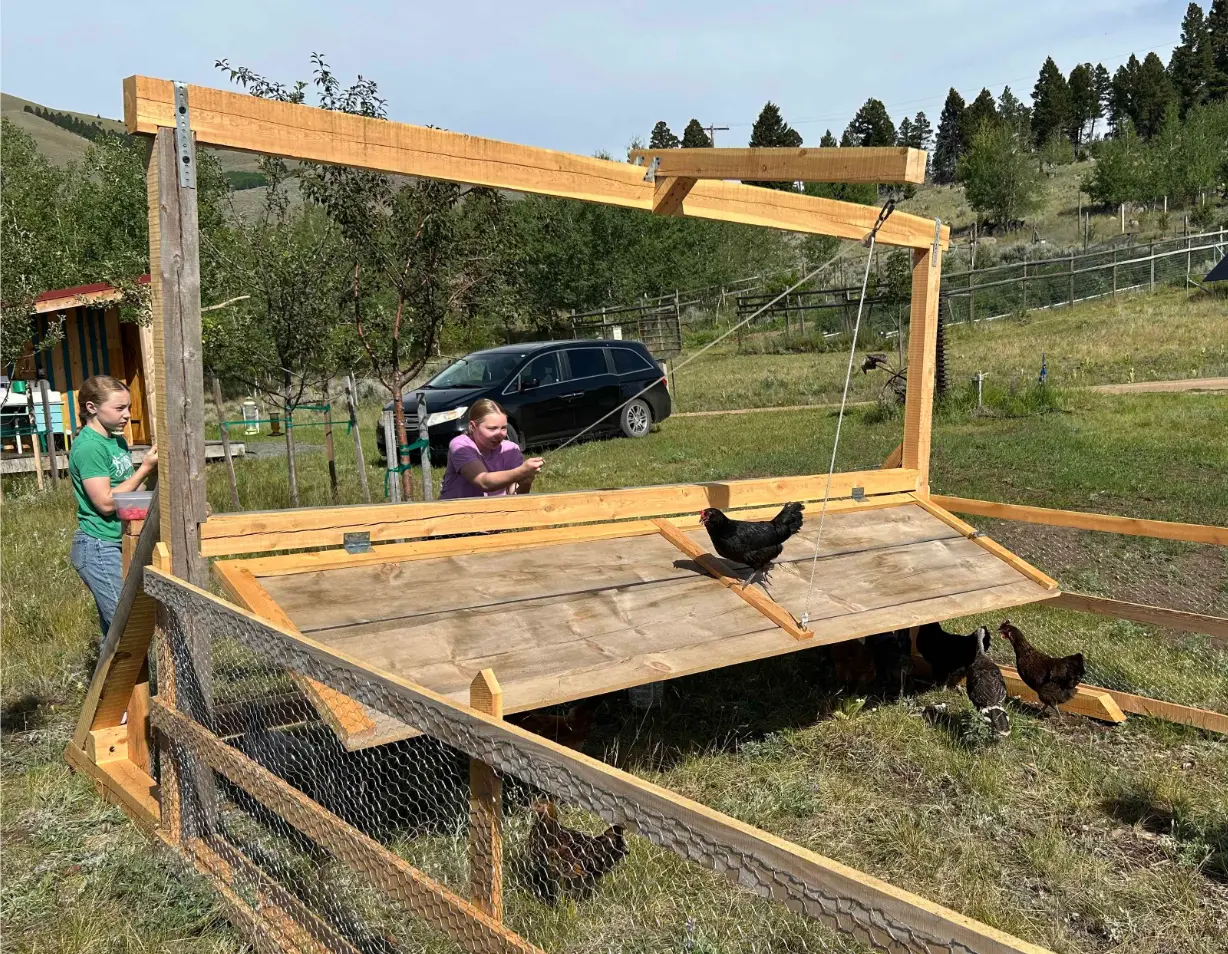
That same July the farm began holding chicken races. Admission is $20 a vehicle, and carpooling is encouraged. Seating is limited, so visitors bring their own camp chairs. Bidding opens at 6:30 p.m., when the crowd scouts the birds and picks a champion, and the races start at 7:00. Under the plan Andrea described to The Monitor, the winners share half the betting pot and the other half goes to a local business or charity.
The first public race, on Friday, July 24, 2026, raised more than $500 for the Friends of the Boulder Community Library. The second, on Saturday, September 5, benefited JeffCo Food Share. On both nights the Windsor Bar served beer and other drinks from the farmstand. On the second, the Dat Cajun Kitchen food truck served food, and the winners took cash, farm prizes and trophies.
The bracket changed between the two nights. In July, two heats of 10 birds each sent their top three to a Championship Race. In September, three heats of eight sent their top two. Before each race the farm posted the same three rules: “No bribing the athletes with fancy treats.” “Loud, aggressive cheering is mandatory.” And: “If a chicken flies off course and lands on you, you are legally obligated to name it.”
Two days before the first race, the farm reported the finishing touches on its racetrack and “20 racing ladies” still to get ready. “They will have saddles, and maybe even hats!!” The race-day post invited spectators to pick a “champion chicken (or turkey!).”
Hedwig, Puffy Cheeks and the 36-foot corral
Andrea told The Monitor that the idea came from the speed of the farm’s 30 chickens at feeding time. Then, on a vacation in Belize, the Sarchets watched children betting on hermit crabs. “This is just a family-friendly, fun thing that people can come out and do on a Friday night,” she said. “Because we don’t have a ton to do in Boulder, right?” She added: “This is not intended to be like a money-making thing for us.”
Trial races began in early July 2026, and The Monitor’s Corbin Vanderby watched one. Twelve-year-old Nora Sarchet hoisted a rope to lift the gate of a makeshift chute, and 10 hungry chickens came out at no great pace. Her father Brent called a high-pitched “Chickens!” and threw hunks of bread and watermelon toward the end of a 36-foot corral. Puffy Cheeks, a big iridescent veteran and Nora’s favorite, made a beeline for the bread. Hedwig, a small, fluffy white Polish crested the Sarchets had recently bought, got stuck in the chute. The winner showboated around the track and jumped onto the gate, and Brent stopped him and called a second race.
This time a turkey took long, slow strides and Puffy Cheeks came out fast. Then Hedwig shot from the chute, ignoring the other racers, ran straight to the end of the track and tapped his short beak on the fence. He turned a victory lap and never took a bite of bread.
Brent’s theory, the paper reported, was that heavier birds such as Puffy Cheeks and Bossy Betty, the purple-caped coop bully, would run better out of their passion for food. The Sarchets had bought the turkey and the odder-looking birds on purpose. “You gotta have some weird looking chickens if you’re gonna have chicken races, right?” Andrea said. “They can’t just be run-of-the-mill white chickens or whatever.” At the time they hoped to lengthen the track to 60 feet and add a PA system before July 24.
Forty acres near Amazon
Andrea grew up in rural California, where, she said, 4-H cemented her love of producing. When she saw the chance in 2014 to buy the 40-acre farm near Amazon, she jumped on it. “I like the idea of the self-sufficiency of agriculture,” she told The Monitor. She works full-time in produce safety at the Montana Department of Agriculture on top of helping run the farm. Brent is a certified International Society of Arboriculture arborist and certified crop advisor. He writes about trees and landscaping for The Monitor and has taught a honeyberry workshop at Garden Werks in Helena.
Brent’s columns give an earlier date. In July 2024 he wrote that some of the orchard’s apple trees “had been in the ground since 2013 when we started our first orchard.” The pages do not reconcile his 2013 with Andrea’s 2014.
In the same column he set down two bad seasons. In 2023 a couple of hard freezes struck at full bloom and the trees bore very little fruit. The following winter brought days of 30 below. By spring 2024, trees in Helena had been blooming for weeks, and the farm’s honeyberries and strawberries were in full bloom and buzzing with pollinators, but many of the apple trees had barely stirred. Some bloomed late, only to be hit by two late frosts. Several apple trees died, and many lost half their canopy to winter injury. Among the dead were a few of what he called his “mother trees,” one of which had borne 12 varieties of apple from grafts he had made over the years. “I had to hold back tears when I cut those trees down and ran them through the chipper this spring,” he wrote.
He asked himself whether fruit growing was worth the losses. “I pondered that question this spring as I was buying replacement trees for our orchard — but only for a few seconds.”
Notable Events
- 2013The farm's first orchard went in; some of its trees stood until the winter injury of this decade's harshest spring. jcmonitor.com
- 2013Brent Sarchet recalled starting their first orchard; some trees had been in the ground since then. jcmonitor.com
- 2014Andrea Sarchet said she jumped on the opportunity to buy the 40-acre farm near Amazon. jcmonitor.com
- 2024After an extreme cold winter and two late frosts, several apple trees died of winter injury and were cut down in the spring. jcmonitor.com
- 2026The first race was advertised to benefit the Friends of the Boulder Community Library. facebook.com
- The orchard produced very little tree fruit after a couple of hard freezes hit at full bloom. jcmonitor.com
- Brent Sarchet bought replacement trees for the orchard after the losses. jcmonitor.com
- Several apple trees died and many lost half their canopies to winter injury; dramatic temperature swings over the previous year probably had taken their toll. jcmonitor.com
People
- Andrea, Brent Sarchet's wife, who runs Finn Creek Farm with him.
- Andrea Sarchet, Helps run the farm and works full-time in produce safety at the Montana Department of Agriculture (2014 purchase opportunity).
- Brent, Andrea Sarchet's husband, who runs the farm with her; together they devised the chicken races after observing their chickens at feeding time and children betting on hermit crabs in Belize.
- Nora Sarchet, Operated the makeshift chute during the family's chicken-race trials.
- Brent Sarchet, Runs Finn Creek Farm outside Boulder with his wife Andrea; an ISA-certified arborist and certified crop advisor (since 2013).
Sources
- finncreekfarm.com
- facebook.com/p/Finn-Creek-Farm-U-Pick-100094310592730
- abundantmontana.com/amt-lister/finn-creek-farm
- jcmonitor.com/do-chickens-race-come-see-at-finn-creek-farm
- jcmonitor.com/when-really-bad-weather-happens-to-good-fruit-trees
- jcmonitor.com/landscaping-go-for-old-fashioned-mulch-not-fabric
- aeromt.org/helena-community-food-system-assessment
- facebook.com/events/1535686771386314
- abundantmontana.com/event/growing-haskaps