Fillmore Trout Hatchery
Fillmore, Ventura County, California. Trout hatchery; All year.
Details

- Where
- 612 E. Telegraph Road, Fillmore, CA 93016. Directions
- When
- Open 8:00 a.m. to 2:00 p.m., all year.
- Getting there
- From the south (Los Angeles) travel north on I-5 to Hwy 126. Take Hwy 126 west toward Ventura for 18 miles to Fish Hatchery Road, turn left and travel one quarter mile to visitor's parking lot.
- Access
- Open to the public.
- Phone
- (805) 524-0962
- Managed by
- State of California Department of Fish and Wildlife.
- Established
- 1942.
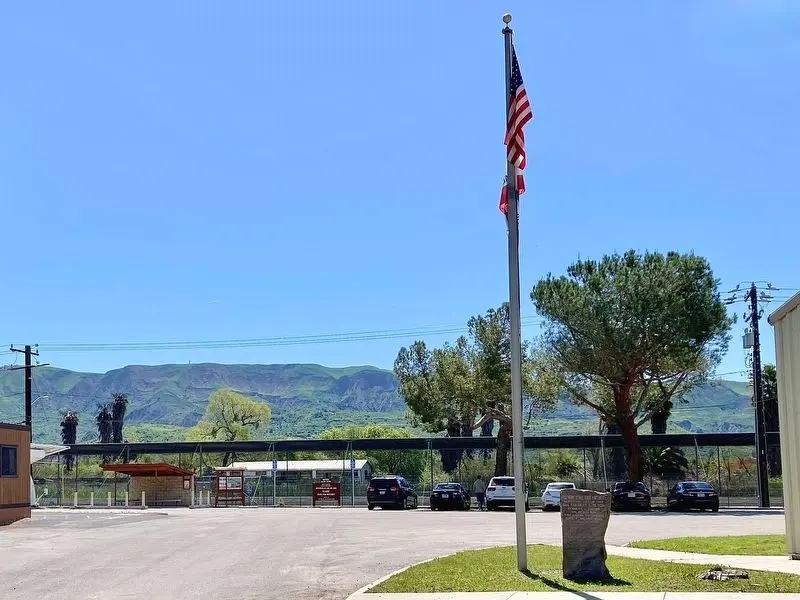
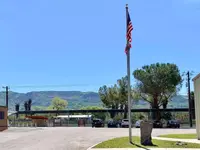
A quarter mile off Highway 126 on Fish Hatchery Road, a visitors’ lot opens onto four concrete raceways, each 1,000 feet long, laid side by side on what was once a citrus grove beside the Santa Clara River. A large net cage covers them. When KCLU’s Caroline Feraday came in August 2022, a heron stood on the outside of it, looking for a gap.
“Without that net we’d probably lose about 200,000 fish a year just to birds at night,” the manager, Shawn Fedrow, told her. “It’s a big buffet for predators.”
Four raceways under a net
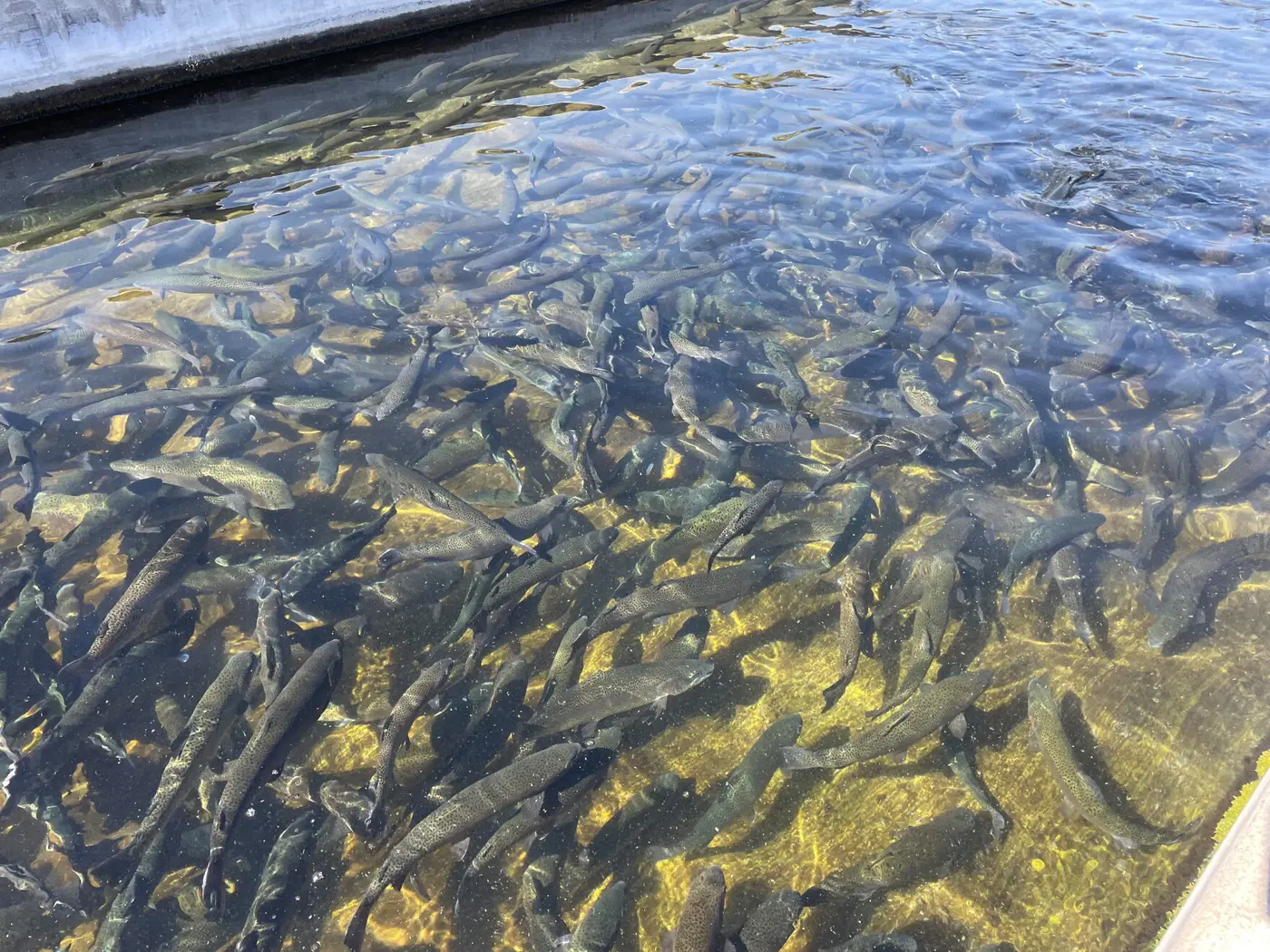
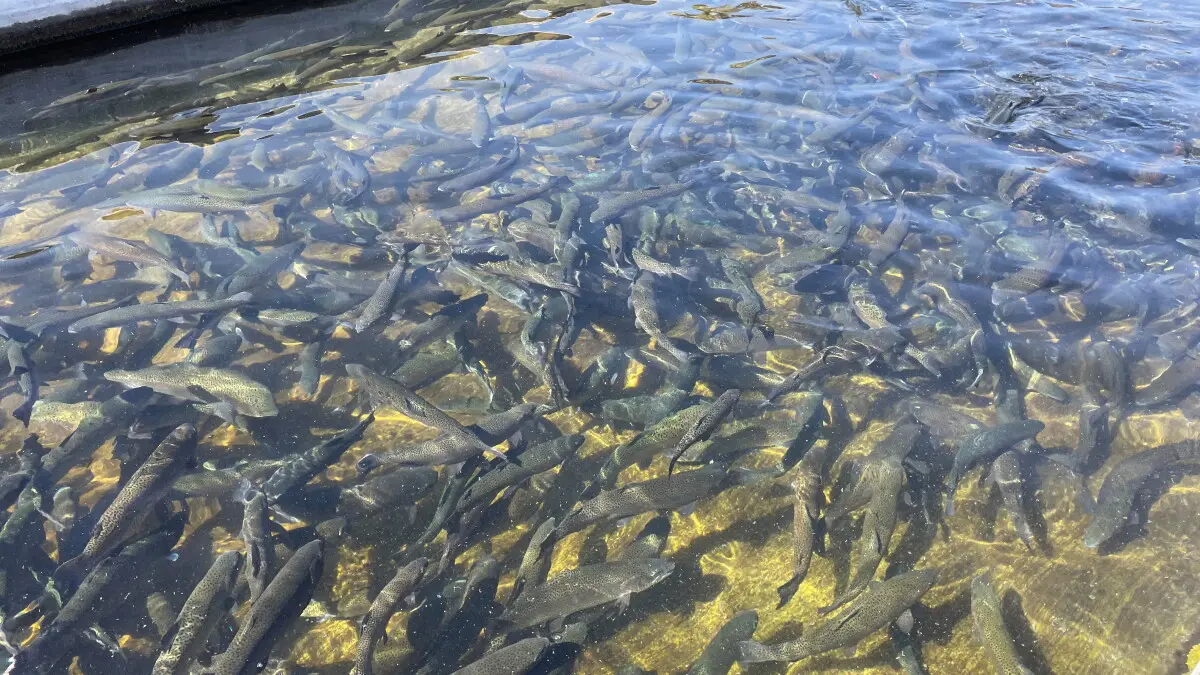
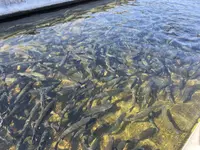
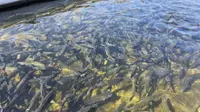
The Fillmore Trout Hatchery is run by the California Department of Fish and Wildlife. It sits in eastern Ventura County among citrus and avocado orchards, with fruit vendors along Highway 126 and the Los Padres National Forest north of the valley. Visitors walk the raceways and feed the fish. Andy and Isela Murillo brought their sons in 2022, Max, 5, and Jeremy, 4, hoping the boys would grow up loving to fish. Max fed the trout and guessed there were “a hundred thousand” of them. Fedrow put the count at around one and a half million, from 1 inch to 14 or 15 inches long.
The fish in the ponds are rainbow trout. The hatchery also raises brown trout, and both are now sterile triploids. It receives fertile eggs from a state egg production hatchery and raises the fish for a year before release. The figures for what leaves the gate vary by source. The department gives an average of 700,000 trout a year, primarily for Southern California lakes and streams. A marker on the grounds gives approximately 252,000 pounds of rainbow, brown and brook trout, about half a million of them rainbows. KCLU reported around a million fish. Fedrow said the hatchery stocks 10 counties, from Kern to Orange, San Luis Obispo and Ventura. “A lot of people keep them and cook them up for dinner,” he said. From November through February, according to the marker, the hatchery and the Department of Water Resources put one-pound trout into Pyramid Lake for winter fishing.
Older accounts give the daily round. In 1990 the Los Angeles Times described eggs trucked from a broodstock hatchery in the Sierra Nevada four times a year, up to 500,000 at a time in Styrofoam cases, hatching in indoor incubators within about five days. The fry, about half an inch long, went into their own 100-foot section of a raceway. Baffles separated the sections because bigger trout eat smaller ones. “They’re very cannibalistic,” assistant manager Terry West said in 1994. An employee drove a cart with a motorized “fish-food thrower” down the aisles, and the hatchery went through 2,000 pounds of food a day. The fish learn the cart. “When they feel the vibration or see the movement, they know they’re about to be fed,” hatchery employee Ken Robledo said in 2000. In 1994 a visitor’s handful of pellets cost 5 cents. By 2000, dispensers sold a serving for a quarter.
The 2000 Times account described the trout as animated dark gray shadows, the larger ones showing a metallic pink along their lower halves when the light caught them. In 1990, Ellen Shepard, 30, worked through a raceway in rubberized wading overalls with a net, chasing a stray trout. “Everybody does everything,” she said. “It’s fascinating to watch them go from fry to plantable size.”
Well water under the orchards
The department says the hatchery draws on springs and wells, with water averaging about 60°F, warm enough for fast growth. The marker describes four large wells pumping from 150 to 600 feet down, the water running 59 degrees in winter and 62 in summer, about 10.7 million gallons a day. The department’s history page says the hatchery now uses one large well and a recirculation pump to conserve water. After the water leaves the hatchery it goes to farm fields and percolates back into the sandy ground. The 1990 Times account says it eventually reaches the wells again. One of the marker’s 2023 photographs shows the outflow, where fish wait for scraps. Birds wait there too.
Ponds dug in wartime
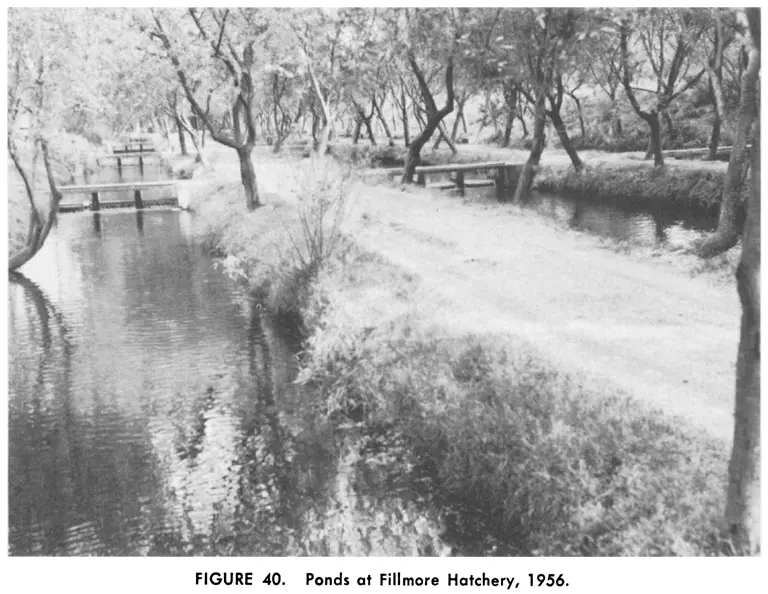
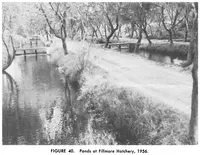
The ground lies in the traditional territory of the Ventureño Chumash, according to a state hatchery environmental report of 2009 and 2010. Testing of the water supply began in 1941. In 1942 the state built 30 earthen ponds, 4 cottages, a feed room and a garage for about $74,000. An inscription near the entrance records the dedication of the Fillmore State Fish Hatchery on July 19, 1942, when Culbert L. Olson was governor.
The state calls Fillmore one of California’s first warm-water hatcheries built to produce catchable-sized trout. Earlier state stations had turned out fry and fingerlings in clear, cold water. Anglers pressed for catchable fish, and the state report notes that large trout grew better in foothill and valley water of 55 to 65 degrees. Wartime shortages made Fillmore one of the last hatcheries built until the war ended, and plans for seven more warm-water hatcheries for catchable trout were put on hold. The 1990 Times gives a different early history: the hatchery raised largemouth bass and various warm-water species until the early 1950s, when it turned to trout alone. In 1949 the grounds served as a set for the Roy Rogers shoot-‘em-up Susanna Pass.
The sources also disagree on when the dirt ponds gave way to concrete. The marker dates the modernization to 1969, when the raceways and a hatchery building with seven circular tanks were built. The department’s history places renovations in 1968 and 1972, totaling 40 concrete ponds and two additional wells. The cottages still stand; a 2023 photograph labels them private property. Staff have long lived on the grounds. Manager Jim Adams, 41, lived on the 27-acre facility with most of his staff in 1990. “The hatchery belongs to the anglers of the state, so everyone is more than welcome to come by and take a look,” he said. Robledo explained the arrangement in 2000: if a pump failed, the fish would die for lack of oxygen. Backup diesel generators stood ready.
Herons, overalls, and a Saturday-night pump
The birds came first. Before Fish and Game workers strung netting over the rearing ponds, which by a 1994 account was eight years earlier, egrets and herons took about 30 percent of the fish, according to the Times. In 1990 Adams estimated losses to birds of 10 to 25 percent in bad years. By 1994 workers were feeding the birds the 25 to 30 fish that died each day. In 2000 about 30 egrets and herons waited in the trees around a pond outside the north fence. A couple of escaped adult trout circled that pond, a foot and a half long.
People tried as well. A sign in the parking lot quotes DFG Code 1124: “No fishing for fish, crayfish or frogs.” Lures taken from would-be poachers were displayed in the office in 2000. “They always have some angle—you know, try and scoop them out with cups or plastic bags or whatnot,” Robledo said. As West told it, the boldest case came in the 1970s, when four men in overalls were caught pulling out fish on lines dropped down their pants’ legs.
The worst loss came from inside. In January 1989 the hatchery began a “Trophy Trout” program, and production reached an all-time high of 410,000 pounds. A recirculation pump that had been running around the clock since January carried the extra load. It was the only one of four pumps without an alarm. On a Saturday night that November it overheated and failed, cutting off a third of the fishes’ water and oxygen. Suffocated trout piled against the retaining screens until the screens gave way, and about 20,000 live fish were swept into a creek on a neighboring watercress farm. Another 180,000 rainbow trout died in the ponds. “We should have had an alarm system, bottom line,” said James R. Adams, then assistant manager. Workers scooped dead fish through Sunday and Monday. Most were buried in a pit on the grounds, and at least three truckloads went to neighboring farms as fertilizer. “We put ourselves into it so much—it’s like losing your kids,” said Bob Peery, a fish and wildlife assistant.
The Jan. 17, 1994, earthquake left the hatchery undamaged but shut it down for two days on auxiliary power. About 600 fish were lost, sloshed out of the troughs or starved of air. “We lost a few fish,” West said. That year the hatchery drew 3,000 to 7,000 visitors a month. “I’ve heard people mention that water calms the nerves,” West said. In 2000 Barbara Higgins of Ventura brought her grandchildren. She had last visited in 1962 and remembered nothing of it.
Steelhead out of Topanga
During an unprecedented drought in 2014, the hatchery installed Endangered Species Fish Rescue Tanks, kept apart from the main hatchery and rearing ponds, with controlled temperature, oxygenation, recirculation and disease control. In 2025 they held fish the Palisades Fire had left stranded.
On Jan. 23, 2025, about 50 people worked Topanga Creek with nets, buckets and backpack electrofishers, collecting the last known population of Southern California steelhead in the Santa Monica Mountains. The VC Reporter counted 271 fish brought to Fillmore; the Land Trust for Santa Barbara County said over 200. Most were no bigger than 12 inches. “Failure to take action could result in really losing this remaining isolated population,” said Kyle Evans, a department environmental program manager. Late-January rains filled Topanga’s pools and channels with debris. “Any fish remaining in Topanga have been lost to the mudflows,” said Rosi Dagit, principal conservation biologist for the Resource Conservation District of the Santa Monica Mountains.
On February 10, 2025, a truck carried the steelhead from Fillmore to Arroyo Hondo Creek on the Conception Coast. There a team from the department, the conservation district, NOAA, the Watershed Stewards Program and the Land Trust moved the fish into 5-gallon buckets fitted with aerators and carried them to release points, some along the trail and some reached only by hiking up the stream channel.
Notable Events
- 1941Initial testing of the water supply began in 1941. wildlife.ca.gov
- 1942Fillmore State Fish Hatchery was dedicated July 19, 1942. hmdb.org
- 1942An entrance inscription gives the dedication date during Culbert L. Olson's governorship. latimes.com
- 194230 ponds, 4 cottages, a feed room and a garage building were constructed at a cost of approximately $74,000. wildlife.ca.gov
- 1949The hatchery was used as a set in the Roy Rogers shoot-'em-up Susanna Pass. latimes.com
- 1950sThe hatchery changed from raising largemouth bass and various warm-water species to focusing exclusively on trout breeding. latimes.com
- 19681968 and 1972 saw renovations with construction of a total 40 concrete ponds and two additional wells. wildlife.ca.gov
- 2014Due to unprecedented drought, rescue tanks were installed to maintain a controlled living environment separate from the main hatchery and rearing ponds. wildlife.ca.gov
- 2025In the second phase of the rescue operation, a truck transported trout from Fillmore Hatchery to Arroyo Hondo Creek. sblandtrust.org
- Under the new Trophy Trout program the hatchery was raising trout at record levels, with annual production at an all-time high of 410,000 pounds, about 10,000 pounds above the norm. latimes.com
- A pump accident killed 180,000 rainbow trout and sent 20,000 more into a creek on a neighboring watercress farm; officials said a missing alarm contributed. latimes.com
- Fish and Game workers installed netting over the rearing ponds; before it, egrets and herons snatched about 30% of the fish. latimes.com
- The hatchery was not damaged in the quake but shut down for two days while operating on auxiliary power. latimes.com
- The hatchery served as a temporary home for 271 endangered Southern California steelhead trout whose habitat was impacted by the Palisades Fire. vcreporter.com
People
- Shawn Fedrow, Manager of the hatchery.
- Bob Peery, Fish and wildlife assistant who helped raise the hatchery fish.
- James R. Adams, Assistant manager of the hatchery (since 1980).
- Ellen Shepard, Hatchery worker cleaning a raceway.
- Jim Adams, Hatchery manager, living on the facility with most of his staff.
- Terry West, Assistant manager of the hatchery.
- Culbert L. Olson, Governor when the hatchery was dedicated (July 19, 1942).
- Ken Robledo, Hatchery employee.
- Roy Rogers, Associated with the shoot-'em-up Susanna Pass, which used the hatchery as a set (1949).
- Freddy Ramirez, Chumash representative consulted about the Fillmore Hatchery area.
- Julie Lynn Tumamait, Chumash representative recommended for additional input in the hatchery cultural-resources consultation.
- Rosi Dagit, Principal Conservation Biologist for RCDSMM commenting on the rescued trout held at Fillmore before relocation.
- Kyle Evans, CDFW Environmental Program Manager explaining the endangered-steelhead rescue.
- Valerie Termini, CDFW Chief Deputy Director commenting on the wildfire recovery effort.
Sources
- wildlife.ca.gov/Fishing/Hatcheries/Fillmore
- wildlife.ca.gov/Fishing/Hatcheries/Fillmore/History
- wildlife.ca.gov/Fishing/Hatcheries/Fillmore/Species-Raised
- kclu.org/local-news/2022-08-12/millions-of-fish-are-nurtured-at-this-ventura-county-hatchery-every-year
- hmdb.org/m.asp?m=218875
- latimes.com/archives/la-xpm-1990-05-24-vl-602-story.html
- latimes.com/archives/la-xpm-1989-11-30-ve-149-story.html
- latimes.com/archives/la-xpm-1994-02-24-vl-26637-story.html
- latimes.com/archives/la-xpm-2000-nov-23-me-56247-story.html
- nrm.dfg.ca.gov/FileHandler.ashx?DocumentID=15297
- nrm.dfg.ca.gov/FileHandler.ashx?DocumentID=15293
- vcreporter.com/news/vc-hosts-endangered-fish-steelhead-impacted-by-wildfire-find-temporary-refuge-at-fillmore-hatchery/article_83d1cec8-ef0a-11ef-a962-97c86715c185.html
- sblandtrust.org/press-release-topanga-creeks-rescued-southern-california-steelhead-trout-find-new-home-in-arroyo-hondo-creek-after-palisades-fire