Fiddletown Fiddlers' Jam
Fiddletown, Amador County, California. Performance and Event Venue.
Details

- Where
- 14445 Fiddletown Road, Fiddletown, CA 14445. Directions
- When
- Annual; held the third Saturday of September.
- Fees
- FREE event.
- Hours
- 11:00 AM - 5:00 PM.
- Phone
- (209) 256-9513
- Managed by
- Fiddletown Community Center.
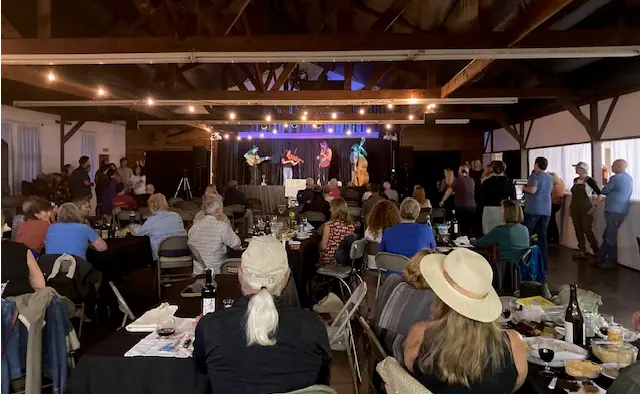
On the third Saturday of September, the street in front of the Fiddletown Community Center at 14445 Fiddletown Road closes and fills with fiddlers. Musicians who bring their own instruments gather at the Street Jam Joints, three spots under pop-up tents, and play with whoever turns up. Others take to the porches. Above the hall’s tin roof lies a fiddle fifteen feet nine inches long.
The street on the third Saturday
The 2026 Jam was held September 19 from 11 a.m. to 5 p.m. and was billed as the 75th. Admission was free, and dogs were welcome. The Ledger Dispatch’s preview laid out the day on the Mendoza Main Stage. High Grade Jug Band was to open at 11. Veteran Jack Magee was to sing “Proud To Be An American” at 11:55, followed by opening remarks and the National Anthem. The Fiddle Contest, open to all ages, was set for 12:15.
The afternoon belonged to the Fellman Family Fiddlers, Silver City, the Acapella Bellas, and Nedra & Julio. The headliner was Dirty Cello of San Francisco, on its third visit to Fiddletown. At 4:50 every performer was to gather on the main stage for “Amazing Grace.” Giorgi Khokhobashvili, the event’s Fiddler on the Roof, was to be up there again, and the paper told the crowd to look up.
Organizers expected around 1,500 people. Vendors sold commemorative hats and shirts, artisan crafts, food, microbrew beer, and wine. Gold Rush buildings within walking distance were open for tours. Cars parked at Al Hiatt’s field on Jibboom Street and at the former Moose Lodge on Ostrum Road, and a shuttle carried people in.
The Fiddletown Community Center runs the Jam, and its president, Susie Jones, coordinates it. The Rotary Club of Plymouth Foothills gave “strong support” in 2026, according to the Friends of the Fiddletown Fiddlers Jam. That group’s page is dedicated to “the preservation of the Old Tyme music tradition of Fiddletown and the USA.” Paula, who posts there, lost her house and all her equipment to fire in 2024. In 2026 she wrote that she hoped to have a camera by the next Jam: “I love taping our events and preserving our culture.”
A fiddle on the roof
The fiddle above the hall is the fourth. The first Big Fiddle was built in 1934 for the Ione Homecoming Parade and was later set on the roof of the building, then called the Fiddletown Community Club. The Pine Grove California Youth Authority restored it in 1984 while renovating the club inside and out, and a bow was added in 1991.
In July 2001, the Ledger Dispatch reported, a guidewire snapped and the 15-foot fiddle fell and shattered. No one was hurt. Cheryl Smith, then club president, raised money for a replacement. Officer Emilio Del Rio rallied the boys of the Pine Grove CYA to build it.
The replacement, 20 feet long, went up on June 9, 2002. At precisely 1 p.m. Larry Oliphant rang the hall bell while his wife Sherry, the next club president, watched. An estimated 1,000 people ate Incahoots barbecue, shopped 25 vendors, and saw volunteers hoist the fiddle. Three people dedicated it: Mrs. Oliphant, County Supervisor Mario Biagi, and State Assemblyman Rico Oller. That party began the custom of closing the street for the Jam.
Weather wore the fiddle down. Marilyn Newton, John Newton, and Gene Lovet repaired it, Laurie Estreito refinished it, and it was back on the roof in December 2006. For the 60th anniversary Jam in 2011, Marilyn Newton and Jack Vining restored it again, replacing most of the worn wood. It then weighed 687 pounds.
For the fourth, Susie Jones and Marilyn Newton turned to Erik Wilson of Plymouth. At eleven, Wilson had built and painted sets at a Palo Alto theater. He later worked as a union set carpenter for FM Productions, a Bill Graham company, in south San Francisco. He likened the job to carving a surfboard.
Wilson began with a mockup four and a half feet long, cut from foam insulation. For the full-size fiddle he laminated twelve 4-by-8 sheets of two-inch foam into a body and cut the outline with a homemade hot-wire cutter. He routed out the f-holes and shaped the rest with a planer, a grinder, and hand sanding. The body took ten coats of paint and two layers of fiberglass, and the fragile foam neck took heavy fiberglass on top of that. He was told to add a chin rest so the fiddle would look less like a cello.
“I learned the hard way, luckily I started on the back, that polyester boat resin melts foam so I switched to epoxy resin which cooks much slower,” Wilson said. “It took three times longer between coats and was four times more expensive, which I hadn’t planned on.” He used six gallons of it.
The work took six weeks, while the Caldor Fire, the Lawrence Fire, and other fires burned around Plymouth and Fiddletown. Wilson drilled through the angle-iron support on the roof and secured the 150-pound, ten-inch-thick body with adhesive and lag bolts. It was unveiled at the 70th anniversary Jam on September 18, 2021.
A town that was always fiddling
Missourians settled Fiddletown in 1849, and it became a trading center for American, Loafer, and French Flats, Lone Hill, and other mining camps. The state landmark listing says it was named because residents “were always fiddling.” In the Ledger, Mike Spinetta recorded competing legends about whether they fiddled in the winter months or the summer. He also recorded a story of an old granny who called the place “Violin City” because her own family played.
In 1878 the town became Oleta. Rumor credits Columbus Allen Purinton, who supposedly named it for his daughter, though his daughter was Mary Elizabeth and no Oleta appears in any Fiddletown census. Another story has Purinton embarrassed on his trips to Sacramento and San Francisco at being called “The Gentleman from Fiddletown.” The phrase came from Bret Harte’s 1873 story “An Episode of Fiddletown.”
A metal plaque gives Oleta as a Miwok term for “old home spring.” Spinetta noted that in Northern Sierra Miwok the word is closer to “outside,” and that the tribal Culture Department was still researching it. In 1932 a petition to the postmaster restored the old name. The town keeps over a dozen structures on the National Register of Historic Places. Among them is the Chew Kee Store, a rammed-earth building that became a Chinese culture museum, and the schoolhouse, about 1860, which served until 1955.
Homecomings, a skating rink, and a magazine
The hall itself went up as a dance hall in 1932, and Amador County Supervisor Irving Ostrum willed it to the town in 1941. On July 22 and 23, 1934, the town marked its new electricity and the hall’s dedication with a Fiddletown Homecoming. “Several thousand” came for concerts, two dances, barbecue, a greased pig chase, speakers, and gold panning.
In 1937 the violinist David Rubinoff came to town and was named honorary Mayor of Fiddletown. “It was a big deal…banners and flags were hung, welcoming the famed violinist,” Jones told the Ledger. Secretary of State Frank C. Jordan gave the oath of office. Rubinoff received a watch chain of gold nuggets. In turn he presented a valuable violin to Blanche Lawrence, winner of a local contest, and she played a tune on it for the crowd of about 2,000.
Rubinoff returned in 1939. After a lone dance in 1941, the festivities paused until 1950. The Ledger ties that return to the town’s designation as State Landmark No. 35, though the state’s listing gives a registration date of August 1, 1932. The 1950 crowd heard “Clementine” and “Beer Barrel Polka” over broiled steaks from E. Clampus Vitus.
The Center counts 1951 as the first Fiddlers’ Jam. “The main reason we use 1951 as the first Fiddlers’ Jam is because it was the first to feature a Fiddler’s Contest while the previous Homecomings did not,” Jones said. “Although we could claim 1934 as the first event.”
Jade Waller, a Center board member, found questions about those origins when she raised funds in 2011, and the Ledger’s 2021 account tells it differently. In that version, Ray Fine came home from the Korean War and opened a roller-skating rink in the hall in 1956. He then brought in fiddlers from all around for a Homecoming to pay for repairs to the floor. “There were fiddlers playing on the front porch of Fiddletown’s general store as spectators filled the streets,” Waller said.
In 1964, by the 2021 account, the new Fiddletown Preservation Society and the Community Club took up the idea to restore the one-room schoolhouse. The festival moved to Mother’s Day. Jones dates the first Mother’s Day event to 1965. It opened with a parade of riders in Gold Rush dress, and Larry Hinckley ran it. Seven fiddlers competed in the contest, which Flynn Strode of Sutter Creek won. About 2,000 people came in 1967 and 1968, when a dance was added.
Then in 1971 Sunset Magazine ran “Fiddlers in Fiddletown.” More than 3,500 spectators came, and the parade drew over 100 entries. Witnesses interviewed in 2021 remembered hippies bathing in the creek and lying in the fields, with cars parked “all the way” to Plymouth. The following year’s event ended early under a strong police presence.
Out to the fairgrounds and back to the street
In 1980 the contest moved to Calaveras County under the California Old Time Fiddler’s Association. In 1981 the event went to the Amador County Fairgrounds as Fiddletown Goes to the Fair. It became Fiddletown Days, or the Gold Country Jubilee, with these attractions:
- banjo, flat-top guitar, and fiddle contests
- chicken flying and husband-and-wife calling
- a “have your wife pack-a-pair of jeans contest”
- mud drags, a motorcycle race, and tug-of-war
In 1987 it was renamed Fiddletown Days: Old Time Fiddler’s Contest and Wine Tasting. By Spinetta’s account it came home because the fairgrounds lacked the feel of a block party with houses full of jamming artists.
The Jam returned for good in 1993, Jones says, as a jam session with barbecue, arts and crafts, children’s activities, and a horseshoe contest. The Fiddler’s Contest came back in 1997. The 2011 Jam, the 60th, brought The Brothers Comatose, Extended Roots, and Second Calling, and Khokhobashvili stood on the roof for the opening ceremony.
Wildfires and COVID-19 forced more skipped years. In 2021 Jones and Treasurer Deirdre Mueller moved a scaled-back event back outdoors. “With only about 3 months to pull it together, we took the Fiddlers’ Jam back to the street, where it has been ever since,” Jones said.
That September 18 was “slightly breezy.” Over 450 people walked the quarter mile between the two stages, past 16 vendors selling candles, succulents, clothing, and harmonicas. Rotarians served pulled pork sandwiches, hot dogs, and chicken skewers. The upright bass was kept indoors for the acoustics, and Spinetta wrote that it “truly could be felt across the street.”
Seven fiddlers played at least eight minutes each in the contest. Evan Fellman, a contestant and local high school teacher, brought ten of his young violin students to play, and the crowd called on all of them to come back and enter the contest the next year.
Notable Events
- 1932Homecoming events began at the Dance Hall (Fiddletown Community Center), built in 1932. ledger.news
- 1934To commemorate the newly electrified town and the dedication of the Dance Hall, on July 22nd and 23rd of 1934 Fiddletowners and several thousand folks enjoyed the Fiddletown Homecoming with concerts, two dances, a barbecue, a greased pig chase, speakers and gold panning. ledger.news
- 1934The first Big Fiddle was made for the Ione Homecoming Parade and later placed on the Fiddletown Community Club roof. ledger.news
- 1937In 1937 violinist David Rubinoff appeared and helped celebrate Fiddletown, whose name had been changed back from Oleta in 1932. ledger.news
- 1950After Rubinoff's return for the 4th annual festivities in 1939 and a sole dance in 1941, the festivities paused until their return in 1950, coinciding with Fiddletown's State Landmark #35 status. ledger.news
- 1951By 1951, the first official Fiddlers' Jam was established with the inaugural Fiddlers' Contest. ledger.news
- 1956After opening a roller-skating rink in the hall, Ray Fine brought fiddlers from all around to a Fiddletown Homecoming fundraiser to repair the floor. ledger.news
- 1964The Preservation Society and Community Club used the Homecoming idea to restore the one-room schoolhouse. ledger.news
- 1965In 1965 the recently formed Fiddletown Preservation Society and Fiddletown Community Club marked Mother's Day with celebrations. ledger.news
- 19711971 saw a particularly notable 100+ parade entries and more than 3,500 attendees. ledger.news
- 1971A Sunset Magazine article drew over 3,500 spectators; the following event ended prematurely with a strong police presence. ledger.news
- 1980The Fiddler's Contest moved to Calaveras County in 1980, hosted by the California Old Time Fiddler's Association. ledger.news
- 1981In 1981, the event moved to the Amador County Fairgrounds under the name Fiddletown Goes to the Fair. ledger.news
- 1984Pine Grove California Youth Authority restored the fiddle while renovating the club inside and out. ledger.news
- 1987The event name became Fiddletown Days: Old Time Fiddler's Contest and Wine Tasting. ledger.news
- 1991A fiddler's bow was added to the roof emblem. ledger.news
- 1993In 1993, the Fiddlers' Jamboree (Jam) as it is known today returned, for good, originally as a jam session with a barbecue, arts and crafts, kids' activities and a horseshoe contest. ledger.news
- 1997The Fiddler's Contest didn't return until 1997. ledger.news
- 2001The roof fiddle fell and shattered when a guidewire snapped; no one was injured. ledger.news
- 2002The Raising of the Fiddle party began the tradition of closing the street for the September Jam. ledger.news
- 2006Marilyn Newton, John Newton and Gene Lovet repaired the weather-damaged fiddle; Laurie Estreito refinished it and it returned to the roof in December. ledger.news
- 2011Marilyn Newton and Jack Vining restored the fiddle, mostly replacing worn-out wood, for the anniversary Jam. ledger.news
- 2021After wildfires and COVID-19 caused additional skips, the Fiddlers' Jam returned with a bang in 2021 when the world began re-opening. ledger.news
- 2021Plymouth artist Erik Wilson's Fantastic Fourth Fiddle was unveiled at the anniversary Jam. ledger.news
People
- David Rubinoff, famous violinist named the honorary Mayor of Fiddletown.
- Deirdre Mueller, Fiddletown Community Center Treasurer who helped bring the scaled-back event to the street.
- Irving Ostrum, Amador County Supervisor who willed the Dance Hall to the town (1941).
- Larry Hinckley, in charge of the Mother's Day event.
- Susie Jones, Fiddletown Community Center president supporting the fourth Big Fiddle.
- Cheryl Smith, FCC president who raised replacement-fiddle funds.
- Emilio Del Rio, Pine Grove CYA officer who headed the replacement-fiddle project.
- Erik Wilson, Plymouth artist tasked with creating the new giant fiddle.
- Evan Fellman, Contestant and local high school teacher who brought young violin students to play.
- Gene Lovet, Worked on the roof fiddle repair (2006).
- Giorgi Khokhobashvili, Fiddler on the Roof for the sixtieth-anniversary opening ceremony.
- Jack Vining, Restored the roof fiddle with Marilyn Newton (2011).
- Jade Waller, Community Center board member responsible for fundraising and investigating Jam origins (2011).
- Janice Bailey, Donated fiddles and bows for hall decor.
- Jessie Campbell, Donated fiddles and bows for hall decor.
- John Newton, Worked on the roof fiddle repair (2006).
- Lance Harmon, Donated fiddles and bows for hall decor.
- Larry, Sherry Oliphant's husband, who rang the hall bell at the Raising of the Fiddle party (June 9, 2002).
- Laurie Estreito, Refinished the roof fiddle (2006).
- Marilyn Newton, Supported creation and restoration of the hall's Big Fiddles.
- Mario Biagi, County supervisor who presented the fiddle dedication.
- Paula Campbell, Donated fiddles and bows for hall decor.
- Ray Fine, Resident who expanded the gathering into a floor-repair fundraising Homecoming.
- Rico Oller, State assemblyman who presented the fiddle dedication.
- Robert Kerwin, Fiddlers' Contest performer.
- Sherry Oliphant, FCC president at the Raising of the Fiddle party (June 9, 2002).