


Evergreen State Fair
Monroe, Snohomish County, Washington. County Fair.
Details

- Where
- 14405 179th Avenue SE, Monroe, WA 14405. Directions
- When
- Last held August 27–September 7, 2026; next year’s date not yet stated.
- Season
- Every year for 11 days, the final day of fair ending on Labor Day.
- Getting there
- In Monroe, WA, just 30 miles NE of Seattle and about 15 miles SE of Everett; 14405 179th Ave SE, Monroe, WA 98272.
- Fees
- Adults 13-64: $16 weekdays (incl. Labor Day), $18 weekends, $15 advance online by August 26; seniors 65-89: $13 daily.
- Hours
- Aug 27-Sep 1 & Sep 3-6: 10:30 AM-10 PM (barns, display hall, 4-H building, event center close 9 PM); Sep 2 closed; Sep 7: 10:30 AM-7 PM, admission gate sales end 5 PM.
- Access
- Healthy Communities Day Thursday offers $5 admission and $5 parking all day.
- Walk-in or reserve
- Walk-up gate admission sold at any gate entrance during the fair.
- Phone
- 360-805-6700
- Website
- evergreenfair.org
- Managed by
- Snohomish County Parks System.
At a booth near the animal barns, the Snohomish County Dairy Women make the Purple Cow: blackberry ice cream, blackberry syrup and 7-Up. In 2021, with Coca-Cola a fair sponsor, the lemon-lime soda was Sprite. The woman making them keeps a tally, and on every thirteenth drink she rings a bell and that cup goes out free. Carrie Neff had run the booth and the whole Purple Cow operation for about eighteen years by 2021. She told KIRO Radio that people try to shift their places in line to catch the bell, as her own son did as a teenager, though the thirteenth cup is almost impossible to predict. “It sounds very sweet, but it’s actually quite refreshing,” she said. The money goes to the group’s Dairy Ambassador outreach and to scholarships for dairy families. Apart from the fair, the drink is sold only at two car shows on the same grounds in May and October.
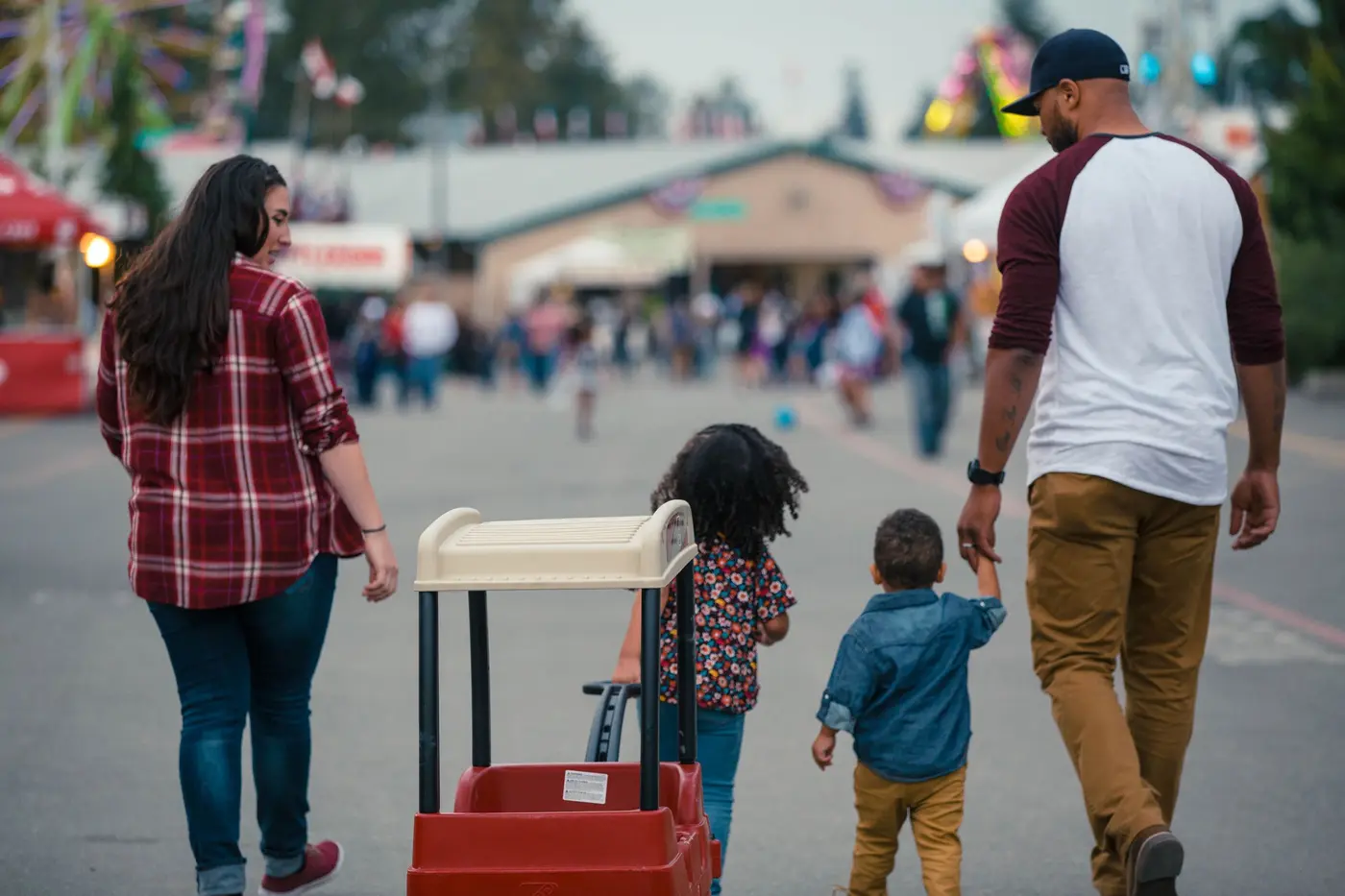
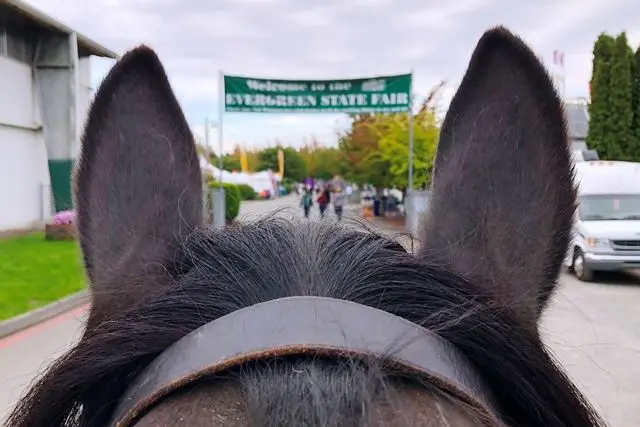
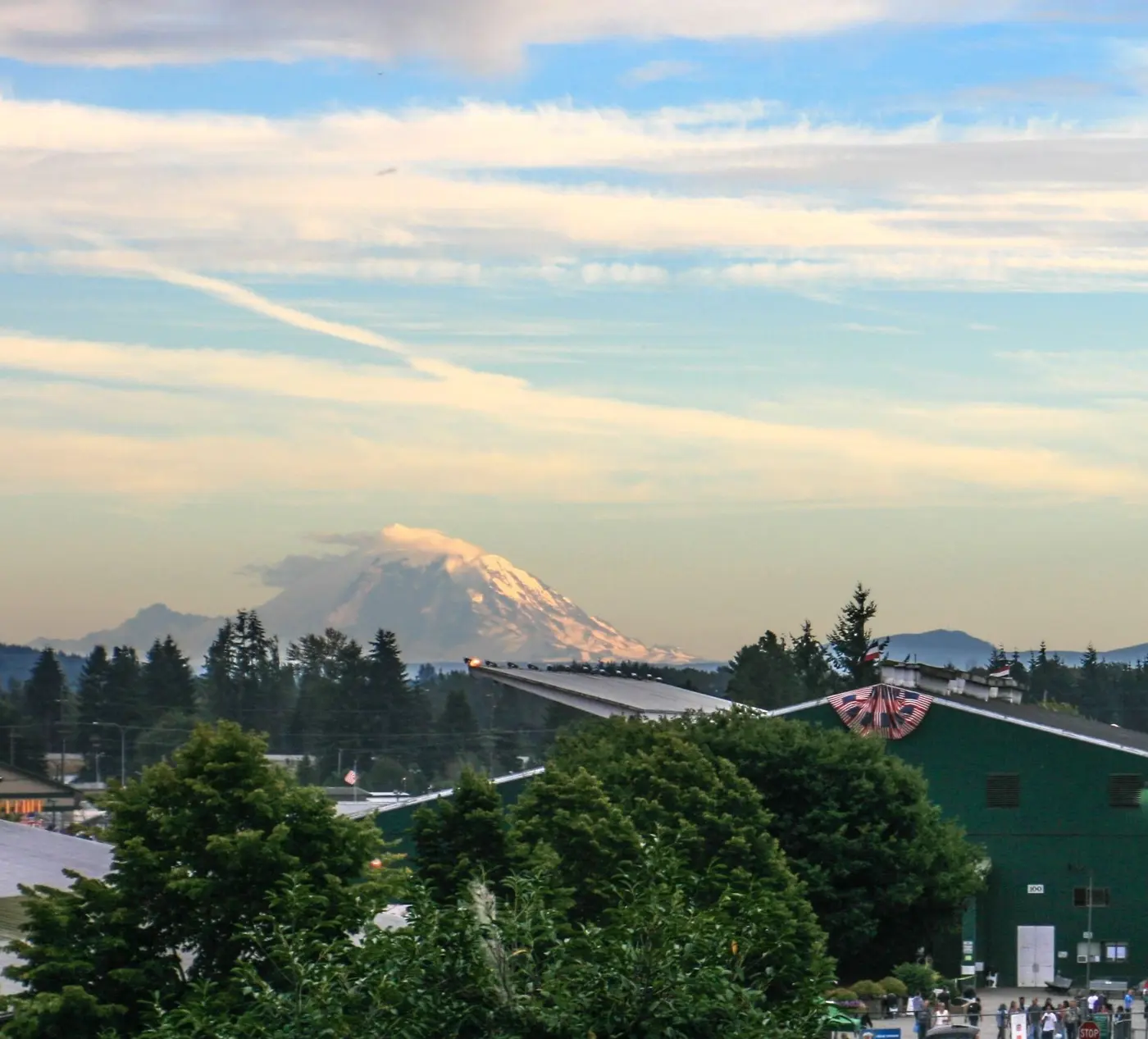
The grounds are the Evergreen State Fair Park, 193 acres of Snohomish County parkland at Monroe, where Highway 2 meets State Route 522, about 30 miles northeast of Seattle. The fair runs eleven days, ends on Labor Day, and goes dark for one Wednesday partway through. The 2026 fair, the 117th, ran August 27 to September 7 under the theme “Barn in the USA! Celebrating America’s 250.” The fair has announced August 26–31 and September 2–6 for 2027. The rest of the year the park holds horse shows, swap meets, trade shows and races at the Evergreen Speedway.
Barns, a cabin and the Longhouse
“Our animals course, that’s what we’re really known for,” fair manager Jeremy Husby said in 2021. Third-generation exhibitors lead dairy cows into a show ring that has stood on the property since 1949. On load-in day in 2025, Sara VanLoo, 17, the third generation of her Lynden family to show Clydesdales, stood at the fence while a horse named Chief kicked it with a hoof for attention. Then a second Clydesdale, Woody, started kicking too. In the Display Hall, demonstrators work at lace making, quilting and spinning, and the competitive exhibits run to sewing, photography, floriculture, fine arts and homemade beverages.
Antique tractors and pedal tractors stand east of the pavilion. East of the Western Heritage Center, pigs race four times a day. In 2026 these were the All-Alaskan Racing Pigs, billed by the county as “the fastest bacon in the west.” The Monroe Historical Society hosts the Shannahan Cabin and its historical displays. In the Frontierland area, the International Lumberjack Show, running for more than four decades, gives three logging-sports shows a day. The Aztec Indian Dancers perform in front of the Longhouse at 2 and 6 p.m. The Longhouse carries the cultural programming of the families of Skykomish Valley Indian Education. During the 2026 fair, Renée Roman Nose, a citizen of the Cheyenne and Arapaho Tribes of Oklahoma and author of Sweet Grass Talking, read poetry there. The next afternoon Peter Ali played Native American-style wooden flutes. He taught himself to play after hearing the call of the instrument at a low point in his life, and he once performed for the Dalai Lama on the Seeds of Compassion tour in Seattle.
Ponies give rides in a covered arena east of the carnival. On the Butler Amusements midway, rides and games are paid from a single reloadable wristband called Magic Money. For one morning on the fair’s Tuesday, the Morning of Dreams runs the fair from 9 to 11 without lights or sounds for visitors with disabilities or sensory needs. Food runs to fair scones, bratwurst from Ziegler’s Bratwurst Haus, Pioneer Popcorn, and gorditas, with beer and wine at four beer gardens. The Tualco Grange has fed fairgoers from its kitchen on the site since 1947.
The grandstand and the arena
The grandstand is a covered stand of 7,000 seats on the Speedway’s paved oval. It opened the 2026 fair with a classic car display and 9 p.m. fireworks, then hosted Monster Truck Mayhem, with jump trucks and a car-eating machine called Megasaurus. Lee Brice, Sir Mix-A-Lot and Amy Grant played on following nights. On September 4 the Northwestern Philharmonic Orchestra, conducted by Edward Benyas, played Copland, Morton Gould and John Williams. Washington State Supreme Court Justice Theo Angelis read from the Declaration of Independence. At 5:55 that evening, lightning in the area stopped the carnival and sent fairgoers indoors. The fair announced at 6:45 that operations had resumed.
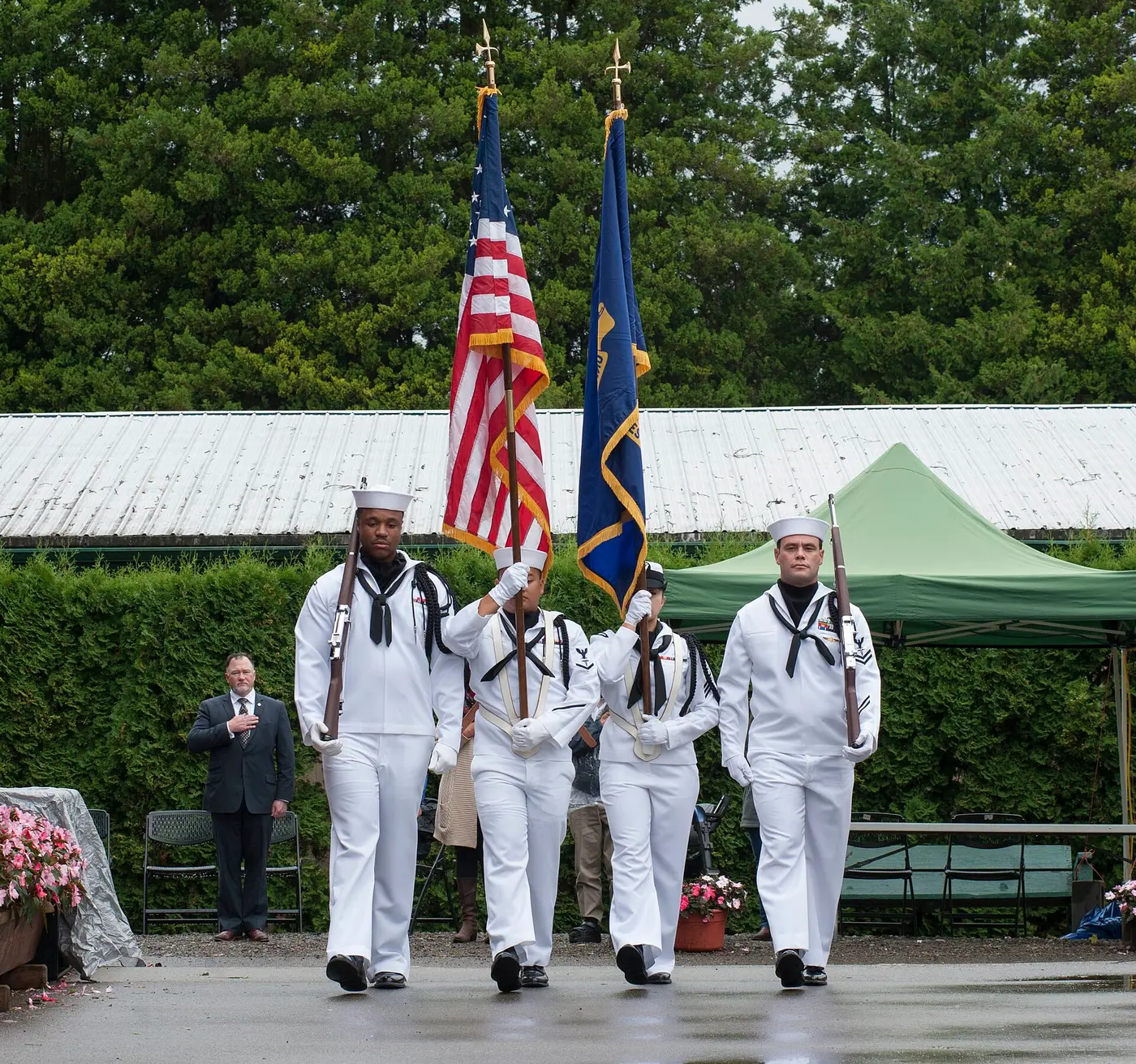
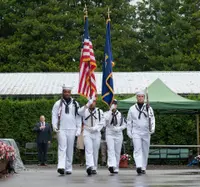
The last nights belong to the Speedway. Figure-eight cars raced on September 5. The Speedway Chevrolet Night Demo Derby followed on September 6, with classes for boats, buses, Youth Hornets and Hornets, closing with fireworks. The fair warned that the derby usually sells out. Across the grounds in the equestrian arena, the rodeo ran its three closing nights, and the Stirrin’ Dust Drill Team rode in each night to present the colors. The fair’s opening is marked in town by the Monroe Fair Days celebration and its parade down the downtown streets, held in 2026 on the first Saturday.
A former saloon in Snohomish
On September 16, 1876, Eldridge Morse, a farmer and underemployed frontier lawyer, published the fair’s first notice in The Northern Star. He had brought a used printing press from Olympia to the town of Snohomish and taught himself to set type. “Two years ago an impromptu citizens fair was held in our town on only a few weeks notice,” he wrote. The 1874 fair met in E. C. Ferguson’s Blue Eagle building, which was built as a saloon in 1864 and had served as the county courthouse ever since. Perhaps 500 people took part. Selected produce went on to the Territorial Fair in Olympia, where the Snohomish display of fruits and vegetables took first place. The fair’s own history adds that Monroe pioneer Salem Woods was vice-president of the agricultural society when the display was held.
In November 1874 the Snohomish County Agricultural Society was formed, and it acquired 40 acres in Snohomish for a fairground. Morse called its fall 1875 fair the first, since it was the first the society organized. In 1876 he urged farmers to come and “not get miffed because somebody has a [b]igger pumpkin, a fatter calf, or a faster horse than all others.” He also warned them: “this is no travelling show, no Punch and Judy affair.” The society held four fairs between 1875 and 1878. In 1878, during a financial panic, it sold its fairground with less than $150 owed and stopped holding fairs. The last issue of The Northern Star appeared on May 3, 1879.
Granite Falls and the three valleys
The fair’s history places the county fair at Tenth and Avenue D in Snohomish by the mid-1890s. HistoryLink tells it differently. In its account, Grange fairs were held in the old armory in 1909 and 1910, and the 1910 fair was extended a day by popular demand. That success led to the eight-acre county fairgrounds at that corner in 1911. The 1911 grounds were lit by electricity for evening viewing. The Main Building was 300 feet long, and the Baby Show had fifteen entrants, each held up by a mother working to make the child laugh and gurgle. The noise, the Snohomish County Tribune reported, “sounded like a full fledged carnival in operation.”
Monroe had its own fairs by then. The Monroe District Fair was held September 4–5, 1903, at the IOOF Hall and grounds on North Lewis Street. It showed livestock, dairy produce, and “ladies’ useful and fancy work,” along with horse racing and baseball. On Saturday night came a Grand Ball, with a fair queen and six maids of honor presiding. The 1904 program promised “a maze of everything that is rare, interesting and the best in the land.”
The lights went off at Snohomish after the 1916 fair, and the county fair moved to the city park on Union Street in Granite Falls. The town’s first doctor, Frank Chappell, a druggist and published poet, wrote the introduction to the 1922 premium list. He judged the fair’s “chief value” to be “the getting together of the people.” HistoryLink names 1929 as the last Granite Falls fair; the fair’s history says the fairs there lasted until the Depression. Grange fairs carried on through the 1930s and the war. In 1937 the Tualco, French Creek and Cherry Valley Granges held a community fair and parade at Main and Ferry streets in Monroe. The event took the name Cavalcade of the Valleys, for the Snohomish, Skykomish and Snoqualmie. By 1941 it ran four days near Park and Powell streets, with posters promising “4 Days of Fun and Frolic.” It was not held in 1942 or 1943. HistoryLink and the historical society have it back in 1944. Historian Feliks Banel dates the restart to 1945, as a 4-H-focused event.
The Poor Farm, 1949
The accounts part again over 1946. HistoryLink puts the first Snohomish County Fair in Monroe on September 5, 1946, at the Park and Powell grounds. Its parade included more than 200 head of cattle and horses, and that year’s ads featured 4-H and FFA for the first time. In this account, two more fairs followed there before the crowds outgrew the site. Plans were drawn in 1948 to move to the county Poor Farm, established in 1893 to give room and board to paupers. The fair’s own history and the Monroe Historical Society place the 1946 fair on the Poor Farm grounds from the start.
In September 1949 the fair became the Evergreen State Fair. The historical society dates that fair to September 8–11, and during its run the new highway link between Monroe and Snohomish, now US 2, opened. HistoryLink says the move to land beside the planned highway “called for a bigger name.” Banel says the name honors Washington’s 1890s nickname. No state process exists for promoting a county fair to a state fair. The first Evergreen State Fair recorded “Paid attendance 40,000, free 2,000,” a horse show, vaudeville acts and cattle judging, and a “duration four days and nights with good weather.” Fair manager Mike Ohlsen pointed in 2025 to the show ring from that year. “It’s now a ring — used to be a dirt lot,” he said. “I’ve got pictures of my dad there — pictures of my wife showing there.”
Snohomish County took over the fair in 1964, when it ran seven days. Four years earlier, according to Neff, Dairy Women Mary Lou Lane and Ellen Dodge and their husbands had introduced the Purple Cow. They named it for Gelett Burgess’s 1895 poem. HistoryLink counted twelve days in 2017, as did the historical society. The fair now gives eleven. Each year it honors a Snohomish County family that has farmed for a century or more, and by 2025 there were 42. That same year it honored Pat Pehling, leader of the 4-H Horse Program since 1979.
Rain cut attendance in 2013, by Husby’s account. The 2019 fair drew a record 355,000; the fair’s own history gives its draw as over 330,000. The 2020 fair was skipped for COVID, and in 2021 it returned under the theme “Back in the Saddle,” after Gene Autry’s song. “We fell off the horse, and we’re going to get right back up on it,” Husby said. On the weather, he added, “We try not to even mention the word ‘rain.’ It’s kind of unspoken around our office that you just don’t even bring it up.”
Notable Events
- 1874The Snohomish Agricultural Society, with Monroe pioneer Salem Woods as vice-president, staged the county's first agriculture display, which makes the Fair one of the oldest in the state. evergreenfair.org
- 1875Buildings were added in time for the second fair, which Morse called the first because it was the society's first organized fair. historylink.org
- 1878The society sold its 40-acre fair ground during a financial panic and stopped holding fairs. historylink.org
- 1890sBy the mid-1890s the Snohomish County Fair was held in Snohomish at Tenth and Avenue D on an eight-acre site. evergreenfair.org
- 1903The Monroe District Fair was held at the IOOF Hall and Grounds on North Lewis Street in Monroe, where the Monroe Eagles Club is today. evergreenfair.org
- 1904A second district fair was held in the same location the following year; its program described enclosed grounds and arrangements to handle entered stock. historylink.org
- 1911Grange-fair popularity inspired establishment of the eight-acre Snohomish County Fairgrounds, entered at 10th Street on the west side of Avenue D in Snohomish. historylink.org
- 1916In 1916 the fair moved to the Granite Falls city park on Union Street and continued to be held there until the Depression. evergreenfair.org
- 1929That year was the last for Granite Falls to host the Snohomish County Fair. historylink.org
- 1937Tualco, French Creek and Cherry Valley Granges organized fairs and parades on a small site at Main and Ferry Streets. monroehistoricalsociety.org
- 1941The first Cavalcade of the Valleys featured a parade, carnival and agricultural fair at a larger site near Powell and Park Streets. monroehistoricalsociety.org
- 1942Cavalcade of the Valleys was not held because of World War II. historylink.org
- 1944The source describes a return with exuberance, judging by posters reproduced in the Monroe Historical Society account. historylink.org
- 1945The source says the fair started again near downtown Monroe with a 4-H-focused event that morphed into Snohomish County Fair in 1946. mynorthwest.com
- 1946The Snohomish County Fair was first held in Monroe on September 5, 1946, on the fairgrounds at Park and Powell streets. historylink.org
- 1947The Grange began feeding fairgoers from its kitchen on the site. monroehistoricalsociety.org
- 1948With the fairs' success outstripping the existing grounds, plans began that summer to relocate the fairgrounds northwest of Monroe to the county Poor Farm, established in 1893 to provide room and board to paupers. historylink.org
- 1949The Snohomish County Fair became the Evergreen State Fair, and during that year's run the new state highway link between Monroe and Snohomish (now US 2) opened. evergreenfair.org
- 1960According to Neff, the signature drink was invented by Mary Lou Lane, Ellen Dodge and their respective husbands. mynorthwest.com
- 1964In 1964, Snohomish County took over the operation of the Evergreen State Fair, which by then had expanded to seven days. historylink.org
- 2019Husby says the fair drew a record 355,000 people. mynorthwest.com
- 2021Husby and staff prepared for vendors, 4-H participants, animals and hoped-for crowds after deciding to produce the fair. mynorthwest.com
People
- Salem Woods, Monroe pioneer and vice-president of the Snohomish Agricultural Society when the county's first agriculture display was held in 1874.
- Scoop Jackson, Senator pictured at the fair (1970s).
- Pat Pehling, 4-H Horse Program leader honored by the fair for decades of service and work in 4-H and youth development (since 1979).
- E. C. Ferguson, Owner of the Blue Eagle building in Snohomish, where the first fair's event was held; the building had served as the county courthouse (1833-1911).
- Eldridge Morse, Farmer and community activist who planted the roots responsible for what became the Evergreen State Fair (1847-1914).
- Frank Chappell, Wrote an introduction to the fair booklet (1846-1925).
- William Whitfield, One of three fair judges (1846-1940).
- Carrie Neff, Ran the fair's Purple Cow booth and operation (past 18 years or so).
- Ellen Dodge, Co-inventor of the fair's Purple Cow drink, according to Neff (1960).
- Gelett Burgess, Author of the poem from which the Purple Cow drink takes its name.
- Gene Autry, His theme song inspired the fair's post-COVID Back in the Saddle theme.
- Jeremy Husby, Snohomish County manager of the Evergreen State Fair and year-round fairgrounds.
- Mary Lou Lane, Co-inventor of the fair's Purple Cow drink, according to Neff (1960).
- Mike Ohlsen, Fair Manager.
- Sharon Walker, Snohomish County Parks Director speaking about the fair.
Sources
- evergreenfair.org/162/Daily-Schedules
- evergreenfair.org/272/Grandstand-Events
- evergreenfair.org/148/Carnival
- evergreenfair.org/163/Entertainment
- facebook.com/EvergreenStateFair
- commons.wikimedia.org/wiki/Category:Evergreen_State_Fair
- evergreenfair.org
- monroehistoricalsociety.org/stories/the-fair
- mynorthwest.com/history/historic-purple-cow-returns-in-august-along-with-the-evergreen-state-fair/3059079
- snohomishcountywa.gov/m/newsflash/Home/Detail/3208
- evergreenfair.org/136/History
- historylink.org/File/20645
- heraldnet.com/2025/08/20/evergreen-state-fair-ready-for-116th-year-of-magic-in-monroe