
Estacada Timber Festival and Fourth of July Parade
Estacada, Clackamas County, Oregon. July 4.
Details

- Where
- 30878 N.W. Evergreen Way, Estacada, OR 30878. Directions
- When
- Last held July 4, 2026; next year’s date not yet stated.
- Getting there
- the parade will begin at Estacada High School, travel along Main Street, and return to the high school via Southeast Fourth Street and Broadway Street.
- Access
- If you'd like to participate with a float, vehicle, animals, or a talent, applications are here (applications open ~a month before the event).
- Phone
- (503) 630-8270
- Website
- estacadatimberfestival.com
- Managed by
- Estacada Area Community Events.
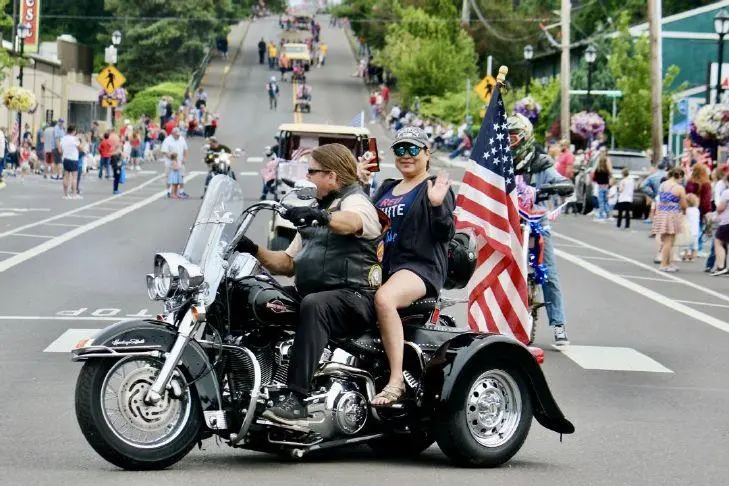
At ten in the morning on the Fourth of July, the parade leaves Estacada High School, runs the length of Main Street, and returns to the school by Southeast Fourth Street and Broadway. The 2026 parade fell on Saturday, July 4, and marked the nation’s 250th birthday. The Outlook listed floats, marching bands, local athletes, elected officials, big rigs, horses and dogs, and bikes and motorcycles. Many riders carry candy to throw. Thousands line the route, and the thickest crowds gather in the heart of downtown. The Downtown Estacada Commission runs the parade with volunteers. In 2015 its sponsor was the Estacada Fire Volunteer Association.
Down Main Street and back
Anyone can join, and the town has long made a habit of it. The Oregonian’s account of the 2009 parade found classic cars, motorcycles, llamas, trucks, fire engines, goats, unicycles and ponies in no fixed order, all in red, white and blue. Riders in the Old Coots on Scoots stopped for the national anthem. The four Stamm cousins, aged 8 to 15, had used temporary dye and hairspray to spike their mohawks in three colors. “People have said they look sweet,” said Zach, 12. “And awesome,” said Jordan, 15.
That year’s grand marshals were the siblings Tom Burnett and Joanne Broadhurst. They sat atop a cherry-red convertible with Broadhurst’s grandson, Kasey Tamoro, 13, between them. Together they stood for the fifth and seventh generations of the pioneer Philip Foster, whose homestead in Eagle Creek is now a national historic site and living history park. “You have roots, really deep roots,” Broadhurst said. “You realize that you’re a part of Oregon.”
Children scrambled for Tootsie Rolls, suckers and the occasional chocolate bar. “I like that they throw candy,” said six-year-old Elly Erickson. “And I like the ones with tractors.” Six months earlier, heavy rains had breached holding ponds above town and sent water into homes and businesses, and the new public library had filled with mud. Becky Arnold, a minute into her first term as mayor at 12:01 a.m. on January 1, took the first frantic call. “We come together when there’s adversity in front of us,” she said on parade day. “And we come together to celebrate.” About an hour after the start, a flatbed trailer honoring Boy Scouting closed the parade. The crowd went off to shaded yards, grilled hot dogs, horseshoes and lemonade.
Themes change from year to year. In 2015 the theme was “A Fresh Start,” and the parade honored the agencies that had fought the 36 Pit Fire the previous fall, which burned thousands of acres along the Clackamas River less than 10 miles from town. Officials from the U.S. Forest Service, Estacada Fire, Clackamas County Emergency Management and the Oregon Department of Forestry were expected as grand marshals. In 2018 the theme was “Red, White and Blue.”
At night the town gathers again behind the high school. In 2026 music began at 7 p.m., and the Estacada Rural Fire District fired the display at 10 p.m. sharp. The show is free and depends on donations, and pets, alcohol and personal fireworks are not allowed. “Estacada is well known for its fireworks show,” the chamber of commerce’s listing said.
Poles, saws and a log pond at Timber Park
For many years the parade shared the holiday with the Timber Festival at Timber Park, 30878 N.W. Evergreen Way. KATU called the grounds PGE Timber Park, and OPB placed them just outside of town under towering pines. Estacada Area Community Events organized the festival. Its president, Steve Stone, described the competitors in 2015: “It’s an amateur logging show. These are real, everyday loggers out there, not like the competing pros…it’s been a tradition here.” John Wood, who had been coming since the early 1980s, told OPB in 2017, “Almost all of these guys here are local loggers, or they were local loggers.” Bud Simpson, the axe-throw champion of 2016, had thrown since 2004. “Every year there’s always a few new competitors,” he said, “but by and large the same people compete year after year.”
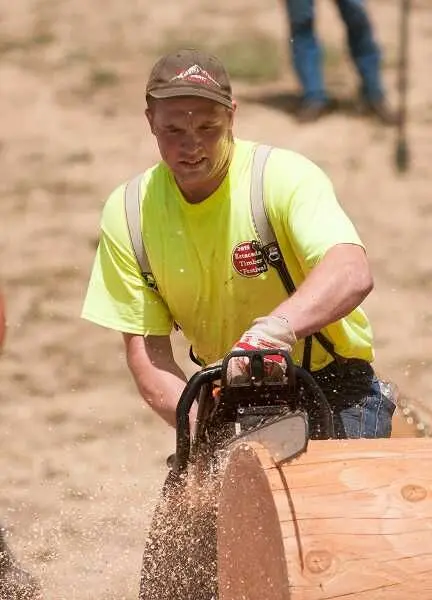
The events come from work in the woods. “Guys have to cut logs, set chokers on them and climb (the logs) to rig them,” Stone said in 2018. “It’s a nonstop event.” The program has included pole climbing, ax throws, chainsaw contests, choker setting and log pond roll offs. In the Jack and Jill, teams of two race to saw through a log. In double bucking, two sawyers take the end off a log together. In the chainsaw races, the winner is the first one whose block hits the ground. In the 2017 obstacle pole, Jeff Fetter of Buckley ran the length of an elevated log with his chainsaw, cut off its end, and raced back.
The 2015 festival ran in temperatures in the upper 90s. One logger climbed to the top of the timber poles, ziplined down through the trees, and waved his hat to the crowd. The log roll in the pool came last, and the competitors welcomed it. Draft horses dragged a sled that their owner, Jerry Lee, said weighs about 2,000 pounds. “It takes lots of conditioning, just like an athlete,” he said. “We run the horses about 2-3 miles per night.” OPB’s reporter noted the smell of grass and sawdust, and a crowd in cut-off shirts, ripped jeans and work boots.
Families arrived early to take the shade on the lawn. Children ran their own choker-setting race, a contest to wrap a rope around a log fastest. In 2017 Wes Young helped his two-year-old son, Daniel, through it. “(The best part) is the look on the kids’ faces as they watch the events,” Stone said in 2019. Over the years the kids’ area has offered a rock wall, live exotic animals, pony rides, a petting zoo, bouncy houses, llamas and a superhero puppet show. Food carts and a barbecue by the beer garden fed the crowd. In 2015 the beer garden moved to a shadier spot with a better view of the events.
Evening bands have included Brass Tacks, Strawberry Roan, the Ron Carnes Band, O Brother, Thunder Road, the Clear Creek Renegades and Reckless Company, and fireworks have closed the night. As many as 10,000 people have attended, according to the Estacada News.
A dam camp that became a mill town
Estacada, pronounced Esta-CAY-da, sits on the right bank of the Clackamas River about 30 miles from downtown Portland. According to the Oregon Encyclopedia, the name comes from a Spanish word for staked out, as territory, and may have been borrowed from the Llano Estacado in Texas. The town began in 1905 as a camp for workers building Cazadero Dam, a power plant to light Portland’s streets. The Oregon Water Power Railway Co. hauled in the crews and freight, then became an excursion line for city people who picnicked at the riverside park and stayed at the Estacada Hotel.
When paved roads reached the town and pushed deeper into the woods, Estacada became a mill town. In the 1950s and 1960s log trucks rumbled through one after another, with logs so big that three often made a load. Robin Cody wrote in the Oregon Encyclopedia that in the boom years the mill could be smelled and heard day and night. “If the mill shut down or the trucks stopped rolling, it was Sunday.”
The festival grew out of that mill. OPB reported in 2015 that it began sometime in the 1960s as a “water festival” at the Estacada sawmill. In the 1970s it moved to Timber Park, where it thrived until the mid-1990s, when mismanagement shut it down. The Oregonian gave a different account in 2013. In that version the festival limped along after the timber industry fell in the recession of the early 1980s, and it ended in 1993 after logging in federal forests was newly restricted in 1990. The Outlook wrote in 2019 that the festival disappeared in the 1980s, came back in the early 2000s as the Estacada Timber Show, and lapsed again for a spell. “People loved our timber festival, and it pretty much folded up when the logging industry went away,” said Becky Arnold, by then a board director of Estacada Area Community Events and a former mayor.
Log trucks on the parade route
The 2012 Fourth of July celebration included some timber events, the Oregonian reported, and in 2013 the full Timber Festival returned after a 20-year break. The Outlook dated the return to 2012. On July 4, 2013, log trucks led the way, honking and flying American flags past the high school, junior high and elementary school on the mile-long parade route. Behind them came residents on horses, on motorcycles and in vintage cars.
At the festival grounds that afternoon, men raced up 50-foot wooden poles and took turns in a Caterpillar log loader, stacking towers of logs. Mower races drew the largest crowds that year. Racers drove modified mowers with the blades removed, and their engines raised clouds of dust. During one heat the judge threw up a red flag, and the audience gasped at a racer lying on the ground. He raised his black leather gloves and shouted “Woo!” “His arms are in the air signifying he is OK,” the announcer droned.
Boya Osburn of Gresham brought her parents, visiting from China, who had never seen woods before. “They’ve never been to the forest,” she said. “They’re afraid of all the trees and silence.” Some old residents found the revival smaller than the festival they remembered. Debbie Ketchersid recalled a much bigger site and a Miss Timber competition. Her friend Kay Butler, who had moved away in 1975, said, “It was worth coming back for.”
The last Timber Festival was held in 2019. During the pandemic hiatus it lost some of its key volunteers. In March 2024 an organizer named Jordan Winthrop called a drop-in meeting at the Estacada Library to recruit replacements, and he noted that people did not need to know anything about logging to help. No date had been set for a festival at that time. “The Timber Fest is always going to be a big part of Estacada,” Winthrop said.
Notable Events
- 1905The town was founded in 1905 as a camp for workers building Cazadero Dam, a power plant to generate electricity for Portland street lights. oregonencyclopedia.org
- 1970Estacada made national news when Governor Tom McCall diverted tens of thousands of visiting protesters to Milo McIver State Park for a week-long rock concert; the stage lumber was donated by a local timber company. oregonencyclopedia.org
- 1980sThe longtime Estacada festival disappeared in the 1980s. theoutlookonline.com
- 1993After logging declined in the early 1980s, a further 1990 plunge amid new federal-forest logging restrictions proved too much, and the festival ended in 1993. oregonlive.com
- 2000sThe festival was resurrected under the name Estacada Timber Show, then discontinued again for a spell. theoutlookonline.com
- 2012After another discontinuation, Estacada Area Community Events brought back the festival in 2012. theoutlookonline.com
- 2013After the prior year's Fourth of July celebration included timber-related activities, the Timber Festival officially returned after a 20-year break. oregonlive.com
- 2019Estacada's last Timber Festival was in 2019; the later hiatus was described as pandemic-related. estacadanews.com
- The water festival moved from the Estacada sawmill to Timber Park, where it thrived until the mid 90s. opb.org
People
- Ben Wheeler, director of the family friendly Timber Festival.
- Jordan Winthrop, Organizer in the effort to bring the Timber Festival back.
- Steve Stone, President of Estacada Area Community Events.
- Bud Simpson, Timber Festival axe thrower and the previous year's axe throwing champion (has competed in the axe throw since 2004).
- John Wood, local logger who competes in the Timber Festival events (coming to Estacada's Timber Festival since the early 1980s).
- Becky Arnold, Board director for Estacada Area Community Events, the organization running the festival, and former Estacada mayor.
- Joanne Broadhurst, parade grand marshal representing, with her brother, the fifth and seventh generations of pioneer Oregonian Philip Foster.
- Tom Burnett, grand marshal of the Estacada Fourth of July parade, with his sister Joanne Broadhurst.
Sources
- cityofestacada.org/calendar-events/2026-4th-of-july-parade
- oregonencyclopedia.org/articles/estacada
- estacadanews.com/2015-07-01/timber-festival-provides-two-days-of-foresty-fun
- opb.org/artsandlife/article/estacada-timber-festival-logging-competition
- oregonlive.com/news/2009/07/fourth_of_july_is_big_time_in.html
- opb.org/news/article/estacada-timber-festival
- opb.org/video/2017/07/05/the-estacada-timber-festival-celebrates-logging-history
- oregonlive.com/clackamascounty/2013/07/post_108.html
- estacadanews.com/2024/03/18/group-working-to-revive-beloved-timber-festival
- theoutlookonline.com/2019/06/21/july-4th-tradition-celebrates-estacadas-history