Empire Mine State Historic Park
Grass Valley, Nevada County, California. State historic park.
Details

- Where
- 10791 East Empire Street, Grass Valley, CA 10791. Directions
- When
- Guided Mine Yard tours daily and Friday-Sunday, times by season: November-April 12 p.m. daily and 2 p.m. Friday-Sunday; May-June and September-October 12:30 p.m. daily and 2:30 p.m. Friday-Sunday; July-August 11:30 a.m. daily and 1:30 p.m. Friday-Sunday.
- Season
- The grounds are closed Thanksgiving Day, Christmas Day, & New Years Day.
- Getting there
- Drive 24 miles north of Auburn on Highway 49 to the Empire Street exit in Grass Valley.
- Fees
- Adults $5.00; youth (6 yrs. and up) $5.00; children 5 and under free; cash, check or credit card accepted.
- Hours
- Historic grounds open daily: winter (Nov. 1-Feb 28) 10AM-4PM; summer (Mar 1-Oct 31) 10:00 AM-5:00 PM; closed Thanksgiving Day, Christmas Day and New Years Day.
- Access
- Dogs allowed on roads and trails, in the Visitor Center and on historic-zone grounds; not inside historic buildings or mine shafts, service animals excepted; park trails and the Penn Gate parking lot are open sunrise to sunset.
- Walk-in or reserve
- No reservations needed; tours are first-come, first-served - sign up at the Visitor Center; groups of 10 or more must book a private tour.
- Phone
- (530) 273-8522
- Website
- parks.ca.gov
- Managed by
- California State Parks.
- Established
- Opened to the public July 4, 1976; classified as a State Historic Park October 7, 1976.
The model in the blacked-out room
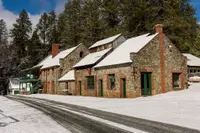
The visitor center at Empire Mine State Historic Park occupies the mine’s former carriage and automobile house on East Empire Street, at the southern edge of Grass Valley in Nevada County. Gold samples are on display, along with a “gold room” of ore from local mines, the Assay Office and a mineral collection. Beyond them is the Secret Room. In the 1930s the mine built it with blacked-out windows and filled it with a scale model of everything below ground. The park brochure dates the model to 1938 and says it was updated as the mine grew. While the mine operated, only management and their engineers were allowed in, and few people knew the room existed. The model now runs with dramatic lighting and a recorded narration. It shows 367 miles of tunnels covering five square miles, some of them beneath downtown Grass Valley. On the model, the stretch of shaft a visitor can walk down measures less than one inch. Anything past two inches is underwater.
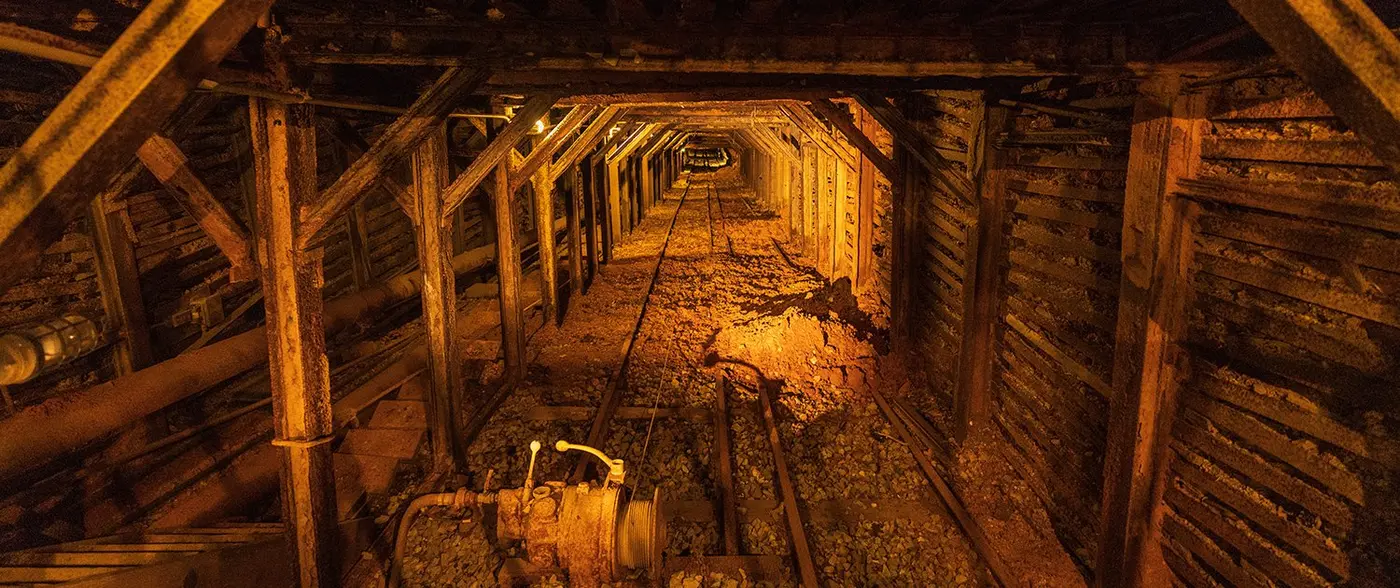
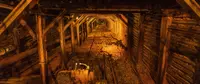
Outside, at the shaft viewing area, visitors look down the portal to the 150-foot level. The ore skips once ran through this opening at 600 and 1,200 feet a minute, and the deepest shaft goes more than 5,000 vertical feet down. The Sierra Gold Parks Foundation says the mine is now almost completely filled with water.
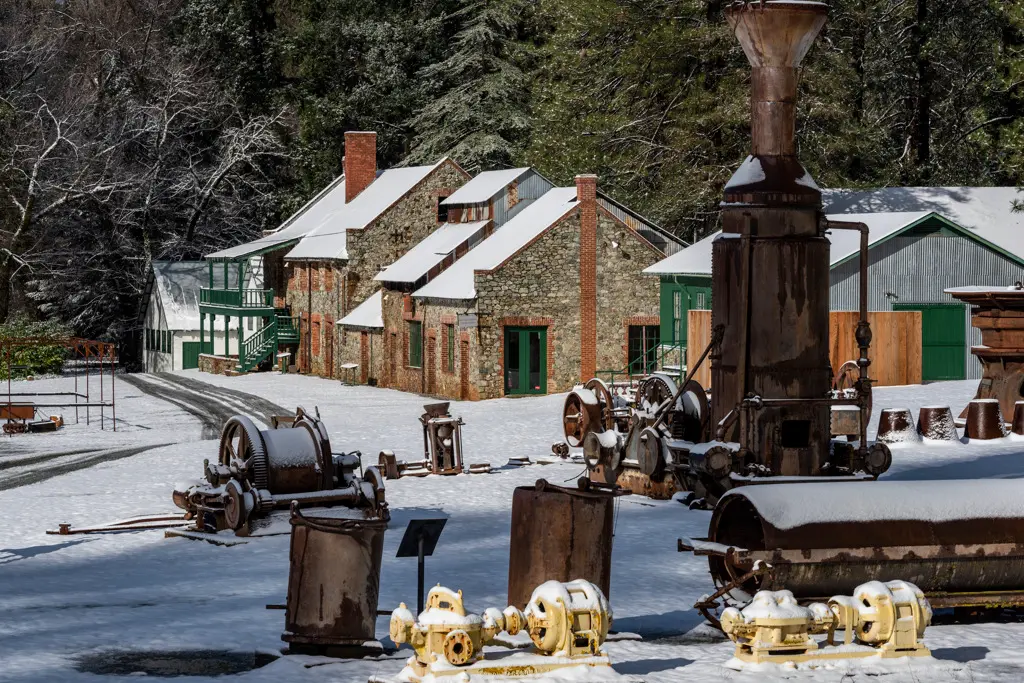
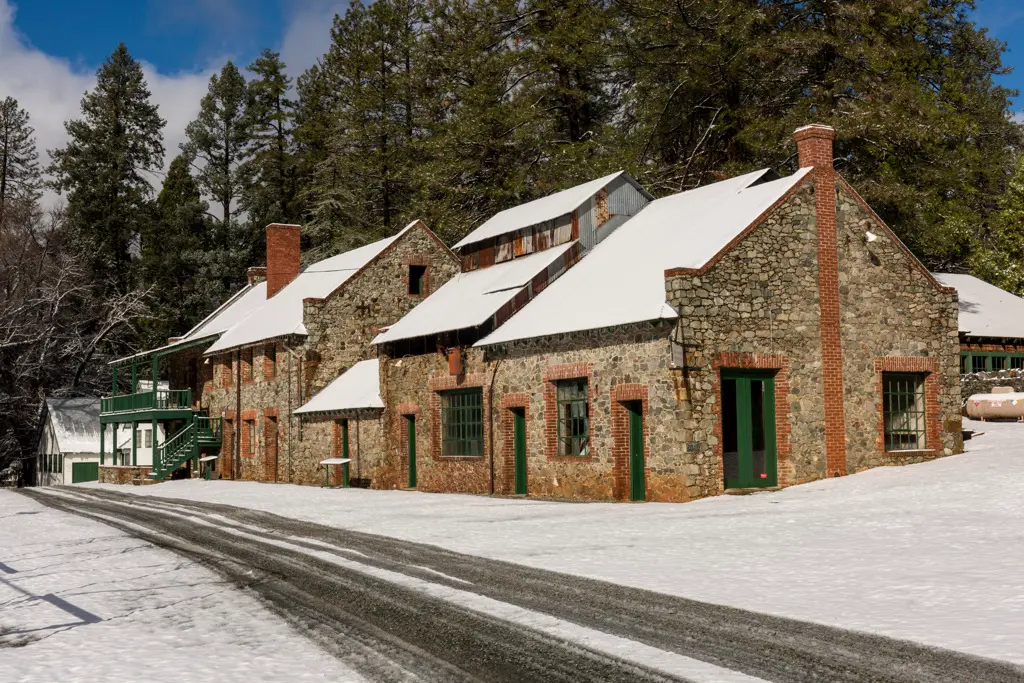
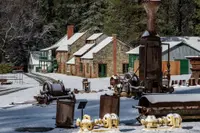
The mine yard around the portal holds the working buildings. In the machine shop, the leather belts and ceiling-mounted shafts and wheels are still in place. By 1886 Pelton water wheels drove the machinery and the lights. Mercury from the stamp mill was recycled in the refinery room, and the gold was cast into 89-pound bars and taken to the United States Mint in San Francisco. The Assay Office, where each sample was given its value, now serves as a rescue station. Volunteers rebuilt the hay and supply warehouse in 1989. Of the stamp mill, whose eighty stamps crushed the raw ore, little remains. The headframe that carried men, equipment and rock in and out of the mine was demolished in 1969.
The blacksmith shop is set up much as it would have been around 1925. Six smiths then worked eight to ten hours a day, six days a week. Five of them made tools, candle holders and other devices in the shop, and the sixth worked underground shoeing mules. Today’s smiths forge replica items while visitors watch, and the pieces are sold in the smithy and in the gift shop. They also tell, the foundation says, the legend of the dreaded Tommy Knocker.
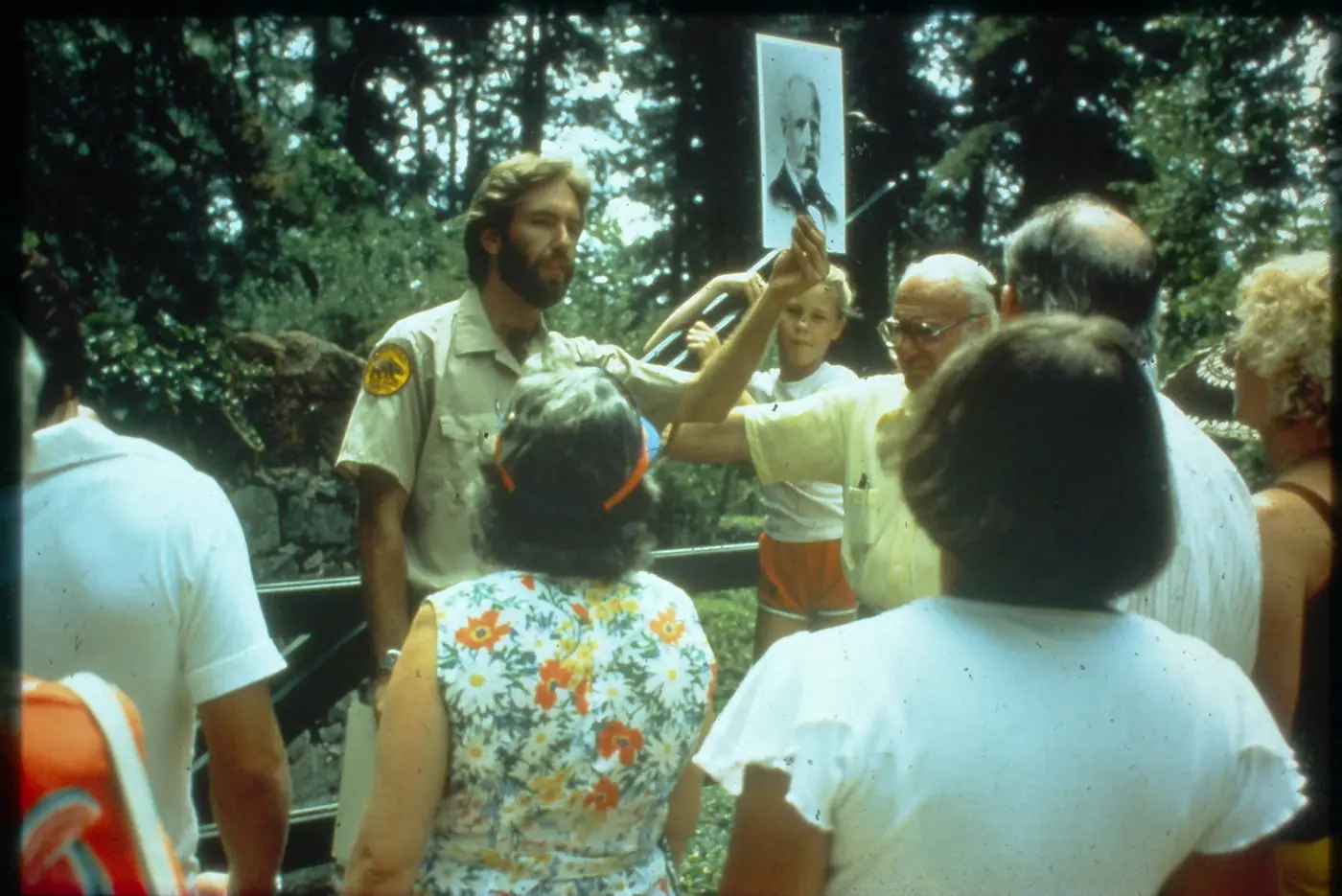
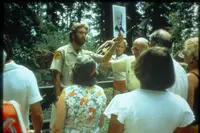
Forty-five-minute guided tours of the estate and the mine yard are included in the entry fee. The guides are volunteers, and at many stops there are audio boxes for days when no guide is available. When the temperature passes 90 degrees, an estate tour replaces the mine yard tour and the blacksmith shop may close early. In 2002, The Union reported that the mine yard came alive one weekend a month with volunteers playing mine workers, the machinery running and the smell of the blacksmith’s coal in the air.
A cottage, a clubhouse, a thousand roses
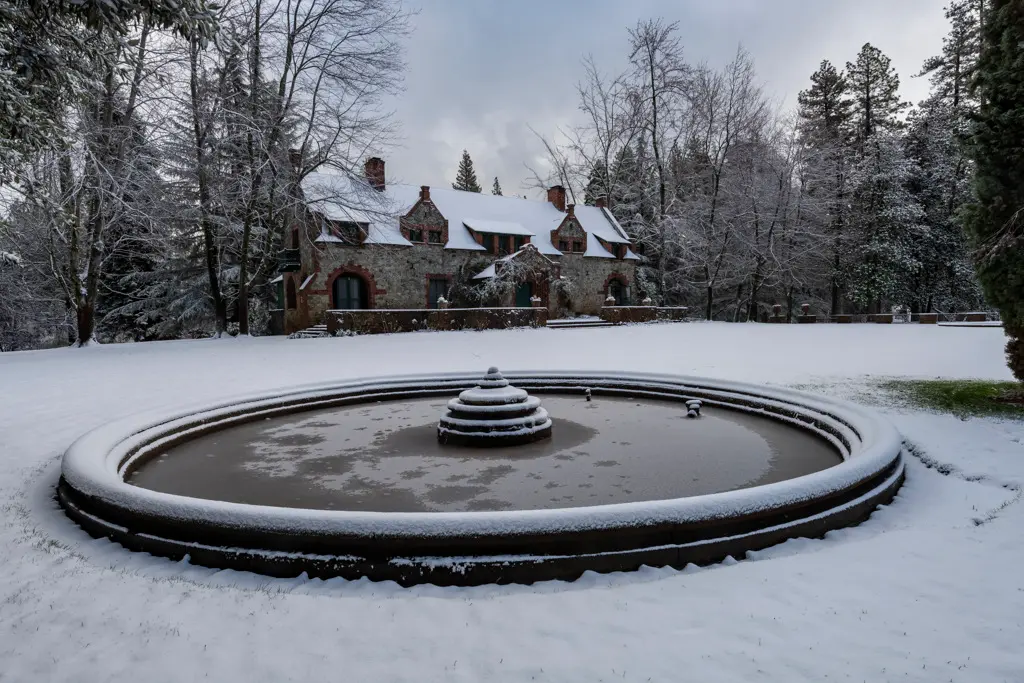
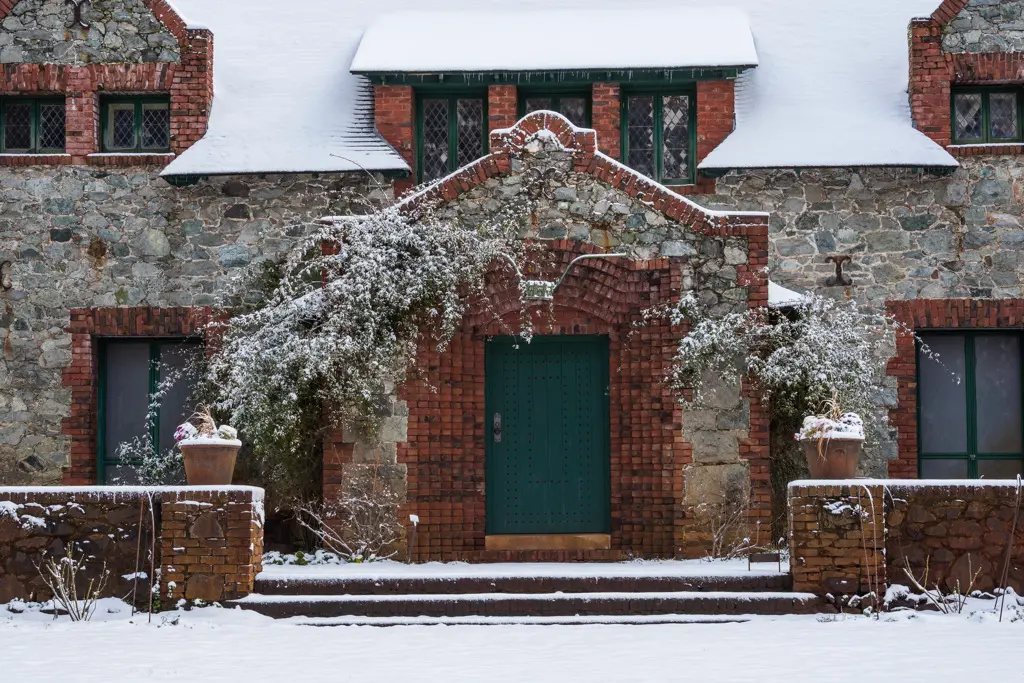
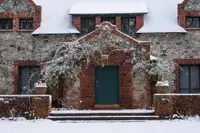
Across the grounds from the mine yard stands Empire Cottage. The architect Willis Polk designed it in 1897 for William Bourn, Jr. The park brochure calls it an English manor home, and a State Parks archive guide calls it an English Renaissance-style mansion. It was named a cottage to set it apart from Bourn’s other homes. The Union noted its leaded glass windows and redwood paneling. On the main floor are the kitchen, service rooms, living room, dining room, and a reading room that Bourn later used as his bedroom. Upstairs are four bedrooms and two baths, and the servants’ rooms sit above the kitchen.
On selected summer weekends, docents in early-1900s dress portray the Bourns, the superintendent George Starr and his wife Libby, and the housekeeper Katy Moriarty, whose first name the foundation’s tour page spells Katie. Moriarty was born in Ohio in 1865 and kept house for the Bourns on Webster Street in San Francisco. She came to the cottage in 1900 and stayed until she retired in 1934. She was reputed to run the place like clockwork and often sent home-baked cookies to the local orphanage.
Polk also designed the Clubhouse, built in 1905. It held the tennis court, a squash court, a bowling alley, a billiards table and a ballroom. Bourn built it for his supervisory staff and his guests. In 1915 Libby Starr and her friend Grace Clinch formed the Empire Country Club, whose members met there for games, dining and dancing. The brochure says the club still uses the building. Nearby, only the foundation remains of Ophir Cottage, the Starrs’ home, which burned on October 28, 1935, despite all efforts to save it.
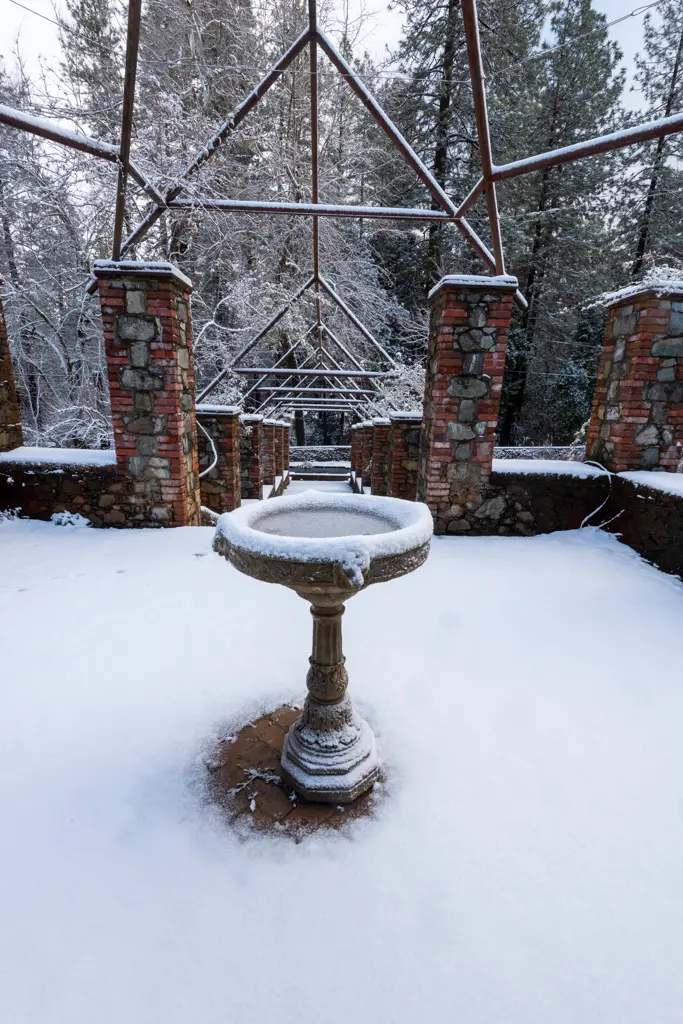
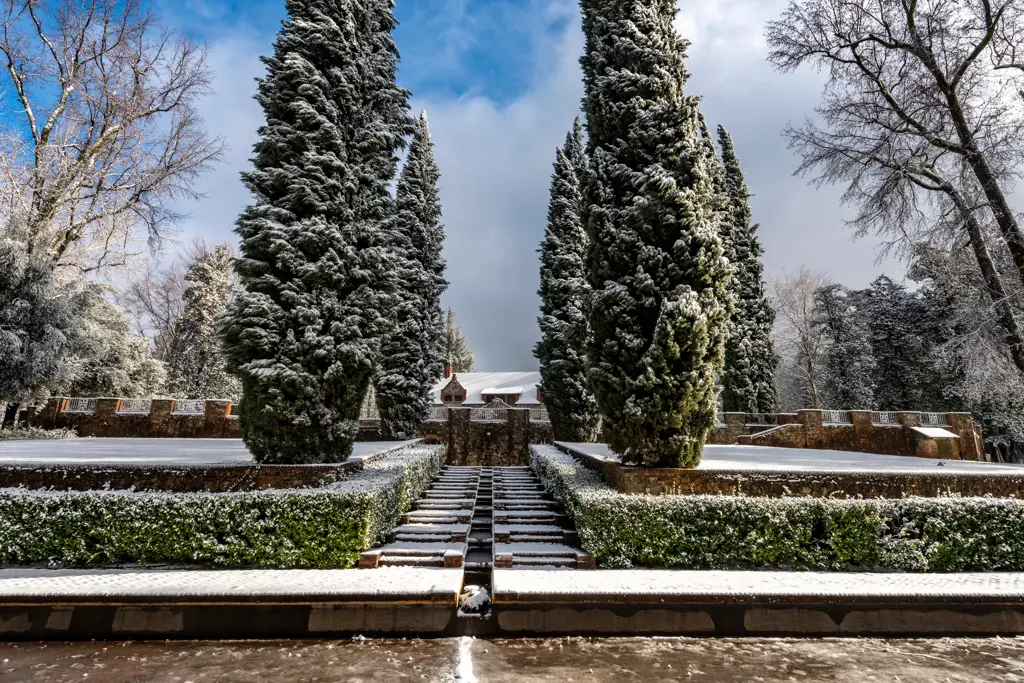
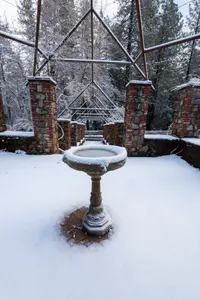
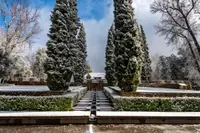
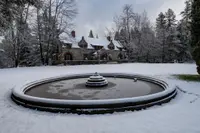
The gardens were restored in the English style of the Arts and Crafts years. The park counts more than 150 kinds of plants and trees and names the roses in the Rose Garden as pre-1930 varieties. The brochure gives nearly 1,000 vintage rose bushes and says the Bourns raised them in their own greenhouse. The foundation says most of the roses come from original plantings made around 1897. The foundation credits Agnes Moody Bourn, who married William in 1881 and played the piano, with much of the work on the grounds and rose gardens. A later note on the same page calls Bourn’s wife Sarah. In 2002 The Union described the roses arranged in eleven groups by date of discovery, from the 1300s to before 1929, beginning with the Gallica, the “apothecary rose” used in France for medicines and perfumes. The Bourns also kept a reflection pool, fountains and greenhouses on the grounds.
Trails over the old diggings
The park covers 856 acres of forested foothills at 2,500 to 2,900 feet, with fourteen miles of trails for walking, cycling and riding. Horse trailers stage at the Penn Gate lot, and horses stay off the historic grounds. The easy two-mile Hardrock Trail follows the road where trucks once hauled waste rock and crosses Little Wolf Creek on a wooden footbridge. Along it are the foundation of what the brochure calls California’s first stamp mill, the sites of the Orleans and Pennsylvania mines, a mule corral, and the W.Y.O.D. mine, the “Work Your Own Diggins,” which leased claims to miners. A sand dam of waste rock once carried a narrow-gauge rail line over the creek. The steeper Osborn Hill Loop climbs past the Prescott Hill, Betsy, Daisy Hill and Conlon mines. The Conlon was hard to keep drained and closed in 1908.
Across the Colfax Highway, the Union Hill trails form loops of one to three miles, with wildflowers in spring. The Pipeline Trail once ran from the Empire to the North Star powerhouse. The Indian Ridge Trail, the brochure says, was used by the Nisenan/Maidu people. The Foothill Nisenan lived in the western Sierra Nevada at least 10,000 years ago, and the gold discovery of 1848 devastated them. California State Parks acknowledges that the Nisenan were here since time immemorial and remain here today.
Coyote holes to a vertical mile
In June 1850, George McKnight found gold-bearing quartz about a mile away, near St. Patrick’s church in downtown Grass Valley. In October of that year a lumberman named George Roberts found flecks of gold in a quartz outcrop where the park’s main parking lot is now. Hundreds of miners came to stake claims of 40 by 30 feet and found that they lacked the skill to tunnel. By 1851 the ground was pocked with hundreds of “coyote holes,” 20 to 40 feet deep, and men were lowered into them in buckets. Roberts became discouraged and sold his claim for $350 to a group that combined it with others as the Ophir Hill Mine. John Rush bought the property in 1852 and renamed it the Empire Quartz Hill Company. The Empire Mining Company was incorporated in the spring of 1854, and a 30-stamp mill went up in 1865.
San Francisco capital took control in 1869 under William B. Bourn, Sr. The park brochure and the foundation date his sudden death to 1874. A State Parks history page gives 1876 and says a production slump followed. In 1879 his son William, Jr., then 22, took over a mine that seemed headed for closure. Many believed it could not run at a profit below the 1,200-foot level, but young Bourn pushed shafts deeper, and by 1884 the mine was paying again. His cousin George W. Starr started in 1881, at 19, as a mucker loading rock into cars, and was superintendent by 1887. Starr brought in compressed-air drills. In 1893 he left for the gold mines of South Africa with the engineer John Hays Hammond. In 1898, on his way to Alaska, he stopped in San Francisco, and Bourn talked him into returning to the Empire. The State Parks history has him serving as superintendent until 1929.
Most of the men underground came from Cornwall, where hard-rock mining went back a thousand years. They arrived around the mid-1850s with the Cornish pump, which could draw 18,000 gallons of water an hour and stayed in use into the early 1930s. By the 1890s the Empire’s labor force was roughly 90 percent Cornish, and by one State Parks account Grass Valley was reportedly 85 percent Cornish by 1890. The Cornish also brought the Tommyknockers, elves about two feet high said to tap warnings on timbers and air pipes. The Grass Valley historian Gary Noy recounts a cave-in at the Empire, during a shift change, that collapsed hundreds of feet of tunnel. The miners firmly believed the Tommyknockers had held up the rock until the crew got out and then let it fall. In a 1957 interview, the retired miner Fred Nettell said: “When a Cornish miner of the old school tells you how his life was saved by a Tommyknocker’s warning, he is not being facetious.”
Mules came into the mine in 1899 to pull the ore cars. They lived in underground barns until they were too old to work. The cyanide process, adopted in 1905, leached gold out of the quartz. By 1901 Starr’s rebuilding had taken the workings past the 3,000-foot level, and some tunnels eventually angled down some 11,000 feet. The miners’ families held the first Miner’s Picnic in 1895 to raise money for orphans and for the families of injured and dead miners.
Pumps off, gates open
In 1929 Bourn, in failing health, sold the Empire to Newmont for $250,000. Newmont joined it with the North Star as the Empire-Star Mines Company Ltd. In the State Parks account, the gold made the Great Depression something Grass Valley residents “only read about in the papers.” In 1942 the War Production Board halted gold mining as nonessential, and many miners had already enlisted. State Parks gives the reopening as 1945, and the archive guide gives 1947. Gold stayed fixed at its 1934 price of $35 an ounce, and by the early 1950s it cost $45 to mine one. The miners struck on July 5, 1956. The State Parks history says the pumps ran for months afterward in expectation of their return, and that removal of equipment began in January 1957 and the last pump was shut down on May 28. The foundation places the pumps’ end in 1956. The equipment was auctioned in September 1959. The park gives total production as 5.8 million ounces of gold, and other State Parks pages say nearly six million.
Newmont kept the grounds until 1975, when California bought the surface property for $1,250,000. The park opened on July 4, 1976, and was classified a state historic park on October 7, 1976. State Parks revived the Miner’s Picnic in the 1970s. The 2026 picnic, at the end of August, sold pasties and ice cream, with early-1900s music and a Mine Disaster Rescue Reenactment in the mine yard.
The park marked its fiftieth year with a reunion on Saturday, October 10, 2026, from 11 a.m. to 2 p.m. Former staff were to lead “What Used to Be Here” tours. Descendants of the miners were asked to bring family photographs and documents for scanning, and an oral history station was set to stay open until 5 p.m. Among the names in the record is Orlo Steele, described as the last living miner employed at the Empire in the 1950s.
Notable Events
- 1850Lumberman George Roberts found gold in a quartz outcropping at the present main parking lot. parks.ca.gov
- 1850sMiners from Cornwall brought their hard-rock mining experience and the Cornish pump. parks.ca.gov
- 1851Hundreds of vertical coyote holes perforated the land; miners descended in buckets. parks.ca.gov
- 1851Roberts sold his interest in the mine. sierragoldparksfoundation.org
- 1852John R. Rush and the Empire Quartz Hill Company purchased the mine at auction; within two years the company bought out Rush, becoming sole owner. oac.cdlib.org
- 1854In the spring of 1854, the Empire Mining Company was incorporated. ohp.parks.ca.gov
- 1865New works, including a 30-stamp mill, were erected. ohp.parks.ca.gov
- 1869In 1869 Wm. B. Bourn, Sr. purchased the Empire; when he died, Wm. B. Bourn, Jr. took over its management. ohp.parks.ca.gov
- 1874William Bowers Bourn, Sr. died in San Francisco. sierragoldparksfoundation.org
- 1874The shaft reached the 1,250-foot level with 7,900 feet of drifts. sierragoldparksfoundation.org
- 1876This account dates Bourn's death to 1876 and says a production slump followed. parks.ca.gov
- 1879William Bowers Bourn, Jr. took over management to keep the mine from closing and brought it back to profit. sierragoldparksfoundation.org
- 1879William Bourn, Jr. formed the Original Empire Mill and Mining Company. sierragoldparksfoundation.org
- 1881Bourn's cousin George Starr began working at Empire as a mucker. sierragoldparksfoundation.org
- 1884After several years barely covering operating expenses, the mine was making a profit again. parks.ca.gov
- 1885William Bourn, Jr. formed the water company to supply Empire and North Star Mines. sierragoldparksfoundation.org
- 1886Pelton water wheels provided energy for mine operations and lighting. parks.ca.gov
- 1886The main power source was changed from steam to water. sierragoldparksfoundation.org
- 1887George W. Starr advanced from loading rock and ore as a mucker to superintendent. sierragoldparksfoundation.org
- 1890sBy the 1890s, Empire Mine's labor force was roughly 90 percent Cornish. oac.cdlib.org
- 1890George Starr installed compressed air-powered drills for development work. sierragoldparksfoundation.org
- 1893George Starr moved to South Africa to supervise a gold mine. sierragoldparksfoundation.org
- 1895The first picnic raised funds for orphans, families of deceased miners and families of injured miners. theunion.com
- 1897Architect Willis Polk designed and constructed Empire Cottage and its grounds for the Bourns. sierragoldparksfoundation.org
- 1898George Starr returned to Empire as mine superintendent. sierragoldparksfoundation.org
- 1899Mules were introduced to the mine. sierragoldparksfoundation.org
- 1900The hoist and pump works at Betsy Mine were removed. parks.ca.gov
- 1900sThe Orleans stamp mill operated until the early 1900s. parks.ca.gov
- 1900Katy Moriarty arrived as housekeeper at Empire Cottage. sierragoldparksfoundation.org
- 1901George Starr's reconstruction was completed and the mine reached depths exceeding the 3,000-foot level. sierragoldparksfoundation.org
- 1905Willis Polk designed and constructed the prestigious Clubhouse. sierragoldparksfoundation.org
- 1905Empire adopted a more efficient process using cyanide to dissolve gold embedded in quartz. sierragoldparksfoundation.org
- 1908Conlon Mine, which was difficult to drain, closed. parks.ca.gov
- 1910After installation of the cyanide process, additional furnaces recovered gold and silver more efficiently. parks.ca.gov
- 1915Libby Starr and Grace Clinch formed the club; members gathered in the clubhouse for games, dining and dancing. sierragoldparksfoundation.org
- 1929Newmont also acquired a controlling interest in North Star; the combined operation became Empire-Star Mines Company Ltd. parks.ca.gov
- 1929The Bourn Family retained ownership until 1929, when Empire Mine was purchased by the Newmont Mining Company for $250,000. sierragoldparksfoundation.org
- 1930The stamp mill was increased to 80 stamps. sierragoldparksfoundation.org
- 1934Empire Cottage's caretaker and housekeeper retired. sierragoldparksfoundation.org
- 1934The federal government fixed monetary gold at $35 per troy ounce and became its only legal purchaser, constraining the mines' sales. theunion.com
- 1935Fire destroyed George Starr's home, Ophir Cottage, despite efforts to save it. parks.ca.gov
- 1938The sprawling model of the Empire-Star complex dates to this year and was subsequently updated to track mine growth. parks.ca.gov
- 1939The OHP landmark record gives this registration date. ohp.parks.ca.gov
- 1941The North Star shaft attained its greatest incline depth of 11,007 feet. sierragoldparksfoundation.org
- 1942The federal government curtailed gold mining as nonessential to the war effort. theunion.com
- 1945The mine reopened, but gold remained at its 1934 price of $35 per troy ounce. sierragoldparksfoundation.org
- 1956Miners struck after the company could not pay enough to support their families. parks.ca.gov
- 1956This account says the mine's doors closed forever after production of nearly six million troy ounces of gold. sierragoldparksfoundation.org
- 1956Operations ceased in 1956; the stamp mills that once thundered 24 hours a day were silent. sierragoldparksfoundation.org
- 1956This account dates the end of groundwater pumping and flooding of the underground workings to 1956. theunion.com
- 1956The account says machinery, tools and equipment from Empire, Pennsylvania and other mines had been or were being auctioned within two years. theunion.com
- 1957Removal of underground mining equipment began. parks.ca.gov
- 1957The last pump was shut down and the mine finally closed. parks.ca.gov
- 1959Mine equipment was sold at auction. parks.ca.gov
- 1959Newmont held an auction to sell the contents of many of the buildings and materials. sierragoldparksfoundation.org
- 1969The headframe that carried men, equipment and rock to and from the mine was demolished. parks.ca.gov
- 1975The state purchased Empire Mine's surface property from Newmont Mining Company for $1,250,000. sierragoldparksfoundation.org
- 1976Empire Mine State Historic Park opened to the public. parks.ca.gov
- 1977The property was listed in the National Register of Historic Places. ohp.parks.ca.gov
- 1989Volunteers reconstructed the former hay- and supply-storage area as a meeting and training facility. parks.ca.gov
- Empire Mine closed during the war when many miners enlisted. sierragoldparksfoundation.org
- State parks began holding the picnic again. theunion.com
- World War II ended the picnic event. theunion.com
- After 18 years of planning, Phase One construction began; the source describes its start only as a year ago. theunion.com
- The state suspended adit work after miners encountered old workings and unresolved safety concerns. theunion.com
People
- George Roberts, found hard-rock gold in a quartz vein, beginning Empire Mine's history (1850).
- John Rush, Purchased Ophir Hill Mine and renamed it Empire Quartz Hill Company (1852).
- George W. Starr, Bourn's cousin; began as a mucker, became mine superintendent (began 1881; superintendent by 1887).
- Jean Rhyne, Park Interpreter associated with Empire Mine's anniversary oral-history gathering.
- Agnes Moody Bourn, William Bourn's wife, actively involved in developing Empire Cottage's grounds and rose gardens (1881 (marriage)).
- Arthur Rose Vincent, Maud's husband; linked through the Bourn family in the page's Muckross note.
- Dorothy, Child of superintendent George Starr and Libby Starr.
- Grace Clinch, Libby Starr's close friend and co-founder of the Empire Country Club (1915).
- Katy Moriarty, Empire Cottage's caretaker and housekeeper (1900-1934).
- Libby Starr, Wife of superintendent George Starr and co-founder of the Empire Country Club (1866 (birth); 1886 (marriage); 1915 (club formation)).
- Maud, Daughter of Mr. and Mrs. Bourn.
- Sarah, Named as William Bowers Bourn, Jr.'s wife in the page's Muckross family note.
- William Bowers Bourn, Jr., Took over management to prevent closure and returned the mine to profit (1879).
- William Bowers Bourn, Sr., Controlling owner of Empire Mine (1869-1874).
- William, Child of superintendent George Starr and Libby Starr.
- Willis Polk, Architect who designed and constructed Empire Cottage and its grounds for the Bourns (1897-8).
- Jeanne Rhyne, California State Parks interpreter serving Empire Mine State Park.
- Orlo Steele, Described by the source as the last living employee miner who worked at the mine in the 1950s (1950s).
- Mike Miller, Morning Glory Gold Mines owner whose crew advocated a visitor view of the discovered stope during the underground tour project.
Sources
- parks.ca.gov/?page_id=499
- parks.ca.gov/?page_id=32062
- sierragoldparksfoundation.org/page/empire-mine-state-historic-park
- yubanet.com/regional/empire-mine-shp-50th-anniversary-staff-mining-family-reunion
- facebook.com/EmpireMineSHP
- ohp.parks.ca.gov/ListedResources/Detail/298
- sierragoldparksfoundation.org/page/history-of-empire-mine
- oac.cdlib.org/findaid/ark:/13030/c84j0knt