.jpg)


.jpg)
.jpg)
East Jesus
Niland, Imperial County, California. Art Museum.
Details

- Where
- 23 Sidewinder Road, Niland, CA. Directions
- When
- Open daily, sunup to sundown.
- Getting there
- Less than a mile past Salvation Mountain, near the Salton Sea.
- Fees
- Free admission.
- Access
- Travel north of Niland is not recommended in rain; do not arrive after dark.
- Walk-in or reserve
- Daylight public-art-garden and museum visits need no advance contact; overnight camping requires a vouch and advance permission.
- Phone
- info@eastjesus.org
- Website
- eastjesus.org
- Managed by
- Chasterus Foundation, a 501(c)(3) nonprofit.
- Established
- 2006.
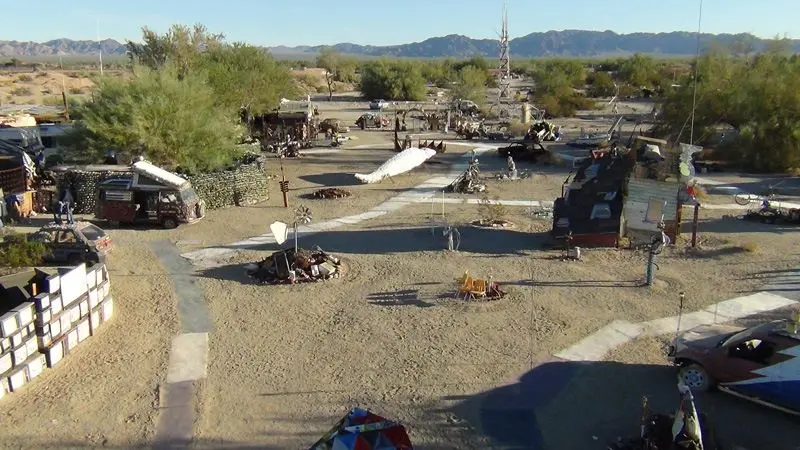
A woolly mammoth made of discarded tires stands in the desert a little less than a mile past Salvation Mountain, on the northwestern edge of Slab City outside Niland. Joe Holliday built it, and it is one of the larger pieces in the Art Garden at East Jesus, a 30-acre museum of large-scale art assembled from what other people threw away. The Chasterus Foundation runs the place. It describes East Jesus as the only registered art museum in Imperial County, and the museum is a member of the California Association of Museums. The garden is open from sunrise to sunset every day of the year and charges no admission. Donation boxes take what visitors choose to leave, and the foundation counts thousands of guests in a week.
The setting is a few hours east of Los Angeles, near the Salton Sea, with no municipal utilities of any kind. Jenn Nelson, the curator, places it “in a triangle between Yuma and San Diego and Los Angeles,” where “it’s 50 miles to the next supermarket.” Slab City takes its name from the concrete slabs left behind when a military training facility there was decommissioned. KPBS reported in 2015 that a few hundred people lived on it without electricity or running water. At dusk, an anthropologist wrote for SAPIENS in 2024, the Chuckwalla Mountains turn rosy shades of sepia and gold, a warm breeze lifts the scent of creosote off the desert floor, and the art cars and assemblage works of East Jesus “twinkle in the fading light.”
Tires, televisions, and four thousand bags
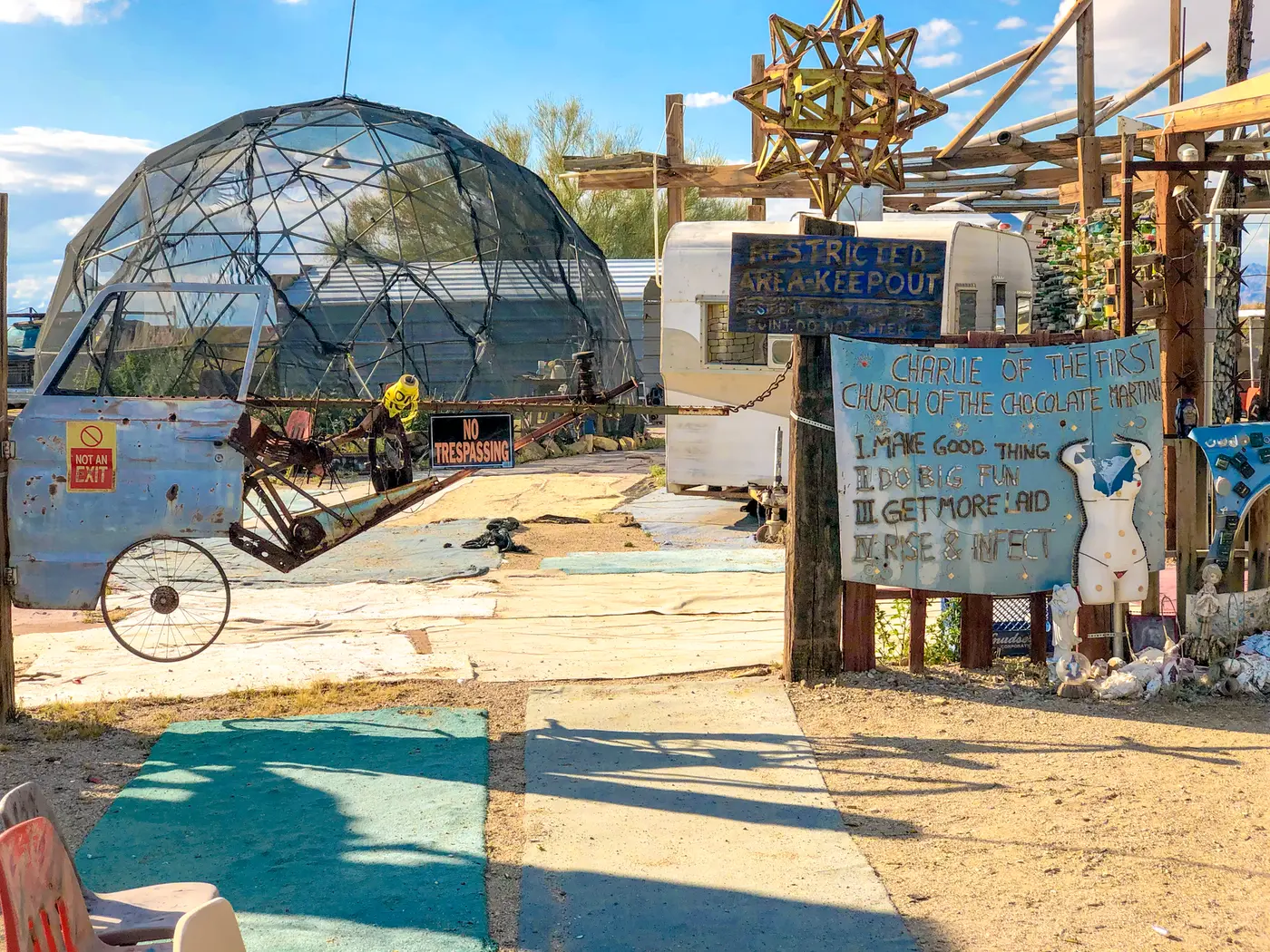
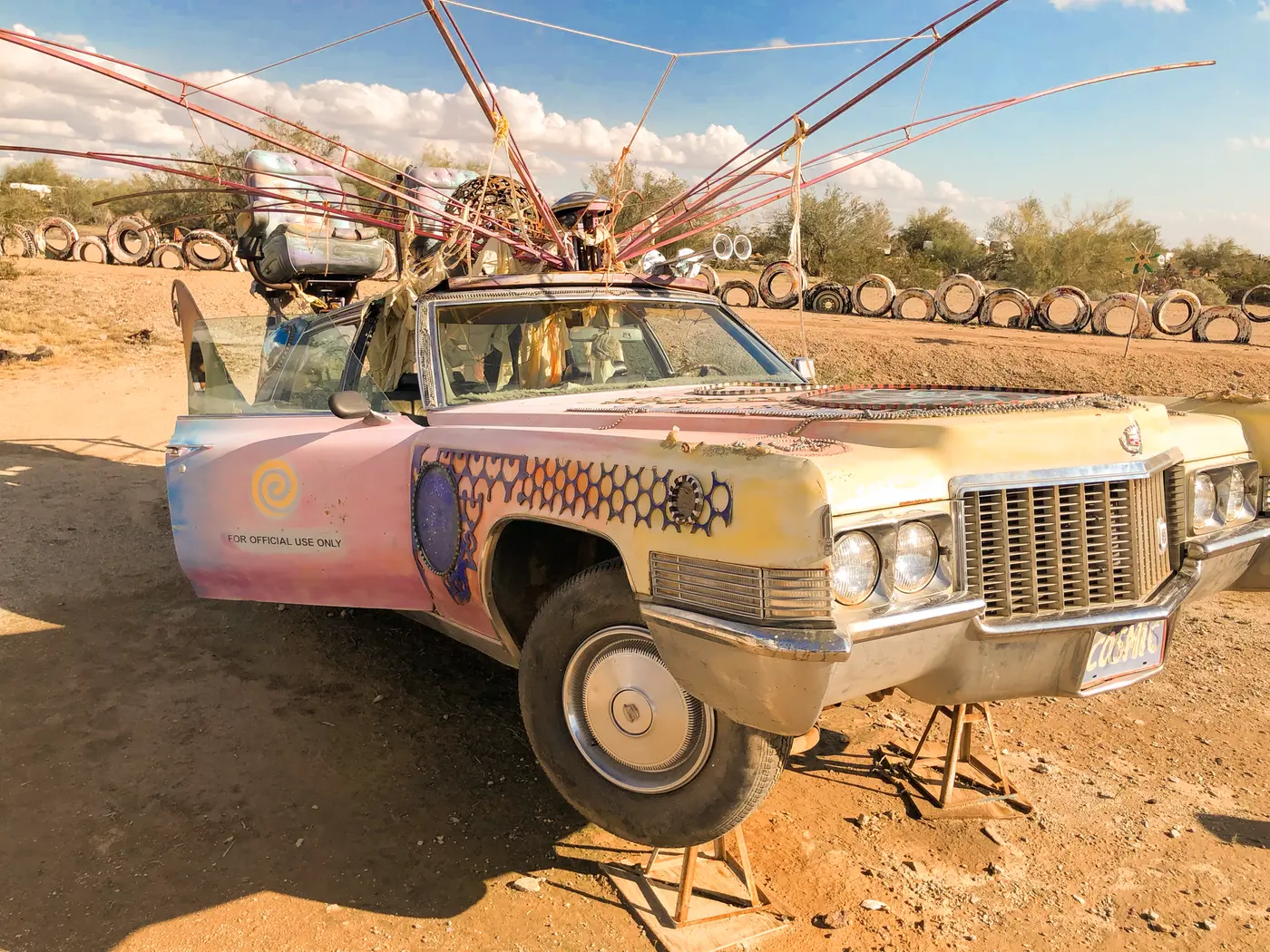
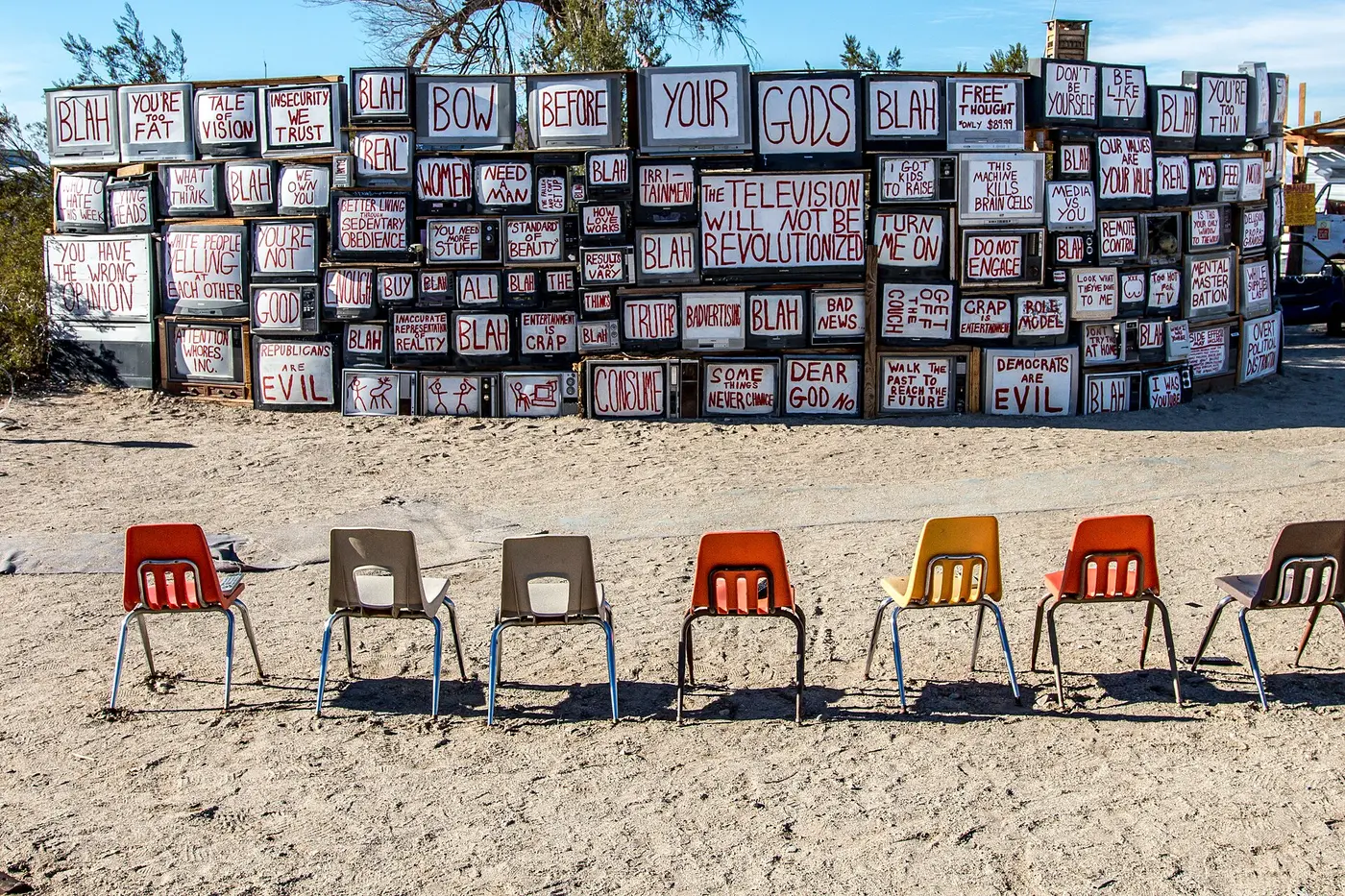
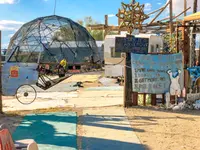
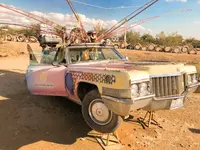
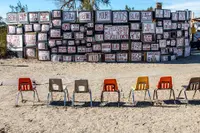
None of the work in the garden carries a label, as the SPACES archive noted from photographs made in 2019. The foundation lists more than thirty contributors, among them Royce Carlson, Shing Yin Khor, Angelina Christina, Ben Wolf, Midnight Ridazz, Transit Antenna, Frank Redford, and Charles Russell himself. A grid of old television sets, Flip Cassidy’s “The Television Will Not Be Revolutionized,” is repainted with changing political messages. SPACES recorded “fake news” and “white people yelling at each other.” Sheet-metal sharks circle. A pair of Volkswagen Beetles is posed amorously. An art car near the entrance is covered with nude dolls. Toward the edge of the garden, a glass hallway with colored panes leads into a round room walled with doors, each with its own face.
Carlson’s “Albrino” is made of discarded plastic bags. KPBS put the count at 4,000 and called the piece a “mutant albino whale.” PBS SoCal’s Artbound described it as a brine shrimp, inspired by the East Jesus myth that a giant mutant whale albino shrimp lurks in the depths of the Salton Sea. Carlson also began the “Tower of Barbarella,” a structure others keep adding to. Ben Wolf and Heidi Tullmann built “Fame Retardant,” a sunken house that recalls months the two spent in Detroit and New Orleans. Wolf’s “Fainted Foundation” is a collapsing house made from materials taken out of an abandoned apartment complex in Inglewood and modeled on Duchamp’s “Nude Descending a Staircase, No. 2.” “The Can Organ,” which Artbound credits to Ty Johnson, sounds when rain or sand drips through it. “The Dusty Junk,” a vehicle patterned on a Chinese junk, carries residents around Slab City, particularly to its hot springs. Artbound also described “Walter” in 2014: a New York City transit bus turned biodiesel RV and then buried, where a permanent driver named “Earl” presided. A spiral sundial, a swing set, a bicycle-wheel windmill, and an entry archway fill out the garden’s list.
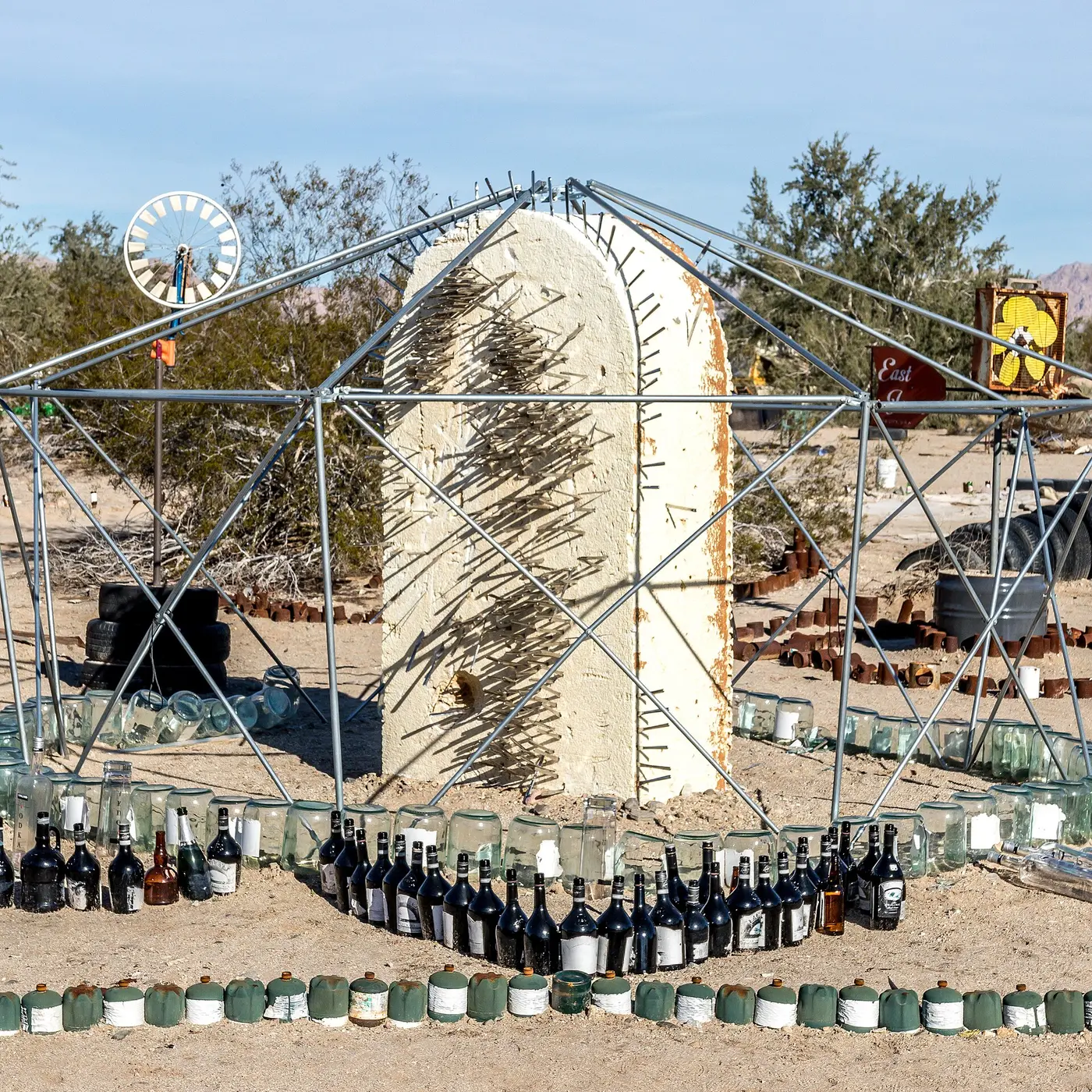
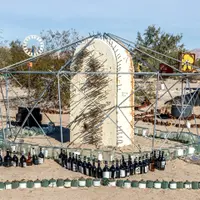
Frank Redford’s “Bottle Wall” continues a collection of about 1,500 bottles Russell had gathered. Sun shines through the glass by day, and the wall lights up at night. Redford, a former restaurateur and chef who gave most of the guided tours in 2014, built it while in remission from cancer. “I wanted to leave a mark on the world after being dealt a death sentence,” he told Artbound. He also described the garden’s method: “People come out and do some art over other art, or add to it or subtract from it, so the place is constantly growing.” The Survival Guide is blunter. All art must be placed by an official curator, “And we might move it later. Who knows? Erosion is a bitch here.”
Large works from gallery shows and art festivals come here to stay once their exhibitions close. Smaller gifts arrive too. Nelson told KYMA in 2022 of a visitor from Minnesota who brought a box of her grandmother’s perfume collection and asked whether there was room for her memory to live on.
A studio grand behind the sculptures
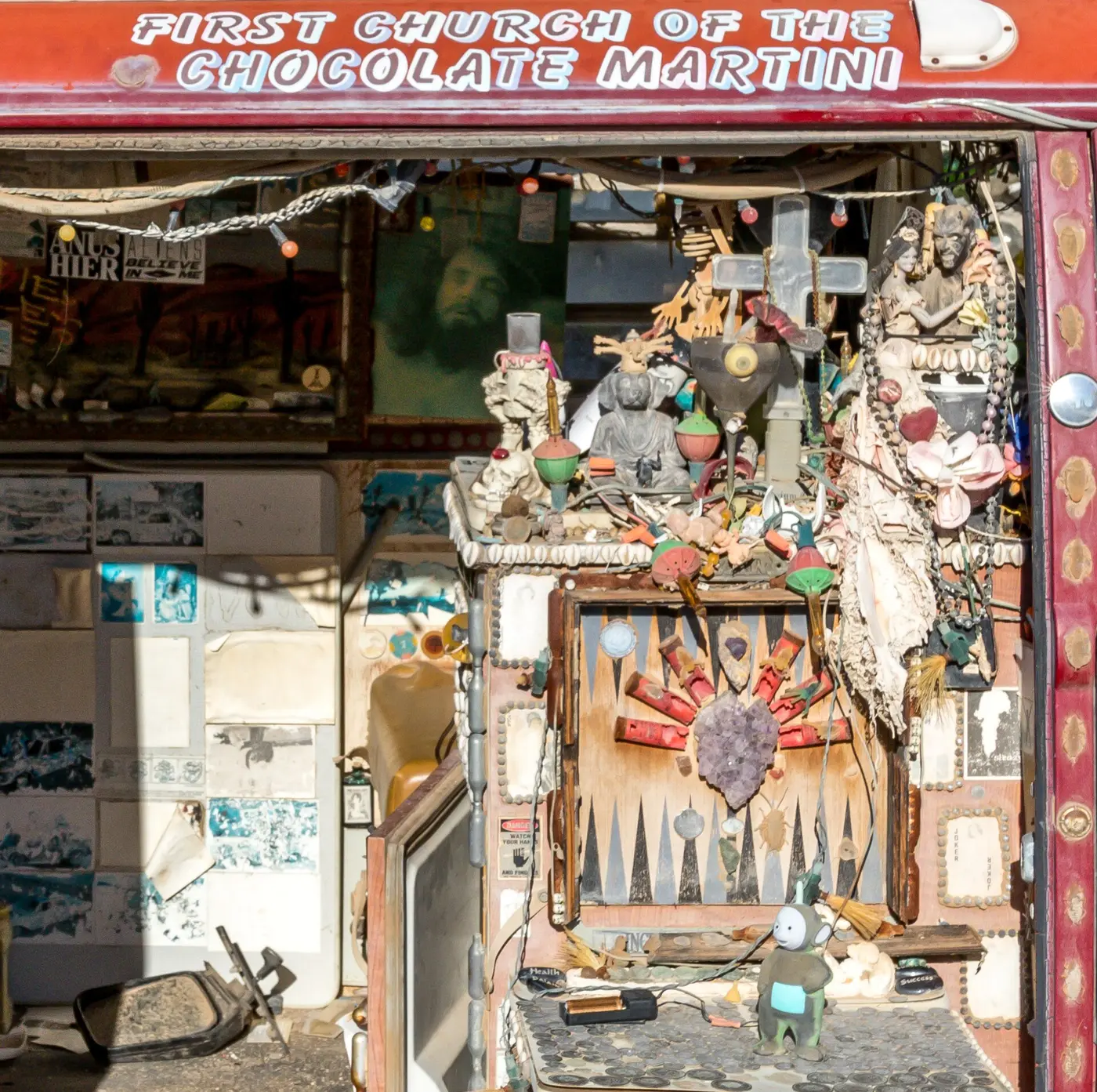
Behind the garden stands the labyrinthine central complex Russell built. It holds the administrative, operations, and hospitality rooms, and assemblage covers nearly every inch of it inside and out. It also holds a performance space with a PA, stage lighting, and a piano. The Survival Guide is particular about the instrument: “No, that’s not a baby grand. It’s a fucking full-size studio grand, OK? Six feet.” No drinks go near it, and only bona fide musicians go in the room. According to Redford, Russell bought a piano, taught himself to tune it, and then taught himself to play it. Russell’s ashes are in the music room. “His mother decided that he wasn’t happy in Maine, so she brought him out here to keep an eye on us,” Redford said, and other people have left the ashes of their own dead there as well. In 2014 the complex also held a library, an art supplies tent, and a living room and bar. The shower stood beside the piano so that a bather could listen to live music.
About a dozen people live at East Jesus. Artbound reported in 2014 that newcomers had to build their own homes. The residents grow most of their own food. “We try to focus on exotic varieties or efficient varieties to get the most nutritional value for the water we are using,” Nelson said in 2015. Water is trucked in; in 2014 it came in two 250-gallon bladders. Shower and laundry water irrigates the fruit trees, and drip lines water the vegetables. Solar panels feed a battery bank Russell designed. A post on the museum’s Facebook page in August 2026 explained the backup generators for the backup generator. Human waste goes into five-gallon buckets with peat moss and is composted with food scraps into soil for the garden. Living quarters are framed from scrap wood, straw bales, and Styrofoam and sheathed in cob. The foundation is testing a bank of 85 panels retired from a solar farm for minor damage. In the late summer of 2026 the Facebook page carried videos of Nelson explaining seedless watermelon, of layer chickens and canning tools, and of foster kittens in need of homes.
“We believe in hospitality,” Redford said. “We always come up with an extra plate of food and we always find a place for somebody to sleep because, yeah, we’re just homeless bums living in the desert, we don’t mind sharing what we got.”
Rules in the founder’s voice
Russell wrote the original East Jesus Survival Guide. The residents have updated it over the years but keep it in his voice. A daylight visit to the garden needs no notice. An overnight stay needs advance permission and “a vouch from an East Jesuit in good standing.” First-time visitors who have not met the residents are asked to camp outside the borders, and no one under 21 may stay the night. Unless an event is scheduled, no one is to arrive after dark: “Given the nature of Slab City and some of its inhabitants, unexpected visitors after dark are presumed to be trespassing with ill intent and risk staring down the barrel of a 12GA.” In rain, travel north of Niland is not advised, since the washes run deep. “Black widows, scorpions, centipedes, vinegaroons, rattlesnakes and the occasional tarantula all live and work here.” Horseflies are the larger threat, and white or bright clothing discourages them. Children are welcome in the public garden under close watch. Recycling counts only if it is marked CA CRV, because Imperial County has no comprehensive recycling. There is a clothing-optional firing range with a rangemaster present, and the guide adds, “No shooting during musical performances, please.”
In 2014, Redford said, the first 48 hours of a stay were free, and after that a guest was expected to put in at least an hour of work a day. Residents were also encouraged to go back out into “the real world” for an extended stretch at least once a year, and their homes waited for them while they were gone.
The most trash-strewn corner of the Slabs
Charles Stephen Russell, called Charlie, was born in 1965. Redford described him as a sound engineer who had attended university in Germany. KPBS described him as an artist and a regular at Burning Man. He first came to Slab City in 2006 to work alongside Leonard Knight on Salvation Mountain, and he took to the idea of the Slabs as “The Last Free Place.” In early 2007 he left a technology job in the Bay Area, shipped everything he owned to the desert in a shipping container, and set down his two art cars on the northwestern edge of the Slabs. The foundation dates the start of East Jesus to 2006. SPACES, Artbound, KYMA, and SAPIENS give 2007.
“When Charlie Russell first came out to the Slabs, this was the messiest, most trash-strewn corner,” Nelson said. SAPIENS calls the site Slab City’s communal landfill. Redford met Russell because people drove out to the Slabs to dump garbage rather than pay a disposal fee, and Russell turned that garbage into art cars and sculpture. Redford’s motto for the work is “Recycle it, reuse it, repurpose it or set it on fire.” The sculptures Russell gathered around his art cars became the foundation of the Art Garden. Artbound calls the first of them “Cinnabar Charm,” the Volkswagen Westfalia camper that carried him to Burning Man. Its name and inspiration come from a poem by Thom Metzger, and a photovoltaic panel on its pop-top roof powers it.
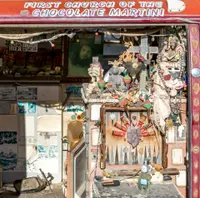
He named the place East Jesus, an old colloquialism for the middle of nowhere, without religious meaning. “’I live out past East Jesus’ used to mean you live out past where the postal service or the telephone lines go,” Redford explained. SPACES notes that the name also keeps a thread back to Salvation Mountain. Russell died in 2011, at 46 by Redford’s account and of a heart attack according to KPBS. He left instructions to form a foundation and a board of directors.
Buying the landfill from the state
Nelson, a former teacher, had visited Slab City many times and befriended Russell. Her health declined around the time he died, and she retired from teaching to become the full-time curator. “My husband and I started The Chasterus Foundation,” she told KYMA. Her husband is Matt Cadwallader, and the foundation became a 501(c)(3) in 2014. Like the rest of Slab City, East Jesus then sat on state-owned land. In 2015 the state was open to selling it, and Nelson worried that a solar or geothermal company would buy it first. “We’re not going to wait until the bulldozers show up,” she said. “People have been allowed to live on this land for free for 40 years. At a certain point, you have to recognize this isn’t our land. We’ve been lucky so far. But if you can’t tell that the light at the end of the tunnel is a train, you’re going to get run over.”
In 2016 the State Lands Commission invited the foundation to buy the land. A donor Nelson called an angel gave a no-interest loan to complete the purchase, and in November 2022 she reported $35,000 still to repay. The negotiations had one smaller consequence. A picture that once ran on the Survival Guide page is gone, because the state asked for it to come down: it kept tripping the state’s firewall, and officials were tired of filing reports swearing they had not been looking at pornography.
Each year the foundation holds a Day of the Dead weekend in Charlie Russell’s memory, open to East Jesuits in good standing and their guests.
Notable Events
- 2011Since Russell's passing in 2011, a board of directors has guided the curation and expansion of East Jesus. eastjesus.org
- 2014In 2014 the Chasterus Foundation was formed as a 501c3 nonprofit. eastjesus.org
- 2016In 2016 the foundation purchased the East Jesus land from the state of California to keep Charlie's dream alive. eastjesus.org
People
- Angelina Christina, Artist with pieces installed at East Jesus.
- Ben Wolf, Artist with pieces installed at East Jesus.
- Christian Hernandez, Artist with pieces installed at East Jesus.
- Mirabelle Jones, Artist with pieces installed at East Jesus.
- Royce Carlson, artist; creator of "Tower of Barbarella" and "Albrino" at East Jesus.
- Shing Yin Khor, Artist with pieces installed at East Jesus.
- Jenn Nelson, Curator of East Jesus; president of the Chasterus Foundation and former teacher.
- Charles S. Russell, Founder of East Jesus, also called Charlie (2011).
- Leonard Knight, Creator of Salvation Mountain, which inspired Charlie's East Jesus project.
- Frank Redford, former restaurateur and chef who usually handles the guided tours of the East Jesus installations.
- Bruce Boyd, Artist at East Jesus creating with repurposed objects.
- Caddy, Resident identified by a pseudonym who explains the community's educational aims.
- Kenny Irwin, Artist at East Jesus who combines junk into imaginative sculptures.
- Charles Stephen Russell, founder; artist of East Jesus (1965 - 2011).
Sources
- eastjesus.org
- eastjesus.org/art-garden
- eastjesus.org/contact
- eastjesus.org/east-jesus-survival-guide
- facebook.com/eastjesus
- spacesarchives.org/explore/search-the-online-collection/east-jesus
- pbssocal.org/shows/artbound/off-the-grid-enlightenment-and-spirit-at-east-jesus
- kpbs.org/news/arts-culture/2015/04/16/slab-citys-east-jesus-not-waiting-bulldozers-arriv