Eagle Guard Station
Townsend, Broadwater County, Montana. Guard Station.
Details

- Where
- 415 S. FRONT STREET, Townsend, MT 59644. Directions
- Season
- Accessible by car; the last 4 miles open to foot, horseback and cross-country ski traffic only from December 2nd through May 15th.
- Getting there
- Directions to Eagle Guard Station from the intersection of highway 287 and Indian Creek Road (which is just north of the Missouri River Bridge, north of Townsend). Take the Indian Creek Road (traveling west) approximately 3.5 miles, you will pass a National Forest Access that says "Indian Creek", there will also be a sign on the left saying "Eagle Guard Station".
- Access
- Road is native surface dirt, with ruts and rocky sections, higher clearance vehicles are a must, 4x4/AWD recommended, road is NOT for passenger cars.
- Walk-in or reserve
- No electricity, water or indoor plumbing; entry by combination lock, code in the reservation confirmation email; print and present the confirmation letter to officials.
- Phone
- 406-266-3425
- Managed by
- Helena-Lewis and Clark National Forest.
- Established
- 1895.
- Coordinates
- 46.323923, -111.744473.
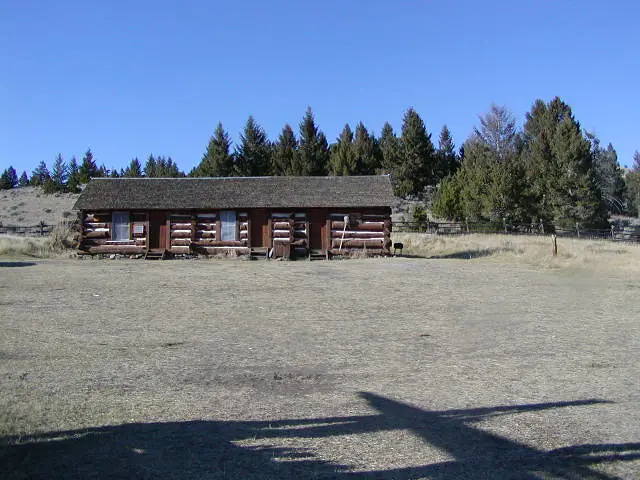
The cabin sits in a grassy basin above Eagle Creek, a seasonal tributary of Crow Creek, on the southeast flank of the Elkhorn Mountains, about 11 miles due west of Townsend. Below it, low grassland is dotted with juniper and sage. Above it, Douglas-fir forest begins. A jackleg pole fence with a drive-through double gate encloses about five acres. Inside the fence are the long log cabin, pole horse corrals with a loading chute, a plank tack shed, a woodshed, a vault toilet, and a fire pit ringed with log-and-plank benches. The access road crosses the Eagle Creek drainage out of sight of the cabin. In the words of the National Register registration form, vehicles “can be heard coming and going but they are hidden from view.”
A cabin in the Eagle meadow
The Helena-Lewis and Clark National Forest rents the cabin. It sleeps six on three sets of bunk beds with mattresses. A wood stove gives heat, and a propane camp stove is set up for cooking. The kitchen has a table and chairs, dishes, a propane lantern, utensils and cookware, and an axe and a snow shovel are left for guests. There is no electricity, no potable water and no indoor plumbing, so guests carry in water and small propane canisters. The door opens with a combination lock. Firewood may be in the shed, though the Forest Service supplies none from June 1 through August 31, and all trash and food go out with the guest.
The approach runs west from U.S. 287 on Indian Creek Road, just north of the Missouri River bridge above Townsend, and then follows Road 4031 through a canyon and across the hills. The road is native dirt with ruts, rocky stretches and narrow spots of poor visibility, and the Forest Service warns that it is not for passenger cars. From December 2 through May 15 the last four miles are closed to motor vehicles, and the cabin is reached on foot, on skis or on horseback. When the snow allows, skiers come close to the elk that winter in the grasslands. Riders find corrals at the gate, and their hay must be certified weed-free.
The open country around the cabin is elk range. Bighorn sheep, mule and white-tailed deer, black bear and moose are commonly seen. Badger, wolverine and mountain lion also live here but are seen less often. Crow Creek Falls, the largest waterfall in the Helena National Forest, is within hiking distance and gives habitat to the Canada lynx, the goshawk and the westslope cutthroat trout. Poe Park is another frequent hike. A short interpretive trail starts just beyond the cabin, and a trailhead north of it leads to old cabins in the Tizer Basin. The mining sites of Elkhorn, Hassel, Ruddville and Diamond Hill lie nearby.
Forty-six-foot logs from Eureka Creek
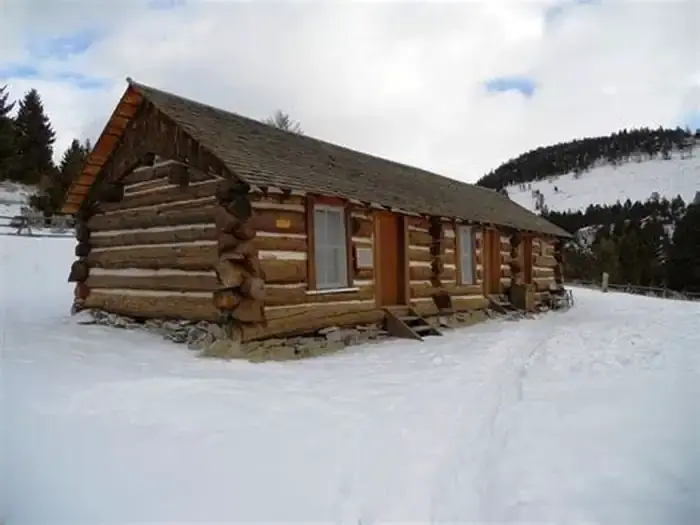
The cabin is one story, three rooms, and 46 feet by 14 feet 6 inches. Each wall log is a single unpeeled piece averaging 46 feet long and 14 inches through. The logs are Douglas fir and ponderosa pine, cut on Eureka Creek with a crosscut saw and hauled to the site by a team of oxen or horses. The corners were notched with a broadax in a “V” or “Cathedral” style, and the felling scars were never trimmed from the log ends. Inside, the logs are hewn flat on the room side only. Relief cuts in the west walls kept the logs from bowing, and split log sections are fitted between the wall logs throughout.
The roof is two roofs. The first was sod laid over double-coursed Douglas fir planking on log gables, purlins and a ridgepole. In 1911, soon after the government took possession, a new roof was built directly over it, and the sod roof is still intact underneath. A dormer over the middle room, the kitchen, lets light down onto the cook stove. Mud daub chinking from the builders still shows on the west wall and in the westernmost room. Later patches of lime and Portland mixture differ in texture from one era to the next. The kitchen once had a built-in root cellar that apparently used the snowdrifts piling against the north wall. The cellar is gone. Each room keeps what is presumed to be its original stovepipe, and all three keep their original floor planking. A pass-through telephone box, 18 by 20 inches, is set into the south wall of the east room.
Dick Owen, Jack Wilson, and Wilson Creek
The sources agree that Dick Owen built the cabin, but they differ on the date and on who helped him. The Forest Service and Recreation.gov give 1895 or about 1895 and name Richard Owen alone. They say he built it as a home for himself, his wife Sarah and their daughter Sadie while the country was in a booming gold rush. A 1991 Forest Service newsletter says it is “understood” that Owen built it “sometime around 1890,” after bringing his family from Minnesota in the late 1880s. The National Register form describes Owen as a Welsh miner born in Ridgeway, Wisconsin, on April 6, 1853, and gives him a partner, Jack Wilson. Both men were hard rock miners at St. Louis, also called Hassel, five miles away. The form says they built close to the mines yet far enough off to give Owen’s wife privacy.
The form also records what happened to Wilson. During construction he disappeared and was never seen again. Years later Forest Ranger Earl Welton found Wilson’s rifle partly grown into a tree in a nearby drainage, which has been called Wilson Creek ever since.
The Owens did not stay long. The Forest Service says that by the early 1900s they had moved to Radersburg, where Sarah Owen ran a boarding house. The National Register form dates the abandonment to 1903 and says the cabin then served as a line camp for cowboys tending herds in the Elkhorns.
Rangers, riders, and a telephone line
The Elkhorn Forest Reserve was formed in 1905, and the Helena National Forest was designated in 1908. The Forest Service took over the cabin for administrative use somewhere in those years. Most accounts give 1908, and the National Register form adds that the station was withdrawn from private ownership in 1913. The cabin predates the forest itself and is the oldest administrative log structure on it. A telephone line joined the Eagle, Tizer and Glendale stations to a switchboard in a Radersburg store. The National Register form dates the grounded line running toward the Tizer Basin from 1911 to the 1950s.
In the 1920s an area rancher, working under a Special Use Permit, took down a plank building near Radersburg, about fifteen miles off, and rebuilt it inside the compound as the tack shed. The original stairway supports still show inside it. Regular Forest Service use ended in the early 1950s. Riders from the Crow and Indian Creek Livestock Associations kept using the cabin into the 1970s. Clarence Murry, a local lion hunter, left his initials, CM, on one of the door frames.
The crew of 1991
By the late 1980s the cabin needed substantial repair. In 1989 two Forest Service volunteers, Al Adams and Ben Mayger, began promoting and supervising a restoration. They had learned the methods in a one-month restoration workshop at Cape Hatteras National Seashore. Bernie Weisgerber, a National Park Service historic preservation engineer, led the work. Glacier National Park employees Frank Vitale and Carrie King joined them, along with Tom Blunn, a retired district ranger from the Clearwater National Forest.
The sources date the project differently. The National Register form calls it the 1989 restoration project. The Forest Service gives 1991 to 1994, with volunteers, donated materials and primitive building skills. The newsletter of September 25, 1991, describes the work as happening that summer. In early July a crew of eight made camp at Eagle for three weeks, and employees and retirees from around the region came and went. The crew replaced the rotted original logs with local logs in the same style and reshingled the roof with clear cedar. The windows, doors and floor were to be remade that fall.
The concrete curbing and columns under the cabin replaced the fieldstone foundation to stop settling and keep out vermin. The floor planks were numbered, lifted and laid back in order. The outhouse was rebuilt from salvaged original material, and the woodshed, fire pit and outer corrals were built new. According to the National Register form, the project gave rise to the Forest Service’s Region 1 Historic Preservation Team. The Forest Service has determined the cabin eligible for the National Register of Historic Places, and the Federal Register of October 2, 2001, lists its nomination as pending.
Adams wrote of the site in the same 1991 newsletter: “On the southeastern slope of the Elkhorn Mountains in the Helena National Forest is a pleasant, open grassland called Eagle.” On the new logs, the crew hewed the interior faces by hand to match the smooth-sided walls Mrs. Owen had wanted in her first mountain home.
Notable Events
- 1895During the cabin construction Jack Wilson disappeared and was never seen again; years later Forest Ranger Earl Welton found Wilson's rifle partially grown into a tree in a nearby drainage, known since as Wilson Creek. npgallery.nps.gov
- 1903Following its abandonment by Owen in 1903, the cabin served as a line camp for cowboys tending cattle herds in the Elkhorns. npgallery.nps.gov
- 1905The cabin was taken over for administrative use between formation of the Elkhorn Forest Reserve in 1905 and Helena National Forest in 1908. upload.wikimedia.org
- 1911In 1911, the Forest Service added the new roof. npgallery.nps.gov
- 1913In 1913, the Eagle Guard Station was withdrawn from private ownership. npgallery.nps.gov
- 1950sEagle Guard Station fell into gradual disuse by Forest Service employees beginning in the early 1950's. npgallery.nps.gov
- 1970sCrow and Indian Creek Livestock Associations used the cabin through the 1970's. upload.wikimedia.org
- 1989In 1989, the cabin was completely restored to its original, 1930-1950's Forest Service guard station appearance. npgallery.nps.gov
- 1989Two Forest Service volunteers began promoting and supervising restoration. upload.wikimedia.org
- 1991From 1991-1994, the Forest Service, with the help of volunteers and donated materials, restored the cabin using primitive building skills and materials. fs.usda.gov
- 1991Crew replaced rotten original logs and reshingled the roof; windows, doors and floor were to be remade during fall. upload.wikimedia.org
People
- Richard (Dick) Owen, built the cabin as a home for himself, his wife Sarah, and daughter Sadie (about 1895).
- Sadie, Richard Owen's daughter; cabin intended as family home.
- Sarah Owen, Richard Owen's wife; cabin intended as family home.
- Al Adams, Forest Service volunteer who promoted and supervised the restoration.
- Ben Mayger, Forest Service volunteer who promoted restoration.
- Bernie Weisegerber, National Park Service Historic Preservation Engineer who led the restoration.
- Dick Owen, Local miner understood to have built the cabin (sometime around 1890).
- Jack Wilson, builder and Owen's partner; disappeared during construction (1895).
- Carrie King, National Park employee on the restoration team.
- Clarence Murry, Local lion hunter whose initials CM are on a cabin door frame.
- Frank Vitale, National Park employee on the restoration team.
- Tom Blunn, Retired Clearwater National Forest District Ranger on the restoration team.