Dworshak National Fish Hatchery
Orofino, Clearwater County, Idaho. National fish hatchery.
Details

- Where
- 276 Dworshak Complex Drive, Orofino, ID 83544. Directions
- When
- Spawning almost always occurs on Tuesdays.
- Season
- Spring Chinook spawning begins in August and runs through April.
- Getting there
- Turn off State Highway 12 at the Orofino bridge and continue one block north. Turn left and follow State Highway 7 about 3 miles to the hatchery.
- Hours
- Visitor center and self-guided tours 7 days a week, 7:30 am - 3:00 pm.
- Access
- Nez Perce Tribal Fishing Trail closed until further notice due to construction; the rear NPT fishing gate is open.
- Walk-in or reserve
- Walk-in visitors welcome to tour the facility by its informational signage; guided tours require an appointment at least 2 weeks ahead, 208-476-4591.
- Phone
- 208-476-4591
- Website
- fws.gov
- Managed by
- Nez Perce Tribe of Idaho.
- Established
- 1969.
Spawning at Dworshak National Fish Hatchery almost always happens on a Tuesday. In August 2026 the hatchery posted its notices online. The first called for spring Chinook on Tuesday and Wednesday, August 18 and 19, at 8 a.m. The second set August 25 and 26 for the same work, with well over 1,500 fish that had returned to Dworshak and to Kooskia waiting to be sorted and spawned. The crew “could be done as early as 11, so don’t delay!” and visitor services staff would be “intermittently on hand” for questions. The earlier post listed the likely effects of seeing the fish: “gasping in amazement, jaw drops, cheering for the full baskets, pointing at the big one, ooh-ing and finally, ahh-ing.”
The spawning deck and the ponds
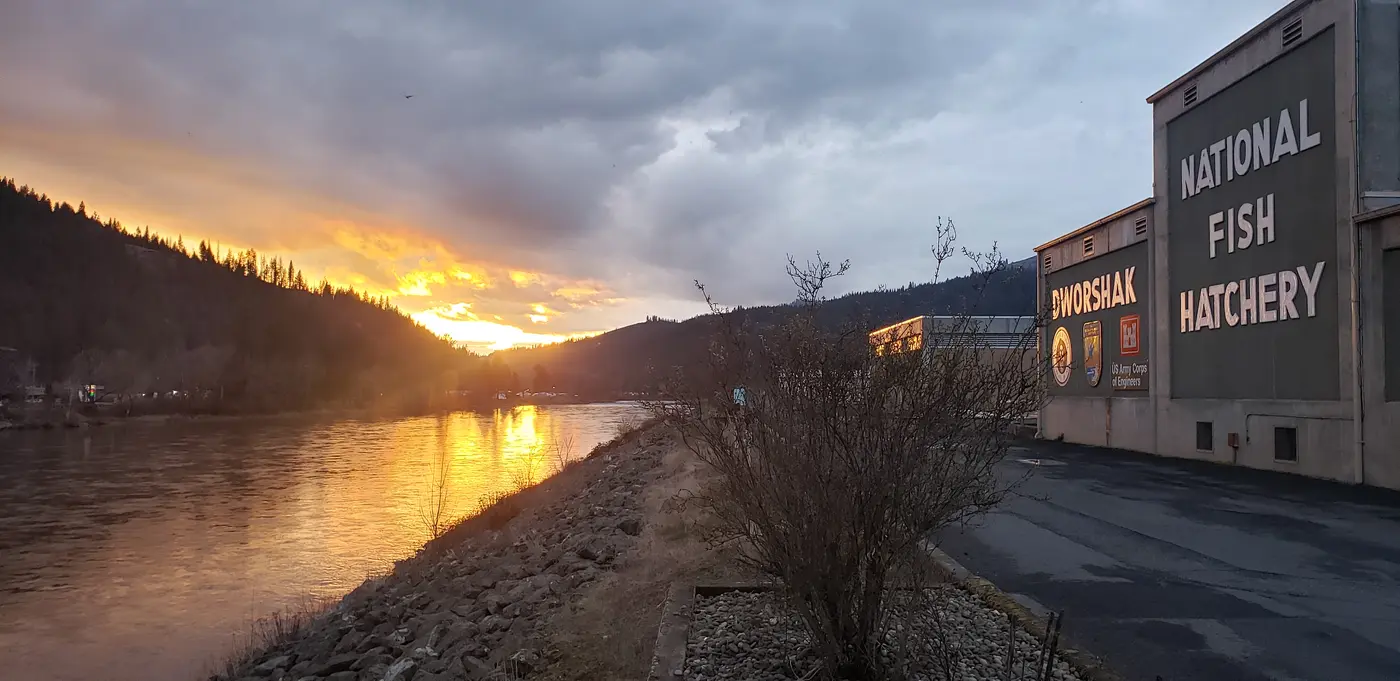
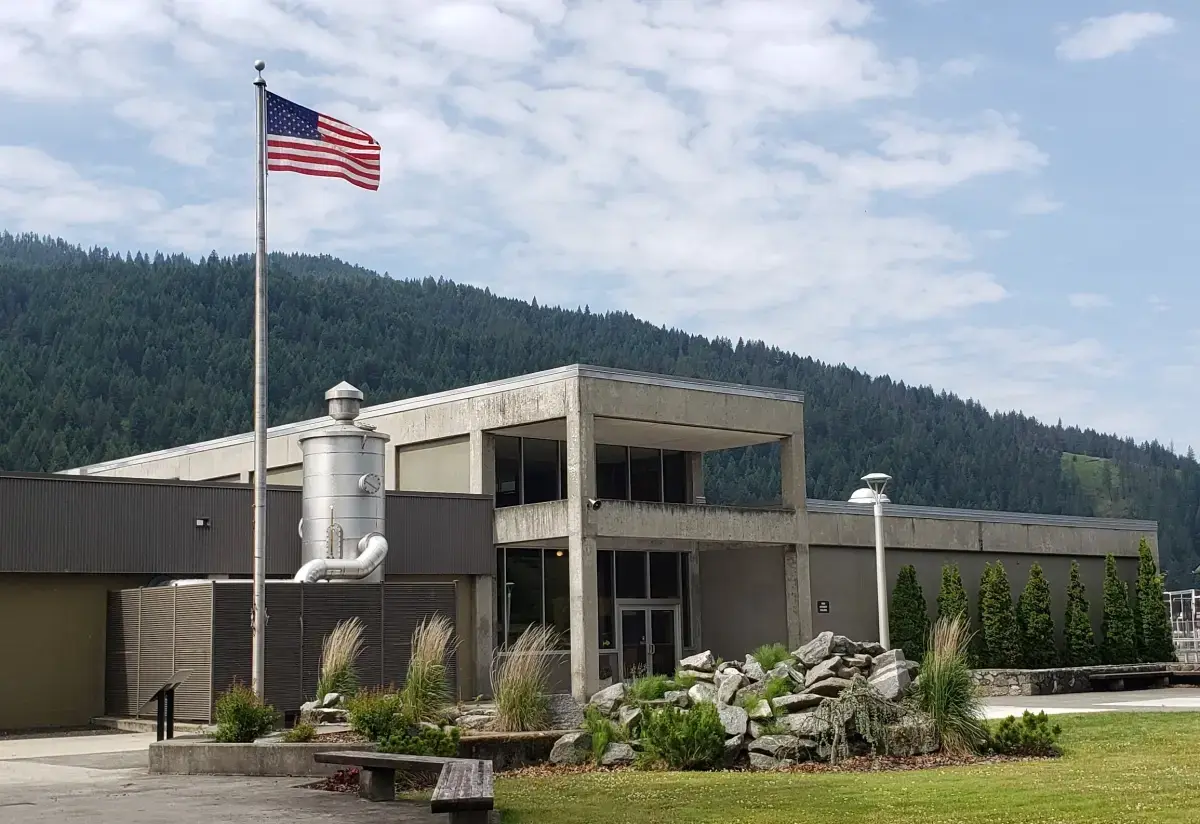
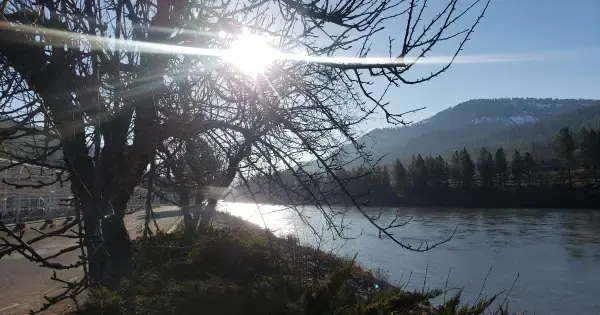
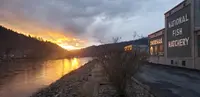
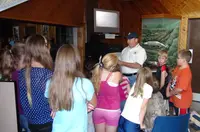
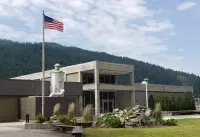
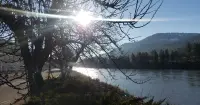
The hatchery stands in Ahsahka, Clearwater County, about three miles west of Orofino. It sits where the North Fork comes into the main stem of the Clearwater River, just below Dworshak Dam, and State Highway 7 runs out to it from the Orofino bridge. Visitors can walk the grounds on their own with a brochure and the signage. A guided tour takes 45 minutes to an hour and must be booked at least two weeks ahead. Both routes go inside and out:
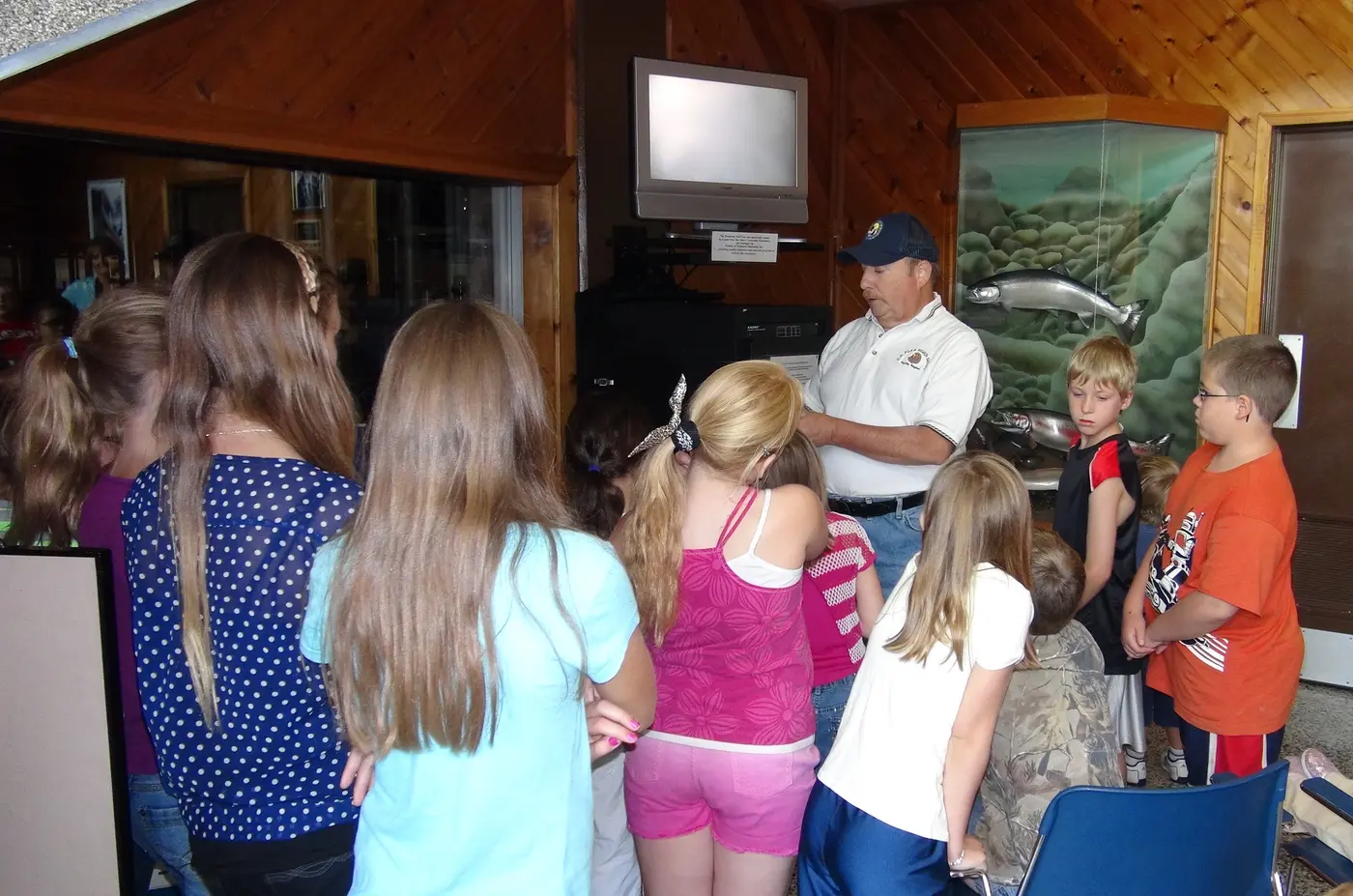
the lobby, with its dioramas and videos the indoor spawning deck the outdoor ponds where adults are held before spawning the fish ladder that connects the hatchery to the river * lookouts onto the dam and both rivers
Ramps and an indoor elevator serve wheelchairs. Visitors are asked not to climb on or touch the ponds, the water, or the equipment.
Outside are the Chinook fry raceways and the coho and steelhead fry ponds. At certain times of year marking trailers stand on site while crews clip adipose fins and tag fish. In spring and summer a pollinator garden flowers along the route. The Nez Perce Tribal Fishing Trail, which leads from the front parking lot, is closed until further notice for construction. The rear Tribal fishing gate remains open.
The spawning season runs from August into April, one species after another:
Spring Chinook return from May to August and are spawned from late August into early September. Coho return from October through late November and are spawned during that time. * Clearwater “B” strain steelhead come in from the Pacific from October until May and are spawned from January through April.
“We are one of the largest steelhead facilities in the United States,” said Jeremy Sommer, the Nez Perce Tribe’s hatchery manager, in 2022. The hatchery’s yearly count is 2.1 million steelhead, 1.65 million spring Chinook smolts, and 500,000 coho. It also raises spring Chinook parr, which one of its pages puts at 700,000 and another at 400,000. Twenty-five people work there full time.
A year in the nursery
Sommer described the work to an Army writer in 2022. Eggs and milt are taken from the returning adults. The fertilized eggs go into incubation trays on water from Dworshak Reservoir. “Water temperature controls how fast or how slow your fish are going to grow,” Sommer said. Steelhead eggs taken in January and in April are held at different temperatures “so the ones in April get just as big as the ones in January.” In fall, spring Chinook eggs are kept on chilled water so they develop in step with their natural cycle.
The hatchlings, called alevin or sac fry, live for several weeks on their yolk sacs in the darkness of the trays. “Once the egg sac is absorbed, they look like there’s a zipper up their center,” Sommer said. “Once they’re ‘zipped up’ that’s when they get moved into the nursery.” The nursery holds 124 tanks and is kept bio-secure. Staff wash their hands and arms and wear raingear and boots used nowhere else. The first feed is “Number Zero,” which Sommer called “a very fine dust-like feed.” The pellets grow as the fish do.
In summer the young steelhead move outside to the Burrows Ponds. Demand feeders hang over the water there and drop food when the fish trigger them. The fish stay on reservoir water until they are 60 to the pound. “We get them up to 5.8 fish per pound,” said Jeremy Pike, a biologist for the Tribe. “And at that point, they’re ready to hit the river.”
Releases come in late March and into April. Mark Drobish, the Fish and Wildlife Service’s hatchery manager in 2022, said 900,000 of the steelhead are trucked off-site:
a couple hundred thousand to Lolo Creek 300,000 to Clear Creek * 400,000 to Red House, on the South Fork of the Clearwater
The rest go into the river at the hatchery. The young fish imprint on the water they were raised on. They travel down the Snake and Columbia to the Pacific and come back one to three years later. The Interior Department puts the trip to the ocean at 550 miles; the hatchery puts it at more than 500.
The plant is old. “This place was a technological marvel in its day, and it tends to break with all the different things that are used, the pumps, the screens, all the moving parts,” Sommer said. An alarm system calls in staff who stand on call. Backup generators keep oxygen in the water if the power fails.
Bruces Eddy and a dam too tall for a ladder
Salmon and steelhead once ran up the North Fork of the Clearwater to spawn. The dam that ended those runs began after a May 1948 flood on the Columbia overtopped the cofferdam at McNary Lock and Dam. Through the 1950s, reports pointed to the Clearwater for a large flood-control dam, and the choice of site kept coming back to Bruces Eddy. The eddy was a circular current at a sharp bend in the North Fork. The Army’s history says it was named for an engineer, Bruce Lipscom, who lost his life there at the turn of the 20th century.
The Flood Control Act of 1962 authorized the project and renamed it for the late Idaho Senator Henry C. Dworshak. The 1948 plans called for a dam 370 feet tall. It was finished at 717 feet as a concrete gravity dam, by the Army’s account the third tallest in the United States. The first bucket of concrete was poured on June 22, 1968, and the dam was dedicated on June 15, 1973. Hatchery International gives the dam’s construction as 1966 to 1970.
The hatchery’s own page says the dam’s height made a fish ladder impossible. The Corps of Engineers built the hatchery below it instead. The Army dates its completion to 1969, and the Fish and Wildlife Service dates its construction to the late 1960s. It was built for steelhead alone; salmon were added in the 1980s. The B-run steelhead make up for habitat lost on the North Fork. The spring Chinook make up for habitat lost to the four federal lower Snake River dams. In summer, cold water from deep in the reservoir is released to keep the Snake River below 68 degrees for adult fish moving upstream.
Fourteen million fish and a pipe through the dam
Infectious hematopoietic necrosis virus (IHNV) first appeared in the Columbia watershed in the 1970s. Dworshak had its first losses in 1982. Between 1982 and 1989, according to Hatchery International, 14 million of the 21 million fish hatched there died. Returning adults shed the virus into the North Fork. The hatchery drew its water straight from the river, about a kilometer below the dam.
Some relief came in 1992, when the state of Idaho built Clearwater Fish Hatchery across the river. Engineers ran a pipeline through 25 feet of concrete in the dam and more than a mile and a half downstream. Dworshak was allotted 5,000 gallons a minute of that reservoir water for egg incubation and early rearing. “So we’ve had very little IHNV impact there,” said Steve Rodgers, manager of the Dworshak Fisheries Complex.
The outdoor ponds stayed on river water, and in 2009 the virus killed 60 percent of the juvenile steelhead. In 2010 the hatchery replumbed with the Clearwater hatchery’s cooperation. The outdoor ponds now ran on reservoir water from May through August and on a river-reservoir blend from September. Survival from eyed egg to smolt, Rodgers said, reached 86 percent in 2014. He still called the arrangement “a stop gap.”
In 2016 the Corps had the hatchery slated for a complete rehabilitation. Rodgers was pressing for every fish to be raised on reservoir water: “100% reservoir water is simply the right thing to do.”
Co-managers since 2005
The Fish and Wildlife Service and the Nez Perce Tribe began running the hatchery together in 2005. In 2017 and 2018 a turbine repair at the dam pushed dissolved gas in the water to dangerous levels for an extended period. During those two years a major power outage also threatened millions of smolts, and the crew prevented what the Clearwater Tribune called a potentially devastating loss.
In March 2019 the Idaho Chapter of the American Fisheries Society gave the hatchery its Excellence in Aquaculture Award, presented by Eric Pankau of Idaho Fish and Game. “Dworshak is one of the largest and most complicated hatcheries ever built,” Rodgers said then. Covid-19 closed the hatchery to the public for two years, and it reopened on May 2, 2022.
On June 16, 2022, the Department of the Interior transferred fish production at the hatchery to the Tribe. Secretary of the Interior Deb Haaland toured the hatchery that day and called the transfer “a triumph that is nearly 20 years in the making.” The Corps of Engineers still owns the facility, and the Fish and Wildlife Service provides administrative support. “The salmon and the steelhead are very important to the culture of the Nez Perce people,” Sommer said that month.
The Interior Department’s release noted that the Nez Perce, the Nimiipuu, have lived in this region since time immemorial. The town of Ahsahka, beside the hatchery, was once the site of the largest inland fishing village for Native Americans in the Pacific Northwest. Each season the Tribes gathered there to harvest the North Fork runs of Chinook and steelhead.
Notable Events
- 1969Completed with a sole focus on steelhead as mitigation for lost spawning habitat. army.mil
- 1969The U.S. Army Corps of Engineers constructed the facility as dam-impact mitigation and retained ownership. doi.gov
- 1969The hatchery was built on the Clearwater River to mitigate salmon runs lost to Dworshak Dam construction. fws.gov
- 1980sSalmon production was added to the hatchery. army.mil
- 198214 million fish died out of 21 million hatched. hatcheryinternational.com
- 1982Dworshak suffered its first losses from IHNV. hatcheryinternational.com
- 1992Reservoir water began being used for egg incubation and early rearing, with very little IHNV impact there, according to Steve Rodgers. hatcheryinternational.com
- 2005U.S. Fish and Wildlife Service and Nez Perce Tribe began joint operation and management. clearwatertribune.com
- 2009The hatchery lost 60% of juvenile steelhead production. hatcheryinternational.com
- 2010Plumbing changes allowed some Burrows Ponds to receive reservoir water, helping manage around IHNV disease. army.mil
- 2010With Clearwater Hatchery cooperation, outdoor ponds received reservoir water from May through August, then a river-reservoir blend in September. hatcheryinternational.com
- 2017Crew adapted to protect fish from dangerously high dissolved gas caused by a turbine repair at Dworshak Dam. clearwatertribune.com
- 2019The Idaho Chapter of the American Fisheries Society presented the hatchery with its Excellence in Aquaculture Award. clearwatertribune.com
- 2022Announced reopening after a two-year Covid-19 closure. clearwatertribune.com
- 2022The Department of the Interior transferred hatchery fish production to the Nez Perce Tribe. doi.gov
People
- Jeremy Pike, NPT staff representative receiving the hatchery award.
- Jeremy Sommer, NPT award-delegation representative.
- Mark Drobish, U.S. Fish and Wildlife Service Hatchery Manager for Dworshak National Fish Hatchery.
- Adam Izbicki, USFWS award-delegation representative.
- Aidan Frye, USFWS award-delegation representative.
- Angela Feldman, USFWS staff representative receiving the hatchery award.
- Eric Pankau, IDFG; chairman of AFS Aquaculture committee who presented the hatchery's award.
- Lautiss Shebala, NPT award-delegation representative.
- Russell Brotnov, NPT staff representative receiving the hatchery award.
- Sara Dimick, USFWS staff representative receiving the hatchery award.
- Stephanie Baptiste, NPT award-delegation representative.
- Steve Rodgers, Dworshak Fisheries Complex Manager.
- Angela Feldmann, Hatchery public-information contact for reopening and tours.
- Deb Haaland, Secretary of the Interior who toured the hatchery and commemorated the transfer (June 16, 2022).
- Rachel Breyta, US Geological Service Western Fisheries Research Center researcher studying successful viral-disease mitigation at the hatchery.
Sources
- fws.gov/fish-hatchery/dworshak
- fws.gov/fish-hatchery/dworshak/visit-us/tours
- facebook.com/dworshakcomplex
- commons.wikimedia.org/wiki/File:Dworshak_NFH_sunset_Clearwater_River.png
- fws.gov/fish-hatchery/dworshak/visit-us/locations/dworshak-national-fish-hatchery
- fws.gov/fish-hatchery/dworshak/about-us
- doi.gov/pressreleases/secretary-haaland-joins-nez-perce-tribe-army-corps-engineers-commemorate-transfer
- army.mil/article/257806/4_million_mouths_to_feed_life_at_the_dworshak_national_fish_hatchery
