Durango & Silverton Narrow Gauge Railroad
Durango, La Plata County, Colorado. Landmark & Historical Place.
Details

- Where
- 479 Main Avenue, Durango, CO 81301. Directions
- When
- Durango Departure: 9:00am Silverton Arrival: 12:30pm Silverton Departure: 2:45pm Durango Arrival: 6:15pm.
- Season
- Durango – Silverton (Steam) May 2 – Nov 1, 2026.
- Getting there
- The last point of highway access between Durango and Silverton is the Rockwood Station. Between Rockwood and Silverton it is a designated wilderness area and there is no motorized access.
- Fees
- Durango – Silverton (Steam) $108 – $313.
- Access
- Passengers must be seated on the train 30 minutes prior to departure or seats may be released to waiting passengers. All seats are assigned.
- Walk-in or reserve
- For passengers with special needs (ADA) and boarding requirements, please call our reservation desk at 877-872-4607 to book your tickets.
- Phone
- (970) 247-2733
- Website
- durangotrain.com
- Managed by
- American Heritage Railways.
- Established
- 1881.
The train leaves from the Durango Depot at 479 Main Avenue. The line’s National Register nomination describes the building as a one-story frame station with a two-story central pavilion and a bay entrance on the east side. Near the entrance stands a marker erected in 1999 by the railroad’s employees. It is dedicated to Charles E. Bradshaw Jr., “who established the Durango & Silverton Narrow Gauge Railroad,” and who “saved the Silverton branch of the Denver & Rio Grande Western from abandonment in 1981.” All seats are assigned, and passengers must be aboard thirty minutes before departure or their places may go to people waiting on the platform. Through the 2026 summer season the 9:00 a.m. train ran daily from May 2 to November 1, with earlier and later departures on some dates.
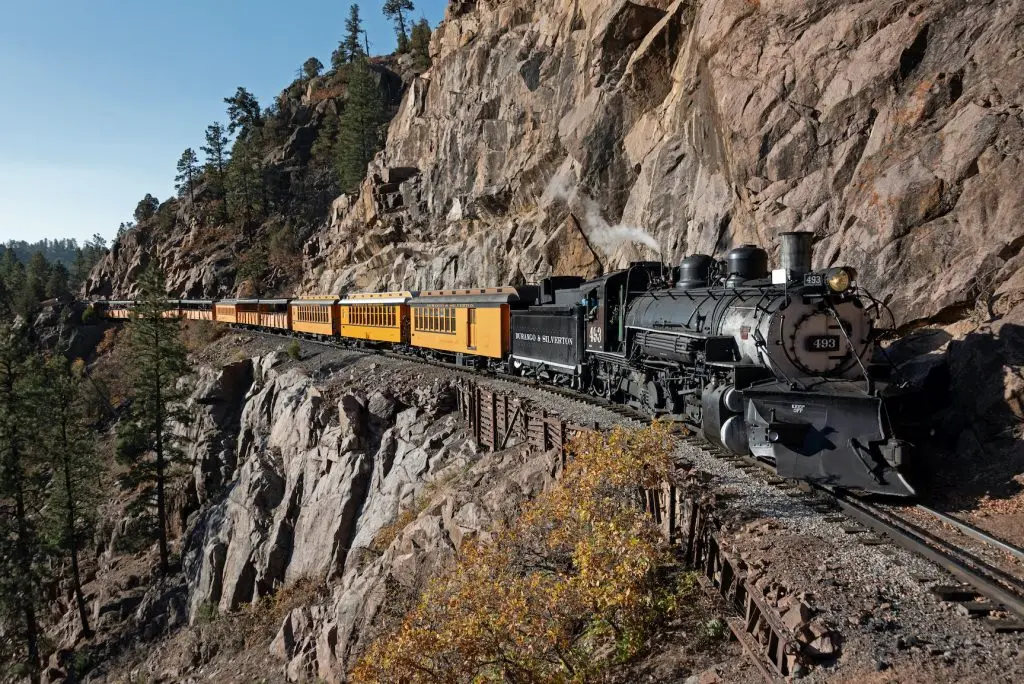
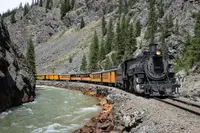
The railroad is owned and operated by American Heritage Railways. Its locomotives are oil-fired or coal-fired steam engines of 1923–25 vintage, along with diesels. They pull what the company calls rolling stock indigenous to the line. The company’s letter to riders, signed by Allen and Carol Harper, ends: “You are now an 1882 railroader.”
Forty-five miles up the Animas
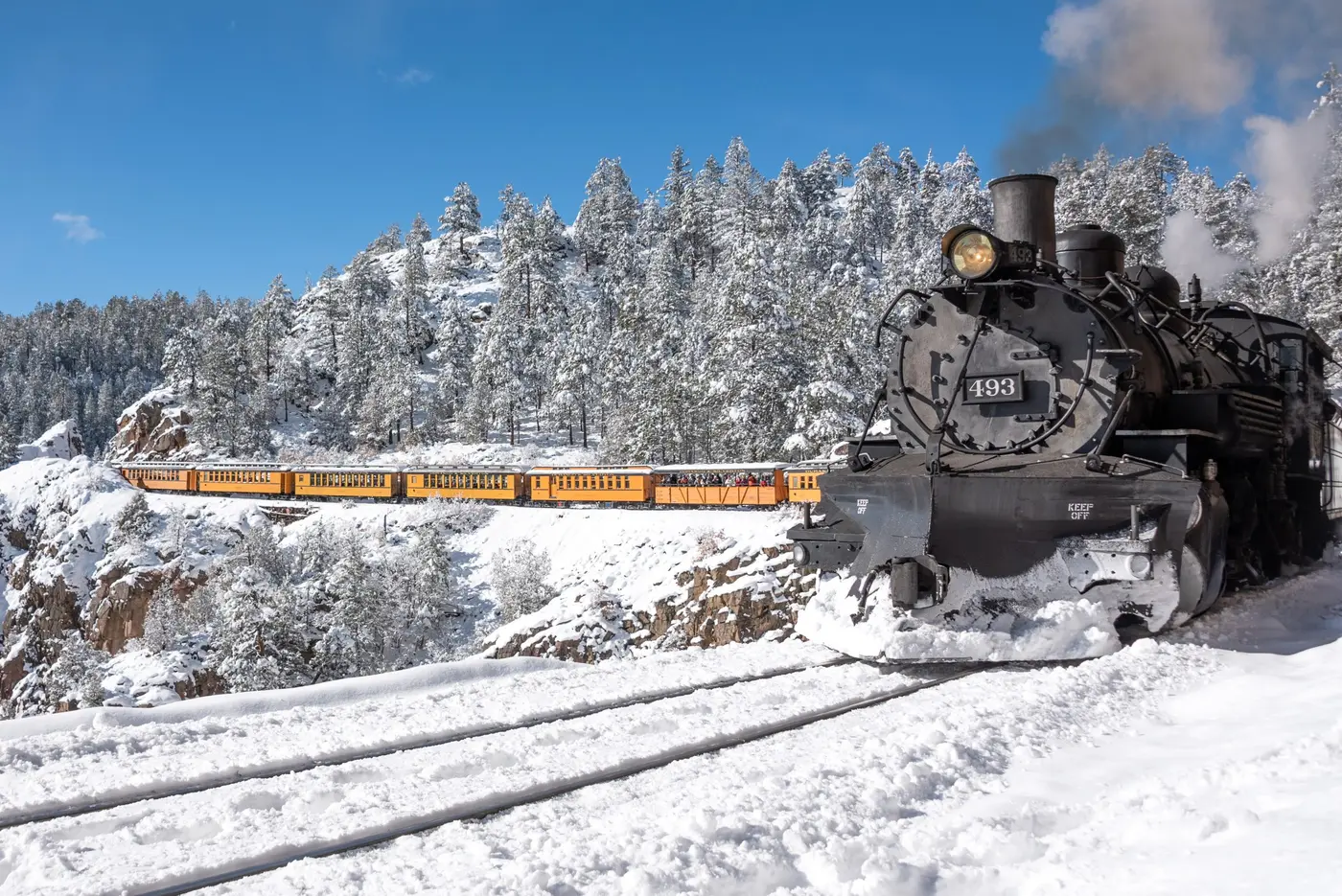
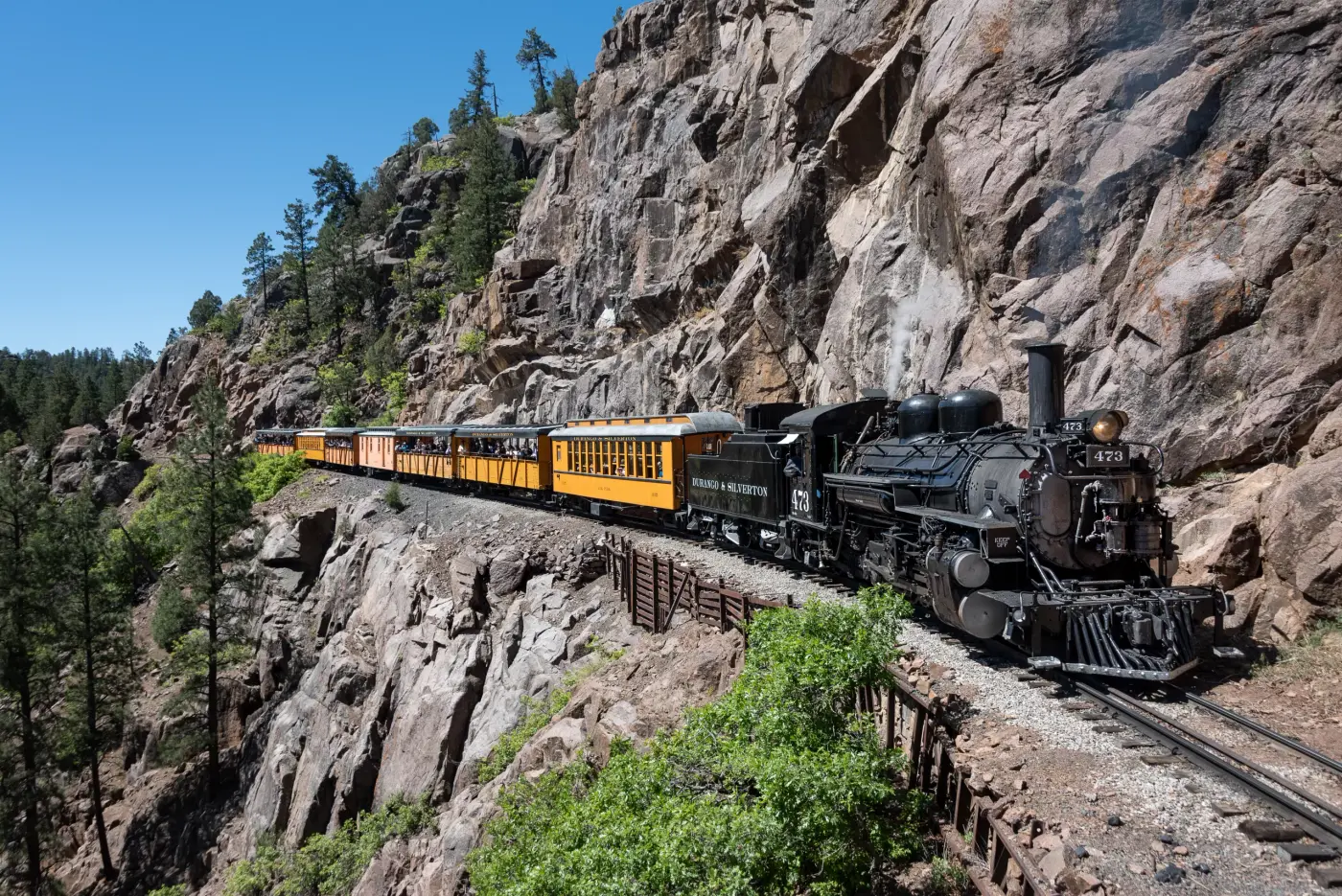
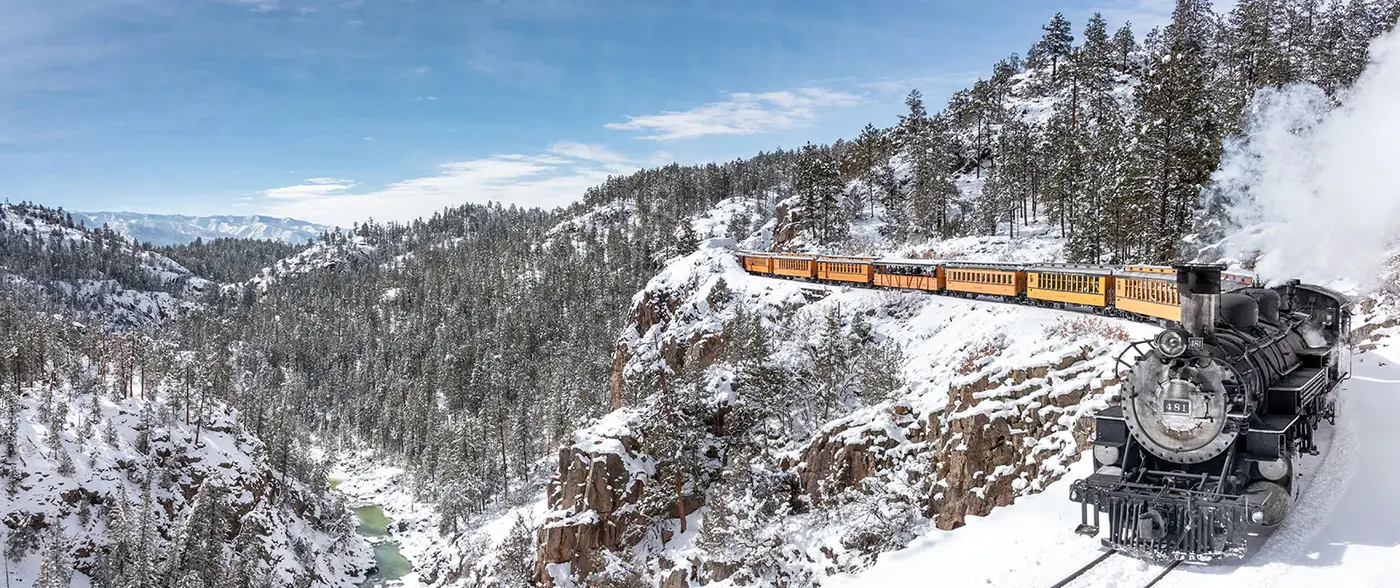
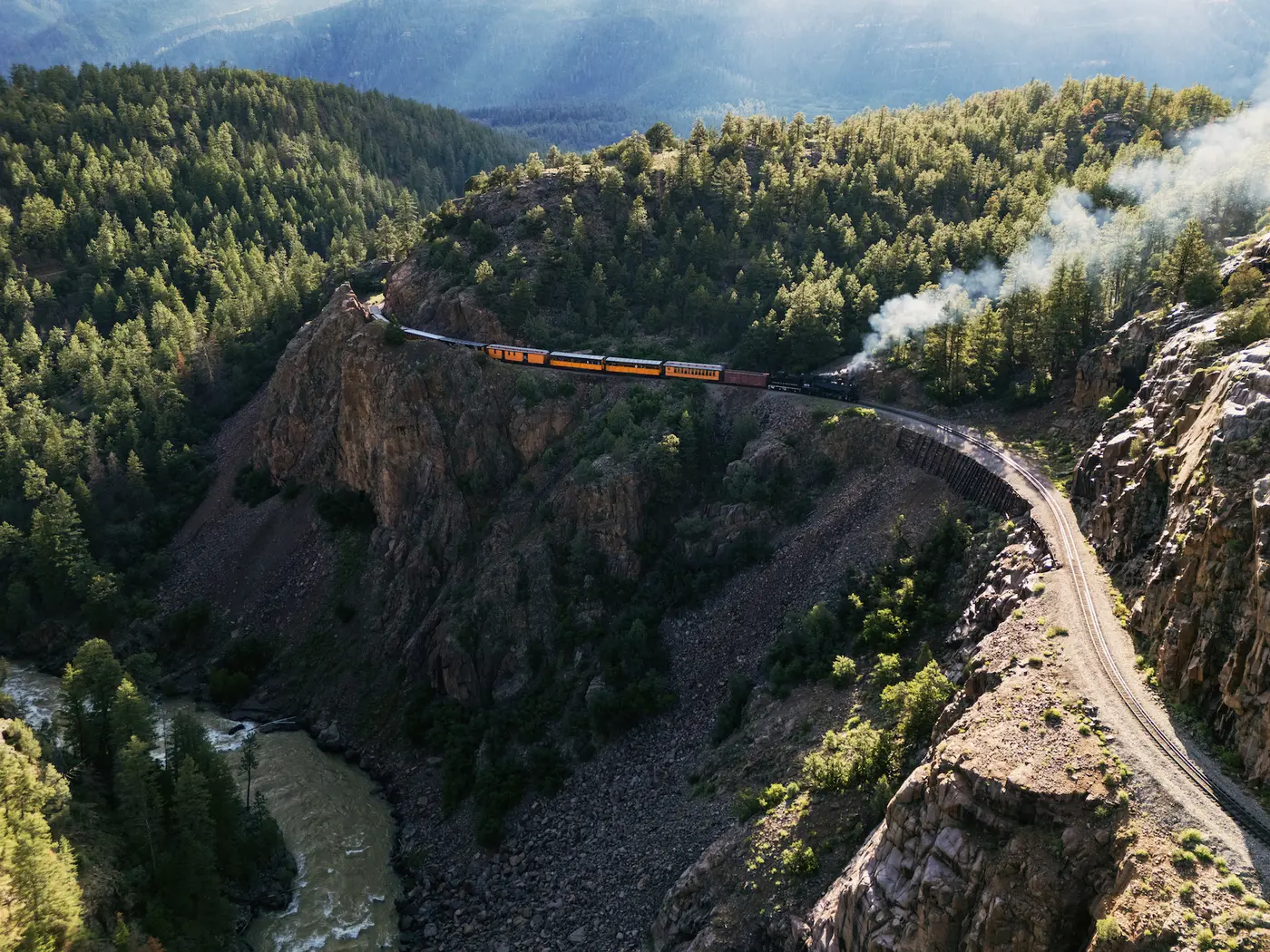
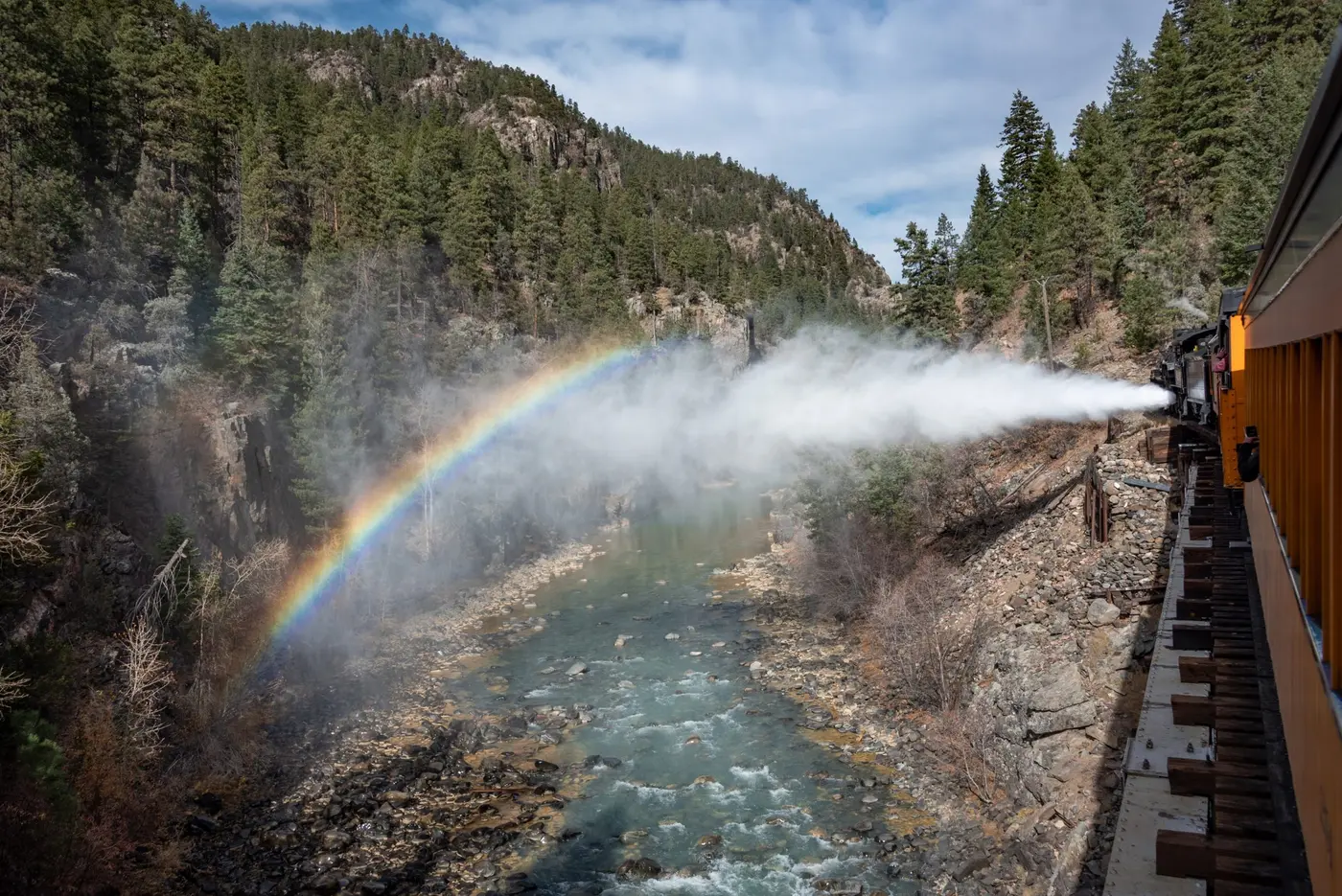
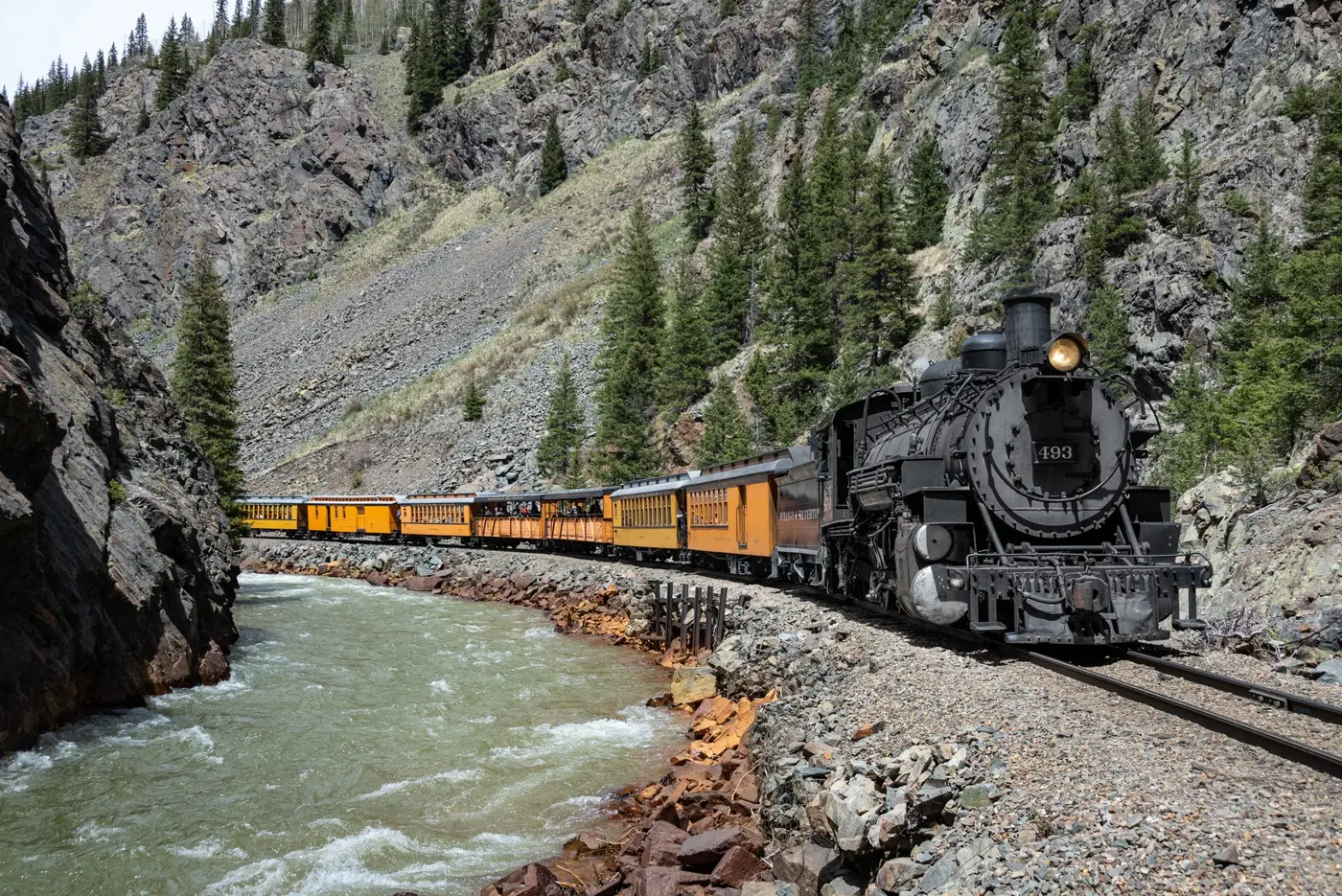
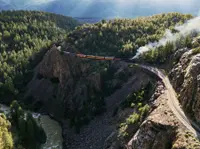
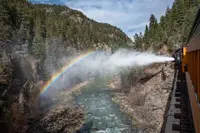
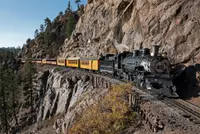
The run to Silverton is 45.4 miles each way along the Animas River and takes about three and a half hours in each direction. Riders get a layover of nearly two hours in the old mining town before the return. The track climbs more than 2,500 feet over the distance, according to the National Register nomination, so the railroad advises dressing in layers. It also recommends sunglasses against cinders in the air. The route crosses Horseshoe Curve and the High Bridge, runs the length of the Animas River Gorge, and rides along the ledges of the High Line. There is no cell service or Wi-Fi in the canyon. The railroad’s own description has riders listen for “the steam whistle echoes through the canyon” and for the locomotive working up the grades.
Rockwood Station is the last point of highway access. From Rockwood to Silverton the line runs through designated wilderness with no motorized access. The train serves backpackers and hunters there, and they may ship their firearms as freight. No personal alcohol may be carried aboard. A concession car sells snacks and drinks on every train, including liquor for standard-class passengers.
Riders who want a shorter day can take the Silverton Express. A motorcoach leaves Durango at noon and climbs the Million Dollar Highway to Silverton. The 2:00 p.m. steam train then brings passengers back down through the High Line cliffs, reaching Durango by 5:30. From late November through early May the trains go only 26 miles, to the wye at Cascade Station, in heated coaches. The winter train allows a 60-minute layover in Cascade Canyon, with a fireside area for lunch and room for a walk along the river. The 2026–27 winter season was scheduled from November 20, 2026, to April 30, 2027. The Christmas-season POLAR EXPRESS™ trains run over the same weeks.
The cars behind the engine
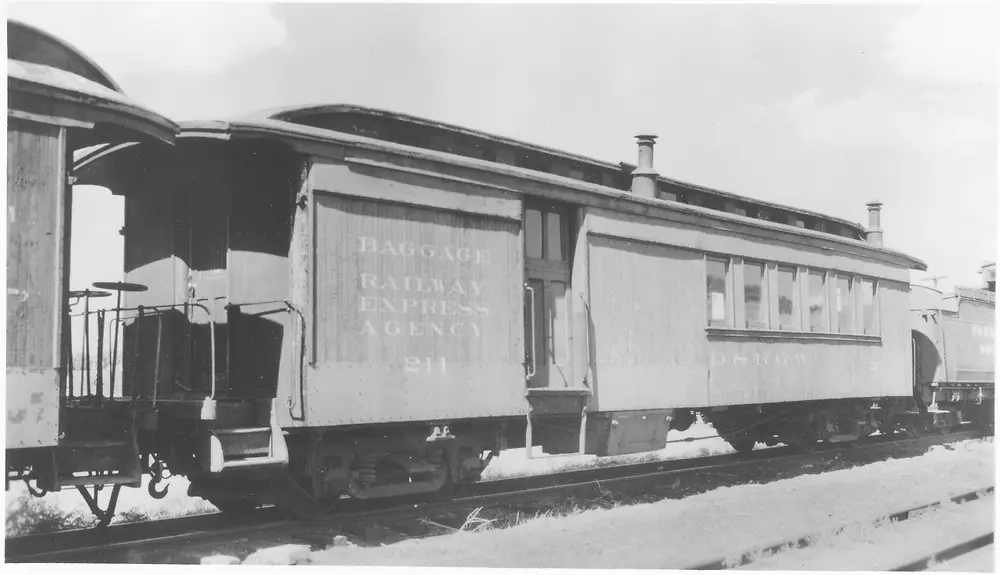
The cars are sold in four classes. Standard class offers a choice between vintage enclosed coaches, whose windows open “a little or a lot,” and open-air gondolas with outward-facing padded rows. The gondola walls are closed from floor to waist and open above. The railroad’s posts promise riders the smell of pine from the gondolas. Standard seats are the width of an economy airline seat.
Several of the upper-class cars carry their own dates. The Yankee Girl was built in 1880 and rebuilt several times over the next 134 years. It went back into service in 2014 under the name of the largest mine in the Red Mountain Mining District. The Alamosa Parlor Car dates from 1881 and seats 24 passengers at tables, with a private outdoor platform. The San Juan, a deluxe coach built in 1887, has three-across reversible overstuffed seats. The Silver Vista has a glass dome over the seats. The Knight Sky, styled after it, was built in Durango and put into service in May 2012. Presidential class is the private car Cinco Animas, open only to riders 21 and over. It offers Pullman berth seating and an Observation Parlor Room at the rear. First-class and presidential riders get an attendant, a morning pastry, and a souvenir mug.
The roundhouse, the museum, and caboose 0501
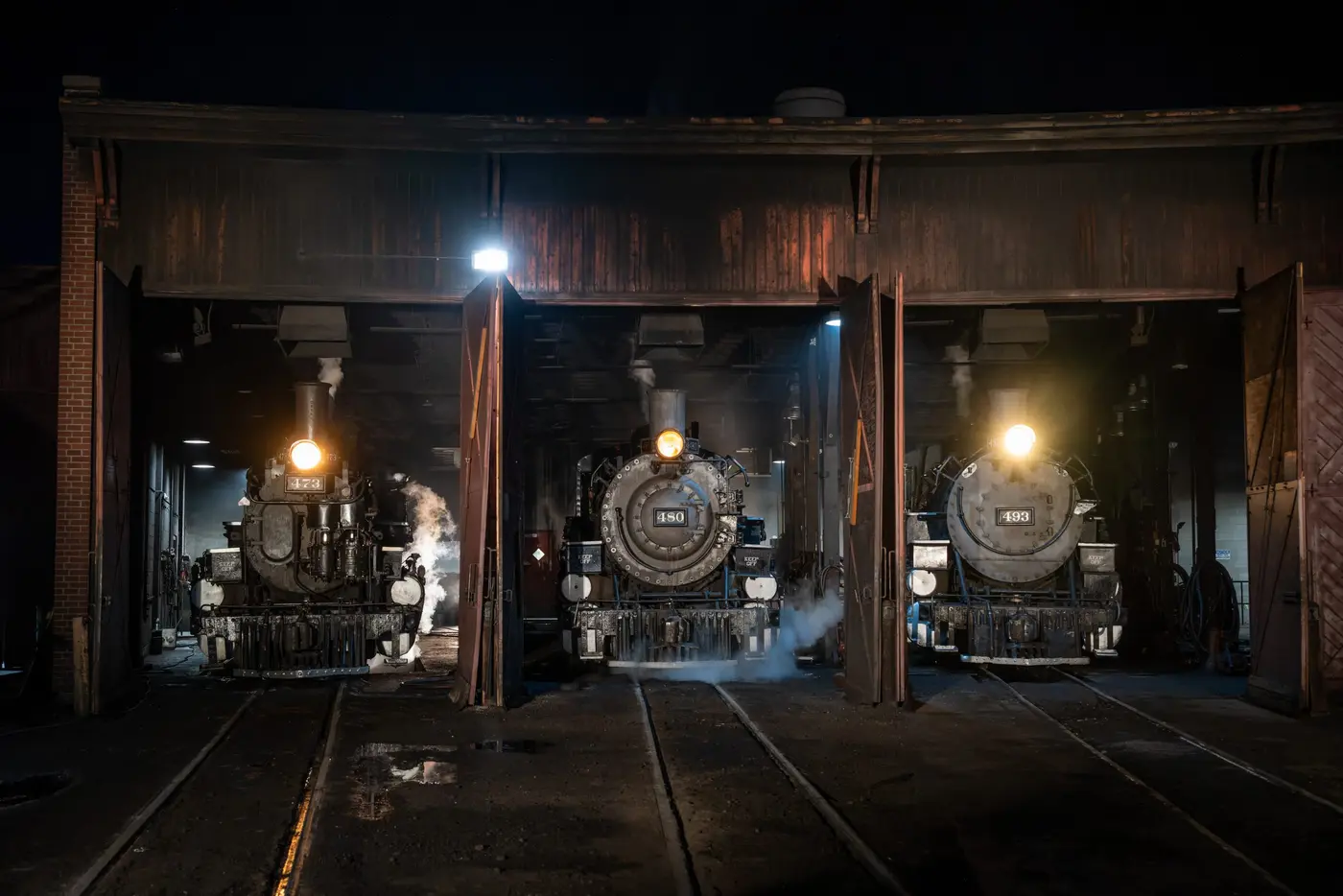
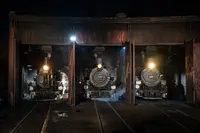
The depot and the first roundhouse were finished in 1882, while track was still being laid toward Silverton. The roundhouse burned, and its 15-stall replacement was built in 1989. In 1998 eight of those stalls became the railroad’s museum. The museum’s own page gives its size as 12,000 square feet; a railroad post from September 2026 says 10,000. Admission is free. Inside are full-size locomotives, historic cars, model train layouts, and artifacts given by local families and by old railroad workers, much of it from the D&RGW. Jeff Ellingson is the curator. In summer, guides lead tours at 10 a.m., noon, and 2 p.m. through the yard, machine shop, roundhouse, and car shop. Each tour lasts about an hour and a half on foot over rocky ground, and no open-toed shoes are allowed.
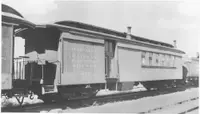
Some of the equipment has come home from long absences. Caboose 0501 was built in 1886, by one account, and worked the Rio Grande narrow gauge system for just shy of seventy years. Jeff Johnson, the railroad’s general manager, has described it as built in the 1860s. In 1953 Jackson Clark Sr. bought the retired caboose and moved it onto family land. His son, Jackson Clark II, was photographed on its ladder in the 1950s. The Clarks’ ties to the line went back to Harry Jackson, who had followed the railroad’s expansion from New Jersey to Durango in the late 1800s. Dustin Bradford lived in the caboose for six months in 2001. Jackson Clark’s daughter, Antonia Clark, eventually sold it back to the railroad. On a March 27, crews picked up 0501 from the Clark property and drove it to the depot. Railroad staff Trevor Chung and Tyler Baker then looked it over for restoration.
Palmer’s three-foot line to Silverton
William Jackson Palmer established the Denver & Rio Grande in 1870. The Animas Museum says his first plan was a line from Denver to El Paso. When the Santa Fe Railroad blocked that plan, he turned the railroad into the San Juan Mountains toward the growing mining town of Silverton. The D&RG was one of the first three-foot narrow-gauge railroads in the United States. Palmer had learned that narrow gauge took tighter curves and steeper grades than standard gauge, which runs four feet eight and a half inches between the rails, and that it cost less to build.
In 1880 the railroad’s land company bought ground along the Animas River just south of Animas City, which had been established in 1876, and laid out a new town there. According to the Animas Museum, it was probably named for Durango in Mexico, where Palmer had other railroad interests. The site had local coal, flat land for a yard, and a smelter. The town was surveyed in September 1880 and had 2,000 inhabitants by December.
The sources give different dates for the rails reaching town. The Animas Museum says late July 1881, another account says July 28, 1881, and the railroad’s own history says August 5, 1881. Work on the Silverton line began that fall. The nomination form gives 1880 as the year the Durango–Silverton stretch was inaugurated. It records that men “had to be lowered over cliffs or scale mountain sides to locate and construct the line.” The tracks reached Silverton in July 1882. The railroad dates its continuous operation from that year, although its Facebook and Instagram pages say “since 1881.”
Ore, war, and the movies
The line was promoted from the first as a scenic passenger route, but it was built to carry gold and silver ore out of the San Juans. The railroad estimates that more than $300 million in precious metals has moved over it. Silverton had grown to 1,100 people by 1885. In 1893 silver fell from $1.05 to $.63 an ounce, and ten large mines in the Silverton district closed. Fire nearly destroyed downtown Durango in 1889. The first automobile arrived there by train in 1902.
The federal government ran the railroad during the First World War. Soon after, the D&RGW reorganized because of financial trouble. The 1918 influenza killed ten percent of Silverton’s people in six weeks. In the Second World War the government requisitioned narrow-gauge equipment for use in Alaska. The Durango smelter reopened to process uranium and kept at it into the late 1940s.
The men who ran the trains in those years were Durango people. A crew photograph shows Alva Lyons, a long-time conductor and Durango resident, and Tom Martin, the brakeman that day. The third man is probably conductor Wayland Bruce. Jim Connor, a Denver & Rio Grande engineer, also lived in Durango.
By 1947 the Silverton branch was in danger of abandonment, and its staff kept it running by promoting tourism. Film crews came next. Over the following decade the train appeared in Ticket to Tomahawk, Across the Wide Missouri, Denver & Rio Grande, Viva Zapata, and Around the World in 80 Days, and later in Butch Cassidy and the Sundance Kid. One record gives the National Historic Landmark listing as July 4, 1961. The railroad’s history places it in the latter part of the 1960s, along with the line’s award as a National Historic Civil Engineering Landmark.
In 1969 the D&RGW abandoned the track south of Durango, cutting the line off from the rest of the system. The National Register nomination from those years describes a tourist train running only four months a year, late June through September. The Durango station got a fresh coat of paint every year. The Silverton depot was out of use and had been given to the Silverton Historical Society for a museum.
A citrus grower buys the Silverton
Charles E. Bradshaw Jr., a Florida citrus grower, bought the 45-mile line from the Denver & Rio Grande Western for $2.2 million and kept the train’s old name, the Silverton. The marker at the depot gives the year as 1981, and the railroad’s history places the sale just before the line’s hundredth birthday. Engine No. 481 was restored and returned to service after twenty years in retirement.
Through the 1980s the new company weatherized engines and coaches for winter. It replaced nearly ten thousand ties and restored locomotives No. 497 and No. 480; No. 497 is the only K-37 ever to run on the line. In 1985 the railroad bought back the Silverton depot and returned it to service. By 1986 four trains a day were running to Silverton, and a fifth went to the Cascade Canyon wye.
Notable Events
- 1860sJohnson described the caboose as built in the 1860s. durangoherald.com
- 1880The Durango-Silverton stretch of the Denver and Rio Grande Railroad was inaugurated, planned by General William Jackson Palmer. npgallery.nps.gov
- 1881The railroad arrived in Durango and construction on the line to Silverton began that fall. durangotrain.com
- 1882Both depot and roundhouse were completed as tracks were laid to Silverton. animasmuseum.org
- 1882Completed in July of 1882, the Durango-Silverton was the main artery for removing ore from the mines of the San Juan. npgallery.nps.gov
- 18860501 was built and rode the Rio Grande narrow gauge system for just shy of seventy years. durangoherald.com
- 1947The Silverton branch was in danger of being abandoned; a determined staff promoted tourism and kept the line alive. durangotrain.com
- 1953Jackson Clark Sr. bought the retired Denver & Rio Grande Railroad 0501 caboose. durangoherald.com
- 1961Durango-Silverton Narrow-Gauge Railroad listed as a National Historic Landmark. nps.gov
- 1969The D&RGW abandoned the tracks south of Durango, isolating the line and leaving its future in question. durangotrain.com
- 1981Charles E. Bradshaw Jr. saved the Silverton branch of the Denver & Rio Grande Western from abandonment and preserved the railroad as a National Historic Landmark. hmdb.org
- 1985The D&SNGRR purchased the Silverton Depot, returning it to service. durangotrain.com
- 1989The roundhouse was rebuilt after a devastating fire. animasmuseum.org
- The railroad picked up 0501 from the Clark property and drove it to the depot. durangoherald.com
People
- William Jackson Palmer, Established the Denver & Rio Grande Railroad (1870).
- Alva Lyons, Long-time conductor and Durango resident.
- Jim Connor, Denver & Rio Grande engineer who lived in Durango.
- Tom Martin, Brakeman on the day the crew photograph was taken.
- Wayland Bruce, Probably the conductor in the photograph with Lyons and Martin.
- Jeff Ellingson, Curator of the D&SNG Railroad Museum.
- Antonia Clark, Jackson Clark’s daughter, selling the caboose back to D&SNG.
- Dale Ray, FLC president when the institution moved from Hesperus to Durango; friend of Jackson Clark.
- Dustin Bradford, Lived in caboose 0501 for six months (2001).
- Harry Jackson, Antonia’s great-grandfather, who followed the railroad’s expansion to Durango from New Jersey (late 1800s).
- Jackson Clark II, Antonia’s brother, pictured on the family caboose ladder (1950s).
- Jackson Clark Sr., Bought retired caboose 0501 (1953).
- Jeff Johnson, D&SNG General Manager.
- Trevor Chung, Durango & Silverton Narrow Gauge Railroad staff inspecting 0501 after its arrival for restoration.
- Tyler Baker, Durango & Silverton Narrow Gauge Railroad staff inspecting 0501 after its arrival for restoration.
- Charles E. Bradshaw, Jr., purchased the Silverton branch.
- Otto Mears, completed the toll road to Ouray.
- General William Jackson Palmer, planned the line; builder.
- Joseph S. Mendinghall, Historian, prepared the National Register nomination form.
- Charles E. Bradshaw Jr., Florida citrus grower who bought the line; president and chief executive officer of The Durango & Silverton Narrow Gauge Railroad Co. Inc.
Sources
- durangotrain.com
- durangotrain.com/about-us
- durangotrain.com/contact
- durangotrain.com/now-booking
- durangotrain.com/excursions/round-trip-silverton-train-tour
- durangotrain.com/ride-us/important-information
- durangotrain.com/history
- facebook.com/DSNGRR
- instagram.com/dsngrr
- npgallery.nps.gov/NRHP/GetAsset/2566584d-57b9-4b8a-a547-fd0ea0221c35
- upi.com/Archives/1981/03/27/Vacationing-citrusman-rides-railroad-and-decides-to-buy-it/8800354517200
- hmdb.org/m.asp?m=71079