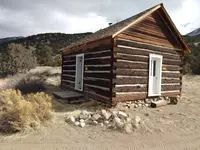
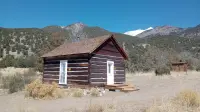
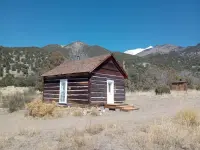
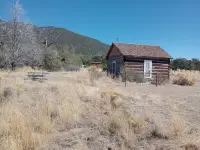
Duncan Cabin
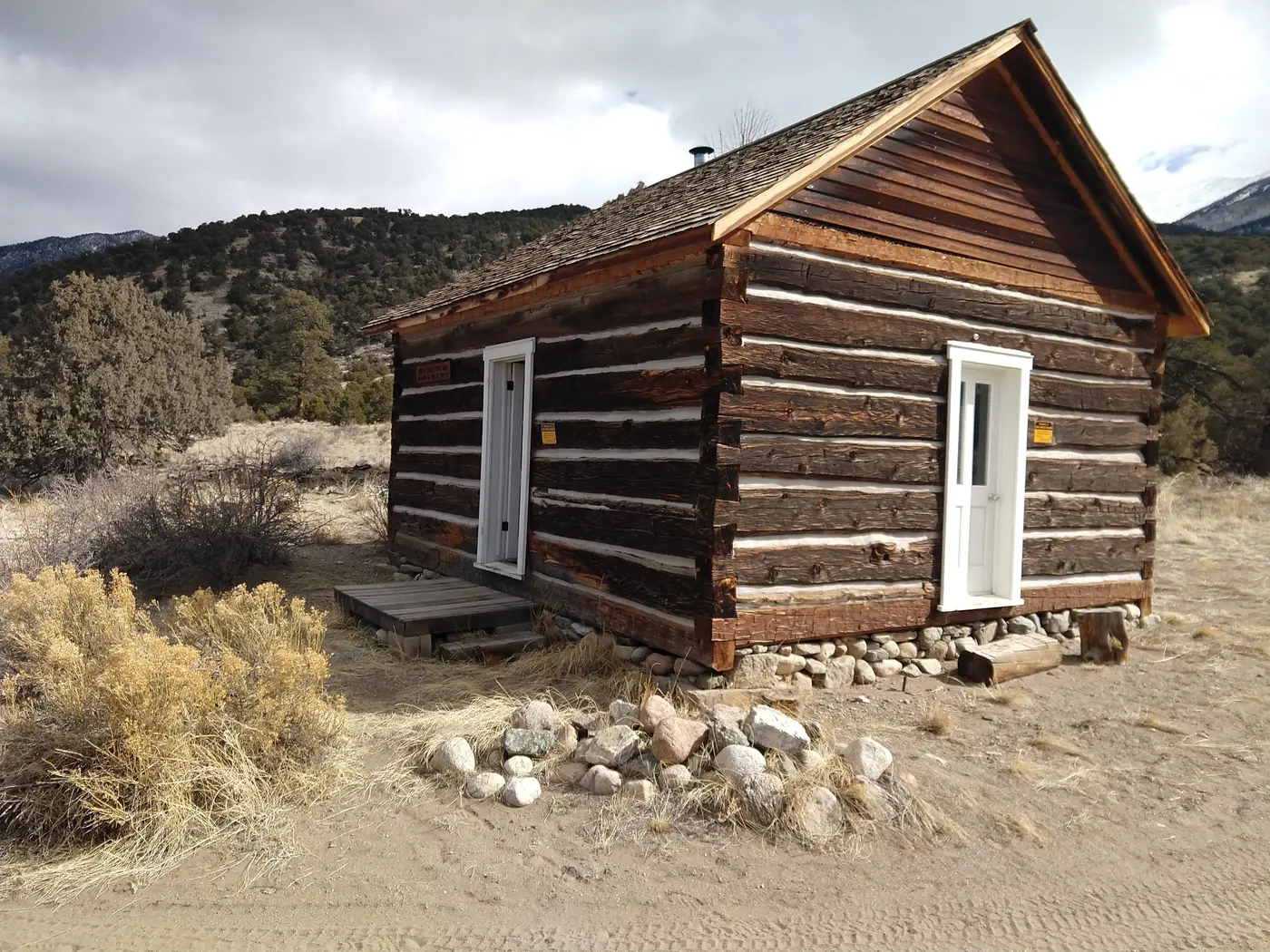
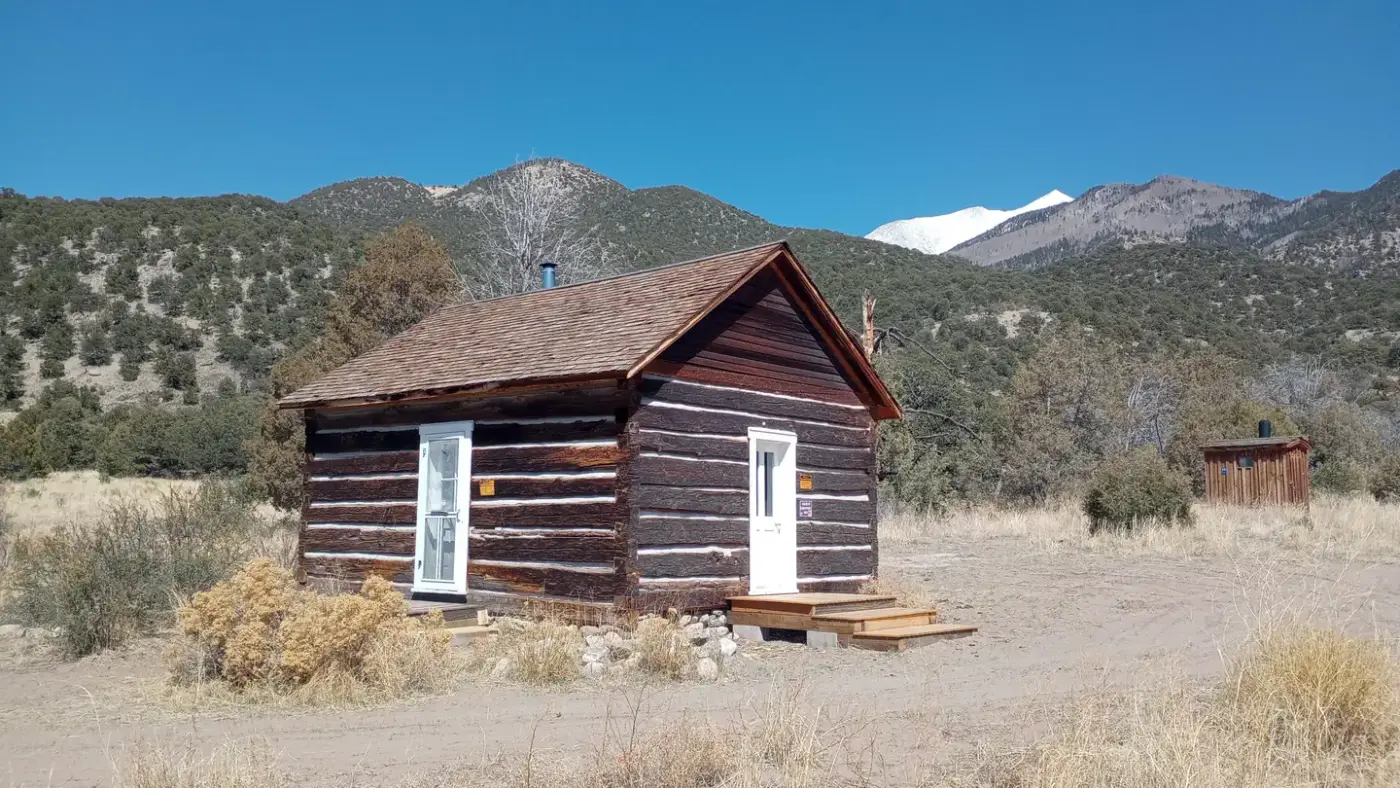
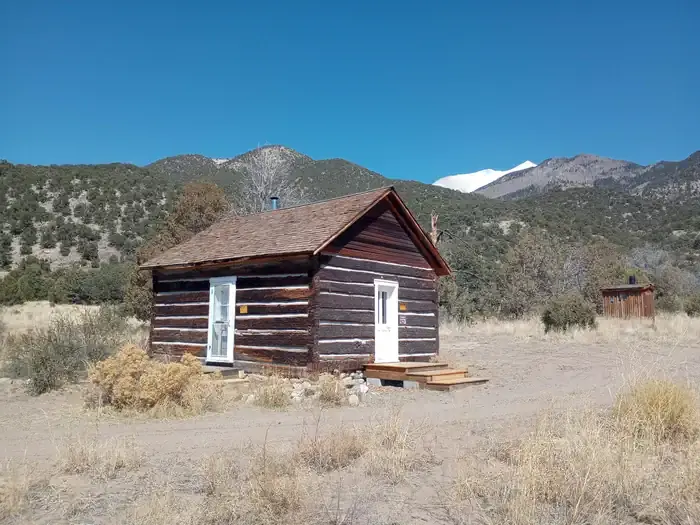
Crestone, Saguache County, Colorado. One-room Forest Service cabin.
Details

- Where
- Crestone, Saguache County, CO. No street address stated. Directions
- When
- Quiet hours are from 10:00 pm to 6:00 am.
- Season
- Cabin will open for the 2026 season from May 22nd to November 18th.
- Getting there
- From Moffat, Colorado, take State Highway 17 south through town. From Moffat, turn east toward Crestone on County Rd T and follow it for 12 miles. Before reaching Crestone, turn right onto Camino Baca Grande Rd and continue for 2 miles.
- Fees
- $40 per night. Recreation.gov charges a reservation fee.
- Access
- Visitors must park at the trailhead. Hike or ride horses or bikes 4 miles to the cabin. No e-bikes.
- Walk-in or reserve
- Please make reservations at Recreation.gov or by calling 1-877-444-6777.
- Phone
- 719-655-2547
- Website
- fs.usda.gov
- Managed by
- Saguache Ranger District, Rio Grande National Forest.
- Established
- 1880s.
- Coordinates
- 37.87414, -105.6144.
Four miles from Liberty Gate
Cars stop at Liberty Gate, at the end of Forest Road 952, after five very rough miles of gravel. From the gate the last four miles to Duncan Cabin go on foot, on horseback, or by bicycle fitted for sand. E-bikes are not allowed. The track runs south through sand and rock, with the sagebrush plain of the San Luis Valley on the right and the Sangre de Cristo Mountains on the left. About two miles in, a wall of tall cottonwoods marks the banks of Deadman Creek, and the route crosses the stream there. Sandy stretches and floods on Deadman Creek can slow or stop the trip. Past the creek the path turns west into the foothills and climbs to the cabin.
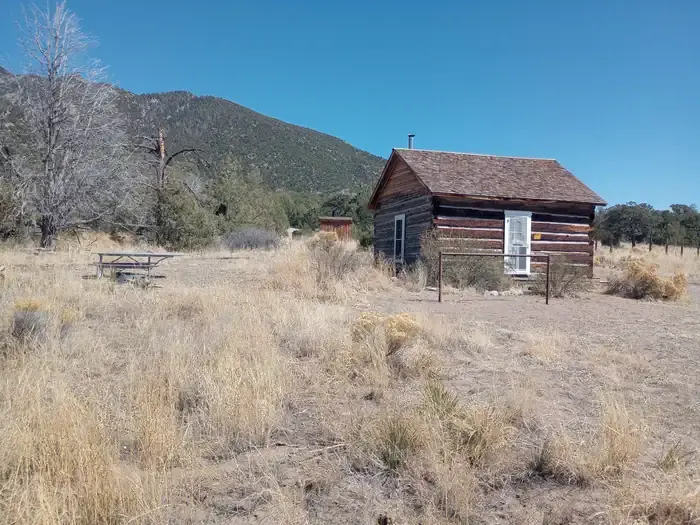
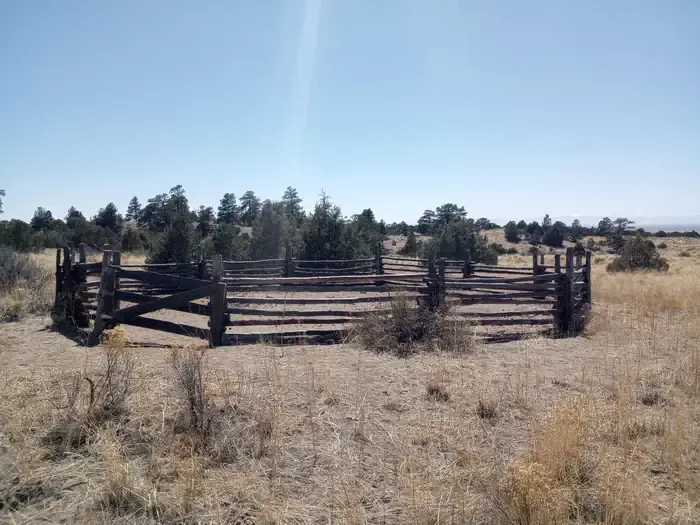
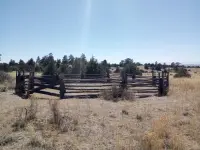
The cabin stands at 8,120 feet, about 11.8 miles southeast of Crestone in the Rio Grande National Forest. It sits beside a small dry streambed on a gently sloping, west-facing grade that looks out over the valley. A few large conifers grow near it, but most of the cover is rabbitbrush, piñon, and juniper. Elk, pronghorn, and mule deer range through the area, and bears are about. The land borders Great Sand Dunes National Park, which is an international Dark Sky Park, and the cabin is used for hunting, hiking, and watching the night sky. The nearest water is Pole Creek, roughly 1,500 feet away. Renters filter it for themselves and their stock. A corral stands near the cabin. The Saguache Ranger District recommends two head of stock and allows no more than three. “With a small corral on-site,” Saguache District Ranger Tristram Post said when the cabin opened, horses “would be the ideal mode of transportation into the cabin.”
Inside the one room
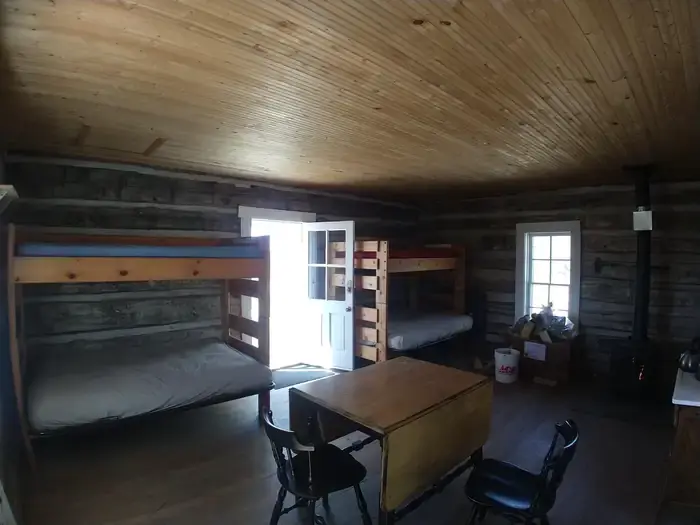
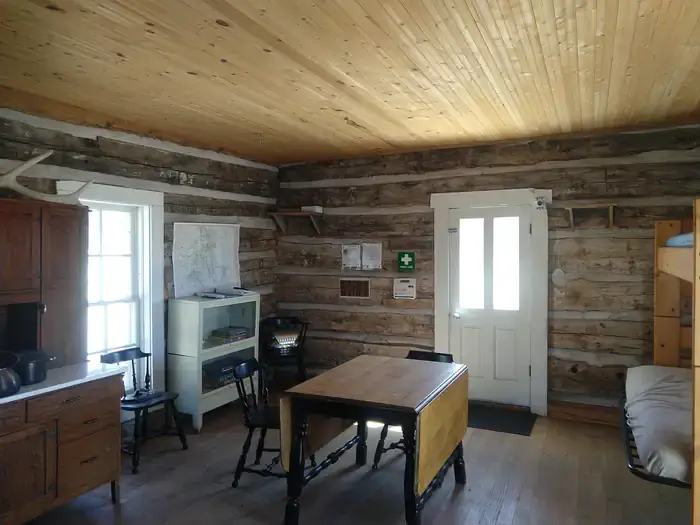
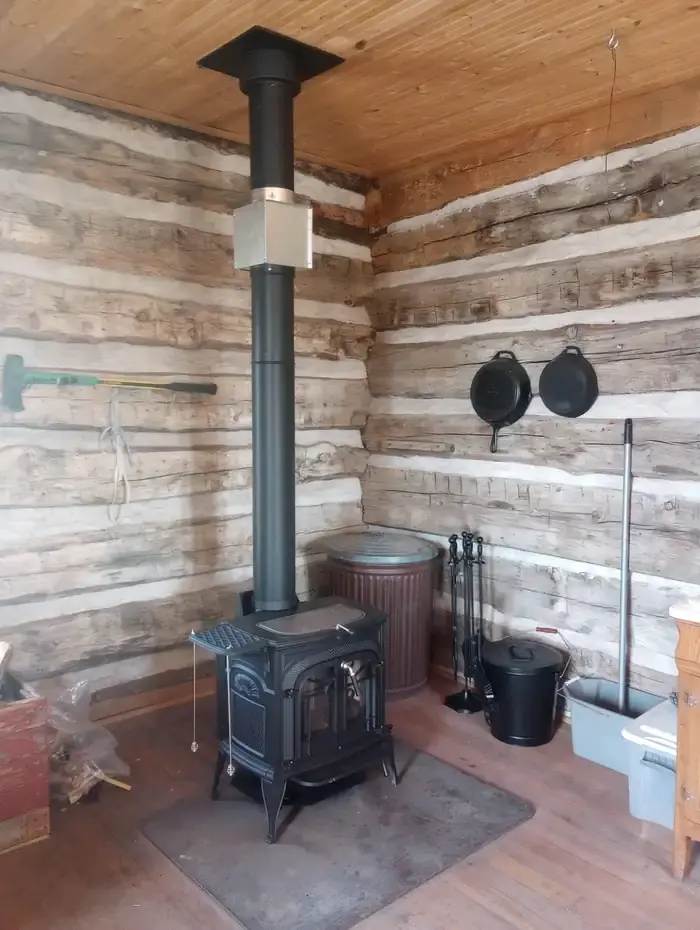
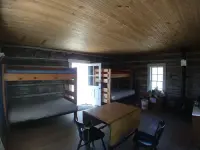
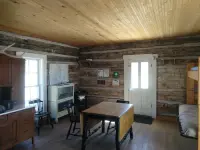
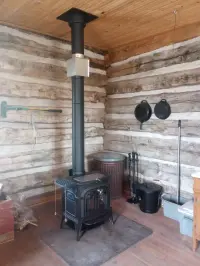
The walls are squared logs, carefully notched so the corners lock together. The Forest Service furnishes the room with two bunk beds. Each top bunk is a single, and each bottom bunk is a fold-out futon couch that sleeps two, so the cabin holds six. A 2023 account in the Alamosa Citizen instead describes two queen-size beds added during restoration. There is also a wood stove for heat, a dining table and chairs, a hoosier cabinet for dishes and cookware, a firewood box, cooking utensils, and some pots and pans. Lamps burn white gas or kerosene. The cabin has no electricity, no running water, and no propane, so renters bring their own backcountry cookstove. Cell phone service reaches the site. A picnic table, a fire pit, and a vault toilet stand outside.
The Saguache District has one primitive cabin, and this is it. It rents for $40 a night. The 2026 season runs from May 22 to November 18, and stays are limited to 14 nights. Matthew Schomburg, a recreation management specialist with the district, described the upkeep plainly: “We’ve been going there, cleaning it, fixing it up.” On the ground around the cabin there are old foundations, century-old broken glass, and rusted iron. Rio Grande National Forest archaeologist Price Heiner said that at many historic sites, “it’s not even close to seeing the landscape the way it was when it was occupied. You’re going to get it there, at Duncan. It’s just super neat.”
Gold at Pole Creek
The broken glass belongs to a town. In about 1874, John Duncan found gold ore at the mouth of Pole Creek and built the one-room home near his find. Colorado Public Radio gives its completion as about 1880, and Recreation.gov dates it to the 1880s. Duncan’s find came a decade after the major gold camps such as Central City and Breckenridge, and more than 100 miles south of them. The ore was not especially rich. Word spread anyway, and Duncan sold lots on land he believed he had bought from the state of Colorado.
“People were slowly, apparently, trickling in,” Heiner said. “Just building cabins in and around his, and eventually it grew up to about 50 structures at its height.” Duncan became an official town in 1892. It had a dry goods store, a newspaper, a freighting company, two saloons, a post office, and telephone service. Colorado Public Radio puts the population at 250 at one time. The Alamosa Citizen reports a Forest Service estimate that the peak ran as high as 4,000.
Baca Grant No. 2
The town stood on contested ground. Under the 1848 Treaty of Guadalupe Hidalgo, the United States pledged to honor Mexican land grants, among them the Baca Land Grant in New Mexico. Settlers had already moved onto that grant, and in 1860 Congress offered the Baca heirs five 100,000-acre tracts elsewhere in the public domain. One tract lay at the foot of the Sangre de Cristos on the eastern edge of the San Luis Valley. William Gilpin, Colorado’s first territorial governor, bought it in 1862 for 30 cents an acre. It became the Baca Ranch and changed hands several times. By the mid-1880s it belonged to the cattle rancher George Adams.
John Duncan made his strike while the ranch was passing between owners. Adams did not finish surveying until the turn of the twentieth century, and the survey put the town inside the ranch boundary. “(Adams) said ‘All you guys are squatting on my property,’” Heiner said. “So, of course, they said, ‘No way, we bought these lots, these are ours.’”
The quarrel turned violent. The Alamosa Citizen reprints an undated dispatch headed “At War With Squatters,” datelined Denver, June 29. It reports that a small miners’ settlement on Dead Man’s creek, on Baca Grant No. 2, “was blown up on Monday night. Three cabins were blown to pieces, the logs being reduced to splinters and rocks used in the foundations hurled hundreds of feet. Windows were broken and small buildings rocked in the neighboring town of Duncan, where the miners spent the night under arms.”
U.S. marshals evicted the residents. Adams paid $125 for each building on the land and offered to sell the buildings back for $10 each, provided they were moved off the ranch. The case was fought for nearly a decade and reached the U.S. Supreme Court, which ruled for the Baca Ranch. Many of Duncan’s settlers moved to Liberty, a mile and a half southeast and outside the grant. The buildings left behind were razed. The town had lived about ten years.
Adams spared one building. He admired the workmanship in the founder’s cabin and kept it as field housing for his ranch hands. The ranch kept changing owners and was later broken up and subdivided, and the cabin stayed where it was. Eventually the Nature Conservancy bought the land, and it passed to the U.S. Forest Service, the U.S. Fish and Wildlife Service, and Great Sand Dunes National Park.
Log by log, 2011
In 1942 the Denver artist Muriel Sibell Wolle visited the Duncan townsite. She was then director of the Fine Arts Program at the University of Colorado at Boulder, and she photographed the cabin. Her pictures record its condition and materials, and the Forest Service later relied on them. Forest monitoring in 2010 noted that the adjacent Liberty Road might be damaging the foundation.
By then the cabin was in severe disrepair. Its foundation, floor, roof, doors, and windows no longer did their work. It was also almost unchanged since it was built, so much of the original material could be recorded and matched. In 2011 the Forest Service contracted with HistoriCorps, a Colorado nonprofit, to restore it to the Secretary of the Interior’s historic preservation standards. Most of the money came from the American Recovery and Reinvestment Act. The crew took the cabin apart log by log. They discarded the rotten wood, most of it at the base, and replaced it with new logs hewn by traditional tools to the same eight-inch dimensions. Then they rebuilt the cabin with a new floor, new windows, new doors, and a reshingled roof. The Forest Service plan stated that “the replacements will mimic, as closely as possible, the historic fabric.” It also allowed that some “measure of conjecture will still be necessary to rehabilitate the cabin.” The corral was rebuilt with unpeeled juniper posts and rails of cottonwood, aspen, or spruce. A historic corral and barn stand to the west of the cabin.
The cabin joined the Saguache Ranger District’s rental program on June 24, 2023. “This new recreational opportunity comes after a significant preservation process,” Post said.
Notable Events
- 1874John Duncan found gold ore at the mouth of Pole Creek and built the sturdy one-room home nearby. cpr.org
- 1892Duncan became an official town with a dry goods store, newspaper, freighting company, two saloons, post office, and telephone service. cpr.org
- 1942Artist Muriel Sibell Wolle visited Duncan townsite and photographed the cabin, creating a record of its condition and materials. alamosacitizen.com
- 2010Monitoring noted that adjacent Liberty Road may be impacting the cabin foundation. fs.usda.gov
- 2011Duncan Cabin near Crestone was included among HistoriCorps projects. achp.gov
- 2011HistoriCorps restored the cabin to preserve its history and eventually include it in the Forest Service cabin rental program. centerpostdispatch.com
- The historic Duncan Cabin joined the Saguache Ranger District cabin rental program. centerpostdispatch.com
- George Adams determined the town sat inside the Baca Ranch; U.S. marshals evicted the residents, and the Supreme Court later ruled for the ranch. cpr.org
People
- Muriel Sibell Wolle, Denver artist and University of Colorado Fine Arts Program director who documented the cabin with photographs (1942).
- Tristram Post, Saguache District Ranger announcing the recreational opportunity after preservation.
- George Adams, Cattle rancher and Baca Ranch owner who kept Duncan's cabin as field housing for ranch hands (mid-1880s).
- John Duncan, Gold miner who found ore at Pole Creek and built the one-room home that bears his name (about 1874).
- Matthew Schomburg, Saguache Ranger District recreation management specialist who helped fix up the cabin for visitors.
- Price Heiner, Rio Grande National Forest archaeologist interpreting Duncan’s historic landscape.
- William Gilpin, Colorado’s first territorial governor, who purchased the San Luis Valley Baca grant plot (1862).