Dufur Threshing Bee
Dufur, Wasco County, Oregon. Festival; Second full-weekend in August.
Details

- Where
- 40 N Main St, Dufur, OR 97021. Directions
- When
- August 8–9.
- Getting there
- 13 miles south of The Dalles.
- Fees
- Car show vehicle entry $20; proceeds support Dufur Historical Society.
- Hours
- Aug 8 at 10:00 AM – Aug 9 at 4:00 PM PDT.
- Access
- Activity and yard-sale maps are distributed during the parade.
- Walk-in or reserve
- Register your vehicle for the Classic Car Show.
- Managed by
- Dufur Historical Society.
- Established
- 1971.
The Saturday of the Dufur Threshing Bee begins at long picnic tables in Dufur City Park, where a country breakfast is served from 7 a.m. Dufur is a wheat town in Wasco County, 13 miles south of The Dalles at the edge of the Columbia River Gorge. The Dufur Historical Society, which puts on the Bee, dates the town’s dry-land farming to the years just after settlers came over the Oregon Trail. Wheat fields and cherry orchards cover the surrounding hills, and the society credits them with the largest sweet cherry crop in the world. The Bee falls on the second full weekend in August. In 2026 it ran August 8 and 9.
Main Street, the bee grounds, and the threshing field
At 10 a.m. the Hometown Tractor Parade winds down Main Street. In 2026, maps of the day’s activities and of the town’s yard sales were handed out during the parade, along with sheets for a scavenger hunt. The hunt sent searchers across Dufur looking for red bandannas and for tokens held by vendors, yard-sale hosts, and local businesses.
The festival grounds open at 9. They hold a petting zoo, old-fashioned games, barrel train rides, a steam engine display, and rows of booths:
- Food: Raspados Garcia served fruit drinks, corn in a cup, Mexican shaved ice, and strawberries and cream. Kettle Korner sold popcorn, cotton candy, and fresh-cut fries. Tygh Shave Ice, the organizers wrote, has been a favorite at the Bee for many years.
- Drink: Friend Spirits poured free tastes of vodka made from organic soft white wheat.
- Crafts: Doug Huntley of Wamic, who has worked leather and braiding for nearly 25 years, brought cowboy gear. Serena Smith sold 100 percent cotton cloth woven by hand.
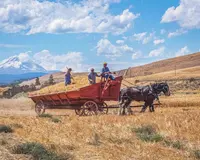
- Rides: A carriage gave rides with Mount Hood in view.
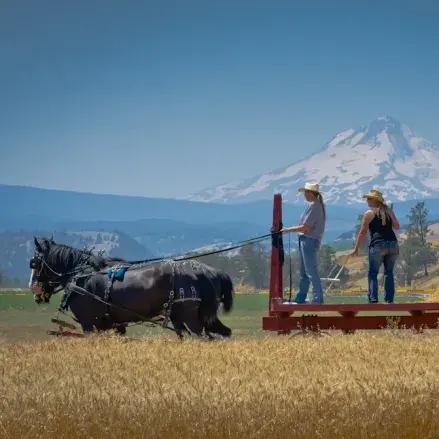
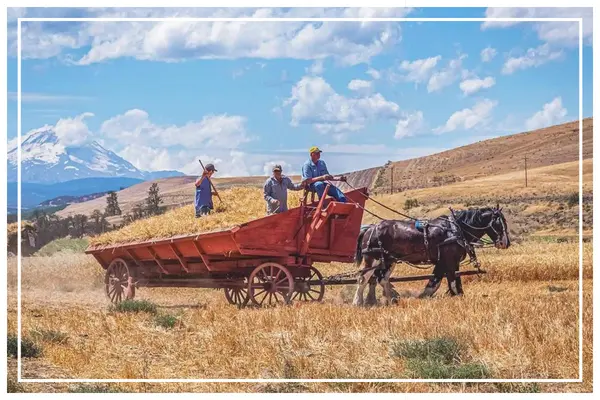
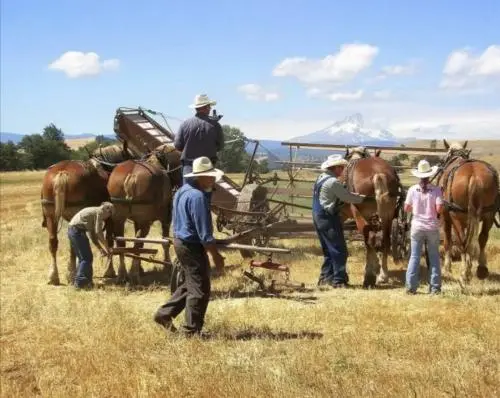
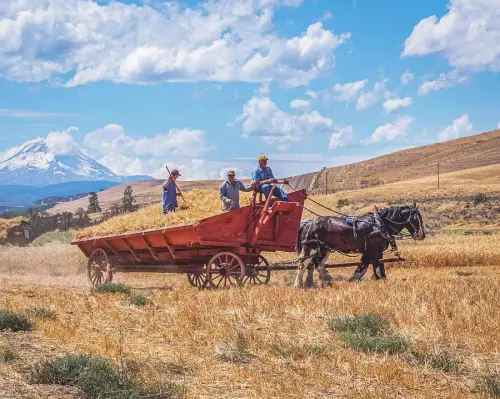
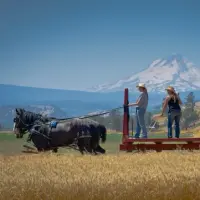
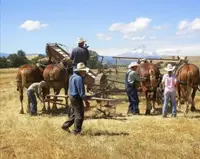
The tractor pull starts at 11 on the threshing field. From 11:30 to 2, local farmers and ranchers bring out antique equipment to harvest, thresh, and bind locally grown wheat. “Driving past the fields it looks beautiful, like ‘amber waves of grain’. But I had no idea what it actually took to harvest wheat,” said Josiah Dean, a Dufur resident. “We got to see the whole process done the old-fashioned way.”
The Dufur Historical Society Museum stays open from 9 to 4. On view are:
- the Schreiber Cabin
- the Endersby One Room Schoolhouse
- exhibits in the Metzentine Building
- horse-drawn equipment
- a cookhouse and a blacksmith shop, which the society also lists among the museum’s buildings
A quilt show and raffle fill the Metzentine Building at 40 Main Street. Raffle tickets were sold in advance at The Forge Coffee.
The sources disagree on where supper is served. The 2026 schedule lists Mel’s steak dinner and live music at 4 p.m. on the Threshing Grounds. The society’s own description of the weekend places the evening barbecue and music on the shady grounds of the historic Balch Hotel. A movie plays in the park at 9.
On Sunday, breakfast starts at 6, and the Dufur Christian Church holds a service at 9. The classic car show fills City Park from 9 to 3 with refurbished cars from the 1930s through the 1970s, and awards are given at 2:30. Entry fees go to the historical society. “We’re keeping the old farming traditions and history alive before we forget and lose them,” said Nancy Gibson, the society’s president and director. “Regardless of where they come from, folks who come here feel a connection to their roots and the beauty of the land here.”
Everett Metzentine’s roadside audience
The Bee was started in 1971 by Everett Metzentine and Bob DePriest, a 1938 graduate of Dufur High School. Mary Lou Bostick, a historical society board member, gave its origin to The Dalles Chronicle in 2016. “Everett farmed with horses, mostly. He tried a tractor, but he didn’t like it,” she said. “As he was working his fields, people would stop along the road to watch, and that is what gave him the idea for the Threshing Bee.”
Metzentine served as front man and emcee. He walked visitors through the fields, explained what the crews were doing and how the equipment worked, and named the many pieces of a working harness. DePriest owned DePriest Farm Equipment in Dufur, a business his son now runs. “He was the background man, he did a lot of the preparatory work,” Gibson said. “He was the quiet one,” Bostick agreed. “Everett was always the front man.”
The Chronicle’s archive keeps a roll of black-and-white negatives in an envelope marked “Dufur Threshing Bee Aug. 1971.” When the paper ran a frame from it in 2024, reader Nicole Hughes wrote, “My dad took me to it many times when I was a kid in the 1970s.”
By 1981 the Bee was drawing a large parade. That August the Chronicle photographed a draft horse team turning “the rich black earth of the threshing grounds.” Parade chairman Blodwin May counted 31 units, more than ever before, and general chairman Bill Hulse was, in the paper’s words, “obviously delighted with the way things went.”
Horse teams and Wayne Ryan’s belt
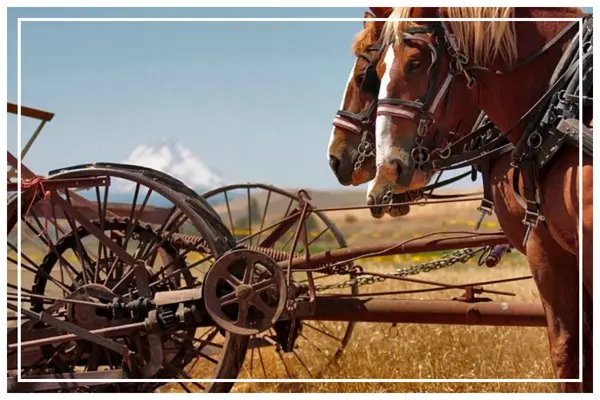
Mike Macintosh supplied most of the horse teams for many years. He had first joined the threshing crew as a small boy who came along with his father. Later he brought his own children: he ran the header, his daughter ran the header box, and his son drove horses. Macintosh approved every horse that worked the field. “The horses had to be trained for the equipment, they had to be ‘bullet proof’ and know what they were doing,” Gibson said. “It takes a lot of hands to get the horses ready, to get the equipment ready. They all came down on Friday night, we fed them dinner there under the tents. It was kind of like a big family.”
The thresher ran off a steam engine with a long belt. The length let teams and wagons unload into the separator without the horses coming too close to the engine. Gibson described the start of a run: “I love the sound as the steam engine would go down into the field, and the old thresher or separator would come to life. As they adjusted the tension on the belt, they would all watch Wayne Ryan (who operated the steam engine) and when the sound was right, he knew the belts were right and would give them a signal to start.” Bostick remembered the same engine: “There is no sound like the sound they make, even before you see it, you know that’s a steam engine.”
Vintage Dufur Days and the return of the name
In August 2016, the Chronicle reported that the Bee had ended after 35 years. Macintosh’s daughter had married and his son was working as a diesel mechanic, and Macintosh himself decided he could no longer take part. “Mike was very close to Everett Metzentine, and it was a very, very hard decision for him,” Gibson said. “But to be honest he was tired, he had been coming for many, many years.” The steam engine was retired the same year because of the cost of certification. Both the engine and the horses had added to the cost of liability insurance.
“We wanted to step away from the Threshing Bee name, because we no longer have the horses,” Gibson said. The event went on as Vintage Dufur Days, with tractors and equipment built no later than about 1950 or 1952:
- The horse-drawn implements went on display at the museum.
- In the field, the thresher ran off a tractor’s power takeoff on a shorter belt.
- A PTO binder that had not left its barn since the 1940s went back around the field behind a tractor.
- Single-cylinder “hit-and-miss” engines, which Bostick called “one lungers,” ground wheat into flour and ran a water pump with their regular pop.
- Much of the machinery belonged to Mike Hulse of Dufur.
- Deanna Suddan of Ashbrook Farms, who farms fields west of the grounds and was president of Oregon Women for Agriculture, led the threshing crews.
The new name lasted four years, and then the pandemic cancelled two more. On Aug. 13, 2022, the Dufur Threshing Bee returned under its own name. Horse-powered wheat harvest demonstrations were back in the field, the Endersby School and the blacksmith shop were open again, and the tractor pull and the tractors in the parade carried on from the Vintage Dufur Days years. Columbia Gorge News photographed a float on Main Street that year, led by two horses.
Notable Events
- 1971Everett Metzentine and Bob DePriest started the Dufur Threshing Bee. columbiagorgenews.com
- 2016The review says the Bee ended after 35 years for lack of horses and was replaced by Vintage Dufur Days using vintage machinery. columbiagorgenews.com
- 2022Returned Aug. 13 after four years as Vintage Dufur Days and two years off due to the COVID-19 pandemic. columbiagorgenews.com
People
- Nicole Hughes, Reader recalling childhood visits to the Threshing Bee with her father (1970s).
- Bill Hulse, General chairman of the Threshing Bee (1981).
- Blodwin May, Parade chairman reporting record participation of 31 units (1981).
- Bob DePriest, Owned DePriest Farm Equipment and did much of the preparatory work behind the Bee (1971).
- Deanna Suddan, Ashbrook Farms farmer and Oregon Women for Agriculture president who would lead the threshing crews.
- Everett Metzentine, Front man and emcee, explaining field crews, equipment and working harnesses to visitors (1971).
- Mary Lou Bostick, Dufur Historical Society board member discussing the transition from horses toward tractor and mechanical displays.
- Mike Hulse, Dufur owner of much of the vintage equipment to be operated in the fields.
- Mike Macintosh, Organized and provided horse teams for many years before deciding he could no longer participate.
- Nancy Gibson, Dufur Historical Society president explaining that the Bee name was dropped when horses were no longer available.
- Wayne Ryan, Operated the steam engine and signaled crews when the belt tension was right.
- Josiah Dean, Local resident describing seeing the old-fashioned wheat harvest process.
Sources
- dufurhistoricalsociety.org/dufur-threshing-bee
- dufurhistoricalsociety.org/welcome-to-the-dufur-living-history-museum/2025-threshing-bee
- dufurhistoricalsociety.org/welcome-to-the-dufur-living-history-museum/2026-threshing-bee
- dufurhistoricalsociety.org/schedule-of-events
- dufurhistoricalsociety.org/contact-us
- dufurhistoricalsociety.org/classic-car-show
- facebook.com/dufurthreshingbee
- facebook.com/events/27616802311237279