Desert Christ Park
Yucca Valley, San Bernardino County, California. Sculpture park; Open daily, year-round.
Details

- Where
- 56200 Sunnyslope Drive, Yucca Valley, CA 56200. Directions
- When
- 7 a.m. to 6 p.m. daily.
- Getting there
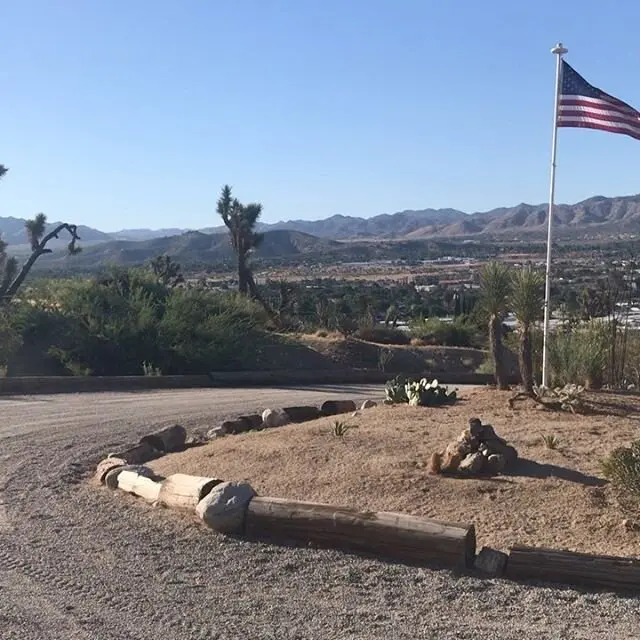
- Overlooks the high desert town of Yucca Valley in Southern California, not far from Joshua Tree National Park.
- Fees
- Free.
- Access
- Free admission. Donations welcome. Open daily with peaceful pathways among more than forty snow-white sculptures and images portraying scenes of Christ's life and teachings.
- Walk-in or reserve
- Walk-in; no reservation required.
- Website
- desertchristpark.org
- Managed by
- Desert Christ Park Foundation.
- Established
- 1951.
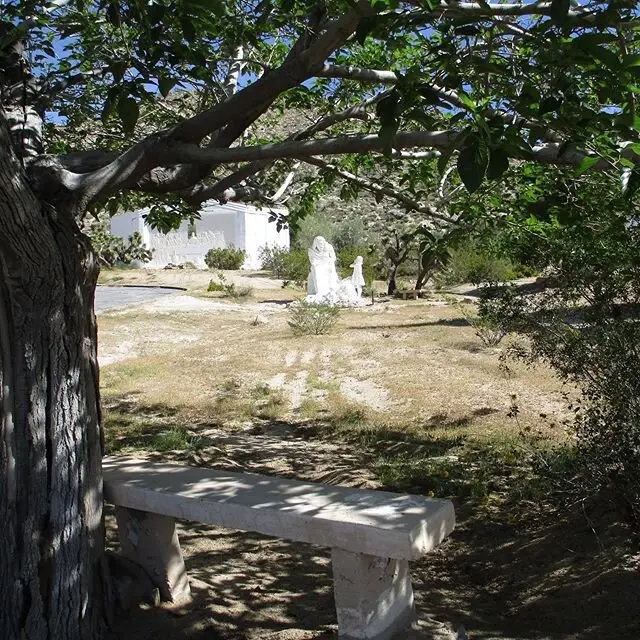
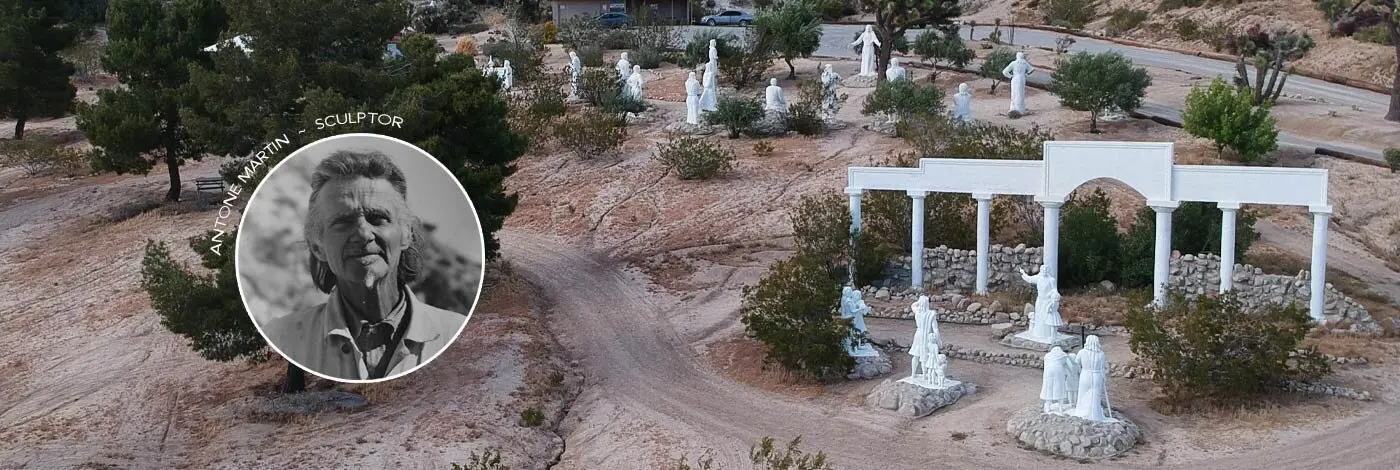
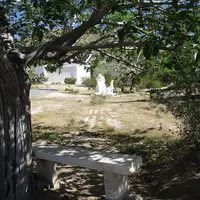
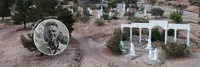
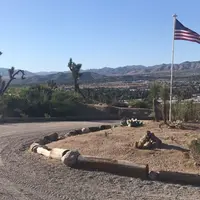
The figures stand white against a brown hillside in the rocky hills west of Highway 62. Below them lie the houses of Yucca Valley, and past the town is the country toward Joshua Tree National Park. Paths run among the statues: more than forty sculptures and images by the Desert Christ Park Foundation’s count, nearly 50 by Palm Springs Life’s in 2018. The ground holds desert scrub, Joshua trees and cottonwoods. The Press-Enterprise gave the park as 2½ acres in 2016; Palm Springs Life and a published essay on the park give 3½. Admission is free. The gates stand open from sunrise to sunset, which the Foundation puts at about 7 a.m. to 6 p.m.
Figures on the hill above Highway 62
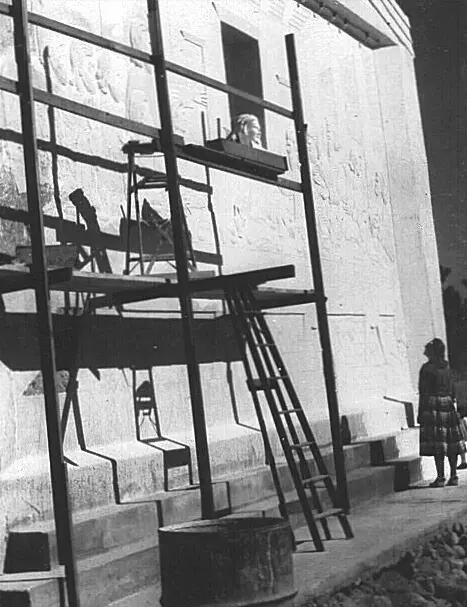
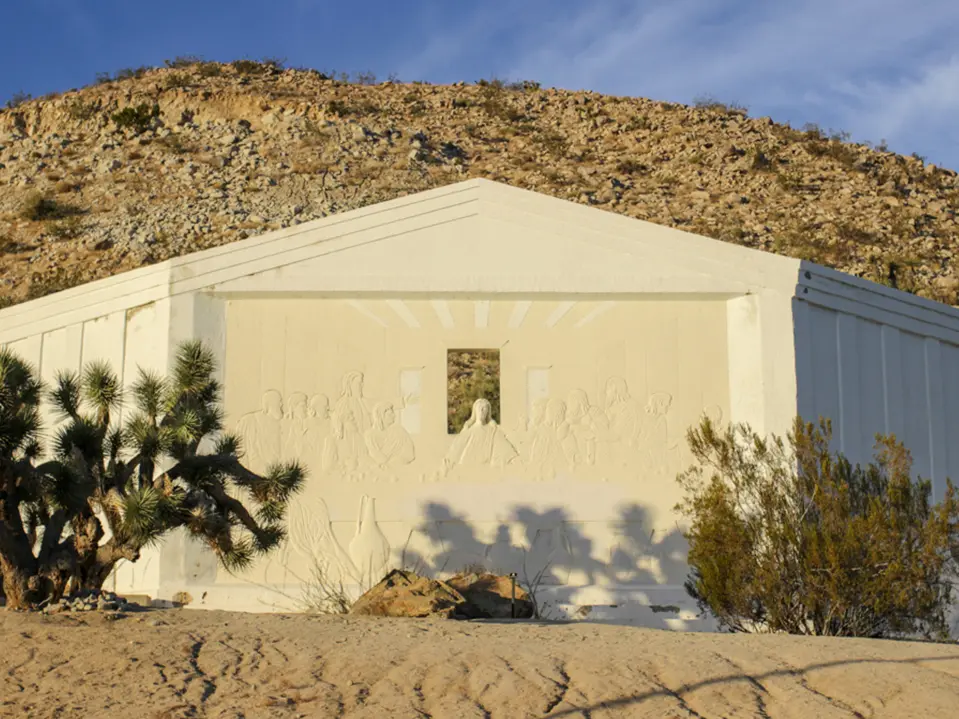
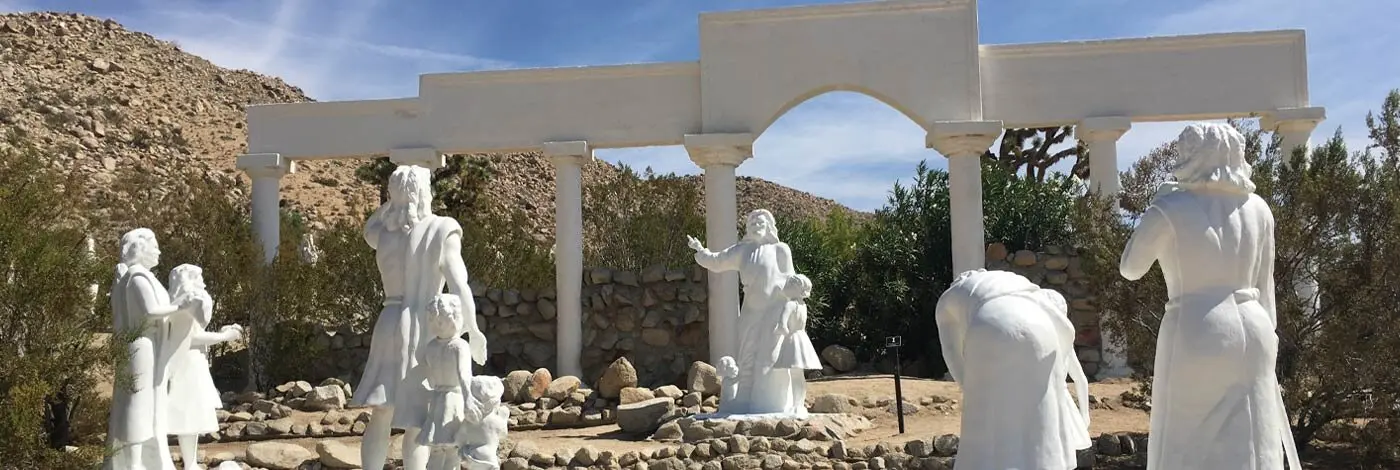
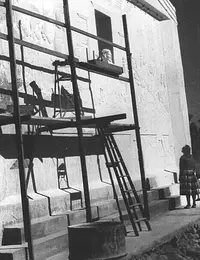
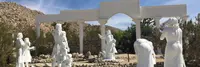
Every figure is steel-reinforced concrete. Each was finished in a coat of silica sand and white cement that throws back the sun. A large Romanesque façade carries the Last Supper in bas-relief, 75 feet by 32 feet, with thirteen figures on a 9-foot scale seated at a 30-foot table. Only the head of Jesus is fully three-dimensional. It is set in an open window, and visitors can look through it to the valley.
In the Sermon on the Mount, the twelve disciples sit in a group. Judas has his back turned and holds a small bag of coins. Higher up the slope, Jesus, Peter, James and John are placed as if in the Garden of Gethsemane. Seated among standing children is the group the Foundation’s gallery calls “Let the Children Come to Me” and San Bernardino County calls “Blessing of the Children.” The sculptor also set modern people among the biblical ones. A businessman carries a briefcase. A worker in a jumpsuit has a newspaper under his arm and tears on his face.
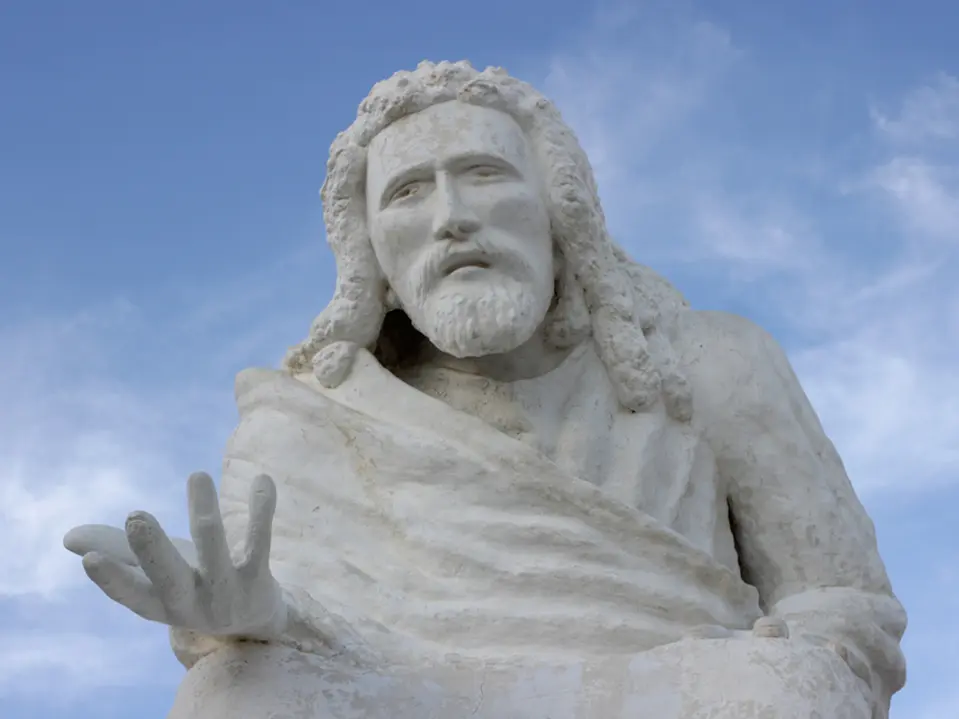
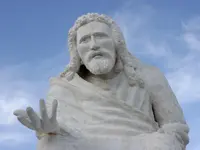
The sculptor placed the figures of Jesus to face the sun, so they glow brighter than the rest. The other faces shift with the clouds and the hour. The essayist found the stiff white figures looked “embalmed in white ash, or frozen.” Volunteer restorer Kate Kenney noticed other things in them. “I’ve appreciated the humor the sculptor had,” she told Palm Springs Life. “There’s a boy with his diaper falling off, a girl who is mad because her father is covering her eyes and she can’t see Jesus … There’s a lot more going on that you don’t see unless you really spend some time with the statues.”
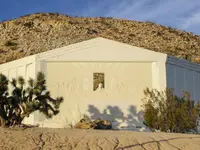
Weather and vandals have marked the work. In 2016 the children in the blessing scene stood on bare spindles of rebar where their legs had worn away. Martha was missing an arm. Of Lazarus only a ragged pedestal was left. Palm Springs Life in 2018 described faces “missing noses, a chunk of cheekbone, an arm.” Nearly 40 birdhouses had been put up by then, along with native plants. The Foundation’s restoration page asks for living Christmas trees to join the pines that shade visitors. It suggests the park for weddings, picnics, photographs, “a walk through the Bible,” or a cup of morning coffee. The stone Rock Chapel is closed for now because honeybees have moved into it. For the park’s 75th anniversary year, the Foundation has set itself two tasks: relocate the bees and open the chapel to the public.
Easter at sunrise
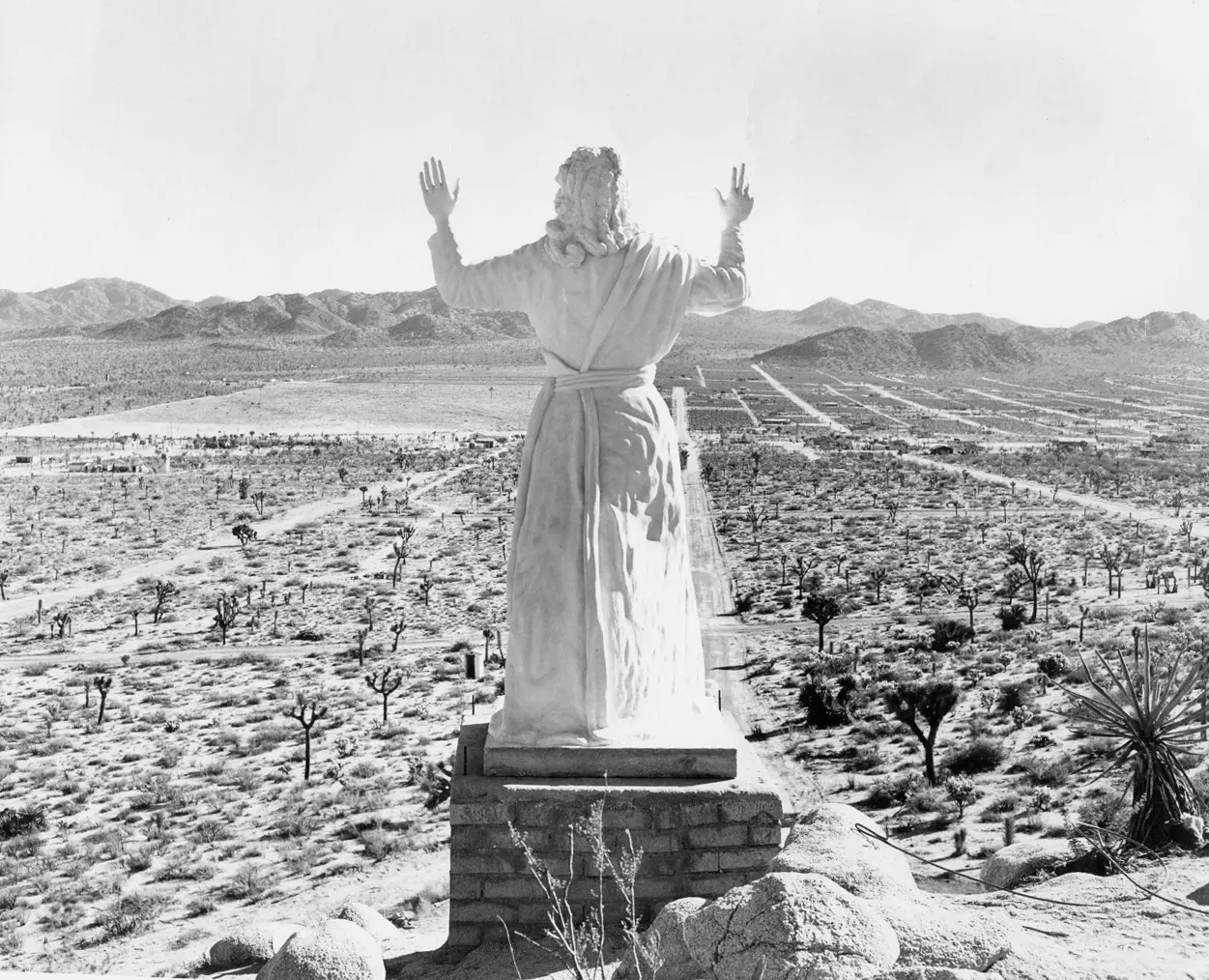
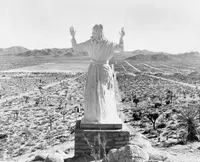
On a higher hill to the south stands a single figure of Jesus with arms raised. Easter sunrise services have been held at this hill since 1951, and in 2016 the service drew about 200 people to an amphitheater cut into the slope. “The sun comes up over the hill and hits Christ first,” Foundation president Roxanne Miller told the Press-Enterprise. An Easter egg hunt on the park grounds follows the service. At Christmas there is a treasure hunt.
That figure was the first one. Reporters once called it “the unwanted Christ,” and later “the Savior that nobody wanted.”
The Savior that nobody wanted
The Reverend Eddie Garver came to the unincorporated town of Yucca Valley with his wife and two children in 1946 to start a church. His congregation was the Yucca Valley Community Church, and he was known as the Desert Parson. In 1950 he acquired five acres on the south-facing slope of the valley from the U.S. Government. In the Foundation’s words, he meant to raise a faith-themed park “as a light for world peace.”
Meanwhile in Inglewood, Frank Antone Martin was building a statue in his backyard. Several accounts give his birth year as 1887, and one puts his birthplace “near Cincinnati, Ohio.” He was orphaned young and was said to have run from a foster home at 12. He then worked many jobs, among them roustabout in mining camps. In 1916, at a mining camp in Oatman, Arizona, he married Alice Walsh, widow of the aviator Charles F. Walsh. In 1939, on a WPA model project, he gave Los Angeles a miniature of covered-wagon pioneers called “Westward Ho!”
By 1949 he was a senior pattern-maker at Douglas Aircraft. At night and on weekends he cast large cement figures in his yard, among them a saber-tooth cat. He sold none of them. “It’s more fun to give it away,” he told the Los Angeles Times. A 1963 article claimed he had been a set designer in his youth. The essay notes that this has never been confirmed.
Around 1949 or 1950, a scientist told Martin that reinforced concrete would withstand atomic assault. He then built a Jesus with arms raised in benediction, 10 feet high. The Press-Enterprise and the Hi-Desert Star give its weight as three tons, the Foundation and Palm Springs Life as five. He offered it to the National Park Service for the rim of the Grand Canyon. The essay says a law forbids statuary in the Canyon. The Foundation says the request ran into separation of church and state.
Turned down there, Martin offered the statue to anyone who would show it publicly. Garver took it. Martin drove out to the desert and found that from a hillside 50 feet above State Highway 62, drivers would see the figure from either direction. One week before Easter 1951, the essay records, Garver and a friend moved it more than 130 miles. They used a borrowed crane, a block and tackle, dockside loading rollers, and a truck only a little heavier than its load. Life magazine followed the trip and printed photographs of the rope-bound figure being hauled uphill. Two dozen volunteers set it in place, and the park was dedicated at sunrise on Easter Sunday 1951.
By late 1952 Martin had brought out a second statue: a seated Jesus 15 feet high among standing children, which he called “Suffer Little Children to Come Unto Me.” He gave a reporter his reason. “I made the first Christ statue after an atomic scientist friend of mine described the world as it would be during an atomic war. His story was one of horror.” Within a year he had retired from Douglas and moved, without his wife, into a trailer at the foot of the site.
Martin worked on the hill for about eight years, first with his own money and later with donations. He set three steel rods in a block of cement, laid heavy wire netting over them, and built up a rich cement mix. He roughed out the form with a tool like a pick chisel while the cement was still setting, then finished the detail by hand. He reckoned a lesser figure took about a month. The smallest weighed about four tons and the largest eighteen. He built the Little Chapel of stone and mortar with his friend Frank Garski, and apart from that he seems to have worked alone.
During the week he drove fast in a beat-up car, or sat by himself in a bar nursing a beer. On weekends he put on a white shirt, a bolo tie, pressed pants and his Sunday straw hat. Then he explained each piece to visitors and posed for their pictures. He told one reporter the park drew 50,000 visitors a year. A Long Beach paper reported in the 1950s that he had built in reinforced concrete because he believed the statues would survive a nuclear blast. In 1955 he told the Los Angeles Times, “My statues may bring mankind together before we are obliterated completely.” One of his poems, “A Desert Reverie,” begins: “I feel Oh, so tiny when out here alone, / The sand and the brush, and the barren, grey stone.”
Noses, a bulldozer, and a lawsuit
Accounts disagree on what ended the partnership. The Press-Enterprise called the cause unclear. Palm Springs Life wrote that the dispute was “allegedly over property ownership.” The essay dates the break to early May 1957, when Garver proposed charging admission. “My statues belong to all mankind,” Martin said. “No one should ever have to pay to see them.” He then knocked the nose off every figure except Judas. “I spared Judas on purpose, as a symbol,” he said later. Within days he was back mending the noses.
That June he hired a bulldozer. With the permission of the owner of the next property, he moved twenty statues, and some were damaged in the move. The Press-Enterprise says a local businessman donated the new ground to him. In 2016 Miller said, “Eddie Garver was almost run out of town.” According to her, the townspeople sided with Martin.
The original statue, the tomb, and, the Foundation says, half of the Last Supper stayed on Garver’s land. Garver sold the land to parishioners named Brownell, who gave it to the Evangelical Free Church of Yucca Valley. Garver went on to mission work in Arizona. The boundaries were redrawn in late 1957 and early 1958, and Martin finished the Last Supper. It was his last major work. He died on December 23, 1961, and was buried at Twenty-Nine Palms. The church’s amphitheater on the old statue site was dedicated in 1962 and billed as “The Desert Christ Park” amphitheater. In 1969 the seated Christ beckoning the children was on the cover of the Yucca Valley High School yearbook, The ILLION.
Palm Springs Life reports that Martin willed his work to San Bernardino County. The essay says that, as he wished, the Yucca Valley Parks and Recreation District ran the park free of charge. In 1987 five county residents, represented by the ACLU, sued the district on grounds of church and state. The Ninth Circuit ruled against the park in July 1991. Early in 1992 the Supreme Court let the decision stand, and the county had to give up ownership. Later that year the magnitude 7.3 Landers earthquake badly damaged the statues. Palm Springs Life records that the Hi-Desert Nature Museum looked after the grounds for a time.
Patching the concrete
The Desert Christ Park Foundation was formed in 1995 by Palm Springs Life’s account and in 1996 by the essay’s and the Hi-Desert Star’s. The essay credits Wolfgang Maschler, a local builder who died early in 2003. Volunteers cleared the site, among them youth groups from the Evangelical Free Church next door. Money was raised to repair statues broken in the earthquake. In March 2000 vandals toppled a figure of Jesus and scrawled 666 on its forehead. After that, Foundation volunteers began driving through the property at night.
In 2016 the Foundation’s yearly budget was under $4,000. A restorer had estimated $86,000 to repair the statues. Since the previous November, a fundraising campaign had raised $200. “Right now, it’s crumbling down to the ground and we don’t have enough people to lift it back up,” said Angela Leggett, the Foundation’s secretary. Miller, its president, first walked the dirt paths at about age 4 with her grandmother, who told her the stories behind each scene.
That same year Kate Kenney began restoring statues. She had no training in sculpture or concrete and worked by trial and error, and by 2018 she had finished about seven. “The first statue was installed two weeks before I was born,” she said. The Foundation’s restoration page credits Kate and Tom Kenny, retired business owners, with long hours on the grounds. They restored sculptures, repaired water lines and put in native plants and trees.
Notable Events
- 1946Garver moved with his family in 1946 to start a church in the unincorporated town of Yucca Valley. palmspringslife.com
- 1950Garver established the Yucca Valley Community Church and acquired the five acres on the southern facing slope of the valley from the US Government in 1950. desertchristpark.org
- 1950sMovable statues relocated to the present-day park after the partnership dissolved. desertchristpark.org
- 1951One week before Easter 1951 the 'unwanted Christ' was trucked up the desert highway from Los Angeles, covered by Life Magazine for its April 23, 1951 issue; the park was dedicated on Easter Sunday. desertchristpark.org
- 1951Life magazine covered the trek bringing the statue to Yucca Valley and published photos of it being wrestled uphill. desertchristpark.org
- 1951Garver and Martin transported the sculpture to the Hi Desert and dedicated it at sunrise. desertchristpark.org
- 1952Invited as sunrise-service guest speaker, Martin decided to move permanently and create more statues. desertchristpark.org
- 1952Martin retired from aerospace pattern-making and moved to Yucca Valley, living in a trailer near the park. desertchristpark.org
- 1952By late 1952 Martin had produced a second statue, a seated, 15-foot-high figure of Jesus surrounded by smaller standing figures of children, and moved it to Yucca Valley. hollymetz.net
- 1957When Garver proposed charging admission, Martin protested that his statues belonged to all mankind and knocked the noses off all the figures except Judas. hollymetz.net
- 1957The park's boundaries were reconfigured and Martin completed his 75-foot-by-32-foot bas-relief reproduction of the Last Supper. hollymetz.net
- 1961The Garvers moved on to missions in Arizona, and Antone Martin died in December of 1961. desertchristpark.org
- 1961Martin continued working until his death. desertchristpark.org
- 1962The amphitheater on the original statue site was billed as The Desert Christ Park amphitheater. desertchristpark.org
- 1987In 1987 the publicly-owned status of the park came into question; five county residents, represented by the ACLU, sued the Parks and Recreation District on separation of church and state grounds. hollymetz.net
- 1990sMoney was raised after the Landers earthquake to repair damaged statues. desertchristpark.org
- 1991The U.S. Ninth Circuit Court ruled in July 1991 that Desert Christ Park violated the state constitution, and the county appealed to the U.S. Supreme Court. hollymetz.net
- 1992An ACLU lawsuit settlement ended public funding just before the damaging Landers earthquake. desertchristpark.org
- 1992Early in 1992 the Supreme Court let the lower court's decision stand and the county was to divest itself of ownership; that year a 7.3 earthquake significantly damaged the park. hollymetz.net
- 1995The Hi-Desert Nature Museum oversaw the area prior to the Desert Christ Park Foundation's formation in 1995. palmspringslife.com
- 1996The nonprofit Desert Christ Park Foundation formed and cleaned up the site with volunteers, including youth from the neighboring church. desertchristpark.org
- 2000In March 2000, after vandals toppled a figure of Jesus and scrawled 666 on its forehead, Foundation volunteers organized night drives through the property. hollymetz.net
- 2016Restoration began in 2016, an effort by volunteer Kate Kenney, who frequented the park as a child. palmspringslife.com
- The American Civil Liberties Union filed a church-and-state-related lawsuit that reached the U.S. Supreme Court and mandated county divestment. palmspringslife.com
People
- (Frank) Antone Martin, Sculptor-poet from Inglewood, CA (died December 1961).
- Eddie Garver, Yucca Valley's Desert Parson who knew Martin.
- Reverend Eddie Garver, established the park with a vision of a Christian-themed park.
- the Brownells, Local parishioners who bought Garver's property and later donated it, including their home, to the Evangelical Free Church of Yucca Valley.
- Kate Kenny, Retired business owner who worked on the grounds, restored sculptures and repaired water lines.
- Tom Kenny, Retired business owner who worked on the grounds, restored sculptures and repaired water lines.
- Angela Leggett, Foundation secretary.
- Frank Antone Martin, engineer and sculptor of the steel-reinforced concrete statues (1887-1961).
- Rev. Eddie Garver, envisioned a Christian-themed park, a place of light amid the desert.
- Roxanne Miller, foundation president (joined the all-volunteer board in 2011).
- Antone Martin, creator of the statues; former aircraft patternmaker (born in 1887, as several accounts report).
- Frank Garski, Martin's friend who helped build the Little Chapel of stone and mortar.
- Wolfgang Maschler, local builder who offered to help restore the park and formed the Desert Christ Park Foundation (died early 2003).
- Kate Kenney, volunteer restorer who frequented the park as a child (restoration from 2016).
Sources
- desertchristpark.org
- desertchristpark.org/about-desert-christ-park
- main.sbcounty.gov/2025/01/08/san-bernardino-county-destinations-desert-christ-park
- desertchristpark.org/visit
- spacesarchives.org/explore/search-the-online-collection/antone-martin-desert-christ-park
- hollymetz.net/files/essays_and_articles/Desert-Christ-Park.pdf
- palmspringslife.com/the-guide/things-to-do/desert-christ-park