Deep Sky Vineyard
Elgin, Santa Cruz County, Arizona. Arizona winery and tasting room in Elgin.
Details

- Where
- 124 Elgin Road, Elgin, AZ 85611. Directions
- When
- Open 7 days a week, 11 am – 5 pm.
- Fees
- First tasting $17 (5 wines) with a souvenir logo glass; $12 when you bring a glass back.
- Access
- Picnic lunches welcome on the grassy meadow in front of the tasting room.
- Phone
- (520) 490-6170
- Managed by
- Kim and Phil Asmundson, owners.
- Established
- 2019, in business since.
A first tasting at Deep Sky Vineyard costs $17 for five wines and comes with a glass bearing the vineyard’s logo, stem or stemless, which the visitor keeps. Bring it back, or a glass from another local winery, and the next tasting is $12. The wine is poured at an indoor-outdoor tasting bar and at a handcrafted rustic bar, with artwork on the walls. A PHOENIX magazine wine column in 2018 described big windows around the room opening onto Mt. Wrightson and the Mustang Mountains. A wrap-around patio faces the same mountains, and in front of it lies a grassy meadow where the winery invites guests to spread a picnic lunch. The address is 124 Elgin Road, on a strip that the same column called Winery Row.
The patio on Elgin Road
The country around the tasting room lies within the Sonoita/Elgin AVA. According to the Arizona Wine Growers Association, it sits between 4,500 and 5,200 feet, an hour south of Tucson and just north of the Mexican border. Native grasses cover rolling hills dotted with Arizona oak, Arizona ash, and mesquite. The Santa Rita, Mustang, Whetstone, and Huachuca mountains ring the valley, and its soil is a reddish-brownish gravelly loam. By 1984 Sonoita had become the Southwest’s first federally recognized American Viticultural Area.
On spring afternoons the patio has music. In May 2026 sets ran from 1 to 4 p.m. Liz & Pete’s Sparrows played on May 16; the duo of Liz Cerepanya and Peter Dalton Ronstadt has performed together since 2019. Jackie Ernst brought folk-rock on Saturday, May 23. On May 30 came Doug Moon, whom the winery calls “a familiar face on the Deep Sky patio,” with acoustic guitar and a set of classic rock and Americana. Beyond the tasting bar, the winery offers tours, barrel tastings, and classes in pruning vines and blending grapes.
The people behind the bar include tasting room manager Dan Goff and Jay Bileti, director of wine education. Phil Asmundson, who owns Deep Sky with his wife, Kim, works mostly in the tasting room. Kim prefers the vineyard. “That’s how I know my vines,” she told the Patagonia Regional Times in 2026.
Bordeaux grapes at 5,000 feet
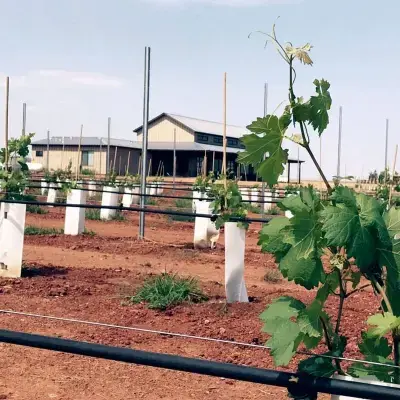
The vines outside the tasting room were planted in 2017, the year the room opened, so that guests could taste the grapes that go into the wines. The winery describes the site as 5,000 feet up, with cool, cloudy weather and limestone soil it compares to Bordeaux. It planted Bordeaux varieties: Cabernet Sauvignon, Cabernet Franc, Petit Verdot, and Carménère. All four bud late, which helps against the risk of spring frost. Summer hail, sunburn from solar radiation, bug and bunch rot pressure after rain, and hungry birds all make the site hard to farm. The berries come in small, full of varietal flavor and high in natural acid. The owners wanted these grapes to blend with their Malbec into a wine they call “Four Forces.”
Sources differ on the size of this vineyard. Farm Progress put the Elgin purchase at 10 acres in 2018, and the Patagonia Regional Times described a 5-acre vineyard in 2026. In 2016 the Arizona Daily Star reported that the Asmundsons planned to plant on the former Lightning Ridge Cellars vineyards on Elgin Road, and that the tasting room should open by late winter. The winery’s own about page lists 2019 as its first year in business.
Behind the tasting room is a custom crush facility. It processes wine for Deep Sky and for the Rune, Autumn Sage, and Omphalos wineries. “They bring the grapes, and they get them back bottled,” Kim Asmundson told the Patagonia Regional Times in 2023. That paper described the season as it runs. From August into October, vineyards truck in grapes in white bins of 1,000 pounds each. A forklift sets each bin on an elevator, which tips the fruit into a de-stemmer, and the stems go to compost. Deep Sky ferments on naturally occurring yeast for 14 to 20 days. Twice a day, cellar master Tom Messier, who also co-owns Omphalos Winery, uses a punch tool to push the skins to the bottom of the bins. The press then works the grapes for about two hours. The wine spends nine to ten months in barrels, and bottling begins in June. The bottling machine resembles a giant espresso machine. It fills, corks, seals, and labels 46 bottles a minute, and six people are needed to keep up with it.
A vineyard instead of a T-shirt
The winery’s own story begins in 2009, when the Asmundsons traveled to Argentina for Phil’s 50th birthday. The Arizona Daily Star dated the trip to 2010. PHOENIX magazine reported that one night in Mendoza, “after more than a few glasses of Malbec,” the couple signed a contract for a 5-acre vineyard. The Daily Star described it as 7,500 vines on three acres in the Uco Valley. It is part of the Vines of Mendoza project, whose 1,500 acres belong to 130 owners from around the world. “Instead of coming home with a T-shirt, we came home with a vineyard,” Kim Asmundson told the Star. Phil told Farm Progress: “We got a bit tipsy and bought a small vineyard in the Malbec region of Argentina. We had the grape bug, we were hooked.” The Argentine Malbec is bottled under the LAKAWA label. A Torrontés bought from Salta and Cafayate in northern Argentina goes out as YENDOLA. The couple usually returns each January or February for the blending.
Phil had retired at 50 from a technology career. The Star identified him as a telecommunications specialist with Deloitte, and he told Farm Progress he had flown “9 million miles on three airlines.” The couple came from Connecticut and moved to Marana in 2012. Back home, they made a list of parallels between the two places. The Uco Valley lies at 33 degrees south latitude and Willcox at 33 degrees north. Neither has a marine influence. Both swing widely between daytime highs and nighttime lows, both sit over large aquifers, and both are high desert above 3,500 feet. The Uco Valley lies at the foot of the Andes, and Willcox lies at the foot of the Chiricahuas. The two hemispheres also set their seasons opposite. In Argentina, bud break comes in October and harvest in April, while in Arizona bud break comes in April and harvest in September. The winery says that “rather than getting six months off” they chose to work all year.
The accounts of the Willcox planting disagree. Farm Progress has the couple buying 20 acres there in 2009. PHOENIX magazine dates the planting to 2010. The Star quotes Kim saying they planted in 2011, with no drawn-out business plan, and that they settled on the name then. “Arizona wine is all about exploration. Nobody really knows how good it can be,” she said. The logo carries an “A” on top for Arizona in the northern hemisphere and an “A” for Argentina in the southern, and the letter also stands for Asmundson. The whole mark tilts 23 degrees, the tilt of the earth. The wines take their names from the same sky: Big Bang, Gravity, Orbit, Nebula, Quasar, Supernova, Constellation.
The first harvest came in 2013. The couple sold most of it and kept back enough for Big Bang, a Malbec; Gravity, a Syrah and Petite Sirah blend; and Orbit. They poured that first vintage at the fall Willcox Wine Festival. In 2014 they held back a little more and made a rosé called Nebula. Phil told Farm Progress, “We were the first in the state to plant Malbec.”
Sensors under the Willcox vines
The Willcox vineyard lies just south of the town, in the Sulphur Springs Valley, where the federal government established the Willcox AVA in September 2016. The Arizona Wine Growers Association notes that the Willcox Playa there is a dry lake left from Pleistocene Lake Cochise, and that thousands of sandhill cranes roost in the area in winter. Phil gave Farm Progress the reason for selling wine elsewhere: Willcox is “so far from civilization that wagon trains still come through there…a great place to grow grapes, but hard to establish a business.”
Sources count the vineyard differently. The winery calls it 20 acres with 15,000 vines, and the Patagonia Regional Times in 2026 reported 15 acres and 20,000 vines across the operation. It grows Malbec, two clones each of Grenache and Syrah, Mourvèdre, Petite Sirah, Counoise, and Viognier. The rows are planted 8 feet apart with 5 feet between plants, close enough to need a specialty tractor. The winery believes the crowding improves the grapes. Each vine is handled at least five times a season, for pruning, leaf-pulling, shoot thinning, fruit dropping, and harvest. Vineyard manager Genaro Alba and his team oversee both the Willcox and Elgin vineyards. In 2022 the vineyard harvested more than 62 tons and sold grapes to other Arizona wineries.
Phil described the early method to Farm Progress. “I was standing there in the hot sun watching Kim and our vineyard consultant go around making auger holes, pulling up dirt and squeezing the samples by hand to determine soil moisture. We knew there had to be a better way.” In 2016 the vineyard teamed with n.iolabs, a Colorado firm, to build a sensor platform. Readings are taken every six minutes at depths of 4, 8, and 16 inches and deeper, across 12 grow zones. “Our vines actually talk to us,” Kim said. Phil said they had reduced berry size by 15 to 20 percent and cut the crop load from 60 tons to 50. The winery reports that bunch rot in its Grenache, which once cost about 30 percent of the fruit, dropped to none in 2018. Phil said the vineyard saved over a million gallons of water in its third digital season.
A 2021 Syrah in 2026
The winemaker is James Callahan, who also owns Rune and Brigand wineries. PHOENIX magazine reported that he made all of Deep Sky’s wines after the 2016 vintage. At the 2026 azcentral Arizona Wine Competition, Deep Sky’s 2021 Constellation won the Governor’s Cup for best wine in Arizona, the Growers Cup for best red, and Best in Class Syrah. The wine blends two Syrah clones grown in Willcox. The 2022 Supernova took Best in Class Mourvèdre. “I’ve been making their wine for 10 years,” Callahan told the Patagonia Regional Times. “My theory is that you keep producing good quality wines, something is going to stick eventually.”
Kim Asmundson credited Callahan and Alba, whom she calls “G,” and her husband’s palate. “It was a 2021, so we really didn’t have that much left, and we kind of decided, nope, we won’t get a lot of sales out of it,” she said. She compared the vines to children, “and they are badly behaved,” she added with a chuckle. “The problem with pruning is you see all the mistakes you made the prior year.”
Notable Events
- 1984By that year Sonoita had become the Southwest's first federally recognized American Viticulture Area (AVA) and hosted the state's first local wine festival. azwinegrowersassociation.com
- 2009Seeing similarities between Argentina and Arizona in soils, temperature amplitude and underground aquifers, the couple looked in their own back yard and purchased the Willcox acreage; Phil Asmundson says they were the first in the state to plant Malbec. farmprogress.com
- 2009After more than a few glasses of Malbec in Mendoza while celebrating Phil's birthday, Kim and Phil Asmundson signed a contract to purchase a 5-acre vineyard, entering the wine world. phoenixmag.com
- 2010Sensing similarities between the terroir and climate of Mendoza and Southern Arizona, the Asmundsons planted a vineyard in Willcox. phoenixmag.com
- 2010The Arizona Daily Star dates the couple's wine-making business to 2010, when they took a trip to Argentina to celebrate Philip Asmundson's 50th birthday. tucson.com
- 2011Kim Asmundson told the paper the name was settled when they planted their Willcox vineyard, putting in Malbec and other Rhone varietals without a drawn-out business plan. tucson.com
- 2012The Connecticut couple moved to Marana and usually go back to Argentina each January or February to oversee the blending of their grapes. tucson.com
- 2013Most of the fruit from their first harvest was sold, with some kept back to make Big Bang (Malbec), Gravity (a syrah-petit sirah blend) and Orbit, and that first vintage was shown at the Willcox Wine Festival. tucson.com
- 2014In that year they kept back a little more of their harvest, producing a rosé they dubbed Nebula. tucson.com
- 2015The vineyard launched an initiative aimed at better understanding how great grapes can be grown in Arizona's desert climate. deepskyvineyard.com
- 2016The vineyard teamed with n.iolabs to develop an Ag Platform giving real time information about vineyard conditions, so the growers could see below ground at the water available to the vines and the stress they are under. deepskyvineyard.com
- 2016The Willcox AVA in southeastern Arizona, covering northern Cochise and southern Graham counties along the northern part of Sulphur Springs Valley, was set out in the 2016 federal regulations, where the vineyard's Willcox fruit is grown. extension.arizona.edu
- 2016All the wines made after the 2016 vintage were made by James Callahan of Rune Wines. phoenixmag.com
- 2017The Elgin vineyard was planted when the tasting room opened, so guests would have an on-vineyard experience and could taste the grapes used in the wines. deepskyvineyard.com
- 2017After Willcox the Asmundsons purchased another 10 acres in nearby Elgin wine country and opened a tasting room there. farmprogress.com
- 2022The vineyard harvested over 62 tons of fruit and sold grapes to some of the best known wineries in the state. deepskyvineyard.com
- 2026The 2021 Constellation won the Governor's Cup from the 2026 azcentral Arizona Wine Competition; the wine also took the Growers Cup for Best Red Wine and two Best of Class. patagoniaregionaltimes.org
- The Asmundsons planted their estate vineyard in Sonoita. phoenixmag.com
People
- Dan Goff, Tasting Room Manager.
- Jay Bileti, Director of Wine Education.
- Kim Asmundson, co-owner who set the goal to grow the best grapes in Arizona and explains the Deep Sky name as being all about exploration (quoted 2011 planting).
- Phil Asmundson, owner; retired from a technology industry where he spent his life on airplanes, bought the first vineyard with Kim on a South America trip, and says Deep Sky was the first in the state to plant Malbec (retired at age 50).
- Stewart, Winery Assistant.
- Tom Messeir, Assistant Wine Maker & Celler Master.
- Vanessa Helms, Wine Club Manager / Elgin Vineyard Assistant.
- Genaro Alba, vineyard manager.
- James Callahan, winemaker for Deep Sky, in addition to owning Rune and Brigand wineries (10 years).
- Tom Messier, assistant wine maker and cellar master at the Deep Sky custom crush facility in Elgin, which processes wine for Deep Sky, Rune, Autumn Sage and Omphalos; also co-owner of Omphalos Winery.