Dave Sipe's Folk Art
Mancos, Montezuma County, Colorado. Open Studio, Sculpture Garden, and Museum.
Details

- Where
- 7763 Road 38, Mancos, CO 81328. Directions
- Getting there
- Between Mancos, Colorado and Mesa Verde on the corner of Colorado State Highway 160 and Road 38.
- Phone
- 970/533-7518
- Website
- davesipe.com
- Managed by
- Dave Sipe.
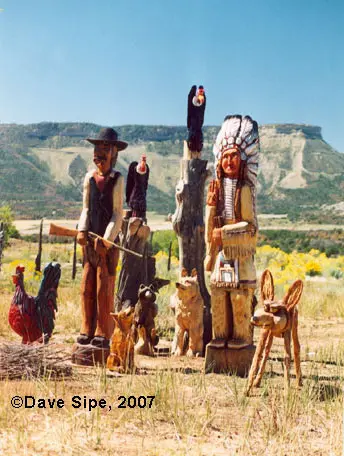
The figures stand along the south side of U.S. Highway 160 at County Road 38, between Mancos and Mesa Verde. The Durango Herald put the place four miles west of Mancos; the artist’s own website puts it three miles east of Mesa Verde. In 2005 the Herald found castoff road signs ringing the artwork and a fence of electrical conduits waving in the wind, all set out to catch the eye of drivers. By 2018 the Cortez Journal counted hundreds of wooden statues and pieces of furniture lining the fence around the house and spilling out from sheds and trailers. Inside the museum, a DGO Magazine writer reported that year, “wild, bulbous eyes and wide, crooked smiles” surround a visitor on all sides, along with the smell of fresh-cut wood.
The carver is Dave Sipe, and the house is his. He made over the dwelling and the ground around it into what the Journal called a “colorful, chaotic museum.” He and his partner, Nancy Segel, chose Montezuma County, he said, because it had no building code. He wanted the studio and museum to look like his work, which is made from recycled material and often comes out asymmetrical and cartoonish.
“I’m not a perfectionist,” Sipe told the Journal. “I’m not anatomically or politically correct in anything I do.”
Bears, buzzards and a kachina in pajamas
Bears are common on the grounds, and so are birds, especially eagles, ravens and roadrunners. Sipe said those sell well. In 2005 he told the Herald that the market runs to bears, eagles, coyotes and buzzards, though he likes doing abstracts best. That year he had a 9-foot kachina doll in striped pajamas leaning against one of the workshops and an abstract priced at $3,000. His prices then ran from $25 to $5,000.
Among the stranger pieces, the Journal found a giant hula dancer, carved while Sipe lived in the Northwest, standing beside a mural of the Virgin Mary. Crude caricatures of Hillary Clinton, Donald Trump and other political figures stood near superheroes and cartoon characters. The DGO writer went looking for a Dudley Do-Right and a Santa Grinch with sinister pasts. Segel could offer only one story. A woman in her late twenties paid for a little bear with a check that bounced. Segel followed up several times and was refused. Five years later the money came in the mail from the woman’s parents.
“I think the piece was possessed and made them feel like they had to pay up,” Segel said.
Sipe himself prefers lighter work. “A certain amount of artist’s life is giving yourself art therapy, so I think you’re all around better off if you make happier work,” he said, though some pieces carry a dark joke. His website names a few of them: Old Bear, Coyote, Circus, Demon, Bull Rider, Make Love Not War, Rooster, Drop the Big One, Three Bears.
The museum kept no regular hours in 2018. Whenever Sipe was home, usually mornings and evenings, he would show visitors around, but he said few came. “Everybody drives by (and says) ‘We’ve got to stop there someday,’” he said. “Everybody is aware that it’s here, but they’re not aware of how much work is here.”
A lean-to between Mesa Verde and the La Platas
Sipe roughs out his pieces in an outdoor lean-to with Mesa Verde on one side and the La Plata Mountains on the other. He carves with a chainsaw and finishes with an angle grinder fitted with a sandpaper disc, the kind used in auto-body shops. “There’s no chiseling or whittling here. We’re not chiselers,” he told the Herald. In 2005 he estimated he carved 100 big pieces a year, plus two or three times that many small ones for tourists. The Journal found him in 2018 still working about 40 hours a week while calling himself semi-retired.
His wood is dead wood from his own property and the surrounding county. He lets its shape decide the sculpture. He works in native trees, piñon, ponderosa and juniper, which he calls “the dying species.” So many come down on their own that in his first five years in the area he never had to cut a live one. He will also carve a dying tree where it stands on someone’s land. He did many such carvings in Minnesota when Dutch elm disease struck the state.
Segel was his partner of 10 years when the Herald visited in 2005. She painted the buzzards and sanded and finished pieces, and Sipe said she sold them far better than he did. By 2018 she was a physical therapist with an office in Cortez. She still did finishing work on the sculptures, and Sipe said she gave him much-needed supervision and moral support.
The Herald described Sipe in 2005 as an independent mountain man of the old school, with long white hair and a beard, who had to stop himself railing against government interference every few minutes. He sells direct when he can. “I hate to see the galleries making as much money as I do for just sitting behind the counter,” he said.
A gypsy carver from Minnesota
Sipe’s website gives his artist’s statement as “Lighten up and Loosen up.” The same biography, and Sipe in conversation, date his career to infancy and “smearing crap on the walls.” He calls himself mostly self-taught, though he credits his school art classes, the parochial ones especially, where materials were plentiful. His first piece was “the wooden Indian with an attitude,” made with hammer, chisel, hatchet, hand saws and grinders. The result pleased him, but the method was too slow. Then, while cutting down a dead tree for another sculptor, he decided to take a few pounds of wood off the log before loading it onto the truck. “The next thing he knew,” the biography says, “he was sculpting with the chainsaw.”
The accounts of his working life differ. The biography says he spent a dozen years as a carpenter, through marriage and a child, “until he got his walking papers,” and that woodcarving has been his only income since. The Herald reported in 2005 that he had earned a living as a sculptor for 20 years, ever since high school in Minnesota. DGO wrote in 2018 that he had been carving his figures with a chainsaw for 35 years.
From Minnesota he took the work on the road, carving summers in the north and wintering in the south. He worked shows, fairs and competitions from the Florida State Fair and the Keys to Alaska and the Pacific Northwest. “I was kind of a gypsy carver for quite a few years,” he told a Durango television reporter in 2020. Carvers in Hurley, Wisconsin, in Minnesota and in Seattle let him into their shops to help build inventory. “I show up with my saws and start carving like a madman,” he said, and on the next pass through he would collect a paycheck. Later he dropped the fairs and competitions and worked at a small trading post in Cave Creek, Arizona. The Herald adds Jackson Hole, Wyoming, to his stops, all of them places where he could find property along a highway.
In 1989 he took second place in the chainsaw sculpture competition at Tupper Lake, New York. The biography says he won the World Championship chainsaw competition in Minnesota. The Herald dates that win to 1989 and says he beat five other competitors. In the late 1980s the Minnesota Arts Council listed him in its Folk Art Directory, and he showed in the permanent sculpture garden at the Wolinsky Art Gallery. He calls his kind of work “folk freelance,” made by people who were never schooled in a style. “I’m not looking for too much guidance,” he said.
Carvings around Montezuma County
Sipe’s public pieces stand far from the highway lot. The biography lists “Paul Bunyan and His Pals” at Hunter Park in Ramsey, Minnesota, and “The Great Giant Paul Bunyan” at the Mall of America in 1989. It also lists “The Umpire, You’re Out” at Lehman Field Park on Whidbey Island, Washington, in 1990, and “Woodland Critter” in the city park at Ridgway, Colorado, in 1997. In 1999 the Sonoran Land Trust gave his “Harley Havilena” to the president of the Harley-Davidson Company, and it went on display at the company’s headquarters.
Closer to home, “The Memorial” went up in 2001 at Kotarski Kids World Park in Dolores, a playground the Journal later reported torn down. Southwest Memorial Hospital owns “Ruins under the Rim” and “Eagles Coming Home to Roost.” “He Played his Heart Out” appears regularly at the annual Mancos Fiddle Contest. In 2018 the Journal reported his work on regular display at Absolute Bakery and a totem pole of his outside the Mancos Schools Performing Arts Center.
In July 2016 the school had cut back an old, damaged tree in front of the Mancos Performance Center because of falling limbs, leaving about 12 feet of trunk. The dean of students and athletic director, Showalter, called Sipe, and the booster club paid for the work. Sipe carved the trunk into a blue jay, the school’s emblem. “He did a good job,” Showalter said. “I thought it was interesting, and there were a bunch of people that came to look at it and take pictures.”
Notable Events
- 1980sDave Sipe was recognized in the Minnesota Arts Council Folk Art Directory and showed in the Wolinsky Art Gallery's permanent sculpture garden. davesipe.com
- 1989The Great Giant Paul Bunyan was installed at the Mall of America in Minneapolis, Minnesota. davesipe.com
- 1989Sipe took 2nd place in the Tupper Lake, New York, chainsaw sculpture competition. davesipe.com
- 1989The feature says Sipe won the World Competition against five other competitors. web.archive.org
- 1990The Umpire, You're Out was installed at Lehman Field Park on Whidbey Island, Washington. davesipe.com
- 1997Woodland Critter was installed at the city park in Ridgway, Colorado. davesipe.com
- 1999The Sonoran Land Trust awarded The Harley Havilena to the president of the Harley Davidson Company; the biography says it is displayed at company headquarters. davesipe.com
- 2001The Memorial was installed at Kotarski Kids World Park in Dolores, Colorado. davesipe.com
- 2016Sipe turned an old, damaged tree in front of the Mancos Performance Center into a symbol of school spirit; the report dates the work to the preceding week. the-journal.com
People
- Dave Sipe, Itinerant carver who worked fairs, competitions and then a Cave Creek trading post.
- David A. Sipe, Folk artist and wood sculptor whose place is a museum, open studio, and sculpture garden.
- Nancy Segel, Sipe's partner, painting buzzards, sanding and finishing pieces, and selling them more effectively than he does, according to Sipe (partner of 10 years).
- Health Showalter, Dean of students and athletic director who reached out to Sipe and obtained booster-club funding for the school sculpture.
Sources
- davesipe.com
- davesipe.com/Come_See_Us.html
- davesipe.com/Dave_Sipe_Biography.html
- davesipe.com/Dave_Sipe_Online_Gallery.html
- the-journal.com/mancos-artist-lives-and-works-in-quirky-roadside-museum
- dgomag.com/the-dark-humor-of-dave-sipes-roadside-sculptures
- web.archive.org/web/20050305000000/http://www.durangoherald.com/arts_entertainment/ae050304_2.htm
- web.archive.org/web/20210101000000/https://www.durangolocal.news/newsstories/folk-artist-carves-roadside-attraction
- the-journal.com/mancos-gets-blue-jay-sculpture