Darrah Springs Trout Hatchery
Manton, Tehama County, California. Trout hatchery.
Details

- Where
- 29661 Wildcat Road Paynes Creek, Manton, CA 29661. Directions
- When
- Open 8:00 a.m. to 3:00 p.m. Contact the hatchery for assistance on a visit and current hours.
- Season
- Mid-April through mid-October fish stocking season.
- Getting there
- Near the town of Manton, on Highway 36; 10 miles east of Red Bluff to Dales Station, follow hatchery signs north on County Road A6 for 8 miles. Cross Battle Creek, turn left onto Wildcat Road, proceed 3 miles to hatchery entrance.
- Access
- Visitor facilities are utilitarian; visitation is encouraged and employees are available to answer questions.
- Walk-in or reserve
- Walk-in visitation is encouraged; organized-group tours may be arranged by calling the hatchery.
- Phone
- (530) 474-3141
- Website
- wildlife.ca.gov
- Managed by
- California Department of Fish and Wildlife.
- Established
- 1954-1956.
Wildcat Road reaches the hatchery three miles after leaving County Road A6, and A6 reaches Wildcat Road only after crossing Battle Creek. The usual way in is Highway 36, ten miles east from Red Bluff to Dales Station, then north eight miles on A6 by the hatchery signs. The mailing address is 29661 Wildcat Road, Paynes Creek. The California Department of Fish and Wildlife places the hatchery near the town of Manton in eastern Tehama County. The Department of General Services, in its 2024 filings, put the same address in Shasta County.
A visitor finds outdoor raceway ponds and the trucks that empty them. The department’s own page pictures workers cleaning the raceways and loading a hatchery truck. From mid-April, Monday through Friday, specially equipped stocking trucks take on catchable trout and carry them to waters across Northern California. Planting goes on until mid-October. The department calls spring the most enjoyable season to come and the busiest for stocking. Visitor facilities are, in its word, utilitarian. Walk-in visits are encouraged, employees are on hand to answer questions, and organized groups may arrange tours by calling. Lassen National Park, Hat Creek, Battle Creek and Deer Creek all lie within an hour’s drive.
Trout for other waters
Much of the work here begins or ends somewhere else. Broodstocks of rainbow trout and of the Eagle Lake strain are reared at Darrah Springs and then sent to Mount Shasta Hatchery. The department explains the division: Darrah Springs water is ideal for rapid growth but too warm for successful egg development, and Mount Shasta’s colder water lets the eggs develop properly.
The Eagle Lake trout is known for its resistance to highly alkaline water. It is native to nearby Eagle Lake and its Pine Creek tributary. When flows into Pine Creek diminished, a program to preserve it began in the 1950s, and it now lives in many waters of the state. The hatchery also lists Lahontan cutthroat trout, named for the red markings under the lower jaw. According to the department, rainbows raised for anglers are now sterile triploids.
Some fish leave before they reach full size. For several decades the hatchery has supplied the Almanor Fishing Association’s Fish Pen Program with about 50,000 sub-catchable rainbow trout a year. The fish go to Lake Almanor, where the association’s volunteers grow them out in net pens in the lake. The association pays for the pens and the feed. In spring, once the trout reach catchable size, they are released.
The water reaching the raceways now passes through a filtration and disinfection plant. The department contracted Integrated Aqua Systems to build it so that rain would not swing the water quality. The plant treats 15 cubic feet per second with a drum filter and an in-channel ultraviolet sterilizer, set in a custom aluminum tank delivered in three sections.
Simon Darrah’s springs
That water comes up from artesian springs. Earl Leitritz, in his Fish Bulletin history of the state’s hatcheries, gave the flow as approximately 30 cubic feet per second at a constant 57 degrees Fahrenheit. He wrote that there is little doubt this clear, abundant water drew Simon H. Darrah to the site in 1865. The springs carry his name, and the hatchery takes its name from the springs.
A family biography from the Shasta Historical Society tells Darrah’s life at length. He was born in Wheeling, West Virginia, on May 1, 1832. At 16 he ran away and crossed the plains by ox team, paying his way by carrying water and wood and tending the oxen. He reached the Sacramento Valley in the fall of 1849, tried mining, grew homesick, and went back East by boat with several others. He did not want to stay home. At Omaha he learned the butcher trade in a meat plant. Then he piloted an ox team west for $30 and board, which the biography calls big pay for the time. He worked at Fort Reading and at Millville. In the summer of 1861, at the Old Dry Mill below Shingletown, he met Arzilla Shipton, who had cooked there since she was 13. They married November 16, 1861, when she was 16.
Their first two children, Susan Virginia and George Andrew, were born at the mill. George was quite young when the family moved to Battle Creek, to the ground later named Darrah Springs. There, the biography says, Indians robbed them and burned all they had. The family moved on to South Cow Creek, then Old Adams Ferry, then a mill on Bear Creek. Simon drove ox teams, did blacksmith work, ran a saw, and rafted lumber down the Sacramento River. The biography’s text gives his death as November 29, 1907, though its heading prints his years as 1832–1901. He is buried in Parkville Cemetery.
From test troughs to a plant, 1940–1960
The springs entered the public record again over salmon. In 1940 a report by the Bureau of Fisheries biologists Paul R. Needham, Harry A. Hanson and Osgood R. Smith named Darrah Springs as a local source of cold water where salmon holding ponds might serve, though its flow could hold only a limited number of fish. A board of consultants made up of W. F. Durand, Willis H. Rich and R. D. Calkins sanctioned trucks to ferry captured salmon to the proposed Coleman hatchery and to holding ponds at Darrah Springs.
In 1941 the state’s hatchery inspector for northern California, Leitritz himself, took note of the site. War intervened, and the experimental work that was to test the water waited until 1949. On March 19, 1949, the date as Leitritz’s history prints it, the Wildlife Conservation Board acted favorably on a hatchery modernization program that included construction at Darrah Springs. Troughs and ponds went in that year, and the Darrah Springs Experimental Hatchery ran from 1949 to 1953. Its studies found the water good enough to build on.
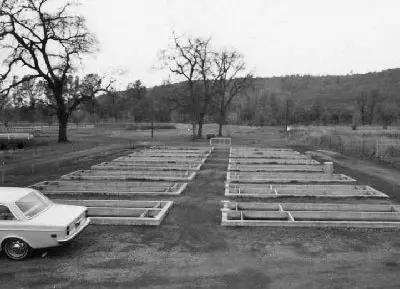
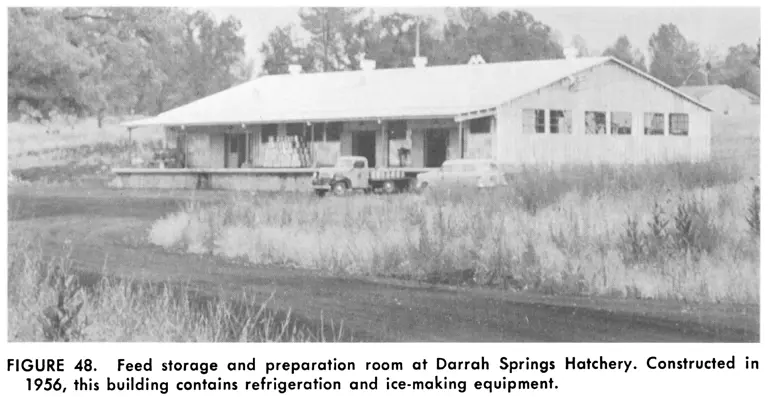
Construction ran from 1954 through 1956. Crews built 60 ponds, 32 nursery tanks, a 120-trough hatchery building, and storage, feed and other buildings. The sources disagree on the cost. Leitritz put it at nearly $800,000 in Wildlife Conservation Board funds, while the department’s history page says nearly $80,000. That page also carries photographs of the feed storage and preparation room and the fish loader as they stood in 1956. Others show the ponds as they were in 1964, old-style ponds with dirt sides and bottom, and a modern loader that moves fish with an auger.
Salmon returned to the place once more. A Department of Fish and Game study by Richard Hallock followed a joint effort by Coleman and Darrah Springs to establish a coho run in the Sacramento River. Jim Baucum, president of the Sacramento River Resort Owners Association, had promoted the program. Returning fish produced soft eggs that failed to fertilize properly, and by 1960 the experiment seemed to have been quietly discontinued. According to Hallock, John Pelnar, the Coleman superintendent, was pleased to be rid of it.
Quarantine, fire and panels
In June 2015, fish at Darrah Springs tested positive for whirling disease, caused by a parasite that destroys cartilage in the spines of trout and salmon. Trout had already been transferred to Mount Shasta Hatchery, and some 3 million rainbow and brown trout at the two hatcheries went into quarantine. Fish that could not be released were to be euthanized and given to food banks. The Red Bluff Daily News reported that the infection was thought to have entered through the water source supplying part of the hatchery, in the Battle Creek watershed. Drought was drawing wildlife to the available water, which made nearby infected waters a likely origin. There had been no hatchery outbreak in Northern California for two decades. “This is a bitter pill to swallow,” said Stafford Lehr, the Fisheries Branch chief. “We have raised and nurtured these trout to provide fishing opportunity. It’s heartbreaking.”
The following January a house on the hatchery grounds burned. The fire started about 1:45 on a Tuesday morning in the home of Chad Glenn, a fish and wildlife technician who had lived on the facility with his family for about 10 years. One person died. Two girls, ages 5 and 8, were burned, and the older was flown to the burn unit at U.C. Davis Medical Center. Neighbors fought the flames until crews arrived. “It’s a very long response time to get here from the closest fire station,” said Lance Berry, a CAL FIRE battalion chief, who put that time at about 30 minutes. The hatchery manager, Kevin Ceccato, said nine of the hatchery’s 11 employees lived on the property. “It was disheartening, it was, it was tragic, absolutely tragic,” he said.
On March 25, 2024, the Department of General Services approved a solar project for the hatchery grounds. The plan calls for 738 ground-mounted arrays on 59,500 square feet, about 321 kilowatts in all, feeding the PG&E distribution system.
Notable Events
- 1940Darrah Springs was suggested as a local cold-water source where holding ponds might prove satisfactory, but its flow could accommodate only a limited number of salmon. nrm.dfg.ca.gov
- 1941California became interested in the site for a trout hatchery because of its consistent artesian springs. integrated-aqua.com
- 1949Experimental troughs and ponds were installed; studies found water quality sufficient to begin hatchery construction. wildlife.ca.gov
- 1954Nearly $80,000 funded 60 ponds, 32 nursery tanks, a 120-trough hatchery building, and supporting buildings. wildlife.ca.gov
- 1960The coho experiment seemed to have been quietly discontinued after returning fish produced soft eggs that failed to fertilize properly. nrm.dfg.ca.gov
- 2015Some 3 million hatchery rainbow and brown trout were quarantined at two North State hatcheries after captive-raised fish at the Darrah Springs Trout Hatchery tested positive for whirling disease; the infected fish were euthanized and donated as food fish. redbluffdailynews.com
- 2016A house fire on Darrah Springs hatchery property killed one person and sent three people to the hospital. krcrtv.com
- 2024The Department of General Services adopted the Initial Study/Mitigated Negative Declaration and approved the Darrah Springs Solar Project. ceqanet.lci.ca.gov
- The book says there is little doubt the spring water attracted Simon H. Darrah to the site. web.archive.org
- The hatchery was built for nearly $800,000 with funds supplied by the Wildlife Conservation Board. web.archive.org
People
- Terry Ash, DGS Senior Environmental Planner and lead/public-agency contact for the Darrah Springs Solar Project.
- Matt Henigan, Deputy Director of the Department of General Services Office of Sustainability, named on the project's approval notice.
- Arzilla Shipton, Simon Darrah's wife, in the family biography of the area's namesake (1845–1924).
- George Andrew, Darrah child who was quite young when the family moved to Battle Creek, in the area later named Darrah Springs (Born Dec. 6, 1866.).
- Simon Hillery Darrah, Settler for whom the Darrah Springs area was named (Died November 29, 1907 (body text).).
- Susan Virginia, One of the first two children in the Darrah family, described before its move to Battle Creek and the naming of Darrah Springs (Born March 16, 1863.).
- Chad Glenn, Fish and wildlife technician who lived with his family in the hatchery residence (Approximately 10 years living on the facility.).
- Kevin Ceccato, Hatchery manager who responded to the residential fire.
- Lance Berry, CAL FIRE Battalion Chief reporting the fatal fire on hatchery property.
- Fred J. Foster, Prepared the supplemental Sacramento River, Battle Creek, and Deer Creek Plan, also called the Foster Plan.
- Harry A. Hanson, Bureau of Fisheries biologist whose report considered possible cold-water salmon holding ponds at Darrah Springs (1940).
- Jim Baucum, Sacramento River Resort Owners Association president who promoted the coho introduction program.
- John Pelnar, Coleman superintendent who, according to Hallock, was pleased to be rid of the joint coho project.
- Leo Shapovalov, DFG participant whose agreement was sought for the resort association's coho project.
- Osgood R. Smith, Bureau of Fisheries biologist whose report considered possible cold-water salmon holding ponds at Darrah Springs (1940).
- Paul R. Needham, Bureau of Fisheries biologist whose report considered possible cold-water salmon holding ponds at Darrah Springs (1940).
- R. D. Calkins, Board consultant who sanctioned trucks to ferry captured salmon to the proposed Coleman hatchery and holding ponds at Darrah Springs.
- Richard Hallock, DFG researcher who conducted the coho study associated with Coleman and Darrah Springs' attempt to establish a Sacramento River run.
- W. F. Durand, Board consultant who sanctioned trucks to ferry captured salmon to the proposed Coleman hatchery and holding ponds at Darrah Springs.
- Willis H. Rich, Board consultant who sanctioned trucks to ferry captured salmon to the proposed Coleman hatchery and holding ponds at Darrah Springs.
- Stafford Lehr, Fisheries Branch chief who pledged disease eradication and bringing the affected hatcheries back online.
- Simon H. Darrah, Early settler of the area and the hatchery's namesake.
- Earl Leitritz, Hatchery inspector for northern California when the State first became interested in the Darrah site; author of this history (1 941).
Sources
- wildlife.ca.gov/Fishing/Hatcheries/Darrah-Springs
- sierradailynews.com/local/cdfw-and-almanor-fishing-association-partner-to-raise-and-release-rainbow-trout-at-lake-almanor
- wildlife.ca.gov/Fishing/Hatcheries/Darrah-Springs/History
- integrated-aqua.com/case-study/darrah-springs-trout-hatchery
- redbluffdailynews.com/2015/06/04/3-million-infected-hatchery-fish-quarantined-could-be-euthanized
- web.archive.org/web/20241215033646/https://www.noaa.gov/sites/default/files/legacy/document/2020/Oct/07354626232.pdf
- shastacounty.gov/media/7831