Curlew Lake State Park
Republic, Ferry County, Washington. State park; Closed Nov. 1 - April 6.
Details

- Where
- 62 State Park Road, Republic, WA 99166. Directions
- When
- Summer: 6:30 a.m. - Dusk.
- Getting there
- Curlew Lake lies along State Route 21, about 10 miles from the town of Republic.
- Fees
- Discover Pass: annual $45, one-day $10; Trailer Dump Fee $5 per use.
- Hours
- Summer: 6:30 a.m. - Dusk.
- Access
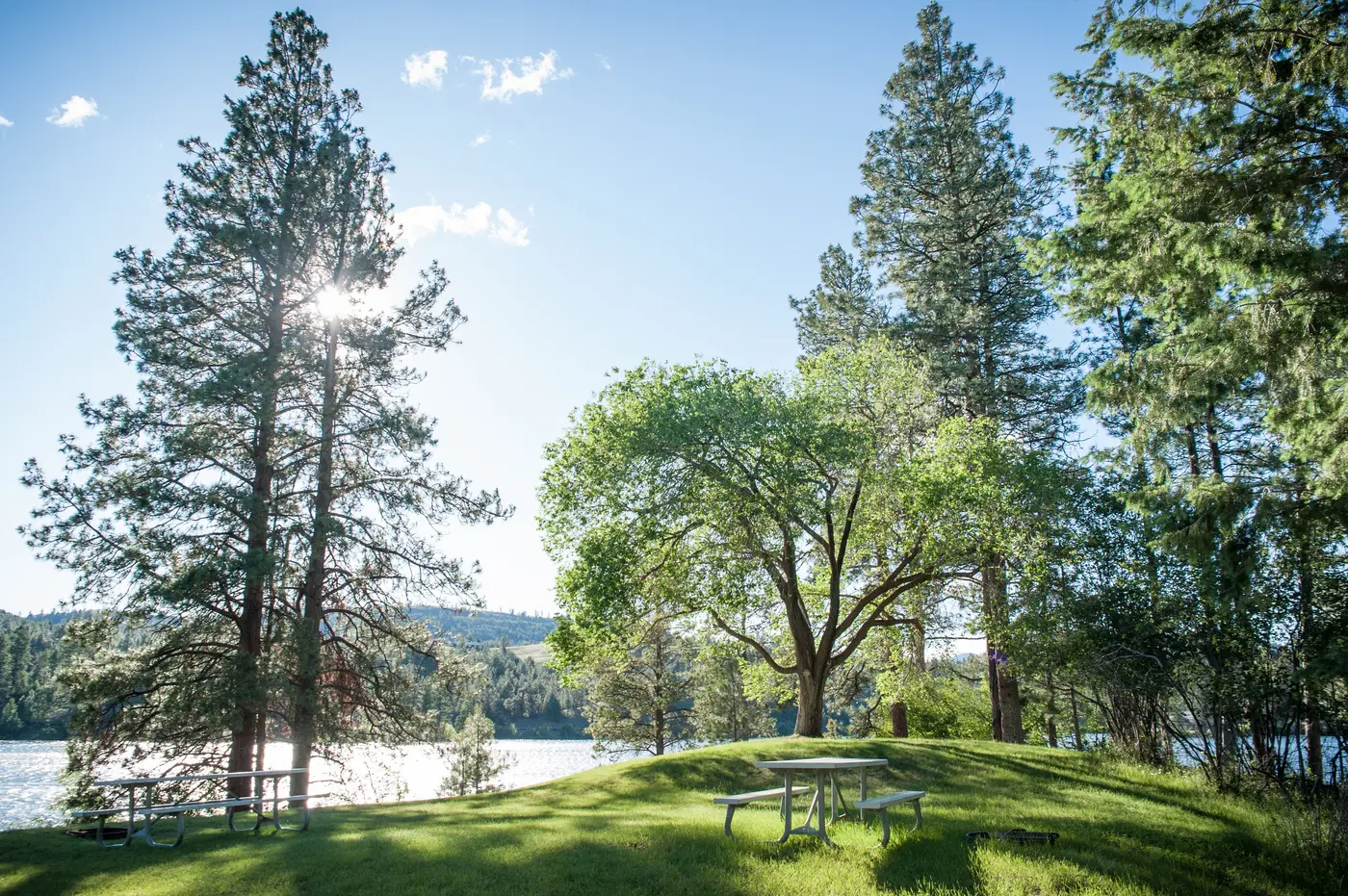
- There are ten unsheltered picnic tables throughout the park, available on a first-come, first-served basis. There are three barbecue braziers by the swimming area.
- Walk-in or reserve
- Most campsites are reservable, with a few first come, first served sites.
- Phone
- (509) 775-3592
- Website
- parks.wa.gov
- Managed by
- Washington State Parks.
- Established
- 1960.
- Coordinates
- 48.71892548, -118.6606674.
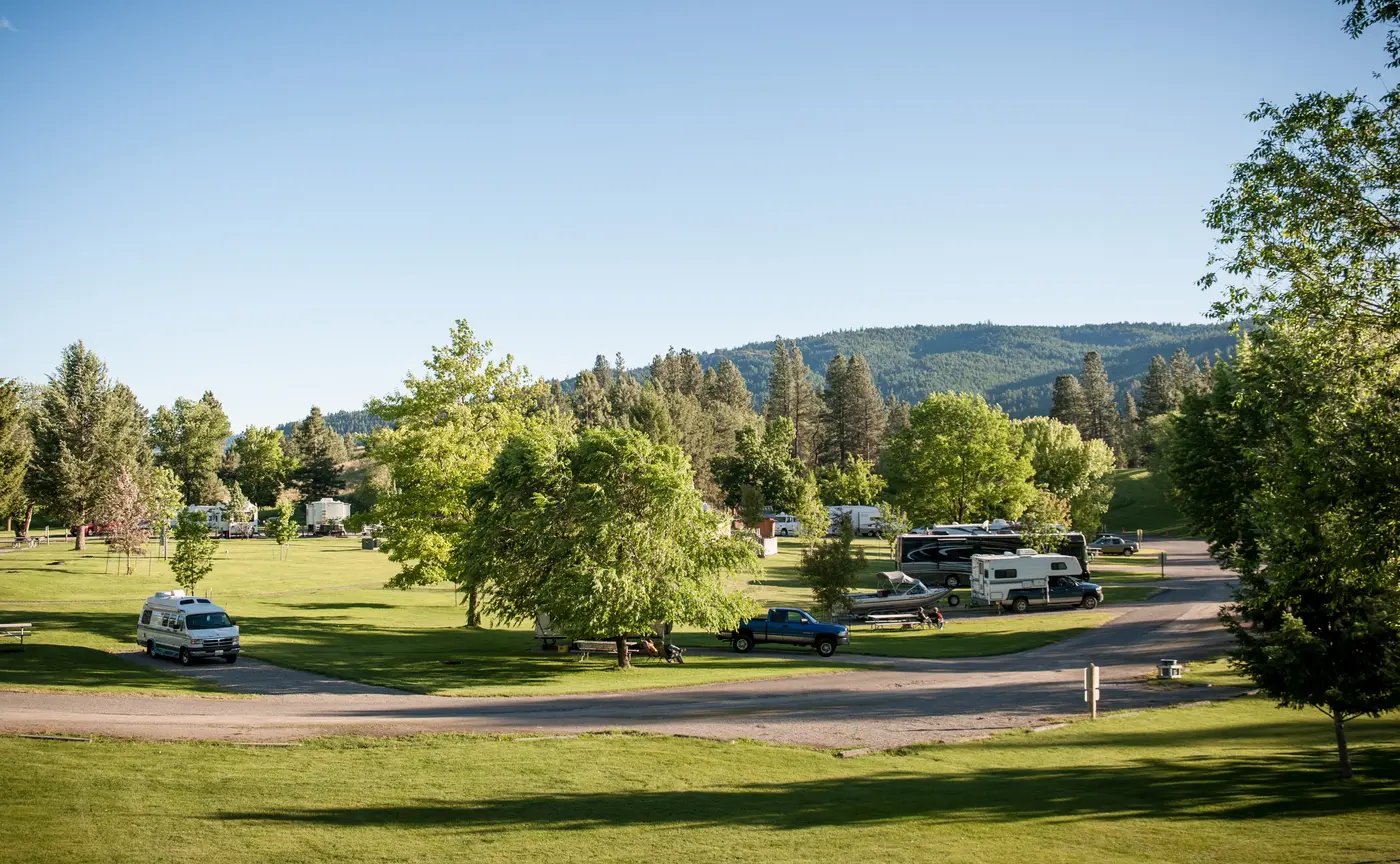
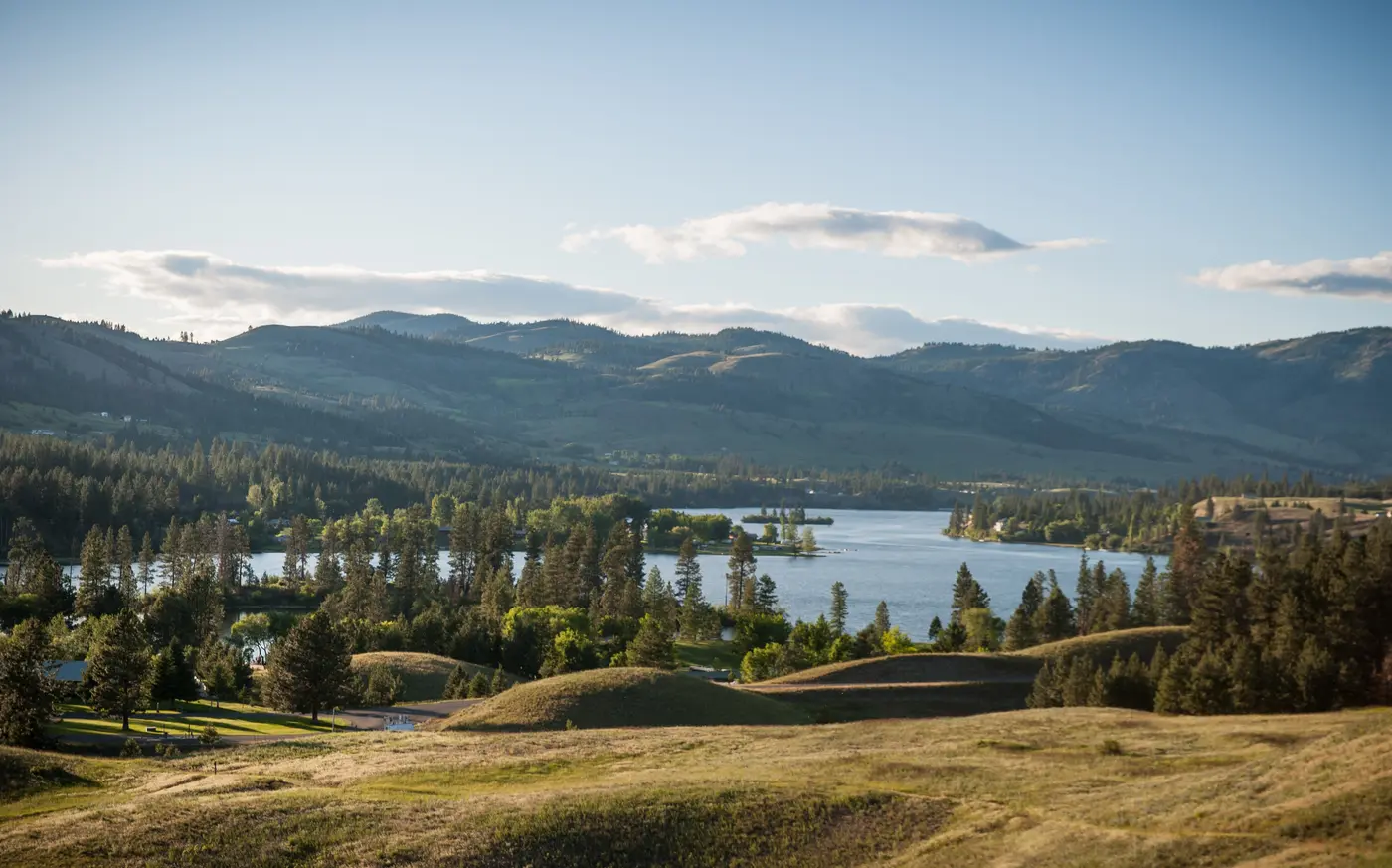
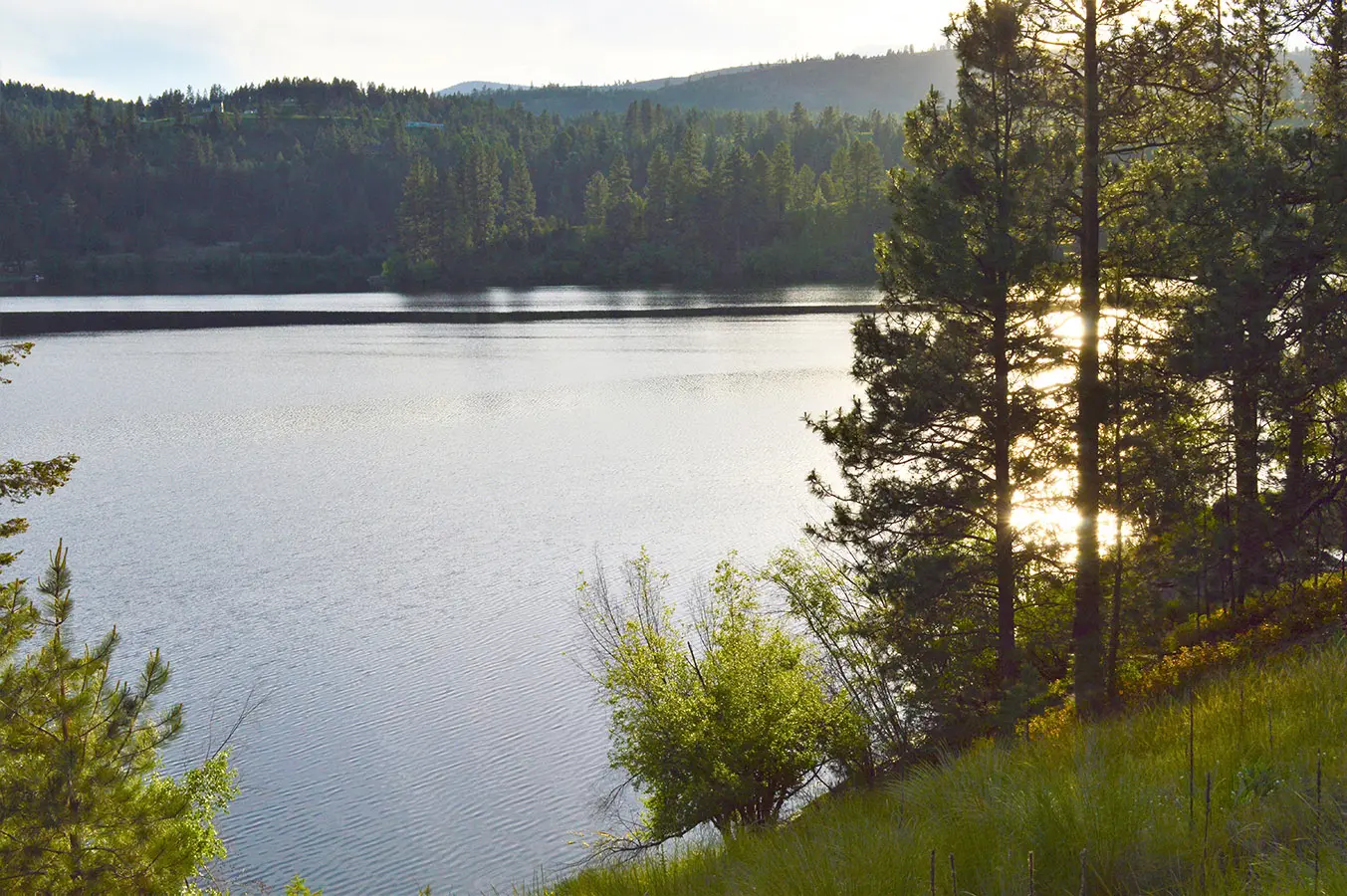
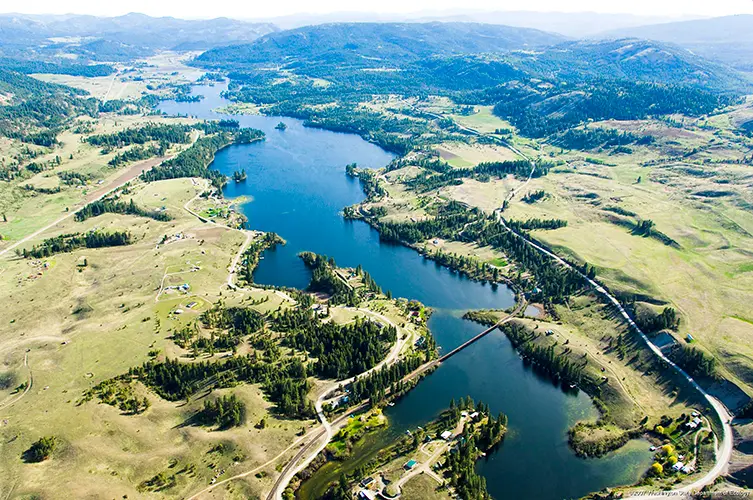
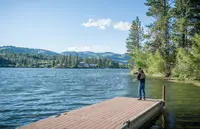
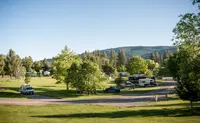
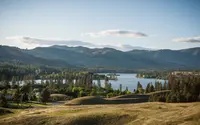
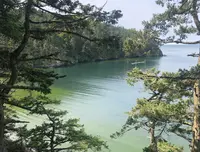
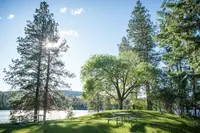
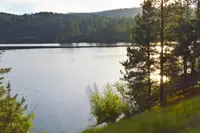
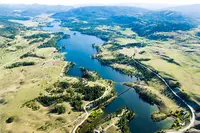
Curlew Lake State Park lies at the south end of Curlew Lake, along State Route 21 about 10 miles from Republic. The state Department of Natural Resources counts Ferry County among the least populated in Washington. Washington State Parks describes green lawns and shade trees looking across the water to pine-covered hills. Its park page gives the park’s size as 87 acres in one place and 123 acres in another. The lake runs six miles long and half a mile wide. State Parks puts its depth at 130 feet and the DNR at 43 feet. The Department of Fish and Wildlife gives a mean depth of 13 meters and a maximum of 40.
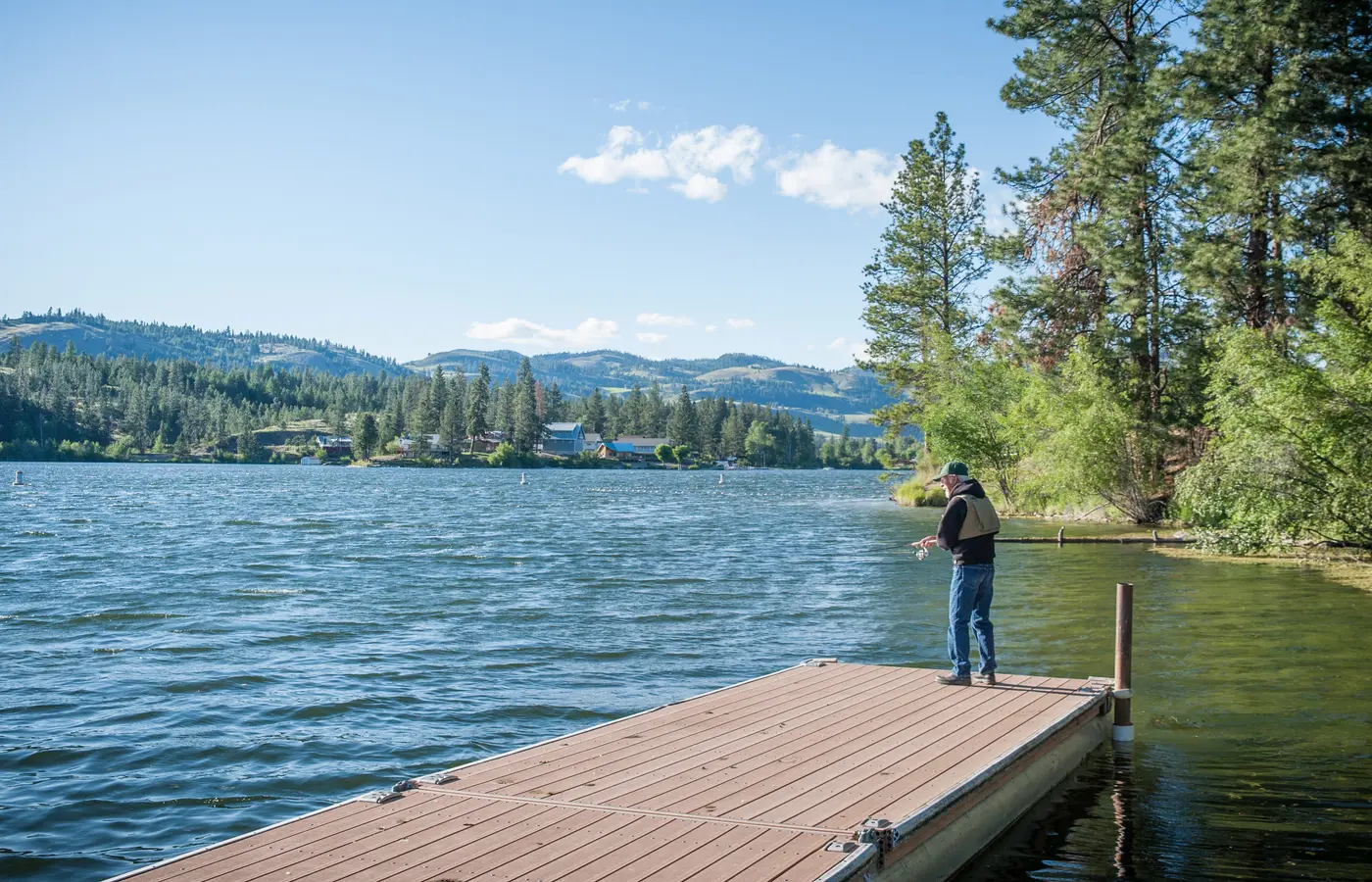
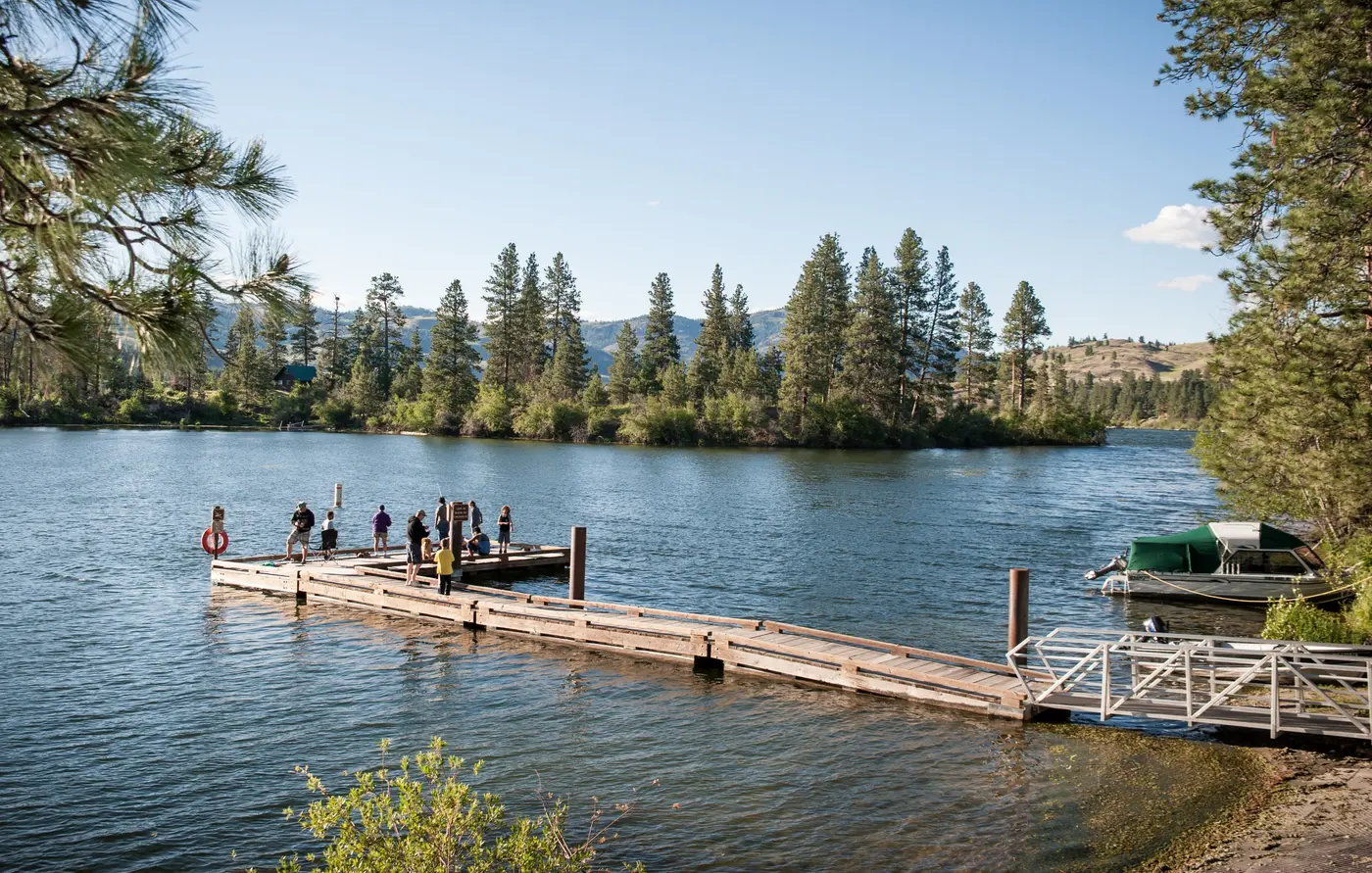
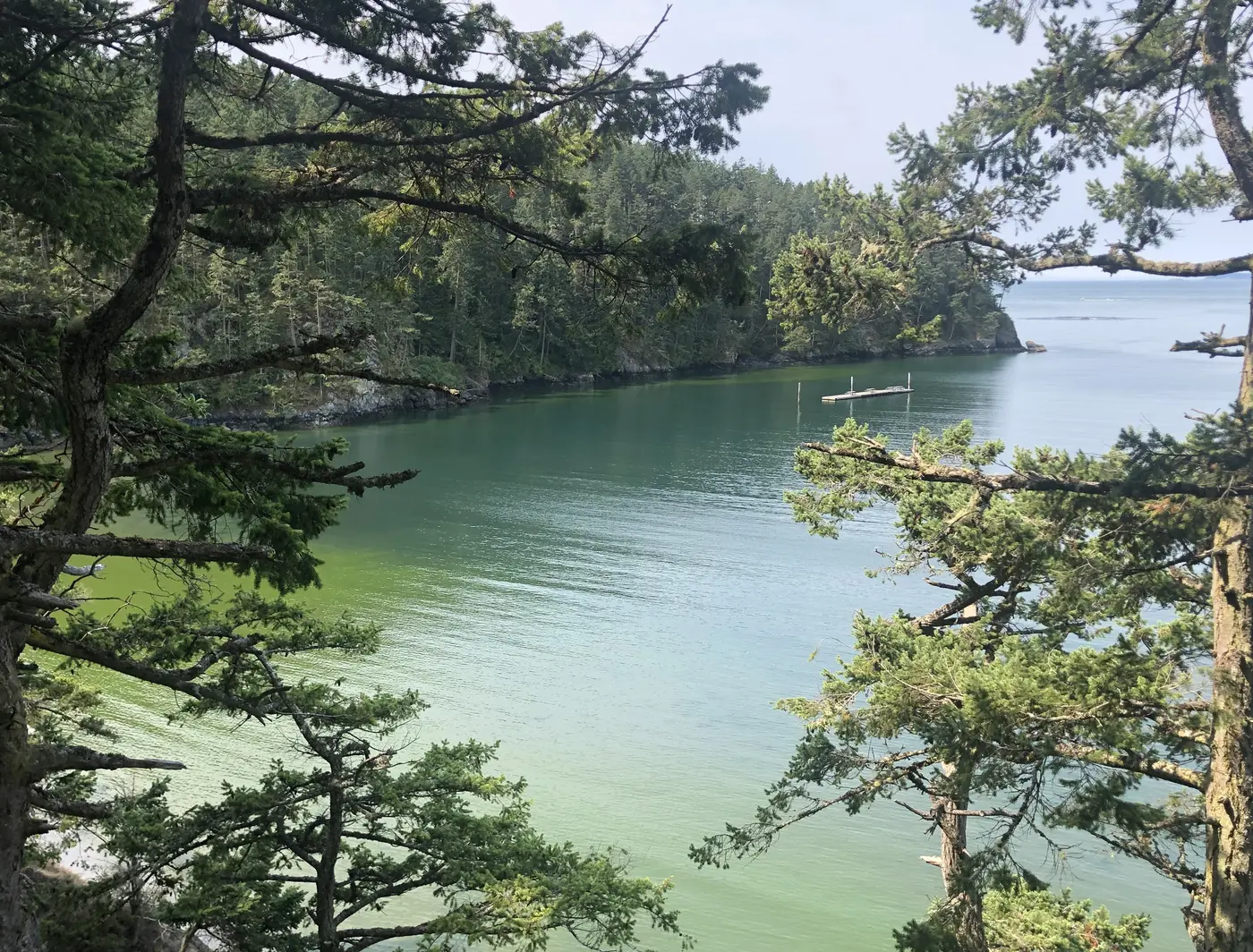
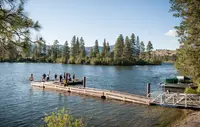
At the shore are one boat ramp, with no fee, and an 80-foot dock. The swimming area has three barbecue braziers, and ten unsheltered picnic tables stand about the grounds. Campsites run from standard to full hookup, six of them pull-through and none longer than 45 feet. Sites 73 through 80 have their own mooring dock and accessible restrooms and showers. Campers register at the ranger station. Two miles of trail serve hikers and cyclists, and bicycle tour groups use the park as a base. Bald eagles, ospreys and herons live in the trees nearby and fly in to take fish from the lake. A heron rookery with active nests can be seen from the park.
The park is one of four main landings on the lake. The other three are private resorts: Tiffany’s Resort, Fisherman’s Cove and Black Beach Resort. The Ferry Conservation District counts nearly 600 residents along the shoreline. Summer surface water commonly tops 72 degrees Fahrenheit. The lake typically freezes over between November and April, and Northwest Sportsman photographed a young angler pulling a sled of ice-fishing gear onto it. The park itself closes from November 1 to April 6. For 2026, State Parks posted that the water would be shut off October 27 and the park would close at 1 p.m. on October 31.
Perch in a trout lake
The fish most often kept here now is the yellow perch. Northwest Sportsman, in November 2023, described lots of 9- to 11-inchers with a few larger ones, taken on nightcrawlers, curltails, tube jigs and Swedish Pimples. That article also pictured a single rainbow lying in a pile of perch caught off the state park on a January 2023 day.
For most of the park’s life the lake was trout water. Fish and Wildlife writes that rainbow trout drove most of the angler effort from the 1950s on. The trout were released as fry or raised in volunteer-operated net pens on the lake. In June 2012, retired warmwater manager Bruce Bolding recalled the anglers he met during a study there: “Every single adult I spoke to was there because their parents took them to Curlew when they were children and now they are taking their children there to enjoy a family fishing experience.” District biologist Bill Baker remembered “a lot of limits of beautiful 13- to 15-inch trout,” with some fish of 17 to 20 inches. In 1998 the department added tiger muskies, a sterile hybrid of muskellunge and northern pike, to prey on the northern pikeminnow. About 250 are stocked each year to keep the population going.
The perch arrived by bucket. The department’s 2023 report says they were first documented in spring 2011 during trout sampling. The Spokesman-Review of June 17, 2012, reported Baker catching a 6-inch perch in a sampling net that week. “We’ve done a lot of intensive surveys in the past and this is the first time we’ve found perch,” he said. “It’s a very selfish act.” Bolding warned that the perch could “completely destroy one of the best blue-ribbon trout fisheries in a lake in the state.” In 2014 resort owners urged anglers to keep every perch they caught, and kids in a “Perch Purge” that fall took 200. By 2019 the number of perch caught in standard sampling had risen 500-fold.
A nine-month creel survey measured the result. The department’s report dates it May 2022 to February 2023, and Northwest Sportsman dates it May 2021 to February 2022. Anglers kept an estimated 81,147 perch and 9,448 rainbows. Ice-fishing harvest peaked in January, and total effort came to 40,682 angler hours. Stocking had already fallen from 225,000 to 235,000 trout a year before 2010 to 185,000 a year through 2021. Beginning in fall 2023 it was cut much further, leaving the fishery to rely mainly on the 80,000 trout raised in the net pens. Kokanee stocking began in 2016 with 50,000 fry and had dwindled to none by 2023. “No sense in trying to pound a square peg in a round hole,” Baker said. “Curlew Lake is arguably the best perch fishery in the state.”
The water has changed as well. The conservation district writes that the lake was long enjoyed for clear, cold water, but toxic algae blooms and more aquatic weeds have followed. In 2020 the district made the lake’s water quality a top priority. It then won a state Department of Ecology grant to draft a cyanobacteria management plan with Herrera Environmental Consultants and Washington State University. Among the suspected sources of phosphorus are lake sediments, shoreline septic systems and the stocked rainbow trout.
A mile of ice
The valley is older than any of its fish. During the last Ice Age, the southern edge of the Cordilleran Ice Sheet pushed into the valley of Curlew Creek and thickened to more than a mile. It covered even the highest summits of the Kettle River Range to the east and scoured the trough the lake now fills. Curlew Creek, which flows north out of the lake to the Kettle River, is in the DNR’s words “much too small to have carved out its valley.”
As the ice melted, streams carried sand and gravel along its edges and laid them against the foothills as flat-topped kame terraces. Blocks of ice calved from the front were buried in gravel. When they melted, the gravel caved in and left kettles. The Ferry County Airport, beside the park, sits on a kame terrace, and the hills and hollows back from the park’s lakeshore are kettles. Glacial till blankets the slopes around the lake, from less than a foot to many tens of feet thick, mostly hidden under grass and trees.
Karanips and Karamip
The park lies in the traditional territory of Interior Salish-speaking people whose descendants include members of the Confederated Tribes of the Colville Reservation. Research for the conservation district names the Colville, Sinixt and Sylix (Okanagan) and records 24 Native American sites near the lake. Stories passed down through generations tell of small groups harvesting shellfish along its sandy shores. State Parks notes that the lake holds a freshwater mussel, Anodonta californiensis, which local Indigenous people harvested.
Edmond S. Meany’s 1923 Origin of Washington Geographic Names gives the lake’s Indian name as Karanips, meaning “curlew.” The town of Curlew was named by Guy S. Helphrey in June 1896, and the creek and lake took its name. Government surveys completed in 1896 showed the water as “Karamip Lake.” The DNR says the name honors the long-billed curlew, the largest North American shorebird, though it adds that the birds are not particularly common here. A 1956 Wilson Bulletin article by Charles F. Yocom said only that the name “suggests that these birds frequented that area.”
The tribes of the area were not represented at Governor Isaac Stevens’s Walla Walla Treaty Council of June 9, 1855. An executive order of President Ulysses S. Grant on April 9, 1872, created a reservation. On July 2, 1872, it was moved to the country between the Columbia and Okanogan rivers and named the Colville Indian Reservation, taking in the site of today’s park. On July 1, 1892, after prospectors found gold, the north half of the reservation, Curlew Lake included, was removed. A congressional report of the time called the reservation “the sporting ground of so sparse, thriftless, and irresponsible a population.” Some Indigenous residents received individual allotments and stayed in their homes, and all members of the Confederated Tribes kept the right to hunt and fish on the former north half.
Thirty-seven acres for $93.29
By 1909 the land of today’s park had passed into private hands as Cash Entry patents. In 1903 Peter C. Jager bought a large parcel running from the present swimming area to the airport. In 1909 Frank B. Wilson bought a smaller one that takes in the main camping area. Early in the 1900s a channel was dug between Curlew Lake and the separate Lake Roberta to the south so logs could float north to the Karamin Mill. In the mid-1930s Lake Roberta dried up one summer without an equal drop in Curlew Lake.
In 1917 Governor Ernest Lister approved Senate Bill 163. It let the Curlew Irrigation District flood the lake’s state-owned shorelands “up to and including the high water mark.” In 1919 the state game warden recommended making the lake a reservoir for irrigation water. A three-foot dam built at the outlet in 1926 held the lake at 2,333 feet above sea level, and the conservation district records the wooden dam’s removal in 1984. Farms, houses, vacation homes and a lumber mill went up along the shore, and public access dwindled.
On August 2, 1948, the Ferry County commissioners sold 37 acres of Jager’s old patent to the Department of Game for $93.29, for a public fishing access. On January 28, 1955, the Ferry County Democratic Central Committee asked for a state park, and nothing was done. Local granges followed with their own resolutions. On June 24, 1958, Game and the State Parks and Recreation Commission agreed to develop the land as a park. On July 31, 1958, the commission bought Wilson’s 24.5 acres from the Republic Chamber of Commerce for $5,000. On May 11, 1959, it bought the remaining 58 acres of the Jager patent from Fred O. Heckly for $6,000. The conservation district gives 1959 as the park’s founding. State Parks says it opened for camping, swimming and boat launching in the summer of 1960.
In 1971 the county asked to lease the park’s level eastern ground, the kame terrace, for an airport runway. Staff favored the lease and proposed fly-in campsites. It passed on December 17, 1973, with Commissioner James W. Whittaker voting no. He cited “the current energy crisis and anticipated decline in the use of light planes.” He doubted that park visitors “would care to see an airstrip in that location any more than they would want a television antenna in a park.” On October 22, 2012, the state sold the runway land to Ferry County for $83,000, and the county became eligible for grants to improve the airport.
Notable Events
- 1872An Executive Order of President Ulysses S. Grant on April 9, 1872 created a reservation; relocated that July, the new reservation included the area of today's Curlew Lake State Park. parks.wa.gov
- 1892On July 1, 1892, the north half of the Colville Reservation, including Curlew Lake, was eliminated after mineral prospectors discovered gold in the area. parks.wa.gov
- 1896Government surveys completed in 1896 showed the lake as "Karamip Lake"; land in today's park passed into private ownership by 1909 as Cash Entry patents. parks.wa.gov
- 1900sA channel was dug between previously separate Lake Roberta and Curlew Lake so logs could float north to the Karamin Mill. ferrycd.org
- 1903A large parcel stretching from today's park swimming area to the Ferry County Airport was purchased by Peter C. Jager in 1903; Frank B. Wilson bought the camping-area parcel in 1909. parks.wa.gov
- 1917The legislature granted the Curlew Irrigation District rights to overflow shore lands up to and including the high-water mark. ferrycd.org
- 1919The state game warden recommended making Curlew Lake a reservoir for storing irrigation water. ferrycd.org
- 1926A 3-foot dam at the north end stabilized the lake at an elevation of 2,333 feet. ferrycd.org
- 1948On August 2, 1948, the Ferry County Board of Commissioners authorized the sale of a 37-acre county parcel on Curlew Lake to the Washington Department of Game for $93.29, for a public fishing access site. parks.wa.gov
- 1955On January 28, 1955, the Washington State Parks and Recreation Commission received a resolution recommending that a state park be established, but no action was taken at the time. parks.wa.gov
- 1958On June 24, 1958, the Department of Game and the WSPRC agreed to use the land for state park and recreational area development; on July 31, 1958, the WSPRC bought an adjacent 24.5 acres from the Republic Chamber of Commerce for $5,000. parks.wa.gov
- 1959On May 11, 1959, the WSPRC purchased another 58 acres, the remainder of the original Jager patent, from Fred O. Heckly for $6,000. parks.wa.gov
- 1960The park was opened for camping, swimming and boat launching in the summer of 1960. parks.wa.gov
- 1973The lease of the park's eastern portion, a kame terrace, for a county airport runway was approved on December 17, 1973, over one dissenting vote. parks.wa.gov
- 1984The wooden dam was removed. ferrycd.org
- 1986Intensive monitoring was conducted through the Washington State Water Resources Center, Washington State University and University of Washington. ferrycd.org
- 1998Tiger Muskellunge, a sterile hybrid of muskellunge and northern pike, were introduced to Curlew Lake by the WDFW in 1998 to prey on Northern Pikeminnow. parks.wa.gov
- 2011Yellow Perch were illegally introduced into Curlew Lake around 2011, and the population increased 500-fold by 2019, becoming the primary sport catch. parks.wa.gov
- 2012On October 22, 2012, the leased land was sold to Ferry County for $83,000, allowing the county to qualify for grants to upgrade the facility. parks.wa.gov
- 2013Following perch expansion and declining trout growth, likely due to competition, stocking fell to 205,000 and 210,000 fish annually in 2013 and 2014, respectively. wdfw.wa.gov
- 2016WDFW began stocking kokanee with an initial release of 50,000 fry. nwsportsmanmag.com
- 2019WDFW documented rapid population growth; catch had increased 500-fold by 2019. wdfw.wa.gov
- 2020Ferry Conservation District identified lake water quality as a top priority and received an Ecology grant to develop a cyanobacteria management plan. ferrycd.org
- 2021The magazine reports 81,147 perch kept and only 9,448 rainbows stringered during that timeframe. nwsportsmanmag.com
- 2021WDFW initiated creel and mark/recapture work to understand angler use and establish a baseline. wdfw.wa.gov
- 2022An access-point creel survey was conducted at Curlew Lake. wdfw.wa.gov
- The reported reduction in stocking should allow sufficient trout growth to produce quality fish. nwsportsmanmag.com
- Bill Baker said he caught a 6-inch perch in a fish sampling net. spokesman.com
People
- Bruce Bolding, Retired WDFW Warmwater Manager commenting on perch discovery at Curlew (June 2012).
- Chris Donley, Region 1 Fish Program Manager commenting on reducing trout stocking.
- Kiran Walgamott, Angler pictured with a Yellow Perch caught at Curlew Lake (August 2019).
- Randy Osborne, WDFW biologist pictured holding the first confirmed Yellow Perch caught at Curlew Lake.
- Frank B. Wilson, Cash Entry patent holder of the parcel that includes the park's primary camping area (purchased the parcel in 1909).
- Fred O. Heckly, Seller of 58 acres to the Washington State Parks and Recreation Commission (sold in 1959).
- James W. Whittaker, Commissioner who cast the sole dissenting vote against the airport lease, doubting park visitors would want an airstrip in that location (dissented in 1973).
- Peter C. Jager, Cash Entry patent holder whose 1903 parcel stretched from today's park swimming area to the Ferry County Airport (purchased the parcel in 1903).
- Bill Baker, District 1 Fish Biologist; coauthor of the Curlew Lake creel report.
- Brian Walker, Assisted the creel study with logistics, data analysis and interpretation.
- Danny Garrett, Warmwater Fish Program - Region 1; coauthor of the Curlew Lake creel report.
- Justin Spinelli, Assisted the creel study with logistics, data analysis and interpretation.
- Kenny Behen, Assisted the creel study with logistics, data analysis and interpretation.
- Kent Mayer, Warmwater Fish Program - Region 1; coauthor of the Curlew Lake creel report.