

Crystal Lake Hatchery
Cassel, Shasta County, California. Fish hatchery.
Details

- Where
- 40158 Baum Lake Road, Cassel, CA 40158. Directions
- When
- 8:00 a.m. to 3:00 p.m.
- Getting there
- Nine miles northeast of Burney, CA on Highway 299. Turn right on Cassel road, take Cassel road for about 3 miles, then turn left Baum Lake Road.
- Access
- CRYSTAL LAKE HATCHERY IS CLOSED TO THE PUBLIC ON WEEKENDS, JUNE 29, 2026 TO SEPTEMBER 12, 2026.
- Walk-in or reserve
- Self-guided tours during business hours.
- Phone
- (530) 335-4111
- Website
- wildlife.ca.gov
- Managed by
- California Department of Fish and Wildlife.
- Established
- 1947.
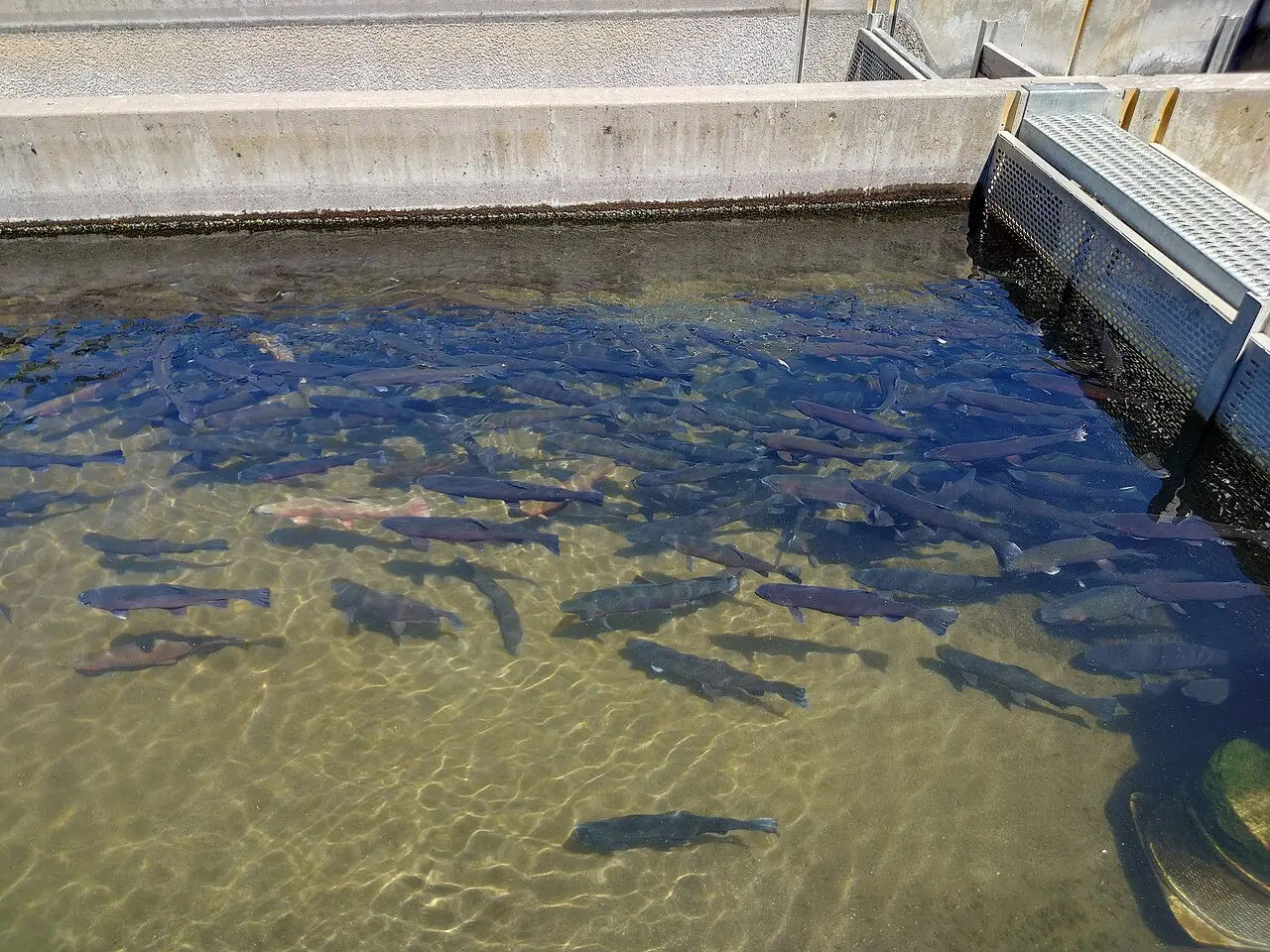
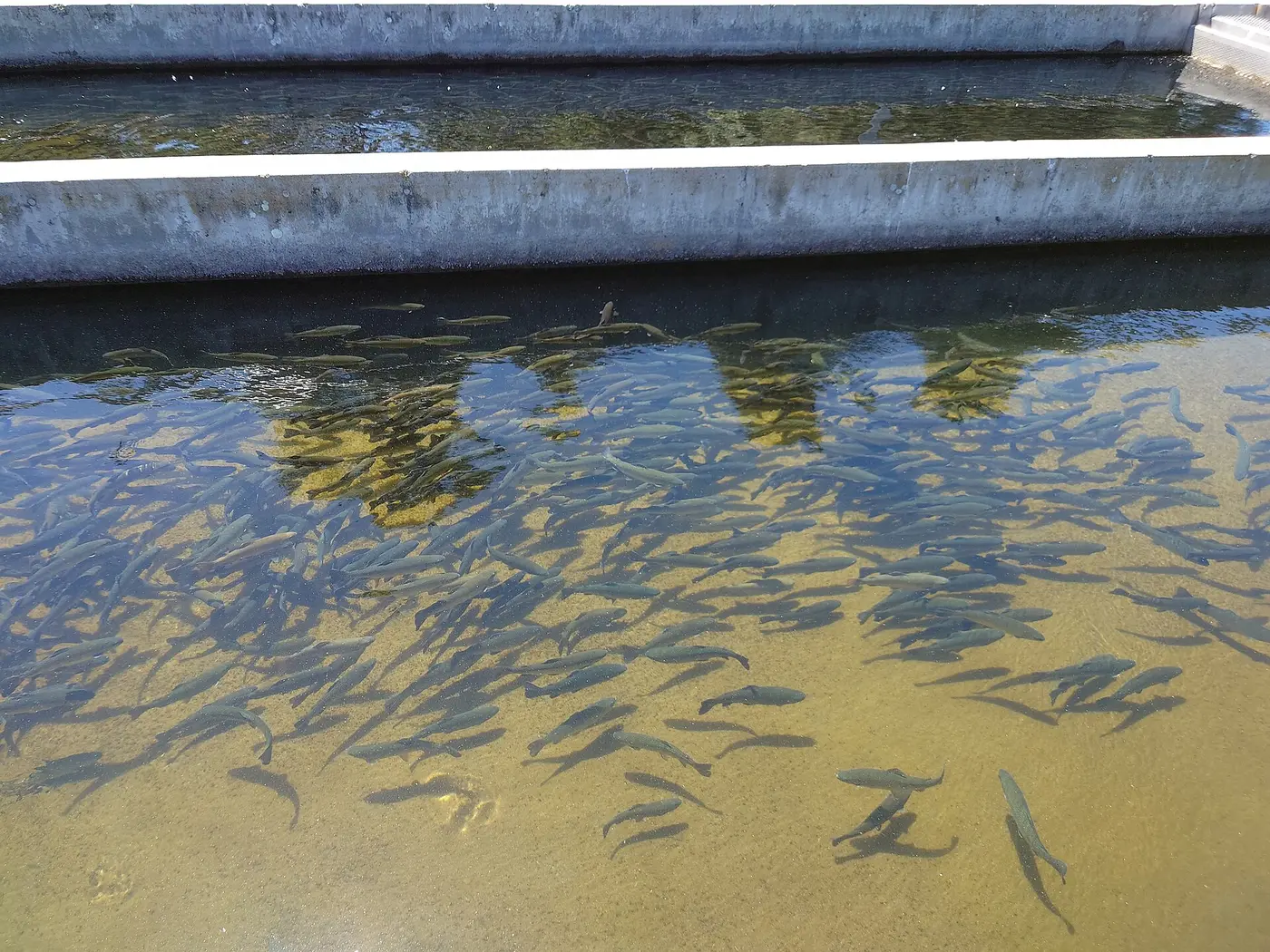
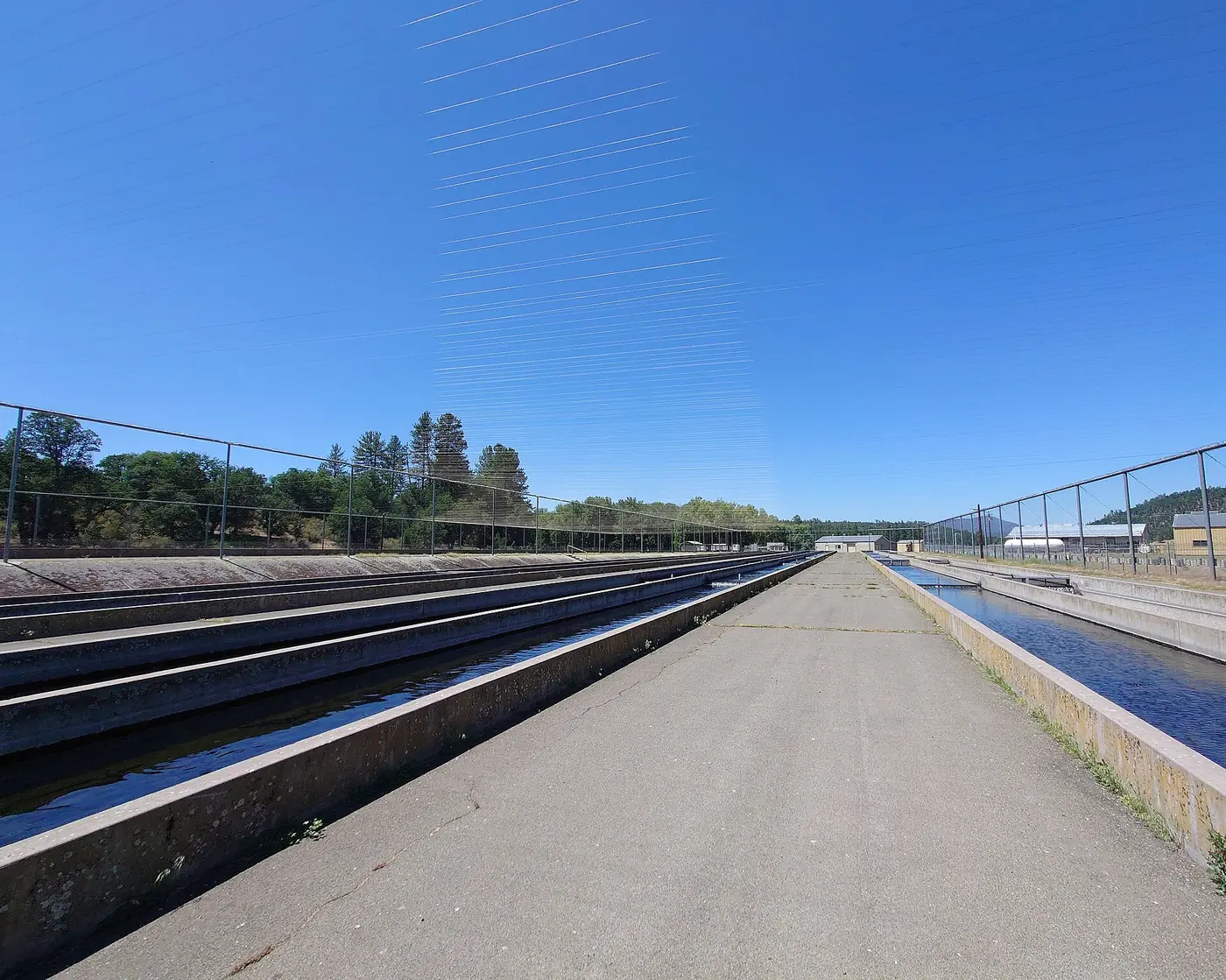
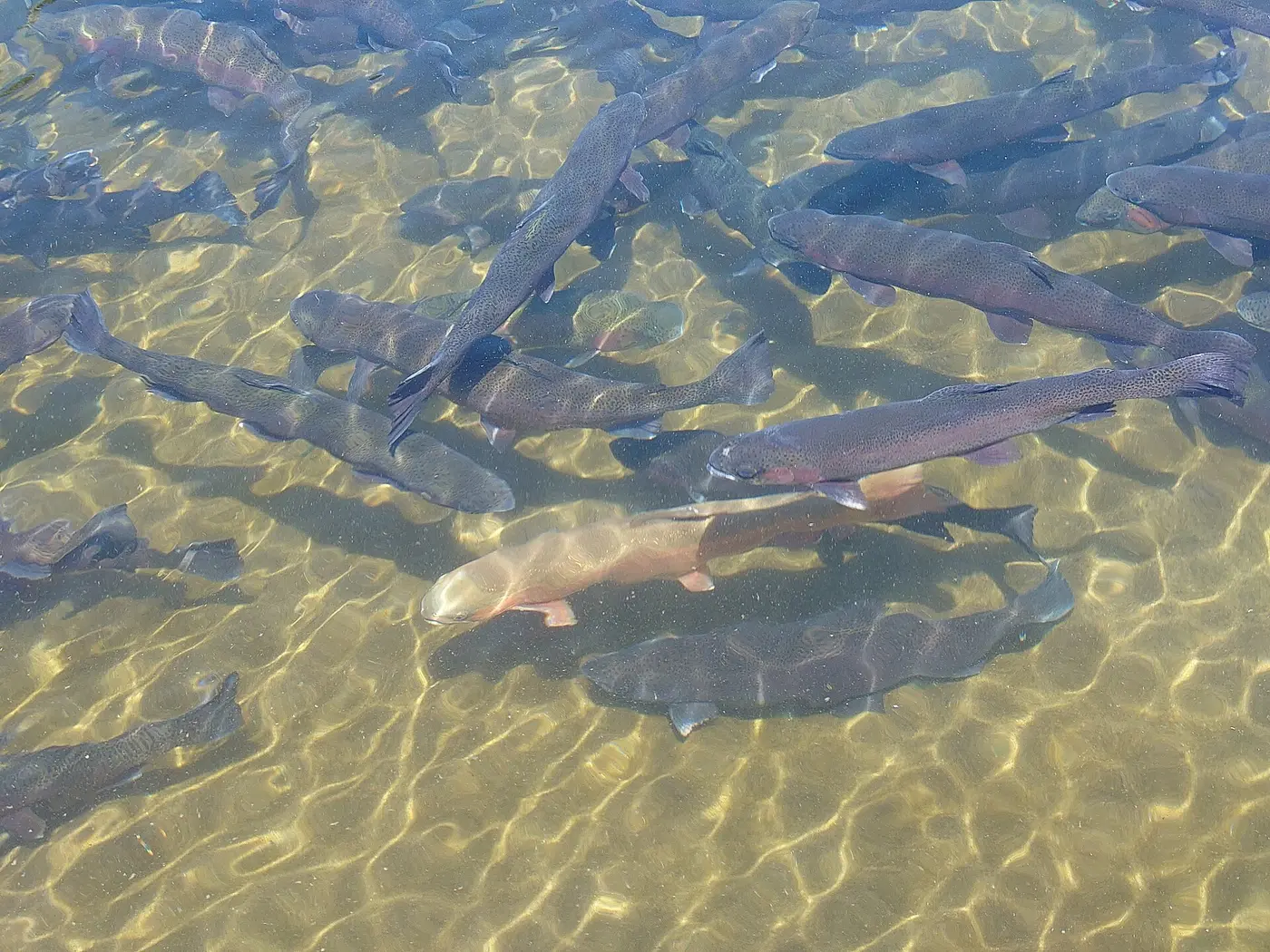
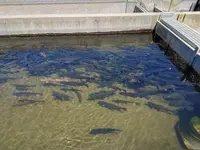
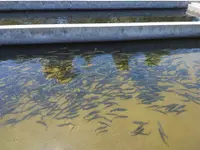
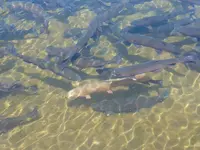
Baum Lake Road runs to a set of long concrete raceways on the south shore of Baum Lake, near Cassel and about ten miles east of Burney. In the ponds lie trout: Pit River rainbow, Eagle Lake rainbow, brown, and brook. Crystal Lake Hatchery belongs to the California Department of Fish and Wildlife. During open hours visitors walk the grounds on their own, look into the raceways from the edge, and watch the crew sort broodstock and tend the ponds.
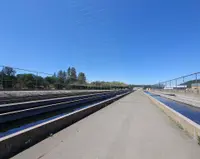
Raceways on the south shore of Baum Lake
A 2010 state report on hatchery operations sets out the layout. Twelve raceways, each 500 feet long and divided into five 100-foot concrete ponds, carry water from Rock Creek Springs. Six form the Upper Series. From there the water passes through an aeration tower that raises its oxygen and runs on to the six raceways of the Lower Series. Two shorter raceways, the Brood Pond Series, draw from Crystal Lake by canal.
Around the raceways stand:
- a spawning building
- a hatchery and egg-incubation building
- a small hatchery building called the Davis Building
- an office and shop
- a truck garage
- a storage freezer the report calls the meat house
- bulk-feed bins
- public restrooms
Everything that leaves the ponds goes through settling ponds before it reaches Baum Lake.
The sources count the plant differently. The Fish Pathogens database lists 66 concrete rearing ponds raising 1,500,000 fish a year, about 500,000 pounds of them. The department’s history page gives 7 raceways and the same 1.5 million fish. By that page’s figures the hatchery stocks approximately 60 waters in Lassen, Modoc, Shasta, Siskiyou, and Trinity counties.
Crystal Lake keeps its own broodstock. It also runs the Eagle Lake spawning program at the Pine Creek trap. Eggs taken there are raised here and at Darrah Springs Hatchery for return to Eagle Lake and other waters, and brook trout eggs go from here to Mount Shasta Hatchery. In the fall the crew spawns trout on site. The department advises calling ahead to arrive while the work is under way.
From spring through summer, 200 to 300 adult Canadian geese bring their goslings onto the hatchery grounds and the shore of Baum Lake, and ospreys nest nearby. The Pacific Crest Trail passes along the edge of the hatchery. Hikers stop there to picnic at the tables, look at the fish, and drop a line in the lake. Baum Lake is open year-round for rainbow and brown trout. Anglers fish it from small boats, float tubes, and pontoon boats, with electric motors only.
Rock Creek water and a crayfish refuge
The hatchery draws on two waters. The Fish Pathogens database gives Rock Creek at 18 to 23 cubic feet per second. Crystal Lake has 50 available, of which the hatchery uses 6 to 8.
Rock Creek’s course above the hatchery was rebuilt in 2016 by PG&E, the department, the U.S. Fish and Wildlife Service, and Spring Rivers Ecological Sciences. The work removed a diversion dam upstream and rerouted the pipeline that carried water down to the hatchery. A dry meadow reach six-tenths of a mile long now flows with cool, clear water among rock clusters and new riparian plantings.
The site was chosen because the hatchery would block Signal Crayfish in Crystal Lake from moving upstream. The Signal Crayfish is an invasive species. It outcompetes the Shasta Crayfish, California’s only remaining native crayfish and an endangered species since 1988, and largely renders its females infertile through interbreeding. Crystal Lake is believed to hold the most genetically robust wild population of Shasta Crayfish left.
In June 2019, Spring Rivers scuba divers took Shasta Crayfish from the bottom of the lake and held them in quarantine for 42 days. On July 15 divers released 28 of them by hand into the restored creek.
The main supply line crosses Baum Lake itself. It is a 24-inch pipe, about 80 feet of it slung from a steel cable suspension bridge. A notice filed February 27, 2026, reported the line in imminent threat of failure. The pipe had shifted, likely in a sudden and unexpected seismic event. It carries the water for the houses, for fire suppression, and for the fish. The department planned to replace the bridge with an Acrow-style modular cantilever launch bridge carrying a new 24-inch pipe on its deck. The plan also takes down the two steel suspension towers and an abandoned 16-inch suspended pipeline, all without touching the lake’s surface or banks. Brian Rushton, senior hatchery supervisor, is listed for the work.
Frank Baum’s ranch at Cassel
The lake carries the name of Frank Baum, a hydroelectric engineer born in 1870 who took his engineering degrees at Stanford. He married Mary Dawson in 1901. He designed the Electra Powerhouse on the Mokelumne River, which, Dottie Smith wrote in a 2008 Redding Record Searchlight column, supplied San Francisco with its first hydroelectric power.
In 1908, while looking for power sources in Shasta County, Baum bought the 1,600-acre Crystal Lake Ranch at Cassel from W. W. Brown. Baum was not a rancher, so he hired Brown to stay on as foreman. As PG&E’s chief hydroelectric engineer from 1912, Baum mapped and designed the Pit River plants, No. 1 through No. 8. He also designed the Hat No. 1 and Hat No. 2 powerhouses, which were built on his own Cassel land. His house stood where Crystal Lake drains into Hat Creek.
After leaving PG&E in 1923, he built a high-voltage laboratory at the horseshoe bend of Hat Creek near the Rock Creek drainage. The laboratory no longer stands. According to Smith he held at least 21 patents and is credited with the first high-voltage circuit breaker. One invention came from watching the ranch hands pitch loose hay onto a wagon: a hay loader, later sold through Sears & Roebuck.
Another invention led to his death. Testing an electric air cooler on the kitchen roof of the Golden Eagle Hotel in Redding, he fell to the pavement. He died two days later, in 1932. The house at Cassel burned in 1936 and was never rebuilt. Mary Baum stayed on the ranch until 1939, then sold it to PG&E and moved away. The utility later leased part of it to the State of California.
From Hat Creek to the 1947 hatchery
The hatchery’s own line begins on Hat Creek. In 1885 the California Fish Commission authorized a salmon hatchery there. Its building was 100 feet by 46, with 64 troughs and room for about 10 million eggs. The runs were already dwindling. The first year yielded 1.2 million eggs and the second about half a million, and in 1888 the site was abandoned.
In 1915 eggs from another station were to be raised at Hat Creek. That May Mount Lassen erupted. Over three days, ash, mud, snowmelt, lava, and debris poured down the Hat Creek drainage, and the creek stayed muddied and unfit for trout for several years. A 2010 state report says the eruption killed all the fish in the creek.
In 1927 PG&E built the Burney Creek Hatchery on the Burney Creek arm of Lake Britton. The utility built it in place of a fish ladder over dam Number 3 on the Pit River, and it opened with 100 troughs. The Civilian Conservation Corps added four dirt ponds in 1933. Winter floods in 1937 badly damaged the hatchery, but it was repaired and kept running. By 1949 its water supply was failing, most buildings were in bad shape, and the operation was moved 20 miles to Baum Lake.
The money for the move came from the state legislature. Between 1910 and 1947 the Fish and Game Commission received no state appropriations, while anglers pressed for catchable trout of 6 to 10 inches. The Wildlife Conservation Act of 1947 created the Wildlife Conservation Board and funded new hatcheries, and Crystal Lake was the first and largest project it paid for.
The new hatchery was built in 1947 and 1948 on 40 acres of PG&E land. The department’s history page says it began with 24 raceway ponds and 6 employee houses. The Fish Pathogens database counts 28 dirt ponds, 6 residences, a utility building, a garage, a shop, and an office. Fish were in the ponds the year construction began.
In that first year the trout parasite Ceratomyxa shasta caused serious losses. The next year, at signs of a second outbreak, the crew switched the supply from Crystal Lake to Rock Creek, which was free of the parasite. The hatchery was completed in 1955 and modernized in 1976.
Notable Events
- 1885In 1885 the California Fish Commission authorized a hatchery on Hat Creek to spawn salmon, the first in the line of hatcheries that led to Crystal Lake. wildlife.ca.gov
- 1888The Hat Creek site was abandoned because adult salmon returns were insufficient to justify operation. wildlife.ca.gov
- 1908While searching for power sources in Shasta County, Frank Baum purchased Crystal Lake Ranch at Cassel from W. W. Brown and hired Brown as ranch foreman. archive.redding.com
- 1915Mount Lassen erupted in May and flooded the Hat Creek drainage with ash, mud, snow melt, lava and debris; its water was uninhabitable by trout for several years. wildlife.ca.gov
- 1923Baum left PG&E for private consulting and built a high-voltage laboratory on his property at the horseshoe bend of Hat Creek near Rock Creek drainage; the laboratory no longer exists. archive.redding.com
- 1927Pacific Gas and Electric built the Burney Creek Hatchery on the Burney Creek arm of Lake Britton in lieu of a fish ladder over dam Number 3 on the Pit River. wildlife.ca.gov
- 1933The Civilian Conservation Corps added four dirt ponds to provide additional space. wildlife.ca.gov
- 1936The home where Crystal Lake drains into Hat Creek was destroyed by fire and never rebuilt. archive.redding.com
- 1937Serious winter floods severely damaged the hatchery, but it was repaired and continued operating. wildlife.ca.gov
- 1939Mary Baum lived at the Cassel ranch until 1939, when she sold it to PG&E; PG&E later leased a portion to the State for the hatchery. archive.redding.com
- 1947The installation was built on 40 acres owned by P.G.& E. as the first major project financed by Wildlife Conservation Board Funds. fishpathogens.net
- 1947Construction started and operation began in the same year. wildlife.ca.gov
- 1949Operations were discontinued as the water supply deteriorated and most buildings were in bad shape. wildlife.ca.gov
- 1955The hatchery was completed. wildlife.ca.gov
- 1976The hatchery was modernized. fishpathogens.net
- 2016Rock Creek restoration removed an upstream diversion dam and rerouted the pipeline supplying Crystal Lake Hatchery; the hatchery would block invasive Signal Crayfish from moving upstream into the restored reach. wildlife.ca.gov
- 2026The main water supply line was in imminent threat of failure; CDFW planned to replace the bridge structure and waterline suspended over Baum Lake. ceqanet.lci.ca.gov
- A serious outbreak of Ceratomyxa shasta, a lethal parasite of trout, caused serious fish loss. wildlife.ca.gov
- Seeing signs of another outbreak, the water supply was changed from Crystal Lake to nearby Rock Creek, which did not have the parasite. wildlife.ca.gov
People
- Frank Baum, Purchaser of Crystal Lake Ranch at Cassel who hired Brown as foreman while devoting himself to hydroelectric energy (1870-1932).
- Mary Dawson, Baum's widow, who remained at the Cassel ranch and sold it to PG&E (until 1939).
- W. W. Brown, Seller of Crystal Lake Ranch to Baum, then hired by Baum as ranch foreman (1908).
- Brian Rushton, Senior Hatchery Supervisor listed for the lead/public agency undertaking the emergency waterline repairs project.
- Chris Prosco, Pit River Tribe director of natural resources and roads who requested more specific hatchery-program information (January 2, 2009).