Crook County Fair
Prineville, OR, Crook County, Oregon. County fair.
Details

- Where
- 1280 S Main Street, Prineville, Prineville, OR, OR 97754. Directions
- When
- 2027 Crook County Fair dates August 02 - 07.
- Fees
- Free admission and free parking; concerts free.
- Hours
- Wednesday, August 5th: 5pm - 9pm; Thursday/Friday/Saturday: 10am - 9pm.
- Access
- No wheelchair rentals; volunteers on golf carts pick up fair guests.
- Walk-in or reserve
- No ticket needed for free concerts; walk-in.
- Phone
- (541) 447-6575
- Website
- crookcountyfairgrounds.com
- Managed by
- Crook County Fairgrounds.
Blue Ribbon Days under smoke
On August 5, 2026, the opening day of the fair billed as Blue Ribbon Days, Frank Rendon rode a full-grown longhorn steer down a row of tents at the Crook County Fairgrounds in Prineville. There was no crowd to work the animal’s horns around. Wildfire smoke lay over the grounds, and OPB reported the air quality index in Prineville at 439, an emergency-level risk to everyone outdoors. Carnival rides turned with few riders, many at less than half occupancy. Rendon expected some people would come anyway. “I think the diehards will be out here today,” he said.
Some fairgoers wore N95 masks. Megan Jones had brought her family to support her 12-year-old daughter, Audrey, who was showing her first animal, a pig named Dexter. “We have headaches and we’re coughing,” Jones said. “It’s miserable, but we take breaks. We have our trailer here, so we go in and turn on the air and take some breaks.” Laila Harling, 11, of Prineville, said her hog, Duke, had shown signs of asthma and that many of the animals had developed a cough. Kimberly Venable, 11, of Alfalfa, whose mother had debated staying home, rode the mechanical bull after the air improved through the day. Rachel Wafford of Prineville photographed her children, John, 3, and Willa, 6, beside a towering Smokey Bear display. For her family, she said, the fair marks the end of summer.
In the main tent the fair organizer, Linda Smith, sat with a couple of volunteers while people trickled in. Some vendors had already dropped out, and she was concerned about a planned breakfast for veterans. “I’m worried about that because they’re older and they have more health problems,” she said. “We usually have quite a few people there and it’s kind of one of my passions.”
Sheep, ponies and a dinky train
In a clear year the fair runs four days, opening Wednesday at 5 p.m. and running 10 a.m. to 9 p.m. Thursday through Saturday. Admission and parking are free. So are the evening concerts on the Main Stage, where there is standing room, first-come seating and tables under the Main Stage Tent, with the food trucks and beer garden beside it. Godfrey the Magician gives a 30- to 45-minute show on the same stage several times a day.
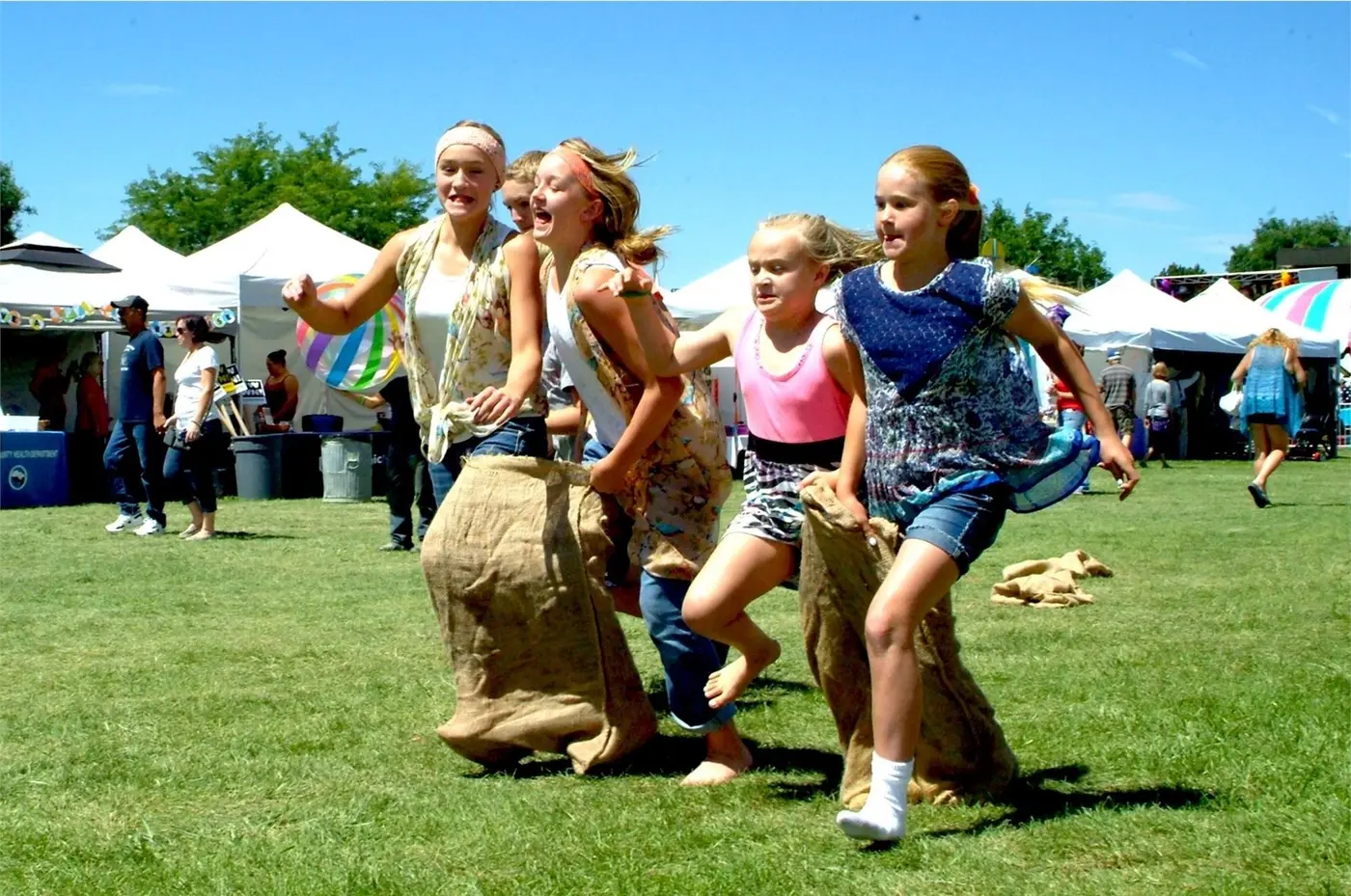
Most of the children’s attractions cost nothing. In Mutton Bustin’, run by Ride Hard Entertainment, children under 55 pounds try to stay on a sheep as long as they can; each gets a prize, usually a ribbon, and the buckle finals are held Saturday evening. Tumbleweed Pony Co. gives rides to children of 70 pounds and under in a ring behind Grizzly Mountain Pavilion, in the shade of the fairgrounds’ mature trees. A dinky train picks up riders of any age at the “Train Crossing” sign near the Info Booth and runs around the asphalt loop. The Super Science Company sets up the Puzzlemania tent, with chess and other games built oversize. Jim and June of JJ Entertainers paint faces and twist balloons for donations. “I’ve been happily twisting balloons off and on since 1996,” Jim says. In its own building between Carey Foster Hall and the Grimes Christmas Scene, the Crooked River Model Railroad Club shows a layout of Central Oregon’s history and landscape, built and kept by members and changed with the seasons.
Wold Amusements brings the carnival; a $40 wristband gives one rider unlimited rides for one day. The fairgrounds have no wheelchairs to lend, but volunteers on golf carts will carry guests where they need to go. Only certified service dogs are admitted, for the safety of the livestock and the exhibitors, and smoking is barred in the barns.
The barns hold the work of the county’s 4-H and FFA members, who spend the year feeding, training and caring for their animals, and who also enter baked goods, artwork and crafts. A youth Horse Fair comes ahead of fair week, and the Youth Livestock Auction closes it. The 2027 fair is set for August 2 through 7, with the auction on August 7, 2027.
A track south of town
The fair grew out of horse racing. The Crooked River Roundup’s history traces racing in Prineville to 1880, when a half-mile track was laid out south of town near where Stewart Dam is now. Carey Foster, whose name the fairgrounds hall carries, said races were sometimes run straight down 3rd Street. Around 1900 a mile-long track went in where Crook County High School now stands. In 1903 another track and some grandstands were built on the present fairgrounds, and the first Fair Association was formed. The next year brought the first Central Oregon Fair, made up mainly of an annual horse race and some small exhibits.
On October 10, 1912, the Madras Pioneer reported that J. N. Williamson, president of the fair society, had been around Madras the day before “doing a little advertising on his own hook,” putting up large posters at crossroads. Nearly everything on the grounds had been rebuilt or built over, the paper said, and the half-mile track was in fine condition for horses already entered, many coming from the circuit races at Boise. The chief new feature was to be aeroplane flights by an aviator whose name the scanned page renders as Christoffcrson. “There is no fake business about this part of the programme,” the paper was assured by Williamson. The society had given every registered school child in the county a season ticket, and the children were reported “very enthusiastic over the expectation of the large amount of pop corn and taffy.”
The 1912 paper already called the track a half-mile, though the fairgrounds’ history dates the half-mile oval to 1915, when the fair sold half its ground and shortened the track. The 4-H program reached Crook County in 1914. In 1917 the fair became the Oregon Interstate State Fair, and in 1927 it took its last name, the Crook County Fair. The grounds meanwhile passed through private hands. J. B. Shipp and Gardner Perry ran them until 1935, when Perry sold to M. D. Spreckles Jr. of San Francisco. Harry Walters bought them in 1936 and sold in 1940 to Robert Lister of Paulina, who sold to Warren Raymond.
Jess Cain’s rodeo and the 4-H corner
There had been no rodeos during the war years. In 1944, according to the Roundup’s history, a group of local ranchers with $320 decided Prineville needed a rodeo. Jess Cain lent $1,000. The stock contractor, Max Barber, sold his stock two weeks before the show, and Pat Fisk supplied stock instead for $1,500. Lew Lynn, a local auctioneer, worked as clown, and Lance Smith repaired and remodeled Cain Hall. The rodeo cleared $850. Elsie Stover, in “The Pioneer Story,” published in 1950, wrote of Cain at the time: “Sure, he was 70 years old, but that didn’t seem like very old, not to Jess Cain.”
The founders sold 120 shares at $100, and Cain sold them all in six weeks. With the money the new Crooked River Roundup and Fair Association bought the grounds from the Raymonds for $11,000 cash. The Roundup’s narrative and the fairgrounds’ history both date the purchase to 1945; the Roundup’s biography of Warren Raymond places the sale in 1946. On September 2 and 3, 1945, the First Crooked River Roundup and 4-H Club Fair was held, with Orville Yancey as chairman and Cain as treasurer. Over those two days there were a bridle horse contest, cow cutting and the 4-H Club Fair.
In 1946 the grounds got new bucking chutes, fences and a grandstand foundation. A city block was set aside for the 4-H Club Fair, 30 stalls were built for stock, and every building was painted white with a green roof. The new sawdust show arena was wet down each day against wind and dust. In 1948 lights went up in the arena, and the school district began playing night football there on the dirt.
In 1954 the fair and the rodeo separated. Fred Grimes replaced Cain as manager, and the Fair Board signed a 50-year lease on the 4-H corner of the Roundup grounds. If the two events were held at different times, each could use the other’s facilities without rent. The Roundup’s history records that attendance at the rodeo fell in the late 1950s and early 1960s and cash ran short. “Splitting fair-rodeo combination had hurt,” it says.
Bees in Cain Hall
In 1972, with laws changing in Salem to make nonprofits pay property tax, the Roundup board had almost no cash and faced bankruptcy. Jim Minturn negotiated the answer: the Roundup deeded its grounds to Crook County at no cost, in return for five years of free rent, and the county could draw on state and federal grants to improve them.
In 1979 the county held a grant for an indoor arena when the design work turned up problems with the old wooden grandstand. Under Judge Dick Hoppes the county tore it down, scaled back the arena and put the savings into a new metal grandstand. Because the grandstand sat differently against the track, about half the track was rebuilt, and the county, the Fair Board and the Roundup together built a new jockey’s room, paddock and pari-mutuel building. Pete Sturza was fairgrounds manager. Roundup president Snoden DeBoard led the volunteers, Archie Hollis led the crew on the grandstand track lights, and Cecil Sly, a retired volunteer, is remembered for leading the final work party.
In 1989 the Roundup bought 40 portable stalls at the Jefferson County Fairgrounds and moved them to Prineville, which put every race horse in a real stall and, in the fairgrounds’ words, helped make the grounds the “Horse Capitol” of Central Oregon. In 1991 lights donated through other Oregon tracks relit the course, and the box seats were rebuilt with local donations. In 1993 Crown Pacific Sawmill gave lumber and the Roundup gave labor to rebuild the paddock. The same year, the Roundup’s history tells, honeybees that had settled on Cain Hall as their permanent home outlasted every attempt to move them. The rodeo office went into the Pari-Mutuel Building, and Cain Hall was torn down.
The Fair Board moved the fair to the third weekend in July in 1995 and returned it to the second weekend in August in 2007. County money and a state grant paid in 1999 for a new office, a maintenance shop and the entryway. The entrance arch off South Main memorializes Art Smith, who led volunteers in preparing the grounds and died in 1987; the Roundup board and his family helped put it up. That same year the Crook County Historical Society built its Ranchers’ Memorial Building on the fairgrounds, to hold donated ranching equipment and a 1907 Studebaker Phaeton, and renovated it in 2014.
In March 2026 the Bowman Museum asked Prineville families for photographs taken at the fair between 1940 and 1980, for an exhibit: the fairgrounds, livestock shows, carnival rides, exhibits and contests.
Notable Events
- 1903The fairgrounds were established; originally only a race track and some grandstands. crookcountyfairgrounds.com
- 1904The first Central Oregon Fair was held, made up mainly of an annual horse race and some small exhibits. crookcountyfairgrounds.com
- 1912The newspaper reported that nearly everything on the grounds had been rebuilt or built over and the half-mile race track put in fine condition. oregonnews.uoregon.edu
- 1914The 4-H Program was established in Crook County. crookcountyfairgrounds.com
- 1915The Fair sold half of the ground and the track was reduced to the current half-mile oval. crookcountyfairgrounds.com
- 1917The Fair name was changed to the Oregon Interstate State Fair. crookcountyfairgrounds.com
- 1927The Fair name was changed a final time to The Crook County Fair. crookcountyfairgrounds.com
- 1945The Crooked River Roundup and Fair Association were formed and the first Roundup Rodeo was held; on September 2 and 3, 1945 the first Crooked River Roundup and 4-H Club fair was held. crookcountyfairgrounds.com
- 1946New bucking chutes, fences and a grandstand foundation were added; a city block was dedicated to the 4-H Club Fair and 30 stalls were built for stock. crookcountyfairgrounds.com
- 1946The biography says Raymond sold the grounds to the Roundup; this differs from the same page's narrative date. crookedriverroundup.com
- 1948Lights were installed in the arena and the school district began holding night football games there. crookcountyfairgrounds.com
- 1954It was decided that the Fair and the Rodeo should separate; the Fair board and the Roundup signed a 50-year lease for the 4-H corner of the Roundup Grounds. crookcountyfairgrounds.com
- 1972Facing property taxes and certain bankruptcy, the Roundup deeded its grounds to Crook County at no cost, in exchange for five years of free rent. crookcountyfairgrounds.com
- 1972Joe Shoun was in charge of redesigning the chutes. crookedriverroundup.com
- 1979Problems were found with the wooden grandstand during design of an indoor arena; the County tore it down and used the money saved by scaling back the arena to build the new grandstand. crookcountyfairgrounds.com
- 1987The historical society's Ranchers’ Memorial Building project produced a new building at the Crook County Fairgrounds. crookcountyhistorycenter.org
- 1987Following Smith's death, the Roundup board and his family helped establish the fairgrounds entrance arch off South Main; no exact construction year is stated. crookedriverroundup.com
- 1989The Roundup bought forty portable stalls at Jefferson County Fairgrounds and moved them to Prineville. crookcountyfairgrounds.com
- 1991Major fairgrounds renovations included donated track lights and rebuilt box seats through local work and donations. crookcountyfairgrounds.com
- 1993The history says persistent honeybees prompted moving the rodeo office into the Pari-Mutuel Building and demolishing Cain Hall. crookedriverroundup.com
- 1993Crown Pacific Sawmill donated lumber and the Roundup supplied labor to rebuild the paddock. crookedriverroundup.com
- 1995The Fair Board moved the Fair from the second weekend in August to the third weekend in July; the July dates held through 2006, and in 2007 the Fair returned to the second weekend in August. crookcountyfairgrounds.com
- 1999County funds and a state grant secured construction funding for a new office, maintenance shop and entryway. crookcountyfairgrounds.com
- 2007The Fair Board moved fair dates back to the second weekend in August. crookcountyfairgrounds.com
- 2014The building at the fairgrounds underwent a major renovation. crookcountyhistorycenter.org
People
- Carter Bond, Bowman Museum collection manager receiving historic fair photographs.
- Gardner Perry, Owned and operated the grounds; sold to M.D. Spreckles, Jr (until 1935).
- Harry Walters, Owner of the grounds (1936-1940).
- J.B. Shipp, Owned and operated the grounds (until 1935).
- M.D. Spreckles, Jr., Owner of the grounds, of San Francisco (1935).
- Robert Lister, Owner of the grounds, of Paulina (from 1940).
- Warren Raymond, Original board member who sold the grounds to the Roundup (1946 sale, as biography states).
- Alvin Grimes, Fairgrounds manager (late 1970s).
- Archie Hollis, Led the crew that got grandstand track lights working by dark during the rebuild (1979).
- Art Smith, Volunteer grounds-preparation leader whose family helped establish the entrance arch after his death (died 1987).
- Cecil Sly, Retired volunteer remembered for leading the final work party preparing the rebuilt grounds.
- Don Snable, Powell Butte farmer who later served as fair manager.
- Doug Smith, Volunteer in the facility rebuilding effort.
- Duaine Mizer, Built and reworked fairgrounds facilities.
- Hugh Rockwood, Designed and built the starting gate used from the start of pari-mutuel racing.
- Jerry Breese, Member of the original board at the combined Roundup and club-fair founding.
- Jerry Sitzman, Volunteer in the facility rebuilding effort.
- Jess Cain, Treasurer at the first Crooked River Roundup and 4-H Club Fair (1945).
- Jim Minturn, Negotiated the deal turning the grounds over to the county (1972).
- Joe Shoun, Directed redesign of roping and bucking chutes (1972 and 1973).
- Judge Dick Hoppes, Led the county decision to replace the old grandstand with a metal grandstand while scaling back the indoor arena project.
- Mike Mizer, Played a major part in fairgrounds rebuilding (1979 and 1980).
- Orville Yancey, Elected Chairman at the first Crooked River Roundup and 4-H Club Fair (1945).
- Pete Sturza, Fairgrounds manager during the rebuilding (1979).
- Snoden DeBoard, Roundup president during the rebuilding; led volunteer work to prepare the facility.
- Von Thompson, Volunteer and board member during the major rebuilding.
- Christoffcrson, Announced aviator for proposed fair flights; name retained as OCR renders it.
- J. N. Williamson, President of the fair society, advertising the Prineville fair around Madras.
Sources
- crookcountyfairgrounds.com/p/fair
- crookcountyfairgrounds.com/directions.aspx
- extension.oregonstate.edu/4h/crook/fair
- crookcountyfairgrounds.com/p/fair/concerts
- crookcountyfairgrounds.com/p/fair/daily-entertainment
- ktvz.com/news/2026/08/05/crook-county-fair-opens-thursday-with-rides-livestock-and-family-fun
- opb.org/article/2026/08/08/smoke-covers-rural-oregon-but-the-county-fair-goes-on
- crookcountyfairgrounds.com/events/fair
- crookcountyfairgrounds.com/p/about
- crookcountyfairgrounds.com/p/about/147
- crookcountyhistorycenter.org/2026/03/fair-memories-wanted-share-your-historic-crook-county-fair-photos
- crookedriverroundup.com/history