Columbia State Historic Park
Columbia, Tuolumne County, California. State Historic Park.
Details

- Where
- 22708 Broadway Street, Columbia, CA 22708. Directions
- When
- Free daily town tours, about one hour, led by park staff and docents; meet in front of the museum.
- Season
- Park Exhibits open daily October 1st through April 30th and May 1st through September 30th; park exhibits closed on Thanksgiving and Christmas Day.
- Getting there
- Columbia State Historic Park is three miles north of Sonora, off Highway 49.
- Fees
- Vehicle Day Use: Free; some special events charge.
- Hours
- Park Exhibits open daily 10 a.m. - 4 p.m. October 1st through April 30th and 10 a.m. - 5:00 p.m. May 1st through September 30th. Most merchants are open from 10 a.m. - 5 p.m.
- Access
- Vehicle Day Use: Free. Park Admission and Parking FREE (some special events require a fee to participate).
- Walk-in or reserve
- Groups of ten or more must arrange town tours in advance by calling 209.588.9128.
- Phone
- (209) 588-9128
- Managed by
- California State Parks (California Department of Parks and Recreation).
- Established
- 1945.
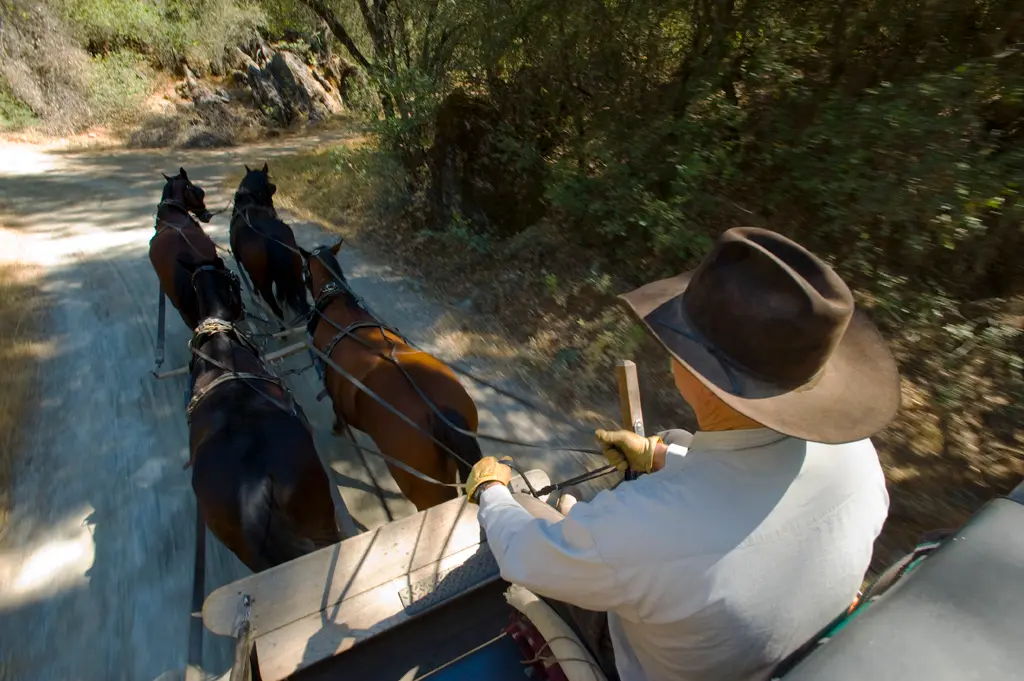
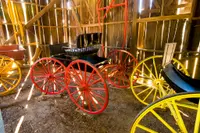
The stagecoach comes down Main Street in Columbia, season and weather permitting, past storekeepers and clerks dressed in the clothes of the 1850s. The town stands at 2,100 feet in the oak woodlands of the Sierra Nevada foothills, three miles north of Sonora off Highway 49. California State Parks manages 273 acres of it, and admission and parking are free. The park’s brochure calls it a living gold rush town with the largest collection of gold-rush-era brick buildings in California. About 2,000 people still lived in Columbia in 2019, and the park lies within the town’s working boundaries.
Main Street, boardwalk by boardwalk
The shops sit on raised boardwalks. The Columbia Candy Kitchen sells hand-dipped chocolates. Candles are dipped in a garden courtyard, and Seven Sisters makes soap and candles in what was Konrad’s Garage. There is Ebler’s leather and saddle emporium, a bookseller and stationer in the old Franklin-Wolfe Variety Store, a photographic studio in a former barber shop, and the Columbia Mercantile for groceries. Music comes out of the saloons. In 2019 a street musician called “Tater” played music reflecting California’s Mexican heritage. That year 15-year-old Jack Douglass worked the antique piano in the Jack Douglass Saloon. He was no relation to the saloon’s namesake. “I actually learned the songs from YouTube,” he said.
At Parrott’s Blacksmith Shop the forge is worked. “What we mostly do is make unique gift items for the people who come and visit Columbia,” blacksmith Erik Waight said in 2019. Down at Matelot Gulch, visitors pan for gold. After two hours of it, 10-year-old Julliette Carol of Oakland gave her finding: “It’s sorta hard to find actual gold.”
Exhibits fill a dozen buildings: the Wells Fargo office, the assay office, a drug store, a bowling saloon, a Chinese store, a justice court, the jail. The Dentist’s Office opened in July 1978 with the instruments of Dr. Paul F. Sikora, given by his son, a Columbia dentist. The display holds an 1850s case of ivory-handled instruments and tooth keys dating to the Revolutionary War period. Visitors crowd its viewing window to hear a recorded exchange between a gold miner and a dentist. One honorary curator, Dr. Matthew Cummings, once played Dr. Malcolm McCleod Moore, Columbia’s first tooth extractor, in top hat and watch chain, with a jar of teeth. “Pulling teeth was about all dentists did in the 1850s,” he told visitors.
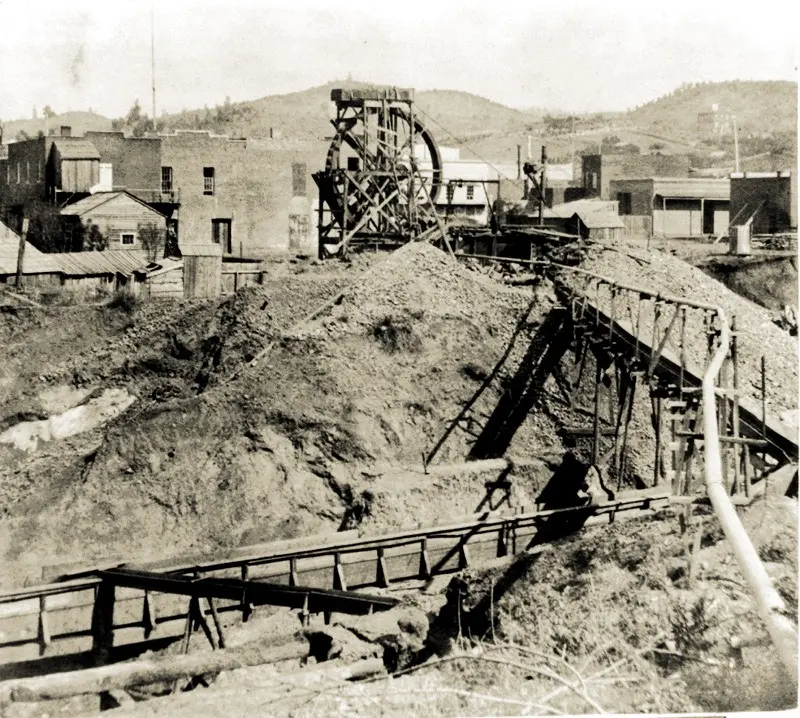
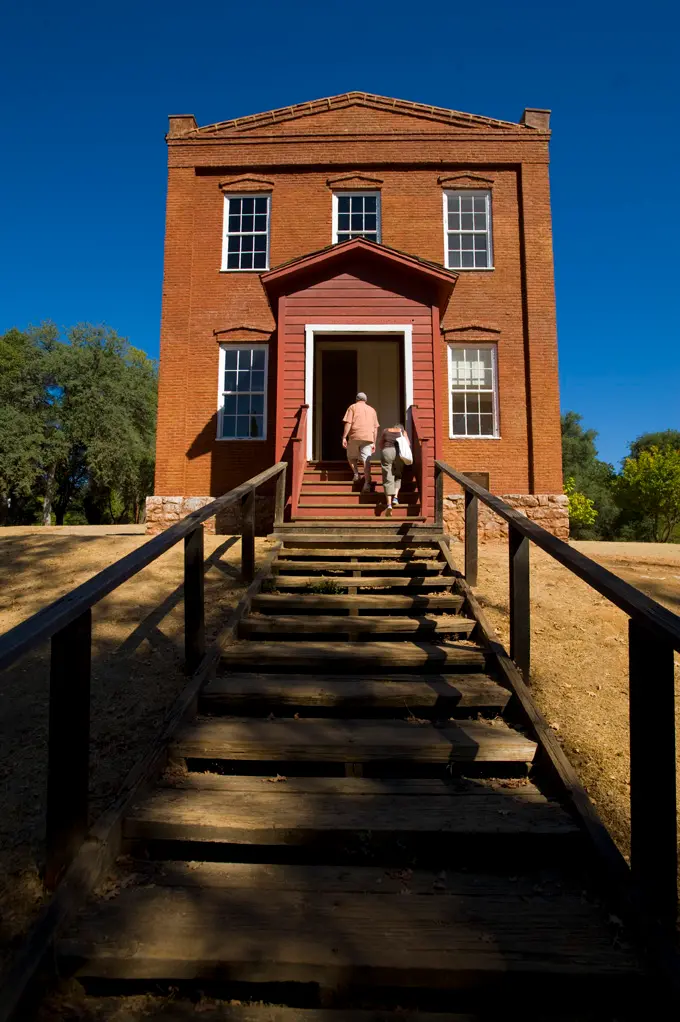
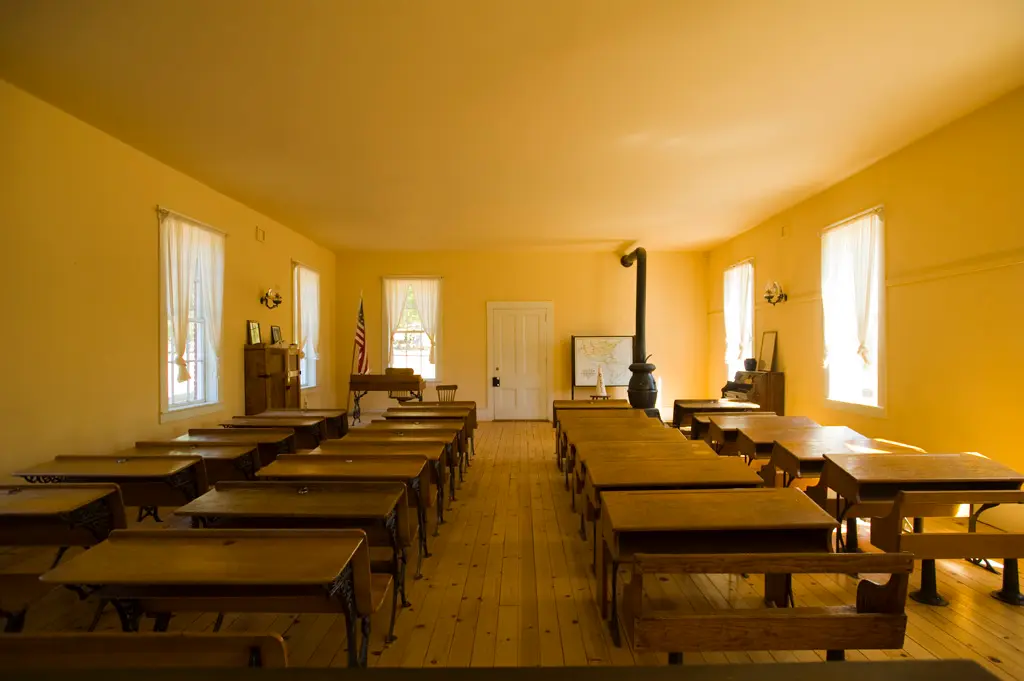
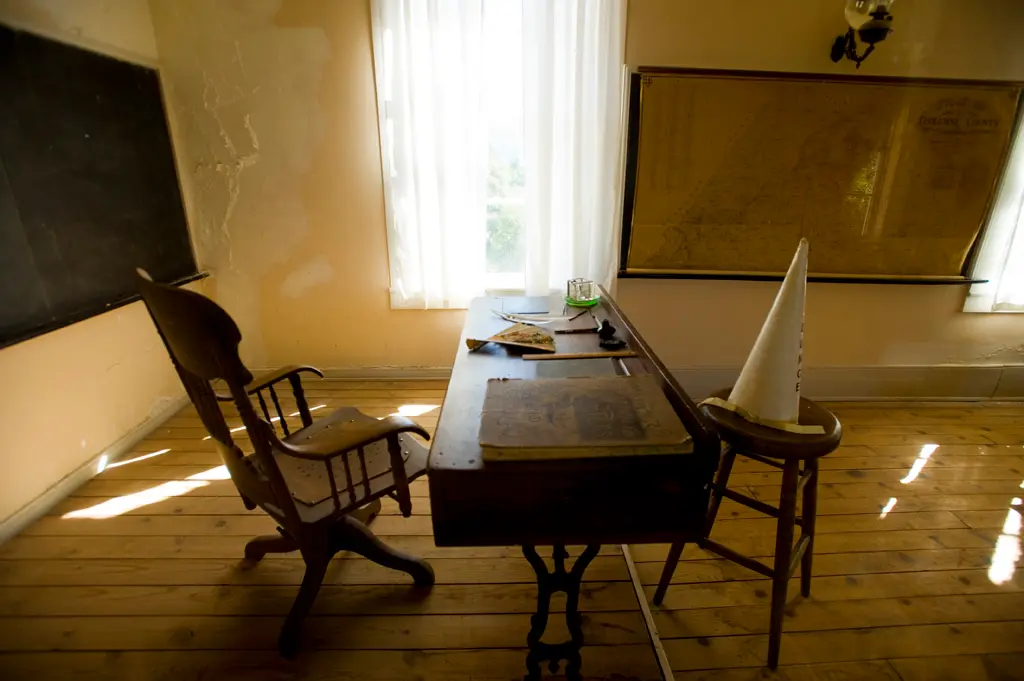
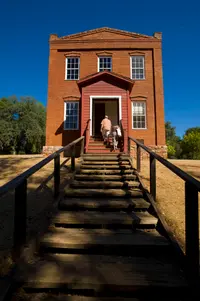
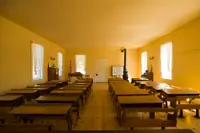
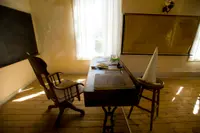
Free town tours, about an hour long, start in front of the museum in the old Knapp Store. In front of the firehouse on State Street is the square lid of a cistern dug beneath the streets after the fire of 1854. Below the main parking lot stand bare limestone formations, washed clean by miners who took the dirt down to bedrock. A walk leads out of town to the two-story brick schoolhouse, built in 1860 and used until 1937, with displays on both floors. The cemetery beside it holds Masonic, Odd Fellows, veterans’, and public grounds. On a hill at the south end of town, facing the schoolhouse, is St. Anne’s Catholic Church, built in 1856. It still belongs to the church and holds services on special occasions. A one-mile nature trail runs through the park.
The 2015 brochure lists Gold Rush Days on the second Saturday of each month, from 1 to 4 p.m., with docents in period dress. It also lists Columbia Diggins, a replica of the 1852 tent town, held the weekend after Memorial Day.
The Fallon House and its boarders
The Fallon Hotel on Washington Street holds the theatre and an ice cream parlor. Owen Fallon, an Ireland-born New Yorker, bought the west lot of the Maine House in 1857. The building had served as a courthouse and boarding house. After fires and rebuilding it became a boarding house named the Fallon House in 1863. That year Fallon bought the east lot and tore down the dividing wall. In 1864 he added ground on the west side for a garden and stables. The ice cream parlor occupies space that once held a gazette and a bakery. The theatre’s box office was once a saloon. The theatre itself was added in 1885.
Dr. Robert Burns, president of the University of the Pacific, bought the hotel in 1944 and sold it to the state in 1947 for $1. From 1949 to 1989 Pacific’s drama students spent their summers in Columbia, living in the Fallon and later in Eagle Cottage, and played repertory in the Fallon House Theatre.
The hotel has its stories, as Our California magazine tells them. A boy is said to have fallen from the window of room six and died. Since then, the account goes, he has been heard running by the door, seen peeking around corners, and has played with toys left in the parlor.
Hildreth’s Diggings
The Central Sierra Miwok lived in the Columbia area for thousands of years. They built multi-family villages near oak groves and water, and lived largely on acorns. Their grinding rocks can still be seen in or near the oak groves. A malaria epidemic struck in 1833, and the gold rush brought further abuses and deaths. The descendants of Miwok and Yokuts people survive today.
The state’s account of the strike is precise. On March 27, 1850, Dr. Thaddeus Hildreth, his brother George, John Walker, and others were caught in a rainstorm. While their gear dried, Walker tried his luck in a nearby gulch. The Tuolumne County Historical Society says the party had come from New England by way of Pine Log camp in the Stanislaus canyon, and that Walker found the gold while they were camped overnight along a seasonal creek. In a 2019 television feature, park interpreter Kelly Leage dated the first arrivals to 1848, after Walker dipped his pan into a creek.
Within six weeks thousands of miners had come. Their camp of log cabins and canvas tents, Hildreth’s Diggings, was formally renamed Columbia on April 29, 1850. Two-thirds of the first miners were Mexican. By the summer of 1850 many had left because of the Foreign Miner’s Tax, which charged foreign-born miners $20 a month. By 1852 the town had more than 150 businesses, three churches, a Masonic Lodge, and a branch of the Sons of Temperance. It also had Chinese, French, Irish, Italian, German, and Jewish miners and merchants. The historical society adds that there were so many French residents that for a short time there was a consulate.
Water governed everything. When the seasonal creek dried in the summer of 1850, most miners left, and the dry spring and summer of 1851 emptied the diggings again. The Tuolumne County Water Company formed in June 1851. The brochure says it brought Stanislaus River water about 20 miles by flume, pipe, and ditch. The historical society says its water came from Five Mile Creek. The miners came back. Its rates were high, and in 1854 a company of miners began a 60-mile aqueduct, the Miner’s Ditch, to undersell it. Facing bankruptcy, they sold out to the older company before finishing.
Fire came the same year. In 1854 a blaze destroyed six blocks. Only the brick Donnell and Parsons store at Main and Washington was left standing. The town rebuilt in local red brick. The 1857 fire left only the thick-walled brick buildings with iron shutters. Two volunteer fire companies formed, and their rivalry lasted into the 20th century.
Estimates of the town’s size at its peak run widely. The state puts it at 25,000 to 30,000 by 1853, among the largest cities in California. The Office of Historic Preservation puts it at 4,000 to 5,000 in the 1850s. The historical society gives 6,000 to 8,000. Estimates of the gold differ too. The state says as much as $150 million was mined between 1850 and the early 1900s. The landmark record estimates gold shipments at $87,000,000.
The town’s own historians lay claim to one celebration. In 1862, according to organizer Barbara Balen, Mexican and Latino miners in Columbia heard of the victory over French forces at Puebla and “celebrated here with songs, food and drink, and speeches.” She called it “the first documented place of spontaneous celebrations of Cinco de Mayo.” At the 2022 commemoration she announced that Columbia and Puebla had become sister cities.
Olmsted, the League, and a dinner with the governor
Mining dwindled in the late 1860s. Miners pulled down empty buildings and dug the vacant lots for gold caught in the crevices of the limestone bedrock. The town’s valuation fell from near $1 million in the late 1850s to $150,000 in 1868. The University of the Pacific’s account counts 500 residents remaining. The historical society counts about 1,000 by 1870. Those who stayed worked the marble quarries, the water company, farms and ranches, and the stores that supplied other camps. The brick buildings were never abandoned. In the early 1890s a recession brought more miners, and logging and tourism helped the town get by.
Talk of preservation began in the 1920s with the Columbia Progressive Club. In 1928 the state park commission hired Frederick Law Olmsted Jr. to survey lands for a park system. He recommended Columbia as one of the best-preserved gold mining towns in the state. The historical society explains why so much had survived. The town lay “just far enough off the major road never to be modernized and just close enough never to be abandoned.” Columbia became California State Landmark 123 on July 6, 1933. In 1934 the local artist Otheto Weston and Rita Zimmerman, a Bay Area preservationist, formed the Historic Mining Town Preservation League. The Depression kept them from raising the matching money.
Dr. James McConnell, a dentist, and his wife Geraldine moved onto Main Street around 1940. Many businesses were shuttered. A rumor that the rundown City Hotel would reopen as a house of ill repute moved Geraldine McConnell to act. Governor Earl Warren was a family friend. Over dinner, she remembered, he said: “I’ll get a bill introduced to make Columbia a state park. All you have to do is raise $50,000.” The McConnells helped raise it. On July 15, 1945, Warren moved his office to Columbia for one day and signed SB 1256. He imagined Columbia becoming “the Williamsburg of the West.” Surviving buildings were restored, and replicas were built from old plans and photographs. The Columbia Historic District entered the National Register on October 15, 1966.
The City Hotel, twice
The City Hotel stands on Main Street. Its saloon is still the What Cheer, after the old What Cheer House. Our California dates its start to 1854, when George Morgan bought the north lot. The Union Democrat says Morgan built the brick hotel in 1856. It burned twice and was rebuilt. By 1874 it was the Morgan City Hotel, holding at various times an auction hall, theater, music hall, restaurant, saloon, and the Morgans’ own rooms. By 1890 it had 20 rooms upstairs. Our California says Morgan hanged himself at about that time. The last innkeepers, Mary and Angelo Nadotti, closed it in 1942.
The state bought the hotel in 1947 and used it for storage for years. Its cherrywood bar had been shipped around the Horn for Morgan in 1856. It lay upside down on the dirt floor of a shed nearby. In 1971 State Parks chief William Penn Mott met Robert Deal, a dean at Columbia College. “If you run it, I will rebuild the old City Hotel,” Mott said. The restoration cost the state about $531,000. In the mid-1970s Mel Wallace and Pat Karnos, who held the park’s carpenter concession, copied the broken pieces of the back bar and saved it. The hotel reopened on October 1, 1975, with nine rooms, antique furnishings, and student trainees.
The first chef, Barry Marcillac, came from Ernie’s in San Francisco. His first menu offered coq au vin for $6.75. Bar manager Ben Smart could recite his list of 100 drinks on request, and on New Year’s Eve he dressed in a diaper as the new year’s baby. Tom Bender, a trainee on opening day, became manager in 1985 and held the post for 20 years. In 1993 a snail ate through several expensive wine labels; staff decided it was after the glue. Bender put on a “Snail Fest” with the damaged wines and escargot. The Victorian Feast began as one night in 1982 and ran 15 nights by December 2005, with music, a melodrama, and four courses with wine.
The college partnership ended in April 2006. Concessionaires followed: Forever Resorts until 2009, Jeff and Jackie Briggs from 2010 to 2014, and the Segarini family from 2015 to 2020. On December 22, 2022, the Columbia City Hotel Cooperative Corp., a patrons’ co-op of more than 300 members, opened the restaurant and saloon under a state contract. The Victorian Feast goes on each holiday season.
The hotel has its own ghost story. In the 1970s it acquired a carved bed for room one. As the story goes, a woman the staff call Elizabeth died in it in childbirth. Since then doors are said to open on their own, and perfume drifts through the room with no source.
Geraldine McConnell lived across the street from the City Hotel until her death in 2003, at 99. For the last two years of her life, someone from the hotel carried her dinner over each evening.
Notable Events
- 1833A devastating malaria epidemic preceded Gold Rush abuses and deaths; descendants of native Miwok and Yokut people survive. parks.ca.gov
- 1850sColumbia became a town of 4,000 to 5,000. ohp.parks.ca.gov
- 1850The tent-and-log-cabin camp was formally renamed Columbia. parks.ca.gov
- 1850The Hildreth party found gold, and Walker's nearby-gulch find drew thousands of miners within six weeks. parks.ca.gov
- 1850Two-thirds of the miners were Mexican, but many left because of the exclusionary tax. parks.ca.gov
- 1850Most miners left in summer when the creek dried and they could not separate gold from dirt. tchistory.org
- 1850The law required foreign miners to pay 20 dollars per month, prompting departures, business losses, and worsening conflict. tchistory.org
- 1851The Tuolumne County Water Company formed to transport Stanislaus River water about 20 miles using flumes, pipes and ditches. parks.ca.gov
- 1851The company provided dependable water from Five Mile Creek; miners returned and Columbia grew rapidly. tchistory.org
- 1851Very dry conditions again caused miners to abandon the diggings. tchistory.org
- 1852Columbia had more than 150 businesses, three churches, a meeting hall, a Masonic Lodge, and a Sons of Temperance branch. parks.ca.gov
- 1852Columbia had a sizeable Chinese, French, Irish, Italian, German and Jewish population of miners and merchants. parks.ca.gov
- 1853Columbia became one of California's largest cities, with an estimated population of 25,000 to 30,000. parks.ca.gov
- 1854The feature traces the hotel's history to Morgan's north-lot purchase. ourcaliforniamagazine.com
- 1854After the fire the New England Water Company built seven street cisterns for domestic and firefighting water. parks.ca.gov
- 1854High rates sparked a competing miners' company determined to build a cheaper 60-mile aqueduct. parks.ca.gov
- 1854Fire destroyed six city blocks, leaving the brick Donnell and Parsons store standing. parks.ca.gov
- 1856The church was built on the hill at the south end of town, facing the schoolhouse. tchistory.org
- 1856George Morgan built the brick hotel, later rebuilt after two fires and expanded. uniondemocrat.com
- 1857Owen Fallon bought the Maine House west lot, previously used as a courthouse and boarding house. ourcaliforniamagazine.com
- 1857Fire left only thick-walled brick buildings with iron shutters intact. parks.ca.gov
- 1858Gold shipments, estimated at $87,000,000, declined rapidly; Columbia never became a ghost town. ohp.parks.ca.gov
- 1860sAs gold diminished, Columbia's population and valuation fell; the remaining 500 residents shifted to quarries, water works, farming, ranching, and supplying other camps. contactpoint.pacific.edu
- 1860sAs mining declined, miners tore down empty buildings and mined vacant lots for gold in the limestone bedrock. parks.ca.gov
- 1860The two-story brick schoolhouse was built and used until 1937. tchistory.org
- 1862Organizers described an American tradition born in Columbia; Balen called it the first documented place of spontaneous celebrations. uniondemocrat.com
- 1863After fires and rebuilding, it became a boarding house named Fallon House. ourcaliforniamagazine.com
- 1863That same year Fallon bought the east lot and removed the dividing wall. ourcaliforniamagazine.com
- 1864West-side property acquired by Fallon became a garden and stables. ourcaliforniamagazine.com
- 1870Population fell from a high of 6,000–8,000 to about 1,000; the brick buildings were never abandoned. tchistory.org
- 1874The Morgan City Hotel had parts used for auctions, theatre, music, dining, a saloon and family living space. ourcaliforniamagazine.com
- 1890By this year the hotel had 20 upstairs sleeping rooms, office, bar, ladies' sitting room and dining room. ourcaliforniamagazine.com
- 1890sA recession brought miners; quarries, logging and tourism helped townspeople scratch out a living. tchistory.org
- 1920sDiscussion of preserving old Columbia's buildings began when the Columbia Progressive Club formed. parks.ca.gov
- 1920sFrederic Law Olmsted surveyed potential parks and admired Columbia's original buildings with few modifications. tchistory.org
- 1928The state park commission hired Frederick Law Olmsted Jr., who recommended Columbia as one of California's best-preserved gold-mining towns. parks.ca.gov
- 1933OHP records Columbia's registration date. ohp.parks.ca.gov
- 1934Otheto Weston and Rita Zimmerman formed the Historic Mining Town Preservation League. parks.ca.gov
- 1937The schoolhouse built in 1860 was used until 1937. tchistory.org
- 1940sThough never a ghost town, Columbia's buildings deteriorated enough that many were considered unsafe. parks.ca.gov
- 1940sThe McConnells moved to Main Street and were disturbed by surrounding buildings' condition. uniondemocrat.com
- 1942Last innkeepers Mary and Angelo Nadotti closed the hotel. uniondemocrat.com
- 1945Dr. James McConnell and his wife helped raise 50,000 dollars in matching funds to secure Columbia a place in the park system. contactpoint.pacific.edu
- 1945Columbia State Historic Park was created to preserve historic buildings and sites. ohp.parks.ca.gov
- 1947The state purchased the hotel; its old cherrywood bar was in poor condition. uniondemocrat.com
- 1949University of the Pacific drama students lived in Columbia during the summer Fallon House Theatre repertory. contactpoint.pacific.edu
- 1966OHP records the district under NPS number 66000242. ohp.parks.ca.gov
- 1970sThe feature says a carved bed was acquired and placed in room one, with no documented hauntings before this period. ourcaliforniamagazine.com
- 1970sRestoration cost the state about $531,000. uniondemocrat.com
- 1970sWallace and Karnos duplicated broken pieces and salvaged the back bar. uniondemocrat.com
- 1971Mott proposed rebuilding the hotel for the college's Resort Management and Food Service program. uniondemocrat.com
- 1975A nonprofit was created to operate the hotel, restaurant and bar and help instruct hospitality students. uniondemocrat.com
- 1976Vicki McClung managed after Clever left, followed by Ron Erickson. uniondemocrat.com
- 1978Artifacts from Dr. Paul F. Sikora's dental office were donated by his son to create an 1870s operatory in the park. contactpoint.pacific.edu
- 1982The annual feast began with one night. uniondemocrat.com
- 1985Tom Bender, an opening-day trainee, became manager and served 20 years. uniondemocrat.com
- 1985The hotel's wine list received The Wine Spectator's Award for Excellence. uniondemocrat.com
- 1993After a snail damaged wine labels, Bender devised Snail Fest using affected wines and escargot. uniondemocrat.com
- 2000Sunset named the hotel one of the country's top 10 bed-and-breakfast inns. uniondemocrat.com
- 2003The hotel supporter lived across the street until her death at 99. uniondemocrat.com
- 2005The feast had grown to 15 nights. uniondemocrat.com
- 2006The corporation dissolved and collaboration with Columbia College Culinary Arts ended. uniondemocrat.com
- 2009Forever Resorts operated the City and Fallon hotels for three years, until 2009. uniondemocrat.com
- 2010Jeff and Jackie Briggs operated the concession. uniondemocrat.com
- 2015Chris, Heather and George Segarini operated the City Hotel Restaurant and What Cheer Saloon. uniondemocrat.com
- 2019The state historic park was described as operating with Erik Waight's vintage blacksmith shop. abc30.com
- 2022The cooperative received a state contract and opened the restaurant and saloon to the public. uniondemocrat.com
People
- Erik Waight, Vintage blacksmith (2019).
- Dr. James McConnell, Chairman of the Columbia State Park Committee and preservation fundraiser (1940).
- Elizabeth, As the story goes, staff's name for a woman who died during childbirth in the carved bed; strange occurrences were reported after its placement.
- George Morgan, Builder of the original brick hotel (1856).
- Owen Fallon, Ireland-born New Yorker who bought the Maine House west lot (1857).
- Dr. Thaddeus Hildreth, Member of the prospecting party.
- Earl Warren, Governor and McConnell family friend who suggested a state-park bill.
- Frederick Law Olmsted, Jr., State park-system surveyor who recommended preserving Columbia (1928).
- George Hildreth, Prospector in the gold-discovery party (1850).
- John Walker, Found gold while camping along a seasonal creek.
- Otheto Weston, Local artist and preservation-league cofounder (1934).
- Rita Zimmerman, Bar Area preservationist and preservation-league cofounder (1934).
- George, Thaddeus Hildreth's brother in the prospecting party.
- Frederic Law Olmsted, Surveyed potential parks for the state legislature (1920s).
- Governor Warren, Signed state-park documents (July 1945).
- Alfonso Mota, Columbia musician who played guitar.
- Barbara Balen, Cinco de Mayo organizer who announced sister-city ties with Puebla.
- Bob Cole, Celebration musician, also known as Cactus Bob, who shared songs in Spanish.
- Chris Stevenson, Celebration musician, also known as Prairie Flower, who shared songs in Spanish.
- Eduardo Rivera Perez, Puebla council president who sent a letter to Columbia's community.
- Felicia Engholm, Joined Balen on stage in old town Columbia.
- Jaron Brandon, Tuolumne County District 5 supervisor and Columbia resident.
- Mathea Salas, Joined Balen on stage in old town Columbia.
- Mercedes Tune, Speaker at the Columbia Cinco de Mayo gathering.
- Richard Learned, Columbia musician who played vihuela.
- Angelo Nadotti, Last innkeeper who closed the hotel (1942).
- Barry Marcillac, First chef for the reopened dining room (10 years as chef and college instructor).
- Ben Smart, First What Cheer Saloon bar manager and college Beverage Management instructor.
- Bennie Smart, Saloon's first bar manager, there on the first night (1975).
- Bill Clever, Former Columbia House proprietor hired as general manager (Left in 1976).
- Charles Wilson, College hotel-training program coordinator.
- Chris, City Hotel Restaurant and What Cheer Saloon operator (2015 to 2020).
- George Segarini, City Hotel Restaurant and What Cheer Saloon operator (2015 to 2020).
- Geraldine McConnell, Main Street resident involved in the park's preservation campaign (Died at 99 in 2003).
- Harvey “Dusty” Rhodes, First Columbia College president and first City Hotel corporation board member.
- Harvey McGee, Union Democrat representative on the first City Hotel corporation board.
- Heather, City Hotel Restaurant and What Cheer Saloon operator (2015 to 2020).
- Howard Van Kessel, First City Hotel corporation board member.
- Jack Eddy, First City Hotel corporation board member.
- Jackie Briggs, Concession operator (2010 to 2014).
- James, Geraldine McConnell's dentist husband and Main Street resident involved in the park's origins (Early 1940s).
- Jeff Briggs, Concession operator (2010 to 2014).
- Kathi Ann Harvey, Dining room manager and Advance Dining Room Service teacher (Almost 25 years).
- Mary Nadotti, Last innkeeper who closed the hotel (1942).
- Mel Wallace, Carpenter concessionaire who restored the back bar (Mid-1970s).
- Neil Power, Park superintendent and first City Hotel corporation board member.
- Pat Karnos, Carpenter concession partner who restored the back bar (Mid-1970s).
- Robert Deal, College dean who met Mott about the hotel partnership (1971).
- Ron Erickson, Hotel manager (1979 to 1985).
- Tom Bender, Opening-day trainee later promoted to manager (Trainee in 1975; promoted in 1985 and served 20 years).
- Vicki McClung, Hotel manager after Clever left (Three years after 1976).
- William Penn Mott, State Parks chief who proposed the hotel partnership (1971).
Sources
- parks.ca.gov/?page_id=552
- friendsofcolumbiashp.com/columbia-state-historic-park-info
- parks.ca.gov/?page_id=30226
- tchistory.org/north-to-columbia
- ohp.parks.ca.gov/ListedResources/Detail/123
- ohp.parks.ca.gov/listedresources/Detail/N34
- uniondemocrat.com/news/article_7dc9fbf2-a4dd-40dd-ba76-048eb115aebc.html
- uniondemocrat.com/news/article_1e5125fc-cfc9-11ec-885d-2308c5f2250a.html
- ourcaliforniamagazine.com/haunted-hotels-ghostly-locations-columbia-ca
- parks.ca.gov/pages/552/files/ColumbiaSHPFinalWeb2015.pdf
- parks.ca.gov/columbia
- friendsofcolumbiashp.com/columbia-state-historic-park-info
- tchistory.org/the-gold-rush
- abc30.com/post/hidden-adventures-the-historic-gold-rush-town-of-columbia/5368914
- contactpoint.pacific.edu/2017/04/gold-country-connections-history-pacificcolumbia-partnership