Clark County Fair & Rodeo
Logandale, Clark County, Nevada. County fair and PRCA/WPRA rodeo; April.
Details

- Where
- 1301 West Whipple Ave., Logandale, NV 89021. Directions
- When
- April 7-11, 2027; days 10 AM-11 PM except Sunday 10 AM-9 PM.
- Fees
- $17.00-$40.00 general admission as listed on the Mesa Valleys Progress event calendar.
- Hours
- Fair days 10 AM-11 PM; Sunday 10 AM-9 PM.
- Access
- Parking is free.
- Walk-in or reserve
- Tickets on sale online starting January 16.
- Phone
- (888) 876-FAIR
- Established
- 1988.
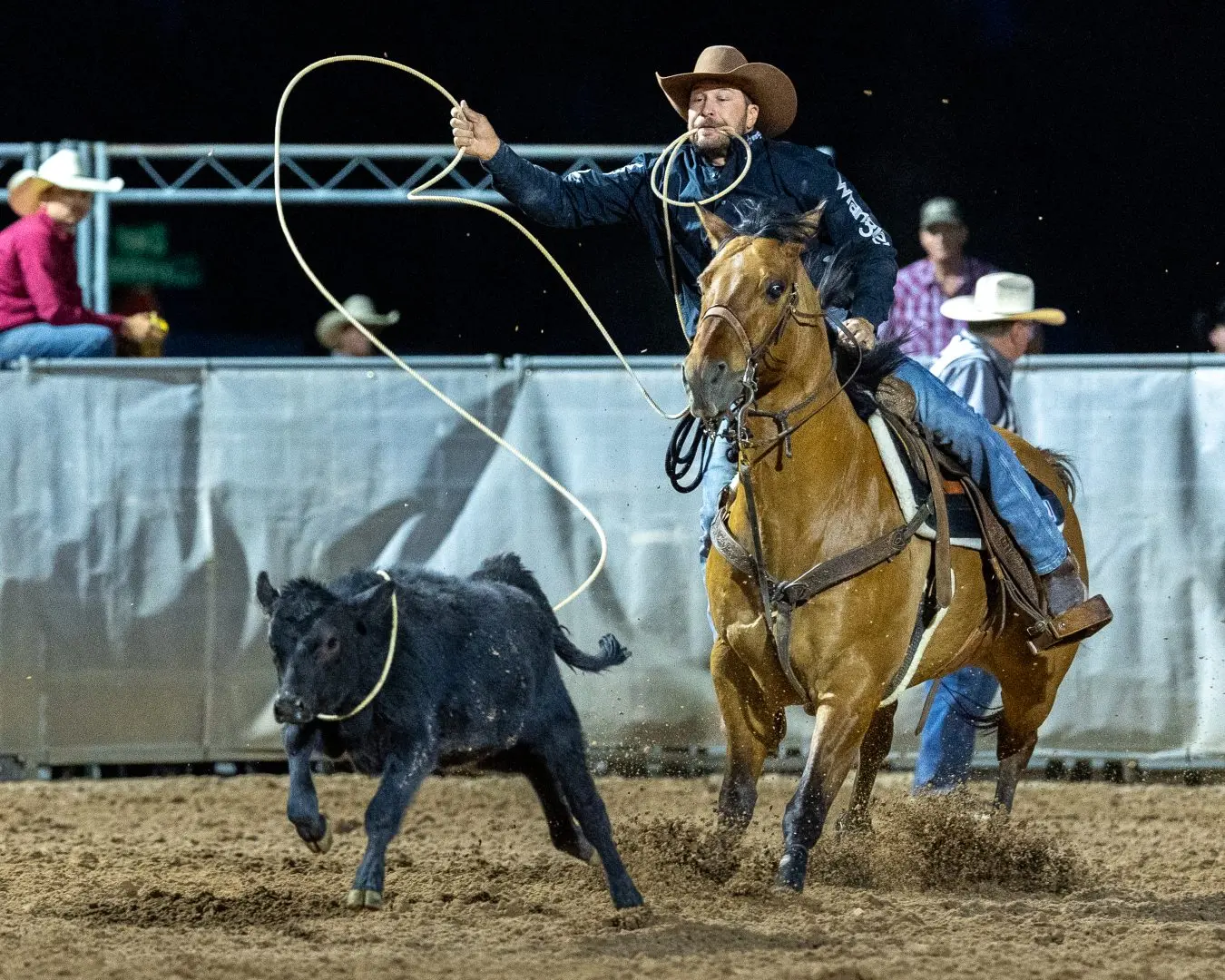
The main arena at the Clark County Fairgrounds in Logandale has lights for night work and seats 4,500. For five evenings each April it fills for a PRCA and WPRA rodeo. Performances start at 7 p.m. Wednesday through Saturday and at 6 p.m. Sunday, with bull riding, bronc riding, barrel racing, steer wrestling and team roping. The fair says more than 600 professional athletes compete over the five days and that Logandale has hosted the rodeo since 1988. Rough stock comes from Macza Pro Rodeo, Legacy Pro Rodeo, Western Rodeos, Sankey Pro Rodeo and Phenom Genetics.
Five nights in the arena
In 2018 Denise Robison, then the fair’s entertainment director, described the rodeo’s standing this way: “It’s one of the top 20 in the nation, (evaluated by) the top cowboys who come to the event, the size of the purse. We’re on the Wrangler (ProRodeo) Tour; we kick it off.” In 2026 the rodeo sold out on Friday and Saturday and nearly sold out on Sunday.
The afternoons belong to younger riders. In mutton bustin, children ages 4 to 7 who weigh 60 pounds or less ride sheep out of a rodeo bucking chute. The 4- and 5-year-olds ride in the Junior Division and the 6- and 7-year-olds in the Senior Division. Each wears a required helmet and protective vest. For the April 8–12 rounds, the schedule listed qualifying rides at 1:00 and 3:00 each day and a championship round at 5:00, with a Gold Buckle and the title of Champion Wool Rider as the prize. The posted lineups drew children from Logandale, Overton, Moapa, Alamo, Pahrump and Henderson, and from as far as American Fork, Utah; Molalla, Oregon; and Malibu, California. “It’s one of the greatest hits of our fair,” Denise Robison said in 2018. “It’s adorable.”
Barns, quilts and a chainsaw juggler
The fairgrounds stand on a 190-acre county site about 60 miles north of urban Las Vegas, reached in 2018 by Exit 93 from I-15 and State Highway 169. The county’s Parks and Recreation staff operates the grounds. Their buildings include the Glen Hardy Livestock Pavilion, 80 by 200 feet, with a dirt floor, evaporative cooling and a small arena seating about 1,000. Beside it is the Wayne Newton Animal Pavilion, also floored in dirt. In the livestock barns, 4-H and FFA members show cattle, swine and sheep. Youth exhibitors with the Clark County Junior Livestock Association raise market animals for show and auction. Denise Robison said the fair “kind of brings you back to your roots, teaches you where things come from. A lot of times we don’t know where milk comes from, we don’t know where our meat comes from.”
The exhibit hall is in the Ron Lewis Fine Arts Building. Local entries fill it by division:
- Home Science: cakes, cookies, breads, pies, jams, jellies, pickles and sauces.
- Home Arts: quilts, knitting, crochet and cross-stitch.
- Industrial Arts: wood and metal pieces, from furniture to sculpture.
- Horticulture: fruits, vegetables, flowers and plants grown in Clark County and the surrounding region.
- Also on display: photographs, fine and creative arts, and science displays.
Outside is the Plaza, a concrete apron 200 by 80 feet joined to a 60-by-20-foot stage. The fair’s roster of acts lists the following:
- On the Plaza Stage: the Doo-Wah Riders, playing country with a Cajun twist; The Imaginaries, an Oklahoma husband-and-wife Americana duo; Radio Ready, a Southern California dance band; The Little Mermen with Disney songs; Mad Chad the Chainsaw Juggler; and Tyzen the Hypnotist.
- Strolling the grounds: Marc Dobson, a one-man band billed as playing 9.1 instruments at once; the stilt walkers of Rebecca Fireplug Circus; Mimealot Mime; Flo the Clown; and Scott Makes Bubbles.
- Ground acts: the All Alaska Racing Pigs; a trick dog show by Cooldog Productions, run since 1989 by Lou Mack, a two-time world champion frisbee stunt dog handler; a mini motocross show; and the Off Axis High Dive Show, which can end the last show of each day with a fire dive.
The midway covers five acres of chatted gravel. Brown’s Amusements runs the rides, and most of the large ones require riders at least 36 inches tall. In 2018 there were sixteen major rides and 17 kiddie rides. Asked about the food that year, Denise Robison listed “Indian tacos, street tacos, corn dogs, crepes, kettle corn, funnel cakes, all kinds of different ice creams, roasted corn on the cob, barbecue. All kinds of weird, fun carnival foods.” She said about 65 percent of fairgoers came from Las Vegas. “I think they love the quiet. It’s so green and you just don’t see that. You go over that hill, and, ‘Oh, my gosh, I didn’t know this was here.’”
From the Overton Community Center to 190 acres
The fair began in 1965 as the Moapa Valley Fair, held at the Overton Community Center, according to the county’s account. Grant Bowler was among its founders. He was the longtime principal of Moapa Valley High School in Overton, and Denise Robison is his granddaughter. “He was just involved in this community and bringing those opportunities for kids to show animals, 4H,” she said. Her husband, Todd Robison, now the fair’s executive director, said in 2018 that his own father was also a founder.
Year by year the fair added a carnival midway, a junior livestock show and a rodeo. Through the 1970s and early 1980s it had no fixed home. The county lists a park, churches and schools as sites, and a 2018 Review-Journal account places it at various locations in Logandale, Overton and Las Vegas. In 1981 the fair committee, under Grant M. Bowler, sought 190 acres in Logandale from the Bureau of Land Management. Todd Robison tells the rest: the committee was not a registered nonprofit and could not take possession, so then-county commissioner Bruce Woodbury suggested that the county take the land, and the two entities developed a property relationship. Grants from the Las Vegas Convention and Visitors Authority and the state paid for construction, along with private funds and donated labor.
In 1986 the event took the name Clark County Fair. That June, Fair Committee chairman Vern Waite announced there would be no fair that year, postponed again while the Logandale grounds were developed. Grant Bowler, of the Fairgrounds Development Committee, said there were “sufficient funds” to begin building. By 1988 the property had been cleared and fenced, and four buildings and a rodeo arena had begun to take shape. That April, with the buildings still unfinished, the first Clark County Fair was held there.
The sources differ on the next name. The fair’s own history says a group of locals rebranded it the Clark County Fair & Rodeo in 1988. The county’s account and a 2018 St. George News article both put the change in 1997, made, in the county’s words, “due to the ever so popular Rodeo.”
Two springs without a fair
The 2020 fair had been set for April 8–12. On March 12, Clark County closed its facilities to gatherings of more than 250 people, and the next day it named the fair among the events that would not be held. The Moapa Valley Progress reported it as the first time the fair had ever been summarily cancelled. “Over the many years of the Fair, we have managed the event through wind and rain and sometimes even snow,” Todd Robison said. “We even managed it through the big Cliven Bundy mess that happened several years ago.” Arts and crafts exhibit chairwoman Robin Maughan said her team’s displays and theme would simply carry over to the next year. Robison told disappointed fairgoers: “We are not going anywhere. We will be back with a flare!”
The 2021 fair was called off as well, in early February. Before that decision, Clark County Junior Livestock Association secretary Missy Hardy had said her board decided “the show MUST go on!” County Commissioner Marilyn Kirkpatrick took it up. “I promised those kids that they would be able to showcase their livestock this year,” she said. She raised about $115,000 in sponsorships for a free three-day Clark County Junior Livestock Show and 4-H Festival, named in her honor. It offered nightly amateur rodeo at 6 p.m., cowboy poets Delmar Leatham and Kenny Marshall on the Plaza Stage, the Muddy River Cloggers, and a Rotary pancake breakfast. At its center was the junior livestock show and auction in the Glen Hardy pavilion.
The Clark County Fair and Rodeo returned in 2022. Its 2026 edition, themed “Red, Wild, and Blue,” ran April 8–12 and drew a little under 90,000 people, more than ten times the population of Moapa Valley. That was down about 14 percent from recent record years of more than 100,000. Sunday came in at 75 degrees with winds reaching 30 miles per hour. “This puts us back to where our normal was before COVID,” Robison said. “So I wouldn’t tell you it’s disappointing at all, because it was a great fair.”
Notable Events
- 1981In 1981 the fair committee decided to pursue a more permanent location for the fair; under the direction of Grant M. Bowler it was able to obtain 190 acres of ground in Logandale from the BLM. clarkcountynv.gov
- 1981In 1981, Todd Robison said, the fair committee tried to secure 190 acres of land from the Bureau of Land Management, but since they weren’t a registered nonprofit, they couldn’t take possession; then-county commissioner Bruce Woodbury suggested the county take possession of the land. neon.reviewjournal.com
- 1986In 1986 the Moapa Valley Fair officially changed its name to the "Clark County Fair". clarkcountynv.gov
- 1988In 1988, a group of visionary locals reimagined the fair’s potential by rebranding it as the Clark County Fair & Rodeo. ccfair.com
- 1988The event was held at its new permanent fairgrounds although the venue was not quite complete. stgeorgeutah.com
- 1997In 1997 due to the ever so popular Rodeo, the fair once again changed its name, now known as the Clark County Fair & Rodeo. clarkcountynv.gov
- 2020The Clark County Fair Board cancelled the fair as part of efforts to contain COVID-19; the annual event had been scheduled for April 8-12. mvprogress.com
- 2021Kirkpatrick said she heard in early February that fair officials had pulled the plug on that year's fair. mvprogress.com
- 2022The Clark County Fair and Rodeo returned after a two-year pandemic pause. fox5vegas.com
People
- Vern Waite, Chairman of the Fair Committee (1986).
- Cliven Bundy, named in the director's recollection of an earlier disruption the fair managed through.
- Kevin Willard, Fair Manager awaiting information on whether the fair could go ahead.
- Robin Maughan, fair arts and crafts exhibit chairwoman.
- Todd Robison, Clark County Fair & Rodeo executive director; born and raised into fair life, with his family involved since the 1960s.
- Marilyn Kirkpatrick, Clark County Commissioner advocating for the fair during pandemic uncertainty.
- Missy Hardy, CCJLA Secretary planning the livestock show with or without the fair.
- Steve Sisolak, Nevada Governor whose pandemic mandates were being watched by fair planners.
- Bruce Woodbury, then-county commissioner who suggested the county take possession of the BLM land.
- Grant Bowler, one of the founders of the Moapa Valley Fair; longtime principal of Moapa Valley High School in Overton (1965).
- Grant M. Bowler, directed the committee that obtained the permanent fairgrounds from BLM (1981).