Clackamas Lake Historic Cabin
Government Camp, Clackamas County, Oregon. Historic cabin.
Details

- Where
- FOREST RD 42 ZIGZAG, Government Camp, OR 97049. Directions
- When
- Open 24 hours/day.
- Season
- Guests can access the cabin by vehicle, as it is open from just before Memorial Day weekend through October each year. Snow conditions may impact travel.
- Getting there
- From Sandy, Oregon, travel east on Highway 26 for approximately 40 miles to Skyline Road (Road 42). Turn right on Skyline Road and travel south for 8.3 miles to the intersection of Forest Service Roads 42 and 57. Continue on Forest Service Road 42 for a quarter-mile.
- Fees
- $180 per night per group on weekdays; $200 per night per group on weekends and holidays (up to 8 people, includes county lodging taxes).
- Access
- Clackamas Lake Historic Cabin is temporarily closed due to wildfire damage.
- Walk-in or reserve
- The cabin remains locked; access codes will be sent in the confirmation letter and should be brought with you to the site.
- Phone
- 503-630-5721
- Managed by
- Mt. Hood National Forest, Clackamas River Ranger District.
- Established
- 1933.
- Coordinates
- 45.099185, -121.75017.
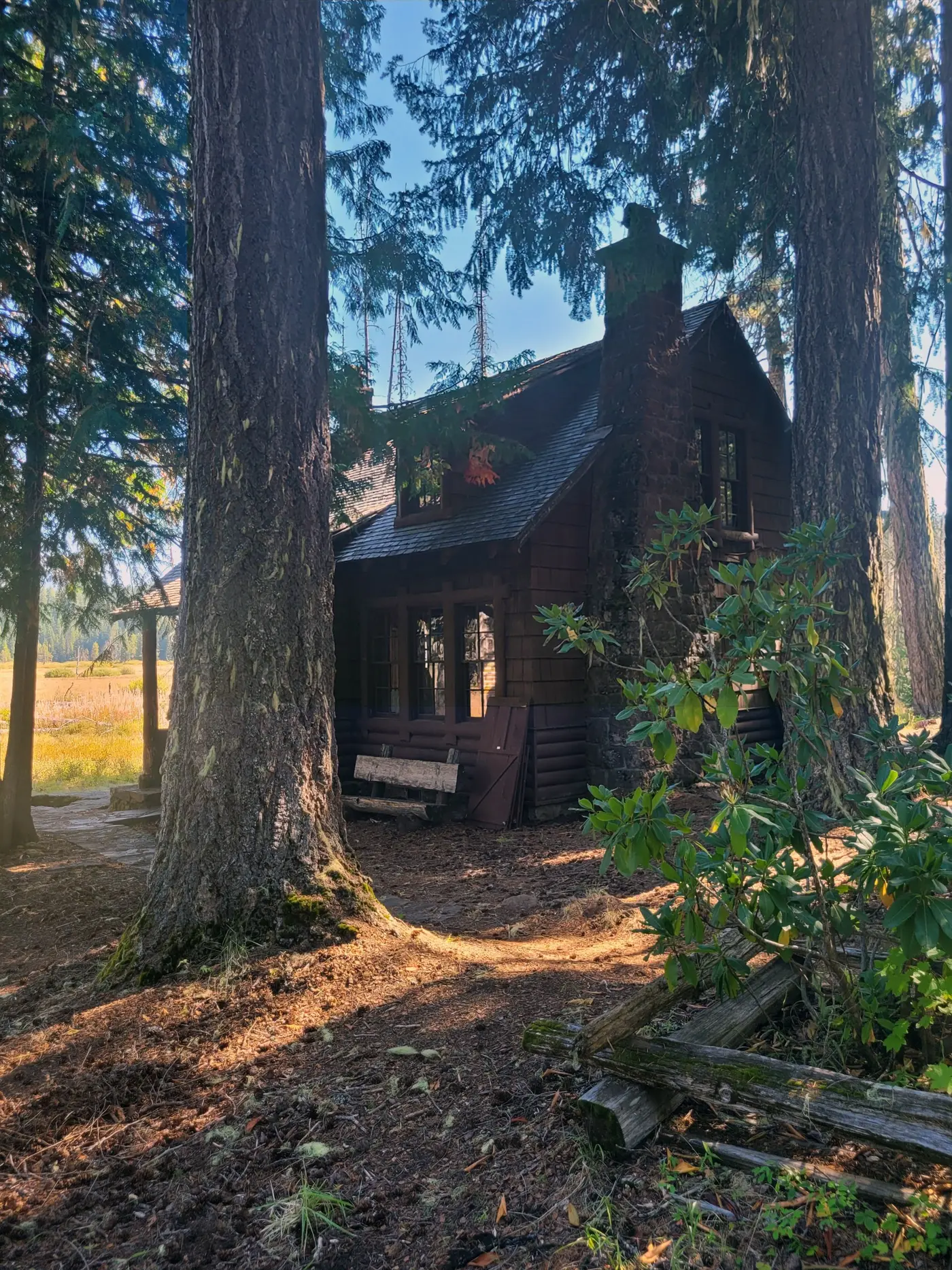
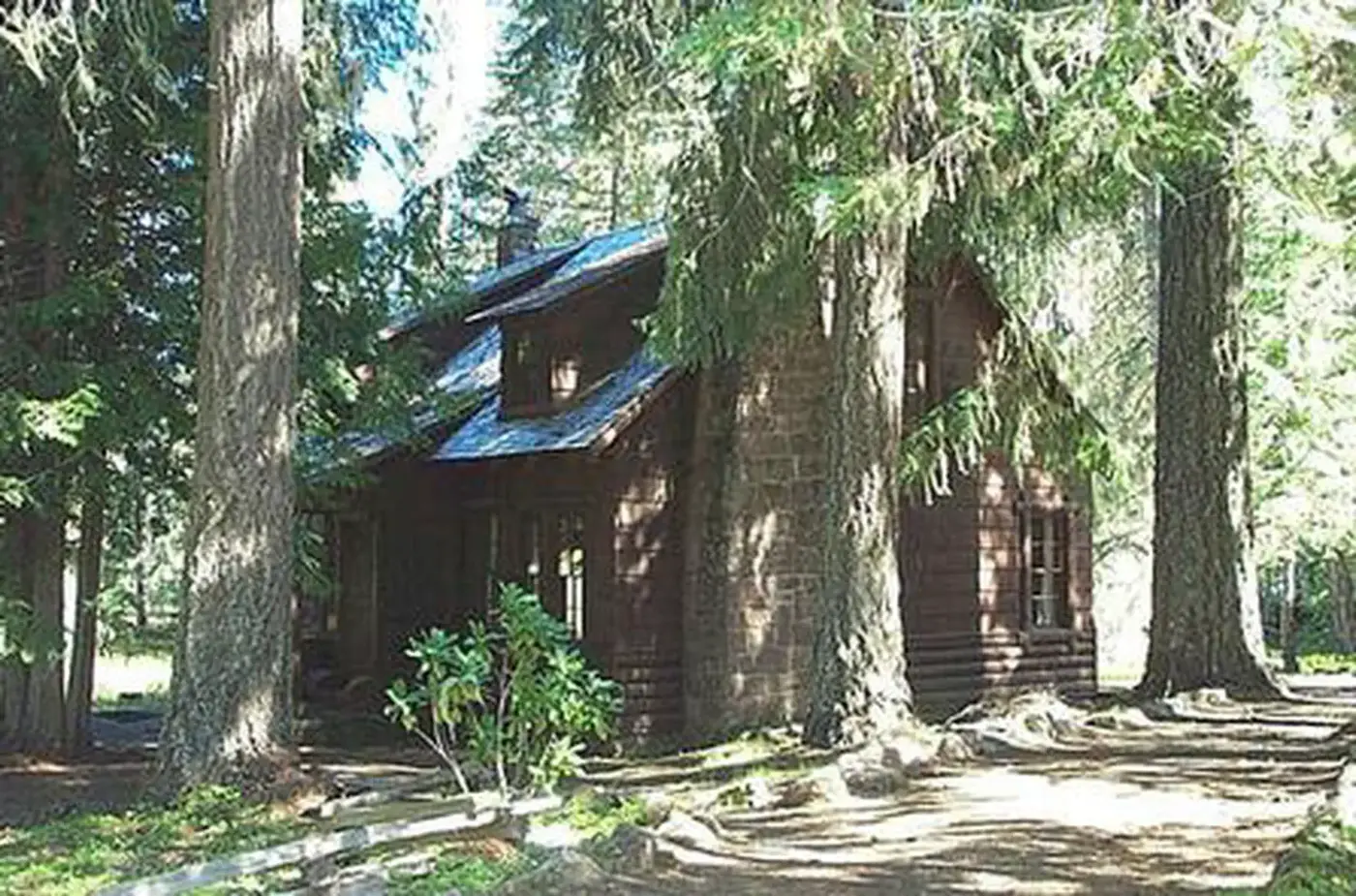
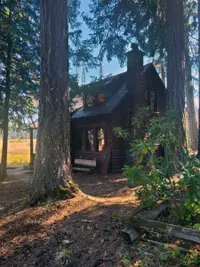
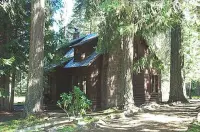
The District Ranger’s Residence at Clackamas Lake stands on the east side of Forest Road 42, about 22 miles south of Government Camp, at 3,400 feet among old-growth Douglas fir. Its front doorstep is a four-foot section of peeled log, the ends square-sawn and chamfered, laid before a flagstone platform and two stone steps. A massive chimney of coursed, squared rubble rises at the west gable end. Slab wood climbs the walls to the four-foot line and shakes cover the rest. The window frames are slab wood cut to look like corner-notched logs. Like every building in the compound, the house is painted dark brown, trim included.
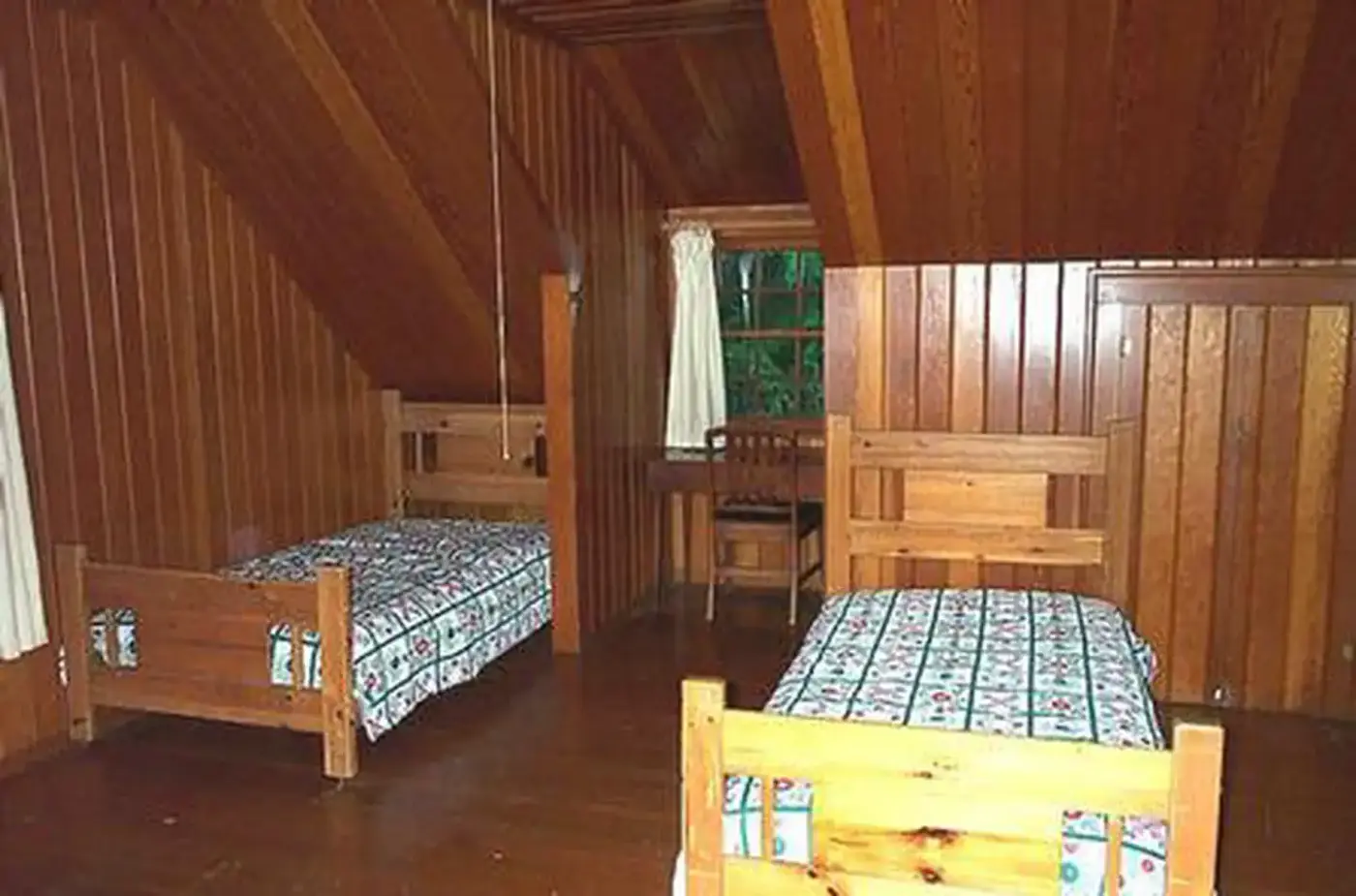
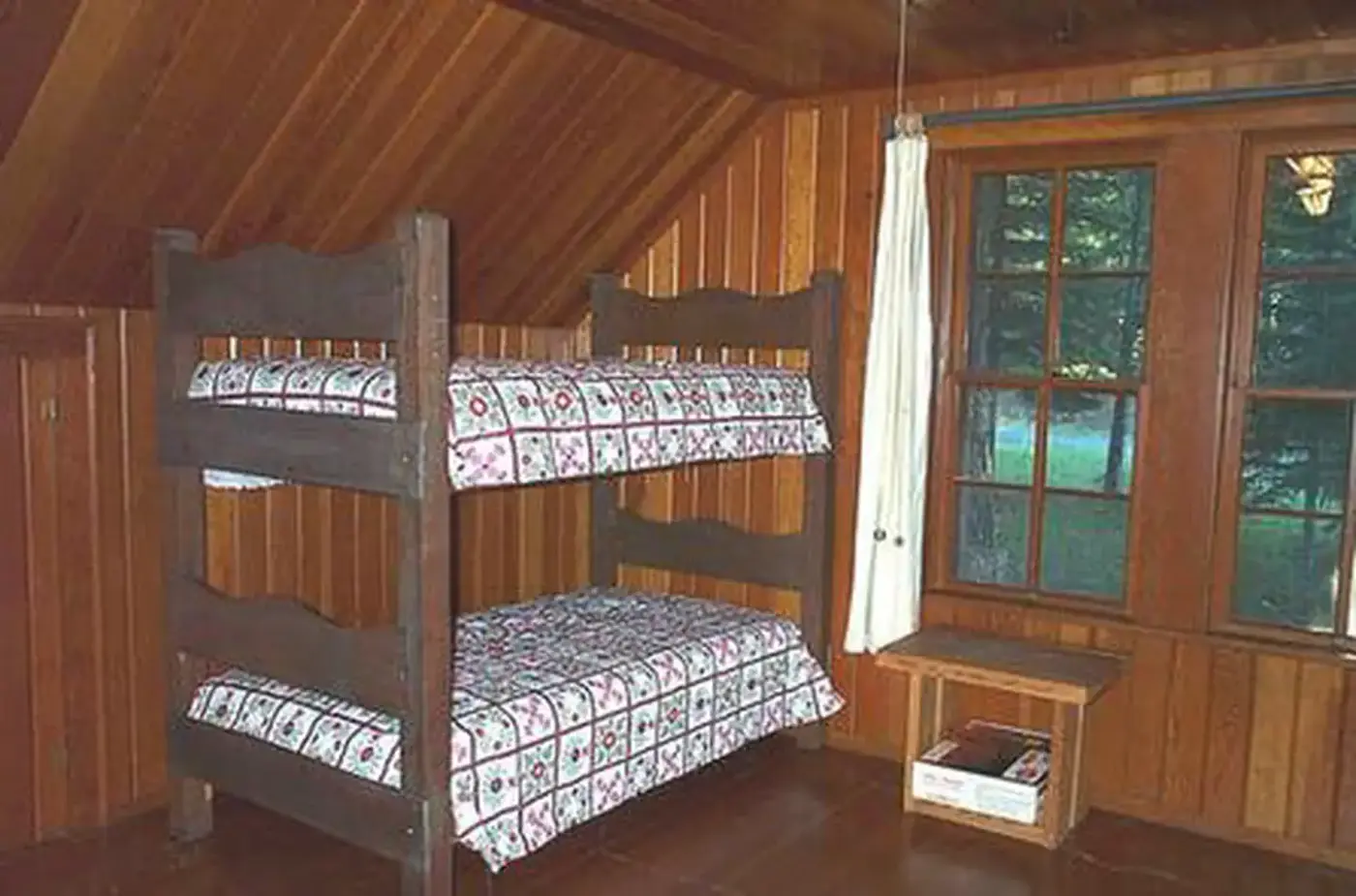
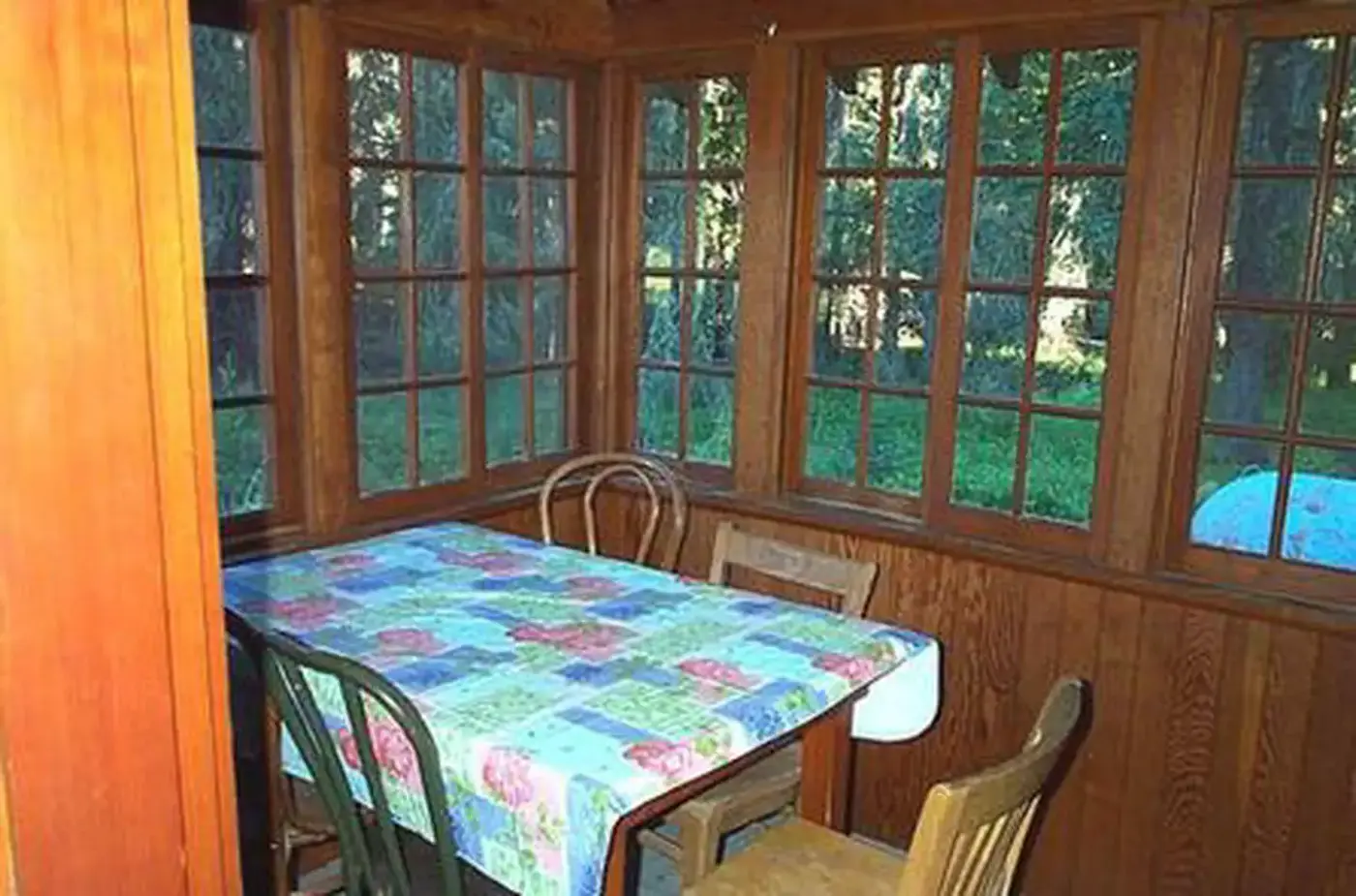
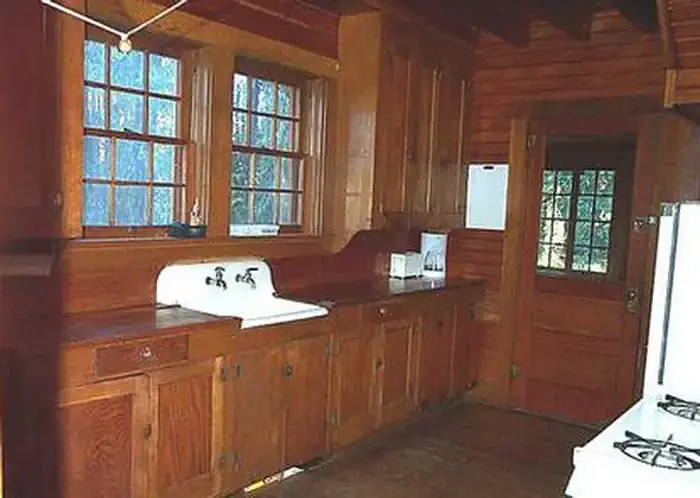
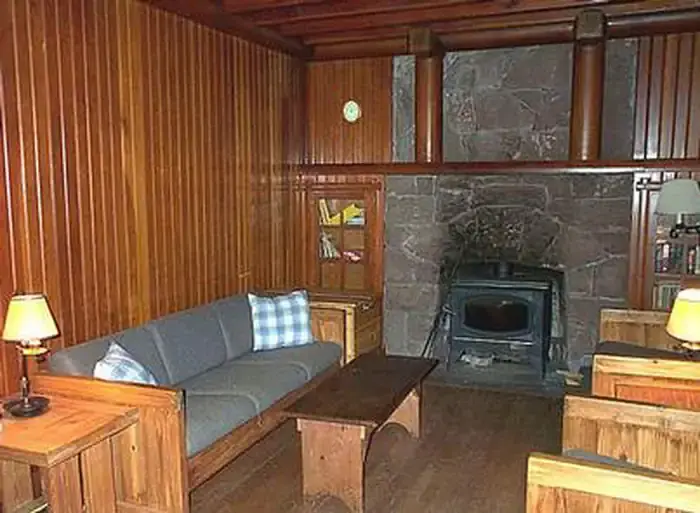
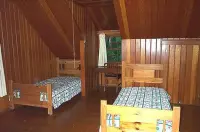
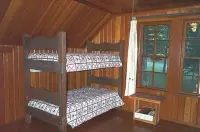
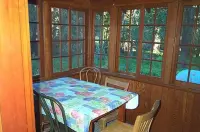
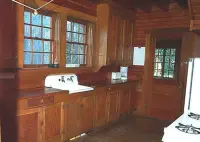
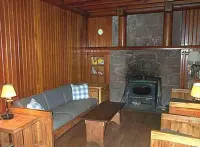
The Forest Service rents the house to parties of up to eight. Its listing, updated in September 2026, shows the site closed, and Travel Oregon reports it temporarily closed due to wildfire damage. In an open season, which Recreation.gov gives as just before Memorial Day weekend through October, guests find a two-story house that the Forest Service measures at 1,380 square feet and Recreation.gov at 1,300. The living room has an open-beam ceiling and a stone fireplace, now fitted with an insert, flanked by built-in bookcases. There is a large dining table, a sun porch, a propane range and refrigerator, and three bedrooms. The downstairs room holds a queen bed, the east room upstairs a full and a twin, and the west room bunks and two twins. Accounts of the paneling differ. The 1981 National Register nomination describes varnished fir boards on walls, ceilings and floors. The Forest Service calls it knotty pine. Recreation.gov calls it knot-free and adds hand-wrought iron work.
The Forest Service describes the generator that powers the lights as “old, finicky and high maintenance.” Guests are asked to run it only from 6 to 10 a.m. and from 5 to 10 p.m. Four propane lanterns light the hours between, and the kitchen has a stovetop percolator and an old-fashioned toaster. Plug-in appliances are barred because the generator’s surges can ruin electronics. In 2008 Terry Richard of The Oregonian found horseshoes, a badminton set and two fishing poles in the house. He also reported that the host living nearby would come over to start the fire for guests who asked where the fireplace’s wall switch was. There isn’t one.
The office across the road
The old District Ranger’s office, built in 1933, faces the residence from the other side of the road. It is now a two-room visitor center and museum, staffed by volunteer caretakers who live on site, keep up the buildings and give tours. Its doorstep is also hewn from a peeled log. Inside, the walls are painted vertical fir boards over varnished floors. In 2008 the telephone still hung on the wall, though it no longer worked by crank as it had in the 1930s. The original desk stood among displays of 75-year-old firefighting equipment, and the floor was pocked where men had not removed their nailed logging boots.
Volunteer Larry Coleman told Richard a story about that telephone. The first Civilian Conservation Corps recruits sent to Clackamas Lake came from Chicago. They were dropped by the highway at a blue box fastened to a tree. Inside the box was a phone wired to the office 10 miles away. Richard imagined the call: “I’m here, come get me.”
The other buildings stand around the office. There is a mess hall whose porch gable was collapsed by snow and removed, a fire warehouse, a roads-and-trails warehouse, and a one-car garage. A blacksmith shop and a gas-and-oil house complete the group, the latter with a single archaic pump under its extended roof. A horse barn with a cupola and a small pump house stand across the meadow. The original landscaping survives: picnic tables, a horseshoe pit, a stone fire pit, and around the residence flagged walkways, retaining walls and tree wells of native stone.
Springs, a meadow, and Mares Eggs
The Cascade summit here is less a crest than a plateau about 12 miles wide, averaging 3,500 feet. The nomination records about 70 inches of precipitation a year, mostly as snow, with depths over six feet. Summers are warm and dry, and the flat site is sheltered from the strong east and west winds of the range. The Oak Grove Fork of the Clackamas River rises in a large meadow nearby. It meanders west through Clackamas Meadow and Timothy Lake, a man-made hydroelectric impoundment, before dropping down the west slope.
Small pools of open water lie scattered across the meadow among mounds of organic matter. The largest is Clackamas Lake, fed by springs on the meadow’s south edge. The nomination gives it six acres and Recreation.gov three. The Forest Service calls it small and very shallow. A rare blue-green alga called Mares Eggs lives in it. A forest of western hemlock, Douglas-fir and silver fir rings lake and meadow. Anglers take cutthroat, brook, rainbow and some German brown trout, and a boardwalk trail runs from the neighboring campground. The 2.2-mile Miller Trail starts there and connects to the Pacific Crest Trail. Timothy Lake, three miles off and 1,400 acres, allows power boats. The name Clackamas comes from the Clackamas Indians, a Chinookan tribe that lived along the river, according to Lewis A. McArthur’s Oregon Geographic Names of 1952.
A dentist’s orchard and Joe Graham’s cabin
According to the nomination, a trapper set up camp at the lake in 1808, perhaps working for the Hudson’s Bay Company. By 1883, when the area was proclaimed part of the Cascade Range Forest Reserve, settlers were exploring the forest and trails tied Clackamas Lake to the Willamette Valley. In 1900 Dr. Hubert Miller built a summer home there. He was a Portland dentist who had founded the North Pacific Dental College. Traces of his cabin, roads, garden and orchard remain on the site.
The Forest Service arrived soon after. Wikipedia dates the agency’s use of the site to 1905. The nomination places the administrative site in 1906 and says it has been occupied continuously since. Joe Graham, the district’s first ranger, built the original cabin and barn in 1906, and traces of that cabin also survive. He served as District Ranger until 1930. He formally named many land features in the area and located its roads, trails, lookouts, phone lines and camp sites.
By 1930 the work had outgrown Graham’s buildings. A compound design was finished in 1932. The creation of the CCC and federal money in 1933 let it go up within about two years. The rental listings credit the residence to the CCC. The nomination divides the credit: skilled Forest Service carpenters built most of the structures, and CCC men did the heavy labor, landscaping and rock work. District Ranger Francis Williamson picked the house plan from a set of Weyerhaeuser designs titled Your Future Home. It was built to that plan in every respect except its exterior materials. The house sheltered the District Ranger, his Resource Assistant, and seasonal workers who covered the district on horseback. The Forest Service says the Resource Assistant soon married, and a “Honeymoon Cabin” was built nearby for the couple.
Guard station, horse camp, and the 2003 fire
After World War II, new forest roads put most country within a few hours’ drive, and isolated ranger stations were closed or downgraded. Clackamas Lake served as the district’s summer headquarters until 1952. It then became a guard station for fire crews and work parties. In 1962 the single unsurfaced access road was rebuilt and paved, and new roads were cut to Timothy Lake and a new campground. That same year the Forest Service ended the Miller family’s special-use permit, on condition that the site become a public campground. The station stood unused for a short time in the 1960s and reopened in the early 1970s. In 1979 a 14-unit horse camp was built beside it, using the old horse barn as a stable.
The Oregonian says the compound was made a National Historic Site in 1979. Wikipedia gives 1981 for its listing on the National Register as a four-acre historic district. The nomination noted that no electricity, new buildings or new structures had been added to the site. Elsewhere, many CCC buildings fell into disrepair and were burned to remove the hazard. Richard credited the compound’s survival to the employees of the station that replaced it. Fire crews lived there in summer, and snow closed it off in winter.
In 2003 fire took the Honeymoon Cabin. Wikipedia records it as a ranger residence and counts the district’s historic buildings at eleven, down from twelve.
Notable Events
- 1808A trapper who perhaps worked for the Hudson Bay Company established a camp at Clackamas Lake. npgallery.nps.gov
- 1883Settlers had begun to explore the surrounding forest and a trail network connected Clackamas Lake with the Willamette Valley when the area was proclaimed part of the Cascade Range Forest Reserve in 1883. npgallery.nps.gov
- 1900Dr. Hubert Miller established a summer home at Clackamas Lake before the Forest Service was created. npgallery.nps.gov
- 1905The nomination dates the start of proactive management of the National Forest to the establishment of the Forest Service in 1905. npgallery.nps.gov
- 1906The Forest Service established an administrative site at Clackamas Lake and occupied it continuously thereafter. npgallery.nps.gov
- 1932An extensive compound design was completed after forest use and management had grown enough to require a larger administrative complex. npgallery.nps.gov
- 1933CCC establishment and federal funds allowed rapid completion; Forest Service carpenters built most structures while CCC men performed labor-intensive work and landscaping. npgallery.nps.gov
- 1962The nomination says the primary change to the site's appearance is its roads: the original single unsurfaced access road was reconstructed and paved in 1962, with new roads to Timothy Lake and the new campground built about the same time. npgallery.nps.gov
- 1962The Forest Service terminated the Miller family's special-use permit with the stipulation that the site become a public campground. npgallery.nps.gov
- 1979A 14-unit horse camp was constructed in 1979 as a base for riders on the district trail system, using the existing horse barn as a stable and the site's history as a pack station. npgallery.nps.gov
- 1979The compound was made a National Historic Site. oregonlive.com
- 2003The nearby Honeymoon Cabin burned down, while much of the historic ranger station remained intact. fs.usda.gov
People
- Dr. Hubert Miller, Portland dentist who founded the North Pacific Dental College, later affiliated with the University of Oregon, and established a summer home at Clackamas Lake in 1900 before the Forest Service existed (1900).
- Joe Graham, Ranger who built the first Forest Service office/cabin at Clackamas Lake and served as District Ranger there, remembered as a colorful, dedicated figure who formally named many land features in the area and located its roads, trails, lookouts, phone lines and camp sites (1906-1930).
- Larry Coleman, Volunteer who shows visitors around the Clackamas Lake Historical Ranger Station and tells its stories.
Sources
- fs.usda.gov/r06/mthood/recreation/clackamas-lake-historic-house
- traveloregon.com/plan-your-trip/places-to-stay/campgrounds/clackamas-lake-historic-cabin
- en.wikisource.org/wiki/Oregon_Geographic_Names_(1952)/C
- npgallery.nps.gov/NRHP/GetAsset/NRHP/81000477_text
- recreation.gov/camping/campgrounds/234239
- oregonlive.com/terryrichard/2008/09/ccc_legacy_lives_on_at_mount_h.html
- npgallery.nps.gov/AssetDetail/c0a7684a-1345-4baf-a04f-148378533213
- mthoodmuseum.org/collection_item/clackamas-lake-ranger-station