China Ranch Date Farm
Tecopa, Inyo County, California. Date farm.
Details

- Where
- #8 China Ranch Road, Tecopa, CA 92389. Directions
- When
- Mon - Fri 9:00 am – 5:00 pm.
- Getting there
- 85 miles west of Las Vegas, Nevada, off Highway 127 en route to Death Valley National Park.
- Access
- Desert site - carry an ample supply of water; the desert's scorching temperatures can lead to rapid dehydration.
- Phone
- (760) 852-4415
- Managed by
- Brown and Sorrells families, since 1970.
- Established
- Original date grove planted from seed in the early 1920s.
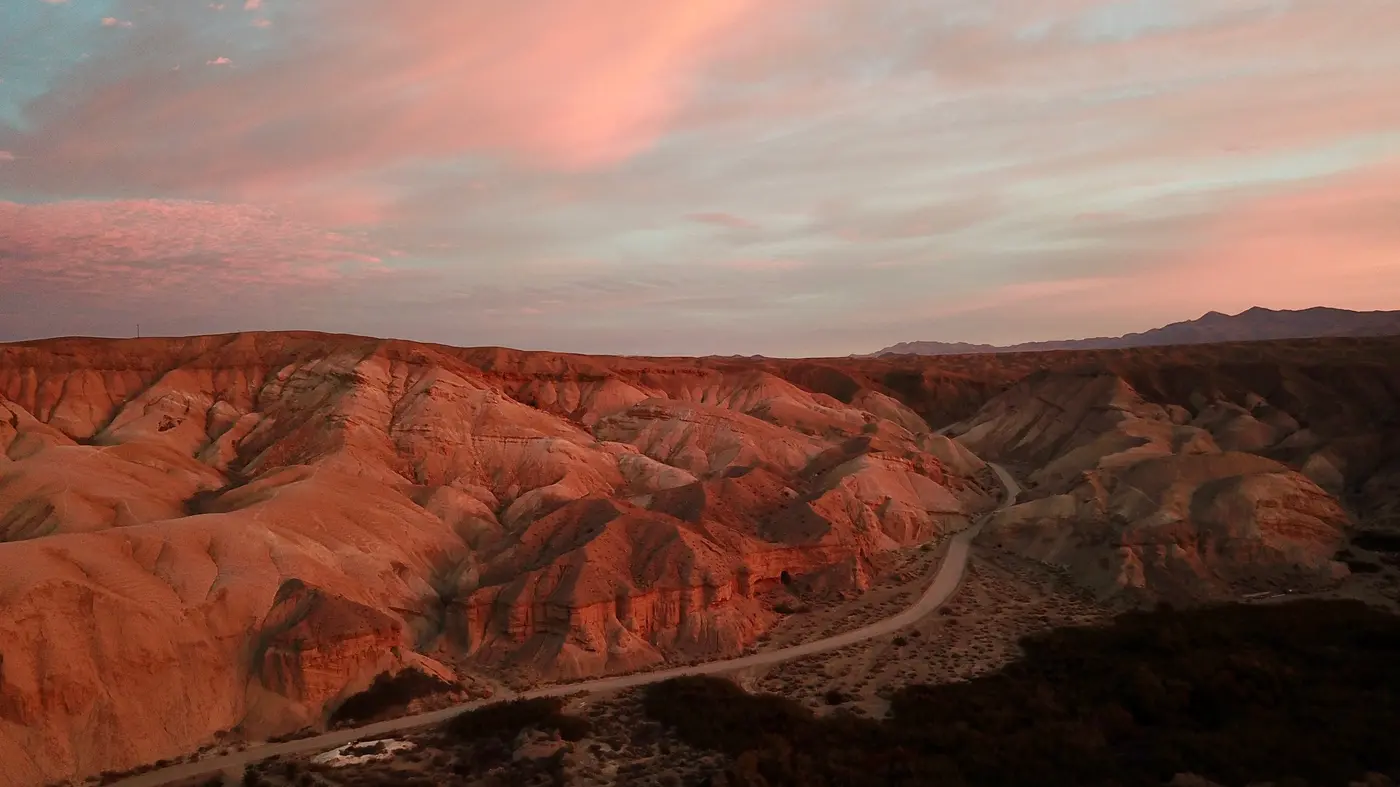
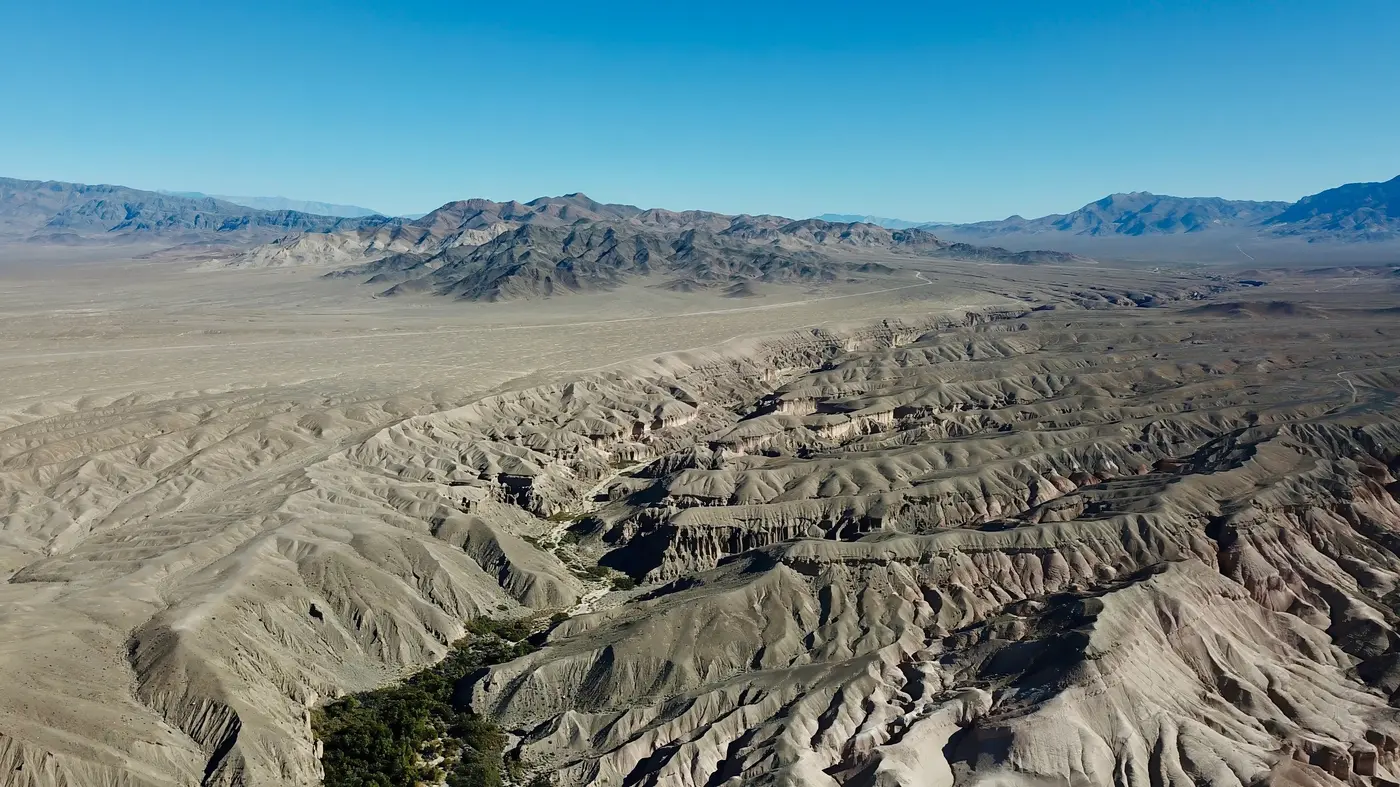
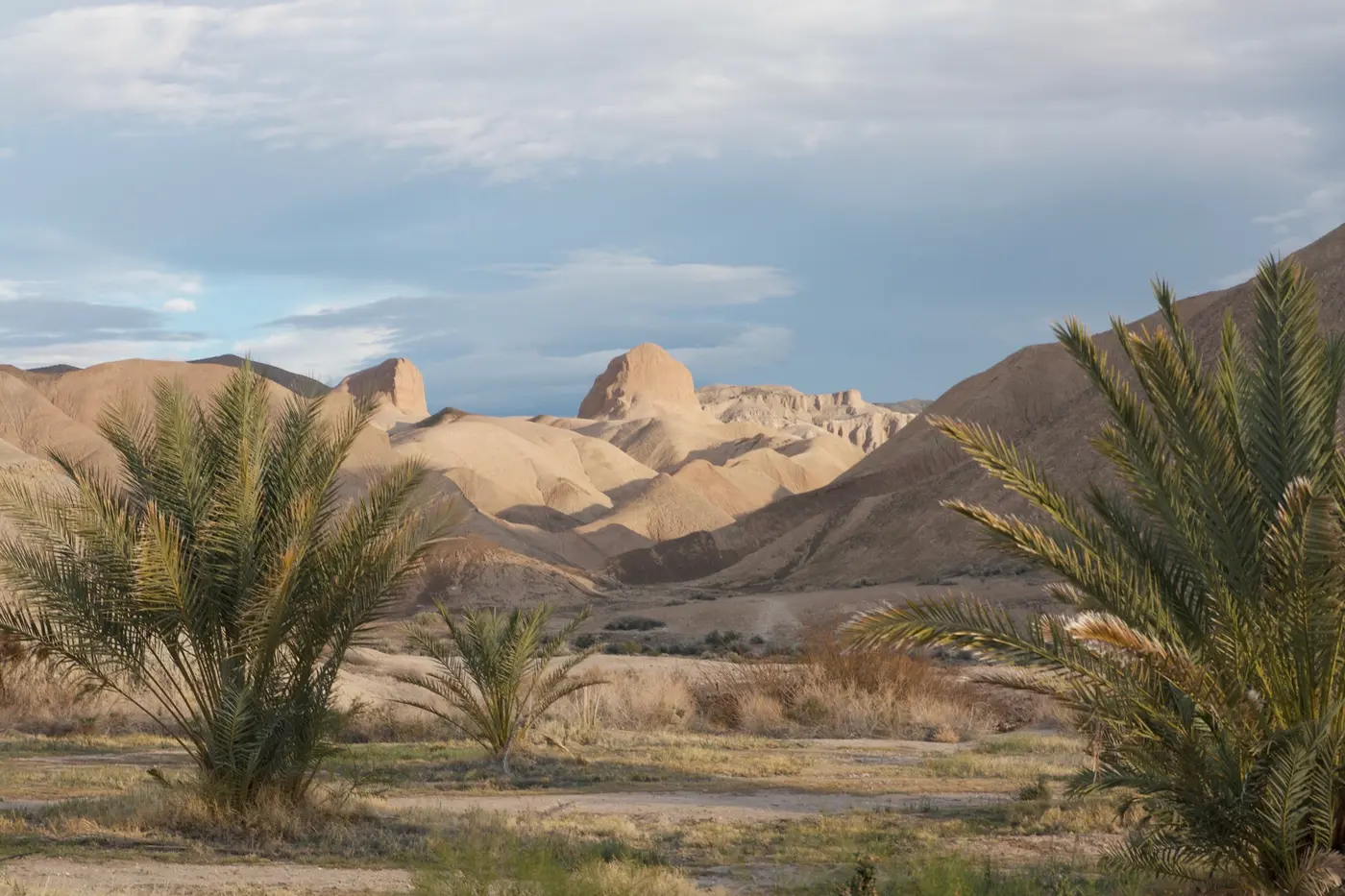
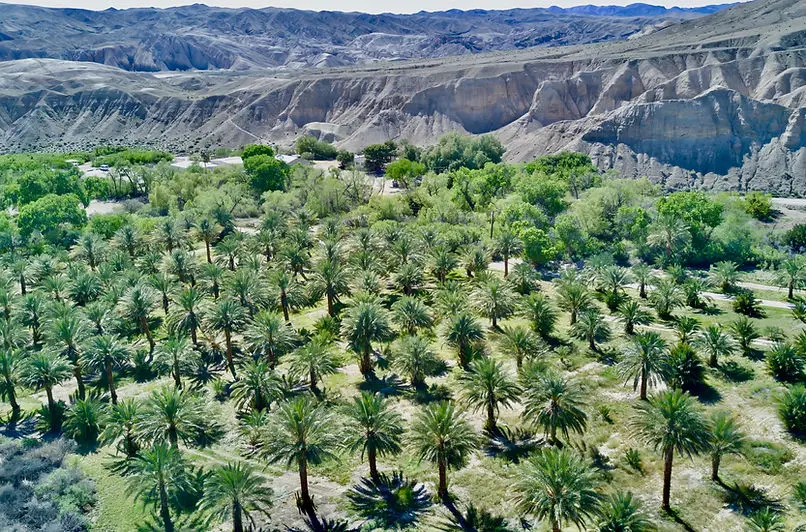
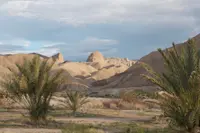
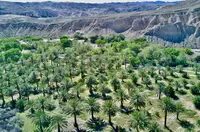
China Ranch Road comes down a steep grade into a canyon cut through old lake-bed clay. On the canyon floor a creek runs under Fremont cottonwoods and willows, and date palms stand in groves along the bottom. The ranch lies at 1,237 feet, off Highway 127 about 85 miles west of Las Vegas, on the road to Death Valley National Park. Its owners call it a working family farm and say plainly that it is no resort or tourist development. There is no camping. The nearest beds and the free hot mineral baths are at Tecopa Hot Springs and Shoshone.
The bakery counter and the grove
The gift shop and bakery stand where the trails begin. The bakery makes date shakes from dates grown on the place, along with date nut bread, muffins and cookies. The shelves hold date samplers, date syrup, local honey, jams and jellies, soaps, jewelry, crafts from local artisans, and consignment pieces of every kind. A sign outside, photographed in 2009, ends: “Come in, sample, enjoy!”
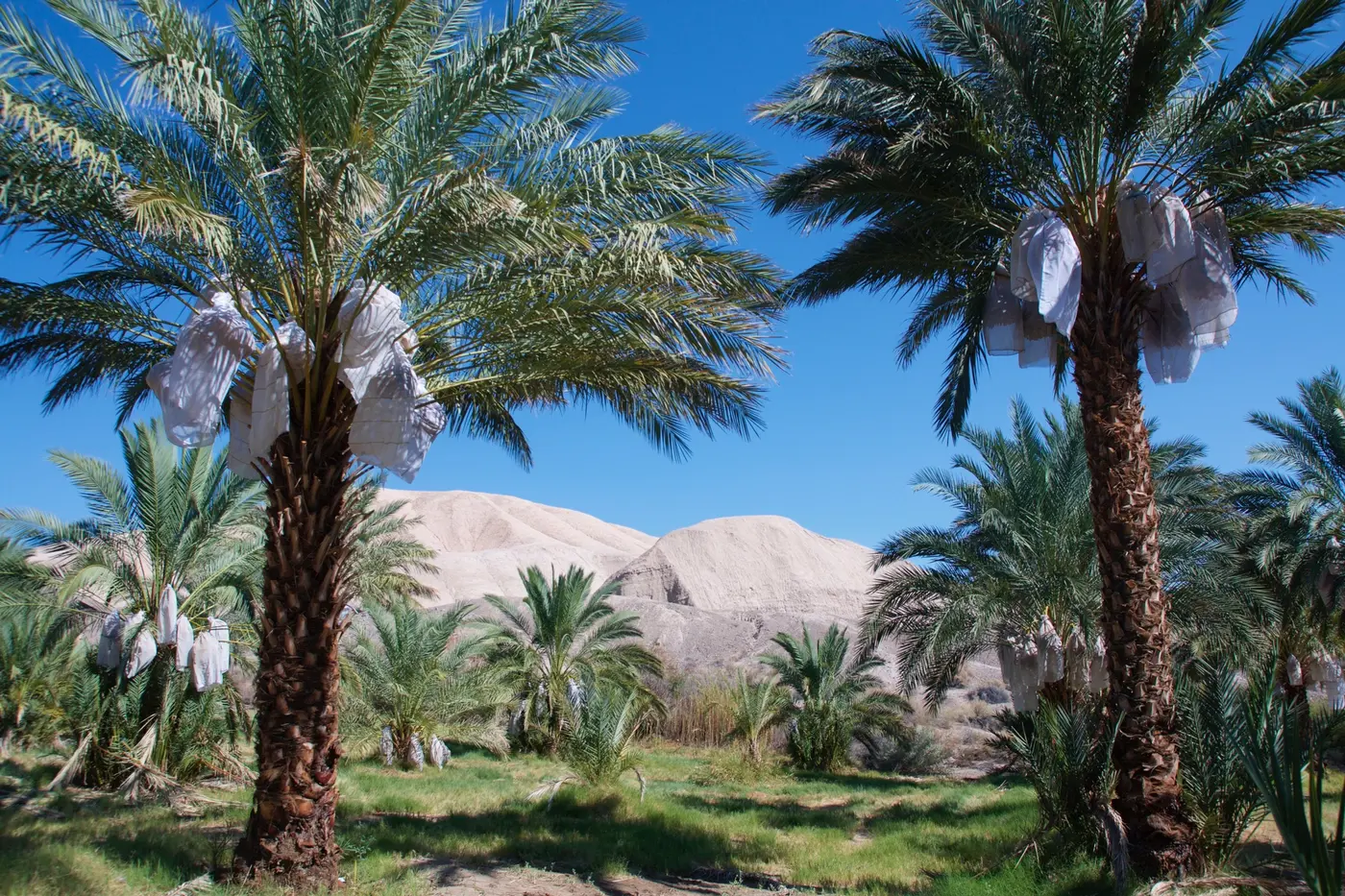
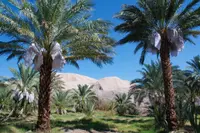
About half the palms in the grove are males and produce only pollen. The females bear in the fall, each yielding 100 to 300 pounds in a season. Deborah Wall of the Las Vegas Review-Journal gave the harvest as September through December, with the ripening bunches covered against birds, rain and sunburn. Signs in the grove name the varieties:
- Khadrawy, from Iraq: round, dark brown and very soft. It is the slowest-growing commercial date palm in height.
- Halaway: a soft, almost blonde date on a thicker, more massive tree.
- Dayri: drier and chewy, often purple, and a light bearer.
- China Ranch Hybrids: offshoots of the best trees in the original grove. Because those parents were planted from seed, the sign calls them “unknown, original types.”
Palms of all sizes are sold for landscaping, chosen straight from the field.
A short walk from the shop, on the way to the grove, is a small museum that opened in the fall of 2009. It holds artifacts from early Indian sites and archaeological digs, material on the pioneer families of the early 1900s, and exhibits on the Chinese man thought to have first settled the canyon. An outdoor exhibit of rocks lays out the geology. Also on the ranch is an adobe house completed in 1991 after five years of work. It was built of more than 18,000 handmade bricks pressed from native materials on the ranch, and it came through the string of earthquakes in June 1992 without damage.
Five trails from the gift shop
The Creek Trail runs 200 yards behind the shop, along China Ranch Creek, through thick native growth labeled with signs. It passes three picnic tables. The signs identify:
- screwbean mesquite, known by its coiled pods
- honey mesquite, whose black pitch, one sign says, served Native Americans as medicinal tea, hair dye and pottery paint
- yerba mansa, which gives off a strong medicinal odor when crushed
- Goodding willow and seep willow
The stream holds frogs, speckled dace (a rare native fish), and a crayfish that a 1972 study could not identify by genus or species. The ranch’s history page counts more than 225 bird species logged here, some from Central and South America. A trail sign gives “over 120,” along with 15 kinds of lizards and 20 of snakes. The ranch’s bird list runs from Phainopepla and Lucy’s Warbler to the Crissal Thrasher and the Roadrunner. Gray and kit foxes, bobcats, coyotes and kangaroo rats live in the canyon, as does what the ranch calls “the infamous horsefly.”
The longer routes climb out of the bottomland:
- Mesa Trail: about 2.5 miles round trip with some 500 feet of gain. It follows an old power-pole road, then a path marked with white-painted rocks. Two rocks painted with asterisks mark the views of the ranch and of the Amargosa River canyon. The walk back down China Ranch Road passes old gypsum mines.
- Ranch View Trail: about two miles round trip along a high, narrow ridge, not recommended for anyone with vertigo. It looks down the length of the ranch on one side and into a small slot canyon cut in the clay on the other.
- Cliffs Trail: two miles or more. It crosses the wet creek bed, thorny mesquite and mud flats, climbs over two dry falls of ten to fifteen feet, and dead-ends in a natural bay beneath a sheer cliff several hundred feet high. The ranch’s hiking page advises: “Try some echoes!”
- Slot Canyon Trail: about four miles round trip, the longest. It goes down the canyon to Acme Siding, an ore-loading stop on the Tonopah and Tidewater Railroad from 1905 until 1938. It then crosses the old railroad grade, rock-hops the Amargosa River, and climbs a wash into a twisting slot in rhyolite that ends at two boulder-choked dry falls.
The ranch names October through April as the hiking months. It asks hikers to go in company and to carry more water than they think they will need.
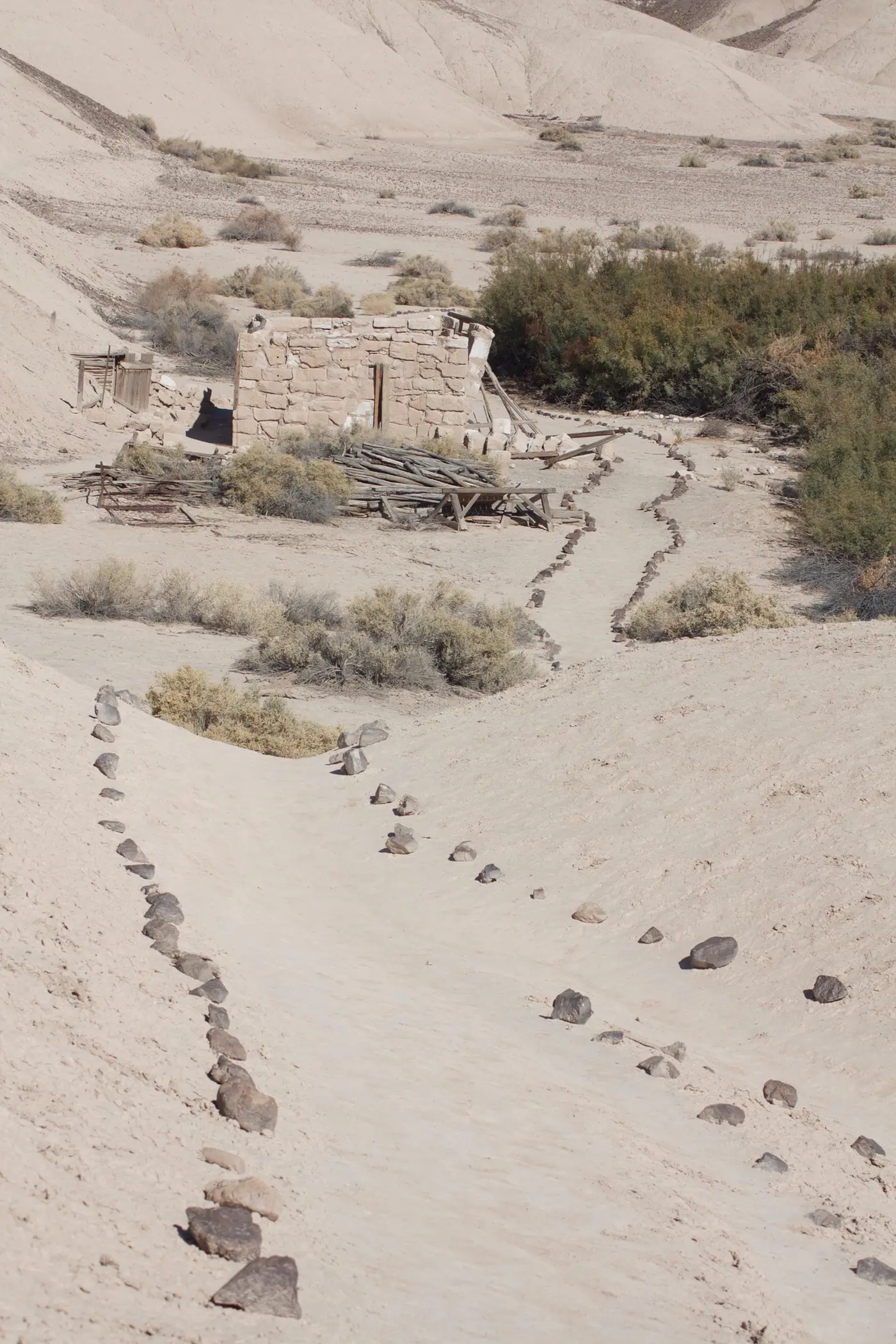
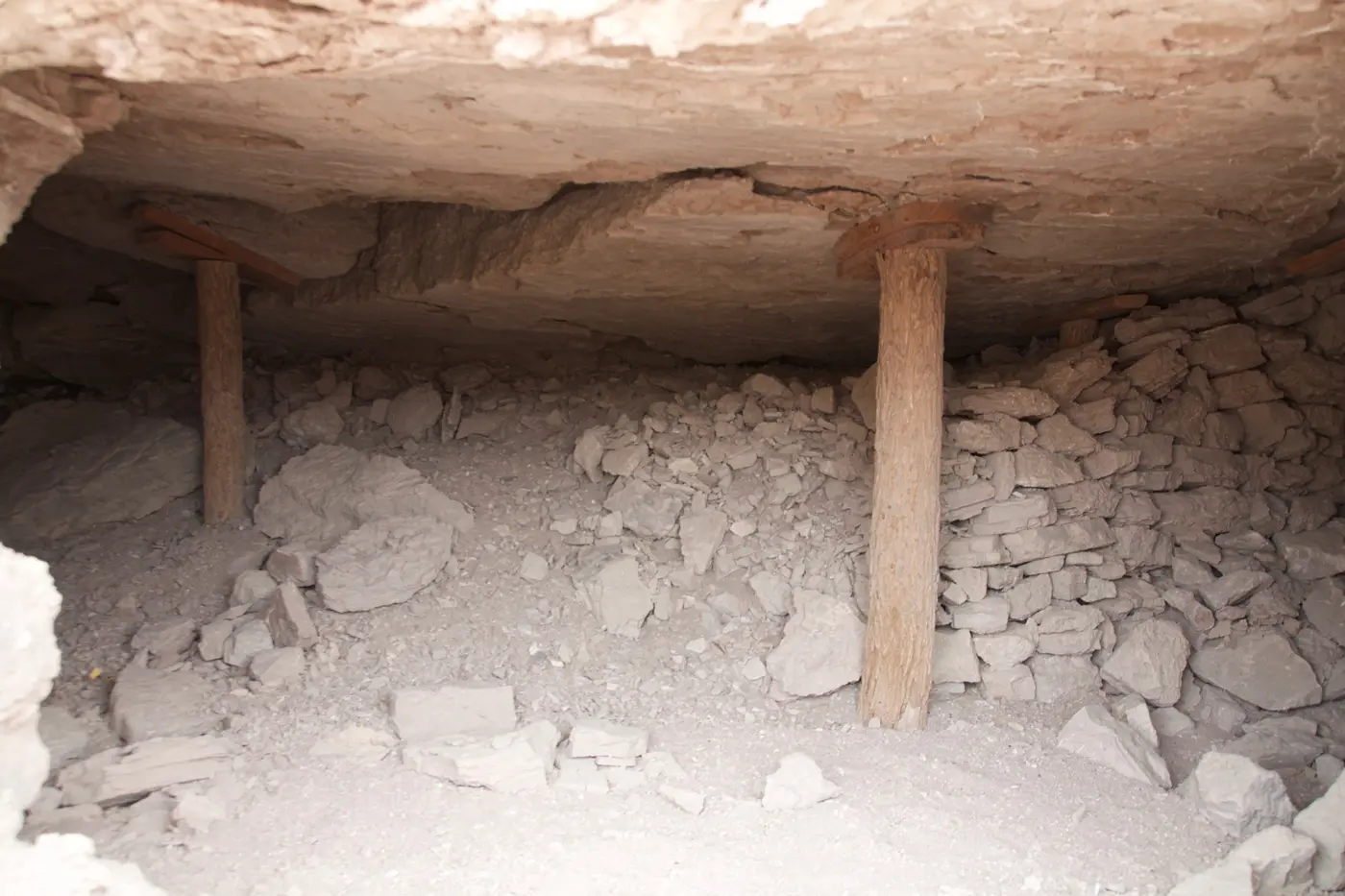
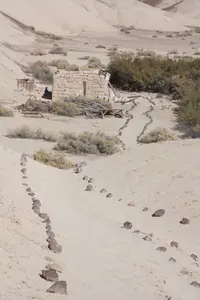
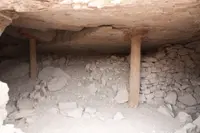
The Slot Canyon route also passes the stone ruin long called the “old saloon.” A report prepared in 2000 for the Bureau of Land Management by Carol A. Corbett of Great Basin Research found “1903” cut in its lintel. It got its nickname from the broken beer and liquor bottles once found inside. Others guessed it had been a railroad way station, a paymaster’s office or a general store, and an 1892 survey map labels it “assay office.” Brian Brown, who runs the ranch, has said prospectors brought samples there to be tested for the nitrate salts used in explosives. The A. R. and M. A. Modine family used it as a bunkhouse for talc-mine workers in the winter of 1923. In a talk at the Shoshone Museum in March 2026, Brown said the building had collapsed in recent years, and he blamed the failure of federal stewardship.
Ah Foo, or Quon Sing
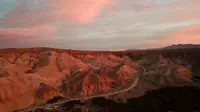
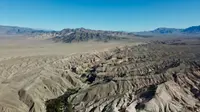
The canyon itself is a product of water. By the ranch’s account, sometime between a million and half a million years ago Lake Tecopa, the end of the Amargosa River, was breached. The outflow carved the Amargosa Canyon a mile to the south and speeded the erosion that shaped this side canyon.
Shoshone and Paiute people used the canyon’s resources. In the spring of 1830 the New Mexican horse trader Antonio Armijo found about 70 people at Yaga, the village at Tecopa Hot Springs, and his route became the Old Spanish Trail. The ranch’s history says John Fremont passed the mouth of China Ranch Creek on April 29, 1843, without coming up the canyon. Two days earlier his scouts Kit Carson and Alexis Godey had shot and killed two Indians in China Ranch Canyon, men involved in a raid at Resting Springs. Corbett cites Waring (1915) for a different account, that Fremont visited the springs at China Ranch in 1844.
The farmer who gave the place its name comes down in several versions.
- The ranch’s history page: a Chinese man named either Quon Sing or Ah Foo came after years in the Death Valley borax mines. He developed the water and raised fruit, vegetables and meat for the mining camps.
- The ranch’s marker: it dates his arrival to the 1890s, from the Borax Works, and says he grew hay as well, feeding silver miners and their draft animals.
- William Caruthers, Loafing Along Death Valley Trails, 1951: Quon Sing was a cook at the Old Harmony Borax Works who quit to serve a wealthy Tecopa mining man named Osborn. Shorty Harris began his version with “I can’t state it as a fact,” then repeated what old settlers told him: Osborn had put the Chinaman on the ranch as a reward for long and faithful service.
- L. Burr Belden, cited by Corbett: Ah Foo was Tibetan. He raised vegetables there in the mid-1880s and later planted fig trees.
- Brian Brown: drawing on payroll records and local memory, Brown says Ah Foo took a small payment from the borax company, left wage work, and found a dependable spring.
The departure has its own versions. In the story the ranch tells, a man named Morrison appeared in 1900 and ran the farmer off at gunpoint. Caruthers wrote that a white man came once the ranch was in a high state of production, chased him off with a shotgun, and the Chinaman “was never again heard of.” The marker says only that Ah Foo “disappears somewhat mysteriously, though the name has stuck.” The county record reads differently. Inyo County Recorder books show that on April 16, 1900, Ah Foo deeded the Willow Ranch home place to Roland Davis Morrison and Michael Walsh for one thousand dollars in gold coin. He signed with his mark. Five years before, on June 1, 1895, the merchant Friederike Rhine had named him in an Inyo Superior Court suit over unpaid merchandise.
Deeds in the Recorder’s books
The place has gone by Evans Ranch, Willow Ranch, Morrison Ranch, Chinaman’s Ranch and China Ranch. In 1890 the Mining and Scientific Press described the “Chinese Ranch” on Clark’s Fork as a good location for a smelter. In 1902 a state report on saline deposits noted irrigation and farming at Willow Ranch.
Corbett’s search of the Recorder’s books traces the title:
- 1905: Morrison mortgaged an interest to Walsh for $2,500.
- August 23, 1912: Morrison sold the ranch and its water rights to Charles L. MacDonald.
- February 23, 1923: MacDonald recorded the patent and that same day deeded the ranch to the Modines.
- July 25, 1929: the Modines sold to Sidney Brock.
- January 9, 1935: Certain-teed Corporation took the ranch in foreclosure.
- June 25, 1936: Certain-teed sold to William Greer.
- After Greer: the ranch passed among W. L. Petersen, the widow Maurine Contreras and Ben Robinson. On January 30, 1967, it returned to Ben and Maurine Robinson. Ben Robinson helped archaeologists locate and survey sites in the area.
In 1919 the legislature moved the county line north far enough to put China Ranch in San Bernardino County. It moved the line back to its surveyed place in 1957, settling the ranch in Inyo.
The canyon was by turns a fig farm, a cattle ranch, a hog farm and an alfalfa farm. Its lasting crop came in the early 1920s, when Vonola Modine, youngest daughter of the Shoshone pioneer R. J. Fairbanks, planted the first date grove from seed.
From hay fields to date palms
The ranch’s history page says Charles Brown Jr. and Bernice Sorrells bought the property in 1970. They were son and daughter of State Senator Charles Brown of Shoshone. Brian Brown has told it as 1969. On January 17, 1984, Charles Brown deeded his half interest to Brian and Bonnie Brown.
Brian Brown kept trying to grow hay and run a Western ranch, though draft animals had long since stopped driving desert commerce. By the mid-1980s, the ranch writes, nearly all mining in the area had ended. “We decided that the desert itself was the main resource we had to offer.” The turn to dates came slowly. Small crops were harvested by hand, loaded into pickup trucks and sold at swap meets and roadside stops, with Bonnie reading what the numbers showed. In 1990 the Browns began planting young date palms, and in 1996 they opened China Ranch to the public.
Notable Events
- 1843John Fremont traveled on the Spanish Trail in the spring of 1843 and on April 29 passed the confluence of China Ranch Creek and the Amargosa River, about 1 mile to the south. chinaranch.com
- 1890sA Chinese man named Ah Foo came to this canyon from the Borax Works in Death Valley. hmdb.org
- 1895Ah Foo was named in a lawsuit filed by merchant Friederike Rhine over merchandise for which she was not paid. amargosaconservancy.org
- 1900Inyo County Recorder records show Ah Foo deeded the Willow Ranch home place to Roland Davis Morrison and Michael Walsh for one thousand dollars in gold coin, signed with Ah Foo's mark. amargosaconservancy.org
- 1900Sometime in 1900 a man named Morrison appeared and, as the story goes, ran the Chinese farmer off at gun point and claimed the Ranch for his own. chinaranch.com
- 1900In 1900 Ah Foo disappears somewhat mysteriously, though the name has stuck. hmdb.org
- 1900Apparently, about 1900 he was run off at gunpoint by a shady character named Morrison who wanted this lush oasis to himself. reviewjournal.com
- 1905Roland Davis Morrison mortgaged an interest in the ranch to his co-owner, Michael Walsh, for $2,500. amargosaconservancy.org
- 1912Morrison sold Willow Ranch, also known as China Ranch on Clark's fork of the Amargosa River, along with water rights, to Charles L. MacDonald. amargosaconservancy.org
- 1919California Statutes were amended to move the county line far enough north to put both China Ranch and the old building below it in San Bernardino County. amargosaconservancy.org
- 1920sThe original date grove was planted from seed by Vonola Modine, youngest daughter of Death Valley area pioneer RJ Fairbanks. chinaranch.com
- 1923A Patent Deed was recorded to Charles L. McDonald, who on that same day deeded the ranch to A.R. and M.A. Modine. amargosaconservancy.org
- 1929The Modines owned the ranch until July 25, 1929 when they deeded it to Sidney Brock. amargosaconservancy.org
- 1935Certain-teed Corporation received a Trustee's Deed to the ranch as a result of foreclosure. amargosaconservancy.org
- 1957The statutes were again amended to place the boundary back in its monumented location, settling China Ranch in Inyo County. amargosaconservancy.org
- 1967George Watsi and Anna Nickels deeded the ranch back to Ben and Maurine Robinson. amargosaconservancy.org
- 1969By the time Brown's family bought the place in 1969, they inherited not a romantic oasis but the problem of how to make China Ranch pay. tecopacabana.com
- 1970The property was purchased by Charles Brown Jr. and Bernice Sorrells, son and daughter of area pioneer and long time State Senator Charles Brown of Shoshone; it remains in these families today. chinaranch.com
- 1970After a series of different owners, the Brown family purchased the property in 1970 and has operated the place ever since. reviewjournal.com
- 1971Gothold et al. describes pre-historic archaeological sites in the China Ranch area. amargosaconservancy.org
- 1984Charles Brown deeded his one-half interest in the ranch to Brian and Bonnie Brown. amargosaconservancy.org
- 1990After many changes of owners and financially unsuccessful ranching attempts over the next 90 years, the current owners began planting young date palms in 1990. hmdb.org
- 1991The adobe house was completed in 1991 after 5 years of work, built from over 18,000 hand made adobe bricks manufactured from native materials on the ranch. chinaranch.com
- 1996The current owners opened China Ranch to the public in 1996. hmdb.org
- 2001Paramount Studios used China Ranch for the desert scenes of The Sum of All Fears, starring Ben Affleck and Morgan Freeman. chinaranch.com
- 2009A small museum opened to the public with exhibits from early Indian sites and archeological digs, the pioneer families of the early 1900's, and the mysterious Chinese man thought to have first settled the canyon. chinaranch.com
People
- A. R. and M. A. Modine, owners of the ranch who used the old building below it as a bunkhouse for talc-mine workers in the winter of 1923 (1923 until 1929).
- Ah Foo, the Chinese farmer of the ranch named in the Inyo County Recorder deed of the Willow Ranch home place to Morrison and Walsh (1900).
- Ben Robinson, owner of China Ranch who worked with the archaeological party in locating and surveying sites and took an active interest in preserving area Native American artifacts (1967).
- Charles L. McDonald, bought the ranch from Morrison, applied for its patent, and deeded it to the Modines (February 23, 1923).
- Maurine Contreras, the widow who bought the ranch and, with Ben Robinson, later sold it and bought it back (December 1, 1955).
- Michael Walsh, co-owner of the ranch with Morrison, to whom Morrison mortgaged an interest, and whose widow Emma Walsh later deeded his share to Morrison (1905).
- Roland Davis Morrison, took the ranch over from Ah Foo and mortgaged an interest in it to his co-owner Michael Walsh; reported as Dave Morrison of China Ranch paying taxes in Inyo County (1905).
- Sidney Brock, bought the ranch from the Modines (July 25, 1929).
- W.L. Petersen, bought the ranch from Clyde Harrell and later sold it to a widow, Maurine Contreras (May 15, 1952).
- William Greer, bought the ranch from Certain-teed Corporation (June 25, 1936).
- Zella Vonola Modine McPartland, wrote the unpublished manuscript describing the Modine period at China Ranch; daughter of Shoshone founder R.J. Fairbanks (1987).
- Bernice Sorrells, purchased the property; daughter of area pioneer and long time State Senator Charles Brown of Shoshone (1970).
- Charles Brown Jr., purchased the property; son of area pioneer and long time State Senator Charles Brown of Shoshone (1970).
- Morrison, claimed the Ranch for his own, as the story goes, and eventually sold out (1900).
- Quon Sing or Ah Foo, Chinese man who came to the canyon after work in the Death Valley borax mines, developed the water, and farmed for the local mining camps.
- Vonola Modine, planted the original date grove from seed; youngest daughter of Death Valley area pioneer RJ Fairbanks (early 1920's).
- Big Bill Greer, held a life interest in the ranch until his death recently, as Caruthers tells it, and talked of the yarns told of the Chinaman on its veranda.
- Mr. Osborn, wealthy mining man with interests near Tecopa whom Quon Sing served, and who was said by old settlers to have located him on the ranch as a reward (a period of many years).
- Bonnie Brown, Brian Brown's late wife, who began leaning into dates with him and saw what the numbers suggested before the operation changed shape.
- Brian Brown, steward of China Ranch Date Farm who told the ranch's commercial history from payroll records and family photographs at the Shoshone Museum.
Sources
- chinaranch.com
- chinaranch.com/things-to-see
- chinaranch.com/things-to-do
- chinaranch.com/history
- chinaranch.com/contact
- chinaranch.com/hiking
- chinaranch.com/birding
- chinaranch.com/camping
- chinaranch.com/event-list
- chinaranch.com/safety
- reviewjournal.com/local/local-columns/deborah-wall/go-for-a-hike-enjoy-date-treats-at-tecopas-china-ranch-2188434