

Chelatchie Prairie Railroad
Yacolt, Clark County, Washington. Heritage railroad; May through December.
Details

- Where
- NE Railroad Ave, Yacolt, WA. Directions
- When
- Departures at Noon and 2:30PM.
- Getting there
- Turn right onto Rock Creek Road and proceed 11.3 miles to Yacolt and the RR station.
- Fees
- Adults $22.00; Military or Senior (60+) $21.00; Youth (3-12) $16.00.
- Access
- All of our trains depart from Yacolt, WA.
- Walk-in or reserve
- Please arrive at least 20 minutes prior to departure time to pickup your tickets.
- Phone
- (360) 686-3559
- Website
- bycx.com
- Managed by
- All-volunteer excursion railroad.
- Established
- 2001.
- Coordinates
- 45.86639, -122.40722.
The train at Yacolt
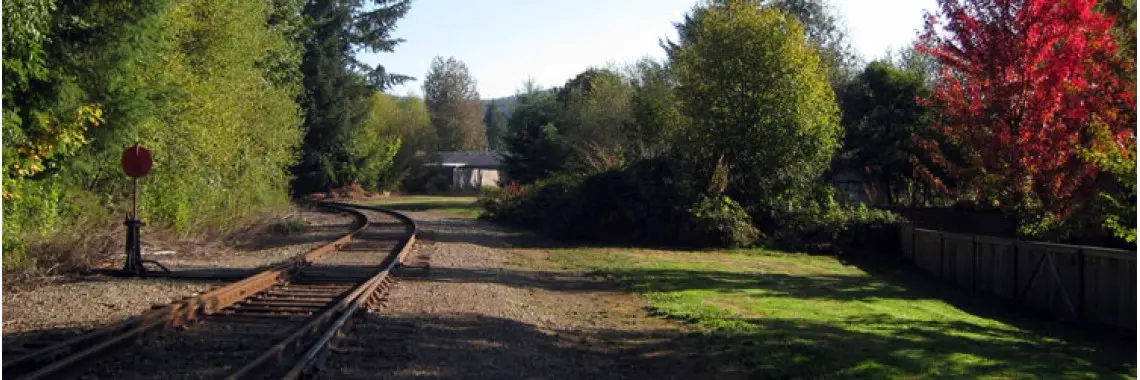
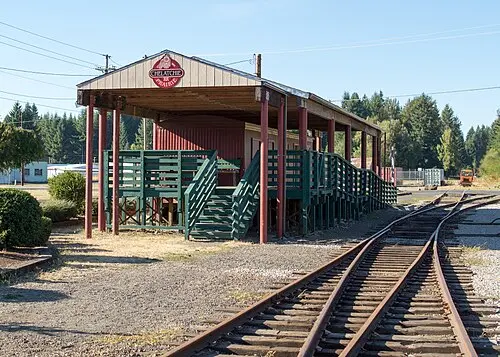
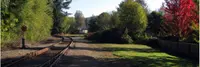
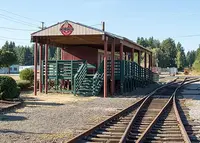
All trains leave from the station at Yacolt, on Railroad Avenue just south of Yacolt Road, in the foothills of Mount St. Helens about 20 miles east of Interstate 5. The usual way in is Rock Creek Road, marked by a brown state sign that names Lucia Falls and Moulton Falls, the two places the train goes. The road changes its name along the way, and the railroad’s directions say to stay on it.
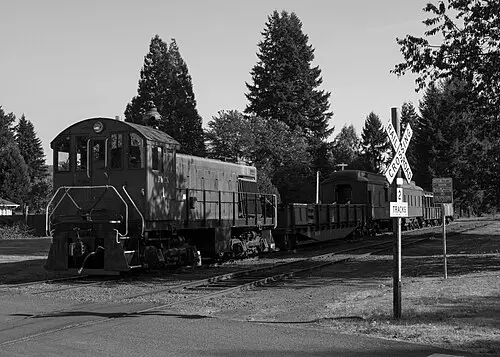
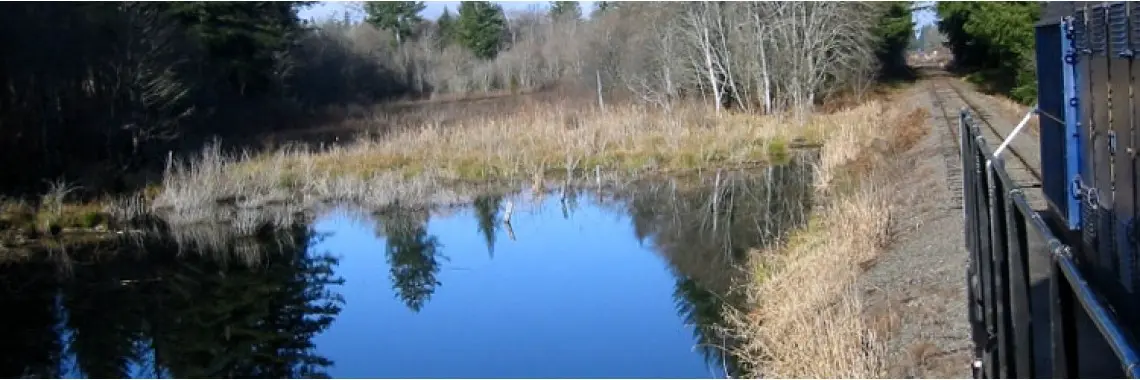
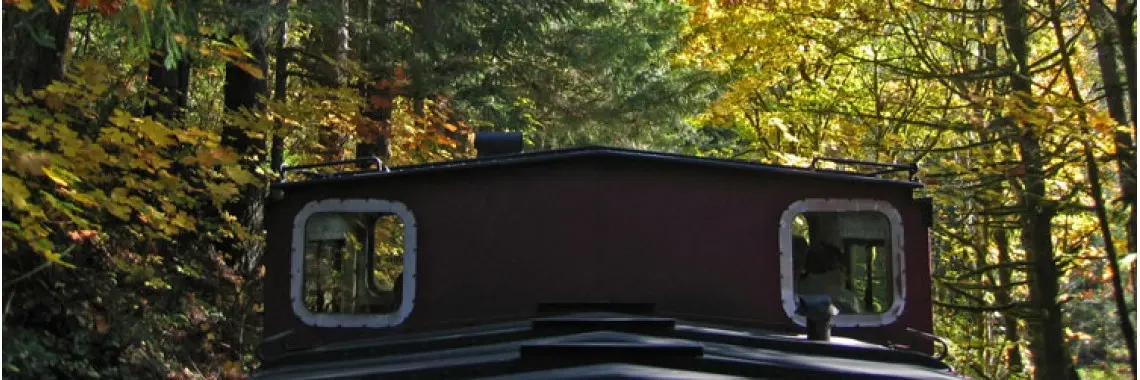
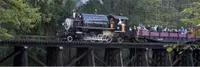
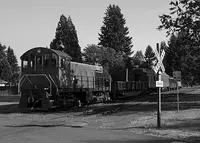
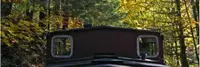
The train is short. An Alco S-2 diesel, once owned by the Los Angeles Junction Railway, pulls a former Spokane, Portland and Seattle Railway Pullman car, an open-air car, and one or two cupola cabooses of Burlington Northern heritage. Leaving Yacolt, the train runs in reverse toward Lucia so that riders in one caboose look forward down the track. The railroad’s ticket page describes the route as running from Yacolt through the tunnel and across the East Fork of the Lewis River on a trestle, with a stop at Moulton Station to visit Yacolt Falls. Wikipedia gives the run as Yacolt to Lucia Falls and back, with a half-hour stop at Moulton Falls Regional Park. Clark County describes it as Yacolt to Moulton Falls and Chelatchie Prairie and back. The tunnel is 300 feet long. The ticket page tells riders to dress for the weather, since the train has both indoor and outdoor seating.
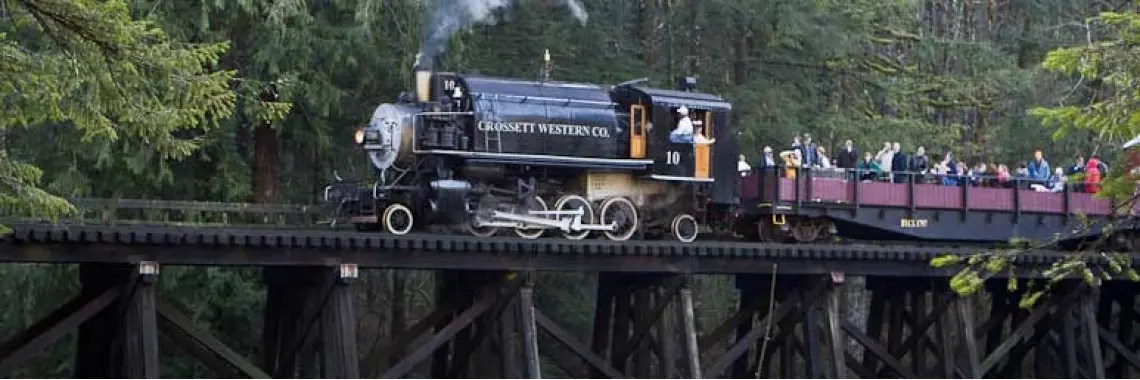
Everyone working the train is a volunteer. The Battle Ground, Yacolt and Chelatchie Prairie Railroad Association, whose reporting mark BYCX also serves as its web address, runs track work, car and locomotive maintenance, the train crew, and the ticket office, and its schedule notes that “both men and women are welcome to join.” The association owns one steam locomotive, a 2-8-2T built by the American Locomotive Company for the Hammond Lumber Company and carrying its original Crossett Western #10 designation. It is out of service while the group raises money for an overhaul. Several more Alco diesels, S-1, S-2, or S-4 models, sit in storage.
Robbers, a horseman, and Christmas trains
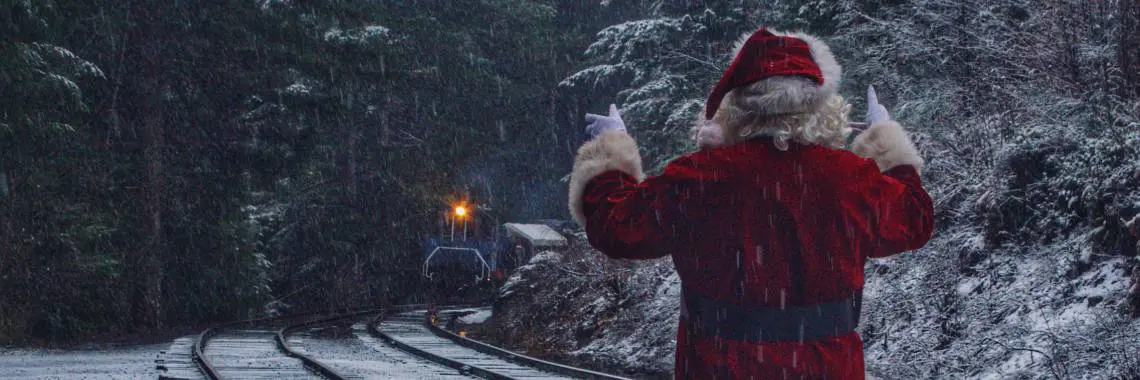
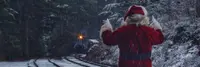
Trains run from May through December, usually on one or two weekends a month, at noon and 2:30 p.m. Each weekend has a name. The 2026 schedule began with Mother’s Day Weekend on May 9 and 10 and went on through Father’s Day, Mid Summer, and Late Summer weekends. On July 4 only, every ticket cost $10, with runs at 1:00, 2:30, and 4:00. Train Robbery Weekend brings actors in costume who stage hold-ups aboard, and the county lists murder mysteries and Christmas tree runs among the special events. The Fall Begins Run went out on October 3 and 4, 2026. The Fall Leaves Run follows on October 17 and 18, a weekend the railroad calls “a fan favorite.” The Headless Horseman Halloween Run comes on October 24 and 25, and Christmas trains run on weekends into December, the last on December 19 and 20.
The Headless Horseman is a volunteer. In 2019 The Columbian reported that Curtis Kelley nearly refused the part because the costume provided was “white, frilly and sort of silly,” he said. The paper then called the ride the Headless Horseman Halloween Steam Train.
A year earlier the Christmas trains nearly did not run. In December 2018 the group announced it would have to cancel its scheduled rides after the Portland Vancouver Junction Railroad, which holds the county’s lease for freight on the line, blocked it from using the track. The Clark County Council rebuked the company, and The Columbian reported that the nonprofit might be close to finding a way to keep the Christmas excursion going. Clark County owns the whole line. Freight runs on the southern part, from Vancouver to Battle Ground, and none moves north of Battle Ground. North of Heisson, the track belongs to the volunteers’ trains.
L.M. Hidden’s road to Yakima
The line began with a Vancouver businessman named L.M. Hidden, who farmed, made brick, ran a hotel, and helped form the Clark County Fair Association. Vancouver had talked about a railroad of its own since the transcontinental line was finished, and the railroad’s history credits Hidden with being the first to act. There is an unverified story that Hidden, his family, and several friends and their families picnicked at Moulton Falls and were so struck by the standing timber that they decided to build a railroad to reach it.
On July 8, 1886, Hidden and five associates left Vancouver to survey a route to Yakima. They were gone a month. Hidden thought the route would open timber, the wheat country around Yakima, and possibly coal and other minerals, and the party came home with estimates of the timber and mineral resources and a practical route. On September 22, 1887, according to the railroad’s history, the Clark County Register announced that the Vancouver, Klickitat and Yakima, Vancouver’s first railroad, had been incorporated with one million dollars in funding, with Hidden as vice-president. The county’s account names the paper as The Vancouver Register and the company as the Vancouver, Yakima and Klickitat. Work began on January 31, 1888, and the first locomotive reached Vancouver on December 20 of that year. The plan was to cross the Klickitat Pass and meet the Great Northern and a Canadian line at Yakima.
The rails got as far as Brush Prairie, 13.5 miles out by the county’s figure. Then depression came and the money ran out. On November 25, 1897, the company was sold, and its new owners renamed it the Portland, Vancouver and Yakima. Within four months it was bringing 50,000 board feet of logs a day from Brush Prairie to Vancouver. In November 1898 the stockholders raised their capital stock from $50,000 to $250,000 and sought right of way to Chelatchie Prairie. By September 1901 four work camps were pushing the line toward Yacolt, and crews were cutting the 300-foot tunnel at Moulton Falls.
The Yacolt Burn and a dead town
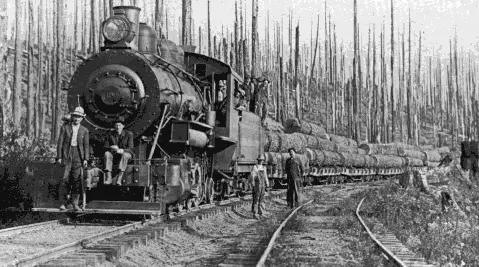
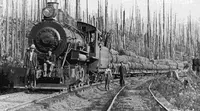
The summer of 1902 was exceptionally dry, and by the second week of September fires were burning all over the Northwest. One fire started near Bonneville in Skamania County and took ten days to cross the timbered hills to the Yacolt area. The wind changed and Yacolt was spared. By the time the fire burned out near Mount St. Helens, the loss in property and resources was about 13 million dollars. Much of the burned land belonged to the Weyerhaeuser Timber Co., which based a large salvage operation in Yacolt and ran it through two subsidiaries, the Clarke County Timber Company and the Twin Falls Logging Company, whose logging trains ran on track laid through the woods. The county says the burn sped up construction of the line.
The rails reached Yacolt in 1903, and the town boomed. The Vancouver Independent wrote: “Keep your eye on Yacolt and Battle Ground. Both of these little towns are now experiencing booms that are almost phenomenal.” That same year the road merged with the Washington and Oregon Railroad as the Washington Railway and Navigation Company, which lasted three and a half months before passing to the Northern Pacific on November 11, 1903. The Northern Pacific put one passenger coach on the line, making the trip each way daily, and a one-way ticket from Yacolt to Vancouver cost $1.07. Before the coaches came, passengers rode wherever there was room: in the caboose, on freight cars, even on the engine.
The salvage of burned timber was finished by 1910, and by the mid-1920s the logging of green timber was winding down. On December 4, 1929, George S. Long, Weyerhaeuser’s general manager, wrote to the stockholders of the Clarke County Timber Company that the country was logged off and that nobody wanted it for farming, since clearing the stumps would cost more than buying land already cleared. Of the company’s holdings in town, he wrote: “At Yacolt we have two or three worn out buildings, all vacant and without any perceptible value whatever, these including an old warehouse, a residence formerly occupied by our logging Superintendent, a hospital building, which has been robbed of much of its equipment, and one or two very small buildings of no value, in fact none of them have any value today for Yacolt is absolutely dead with no promise for a future life.”
Plywood, abandonment, and the volunteers
The Northern Pacific kept log trains running for the small operators who stayed, but passenger service ended, and by the mid-1940s one train a week went to Yacolt. In 1948 Harbor Plywood finished the long-planned extension to Chelatchie Prairie and opened that country to logging. The Longview, Portland and Northern bought the Harbor Plywood line in 1950 and later took the rest of the line from the Northern Pacific, in 1960 by the county’s account. Its parent, the International Paper Company, built a large lumber and plywood mill at Chelatchie Prairie in 1960. The Northern Pacific still ran one log train a day in the late 1950s. It left Kelso at 7:00 a.m., picked up empty cars at Longview, stopped at Battle Ground for the crew’s lunch, reached Yacolt at 12:30 p.m., and was back in Kelso at 7:45 p.m.
The mill closed in 1979, and the whole line went up for sale. In March 1981 three Vancouver businessmen bought it and gave it the name Chelatchie Prairie Railroad. The railroad’s history says they ran it for freight and passengers until January 1984, when they filed for abandonment to sell the rails, the ties, and 340 acres of right-of-way. Wikipedia says the investors bought it intending from the start to tear it up. Before that could happen, Clark County bought the line, mostly in the second half of the 1980s, for commercial, tourist, and recreational use, and leased it to the Lewis and Clark Railway.
North of Battle Ground, hard winters, poor maintenance, and changes of ownership wore down the roadbed, rails, bridges, and buildings. In 1998 a group of community volunteers set out to restore the line as a working historical railroad. With the county’s support they rebuilt the track from Moulton Falls to Chelatchie Prairie, and excursion trains ran again on May 26, 2001, out of Yacolt, the town Long had written off. The railroad’s history says work continues on the track and equipment, with the goal of restoring service to Battle Ground.
Notable Events
- 1886Hidden and 5 associates left Vancouver to survey the proposed route to Yakima. tickets.bycx.org
- 1887The Vancouver Register announced that a group of investors led by L.M. Hidden had incorporated the railroad. clark.wa.gov
- 1888Work began on 1/31/1888; the first locomotive arrived in Vancouver on 12/20/1888. tickets.bycx.org
- 1897The broke railroad had to be sold and was renamed the Portland, Vancouver and Yakima Railroad. tickets.bycx.org
- 1898Stockholders increased capital stock from $50,000 to $250,000 and sought right of way to extend the line to Chelatchie Prairie. tickets.bycx.org
- 1901Four work camps were extending the rail line to Yacolt; crews worked on a 300-foot tunnel at Moulton Falls. tickets.bycx.org
- 1902Construction on the line accelerated following the Yacolt Burn in 1902 to support a multi-year timber salvage effort. clark.wa.gov
- 1902An exceptionally dry summer led to fires all over the Northwest by the second week in September. tickets.bycx.org
- 1902A fire started near Bonneville in Skamania County and moved through the timber covered hills, taking 10 days to reach the Yacolt area; the wind changed and Yacolt was spared, and Weyerhaeuser mounted a salvage operation based in Yacolt. tickets.bycx.org
- 1903The Northern Pacific Railway acquired the railroad for timber salvage and logging green timber in the region, and provided passenger service between Vancouver and Yacolt. clark.wa.gov
- 1903The P,V&K merged with the Washington and Oregon Railroad as the Washington Railway and Navigation Company, then transferred to Northern Pacific on 11/11/1903. tickets.bycx.org
- 1910Salvage of burned timber was completed by 1910. tickets.bycx.org
- 1920sLogging of green timber in the area was winding down by the mid-1920's. tickets.bycx.org
- 1929George S. Long wrote stockholders regarding closure of operations in the area. tickets.bycx.org
- 1940sNorthern Pacific was only running one train a week to Yacolt. tickets.bycx.org
- 1948Harbor Plywood Co. built a line from Yacolt to Chelatchie Prairie. clark.wa.gov
- 1960International Paper Co., the parent company of the Longview, Portland and Northern Railway, built a large lumber and plywood mill in Chelatchie Prairie in 1960; when it closed in 1979, rail traffic dropped drastically. clark.wa.gov
- 1979When the mill was closed in 1979, the entire line was put up for sale. tickets.bycx.org
- 1980sClark County purchased the line for commercial, tourist and recreational purposes. clark.wa.gov
- 1981Three Vancouver businessmen bought the line in March 1981 and changed its name to the Chelatchie Prairie Railroad. tickets.bycx.org
- 1984Used both commercially and for passenger traffic until January of 1984, when the owners filed for abandonment to tear up the line and sell the tracks, ties and 340 acres of right-of-way. tickets.bycx.org
- 1998Community volunteers came together to restore the line as a functioning historical railroad. tickets.bycx.org
- 2001With the support of Clark County the track from Moulton Falls to Chelatchie Prairie was restored, and excursion service resumed on May 26, 2001. tickets.bycx.org
- 2018Chelatchie Prairie Railroad announced it would have to cancel scheduled rides after Portland Vancouver Junction Railroad blocked it from using the track. columbian.com
People
- Curtis Kelley, Played the Headless Horseman during a Halloween-season railroad outing; nearly refused because of the costume, he said.
- George S. Long, Weyerhaeuser general manager who wrote stockholders about closure of local operations (December 4, 1929).
- L.M. Hidden, Vancouver businessman who first acted on the railroad proposal.