Chalk Cliffs Trout Rearing Unit
Nathrop, Chaffee County, Colorado. Cold Water fish hatchery (trout rearing unit); Open to visitors every day of the year.
Details

- Where
- 22605 County Rd 287, Nathrop, CO 22605. Directions
- When
- Daily, 9 a.m. to 4 p.m.
- Getting there
- 22605 CR 287 near Nathrop, about 2 miles west of U.S. 285 toward Mount Princeton.
- Fees
- Free.
- Access
- Park in the visitor parking lot; leave pets and fishing gear in your vehicle.
- Walk-in or reserve
- Visitors welcome, walk-in; no reservation or ticket is stated.
- Phone
- 719-395-2378
- Website
- cpw.state.co.us
- Managed by
- Colorado Parks and Wildlife.
- Established
- 1948, when the state of Colorado began operating the facility; it was originally a private trout farm.
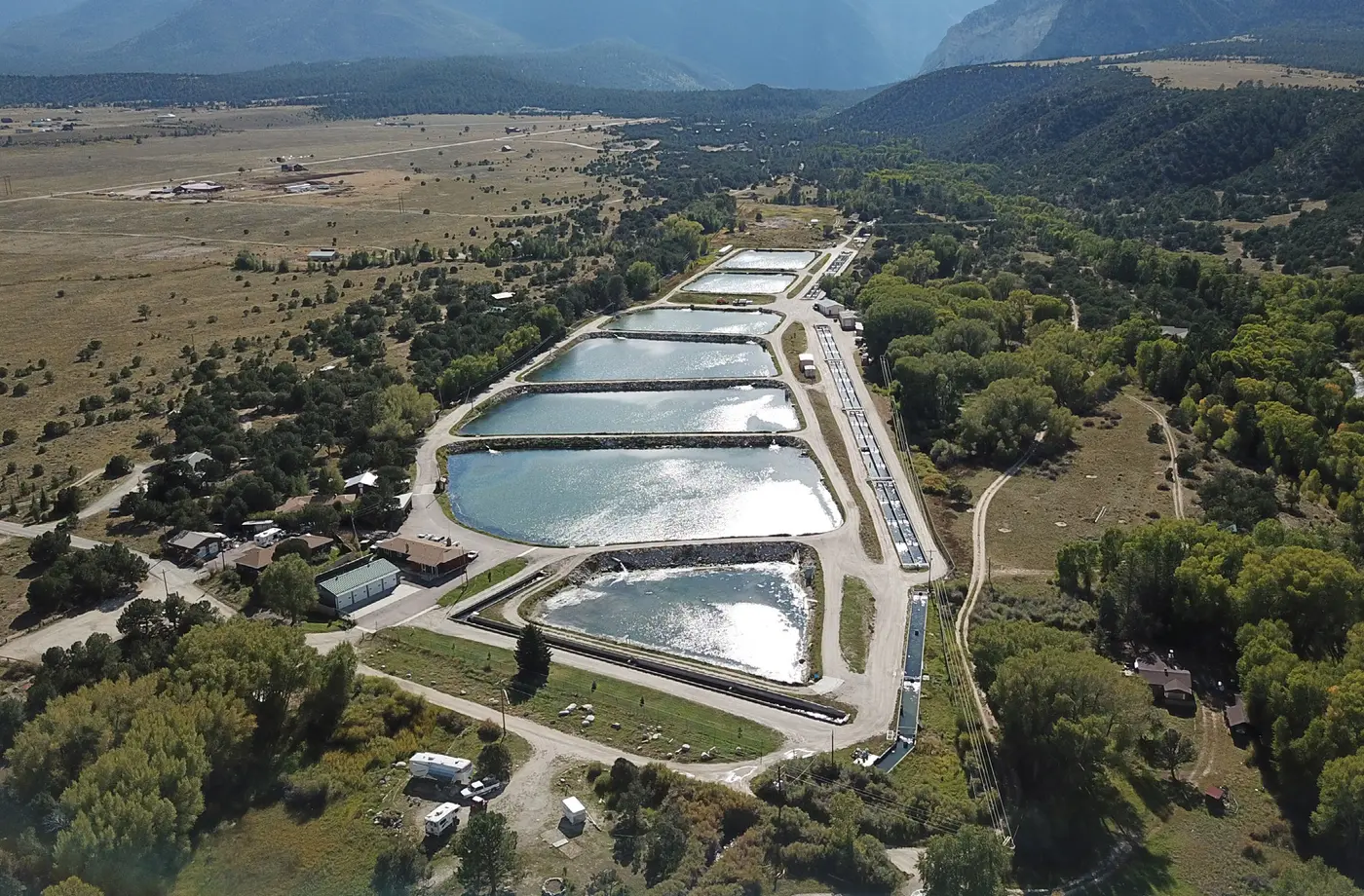
County Road 287 leaves U.S. 285 near Nathrop and runs west toward Mount Princeton. About 2 miles along, at number 22605, it reaches the Chalk Cliffs Trout Rearing Unit, a cold-water facility of Colorado Parks and Wildlife. Visitors park in the visitor lot and leave pets and fishing gear in the car. Beyond the lot are the outdoor rearing ponds and concrete raceways where the trout are raised. Above them, on the south side of the mountain, are the Chalk Cliffs that give the unit its name.
Feed dispensers and raceways
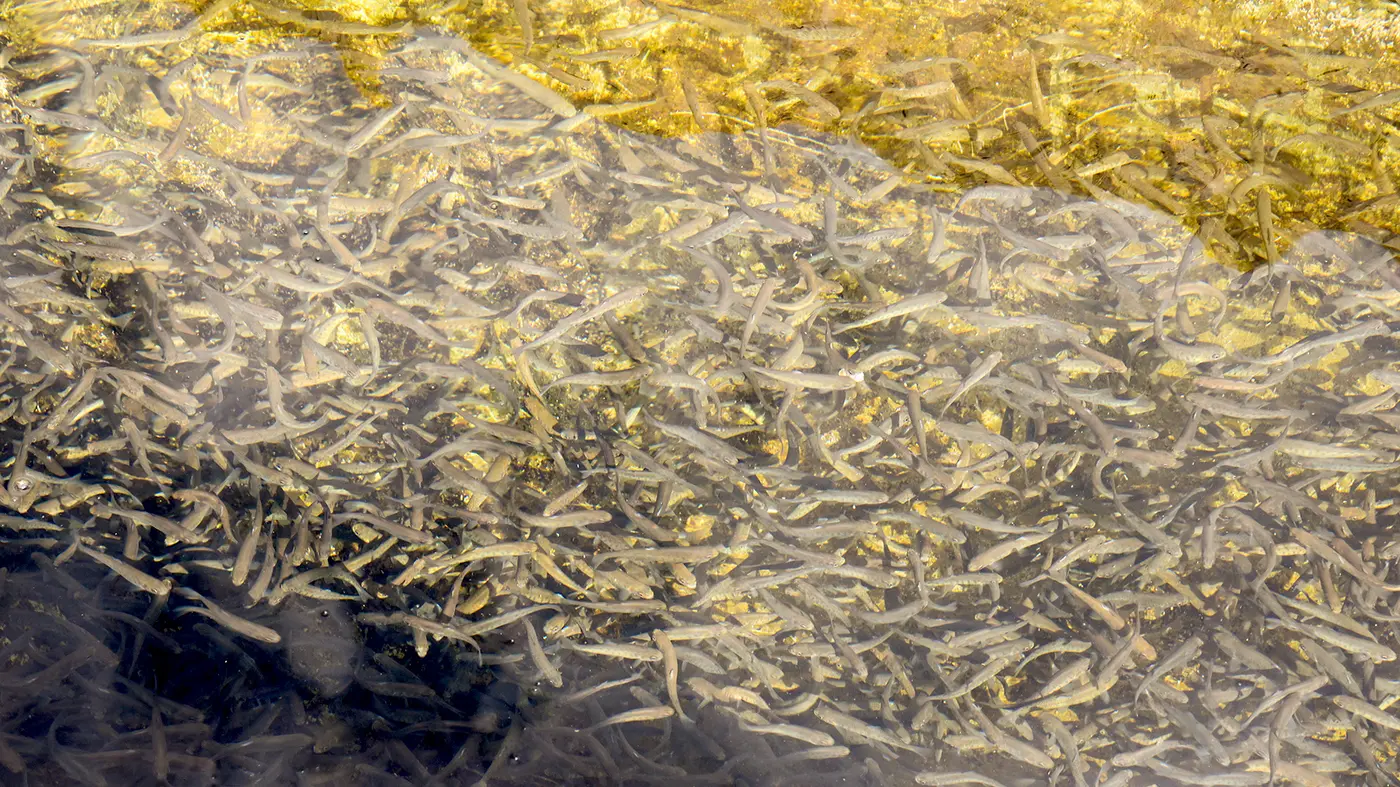
The unit is open to visitors from 9 a.m. to 4 p.m. every day of the year, and admission is free. An information kiosk orients new arrivals. “Feed the Fish” dispensers stand by the water and take a quarter in any season. Colorado Parks and Wildlife’s 2018 press release described what follows a tossed handful: the water bubbles with frenzied rainbow trout that jump into the air.
From Memorial Day weekend through Labor Day, volunteer hosts staff the visitor center. The 2018 release called them “camp hosts.” They hand out buckets of fish food, answer questions, show videos, and lead guided tours for anyone who wants one. Posters and pamphlets are available while they are on duty. During the school year, visitors walk the unit on self-guided tours. The staff’s motto, printed by the agency, is “Your fishin’ is our mission.”
Ten-inch trout for the plains
Chalk Cliffs raises catchable trout, which the agency defines as 10-inch trout ready for immediate recreation. Its brochure gives the output as about 700,000 a year. They are stocked in public ponds and lakes on the Front Range and Eastern Plains, across an area that runs from Loveland to Trinidad and east to the Kansas border.
Stocking begins in January and is busiest from mid-February until mid-June, when most waters grow too warm for trout. It resumes in late September, once those waters have cooled, and continues through December.
The brochure describes the work behind those numbers:
- Moving fish. Whenever fish are moved, for stocking or within the unit, crew members get into the water with them.
- Loading. A calibrated bucket on a boom truck lifts 200 pounds of fish at a time into truck-mounted tanks.
- Hauling. Three hauling trucks carry 5,000 to 7,500 ten-inch trout per load.
- Feeding. Fish under five inches are fed by hand. Larger fish are fed by a truck-mounted feed blower. For most of the year the unit puts out about 1,500 pounds of feed a day.
The crew also works away from the unit. In August 2015, Denver Water drained Antero Reservoir in South Park to repair its 100-year-old dam, and Colorado Parks and Wildlife netted game fish there to move them to nearby waters. A Denver Post photograph from that salvage shows Dave Trojanovich, assistant hatchery manager at Chalk Cliffs, transferring salvaged trout.
A private trout farm on Chalk Creek
The unit began as a private trout farm. According to the brochure, the state of Colorado began operating it in 1948 and bought it shortly afterward. A chronological list of state facilities in William J. Wiltzius’s history for the Colorado Division of Wildlife, Fish Culture and Stocking in Colorado, 1872-1978 (June 1985), gives the unit’s first year as 1950.
The unit’s water comes from Chalk Creek, and the cliffs that give the place its name sometimes foul it. The brochure notes that during heavy rainstorms, large amounts of soft “kaolite” wash off the cliffs into the creek just above the unit’s headgates.
By the 1960s, Chalk Cliffs fish were going into rivers as well as lakes. The Mountain Mail of March 12, 1964, reported that 1,000 pounds of rainbow trout, seven to ten inches long, had been planted on a Wednesday in the Arkansas River between Browns Canon and Texas Creek. A similar plant had recently been made from Texas Creek to Cañon City. The source was Ken Wagner, a wildlife officer with the Colorado Game-Fish-Parks Department, and the trout were raised at Chalk Cliffs.
Lime pits and zinc
In September 1983, a contagious virus diagnosed as infectious hematopoietic necrosis, or IHN, broke out at Chalk Cliffs and at the Mount Shavano unit, which sits along the Arkansas River west of Salida. Both were then run by the Colorado Division of Wildlife. Together they supplied stocker fish for nearly one-fourth of the state’s public waters.
The Chaffee County Times reported on September 22 that more than three million fish had been destroyed the weekend before. Division officials valued them at about $453,000. The fish were buried in lime-lined pits to keep the disease from spreading, the same method used against a similar outbreak in Colorado in the mid-1970s. Rose, the official the Times quoted, said the method “has been 100 percent successful.”
Three years later the trouble came down the creek itself. In 1986, during spring runoff, fish died at the rearing unit. The kill was attributed to elevated metals in Chalk Creek, and sampling found zinc and cadmium above state water quality standards. According to the U.S. Environmental Protection Agency, that kill first brought the watershed of the Chalk Creek Mining District under scrutiny. The district lies in the creek’s upper reaches near the old mining town of St. Elmo.
The EPA account gives the effects downstream: fewer brown trout and no young fish along a 12-mile stretch below the mining district. Metal levels peaked near the Mary Murphy Mine and the Iron Chest tailing piles. A later loading analysis traced 85 percent of the metals leaving the main adit to a single inflow from the north drift on the Mary Vein. That inflow made up 1.5 percent of the adit’s discharge, but at high flow it carried 190,200 micrograms of zinc per liter. It led back to an ore chute on a high-sulfide stope, a mined-out section of the vein, that drained 15 gallons a minute.
Notable Events
- 1948Colorado began operating the facility in 1948, purchasing it shortly after that. cpw.state.co.us
- 1950The agency's chronological list gives Chalk Cliffs' first year in operation as 1950. web.archive.org
- 1983The fish were buried in lime-lined pits to prevent spread of the disease diagnosed as IHN. chaffeecountytimes.com
- 1986A 1986 fish kill at the CDW Chalk Cliffs Fish Rearing Unit during spring runoff was attributed to zinc and cadmium at levels exceeding state water quality standards in Chalk Creek, first bringing the Chalk Creek mining district watershed under scrutiny. response.epa.gov
People
- Rose, Commented on disposing of the contaminated fish during the virus outbreak.
- Dave Trojanovich, Assistant hatchery manager at Chalk Cliffs in Nathrop; shown transferring salvaged trout.
- Ken Wagner, Colorado Game-Fish-Parks Department wildlife officer who reported rainbow-trout planting in the Arkansas River.