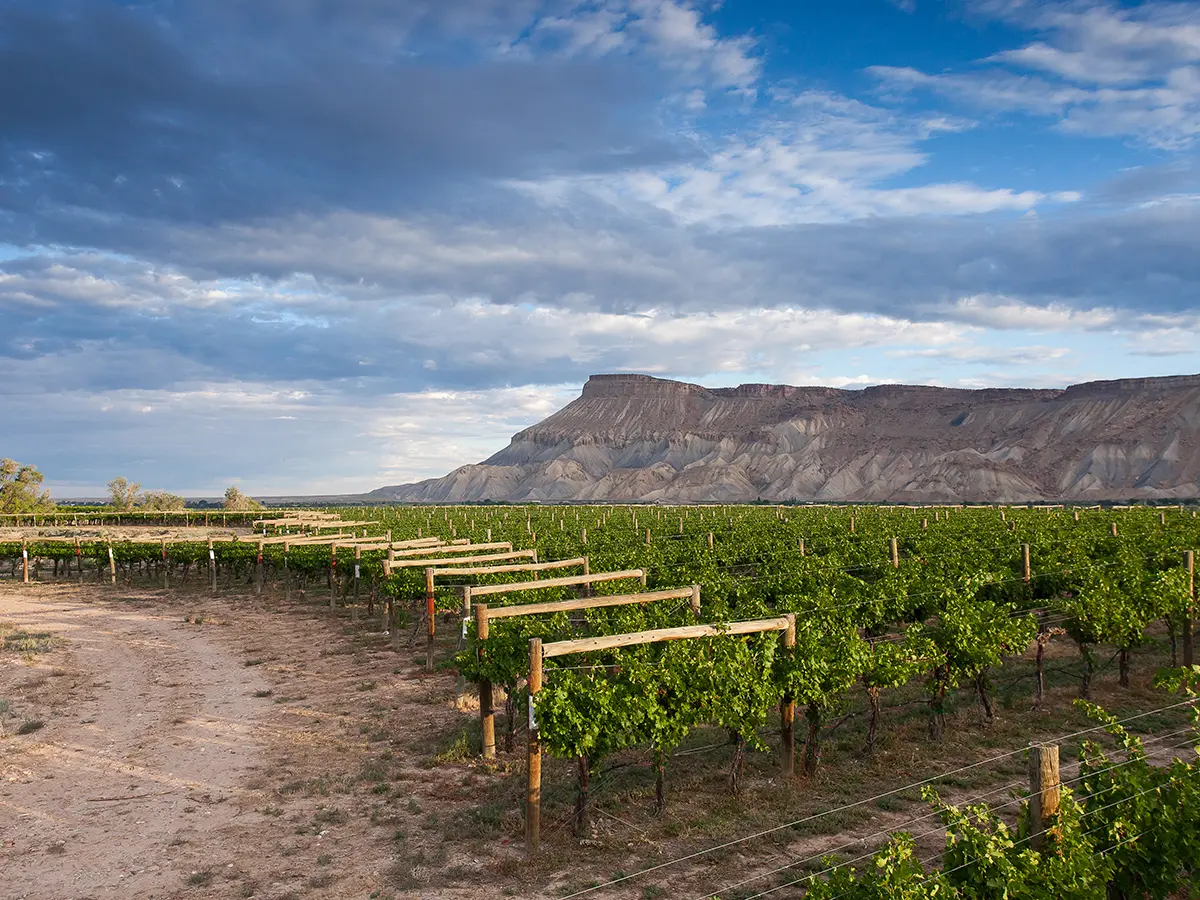
Centennial Cellars
Palisade, Mesa County, Colorado. Winery.
Details

- Where
- 3801 F-1/4 Road, Palisade, CO 81526. Directions
- When
- Monday 11-6 pm, Tuesday 11-8 pm, Wednesday closed, Thursday closed, Friday 11-8 pm, Saturday 11-8 pm, Sunday 11-6 pm.
- Phone
- (970)464-5656
- Managed by
- Talbott Family.
The Talbott family’s Farm Market & Taproom stands at 3801 F-1/4 Road, on what a 2021 Thirst Colorado account describes as a hill overlooking Palisade. The Centennial Cellars wines are poured there alongside the family’s hard ciders, guest wines and ciders, and fresh fruit from its orchards. A small market sells local produce and other Colorado goods. Talbott’s Eatery serves what the family calls farm-to-table Southwest cuisine, using ingredients from its own farm and from other local producers. The market occupies the family’s first cider mill.
The winery describes its list as estate-grown and fruit-forward, running from dry reds to semi-sweet rosés and crisp whites. Among the wines it names are an Off-Dry Viognier, a Semi-Sweet Riesling, a Dry Riesling and a Baco Noir Rose. Its 2026 website announces new bottled wines and shipping to 39 states. Visit Palisade lists Centennial Cellars among the wineries in and around the Fruit and Wine Byway.
Cans, bottles, and a Marine come home
Charles Talbott served in the United States Marine Corps before returning to Palisade to start Talbott’s Cider Company and Centennial Cellars. The family calls the business family- and military-owned. Today he runs its craft beverage division with his brother, Joseph.
Cider came first. In 2015, according to Thirst Colorado, Charles turned an interest in home brewing into a new family venture and became director of operations for the cider company. A year later his father, Bruce Talbott, told the Summit Daily: “The passion for creating cider is coming from the younger generation. From my son, Charles, and from his cousin and wife.”
The family launched the wine brand in 2019. The name refers to the Talbotts’ more than a century of farming in the Grand Valley. The Brandwerks Group, which helped plan the line, writes that the labels were designed with Shaun Cooney around the plant life of the valley’s arid high-desert landscape, as a picture of the family’s deep roots. Brandwerks also writes that it sold the first wines into Whole Foods and Total Wine & More.
Bottles did not stay the whole story. In 2021 Charles told Thirst Colorado that it had been hard to compete on crowded bottled-wine shelves. That May he had moved to canned wine, following the Denver winery Infinite Monkey Theorem. The company concentrated on 375 ml cans and bottled only special reserve wines. “I’m starting to have a little more confidence that in the next 20 years, the Colorado wine industry is going to be pretty big,” he said. “I think we are putting ourselves on the map.”
Grapes on the mesa and the million-dollar breeze
The grapes come from Talbott Farms. Brandwerks calls it Colorado’s largest grower of wine grapes, with more than 160 acres of vinifera and hybrid varieties supplying some 34 wineries. In a 2024 episode of Colorado Experience on PBS, a family member estimated the farm at about 180 acres of wine grapes, about 450 acres of peaches and about 10 acres of cherries.
The farm names Cabernet Franc and Riesling as varieties that grow well here. It credits the high-desert setting, daytime warmth and cool nightly canyon breezes. Its peaches grow at 4,800 feet, irrigated with Rocky Mountain snowmelt carried down into the valley’s alluvial soils.
Growers interviewed by PBS describe the canyon breeze in more detail. On still, clear spring nights a drainage wind comes out of De Beque Canyon. It pushes cold air off the orchard floor and lets warmer air settle in. Because it saved fruit in the valley for years and years, it was known as the million-dollar breeze.
The wine grapes are a later arrival on this ground. According to Doug Caskey of the Colorado Wine Industry Development Board, speaking to the Summit Daily in 2016, the California winemaker Warren Winiarski worked with the Denver winery Ivancie in the early 1970s. Together they investigated vinifera grapes in Palisade and on East Orchard Mesa, and their findings led to the first plantings. Bruce Talbott told the same paper that when the family sends its crushed juice to California labs, the chemistry comes back identical to Napa grapes.
The work in the rows is still largely done by hand. Mario Moreno Hernandez has worked for the Talbotts since 1995 and supervises the crews, hiring workers from San Luis, Monterrey, León, Guanajuato and Michoacán. He told PBS that thinning begins the first week of May and harvest in mid-July.
A letter to an Iowa grain farmer
The family’s story begins, by Thirst Colorado’s telling, with a letter. Western Slope land developers mailed letters directly to Iowa farmers. One of them reached Joseph Evan Yeager, a grain farmer drawn by the promise of better weather and rich alluvial soils. He came to Palisade in 1907 and began growing peaches and other fruit. The Centennial Cellars history counts him among the first settlers to plant orchards in the Palisade region. Bruce Talbott has said that at least half of Palisade’s people were originally from Iowa, which explains the town’s Iowa Street and the Iowa Day celebrations in Grand Junction in the early 1900s.
According to a family member interviewed by PBS, Joe Yeager talked his son, Charlie Yeager, into bringing his family west. Charlie’s daughter Margaret was five or six years old when they arrived.
The Talbotts had come out of Kentucky into Delta County to farm and ranch. In the winery’s account, Joe’s granddaughter caught the eye of a young cattleman from that neighboring county. When they married, Harry Talbott, whom the winery names as founder of Talbott Farms, joined the fruit business. In 2016 Bruce gave the Summit Daily 1908 as the year the Talbott family came to the Grand Valley.
Talbott Farms was incorporated in 1965. The orchards were once 90 percent apples. Bruce has said that in the mid-20th century Colorado peaches went largely to home canners, people who “were already canning tomatoes and sweet corn and pickles and whatever else.” That trade faded in the 1970s, when Del Monte and other large companies began selling cheap canned fruit. By the 1980s the family was selling fresh peaches straight to regional supermarkets.
In 1983 Bruce began pressing apples into sweet cider. “We were trying to find something to do with our off-grade (apples),” he said. Demand grew, and in the 1990s the family built a larger mill. By 2021 the farm grew no apples at all, and most of the cider was made from Washington and Oregon fruit.
The sewer line on East Orchard Mesa
Margaret and Harry Talbott Sr. had a son, also named Harry. The Colorado Sun records that he served as an Army military police officer and earned a master’s degree in environmental science. He came home to work the orchards while teaching biology at Central High School in Clifton.
In the late 1970s an oil-shale boom was expected to cover the Grand Valley with housing for incoming workers. His own parents planned to bring a sewer line to East Orchard Mesa so the orchard land could be built over. Harry and his wife, Bonnie, fought them in court. For a year, Bruce recalled, his parents and grandparents “went in and out opposite doors in the church.” Harry liked to tell it this way: “Developers told us to get out of the way. We told them where to go, and it wasn’t to Paradise.” Bruce put it more plainly: “Had grandpa crossed the river with that sewer line, we wouldn’t have the fruit industry we have today.”
In 1980 Harry founded the Mesa County Land Trust, later the Colorado West Land Trust, to protect the orchard lands in perpetuity. Its first three conservation easements were on Talbott land. The trust now holds easements on more than 70,000 acres of Western Slope farmland.
Harry was still driving the orchards on an ATV loaded with shovels for his irrigation work in the weeks before his last illness. He died in March 2021 at 86. He died at home, in the midst of the family’s budding orchards.
Notable Events
- 1890sThe first orchards were planted in the 1890s, and the growers knew at once they were on to something special. pbs.org
- 1907Joseph Evan Yeager put down roots in Colorado's Grand Valley and was among the first settlers to plant orchards in the Palisade region. centennialcellars.com
- 1907Harry Talbott's great-great grandfather rode in a wagon from Iowa to the Grand Valley to settle land with the right combination of temperatures, soil, water and wind to produce excellent fruit. coloradosun.com
- 1907Joseph Evan Yeager moved to Palisade and started growing peaches and other fruit; the Talbott family later married into the Yeager family. thirstcolorado.com
- 1908The Talbott family came to the Grand Valley; their orchards and vineyards produce Palisade peaches, grapes for many local wineries and apples. summitdaily.com
- 1965The business the family grew out of its early Grand Valley orchards included incorporation in 1965. talbottfarms.com
- 1970sHarry and Bonnie Talbott fought Harry's parents in court over plans to bring a sewer line to East Orchard Mesa so the orchard lands could be developed with housing for oil shale workers. coloradosun.com
- 1980To protect the orchard lands in perpetuity Harry founded the Mesa County Land Trust, later the Colorado West Land Trust, and its first three easements were on Talbott lands. coloradosun.com
- 1983The family built its first cider mill, now home to the retail market. centennialcellars.com
- 1983Bruce started pressing apples and making sweet cider. thirstcolorado.com
- 1990sAs demand grew, the family constructed a larger mill to meet production needs. centennialcellars.com
- 2015Harry's grandson Charles Talbott turned his interest in home brewing into a new Talbott's venture. thirstcolorado.com
- 2019The family introduced Centennial Cellars, an elite line of estate-grown canned and bottled wines. centennialcellars.com
People
- Charles Talbott, Harry's grandson; director of operations for Talbott's Cider Company (2015).
- Harry Talbott, Great-grandfather and the founder of Talbott Farms.
- Joseph Evan Yeager, Iowa grain farmer drawn to the Grand Valley by a land developer's letter; started growing fruit in Palisade (1907).
- Joseph, Brother of Charles Talbott; co-leads the family's craft beverage division.
- Bruce Talbott, Yeager's 5th generation descendent; started pressing apples for sweet cider (1983).
Sources
- coloradowine.com/winery/centennial-cellars
- visitpalisade.com/wineries-to-try
- talbottfarms.com/about
- brandwerksgroup.com/portfolio_page/centennial-cellars-wines
- coloradosun.com/2021-03-17/harry-talbott-farms-peaches-palisade-obituary
- pbs.org/video/palisade-peaches-q7omsh
- centennialcellars.com/about
- thirstcolorado.com/source/2021/7/7/peachy-in-palisade
- summitdaily.com/news/wines-of-the-grand-valley-exploring-palisades-east-orchard-mesa