Carson National Fish Hatchery
Carson, Skamania County, Washington. National fish hatchery.
Details

- Where
- 14041 Wind River Highway, Carson, WA 14041. Directions
- When
- Monday-Friday 8:00 am - 3:30 pm.
- Season
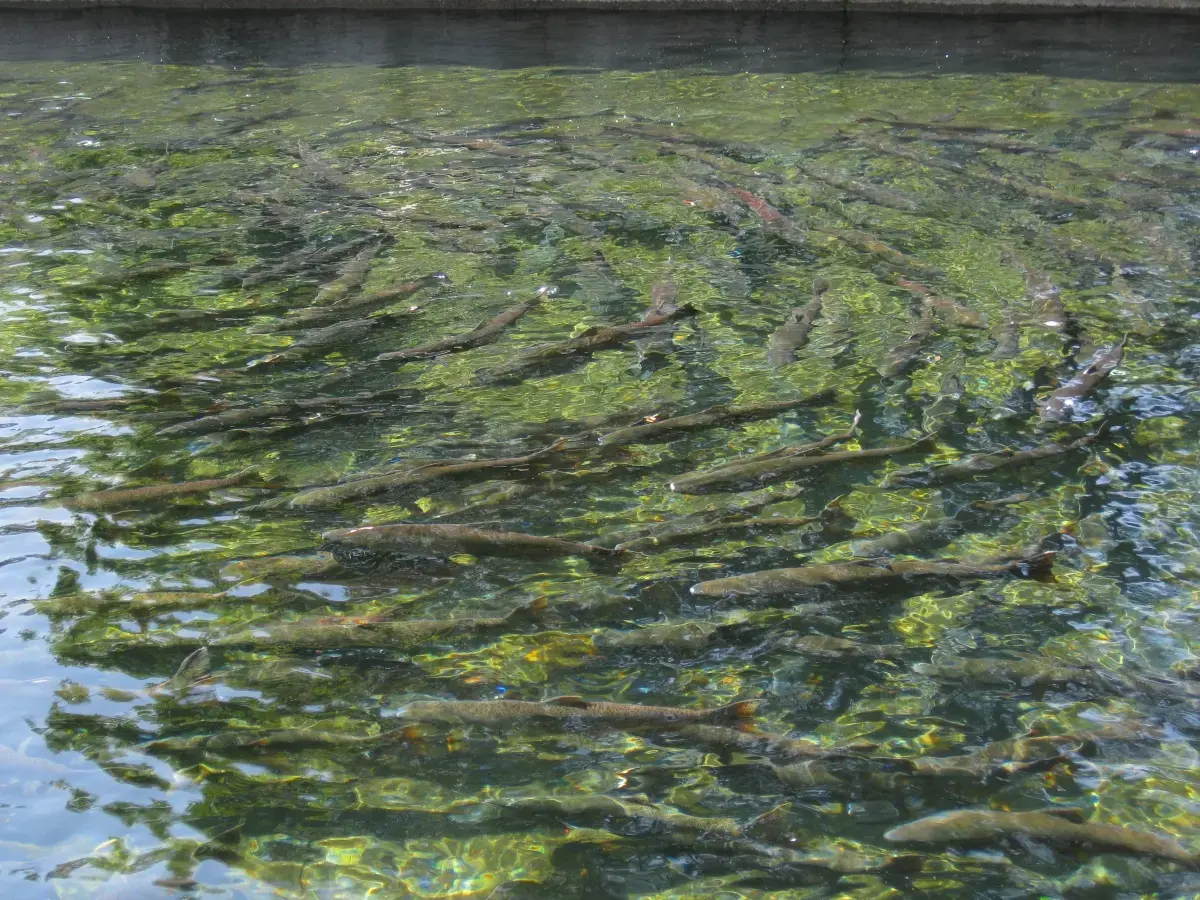
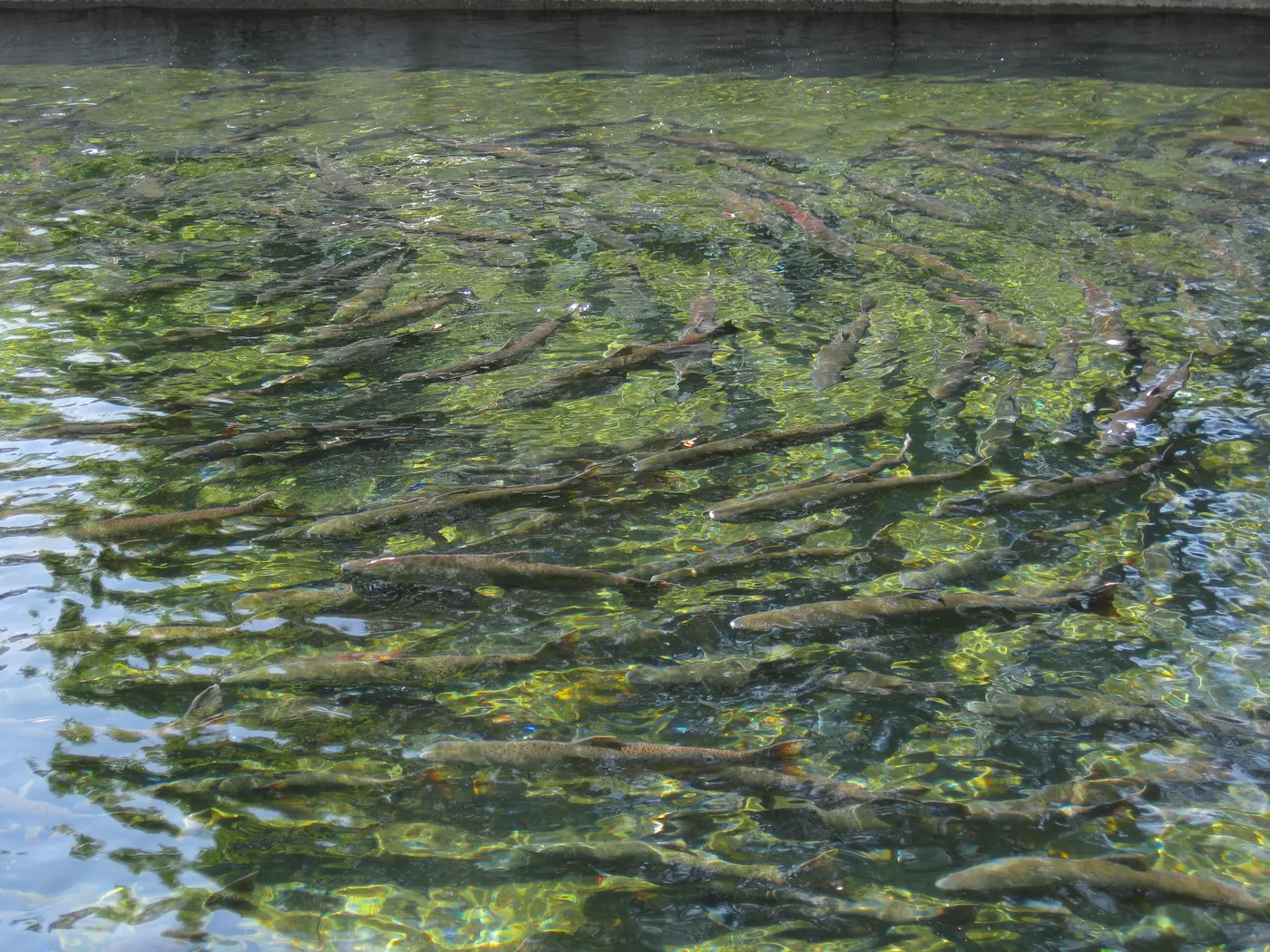
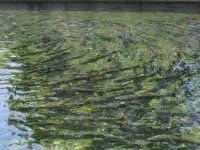
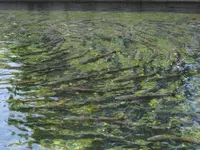
- Fish ladder opens in early May; adult spring Chinook viewing May through August; juvenile salmon in the raceways all year.
- Getting there
- 13 miles northwest of the town of Carson, WA, in a heavily forested valley of the Gifford Pinchot National Forest at the confluence of Tyee Creek and the Wind River.
- Access
- No gate or fee keeps walk-in visitors out, but the fish nursery is open only during visiting hours and visitors should be accompanied by hatchery staff; the outside raceways are accessible to visitors at any time.
- Walk-in or reserve
- Open to walk-in visitors Monday-Friday; tour groups of all sizes are welcome and large groups call (509) 427-5905 to schedule a tour.
- Phone
- (509) 427-5905
- Website
- fws.gov
- Managed by
- U.S. Fish & Wildlife Service, Columbia River Gorge National Fish Hatchery Complex.
- Established
- 1937.
The Wind River Highway runs north from Carson, Washington, into the Gifford Pinchot National Forest. The hatchery stands beside it at the point where Tyee Creek comes down into the Wind. The U.S. Fish and Wildlife Service places it 13 miles northwest of town. A 2016 notice in the Columbia Gorge News placed it 14 miles north, at milepost 14. Deer stand along the road in, wild turkey are often seen, and a resident elk herd lives near the grounds. The hatchery occupies 20 acres of developed river-bottom at river mile 18 on the Wind. The Wind reaches the Columbia 155 miles above the Pacific and 10 miles above Bonneville Dam.
The ladder, the ponds, and the raceways
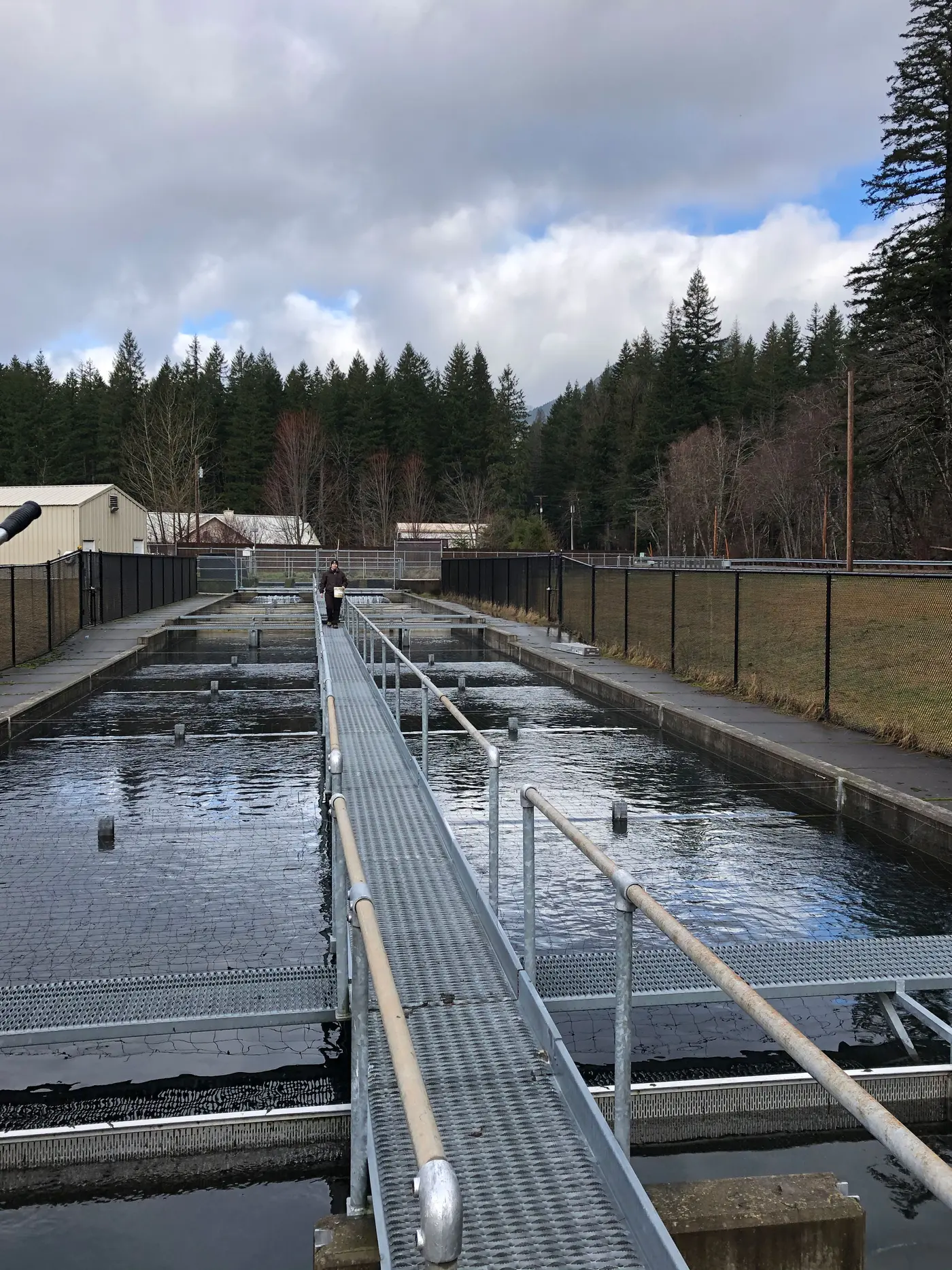
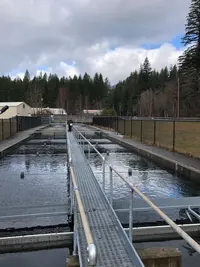
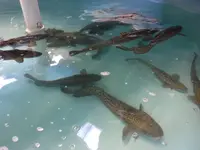
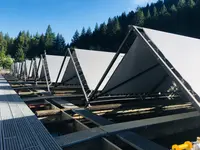
Oregon Public Broadcasting described the place in 2022 as 50 tanks and ponds inside chain-link fencing, set among wood-frame fish nursery buildings and a half-dozen cottages built for hatchery workers in the 1930s. Interpretive signs around the grounds explain each stage of the salmon’s life. The outside raceways hold fry and fingerlings in every month and stay open to visitors at any hour. The indoor nursery opens only during visiting hours, and visitors there go with hatchery staff. It shows eggs, sac-fry and fry from October through December. Two picnic shelters on the grounds have tables, grills and water. There are no hiking trails on the property. The same road continues toward the Spirit Lake entrance of Mount St. Helens National Volcanic Monument.
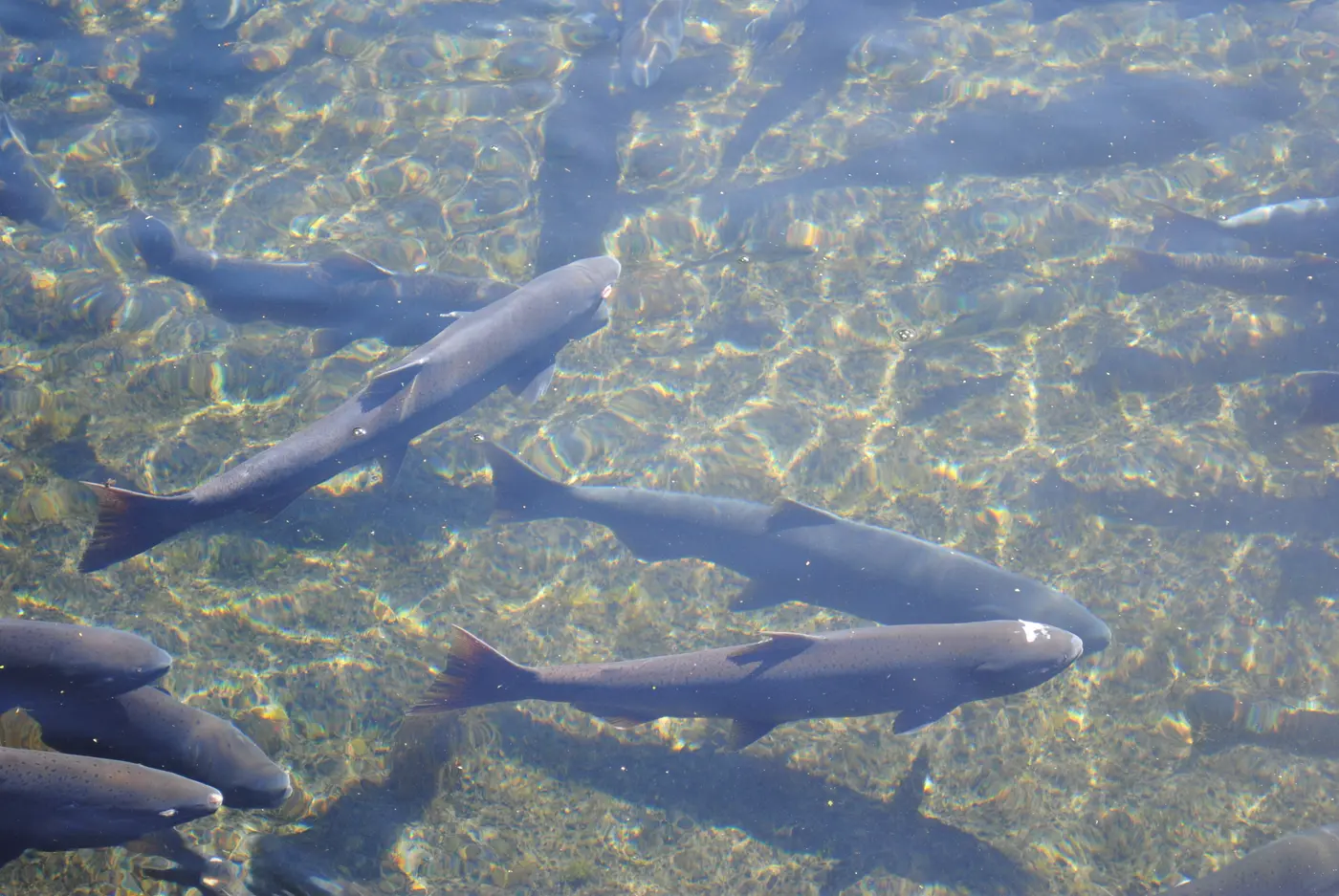
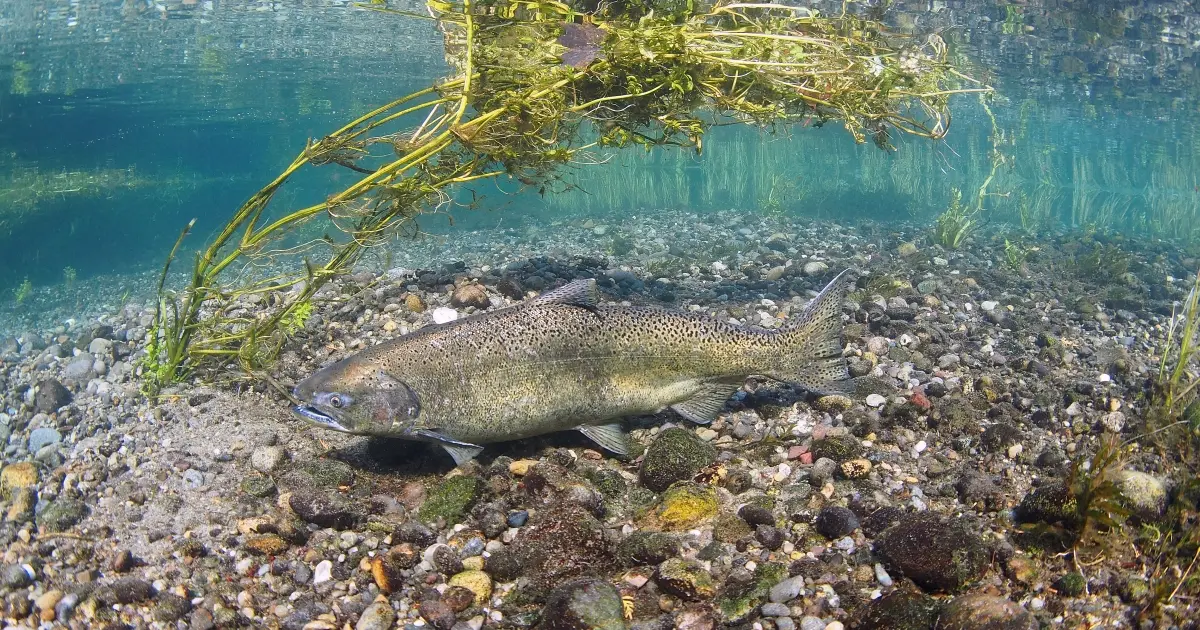
The hatchery’s year turns on one fish, the spring Chinook. The Service describes Chinook as the largest salmon, averaging 18 to 24 pounds, with small black spots on the back, dorsal fin and tail and gray gums at the base of the teeth. Spring Chinook are smaller and slimmer than fall Chinook and less brightly colored at spawning. The annual production goal is 1.52 million fish. Each year the hatchery also sends 250,000 eyed eggs to the Washington Department of Fish and Wildlife’s Lyons Ferry hatchery, to restock a tributary of the Walla Walla River in eastern Washington.
The hatchery’s own posts trace the 2026 season. On April 8 the crew announced, “Release day tomorrow! We will be releasing over 1.6 million spring Chinook salmon smolts into the Wind River to begin their journey to the sea. Feel free to stop by and check it out if you are up this way.” The next morning 1.63 million smolts went into the river. On April 30 the adult holding ponds were reported cleaned and ready. The ladder opened that night, and the first returning adult was in the trap the next morning. By May 12 the count stood at 100. Over one late-May weekend 668 fish came in, and the post that Monday set out the arithmetic: “Our brood goal this year is 1800 so we can spawn 600 females. Since males return at a lower rate, 1800 fish should give us about 600 males.” The total passed 1,800 by June 2. On June 17, “after a two-week hiatus due to family events,” the count stood at 2,284. The year before, 3,676 adults had returned as of August 27, 2025.
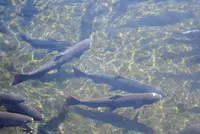
The returning adults wait in the holding ponds until August, and visitors can see them there from May through August. In 2002 the production ponds were coated with polyurethane and colored to approximate the bed of the Wind River. The Skamania County Chamber of Commerce lists May for watching fry being marked before release, August for spawning, and the last Sunday in June for the hatchery’s open house. The Service recommends spring for school groups. Cheri Anderson, information and education specialist for the six-hatchery Columbia River Gorge complex, followed a childhood dream, inspired by her grandfather, to become a park ranger before building the complex’s education programs.
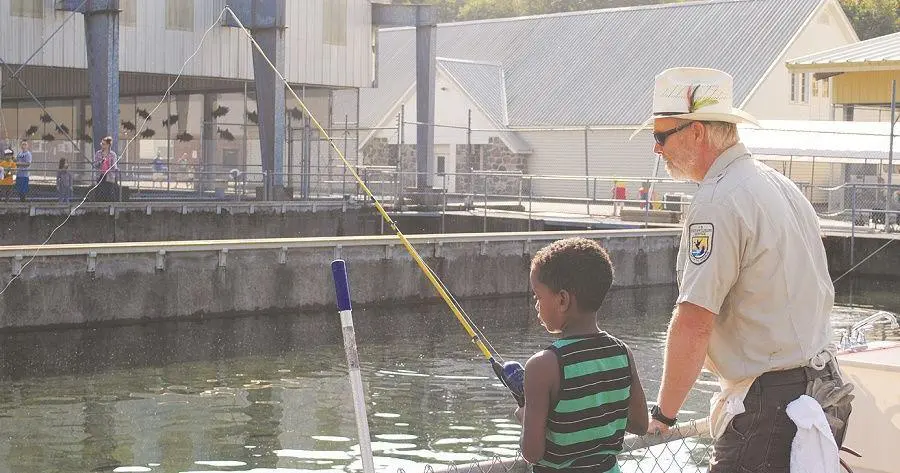
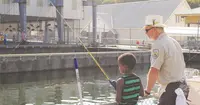
The holding ponds have served a younger crowd as well. On Saturday, September 10, 2016, the 18th annual Kids’ Fishing Day stocked two adult holding ponds with 1,400 rainbow trout for anglers 12 and under, with a two-fish limit. Poles, bait, tackle and fish cleaning were provided. A miniature golf course called “Migration Golf - Links to the Sea” was set up on the grounds, the U.S. Army Corps of Engineers came to talk about water safety, and concession food was sold.
August at the spawning table
Oregon Public Broadcasting and ProPublica described one spawning day at Carson in 2022. The fish were swimming in a concrete pond one minute. The next, they were dumped onto a stainless steel table set on an incline. “Hook-nosed and wide-eyed, they thrashed and thumped their way down the table toward an air-powered guillotine.” Hoses hung from steel girders and flushed blood through a grated metal floor. Workers in splattered chest waders took globs of bright orange eggs from the dead females and dropped them into buckets. They doused the eggs with sperm from the dead males and then with iodine disinfectant. The fish were sorted by sex and tagged to track their DNA, and each batch of eggs was tagged to identify its mother. The fertilized eggs were trucked around the corner to an incubation building, where more than 200 stacked plastic trays held over a million eggs. After hatching, the young fish would grow in rectangular concrete tanks sunk into the ground until their release.
The 2026 spawn ended in the week of August 21: 549 females and 2.2 million eggs, which the hatchery said would hatch in the building around mid October.
The same 2022 report counted the cost. It said that of the million eggs fertilized at Carson, only a few thousand would survive the trip to the ocean and back. It reported that federal officials had spent more than $2.2 billion over 20 years keeping the Columbia’s aging hatcheries running. The hatchery’s own figures show how widely returns swing. Its 2004 management plan counted 10,656 adults back in 1990, 565 in 1995, and 12,074 in 2001. That plan called for every fish to be adipose fin clipped and for 75,000 to carry coded wire tags. It also called for each returning fish to be passed through a tag detector.
Tyee Substation, 1937
Congress authorized the hatchery by Special Act on May 28, 1937, and it went into operation in December 1937. Its purpose was to make up for federal water projects, chiefly Bonneville Dam. The Mitchell Act reauthorized it on May 11, 1938, and an amendment of August 8, 1946 extended its charge to conserving fishery resources across the Columbia River Basin. The Service’s history says the Civilian Conservation Corps built it and that it was first called the “Tyee Substation.” That history says the hatchery began rearing fall Chinook and other salmon and trout in 1937. The Service’s main page and the county chamber both give 1938 as the year the CCC constructed it. The 2022 report called Carson one of the first hatcheries Congress funded to replace wild salmon killed by the Columbia’s dams.
Spring Chinook came later and needed a way in. Shipherd Falls, about two miles above the mouth of the Wind River according to a 2007 Service review, had historically kept out every anadromous salmonid except summer-run steelhead. Another account puts the falls 3 miles upstream and says spring Chinook were not native to the Wind. A fishway around the falls was built in 1955, the year the management plan gives for the start of the spring Chinook program. The hatchery was remodeled in 1956 to establish a hatchery run of spring Chinook in the Wind. Its broodstock came from wild adults trapped at Bonneville Dam during their upstream migration between 1955 and 1964. Genetic analyses, the 2007 review reports, suggest the fish are a composite of upper Columbia and Snake River stocks. The Service’s history notes that the first adults did not return to the hatchery until 1960. That history dates exclusive spring Chinook production from 1981. Another account places it in the 1950s.
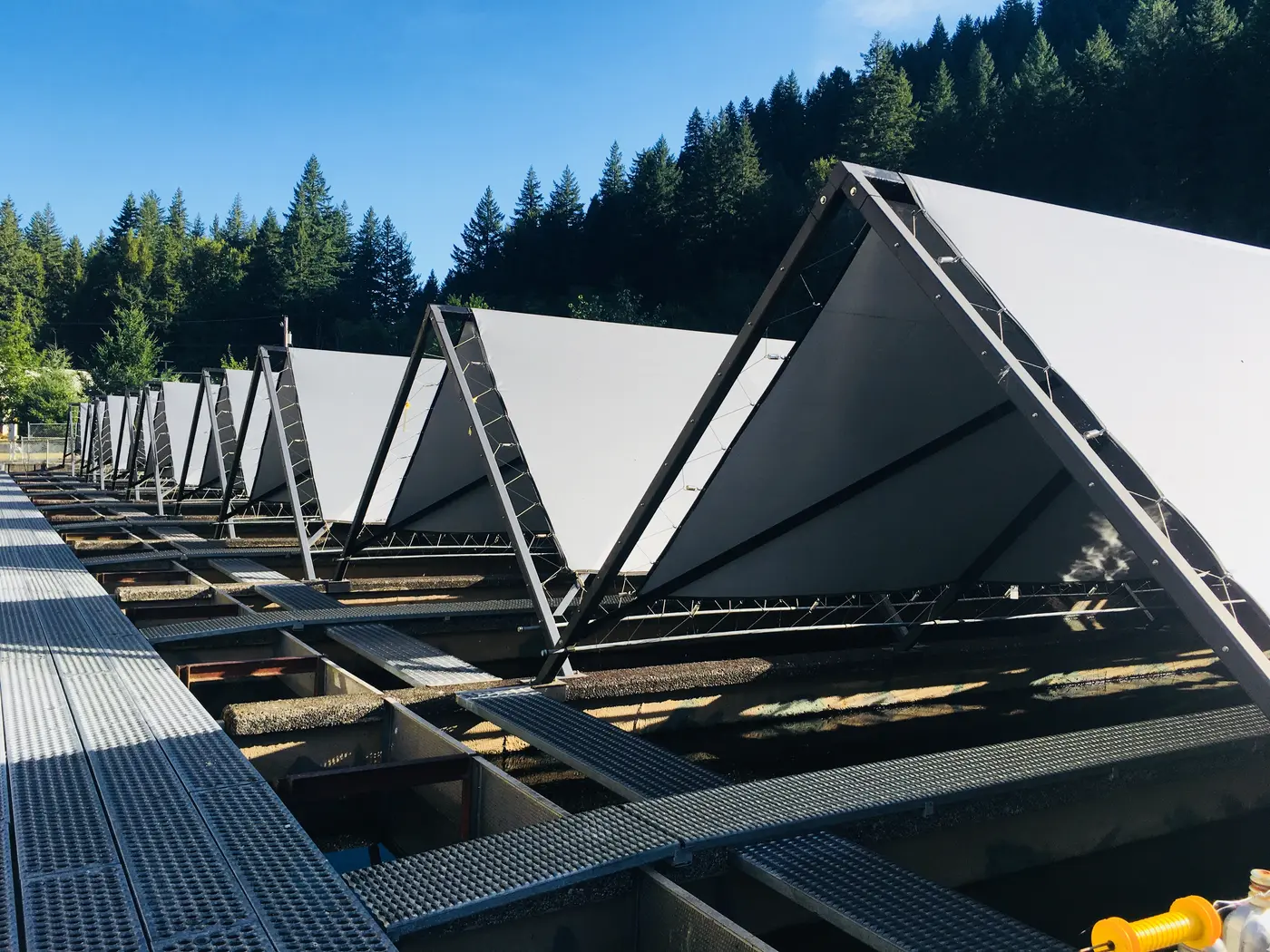
Later decades brought adjustments to how the fish are raised. Production was cut significantly in 1995 to reduce the hatchery’s demand for Wind River water. Beginning with the 1997 brood, the fish were reared at lower densities. In 2001 shade cloth was laid over the upper earthen pond, which the plan reports “seemed to work very well.” In 2001 and 2002 the Service, NOAA Fisheries, the Washington Department of Fish and Wildlife and the Yakama Nation agreed to close the ladder a month early, on August 1. The purpose was to leave fish in the river to spawn and die naturally, to enrich the stream and allow for possible natural production. Capital improvements from 2000 through 2006 came to $1,757,085.
Brook trout in Tyee Springs
The hatchery’s main water comes from Tyee Creek, which anadromous fish cannot reach. The Wind River is a secondary source. The 2004 management plan says raising the smolts almost entirely on Tyee Springs water reduces the number of adults that stray, and that adult steelhead pass the hatchery ladder on their own and continue to the upper Wind.
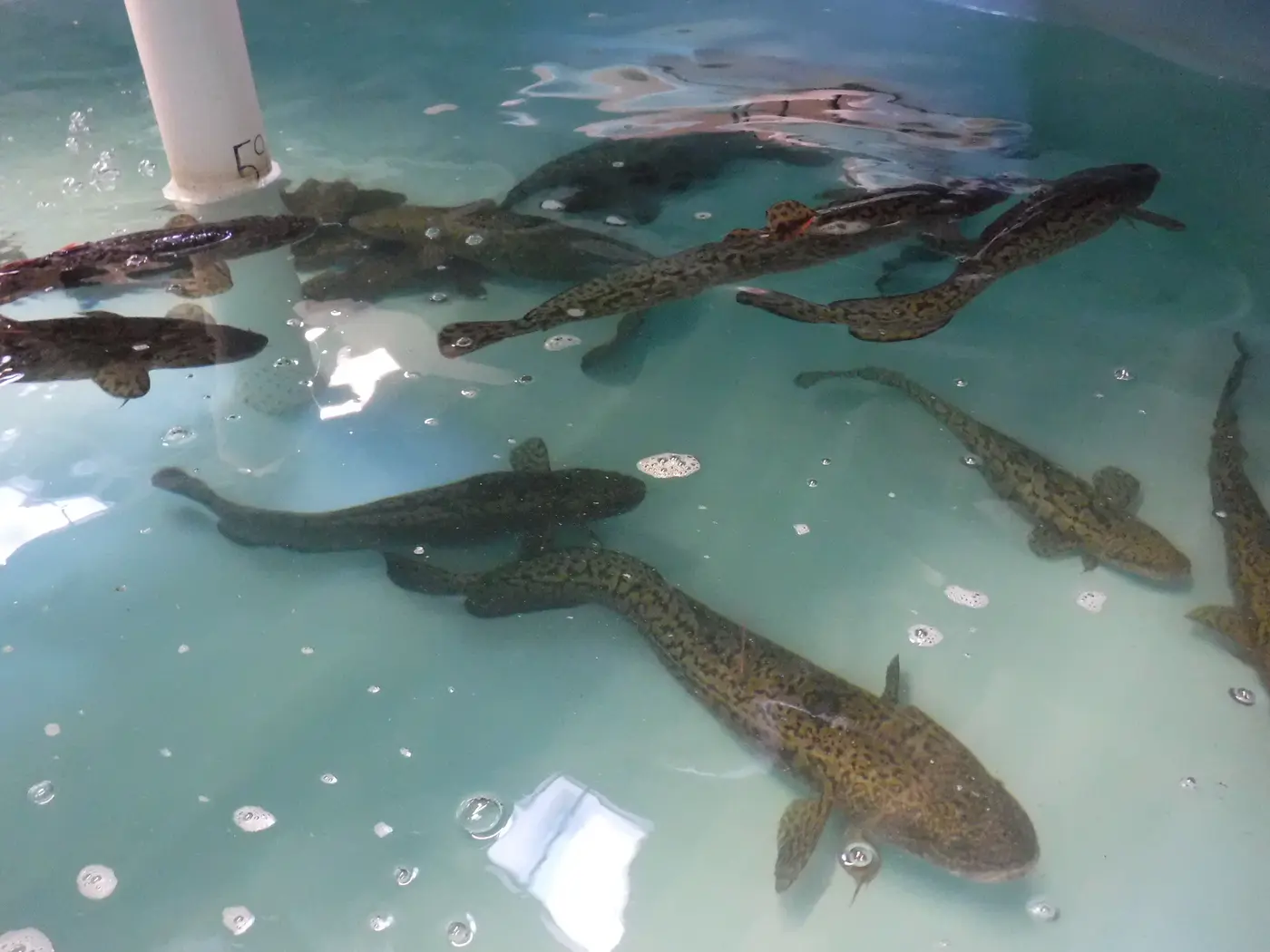
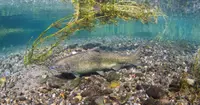
Carson raised and released brook trout from around 1940 until the early 1960s. Today non-native brook trout in Tyee Springs, just upstream of the hatchery, are a concern for the Service. It warns that they can carry bacterial kidney disease and whirling disease to the hatchery’s fish and downstream to endangered populations. In 2018 the Columbia River Fish and Wildlife Conservation Office, the Abernathy Fish Technology Center and the hatchery began a study of whether stocking YY male brook trout could eradicate the springs’ brook trout. The biologists Brian Davis and Jennifer Poirier carried the work forward. In 2020, 600 yearling YY males went into Tyee Springs, and in 2021, 1,923 more, all in their first year.
Notable Events
- 1930sA half-dozen cottages were built for hatchery workers in the 1930s. ijpr.org
- 1937The CCC-built hatchery, originally referred to as Tyee Substation, began rearing fall Chinook salmon and other salmon and trout. fws.gov
- 1937Authorized by Special Act 50 Stat. 220 on May 28, 1937. fws.gov
- 1937Placed into operation to mitigate federal water projects, primarily Bonneville Dam. fws.gov
- 1938The Civilian Conservation Corp constructed the hatchery. fws.gov
- 1960sCarson raised and released brook trout from around 1940 until the early 1960s. fws.gov
- 1946The authorization was amended for conservation of fishery resources in the Columbia River Basin. fws.gov
- 1950sAs lower Columbia spring Chinook plummeted from dams and habitat loss, the hatchery was tapped to preserve the fish and began raising spring Chinook. fws.gov
- 1955Carson's spring Chinook salmon program was initiated in 1955. fws.gov
- 1955The broodstock was originally developed in the late 1950s and early 1960s from natural-origin adults trapped at Bonneville Dam during their upstream migration. fws.gov
- 1956The hatchery was remodeled to establish a hatchery spring Chinook run in the Wind River. fws.gov
- 1960The first adults did not return to the hatchery until 1960. fws.gov
- 1981From 1981 onward the hatchery reared spring Chinook salmon exclusively to promote recovery. fws.gov
- 1995Fish production was reduced significantly, cutting hatchery demand for Wind River water. fws.gov
- 1997Beginning with brood year 1997, rearing space was managed so density indices never exceeded 0.25. fws.gov
- 2000Capital improvements to Carson totaled $1,757,085 during 2000-2006. fws.gov
- 2001The Service, NOAA Fisheries, WDFW and Yakama Nation agreed to close the hatchery ladder one month earlier, on August 1, to allow fish to spawn and die naturally for stream enrichment and potential natural production. fws.gov
- 2001Shade cloth placed over the upper earthen pond for sun protection seemed to work very well. fws.gov
- 2002The ponds were coated with Lifelast4 polyurethane and colored to approximate Wind River substrate. fws.gov
- 2018The Columbia River Fish and Wildlife Conservation Office, Abernathy Fish Technology Center and Carson began a collaborative study assessing the feasibility of stocking YY male brook trout to eradicate nonnative brook trout in Tyee Springs. fws.gov
- 2021A total of 1,923 age-0 YY male brook trout were stocked into Tyee Springs. fws.gov
People
- Cheri Anderson, Information and education specialist for the six-station Columbia River Gorge National Fish Hatchery complex.
- Larry, Hatchery volunteer contact.
- Dan Rawding, WDFW source on emigrant sampling and whether Carson spring Chinook releases draw steelhead out of the Wind River early.
- Rich Johnson, Fish and Wildlife Administrator; responsible-organization lead contact in the hatchery management plan.
- William Thorson, Hatchery Manager.
- Brian Davis, Columbia River Fish and Wildlife Conservation Office biologist using YY male brook trout to eliminate non-native brook trout from the hatchery's Tyee Springs water source.
- Jennifer Poirier, Columbia River Fish and Wildlife Conservation Office biologist using YY male brook trout to eliminate non-native brook trout from the hatchery's Tyee Springs water source.
Sources
- fws.gov/fish-hatchery/carson
- skamania.org/fish-hatcheries-and-wildlife-refuges-in-skamania-county
- columbiagorgenews.com/news/free-fishing-for-kids-at-carson-fish-hatchery/article_bf650d43-7eff-55a2-9c0d-176fbebce86c.html
- fws.gov/fish-hatchery/carson/visit-us
- facebook.com/CarsonNationalFishHatchery
- fws.gov/fish-hatchery/carson/about-us
- fws.gov/sites/default/files/documents/Carson%20hgmp_May04.pdf
- fws.gov/sites/default/files/documents/GorgeNFHReview_19Dec2007_FINAL_508.pdf
- npshistory.com/brochures/nwr/carson-1993.pdf
- columbiagorgenews.com/news/gorge-hatcheries-have-long-history-part-2-of-2/article_0477e2dc-1d95-11ed-aaaf-23e7c79722a2.html
- ijpr.org/environment-energy-and-transportation/2022-05-24/the-us-has-spent-more-than-2b-on-a-plan-to-save-salmon-the-fish-are-vanishing-anyway
- fws.gov/story/2022-10/getting-back-pristine-tyee-springs
- fws.gov/sites/default/files/documents/2024-03/davis_2021_yymale_progress_report.pdf