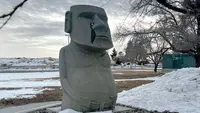
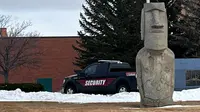
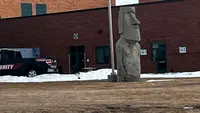
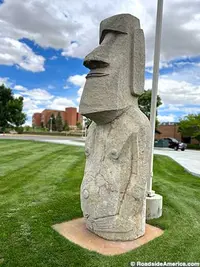
Campus Moai replicas
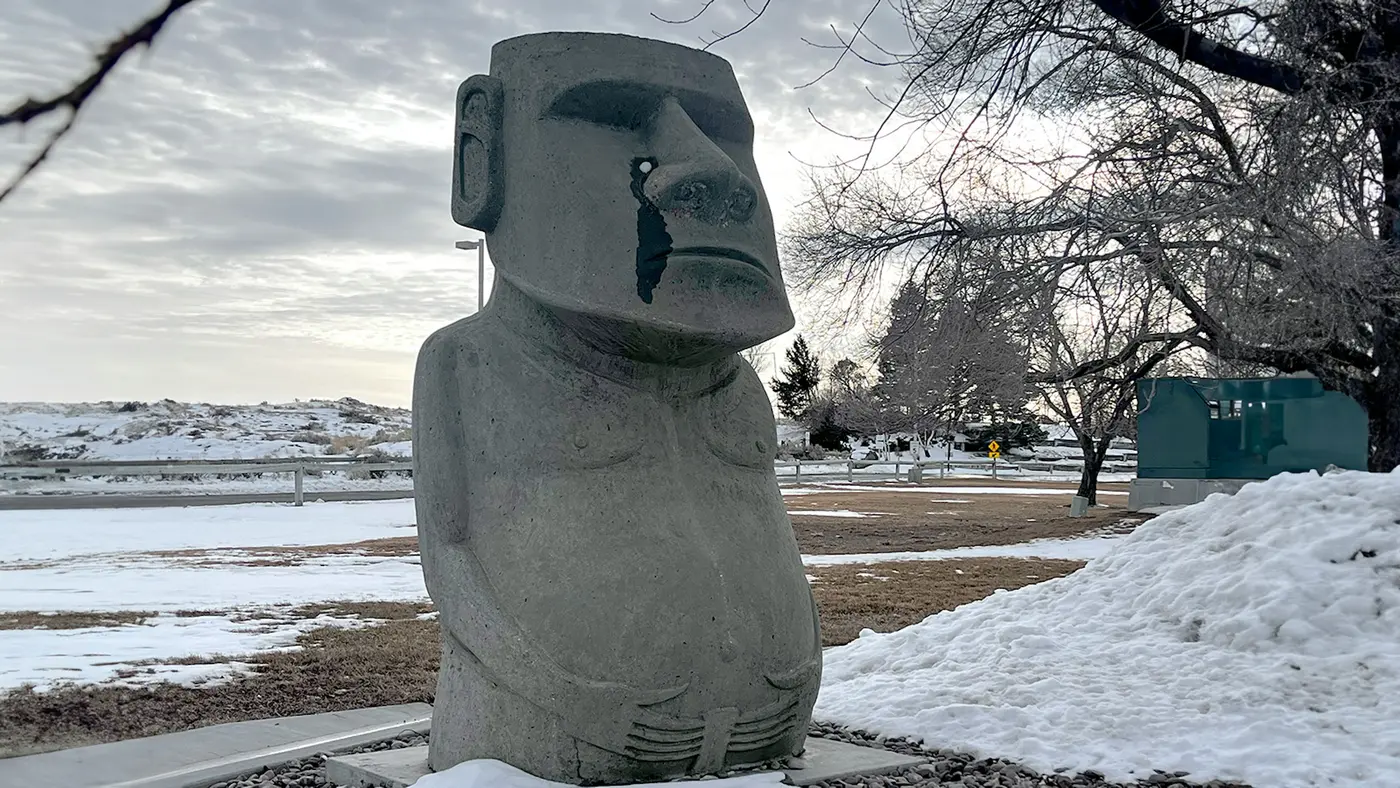
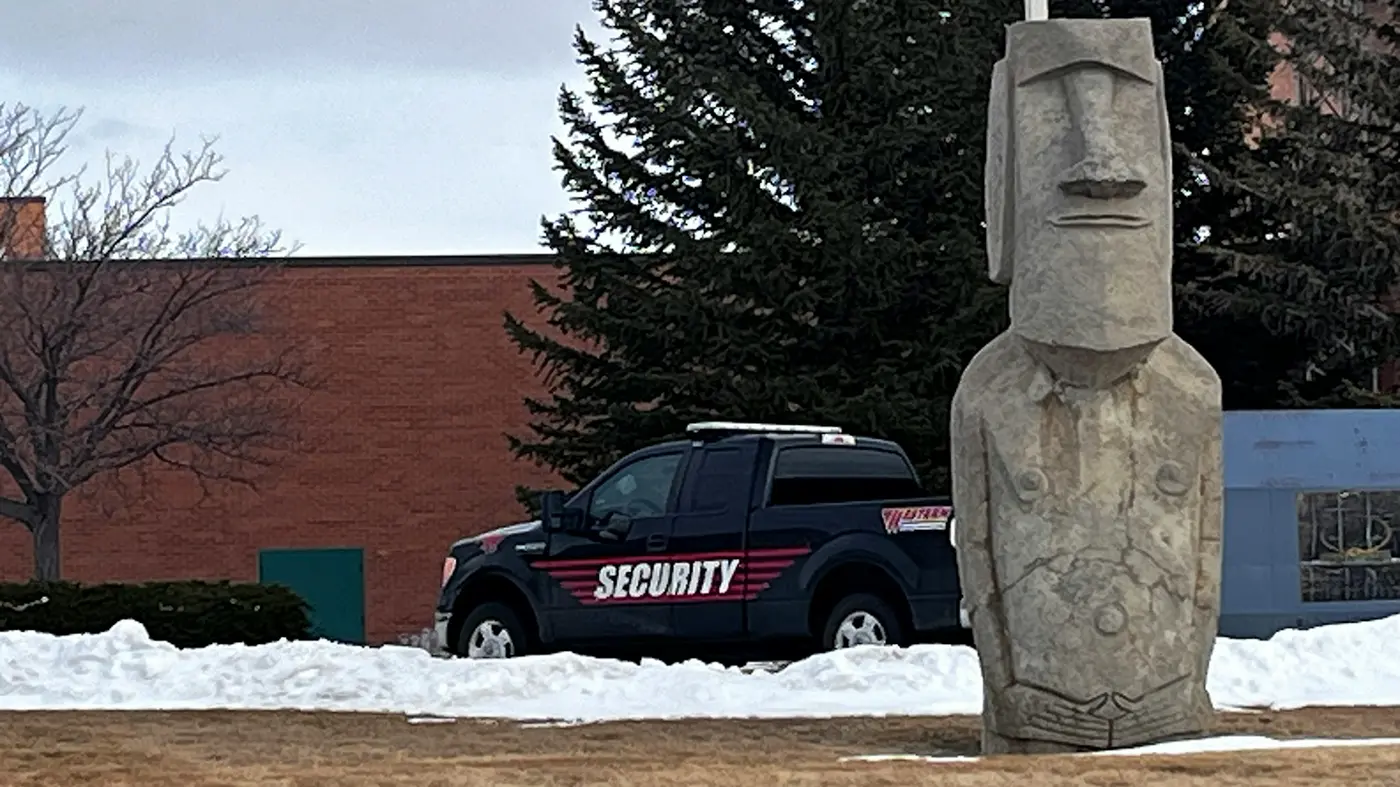
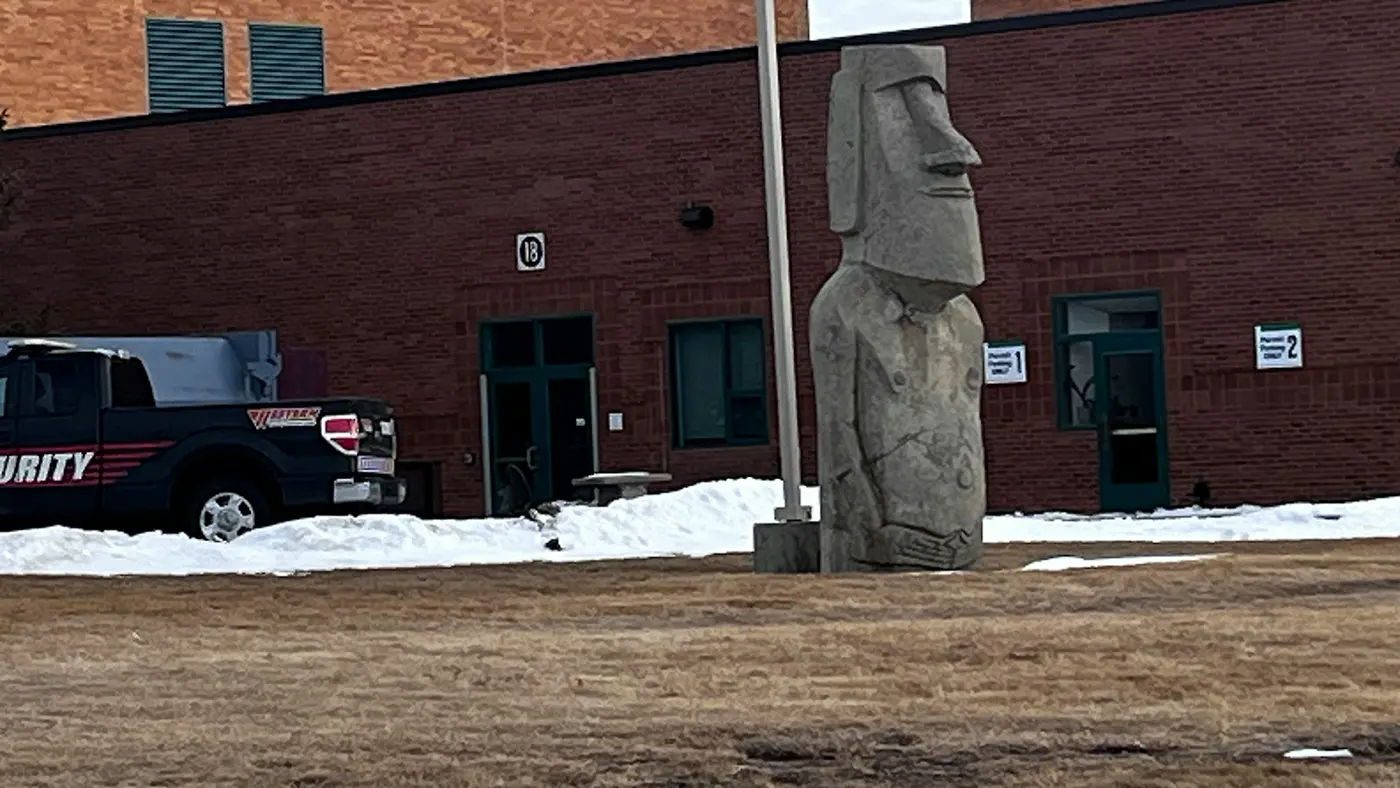
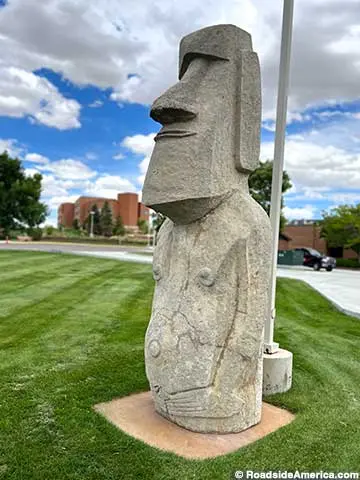
Rock Springs, Sweetwater County, Wyoming. Easter Island statues known as moai; nine ton concrete replicas.
Details

- Where
- 2500 College Drive, Rock Springs, WY 82901. Directions
- Getting there
- Drive to college entrance parking lot -- the head is in front of buildings. To reach the other one, exit the main parking lot and drive north/clockwise to the back parking lot.
- Fees
- Free and open to the public; parking is free also.
- Access
- All the displays at Western are free and open to the public. Parking is free also.
- Phone
- 1.307.382.1600
- Managed by
- Western Wyoming College.
- Established
- 1987.
- Coordinates
- 41.59051, -109.234438.
At Western Wyoming College, on College Drive in Rock Springs, two concrete heads stand outdoors at a school that keeps nearly everything else inside. Because of the winters, the main college sits almost entirely under one roof, its parts joined by hallways. The moai stay out in the weather. The college places them on the back lawn and around the walking track. Roadside America’s directions put one in front of the buildings at the entrance parking lot and send drivers north, clockwise, to the back lot for the other.
Each weighs nine tons. Accounts of their height differ. Cowboy State Daily gives one as about 5 to 6 feet tall and the other as about 8 to 10. NOVA’s summary of the experiment lists Love’s replica as 13 feet and 10 tons. Seeing them costs nothing, and parking is free.
Two heads on College Drive
The moai belong to a short list of exhibits the college opens to the public. The others are an art gallery, a pendulum, the Weidner Wildlife Museum, and reproductions of dinosaur skeletons, which reflect the many fossil finds in the surrounding country. The college’s page for the statues carries photographs of the two campus heads alongside pictures from Easter Island taken by Professor Love.
Easter Island lies about 4,750 miles due south, by Cowboy State Daily’s reckoning. Few on campus can say why the statues are here. “They’ve just always been there,” Kyra Holmes, a freshman from Green River, told the paper in 2024. “I used to come up here with my dad and they were here, but I really have no idea why.”
A professor and a cement truck
The answer goes back to Charlie Love, who taught both geology and anthropology at the college in the early 1980s. Robert L. Stark was then an engineer at the Jim Bridger Power Plant. He took Love’s anthropology class while his wife, Mary, an elementary teacher, took the geology course. Stark later wrote that Love was a second-generation geologist with a master’s in anthropology, and that his father had mapped the geology of Yellowstone National Park.
Love was writing a book about Easter Island. He had spent a year on the island as an anthropologist and geologist, and Cowboy State Daily says he studied there under Thor Heyerdahl and William Mulloy. The question that held him was how the islanders had moved their statues from the quarry to the ceremonial platforms. NOVA puts the average statue at some 14 tons, and the largest ever erected on a platform, Paro, at 82. Rapanui tradition gives its own answer: the statues walked, commanded by those who held mana, or divine power. In 1919 the British archaeologist Katherine Routledge recorded one version of that tradition in her journal. In it, an old woman who cooked for the image-makers “moved the images by supernatural powers (mana), ordering them about at her will.”
Love posed the riddle to Stark, and the two worked out a model of how the moai might have been moved. The Starks then went home to Fort Wayne, Indiana, before the engineering was finished. Love went on with the work. In 1987 he and local artist Gregory Gaylor designed and carved a mold, following the dimensions and proportions of originals on the island. Roadside America says the results were hailed in their time as the world’s most accurate Easter Island replicas. Photographs from that year show the bolted-together molds being filled from the top of the head with concrete from a cement mixer truck while Love watched from a scaffold beside them.
Rope, runners and log rollers
On Nov. 25, 1987, Love and thirteen volunteers began their trial. According to the Daily Rocket-Miner, the statue, called “The Moai That Walks,” came to the test site at the college on a flatbed truck. The crew tilted it far enough to slip rocks beneath it, and Love used the run to judge how many people the actual walking would take. By his account the trial went well. The only trouble came when a rope broke and half the volunteers tumbled down the hill. No one was hurt. The paper called this the third replica Gaylor and Love had made from poured concrete. Every other source counts two.
NOVA describes two methods tried in Wyoming. In the first, the crew stood the statue upright and pulled it side to side with ropes tied around its forehead, the way a refrigerator is walked across a floor. It went a few hundred feet before it toppled and chipped the front of its base. For the second try, the statue stood upright on two sled runners laid atop log rollers. In Love’s own later description, the runners were water-ski-like logs rabbeted under the base. Twenty-five people pulled it 150 feet in two minutes. Love wrote that the rollers tended to bunch up and skid.
Stark gives December 16, 1987, as the day Love moved his first completed replica. The BBC, NOVA, and the Daily Rocket-Miner all covered the project.
The Charlie Love Theory
The film made Love’s name, at least among anthropologists, Roadside America says. For a time his method was a favorite with Easter Island scholars. Then critics pointed out that the island’s ground is harsher than a college campus in Wyoming. Jo Anne Van Tilburg, who later moved a replica lying flat on a wooden sledge, wrote of Love’s method: “This method was superior to the tilting method, but still incredibly dangerous. The logistics of any upright method suggested to date are daunting-to-impossible on the rolling Rapa Nui terrain.”
Love answered in the Rapa Nui Journal in December 2000. He wrote that his 1987 work and the Czech experimenter Pavel Pavel’s 1986 trials had been carried out independently. Both, he said, showed that a statue moved more efficiently upright than lying down. He noted that a 1988 NOVA program had concluded the moai traveled vertically. He also complained that NOVA’s newer program left his experiment out, “so that Van Tilburg’s experiments appear to be the only Easter Island statue moving experiments seriously attempted.”
“It’s called the Charlie Love Theory,” his former colleague Dudley Gardner told Cowboy State Daily. “Some people didn’t agree with him and others did. But the Rapanui people of Easter Island really respected Charlie and even recognized his work as an anthropologist.” Love, now the college’s Professor Emeritus, has spoken often about the originals. “You can’t walk underneath the gaze of those impressive statues without sometimes feeling very, very small indeed,” he once said.
A mold goes east
Stark wrote to Love again on October 10, 2010. By then Love had made a fiberglass mold of a moai, a project into which he had put four to five thousand dollars and a year’s time. Stark asked to borrow it, and Love agreed.
On March 4, 2011, Stark and his friend Boyd Tarney left Fort Wayne for Wyoming. On the way they climbed Boars Tusk, an extinct volcanic neck. They met Love in Rock Springs on March 13. Stark called him “the Wyoming version of Indiana Jones” and described a house full of statues, carvings, paintings, and keepsakes from around the world. The two men loaded the mold on March 15. A spring storm then dropped a couple of feet of snow on parts of Nebraska, and the highway department closed I-80, holding them a second night in Cheyenne.
In Fort Wayne the mold went into Key Concrete’s lay-down yard while Stark planned the pouring and moving of an eight-and-a-half-ton, nine-and-a-half-foot moai. By late September a moai stood on Lower Huntington Road in Waynedale. A Journal Gazette columnist, Frank Gray, wrote of it: “But the piece is a mystery.”
Notable Events
- 1980sLove's crew pulled a standing concrete moai side to side until it toppled after a few hundred feet and chipped the front of its base. pbs.org
- 1980sOn a second attempt, 25 men moved the upright concrete moai 150 feet in two minutes on two sled runners atop log rollers. pbs.org
- 1987Love's experiments demonstrated more efficient movement with the statue upright; he also used rabbeted, water-ski-like logs and rollers pulled by 25 people. evols.library.manoa.hawaii.edu
- 1987Stark says Love completed his first replica and moved it on December 16, 1987; BBC, Nova and the Daily Rocket-Miner covered the project. waynedalenews.com
- 1987Thirteen volunteers and professor Charlie Love began a statue-moving test. According to Love it went well; a rope broke and volunteers tumbled down the hill without injury. wyomingnews.com
People
- Charlie Love, Former Western Wyoming Community College professor and archaeologist who commissioned the replicas to test his moai-transport theory.
- Gregory Gaylor, Local artist who teamed with Charles Love to design and carve the casting mold.
- Robert L. Stark, First-person participant who worked with Charlie Love on a working model of moai transport.
- Charles Love, College Professor Emeritus who teamed with Gregory Gaylor to design and carve the casting mold.
Sources
- westernwyoming.edu/campus-map/exhibits-on-campus/moai-statues.php
- westernwyoming.edu/campus-map/index.php
- westernwyoming.edu/admissions-and-aid/campus-tours
- westernwyoming.edu/about/overview/index.php
- cowboystatedaily.com/2024/02/10/why-the-heck-are-there-two-9-ton-easter-island-heads-in-rock-springs-wyoming
- roadsideamerica.com/story/82133
- explorewy.com/travel-tools/community-resources
- westernwyoming.edu/campus-map/exhibits-on-campus/moai-statues.php
- cowboystatedaily.com/2024/02/10/why-the-heck-are-there-two-9-ton-easter-island-heads-in-rock-springs-wyoming
- pbs.org/wgbh/nova/easter/move/past.html
- wyomingnews.com/rocketminer/touch-of-culture-local-college-offers-displays-of-art-and-history-for-all-to-enjoy/article_efae5a11-c3f1-56c7-bcea-7ada6cd54286.html