

Callaghan Vineyards
Elgin, Santa Cruz County, Arizona. Winery and estate vineyard.
Details

- Where
- 336 Elgin Road, Elgin, AZ 85611. Directions
- When
- Thursday to Sunday 11 to 4.
- Access
- Tastings inside or outside; call-ahead orders can be arranged for contactless car delivery; picnics welcome.
- Walk-in or reserve
- Walk-ins welcome; call-ahead orders can be arranged for contactless car delivery.
- Phone
- 520-455-5322
- Website
- callaghanvineyards.com
- Managed by
- Kent & Lisa Callaghan, Owners.
- Established
- 1990.
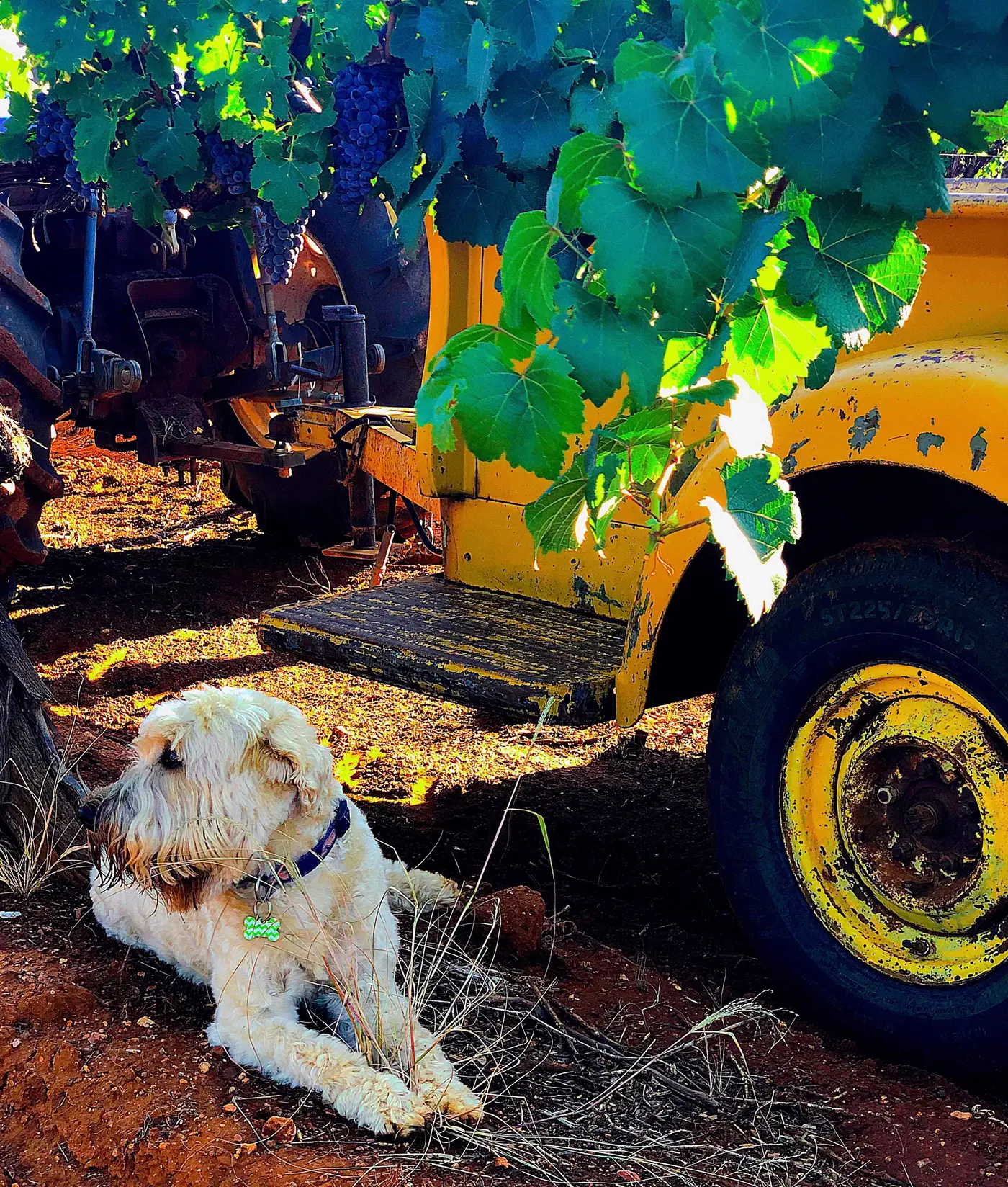
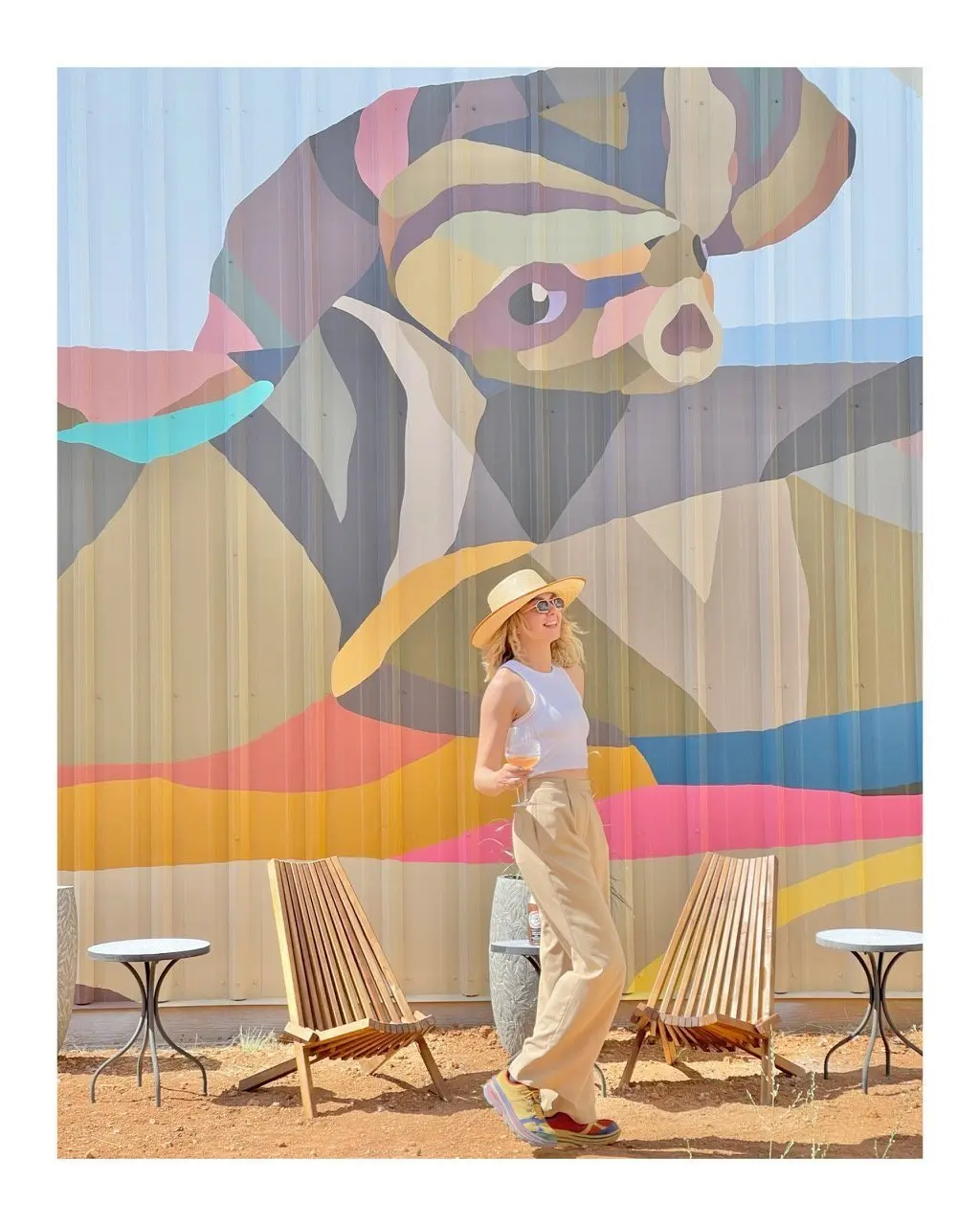
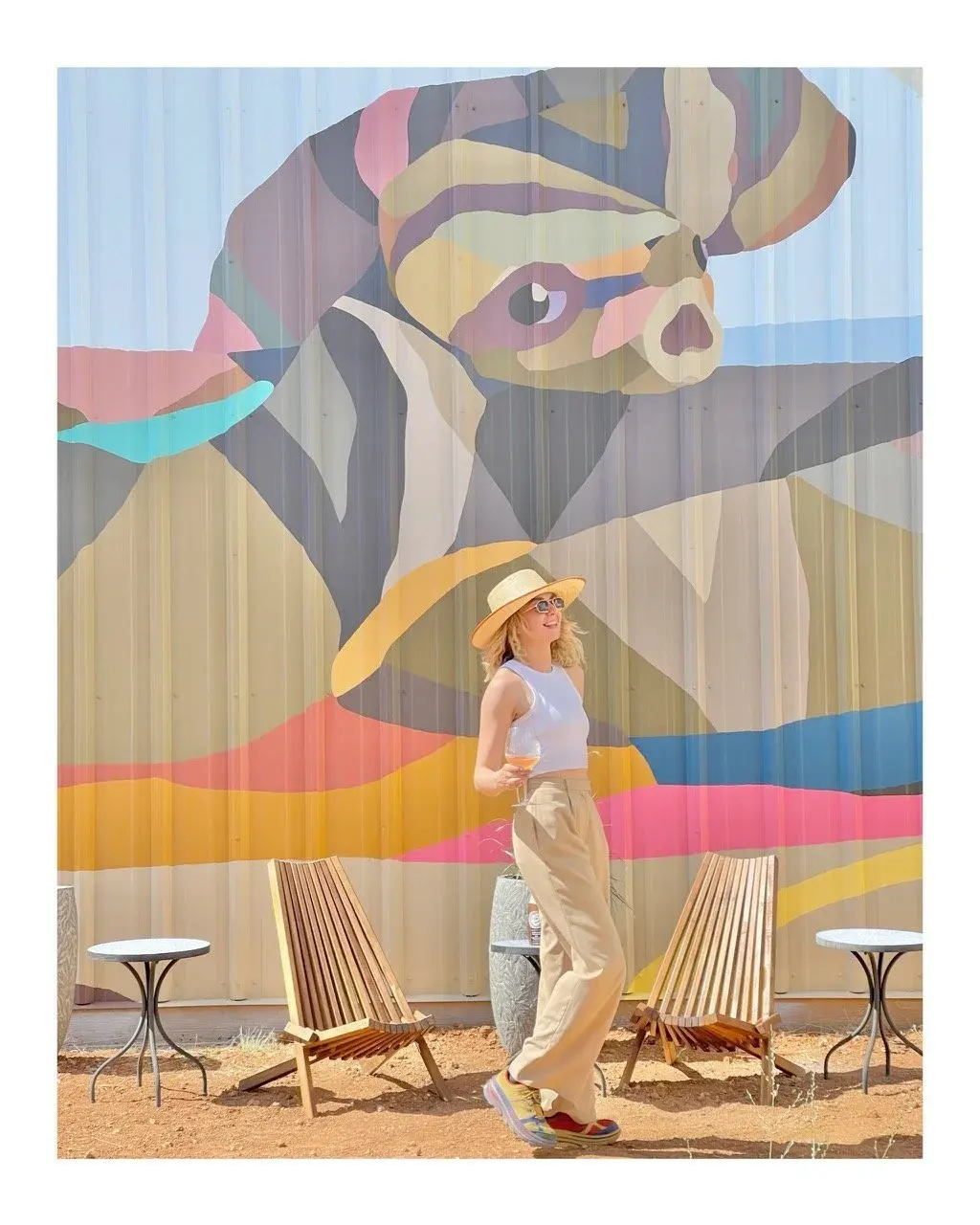
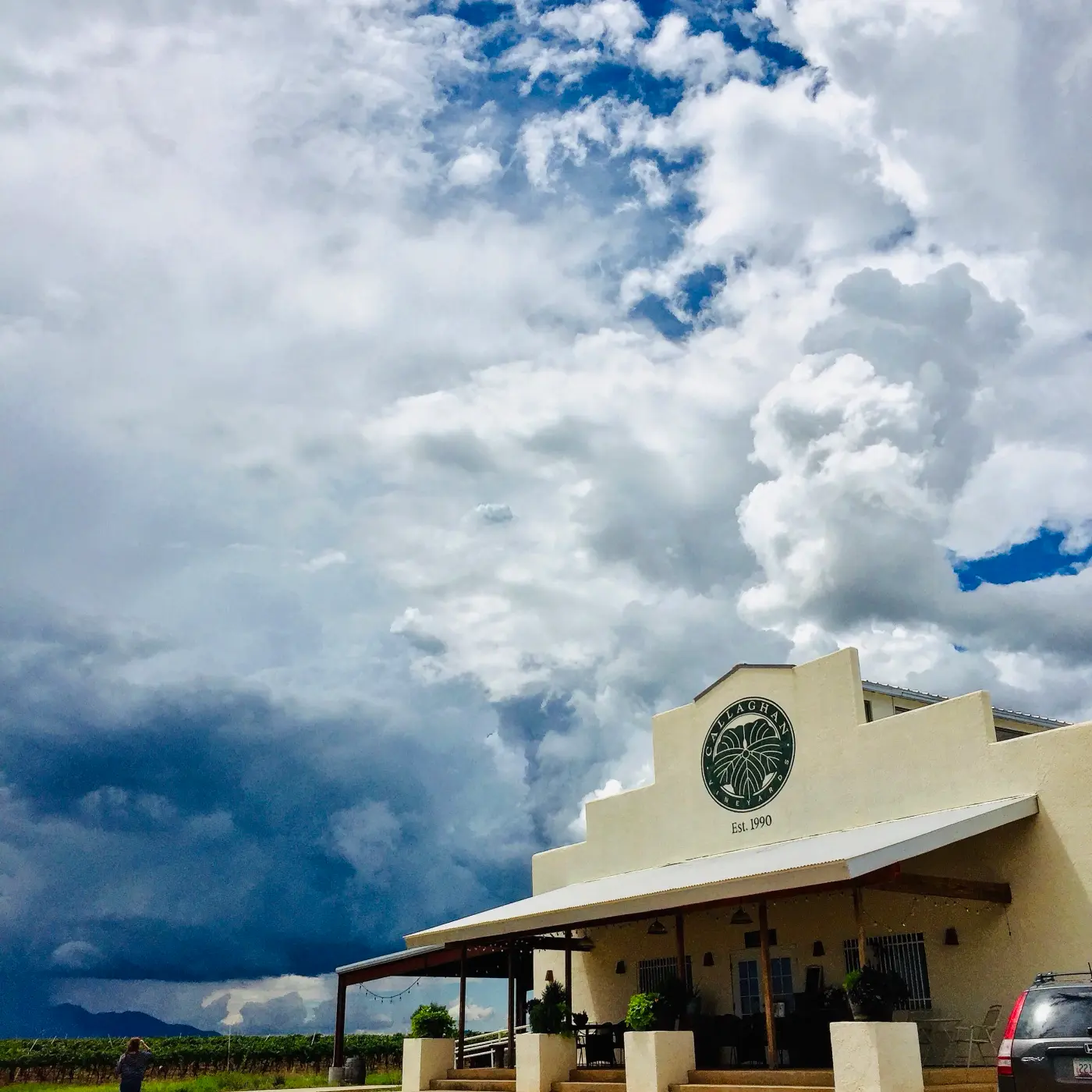
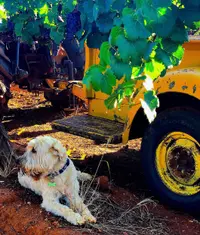
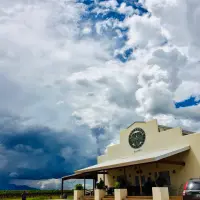
A mural by Alonso Delgadillo is painted under the covered patio at Callaghan Vineyards, 336 Elgin Road, and the winery tells visitors to bring a lunch. Tastings are poured inside or out, Thursday through Sunday from 11 to 4. Leashed dogs are welcome. The winery lists its Wheaten Terrier, Kiva, as working the tasting room and greeting customers during those hours. Kent Callaghan’s daughter Caitlin once put up a map showing where visitors had come from. The winery later had to retire it and put a new one in its place.
The people pouring are often the owners, Kent and Lisa Callaghan. Kent is a third-generation Tucsonan, and the family counts four generations of University of Arizona Wildcats. The Arizona Office of Tourism asked Kent for his favorite thing about the Arizona wine experience, and he answered: “You’re likely to be talking with one of the owners in any given tasting room.” In 2004 a $3 tasting came with an 18-ounce crystal glass to keep. A KOLD profile from that year called Kent a fixture at the vineyard and advised visitors to have him autograph their bottles. Lisa told Tucson Foodie that every weekend brings people from Tucson who say, “Oh, I’ve never been here before. Oh my gosh, it’s only an hour away.”
Graciano, Tannat and a caliche bar
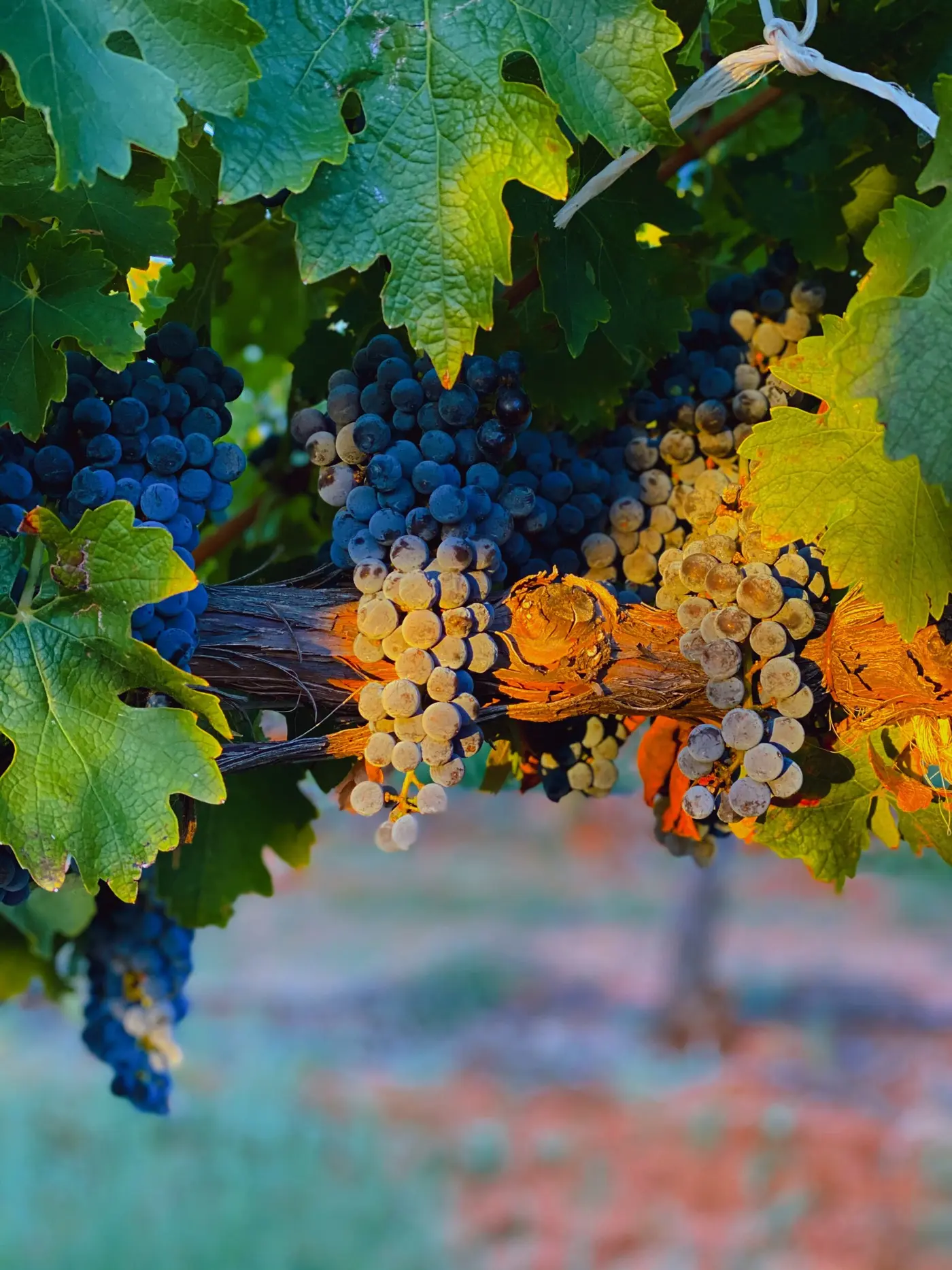
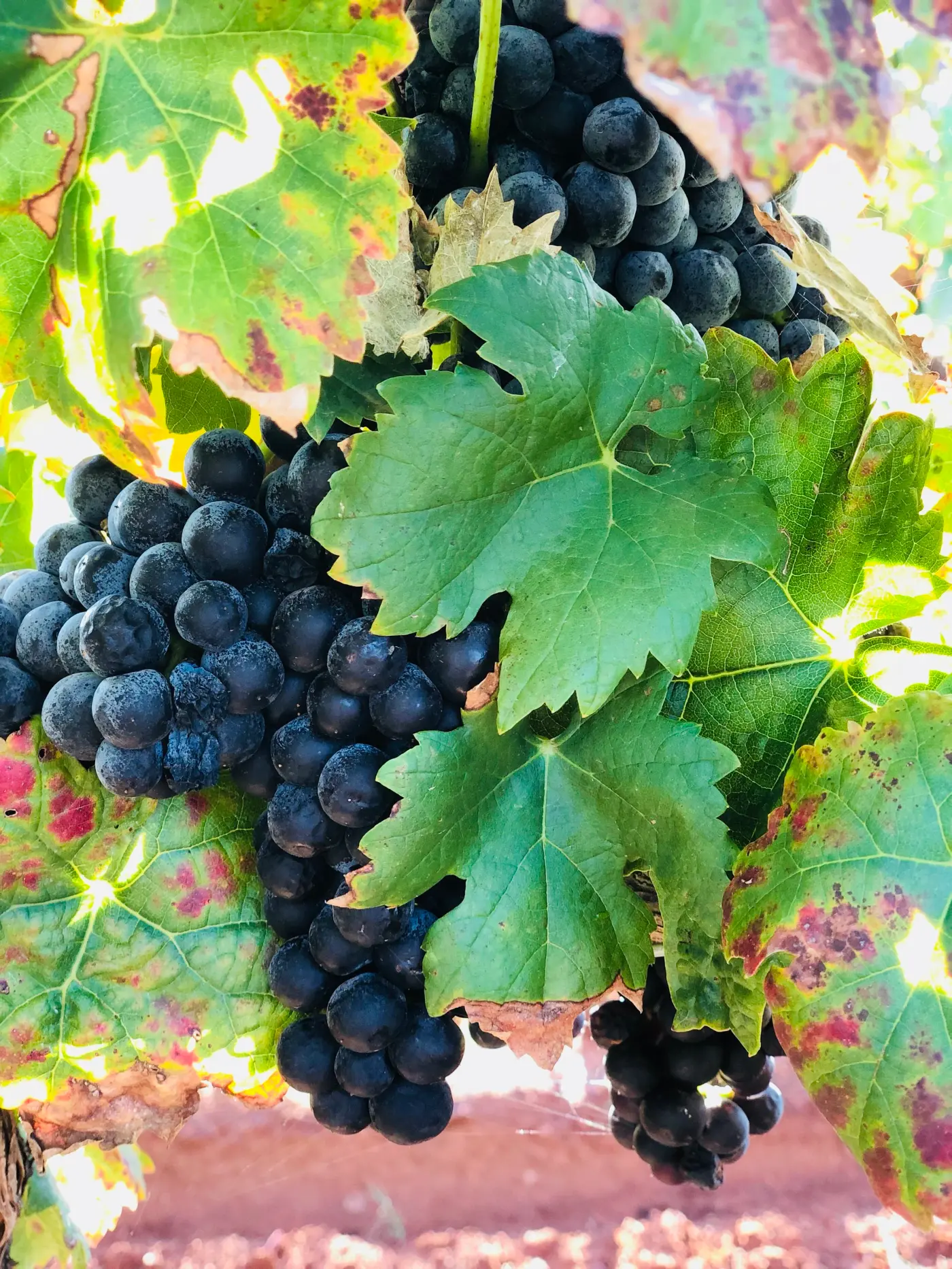
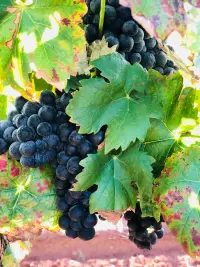
The estate vineyard is Buena Suerte, planted in 1990, and Kent describes the work since then as a long run of replanting. “Over many years,” he writes on the winery’s site, “we have tossed out our original Bordeaux mindset and moved to one rooted in the Mediterranean.” In his account the Spanish varieties suit the site best: Graciano, Mourvedre and Grenache. Petit Verdot is the one Bordeaux grape he kept, for what he calls “a distinctive spicy/peppery/meaty blending component.” Tannat, “a black, burly variety from just north of the Pyrenees,” has also adapted to southeastern Arizona. Kent began planting Graciano in 2009 and counts it among his favorites. There is one estate white, Lisa’s, a blend of Marsanne, Roussanne, Malvasia Bianca, Clairette and Petit Manseng.
Many of the bottles carry first names. Caitlin’s is a Petit Verdot-based blend, and Claire’s is Mourvedre, Syrah and Petite Sirah. The others include Waverly’s, Greg’s Petit Manseng, Harold’s Red Blend, Eloise’s White Blend and Wayne’s Grenache.
In the cellar the method is “no gizmos, lots of barrels (new to fifteen years old), aging on the lees and little racking.” Most of the work happens in the vineyard. Kent has tended the vines and made every wine since the beginning. Wayne Tomasi, a family friend, has worked the vineyard since 2008. The winery’s photographs show early-morning picking of Mourvedre in 2018 and Barrett and Waverly working the 2020 harvest.
After more than thirty years, Kent still digs replant holes with a shovel and a caliche bar. The bar is a 30-pound, six-foot rod with a chisel at one end, made to break the cement-hard calcium carbonate found through the Southwest. Asked how he handles the vineyard’s troubles, he said: “Usually, profanity first, then an actual plan. Or just more profanity, a caliche bar and a shovel.”
The weather has changed as well. Kent told the Patagonia Regional Times in March 2025 that three hail events the year before had damaged the unnetted parts of the vineyard. “It’s something we’re basically banking on now that we didn’t see to any extent for our first 20 years.”
A Grenache with a cowboy label
At the 2025 San Francisco Chronicle Wine Competition, held that January, Callaghan won five gold medals and two silvers. Only two other Arizona wineries matched the five golds. “It’s a nice result,” Kent said. One of the golds went to the 2019 Arizona La Osa, which the winery released in November 2024 to honor the University of Arizona. It is a Grenache aged 18 months in neutral 500-liter puncheons and bottled unfiltered, at 14 percent alcohol. “It just reminds me of a well-concentrated noir-ish style Grenache,” Kent said. Lisa called it “plush and pretty easy-going. I can drink it while I’m making dinner or have it with dinner.”
The cowboy artwork on the label is by Lone Wolf, a Native American man who was a friend of Lisa’s grandfather and spent half of each year at the ranch. Her grandfather hired him to paint. Lone Wolf decorated holiday envelopes for him, and those envelopes are now kept at her parents’ house. The label’s history begins in 1886. As Lisa tells it, that year her great-grandfather, J.C. Kinney, rode the Chisholm Trail at 14 and paid his way by cutting other cowboys’ hair. Kinney Road is named for him. Her grandfather co-founded Tucson’s Fiesta de los Vaqueros rodeo.
The university connection also reaches the winery’s beginnings. “The Arizona wine industry is what it is because of Dr. Gordon Dutt,” Kent said. He meant the University of Arizona professor whose research in the early to mid-1970s started the trade in Elgin.
A shout of “Buena Suerte”
By the late 1980s, investors were planting vineyards along Elgin Road. The road was then almost all unpaved, with no street designations and at most a half-dozen homes. In 1989 Kent Callaghan planted two acres at his house under the name Red Tail Vineyard. In 1990 he and his father, Harold, who had already bought land on Elgin Road, planted the first 17 acres at the present site. “It was my dad’s idea – he got the bug,” Kent told the Patagonia Regional Times. The winery’s own account includes his mother, Karen, in the planting, which took place in May and June of 1990.
The planting coincided with a heat wave that shut down Sky Harbor Airport in Phoenix for several days. “Nobody had tested passenger jets at temperatures over 120F,” Kent wrote. “But it was only 105F in Elgin …Needless to say, we lost a few (thousand) vines.”
KOLD’s 2004 profile tells how the vineyard got its name. Callaghan and his crew were setting thousands of seedlings into the red soil just off Elgin Road when the laborers asked what the field would grow. “A wine vineyard,” he said. The amused workers drove off, and one of them shouted “Buena Suerte!”, meaning good luck. Callaghan gave the vineyard that name.
The first vintage, in 1991, was made from locally purchased grapes in Gordon Dutt’s old barn. Callaghan made wine there until his own building was ready in 1993.
Ninety points and a gloomy decade
In 1994 Robert Parker of the Wine Advocate scored three Callaghan wines at 90 points. Parker also named Callaghan one of 26 national and international “Wine Heroes” that year, the youngest ever to receive the title. The White House contacted him soon after. The Patagonia Regional Times says the Clinton White House served his 1993 Buena Suerte at a dinner announcing that Clinton would run for re-election. The winery lists the occasion as a 1996 dinner for the Democratic National Committee. That wine was a blend of Merlot, Cabernet Sauvignon and Cabernet Franc, the Bordeaux grapes Kent would later pull out.
Three more White House dinners followed:
- 2000: the 1998 Buena Suerte Cuvee at Clinton’s last state dinner, with the prime minister of India. KOLD’s 2004 profile gave 1998 as the year of this second service.
- 2006: the 2004 Claire’s at George W. Bush’s dinner for retiring Justice Sandra Day O’Connor.
- January 2017: the 2013 Caitlin’s at the Governors Dinner.
Also in 2006, Governor Janet Napolitano designated the winery one of Arizona’s Treasures. Parker later scored a Callaghan Chardonnay at 94 points, the first Arizona wine to reach that score. Of the winery he wrote: “As I have said so many times in the past, this is one of the most interesting wineries in America.”
The neighboring vineyards fared worse in those years. Pierce’s disease wiped out part of Dutt’s vineyard in 1994. In October 1996 Dutt reported that Texas root rot had struck it as well. Kent remembers the mid to late 1990s as a “gloomy period,” and Terra Rossa, Whetstone Vineyards and Santa Cruz Vineyards were all abandoned. “It was terrible for us,” Dutt said, “but thank God, Kent Callaghan kept it going and kept making quality wines.”
Most of the region’s early vineyards had relied on California varietals such as Cabernet Sauvignon and Merlot. Callaghan found that grapes from France, Spain and Italy suited the local soil and weather far better. He spent the following decades pulling out what failed and planting varieties usually unheard of in the region.
Other winemakers learned from him:
- Jon Marcus volunteered at the winery for a while, then started Echo Canyon Winery on his Sedona property in 1997.
- Al Buhl founded Dos Cabezas WineWorks in 1995 with Kent’s help.
- Jim Gardner, later of Hannah’s Hill, volunteered at Callaghan’s for three seasons in the late 1990s. “He allowed me to participate in nearly every aspect of his processes,” Gardner said, “from picking grapes to crawling inside wine tanks to clean them before the next racking, to bottling wine.”
Todd Bostock of Dos Cabezas called Kent’s imprint on Arizona wine “undeniable—first proving that wines of the highest quality can be produced in Arizona, then inspiring and mentoring practically everyone producing great wines in our state.” Bostock found his first Arizona wine at AJ’s in Phoenix, where a clerk told him the store carried two, Dos Cabezas and Callaghan’s. “The Dos Cabezas was $2 cheaper,” Bostock said, “so it was an easy decision.”
Notable Events
- 1989Kent Callaghan planted acreage at his house under the name Red Tail Vineyard. patagoniaregionaltimes.org
- 1990Kent and his father Harold, who had previously purchased land on Elgin Road, planted the first 17 acres of Callaghan Vineyards at their current location. patagoniaregionaltimes.org
- 1990sCallaghan recalls a gloomy period with some vineyards failing after only a few harvests; Terra Rossa, Whetstone Vineyards and Santa Cruz Vineyards were all abandoned. patagoniaregionaltimes.org
- 1991His first vintage, from locally purchased grapes, occurred in 1991. patagoniaregionaltimes.org
- 1993Callaghan used Dutt's old barn for making wine until he moved into his new building in 1993. patagoniaregionaltimes.org
- 1994Pierce's disease wiped out a portion of Gordon Dutt's vineyard in 1994, and in October 1996 Dutt told the Santa Cruz Valley Sun that Texas root rot, a fungus that attacks the roots, had hit it too. patagoniaregionaltimes.org
- 1994Parker identified Callaghan as one of 26 national and international Wine Heroes, the youngest ever to receive the accolade. patagoniaregionaltimes.org
- 1994Wine Advocate columnist Robert Parker scored three Callaghan wines at 90 points, and the Clinton White House then arranged to serve his 1993 Buena Suerte at a dinner announcing Clinton's run for re-election. patagoniaregionaltimes.org
- 1996Callaghan 1993 Buena Suerte Cuvee was served at a White House dinner for the Democratic National Committee. callaghanvineyards.com
- 2000Callaghan 1998 Buena Suerte Cuvee was served at President Bill Clinton's last state dinner with the prime minister of India. callaghanvineyards.com
- 2006A Callaghan wine was served at the White House dinner for retiring U.S. Supreme Court Justice Sandra Day O'Connor. callaghanvineyards.com
- 2006Arizona Governor Janet Napolitano designated Callaghan Vineyards as one of Arizona's Treasures. callaghanvineyards.com
- 2008Wayne Tomasi, a family friend, began working in the vineyard and continues to do so. callaghanvineyards.com
- 2017Callaghan 2013 Caitlin's was served at the White House Governors Dinner. callaghanvineyards.com
People
- Jon Marcus, volunteered for a while at Callaghan's winery, then started the Echo Canyon Winery on his Sedona property (1997).
- Robert Parker Jr., wine critic whose rave Wine Advocate reviews called Callaghan one of America's best-kept wine secrets.
- Wayne Tomasi, family friend who began working in the Callaghan Vineyards vineyard (2008).
- Harold, Kent Callaghan's parent and co-planter of Buena Suerte Vineyard (1990).
- Karen, Kent Callaghan's parent and co-planter of Buena Suerte Vineyard (1990).
- Lisa Callaghan, owner of Callaghan Vineyards with Kent Callaghan.
- Dr. Gordon Dutt, region pioneer whose old barn Callaghan used for winemaking until his own building was finished.
- Jim Gardner, later Hannah's Hill grower who volunteered at Callaghan's for three seasons and learned every part of the process there (late 1990s).
- Kent Callaghan, Founder, owner, operator, and vintner.
Sources
- callaghanvineyards.com
- callaghanvineyards.com/visit
- callaghanvineyards.com/gallery
- callaghanvineyards.com/story
- patagoniaregionaltimes.org/callaghan-vineyards-brings-home-five-golds
- callaghanvineyards.com/about
- patagoniaregionaltimes.org/a-history-of-winemaking-in-sonoita-elgin-part-2-the-rough-years
- patagoniaregionaltimes.org/a-history-of-winemaking-in-sonoita-elgin-part-1-the-early-days
- patagoniaregionaltimes.org/a-history-of-winemaking-in-sonoita-elgin-part-3-the-industry-matures
- arizonahistoricalsociety.org/wp-content/uploads/2021/05/Erik-Berg-project_muse_737880.pdf
- tourism.az.gov/connections/kent-callaghan
- kold.com/story/1892486/callaghan-vineyards
- tucsonfoodie.com/news/callaghan-vineyards-arizona-la-osa