



California Gold Panning
Jamestown, Tuolumne County, California. Guide or Outfitter; Year-round.
Details

- Where
- 17712 Harvard Mine Road, Jamestown, CA 17712. Directions
- When
- Winter / 9:00am - 4:00pm; Spring / 9:00am - 4:00pm; Summer / 9:00am - 5:00pm.
- Getting there
- From the West: turn left, immediately right past a locked gate, continue a quarter mile past a monument for the old mine, then right through a second gate to the parking lot. From the East: through Jamestown, right at the gas station onto Harvard Mine Road, over the concrete bridge, parking on the left in a quarter mile.
- Fees
- 2 hours $30.00 per student minimum 30 students; 3 hours $35.00 per student; 4 hours $40.00 per student.
- Access
- We can gladly refer you to another business that has better access to the creek. Due to regulations, we are not allowed to change our embankment.
- Walk-in or reserve
- Book online through the FareHarbor booking widget.
- Phone
- 209-694-6768
- Website
- gold-panning-california.com
- Managed by
- Nugget Nick Prebalick.
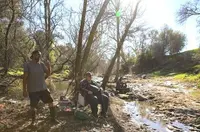
The parking lot at 17712 Harvard Mine Road has no building on it, only a portable toilet and a storage container. Woods Creek runs below, a short walk down the bank. The bank stays as it is. The business says regulations bar it from changing the embankment, and it will refer visitors who need easier access to the water to another outfit. This is the claim of California Gold Panning, a family business just outside Jamestown in Tuolumne County, open by appointment every day of the year, rain or shine. A 2023 KCRA report described it as a leased claim running 500 yards along the creek.
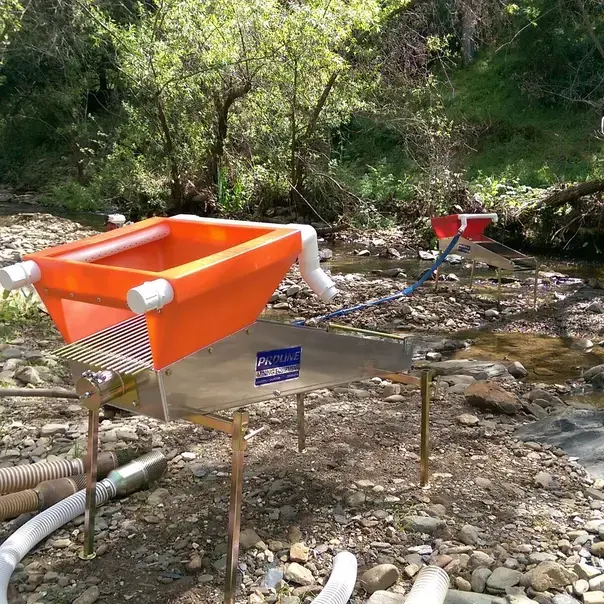
Buckets, a classifier, and a plastic sluice
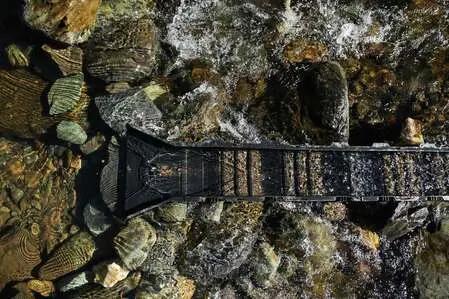
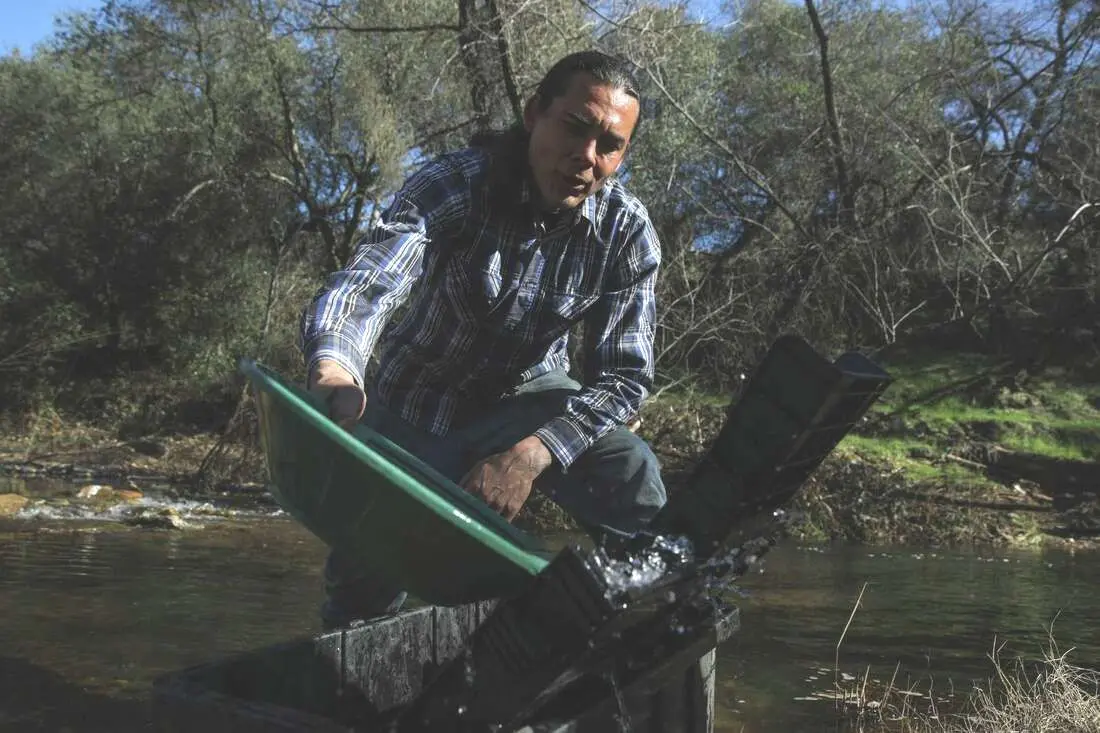
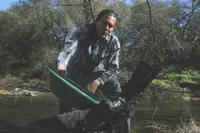
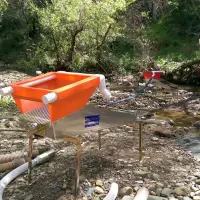
The work begins with a shovel. “Any dirt around us is the material that we’re going to dig up,” Nate Prebalick told a reporter for NTD in 2022. “We sift through it first, using a device called a classifier, and that’s where we filter out large rocks.” What passes through goes into a sluice box set in the current. “So we can run anywhere from one five-gallon bucket of material to 100 five-gallon buckets of material, and it’s going to sift it all down to just one gold pan’s worth.”
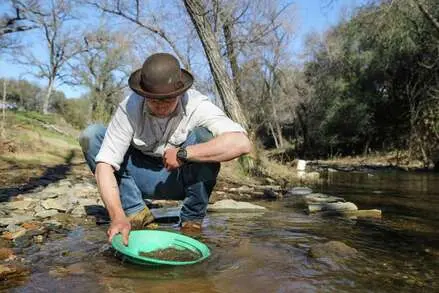
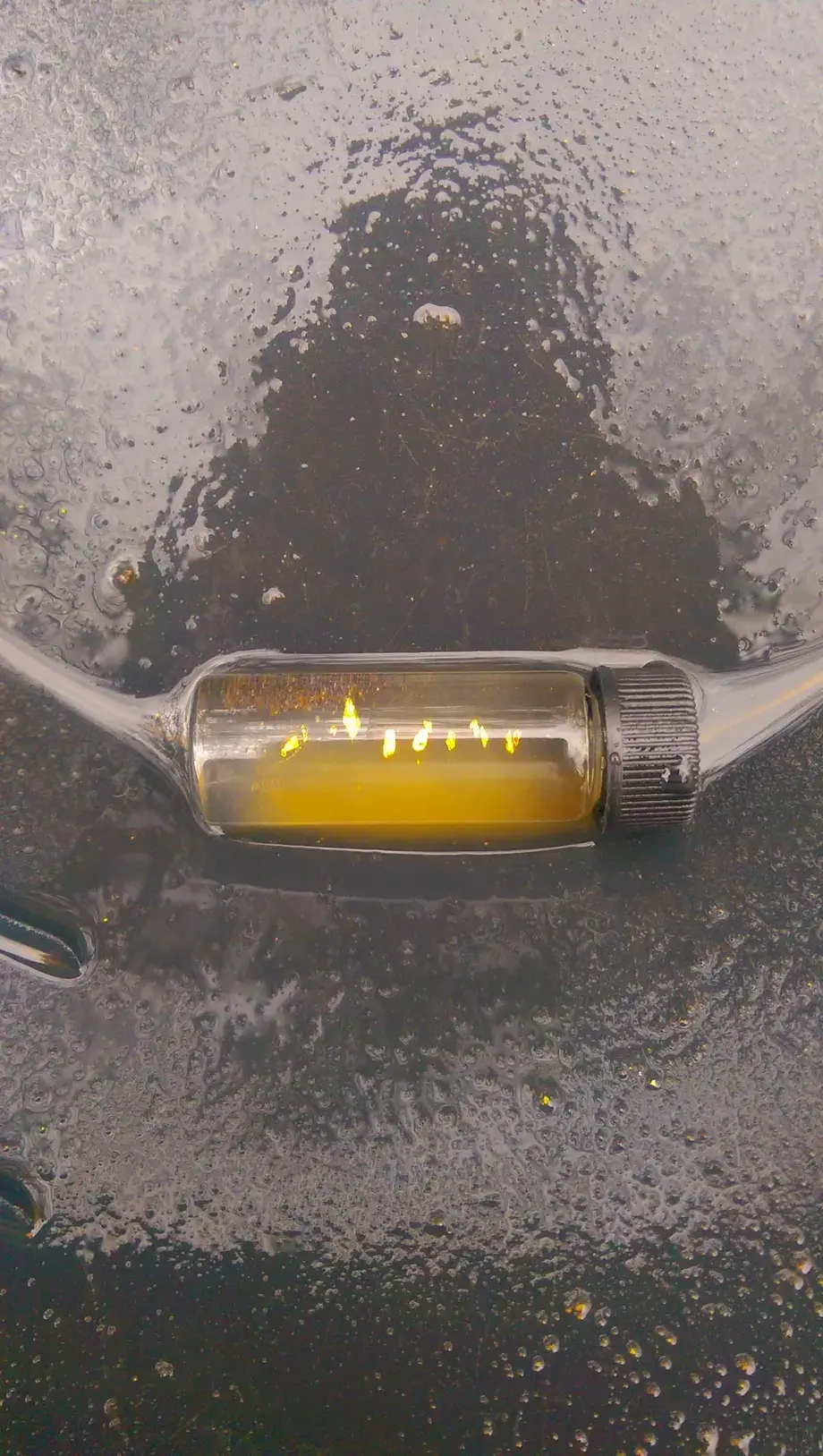
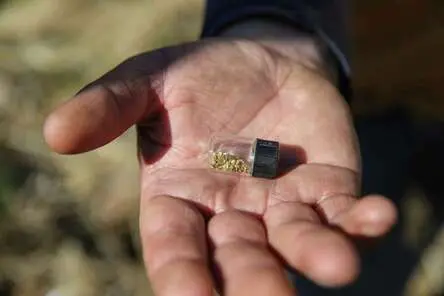
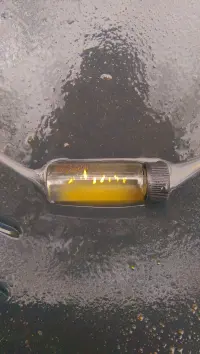
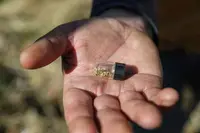
Gold, Nate has explained, is the heaviest material in the river, about 19 times denser than water. The creek carries the lighter sediment off the top of the sluice while the gold sinks to the ridges along the bottom, and the pan finishes the job. At the end Nate picks the specks out with his fingers and drops them into a small jar. What turns up here, he says, is 22- to 23-karat gold.
The tools are the ones the Forty-Niners used, many of them now plastic. In the spring of 2023 Trinity Holman, 11, minded a plastic sluice in the creek shallows while her father, the guide James Holman, explained that miners once ran wooden long toms 60 to 100 feet long. “This one is the same as they used except it’s plastic,” he said. State law keeps big machinery off the creek, so the shovel decides the day. “The more earth you move the more gold you’ll probably get,” Holman told KCRA. “If you don’t move any earth, you don’t get any gold.”
Accounts from visitors, posted by the business, say a person will get wet at least to the knees, that a wide-brimmed hat keeps the sun off the neck, and that white clothes come home dirty. One family found crayfish in the stream. A dog named Tank turns up in one account. In 2023 Holman’s own dog, Frankenstein, was credited with digging up two small nuggets in two days. Sessions run from an hour to a full day, and the two- and three-day digs add high-banking and crevassing. School groups from kindergarten through twelfth grade come to the claim, and each student leaves with a flake, a picker, or a nugget of real gold.
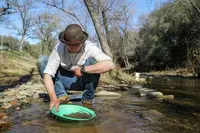
Most of what the pan holds is fine placer gold. “Some days you’re eating top lobster, some days you’re eating top ramen,” Nate told the San Francisco Chronicle. The business’s website records some better days. A 16-year-old girl pulled a half-ounce nugget out of one of the dig holes, and a group of high-bankers washed off a piece of quartz holding three chunks of gold. The claim also gives up jasper, agate, petrified wood, chalcedony, chert, and quartz crystals.
The Harvard Mine and Table Mountain
Across the creek is the historic Harvard Mine, where, the business says, millions of dollars in gold came out of the Mother Lode vein. A Sierra Nevada Geotourism listing notes that the old Highway 49 bridge on Harvard Mine Road looks onto the foundation of the Harvard stamp mill, and that Indian grinding holes and rock walls built by miners lie nearby. A quartz vein runs beside the creek. “Being able to find any gold attached to this quartz is what made this area so valuable back in the day,” Nate said. “Between 1849 and [the] early 1900s, they pulled an estimated 187 tons out of this area.”
The weights of crystalline gold change with the teller. The business’s history page speaks of more than 200 pounds of it found at the Harvard Mine, and of a 43-pound chunk, found in 1989, now on display at the Ironstone Heritage Museum in Murphys. The same page mentions a 72-pound nugget found in the 1800s. Nate told NTD that the world’s largest crystalline gold, about 24 pounds, came from the creek.
The Tuolumne County Historical Society records that the Sonora Mining Company began high-volume open-pit mining near the Harvard Mining conglomerate, the Trio, in 1986. Eight years later, with the average price of gold down to $384 an ounce, the company closed, which the society says ended major gold mining in Tuolumne County.
Behind the mine rises Tuolumne Table Mountain. The business says it formed in the Tertiary Period, when local volcanoes filled an ancient river with lava. Miners have tunneled under it after the buried river’s gold, and the historical society dates tunnel, drift, and pocket mining there to 1853. Besides gold, the business lists what has come out from under the mountain: a man’s skull, arrowheads, leaf fossils, and animal bones.
Woods Creek in 1848
The creek’s discovery has more than one telling. The Tuolumne County Historical Society places it in the summer of 1848, when a party of Benjamin Woods and James Savage found gold at Woods Creek in what is now Jamestown, the beginning of the Southern Mines. By the society’s account the party called their camp Wood’s Crossing and the stream Wood’s Creek. The Geotourism listing also credits a party led by Benjamin Woods, in 1848, with the first gold mining camp in what is now Tuolumne County. The business’s own history gives the find to a group led by James Woods, “in or around 1847.” Another record names James Woods as the first to find gold in the county, in 1848, shortly before Colonel George James founded Jamestown on August 8 of that year.
It was said, the Geotourism listing recounts, that in 1849 a man could earn a week’s wages walking along Woods Creek on his way for supplies, prying gold out of the cracks in the bedrock with a knife. The business says Grizzly Adams kept a saloon just down the creek, where he lived with his bear until the two were run out of town. The Geotourism listing says only that it is alleged he ran a saloon and trading post on the east bank. Holman believes Adams made more money off gold in Jamestown than anyone, because he had the mining supplies and the alcohol. “He didn’t have to dig or sluice,” Holman said. “The miners would bring the gold to him.” The business adds that P.T. Barnum stopped over when his brother needed a little help, and it counts Mark Twain among the names along the creek.
Three generations of Prebalicks
The family’s accounts of its own beginning differ in the particulars. In the business’s version, Terry Prebalick moved from Minnesota to California in 1979 to run a newspaper printing press. On a lunch break in downtown Sonora he watched an old-timer pull a nugget out of Sonora Creek. Nick Prebalick told the Union Democrat in 2023 that his father ran a printer for that paper in the 1970s, when it was still printed in downtown Sonora. In Nick’s telling the panners were in Sonora Creek where the old Wagon Wheel used to be, and one of them hollered and held up what he claimed was a nugget. 209 Magazine has Terry standing on a bridge over Woods Creek when he saw a nugget in the river. Terry gave his own version to NTD in 2022:
“I was out taking my lunch break one day, and I looked down in the creek, and we were watching this old man sitting down on the creek panning—I’d never seen panning before. And all of a sudden he’s waving us down. So we went down and took a look on the creek. He found a three-and-a-half-ounce gold nugget, which is about the size of the palm of our hand… Ran out the next weekend and bought pans and went gold mining.”
“He quit working at the paper and started panning for gold for a living,” Nick said. Terry learned the trade from old-time miners and sold his gold to raise his family. NTD reported that the family has run California Gold Panning since the late 1970s. They dredged on Woods Creek, on the Merced River near Bagby when McClure Reservoir was low, and near old town Melones in the 1990s, until dredging was outlawed.
In the NTD account the family’s largest take, 127 ounces, is Terry’s. He dove eight feet under water and spent two days cleaning out the crevice. “I filled a pan up about that thick of gold,” he said. “The biggest nugget I had in there was just under 3 ounces.” 209 Magazine credits the same 127 ounces to Nick.
Nick, called Nugget Nick, went out with his father on every school break and summer and now owns the business. His son Nate, the third generation, works the claim with him. “It’s great. I get to see my son and my father all the time,” Nick said in 2022. “This is the only exercise that Dad gets. He’d be sitting on the couch otherwise, watching TV.”
The New Year’s Eve flood
In the wet winter the Union Democrat described in May 2023, a New Year’s Eve flood came down Woods Creek. “It took out all the trees in the creek, made it a lot easier to get down in there, and it moved a lot of rock and overburden, all the topsoil,” Nick said. “You could hear rocks and big boulders moving in the creek. That’s a good sign. It took part of my road.” January storms followed. When the Chronicle visited that February, Nate lifted a pan of specks like ground pepper, four to five times what he usually found, and Nick said the storms had done “months of work” for the family. Terry put it with a chuckle: “The only people who like big floods are gold miners.” By the start of May, Nick had been on Good Morning America.
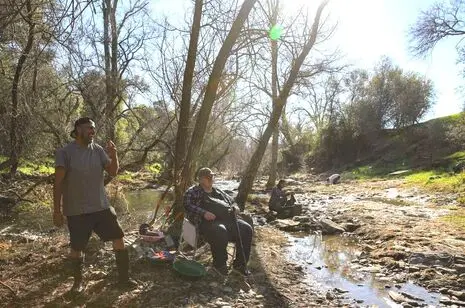
On the Chronicle’s February day, Terry found about $100 in gold in his green pan and another $200 before the hour was out. Around mid-afternoon most of the crew packed up.
“The other guys are up here complaining that you got the most amount of gold for the least amount of work,” Terry’s wife ribbed him.
“I’ve earned that gold, I’ve been here 50 years,” he replied.
Notable Events
- 1848James Woods first discovered gold in Tuolumne County on Woods Creek, shortly before the town of Jamestown was founded. ohp.parks.ca.gov
- 1848Colonel George James founded the town of Jamestown, which became known as gateway to the Mother Lode and the southern mines. ohp.parks.ca.gov
- 1979Terry moved from Minnesota while working for a newspaper running a printing press. gold-panning-california.com
- 1989A 43-pound chunk of the crystalline gold found across from the claim at the Harvard Mine was found in 1989 and is on display at the Ironstone Heritage Museum in Murphys. gold-panning-california.com
- The flood removed trees, moved rock and overburden, and eroded part of the business road, exposing more material. uniondemocrat.com
People
- Nick Prebalick, Owner of California Gold Panning; had leased the business land for five years at the time of the feature.
- Terry Prebalick, Family patriarch and gold prospector (since the 1970s).
- Nathanial (Nate), Third generation, working the claim with his father after growing up around his father and grandfather's mining.
- Nugget Nick, Terry's son, raised mining with his father.
- Prospector Terry, Father of Nugget Nick, who grew up mining with him.
- "Nugget" Nick Prebalick, owner of California Gold Panning.
- Nathaniel (Nate) Prebalick, third-generation gold panner, son of Nick.
- Colonel George James, founded the town of Jamestown (August 8, 1848).
- James Woods, first discovered gold in Tuolumne County, on Woods Creek (1848).
- Chaney Rivera, Member of the California Gold Panning group preparing to hunt for gold.
- James Holman, Guide at California Gold Panning explaining storm erosion and likely placer gold in Woods Creek.
- Nate Prebalick, Nick's son and Terry's grandson, third generation of gold panners in the family business.
- Benjamin Woods, led a party of miners who set up the first gold mining camp in what is now Tuolumne County; the creek was later named after him (1848).
- John “Grizzly” Adams, Holman believes he supplied miners with mining supplies and alcohol in Jamestown.
- Trinity, Holman's daughter, minding a plastic sluice in the creek shallows.
Sources
- gold-panning-california.com
- gold-panning-california.com/booking.html
- gold-panning-california.com/directions.html
- gold-panning-california.com/contact-us.html
- fareharbor.com/embeds/book/cagoldpanning/items/?ref=Homepage
- gold-panning-california.com/woods-creek-history.html
- ohp.parks.ca.gov/?page_id=21534
- sierranevadageotourism.org/entries/california-gold-panning/45deec93-92ee-4228-b47f-6d733ebe96a7
- gold-panning-california.com/uploads/1/3/7/0/137007722/epoch_2022panning_for_gold_in_jamestown.pdf
- gold-panning-california.com/in-the-news-ca-gold-panning.html