
.jpg)


Buena Vista Ferry
Jefferson, Marion County, Oregon. Ferry; Year-round operation.
Details

- Where
- 4997 Buena Vista Rd S, Jefferson, OR 97352. Directions
- When
- from April through October each year.
- Getting there
- From the west side of the river: south of Independence past the Independence Bridge, turn left at Buena Vista Road and stay on it to the ferry. From Salem: south on River Road S. over the Independence Bridge and turn left. From I-5: take the Talbot Road exit and head west.
- Fees
- Pedestrian free; bicycle $1.00; motorcycle $2.00; vehicle under 22 feet $3.00; 22 to 42 feet (including trailer) $6.00; over 42 feet $9.00; effective March 15th, 2021.
- Hours
- Seven days a week, 7:00 a.m. to 5:30 p.m.; closed Thanksgiving Day and Christmas Day; closes when the river level reaches 15 feet.
- Access
- Fees are paid in cash, personal check, or ferry toll card; credit cards are not accepted at the ferry. Maximum weight 80,000 lbs (40 tons), maximum length 60 feet.
- Phone
- (503) 588-7979
- Managed by
- Marion County Public Works.
- Established
- around 1847.
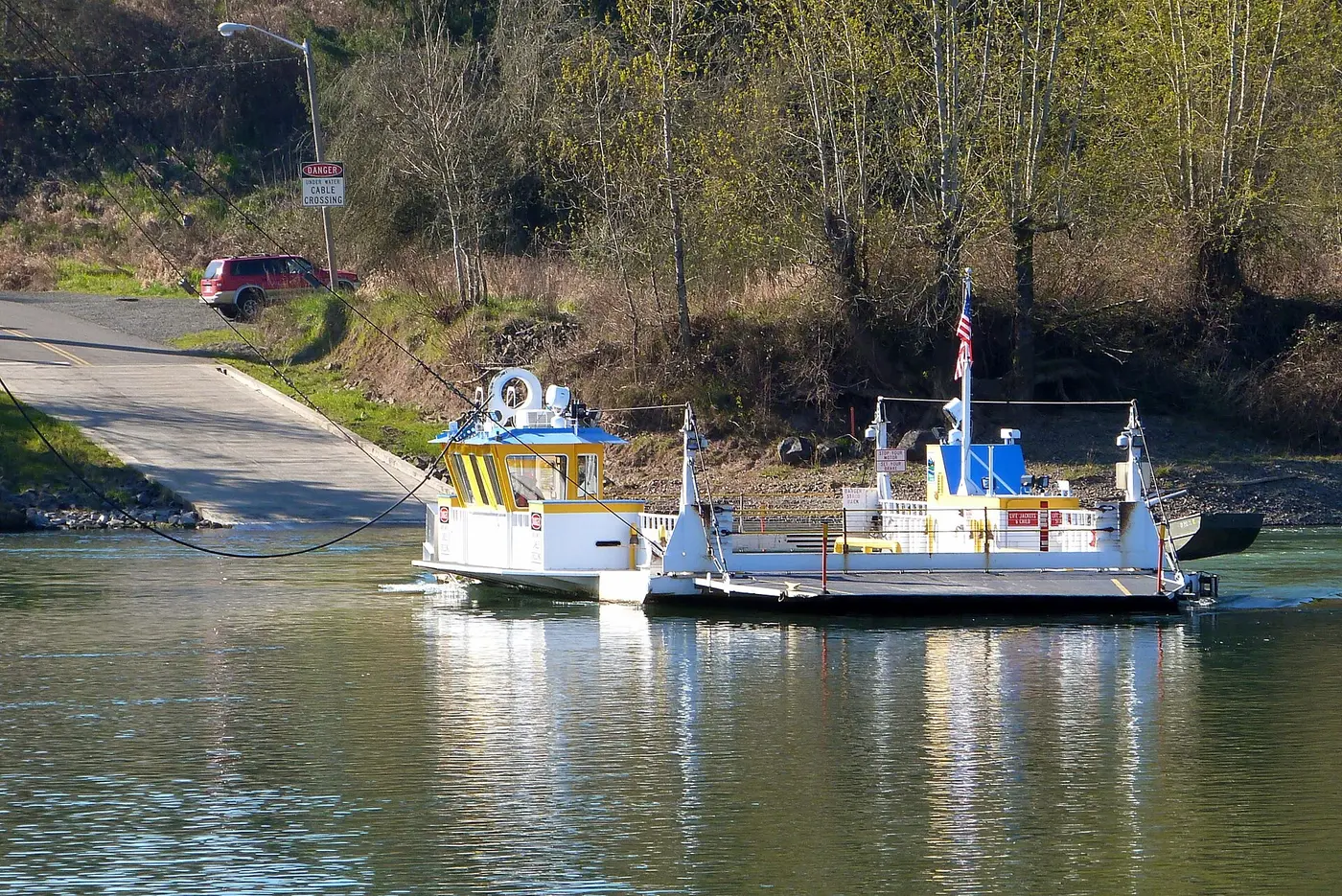
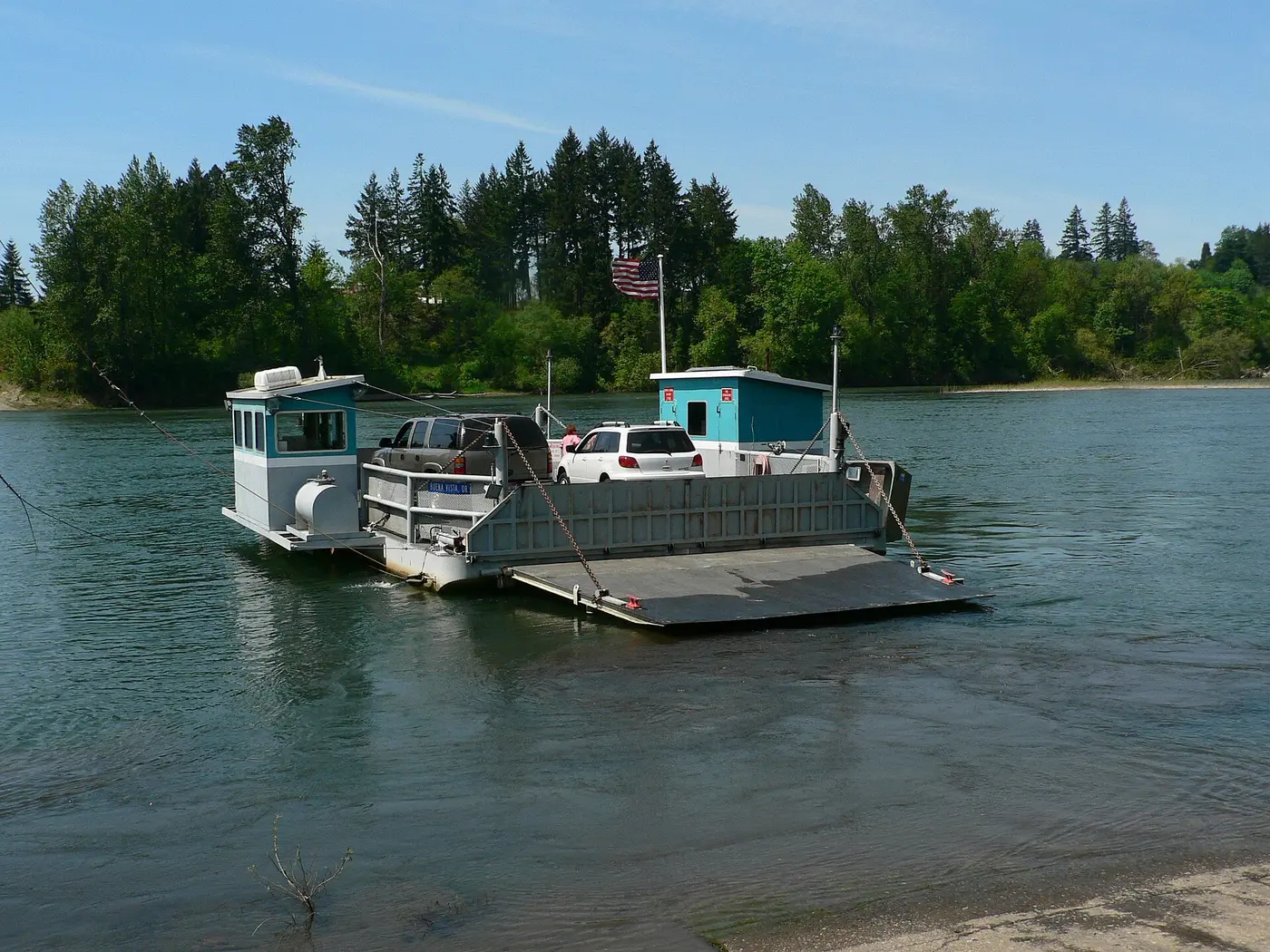
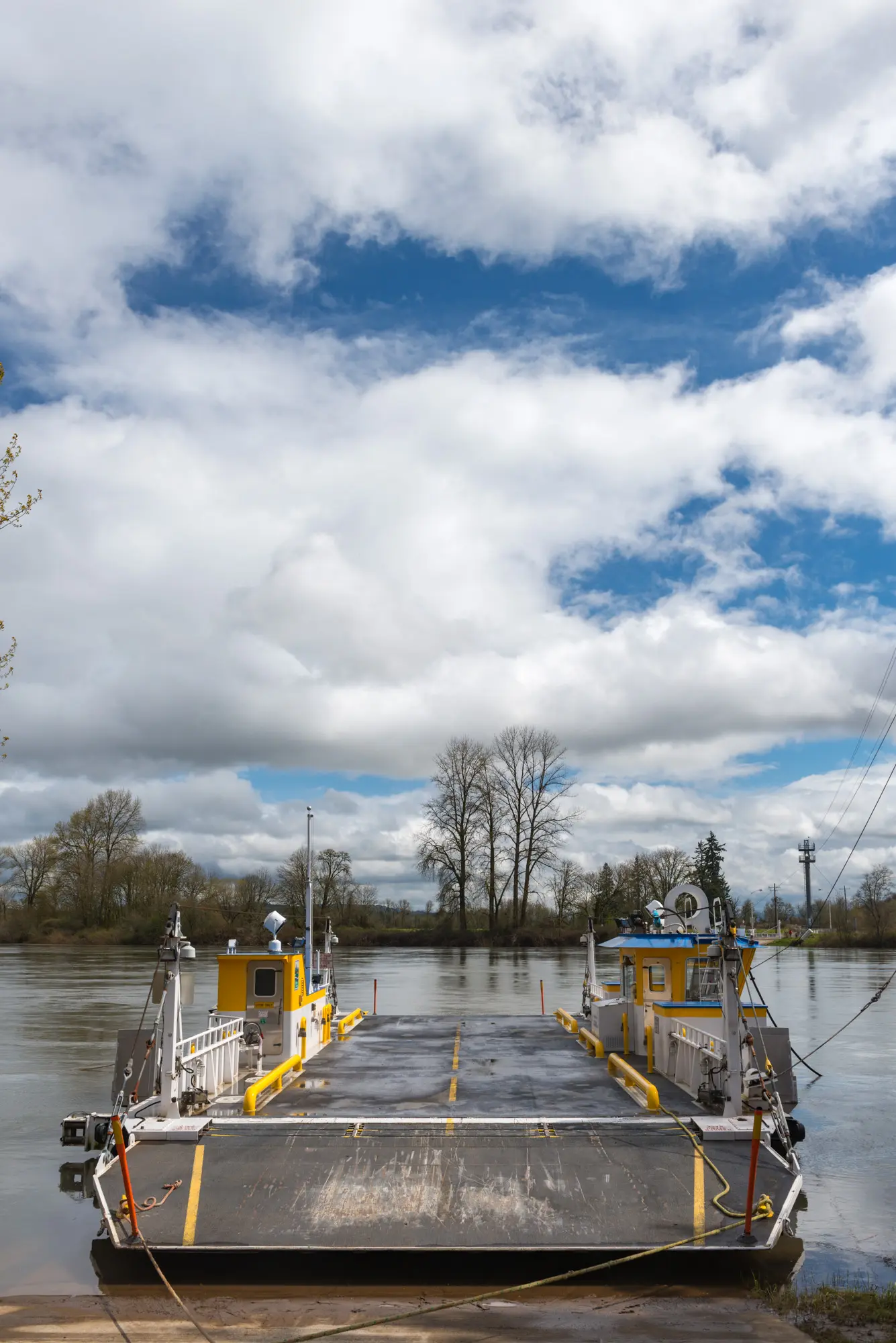
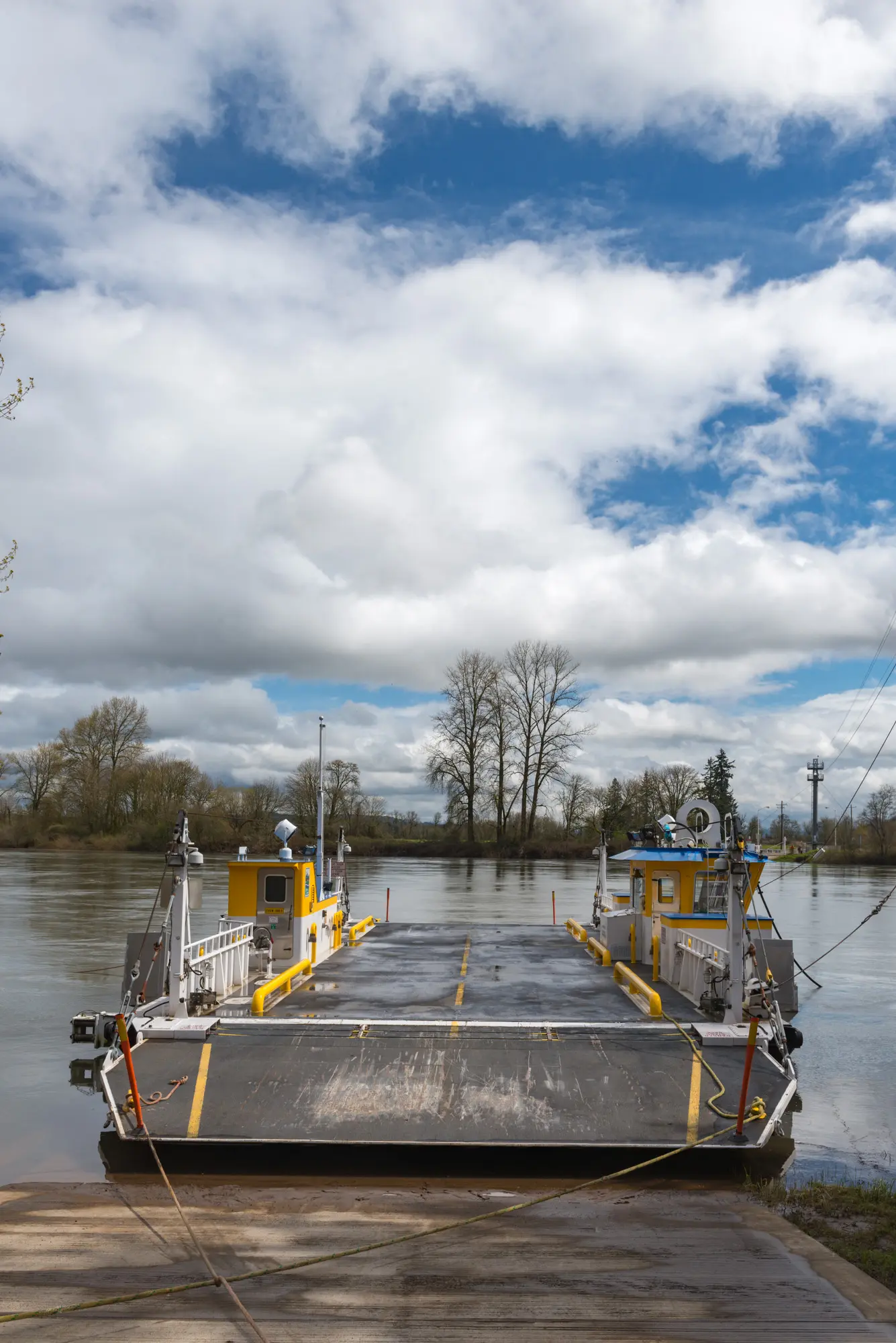
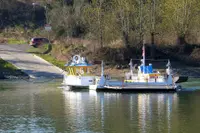
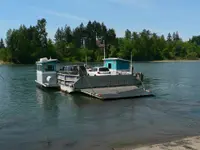
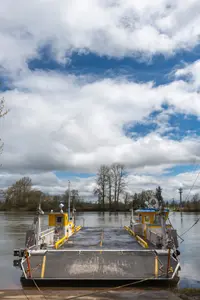
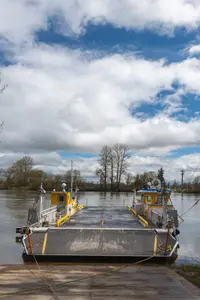
Buena Vista Road runs down to the Willamette and ends at the ferry. The boat is a flat steel deck held on course by cable. It carries up to six vehicles and 49 passengers across about 720 feet of river between Marion County and Polk County. Walkers ride free. A bicycle pays a dollar and a car under 22 feet pays three. Fares are paid in cash, by personal check, or with a Marion County ferry toll card. Credit cards are not accepted aboard.
Marion County Public Works runs the crossing. Darren Jones is its ferry operations crew leader and Michael Shepard its ferry supervisor. People who live nearby treat the ferry as part of the road. A rider signing as JJHartzell wrote in 2021, “we use it almost daily,” and added, “when our grandkids visit we walk down and go across and back.” Another, BuenaVistaBen, wrote in 2019 that “the friendly boat operators are always cheerful and accommodating.”
The county lists the ferry as running year-round, closed only on Thanksgiving and Christmas. The Willamette Valley Visitors Association listing on Travel Oregon gives the service as April through October. The county’s operating-status page has carried a notice that the ferry would stay closed through the summer months for dredging and its five-year Coast Guard haul-out inspection. The ferry also stops when the river rises to about 15 feet.
A barge on an overhead wire
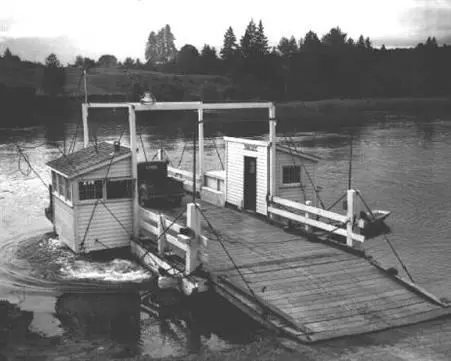
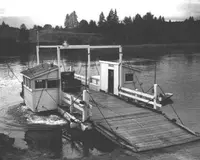
The present boat went into service in 2011. Elliott Bay Design Group designed it and Diversified Marine of Portland built it. According to a Maritime Activity Reports account published that August, it was delivered to the county in May, ahead of schedule. It replaced a diesel ferry that had run for more than 50 years. Travel Oregon dates the continuous daily service, motor vehicles included, to 1955. Part of the cost of the new boat came from the federal stimulus package, the American Recovery and Reinvestment Act.
“This ferry has an unconventional propulsion system,” said Mike Complita, the design group’s project manager. “It’s powered by electricity provided from the shore on a cable that runs across the river. That electricity powers motors that turn propellers mounted on each side of the boat.” The hull is welded steel built in an inland barge style, and it is only four feet deep. The summer river is not much deeper than that, so the propellers sit on the sides of the boat for protection instead of beneath it. “The vessel was designed to be simple and cost effective to build,” Complita said. James Jennings of the firm’s Seattle office acted as the eyes and ears of the Oregon Department of Transportation and the county while the boat was built. The same firm had designed the county’s other boat, the Wheatland Ferry, which went into service in 2000.
A cyclist signing as davidbu2017 described a crossing in 2017. He and two friends were riding a loop around Independence on an eclipse trip. They loaded on with a few cars and “hummed our way quietly across the river,” the boat drawing power “via a trolley riding overhead wires.” He wrote: “Submerged cables kept the ferry on course in spite of the river current.”
The Albany Regional Museum estimates that more than 500 ferries once worked in Oregon. Three remain, at Canby, at Wheatland north of Salem, and here. Two of the three are Marion County’s.
Liberty, Hall’s Landing, Buena Vista
The town on the west bank grew up on the donation land claim Reason B. Hall settled in 1847. A National Register nomination prepared in 1980 for a farmhouse north of town says the landing was first called Liberty. The county’s history says it was known for a time as Hall’s Landing. Hall renamed it, it is said, after some of his relatives fought in the Battle of Buena Vista in the Mexican-American War. The name is Spanish for beautiful or good view.
The sources disagree on when the ferry began. The county says Hall started it around the time he settled, about 1847. The nomination gives 1852 or 1853. Travel Oregon and the Albany museum give 1852. The museum also cites the Albany author Ed Loy on the rules of that time. Before 1849, ferry operators charged whatever people would pay. After that the territorial government required owners to get licenses from the counties, limit their tolls, and post a fee schedule.
Warehouses and general merchandise businesses followed the ferry, then a grist mill, a hotel, a wagon shop, and a blacksmith shop. In 1859 the first school opened in a one-room log house that served as a church on Sundays. When the location of the state capital was in debate in the late 1850s, Hall advertised Buena Vista for it. He pointed to its central place on the Willamette and its high bank not subject to flooding. He also cited the building timber close at hand and the townspeople’s willingness to donate land and assets for a capitol. Voters favored other towns, and Salem became the capital.
Kilns by the ferry landing
Freeman Smith came to Oregon at the end of the Civil War with his wife, six sons, and four daughters. He had worked at a pottery factory in the east and had heard that the clay banks of the river had good firing qualities. He bought land near the ferry, and the family built kilns and started Smith and Company. The nomination dates the firm to 1865 and calls it the first pottery manufactory in the Pacific Northwest. It began with household crockery. Fire clay came from a bed near the factory, and slip clay came from Corvallis, 17 miles up the river. The county says much of the pottery the pioneers used came from Buena Vista and went out by river.
In 1870 Smith sold the company to his son Amadee M. Smith. The brothers added fire brick, stoneware, flower pots, and sewer pipe. The nomination says 15-inch drain and sewer pipe was made here for Portland and other towns as early as 1872 and 1873. The county says a 15-inch pipe under Portland’s SE Stark Street was made and burned in the Buena Vista kilns. Accounts of the workforce differ. The county gives four potters and ten Chinese immigrants mixing clay, and elsewhere says several hundred locals at the height. The nomination says 50 men in prosperous times, some of them Chinese.
In those years the town had two doctors, a drug store, saloons, a hotel, churches, stores, a two-story school, and a busy sawmill. The plant ran until 1886, when A. M. Smith moved the business to Portland and opened a larger factory.
The railroad west of town
The Oregon and California Railroad came through west of town in 1879 and bypassed Buena Vista. The county calls this the beginning of the town’s decline. The river remained the town’s main link, and in low water Buena Vista was the head of steamboat navigation. The town counted 183 people in 1880 and reached 200 in the 1890s. Hops held on as the main industry for more than 50 years and then lost value. River traffic on the upper Willamette fell off, and the county says Salem drew people away.
By the early 1960s, the county says, most of the buildings and houses were gone, leaving a small market and the cemetery. The 1980 nomination counted a few houses, a church, a school, and a fraternal hall from the old days. The cemetery stands on a hillside north of town. George A. Wells Sr. gave the land for it. He settled north of Buena Vista in 1867 and kept a warehouse at Wells Landing for the community.
Notable Events
- 1852Hall established a ferry across the Willamette, and warehouses and general merchandise businesses were established also, followed by a grist mill, a hotel, a wagon shop and blacksmith shop to accommodate the development of trade. heritagedata.prd.state.or.us
- 1852The Buena Vista Ferry was founded; Travel Oregon calls it one of the oldest continuous operating ferries in the state. traveloregon.com
- 1955The ferry entered continuous daily operation in 1955, providing daily shuttle service to the public. traveloregon.com
- 2011A new cable-guided electric ferry designed by Elliott Bay Design Group and built by Diversified Marine of Portland began carrying passengers and vehicles at Buena Vista, replacing a diesel-powered version in service more than 50 years. marinelink.com
People
- Freeman Smith, Pottery manufacturer who bought land near the Buena Vista Ferry and built the kilns that started Smith and Company (came to Oregon at the end of the Civil War; sold his company to a son in 1870).
- Reason B. Hall, Settled the donation land claim the community of Buena Vista grew up on, renamed the landing, and established the ferry across the Willamette there (1847).
- Mike Complita, EBDG project manager for the electric ferry design.
Sources
- co.marion.or.us/PW/ferries/Pages/buenaferryfees.aspx
- co.marion.or.us/PW/ferries/Pages/buenavista.aspx
- co.marion.or.us/PW/ferries/Pages/bvhistory.aspx
- traveloregon.com/things-to-do/culture-history/historic-sites-oregon-trail/buena-vista-ferry
- traveloregon.com/things-to-do/culture-history/historic-sites-oregon-trail/buena-vista-ferry
- marinelink.com/news/launches-electric-buena339770