Buckhorn Ranger Station
Bellevue, Larimer County, Colorado. Forest Service cabin rental.
Details

- Where
- 32317 Buckhorn Road, Bellevue, CO 32317. Directions
- Getting there
- Off Buckhorn Road, west of Stove Prairie Road and east of Pennock Pass.
- Fees
- $175 per night.
- Access
- Site open; potable water available at this site; restrooms available in the cabin; parking available at the site right off the road; horse and pack animals not allowed.
- Walk-in or reserve
- Reservations through recreation.gov.
- Phone
- 970-295-6600
- Website
- fs.usda.gov
- Managed by
- USDA Forest Service, Canyon Lakes Ranger District, Arapaho and Roosevelt National Forests.
- Established
- 1933.
- Coordinates
- 40.58106389, -105.4687139.
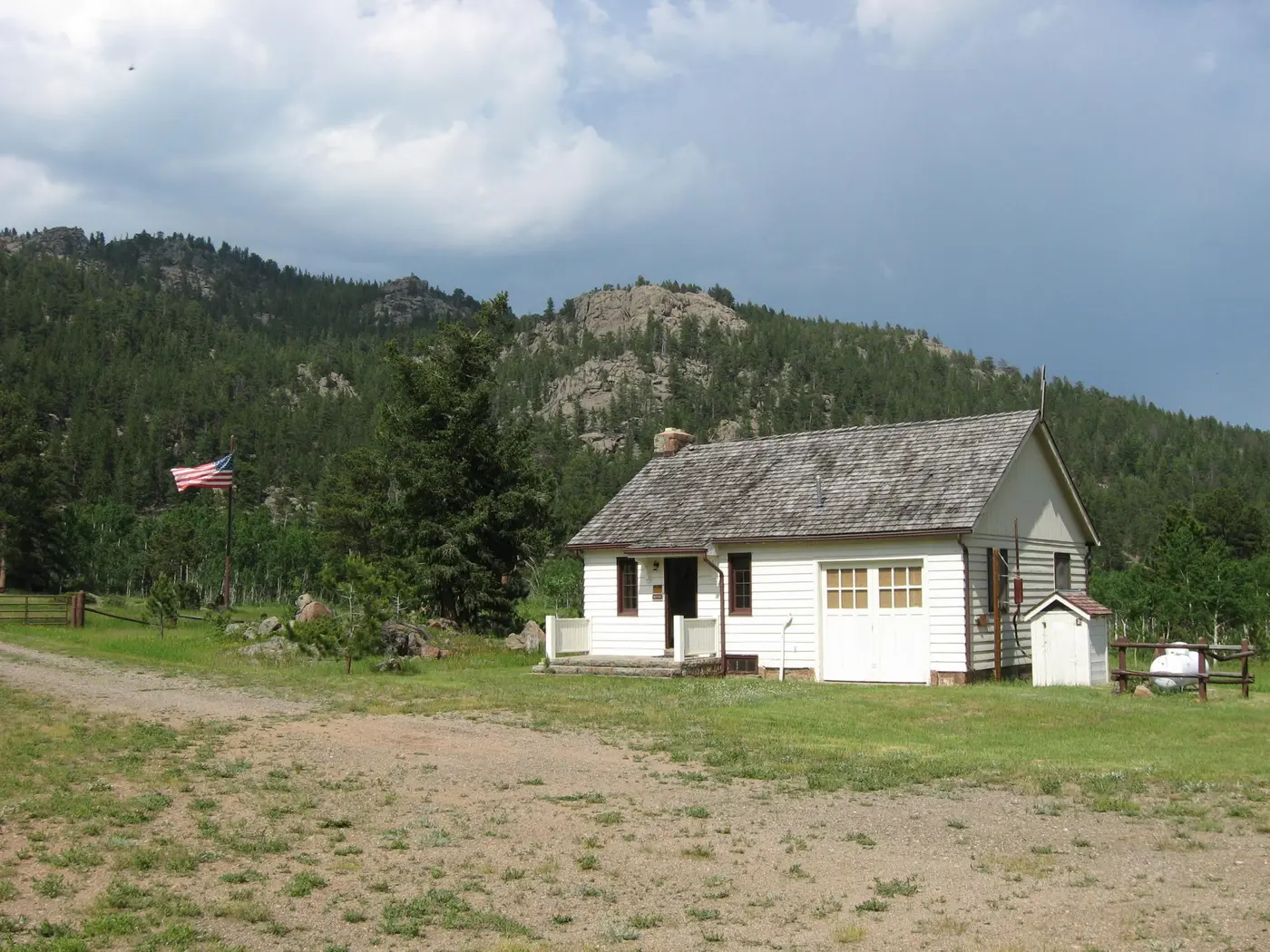
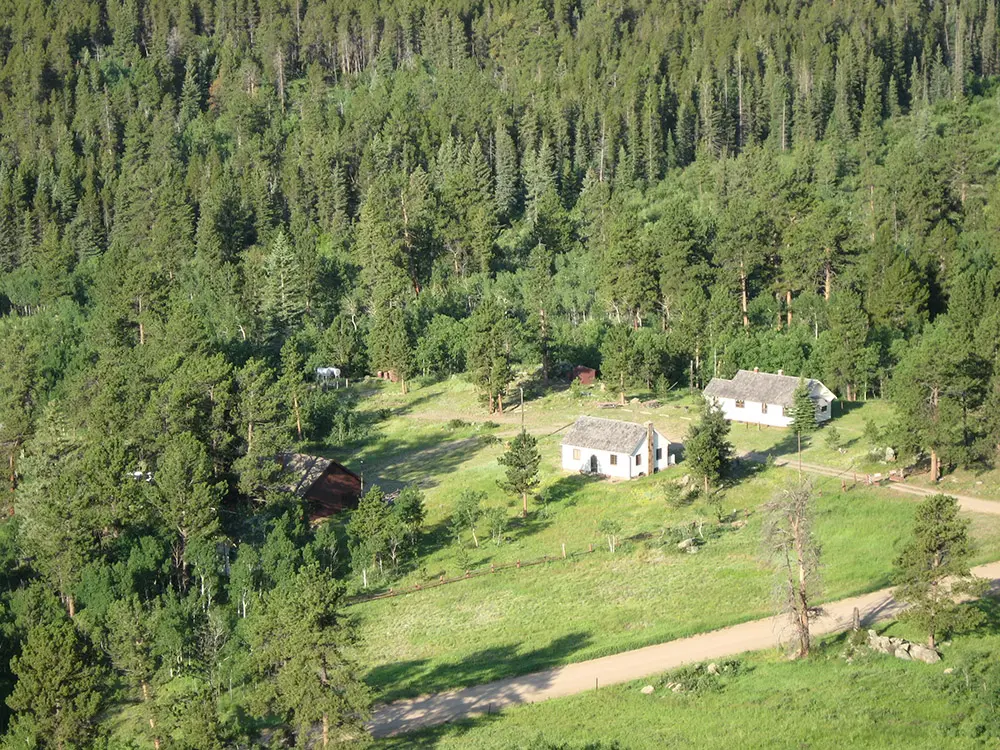
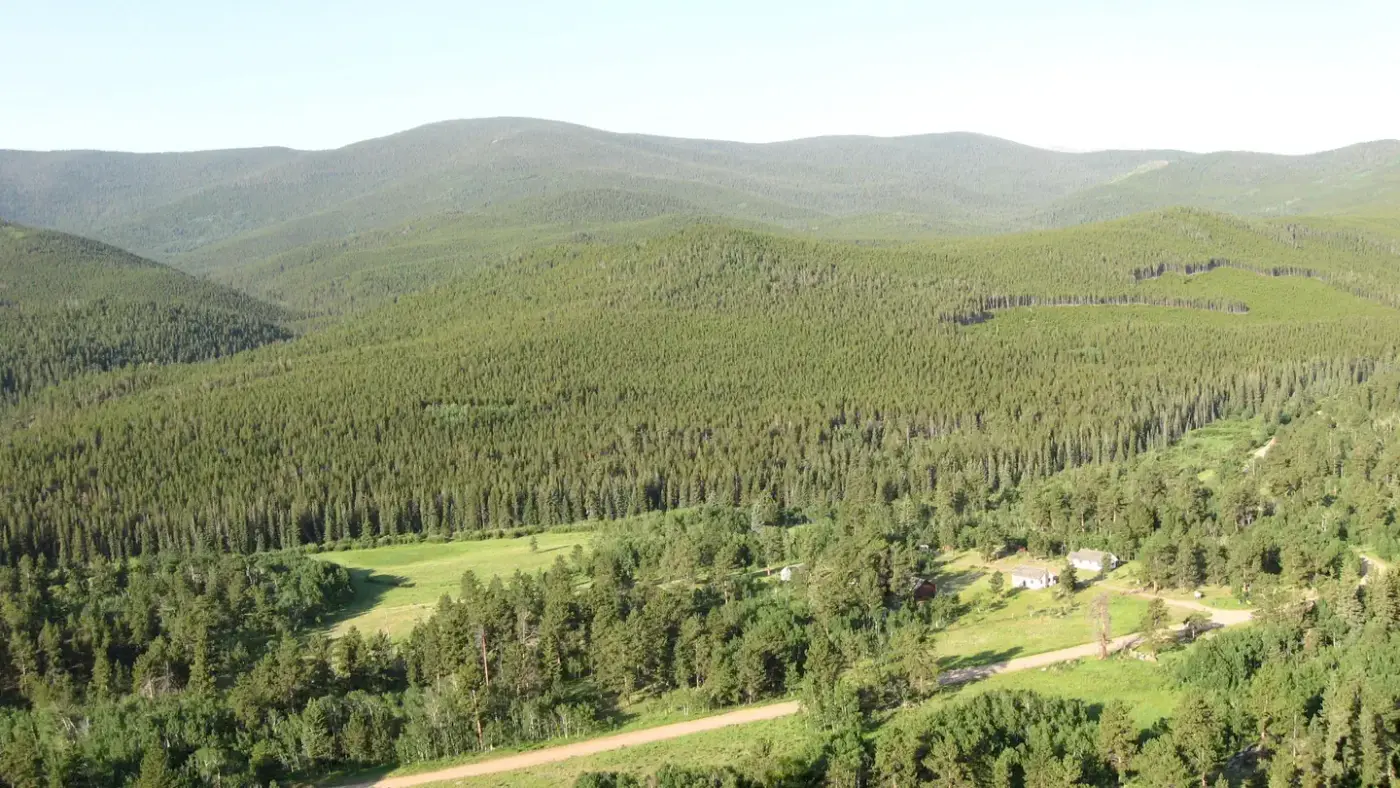
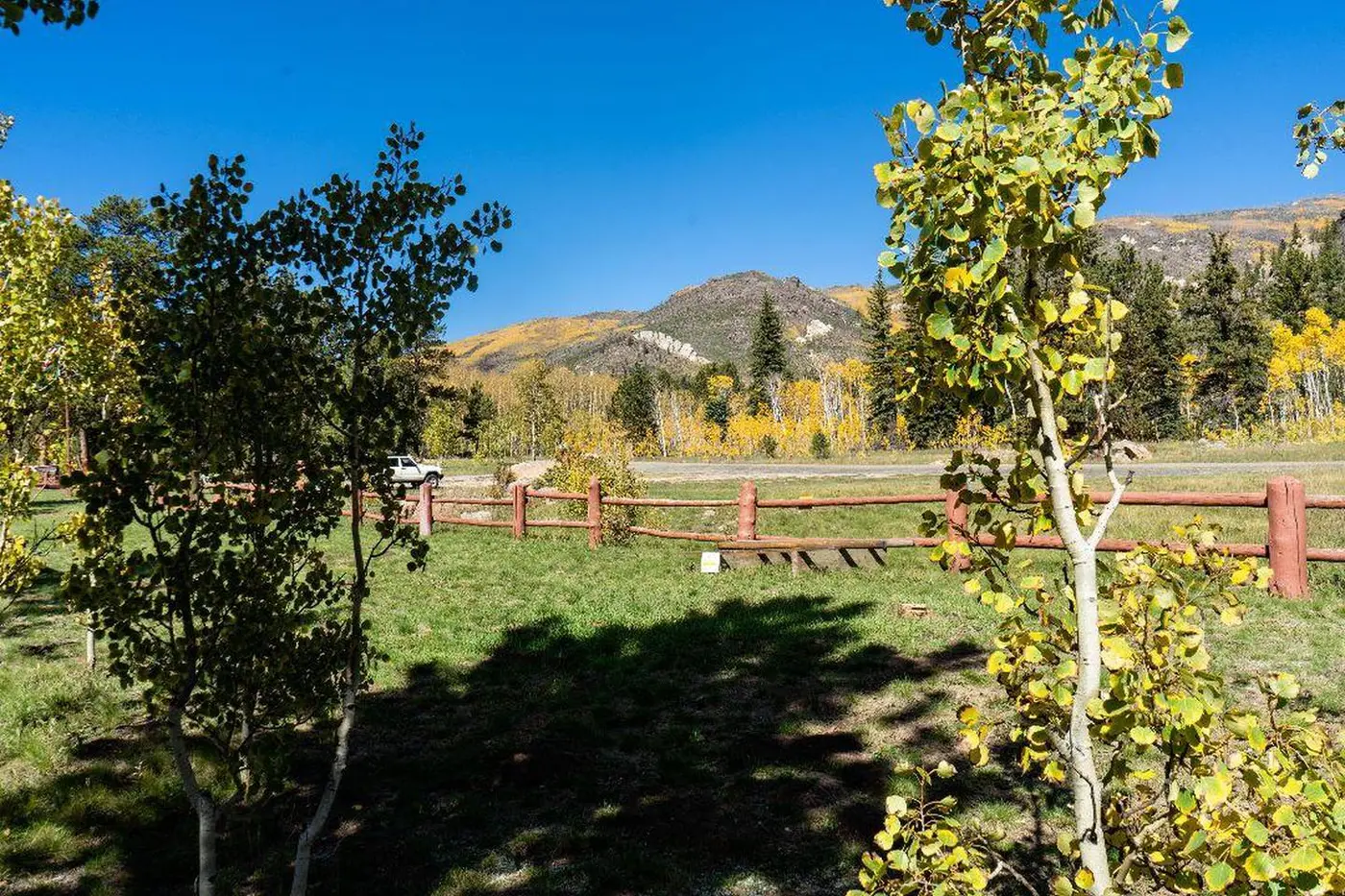
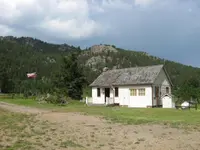
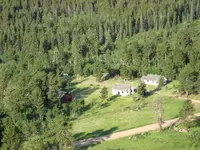
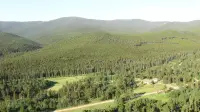
On Larimer County Road 44H, twenty-two miles west of Masonville and just past mile marker 32 for a driver coming from the east, a group of Forest Service buildings stands on both sides of the road. They occupy a broad, open terrace in narrow Buckhorn Canyon, just off Box Elder Creek, a tributary of Buckhorn Creek. West and East White Pine Mountains rise to the north. Lookout and Crystal mountains lie to the south, and Pingree Pass and the Mummy Range to the west. This is the Buckhorn Ranger Station, also called the Buckhorn Work Center. It has three cabins, an office, and a large garage. The Canyon Lakes Ranger District of the Arapaho and Roosevelt National Forests manages it and rents the cabins to the public by the night.
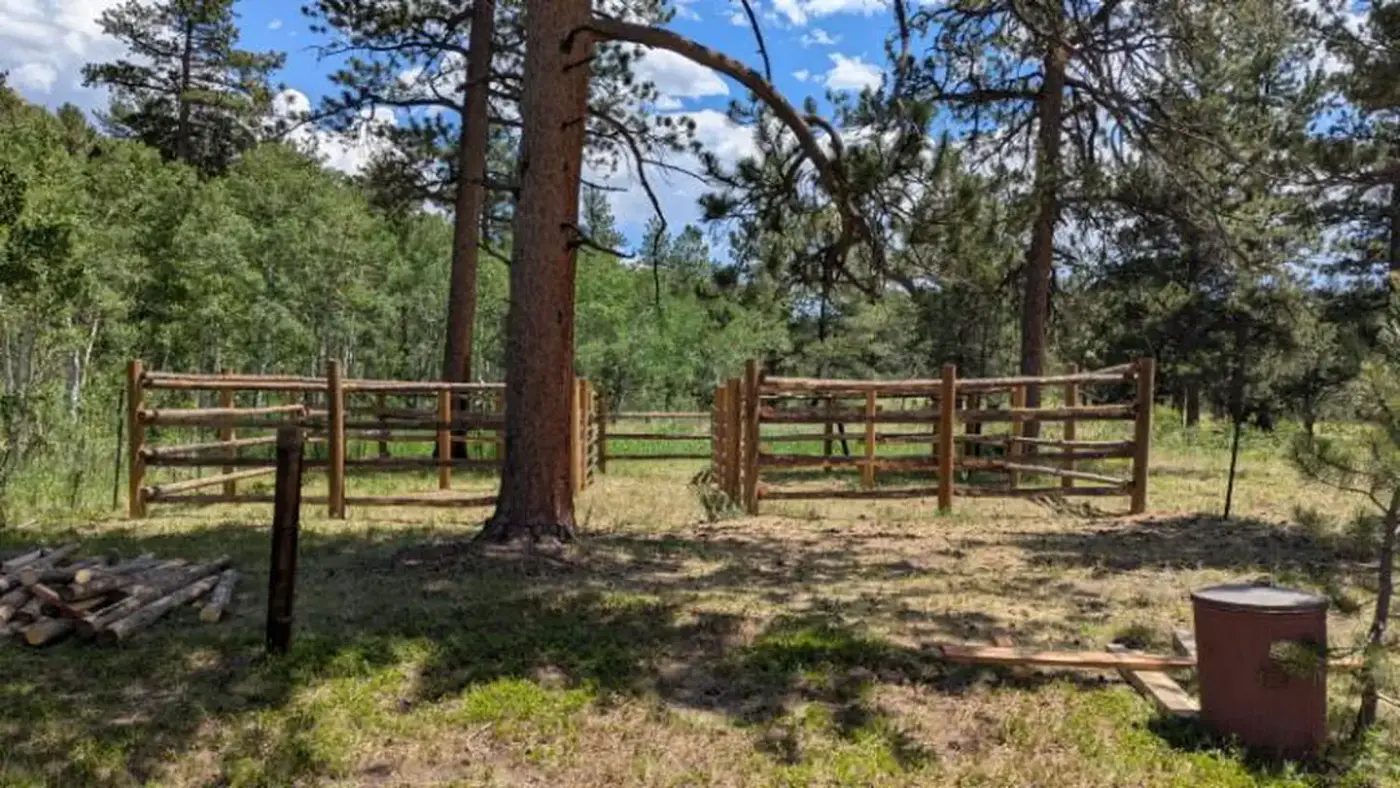
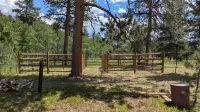
The doors stay locked. A combination comes with the booking, or by telephone from the Forest Service office in Fort Collins. Guests park beside the road and bring their own bedding, towels, and food. Pots, dishes, utensils, tables, and chairs are already in the cabins. Outside are two fire pits, a horseshoe court, picnic tables, charcoal grills, and a bear-proof dumpster, because this is black bear country. HistoriCorps puts the elevation above 8,000 feet. The recreation.gov listing notes that the site has no cell service or public Wi-Fi, and that the nearest services are an hour or more away in Fort Collins or Loveland.
Woodstove, propane heater, and a battery bank
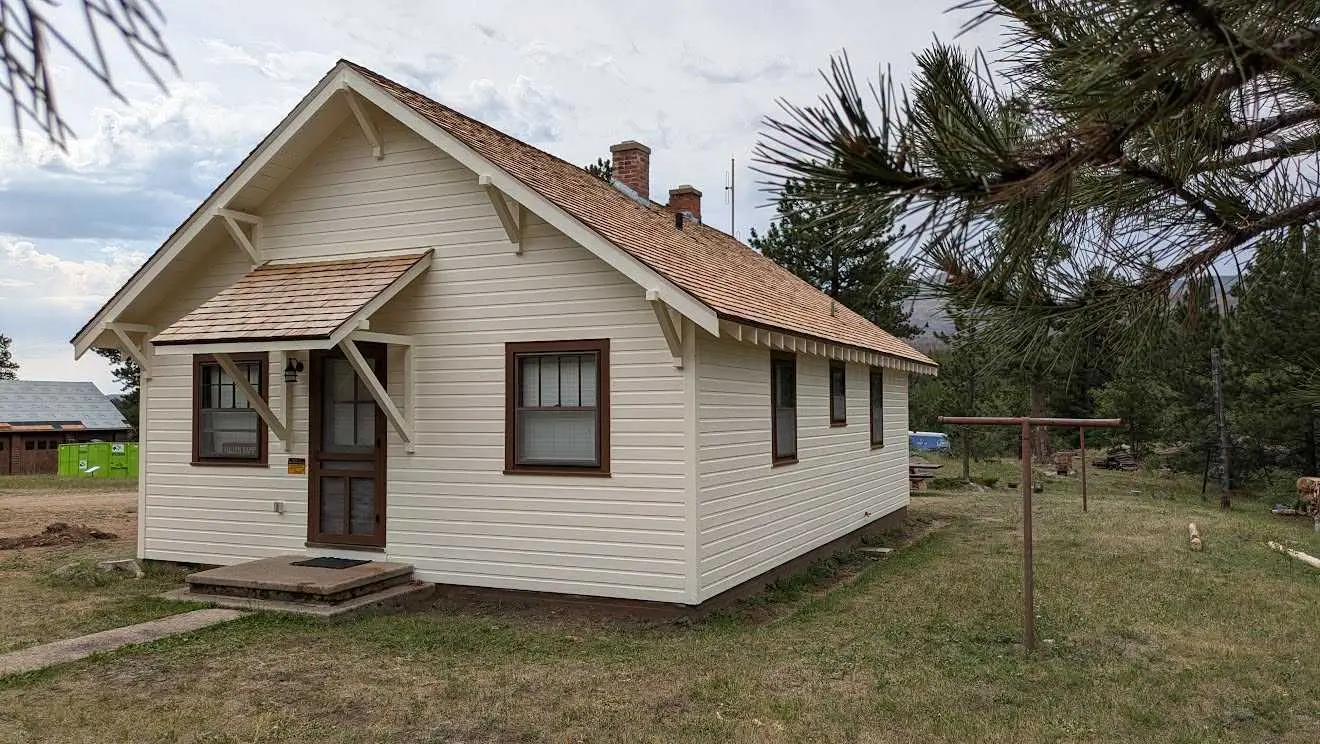
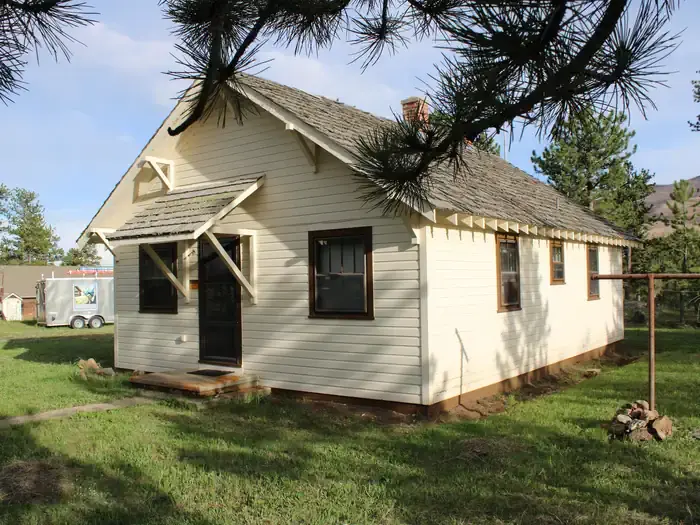
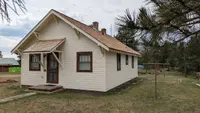
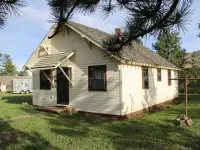
The Civilian Conservation Corps built the Ranger Cabin in 1933. It is a furnished two-bedroom house that sleeps six: two single beds in one room, a queen in the other, and a futon in the living room. It has a woodstove, indoor plumbing, and a kitchen with running water, a stove and oven, a refrigerator, a microwave, and a toaster. The reservation system lists it as “Buckhorn Ranger Cabin (Fullen Kamp).” The Assistant Ranger Cabin has one bedroom with two twin beds, a futon, a propane heater, a gas stove, and a shower. The Bunkhouse is an efficiency, with a kitchen, an eating area, and one small room for living and sleeping. The Forest Service recreation page calls it wheelchair accessible. Recreation.gov and the North Forty News describe it as planned to be.
The station’s power was meant to come from off the grid from the start. The 1941 electrical plans called for wind generation. The Forest Service recreation page states that all five buildings now run on an off-grid solar and battery micro-grid installed in 2024. A North Forty News report of September 5, 2026, lists an off-grid solar system among the station’s future plans. Larry Fullenkamp, the Roosevelt National Forest archaeologist, credited “multiple nationally recognized off grid power experts that live nearby” with giving their time to the work.
Forest Road 100, the West White Pine Road, runs north from the station to the original site of the West White Pine Fire Lookout. The lookout was lifted out by helicopter and moved to Fort Collins. The Danner Hill Trail, also called the Donner Pass Trail, starts just north of the site and heads south toward Lookout Mountain. Pennock Pass is three miles west. The Golden Eagle Disc Golf Course lies across the county road.
A log cabin and four CCC camps
A small log cabin built in 1906 housed the district ranger’s operations here until 1933. Only its cellar is left. The Forest Service writes that the first station was established to help manage what was then the Colorado National Forest. HistoriCorps reports that the 2022 National Register listing rested partly on Buckhorn’s role as the first ranger station in that forest. A federal inventory of the forest’s administrative sites traces the forest’s earlier names. Lands withdrawn from settlement in 1902 became the Colorado Division of the Medicine Bow National Forest in 1905 and the Colorado National Forest by 1910. In 1932 President Herbert Hoover renamed the forest for Theodore Roosevelt.
President Franklin Roosevelt signed the CCC into law on March 31, 1933. Its enrollees were young men from poor families, paid $30 a month, of which $25 went home to their families. By the Forest Service account, they built the new station near the old cabin between 1933 and 1941. The inventory’s field team photographed the compound in July 1993 and credited four camps with the work:
- F-2-C built the assistant dwelling in 1933.
- F-61-C built the small bunkhouse in 1934.
- F-50-C built the Rustic Style garage and shop in 1938–40.
- F-66-C built the Rustic Style office in 1939–40.
The inventory dates a large bungalow-style bunkhouse to 1929–36 and gives its builder as unknown. It dates the whole site 1929–1940. Its finding was that Buckhorn held “the most intact concentration of pre-CCC-era frame administration buildings in Colorado, and one CCC-era Rustic Style building.”
Camp F-50 was the address of Company 2805 at Red Feather Lakes. The company arrived on July 19, 1935, and stayed, except for a short period, until the camp disbanded on May 1, 1942. The Red Feather Historical Society records that besides the garage at Buckhorn, its men built a 57-mile telephone line from Buckhorn to Redfeather to the Laramie and sometimes worked out of a side camp at Buckhorn. According to HistoriCorps, Guy Fowler, a carpenter it calls locally revered, added to the buildings later.
Radon, the High Park Fire, and the flood
Soon after the new buildings were finished, the district ranger moved to downtown Fort Collins. Staff and volunteers came back to Buckhorn only in summer. As the forest consolidated its districts into today’s Canyon Lakes, the station mattered less and less. Volunteers took it over in 2001 to give information to passersby. In 2010 radon was found in the basements of several cabins. “After that, we stopped recruiting volunteers and the buildings sat vacant,” Fullenkamp said.
In 2012 the High Park Fire burned more than 87,000 acres around the empty compound. Dan Bartmann lived a half mile below the station. “High Park really destroyed the landscape, and the year after that we had the big flood that erased the road,” he said. “A neighbor got me on the ham radio and said the road was gone. It didn’t seem possible, but it was. I had to move to town.” Tom Hammond, a fourth-generation resident, said that “a lot of people evacuated and never came back. It kind of fractured the little society we had up here, and it just never returned.”
Broken glass in the snow
The Forest Service’s account of one break-in opens with untouched snow around the compound. The intruders punched out a single section of a door window, kicked through the lower door panel, and went into the office. There they found Smoky Bear stickers, trailhead signs, and Woodsy Owl posters. They moved on to the ranger dwelling, the garage, and the bunkhouse, doing a few thousand dollars more in damage. Then they circled back to throw rocks through the remaining windows. In the writer’s words, they left “with little more than lungs full of radon.” Break-ins like it repeated over the next few years.
In 2017, with budgets at some of their lowest, national guidance told forests to get vacant buildings off their books. District ranger Katie Donahue then sent Fullenkamp to survey the latest damage. “It wasn’t irreparable, but it was definitely the worst I’ve seen,” he said. The extent of the vandalism made the station eligible for $6,000 in facilities funds. That would barely cover the repairs. HistoriCorps, a partner made up largely of volunteers, cost more than that to mobilize. A plan to fix and rent one cabin and use the income to repair the rest was delayed by COVID.
The Great American Outdoors Act then opened new funding, but only for recreation facilities. The forest proposed renting the cabins, and the proposal was approved. Fullenkamp said the compound would also house seasonal workers and firefighters, “but it likely won’t be a ranger station again.”
The National Park Service listed the Buckhorn Ranger Station Historic District in the National Register on August 12, 2022. History Colorado’s entry says the district represents three things:
- early multiple-use management of public lands
- the New Deal shift to more intensive management
- the renewed conservation efforts of the 1960s
Renovation, led by HistoriCorps with the forest’s own staff, was to begin in summer 2023. HistoriCorps crews worked on the Ranger and Assistant Ranger residences in one season. In the spring of 2026, their third year, they turned to the garage, scraping and painting its windows and doors and repairing wood sash. On September 1, 2026, the Forest Service described the restoration as recently completed. Crews had repaired siding, restored windows and doors, and stabilized the structures, keeping original material wherever possible. The Forest Service says fees from stays, $175 a night, help pay for the site’s continued preservation.
Grapette at the Golden Eagle
Hammond keeps a sign at home that reads “Golden Eagle.” It carries the signatures of hundreds of CCC workers, loggers, and Forest Service employees who passed through the canyon. It belonged to the Dickerson sisters, who sold pop and candy bars from a stand outside their place. “That’s some of my first memories, going up there and telling Alice ‘I’d like a Grapette please,’” Hammond said. “I was 4 or 5 years old.” His son has since opened a disc golf course on the family’s land in Buckhorn Canyon.
Notable Events
- 1906The first Buckhorn ranger station was established in 1906 to help manage what was then the Colorado National Forest. fs.usda.gov
- 1929The large bunkhouse (AR0501), a bungalow, was built 1929-36 by an unknown builder. npshistory.com
- 1930sDuring the late 1930s, the Civilian Conservation Corps transformed the site, constructing many of the buildings that remain today. fs.usda.gov
- 1933The Buckhorn Ranger Cabin was built in 1933 by the Civilian Conservation Corps. fs.usda.gov
- 1933The assistant dwelling (AR0502), a bungalow, was built in 1933 by CCC F-2-C. npshistory.com
- 1935Company 2805 arrived at Red Feather Lakes on July 19, 1935 and, except for a short period, remained there until the camp was disbanded on May 1, 1942. redfeatherhistoricalsociety.org
- 1938The Rustic Style garage/shop (AR0505) was built 1938-40 by CCC F-50-C. npshistory.com
- 1941The 1941 electrical plans for the Ranger Station called for off-grid wind power generation. fs.usda.gov
- 2001Volunteers took over in 2001 to provide information to passersby until 2010, when radon was discovered in the basement of several cabins. fs.usda.gov
- 2010The station served the Forest Service for decades before radon was discovered and the facility was closed in 2010. northfortynews.com
- 2012The High Park Fire burned more than 87,000 acres in the surrounding area in 2012, and the vacant compound subsequently experienced broken windows and other damage. northfortynews.com
- 2017With budgets at some of their lowest in 2017, national guidance came down to triage facilities and get vacant buildings off the books, inching the historic ranger station closer to being cut. fs.usda.gov
- 2017Destructive vandalism in 2017 helped spur efforts to preserve the property. northfortynews.com
- 2022The site's historical importance received formal recognition in August 2022, when the Buckhorn Work Center was listed in the National Register of Historic Places. northfortynews.com
- 2023With funding for renovations and rental eligibility approved, work at Buckhorn Ranger Station was to begin summer 2023, with HistoriCorps leading alongside the Forest's heritage resources, engineering and recreation program staff. fs.usda.gov
- 2024All five buildings at the complex are powered by a sustainable off-grid solar and battery micro-grid installed in 2024. fs.usda.gov
- After the High Park Fire a neighbor reached Dan Bartmann on the ham radio to say the road was gone; the big flood had erased it and he had to move to town. fs.usda.gov
People
- Dan Bartmann, Neighbor who lived a half mile below the ranger station and lost the canyon road to the flood after the High Park Fire.
- Dickerson sisters, Buckhorn Canyon family who ran a pop stand outside their place called Golden Eagle.
- Katie Donahue, District ranger who called the archaeologist to survey the most recent vandalism at the cabins.
- Larry Fullenkamp, Roosevelt National Forest archaeologist who advocated for the station's restoration and chased the repair and rental funding.
- Tom Hammond, Fourth-generation resident of the area who said the High Park Fire changed everything up there.
- Guy Fowler, Locally revered carpenter who later added to the CCC-built Buckhorn Work Center buildings.
- Robert Bergstrom, Red Feather Lakes CCC camp property owner who supplied the camp's history to the historical society.
Sources
- fs.usda.gov/r02/arp/recreation/buckhorn-ranger-station
- recreation.gov/camping/campgrounds/10317342
- northfortynews.com/category/life-in-noco/historic-buckhorn-ranger-station-restored-for-public-stays
- fs.usda.gov/r02/arp/newsroom/stories/preserving-legacy-restoration-buckhorn-ranger-station
- historicorps.org/buckhorn-work-center-co-2026
- historycolorado.org/taxonomy/term/71?page=5