Bradford Island Visitor Center at Bonneville Lock and Dam
Cascade Locks, Multnomah County, Oregon. Visitor center.
Details

- Where
- Star Route, Cascade Locks, OR 97014. Directions
- When
- Open daily 9 a.m. to 5 p.m.; closed Thanksgiving Day and December 24 through January 1.
- Getting there
- Take exit 40, I-84, four miles west of Cascade Locks. At the flag pole intersection bear right; after stopping at the guard station, cross the navigation lock and past Powerhouse One and follow the signs about one mile to the visitor center. The large parking lot takes buses and recreational vehicles.
- Fees
- Free: parking and admission cost nothing.
- Access
- Active hydroelectric plant: portions of the visitor areas may be inaccessible with little or no warning, with advance notice posted when possible. Wheelchairs are available to check out on request with a driver's license.
- Walk-in or reserve
- Group tours for teachers, scout leaders and homeschool organizations run about 90 minutes and are booked with the Corps.
- Phone
- 541-374-8820
- Website
- nwp.usace.army.mil
- Managed by
- U.S. Army Corps of Engineers.
- Established
- 1975.
- Coordinates
- 45.6417, -121.9436.
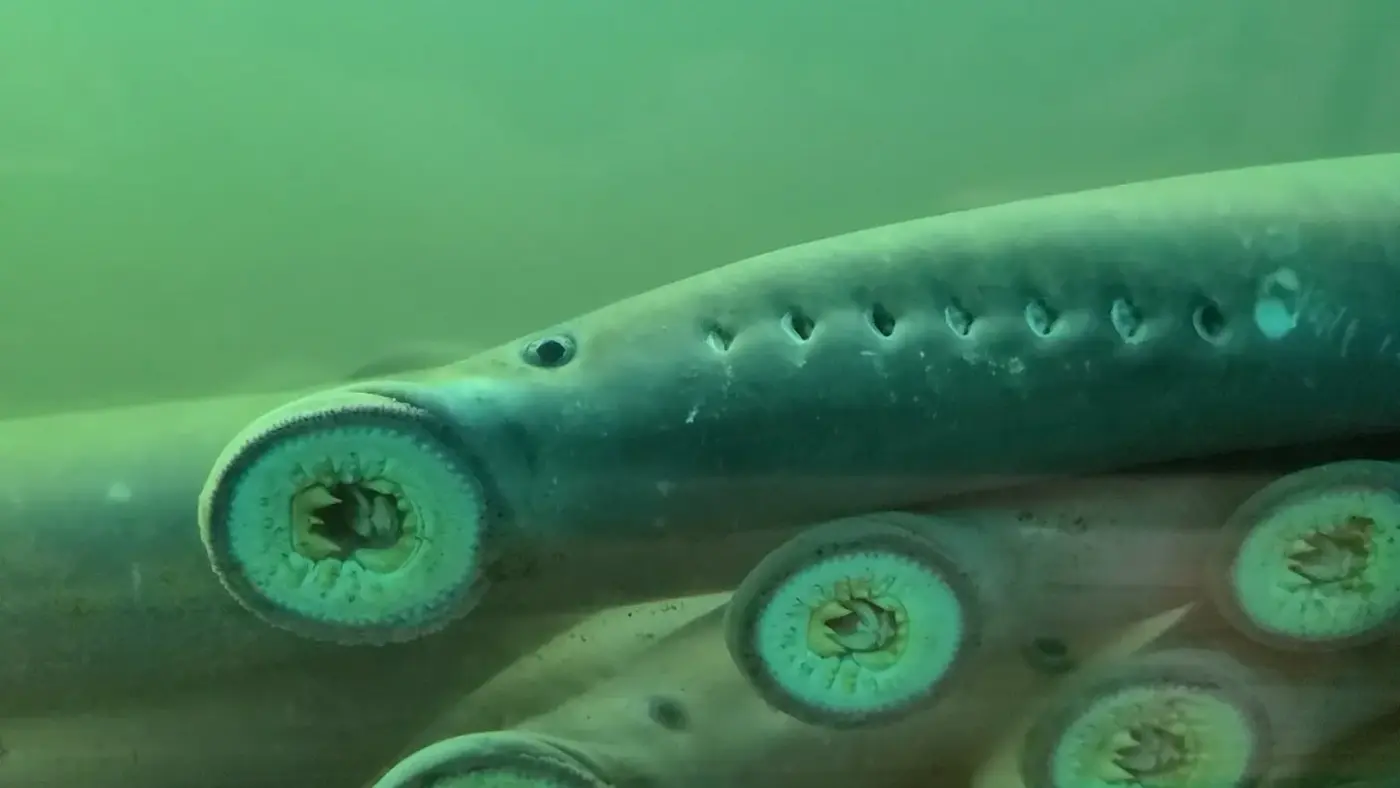
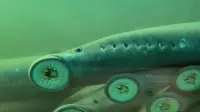
In July the Pacific lamprey hang on the glass. In a post dated July 16, 2026, the Corps described adult lamprey “napping on our windows, using their fascinating vacuum faces to hold on tight in the swift river currents.” As of July 15 of that year they were clumped there, resting before moving upriver. The windows open into the fish ladder at Bonneville Lock and Dam from the lower viewing room of the Bradford Island Visitor Center, where painted supergraphics are still on the walls. By late summer the salmon take over. The Corps reported more than 20,000 salmon through the ladders in a single day at the end of August 2026. It gives September 11 as the average peak day for Chinook.
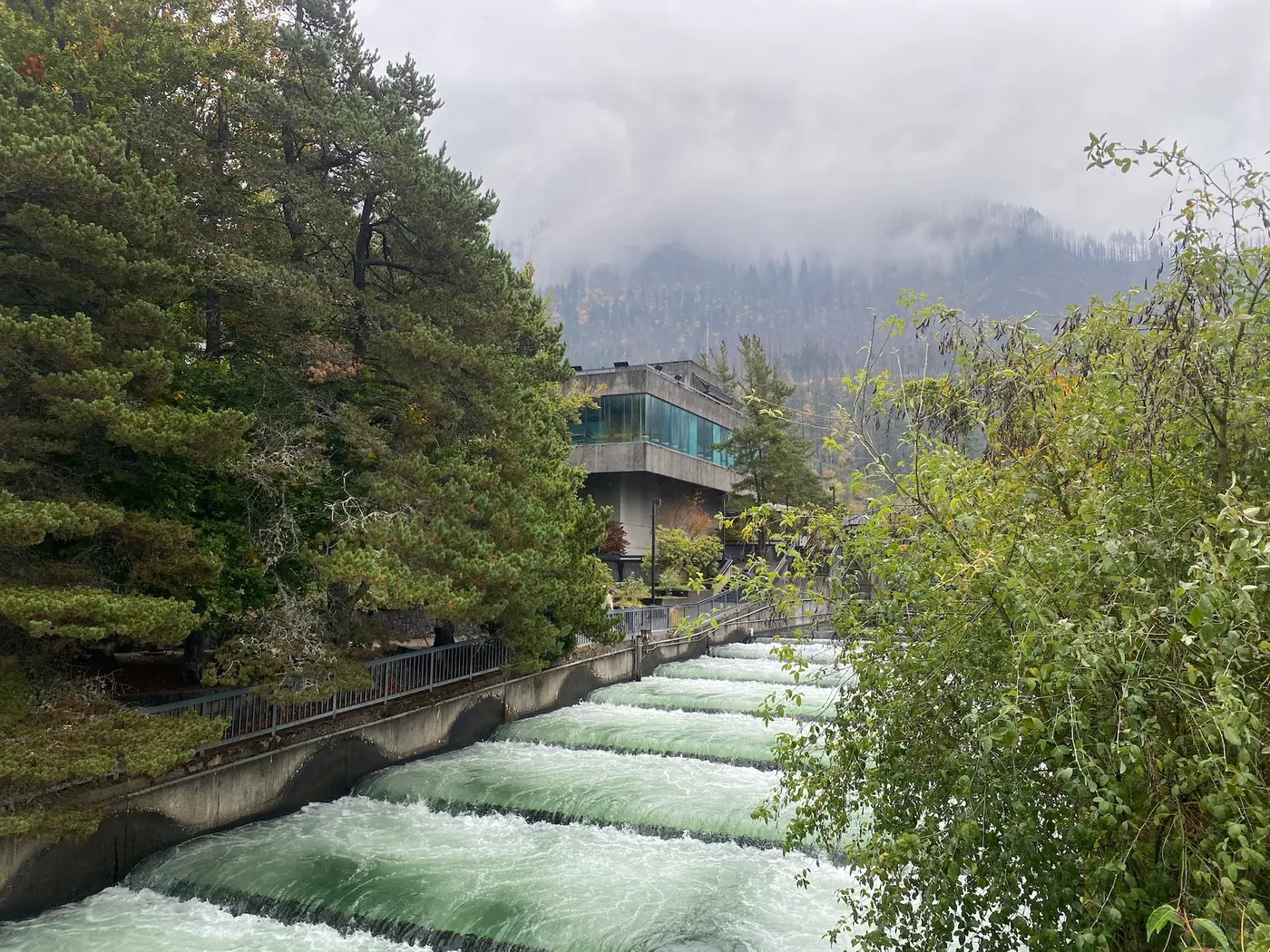
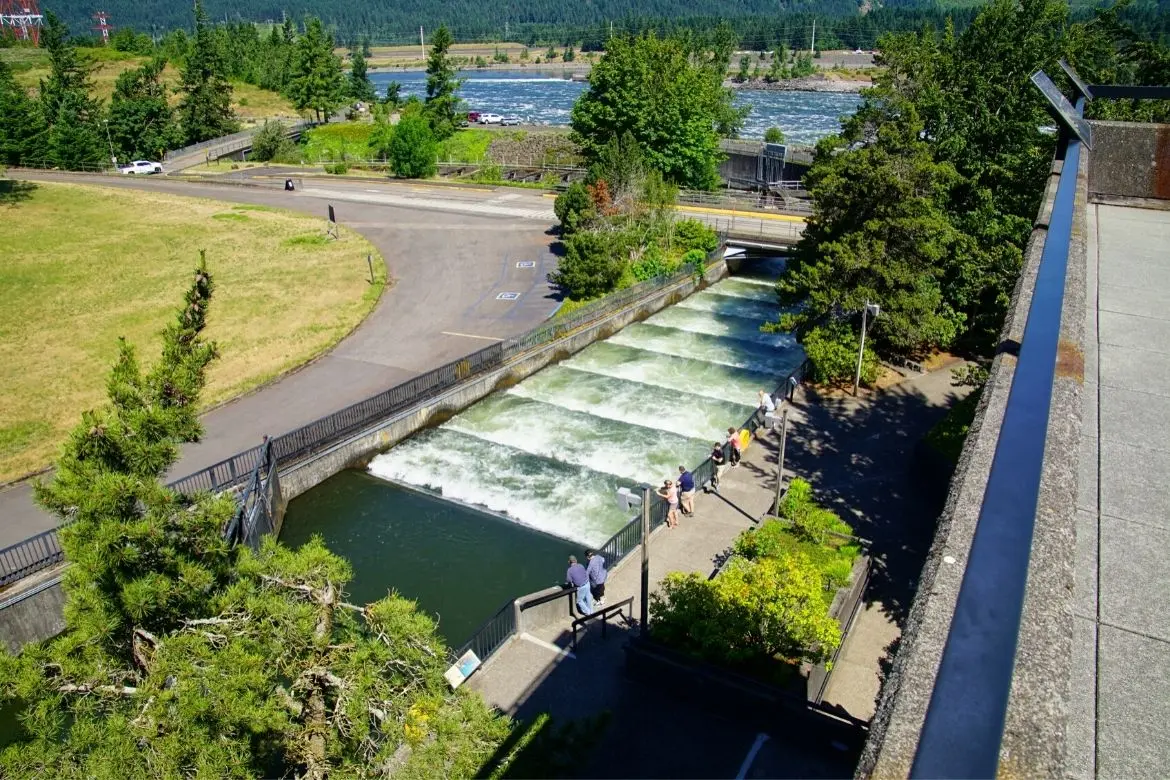
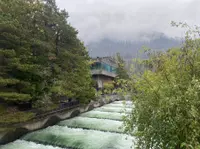
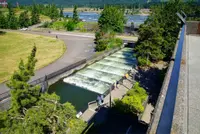
The Gorge Guide keeps a calendar for the windows: shad in June, sockeye in June and July, steelhead in August, Chinook and coho in September. Sturgeon pass as well. Outside, the ladder climbs in steps, a series of weirs with openings along the bottom, each pool a little higher than the last, for a rise of 60 feet past the dam. The same guide says every fish moving through has been counted and recorded since 1938. The counters returned to their posts on April 1, 2026, “armed with nothing but a clicker and an iron will,” as the Corps put it.
Concrete between the powerhouse and the spillway
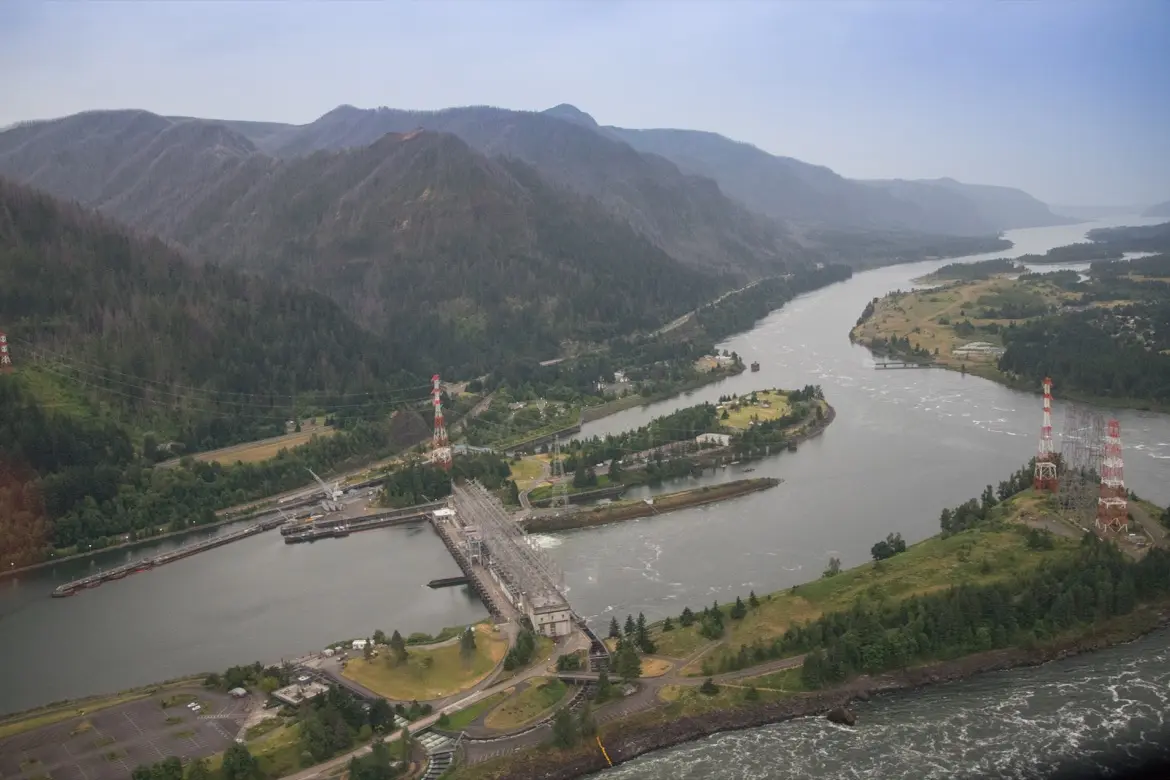
The visitor center stands on the island between Powerhouse One and the spillway. Docomomo Oregon describes it as a subdued but highly functional building by the architect William D. Reid, completed in 1975. Its concrete, the same material used in the fish ladders, is broken by a horizontal band of windows that circles the building and opens it to the gorge. A rooftop deck gives the wider view. Indoor exhibits cover the cultural history of the region, the building of the dam, navigation on the Columbia, and the life cycles of salmon and lamprey. Corps staff and volunteers lead tours into the powerhouse to see the turbines and generators at work. From the outdoor platform visitors watch fish working up the ladder. The National Park Service notes sea lions in the water nearby, feeding on the run.
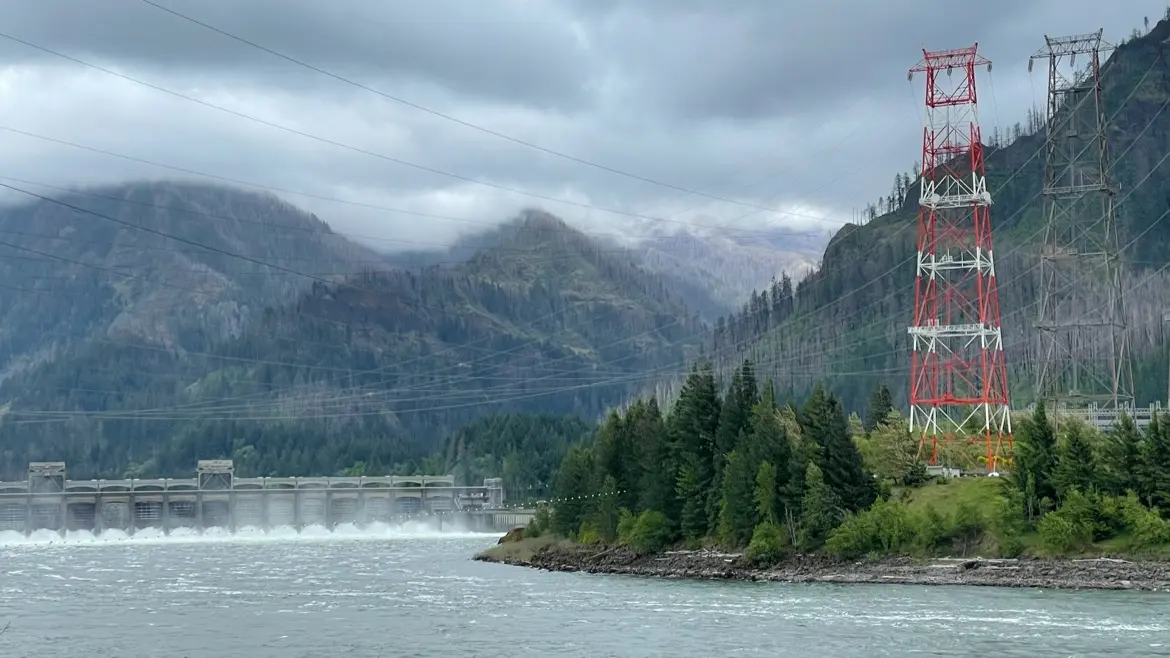
The road in runs through the plant. From I-84 exit 40, four miles west of Cascade Locks, the Corps directs drivers to bear right at the flagpole intersection, stop at the guard station, cross the navigation lock, pass Powerhouse One, and follow signs about a mile to the island. Restrictions across the powerhouse mean there is no bicycle or pedestrian access. The Corps warns that parts of the visitor areas may close with little or no warning. In 2026, work on the first powerhouse that affected the roadway closed Bradford Island on a run of days from April through late September. On those days the Corps sent people to Tanner Creek, below the dam, to see salmon gathering there, with a warning: “Be prepared to hold your nose! It gets fishy as salmon die after spawning and start to decompose.”
Rangers, osprey, and a live lamprey tank
The Corps’ park rangers staff the front desk and give the tours. They also patrol sensitive cultural areas, rescue injured or trapped wildlife, and run safety boats for dam crews. The Corps calls them its “Bonneville Power Rangers.” One of them, Pat Barry, retired after 27 years as a visitor center ranger and wrote Bonneville Lock and Dam: A Gift from the People of the Great Depression.
Each spring the rangers hold a Speaker Series. On Saturday, April 25, 2026, the talks ran on the hour:
- Osprey at 10 and 2
- The fur trade at 11 and 3
- A pollinator walk through the center’s flower beds at noon
- Parasites at 1, billed “are they coming for you?”
On June 24, 2026, the Corps and the Columbia River Inter-Tribal Fish Commission held Lampreypalooza, which opened at 10 a.m. at the center. Jeremy Five Crow of the commission spoke at 11. Grace Adams and Laurie Porter presented the Pacific Lamprey Conservation Initiative at noon. Yakama Nation Fisheries, the Confederated Tribes of the Umatilla Indian Reservation, and the U.S. Fish and Wildlife Service set out tagging gear, eDNA displays, and a live lamprey tank. “Lampreypalooza is a unique opportunity for the public to connect with a species that has been vital to this region’s ecosystem and Tribal cultures for thousands of years,” said Jacob Macdonald, who created the event and is a Corps technical lead for hydrologic and river engineering.
Below the ladders, the Bradford Island Recreation Area looks onto the spillway, with osprey in summer and bald eagles in winter. People fish the island bank for sturgeon, salmon, steelhead, and shad, on a shore the Corps says is mostly steep. On the mainland, at the Bonneville Fish Hatchery, visitors feed rainbow trout and look at white sturgeon more than six feet long. The Corps names one of them, Herman, at 11 feet.
Brant Island
Before the dam, the island stood in the middle of the Columbia. A U.S. Geological Survey page, drawing on the Center for Columbia River History, calls it an old Indian burial ground. Lewis and Clark named it Brant Island for the large flocks of Lesser Canadian Geese they saw nearby.
Accounts of the expedition’s stop on the return journey differ. The National Park Service says the party camped on the island on April 9, 1806. The USGS places that night’s camp on the Oregon shore, upstream of Tanner Creek and across from the island’s lower tip. It quotes the journal for the next morning, April 10: “Early in the morning we dropped down the channel to the lower end of Brant island, and then drew our boats up the rapid.” Its notes say the party stopped on the island to dine. The present name honors the Bradford brothers, who ran steamboats on the river.
The dam takes its name from Benjamin Bonneville, and the sources describe him differently. The Park Service calls him a French officer, 1796 to 1878, who pioneered parts of the Oregon Trail. The Oregon Encyclopedia calls him an early nineteenth-century army explorer and booster of the Oregon Country. The Corps credits him with charting extensive sections of what became the Oregon Trail.
A Depression dam on Bradford bedrock
In 1932, campaigning for president, Franklin D. Roosevelt spoke of the “vast possibilities of power development on the Columbia River.” He promised that “the next hydroelectric development to be undertaken by the Federal Government must be on the Columbia River.” The Oregon Encyclopedia credits the lobbying of Senator Charles McNary and Representative Charles Martin with winning his authorization. Engineers passed over a site at Warrendale for the north end of Bradford Island, where bedrock gave a solid foundation.
The original 1931 plans already included fishways. Passage on that scale had never been attempted, so the Corps brought in fisheries experts. They devised lifts, ladders, and a collection and bypass system that worked when the dam closed.
Work ran from 1933 to 1938 as a Public Works Administration project of the New Deal. At the peak, a workforce averaging about 3,000, most drawn from the Oregon and Washington relief rolls, built timber-crib coffer dams that used eight million board feet of lumber. It was then the largest coffer-dam job attempted on an American river. The Oregon Encyclopedia gives the cost as $83 million; the USGS page gives $88.4 million. When installed, the lock’s 60-foot lift was the highest single lift in the world.
Congress created the Bonneville Power Administration in 1937 to sell the dam’s power. In 1941 the agency hired Woody Guthrie to write songs about it. The Corps dates completion of the first powerhouse, spillway, and lock to 1938, while the Park Service gives 1943. The original ten generators came on between 1938 and 1944. The federal government also promised in-lieu fishing sites to Native people who lost theirs to the pool behind the dam. Of fifty promised, three were completed at first.
The present visitor center came in 1975. A second powerhouse followed, in 1981 by the Oregon Encyclopedia’s account and 1982 by the Corps’, along with a channel cut through Bradford Island. The project went on the National Register in 1986, and portions became a National Historic Landmark in 1987. The new lock of 1993 is 675 feet long and 86 feet wide. By the Corps’ count, filling it takes the water of 42 Olympic swimming pools.
What lies under the island
The island also served the dam as a dump. One account has the Corps dumping electrical equipment there from construction in the 1930s into the 1980s. The Corps’ own record dates a landfill near the eastern end from the 1940s until the early 1980s, alongside chemical and equipment storage.
Investigations began in 1997. In December 2000, electrical equipment was found submerged off the north shore, and about 32 tons of waste came out of the river in 2002. Dredging in 2007 removed 65 tons of sediment. The contaminants include PCBs.
The EPA named Bradford Island a Superfund site in March 2022. The Yakama Nation announced it planned to sue the Corps for not meeting cleanup requirements. It later signed an agreement with the Corps and the EPA giving the tribes government-level access to cleanup documents. A standing advisory tells anglers not to eat any resident fish caught between the dam and one mile upstream.
Notable Events
- 1806The Lewis and Clark Expedition camped on Bradford Island on its return journey, according to NPS. nps.gov
- 1806The returning corps stopped on the island to dine before heading to the southern mainland to camp before portaging the Grand Rapids. volcanoes.usgs.gov
- 1930sThe Army Corps used Bradford Island as a dumping site for electrical equipment during Bonneville Dam construction. opb.org
- 1931The original Bonneville plans included fishways and cost estimates. oregonencyclopedia.org
- 1932During his presidential campaign Roosevelt called attention to the vast possibilities of power development on the Columbia River. oregonencyclopedia.org
- 1933At peak construction the workforce averaged about 3,000, mostly from Oregon and Washington relief rolls; the original project cost $83 million. oregonencyclopedia.org
- 1933The source gives $88.4 million for construction of the spillway on one side of Bradford Island and the powerhouse and locks on the other. volcanoes.usgs.gov
- 1937The dam was dedicated as the first of the federal dams on the Columbia Basin. columbian.com
- 1937The marker detail identifies installation of a turbine for unit 1. hmdb.org
- 1937Congress created the Bonneville Power Administration to market the dam's power. oregonencyclopedia.org
- 1938The original powerhouse's 10 generators were placed in operation and had a generating capacity of 526,700 kw. oregonencyclopedia.org
- 1940The marker's photo inscription identifies assembly of a turbine for unit 4. hmdb.org
- 1941The displayed turbine's in-service date was 9 January 1941. hmdb.org
- 1941BPA hired Woody Guthrie to compose songs informing the public about Bonneville and other Columbia River hydroelectric facilities. oregonencyclopedia.org
- 1943The source says Bonneville Dam was completed and was the first dam built on the Columbia River. nps.gov
- 1975The present visitor center was completed decades after the dam complex, with a horizontal band of windows for broad gorge views. docomomo-oregon.org
- 1980sDumping continued into the 1980s and resulted in highly toxic chemicals including PCBs contaminating the island and surrounding waters. opb.org
- 1980sThe source attributes addition of the second powerhouse and a channel dug through Bradford Island to the Bonneville Power Administration. volcanoes.usgs.gov
- 1981The Corps added a second powerhouse with eight generators producing 558,200 kw. oregonencyclopedia.org
- 1986The Bonneville Lock and Dam project was placed on the National Register of Historic Places and later elevated to National Historic Landmark status. oregonencyclopedia.org
- 1987Oregon's state list identifies the Bonneville Dam Historic District in Multnomah County and Skamania County, Washington, as a National Historic Landmark. sos.oregon.gov
- 1993To accommodate increased barge traffic, the Corps built a larger navigation lock with a chamber 675 feet long and 86 feet wide. oregonencyclopedia.org
- 1999A marker detail identifies installation of a new minimum gap turbine. hmdb.org
- 2000The displayed turbine was taken out of service for replacement on 24 July 2000. hmdb.org
- 2022EPA named Bradford Island a Superfund site, giving it top priority for cleanup. opb.org
- Yakama Nation said it planned to sue the Army Corps for not meeting Superfund cleanup requirements. opb.org
People
- Pat Barry, Retired Bonneville Visitor Center park ranger and author of Bonneville Lock and Dam: A Gift from the People of the Great Depression (27 years).
- William D. Reid, Architect of the Bradford Island Visitor Center (1975).
- Bob White, Chief Engineer associated with the quarter boat housing Navy surveyors at the Bonneville Dam site.
- Benjamin Louis Eulalie de Bonneville, Namesake of Bonneville Dam; French officer who pioneered parts of the Oregon Trail (1796-1878).
- Mednick, Commented on the time needed to finalize the federal facilities agreement for cleanup.
- Rich Francis, EPA Superfund project manager for the site, explaining EPA's oversight of Army Corps compliance.
- Rose Longoria, Yakama Nation's regional Superfund project manager involved in seeking Bradford Island cleanup.
- Charles Martin, Representative whose lobbying helped win Roosevelt's authorization for Bonneville Dam.
- Charles McNary, Oregon Senator whose lobbying helped win Roosevelt's authorization for Bonneville Dam.
- Franklin D. Roosevelt, Presidential candidate who promoted Columbia River power development (1932).
- Woody Guthrie, Folk singer hired by BPA to compose songs about the benefits of Bonneville and other Columbia River hydroelectric facilities (1941).
- Clark, Expedition member associated with the island's Brant Island name and the mainland camp opposite it (April 9, 1806).
- Lewis, Expedition member associated with the island's Brant Island name and the mainland camp opposite it (April 9, 1806).
Sources
- web.archive.org/web/2026/https://www.nwp.usace.army.mil/Media/News-Releases/Article/4508175/summer-recreational-lock-schedule-now-in-effect-on-columbia-river
- web.archive.org/web/20250120152740/https://www.nwp.usace.army.mil/Missions/Recreation/Columbia-River
- web.archive.org/web/20250818064901/https://www.nwp.usace.army.mil/Locations/Columbia-River/Bonneville
- facebook.com/CorpsBonnevilleDam
- columbiacommunityconnection.com/the-dalles/step-into-the-fascinating-world-of-pacific-lamprey-on-june-24-at-bonneville-dam-for-lampreypalooza
- nps.gov/places/bradford-island-visitor-center-at-bonneville-lock-and-dam.htm
- docomomo-oregon.org/resources/bradford-island-visitor-center
- oregonencyclopedia.org/articles/bonneville_dam
- columbian.com/news/2012/sep/15/bonneville-dam-turns-75
- columbian.com/news/2018/jun/05/stories-of-war-power-fuel-bonneville-book
- hmdb.org/m.asp?m=92685
- hmdb.org/m.asp?m=92686
- volcanoes.usgs.gov/observatories/cvo/Historical/LewisClark/volcanoes_lewis_clark_april_10_1806.shtml
- hoodriverhistorymuseum.org/bonneville-dam-site
- opb.org/article/2023/10/12/yakama-nation-given-more-say-over-bradford-island-cleanup-superfund
- sos.oregon.gov/blue-book/explore/pages/almanac-m-n.aspx
- npgallery.nps.gov/NRHP/GetAsset/NHLS/86000727_text
- nps.gov/subjects/nationalhistoriclandmarks/list-of-nhls-by-state.htm