Bonner County Fair
Sandpoint, Bonner County, Idaho. Fairground; August.
Details

- Where
- 4203 N Boyer Rd, Sandpoint, ID 83864. Directions
- When
- Last held August 18–22, 2026; next year’s date not yet stated.
- Getting there
- from Boyer Rd, take the paved road by playground and follow around to the backside of main exhibit building and look for the Fair Office sign on the door.
- Fees
- FREE FAIR ADMISSION.
- Hours
- Fairgrounds 9am - 10pm; Animal Barns 9am - 9pm; Exhibit Halls 10am - 9pm; Fair Office Open Daily 10am - 4pm.
- Access
- Parking Fee: $7. Week-long parking passes only. Fair Parking is available in the front parking lot and on the south lawn.
- Walk-in or reserve
- Bonner County Fair event tickets and Sandpoint Rodeo tickets are sold exclusively via the website.
- Phone
- 208-263-8414
- Website
- bonnercountyfair.com
- Managed by
- Bonner County Fairgrounds.
- Established
- 1927.
The Bonner County Fairgrounds lie on North Boyer Road, just north of downtown Sandpoint at the foot of the Selkirk Mountains. Each August they hold the county fair for five days. The 2026 fair ran from Tuesday, August 18, through Saturday, August 22, under the theme “Independence & Farmers’ Descendants,” chosen to coincide with the nation’s 250th year and to honor Idaho agriculture. Admission was free. Parking in the front lot and on the south lawn was sold only as a $7 pass good for the week. The fair book gives the mission as “to preserve our agricultural heritage and promote the future of the agriculture in our County!”
Barns, halls, and a trout pond
The animal barns open at 9 a.m. The Cattle Barn and the Swine Barn hold what their names say. The Holly Barn holds goats and sheep, and the Rabbit Barn houses poultry as well as rabbits. Judging starts earlier than the barns open. On the opening Tuesday in 2026, the rabbit quality contest began at 8 a.m., market sheep and swine followed at 9, and market goats at 11. Showmanship classes filled the next two mornings. Each species also had a costume contest: swine at 2 p.m. Wednesday, sheep half an hour later, and goats and beef on Thursday. After his competition that Tuesday, Jamen Whitney of the Gold ‘n’ Grouse 4-H Club kept company with his pig, Pigaroni. It was his third year in 4-H and his third raising swine. He had also entered art, wooden crafts and Legos.
At 10 a.m. the Main Exhibit Building opens its two halls, the Main Exhibit Hall and the 4-H Exhibit Hall. The 2026 fair book listed open classes for comforters and quilts, crocheting, handspun yarn and weaving, preserved foods, craft beverages, creative writing, Lego, and fishing and outdoors. A caricature artist works inside during the week. North of the building is the food court, where Pippi the Clown performs. In 2025 the fair manager, Mark Knapp, said the food came from community groups and organizations, with classic fair treats sold alongside handmade goods.
Around the grounds are the Ed Brown Band Stand with its live shows, a hay bale maze, and bouncy houses in the Play Zone. Antique tractors stand in the Tractor Barn from 10 each morning. A newly updated memorial garden honors people whose names are preserved on its original stones. The Lehman Wildlife Education Building is free. It holds more than 120 mounts of area wildlife, birds and fish, interactive identification exhibits, and a fishpond stocked with live trout. Local schools use it for field trips and Hunter Education classes.
Friday morning belongs to the smallest visitors. At 10 a.m. the World’s Smallest Rodeo, run on stick ponies, fills the Warm-Up Arena, and the Little Folks Horse Show follows at 10:30. A tractor driving contest runs an obstacle course there at 3 p.m. On Saturday the Activity Tent holds an ice cream eating contest at 1 p.m. At 3 p.m. comes the Best Mullet, Mustache & Beard Contest, which is open to all ages.
Saturday begins with the 4-H Market Animal Public Auction at 9 a.m. in the Indoor Arena. The Parade of Champions, made up of grand and reserve grand champions, follows at 3:30 p.m., and the 4-H awards come at 4. The 2019 sale raised more than $211,000. On the morning of the 2026 sale the grounds had no electricity. The fairgrounds posted, “Despite the Fairgrounds being out of power as of this posting, we are still open for business!” Less than half an hour later came a second post: “POWER IS BACK ON! Come on out to our Market Animal Sale & Support our 4H kids!”
Evenings in the Mike Flanigan Arena
The 2026 fair book announced the formal dedication of the outdoor arena as the Mike Flanigan Arena. Flanigan moved his family to Sandpoint after an 18-year career as a professional rodeo cowboy. He served many years as president of the Bonner County Rodeo Committee and was, the dedication says, “a fixture at the chutes” at every rodeo. The arena’s grandstand gained 600 bleacher seats by October 1991. Bill Bowman, owner of Connie’s Restaurant, led the funding drive. The North Idaho Draft Horse Association put up $5,000, and every motel owner in Sandpoint added $20 per room.
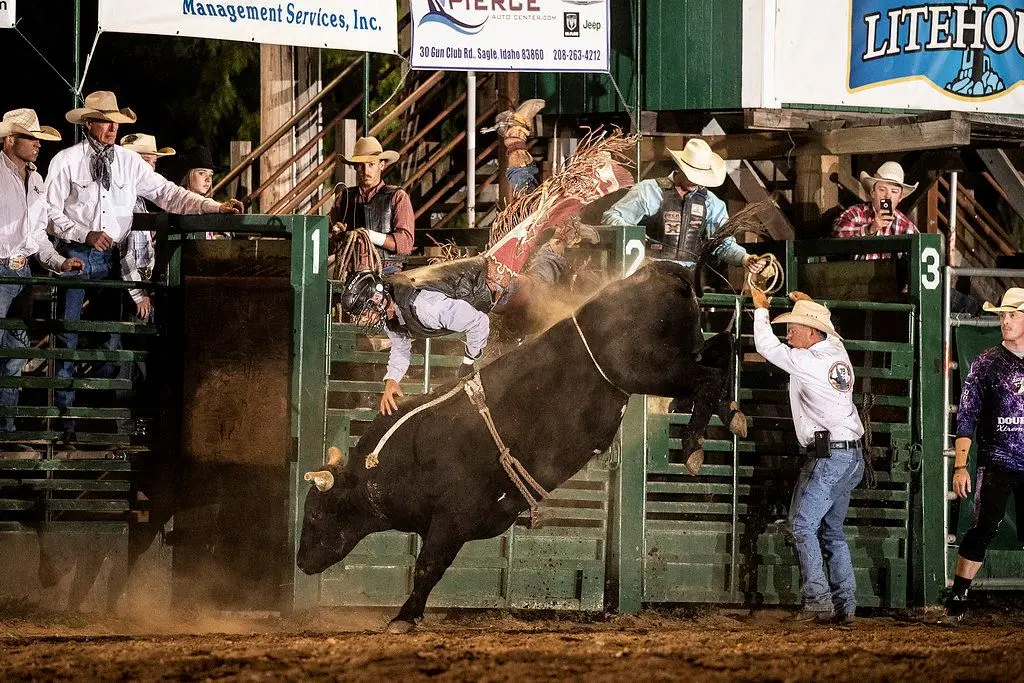
The first three evenings of fair week are free. On Tuesday at 6 p.m., stock dogs herd livestock through the arena. The NWBHA barrel race runs Wednesday at 7, and ranch sorting runs Thursday at 5:30. Friday night costs $26 for general admission. That evening, presented by Wood’s V-X Ranch, brings ranch bronc riding along with junior bull riding and mutton busting. At 7 p.m. that Friday in 2026, the fairgrounds posted: “Broncs, mini bulls and mutton bustin now! Still have tickets at the gate!”
Saturday night closes the week with the Bonner County Brawl demolition derby, presented by CO-OP. The 2025 coverage described area drivers “aiming to be the last to leave the ring.” Tickets for the 2026 derby sold out ahead of time, and the fairgrounds warned they were “Not available at the gate!”
The Sandpoint PRCA Rodeo takes the same arena the weekend before fair week. In 2026 it ran August 7 and 8. Rodeo first joined the fair in 1993, when the newly formed North Idaho Rodeo Association asked the fair board for permission to hold one. That year it staged two performances, on Saturday evening and Sunday afternoon, and both were well attended.
The fair names its honorees each year. In 2026 Levi Irish, president of the rodeo committee, was Volunteer of the Year. The rodeo queen was CayliJo Giard, an incoming University of Idaho freshman who plans to study animal science toward becoming a large animal veterinarian. Melodie Gunn, who keeps a 5,000-square-foot garden, was named vegetables and herbs superintendent. The grand marshals were Steve and Louise Wood, who raise Black Angus cattle on their ranch north of Sandpoint and host carcass shows after the fair for youth interested in the meat industry. The 2025 grand marshals were Randy and Gail Curless of Dover. Gail’s mother, Ruth Allanson Sherwood, showed swine at the first Bonner County Fair in 1927.
A blue ribbon marked 1927
A framed blue ribbon hangs on the wall of the fairgrounds office, with 1927 printed in gold on its worn cloth. Accounts of where that first fair stood do not agree. The fair’s own timeline, a 2023 Bonner County Daily Bee column by a county commissioner, and Sandpoint Magazine in 2000 all place it at the original fairgrounds at War Memorial Park, or War Memorial Field, with 20 communities taking part. The timeline names Walter Thomas as Extension Agent, and the Bee column names Bonner County and the Sandpoint Kiwanis Club as sponsors. Hannah Combs of the Bonner County Historical Society gives a different version. She writes that the fair was held at the Methodist Community Hall, with livestock penned in an empty lot across the street, before it moved to the area now called Lakeview Park. Frank Cochrane, who sat on the board for that first fair, remembered it in the old First Methodist Church, where the First Security Bank later stood. By 2026 that site was a Wells Fargo Bank.
According to the Pend Oreille Review, the fair was a “tremendous success,” with so many entries that visitors could hardly move around them. Premiums totaled nearly $250, and communities competed as well as individuals. Sagle spelled its own name out of apples. Colburn sent filbert nuts, popcorn, buckeyes and rabbit mincemeat. Midas, now Garfield Bay, had the smallest display but won for best spuds. First place went to the Sunnyside-Culver-Oden display, the largest. Much of its strength may have come from Mrs. Ole Peterson of Oden Bay, who alone had more entries than most communities and won for elephant pears, turnips, cantaloupes and nearly every kind of canned good. Animals were accepted that year too. Mrs. E.D. Blood of Dover took the silver cup for a display of chinchilla pelts.
The fair counts its years from 1927, but its roots go back further. At the request of Fairgrounds Director Darcey Smith, the historical society’s research team looked into the fair’s early history and found an older one. In the summer of 1908, Paul Clagstone addressed the Sandpoint Commercial Club. He ran a cattle ranch in the Hoodoo area and was seeking a seat in the state legislature. He offered to bring the county’s farmers together for a fair, saying “the displays could then be taken for exhibition at the Spokane Interstate fair and Bonner County and its resources would thus be doubly advertised.” With the club’s backing and money, the fair opened that fall in the upstairs rooms of what is now Larson’s on First Avenue. Its 250 entries were mostly fruits and vegetables, because the building owners did not want livestock inside. Afterward the exhibits went to Spokane intact.
For the next few years the fair moved between improvised sites. The museum keeps an award slip from 1909 that entitled Ethel Ashley to $1.00 for a watercolor. It also holds a silver-plated trophy from 1912 inscribed “Best Apples.” The fair ended after 1912, for reasons that are unclear but possibly connected to the First World War, and lay fallow for a decade and a half. The society writes that when it was revived in 1927, “it appears the community was so excited that they forgot all about the earlier events.”
From War Memorial Field to North Boyer
The first fair board formed in 1930. That year’s Extension Service annual report called the fair “a free fair, strictly educational, without games of chance, races or other entertainment to detract from the educational exhibits and programs.” No fair was held in 1942, because the war had caused shortages of tires and gas, though the buildings were kept in repair. In 1943 the first exclusively 4-H fair offered Defense Stamps as prizes.
In 1960 the county bought 40 acres and a house on North Boyer from Don Shaffer. In 1963 the Sandpoint City Council declined to extend the lease on the War Memorial Field grounds, and the fair applied for an Accelerated Public Works Grant to build on the new land. The first Fair Queen contest followed in 1964, and Karen Arndt was crowned. Plans for the new grounds went before the public in 1967, to be paid for from a building levy and the fair operation levy, with relocation proposed for 1970. Snow set the work back. In January 1969 the new main exhibit building collapsed under heavy snowfall, causing an estimated $15,000 in damage.
The fair’s timeline gives 1971 as the year of the move and says a Forest Service count put attendance at about 16,000. Sandpoint Magazine gives 1972. On the new site the fair added a main exhibit building, a food service building, indoor and outdoor arenas, three horse barns, a sheep and swine barn, and a poultry and rabbit barn. By the magazine’s account, a fish and wildlife building was added in 1999.
In 2000 the livestock auction was held on Friday night, when, the magazine wrote, hundreds of business representatives tried to outbid one another. Lynnette Rembowski, a former fair manager who had joined 4-H as a girl in 1951, said, “It’s basically a 4-H fair. A lot of parents spend their vacation time there to be with their kids.” She also said, “A lot of folks still come to the fair, even if they don’t have something to show. That’s because it gives them a chance to see all of their buddies.” Her successor, Sharon Bryant, had come from the fair in Winnemucca, Nevada, where a carnival was added to keep the event going. She said that every year the question of a carnival came up, “but the Bonner County Fair Board wants to keep the old-fashioned setting of the fair.”
The fairgrounds added the first of five proposed phases of an RV park in 2009. In 2026 the grounds received a new water truck after keeping the same one for several decades. The 2027 fair is billed as the centennial, a hundred years counted from 1927.
The Bicentennial program of 1976
On a Thursday during the 1976 fair, old-timers gathered for a Bicentennial program to recall the first fairs. Margaret Hunter handed fair board member Mrs. Vernon Ruen a fair book from the first local fair she had attended. It had been held in 1915 upstairs over the post office in Sagle. “It was not a county meeting, but a neighborhood meeting,” Hunter said. “We had a vegetable show and sewing, but no livestock.” One of its awards, she said, went to the best baby.
Frank Cochrane had served on the board continuously since the first county fair, and he received a silver plate. “Tables were set up to display a few farm products,” he recalled of that first fair. At the second fair, he said, three head of Guernsey cattle were shown. Queen Cindy Finney and King Chuck McGuire were introduced as the 1976 royalty. Mrs. Ralph Chicks was honored for 47 straight years as an exhibitor. “I hope you get bit by the fair bug,” she told the crowd. “It’s a disease from which there is no known cure. I got bit in 1929 and I’ve been coming back ever since.”
Notable Events
- 1912The fair ended after 1912 for unclear reasons, possibly connected to WWI, and the fair lay fallow for the next decade and a half. bonnercountyhistory.org
- 1927In 1927 the fair was held at the Methodist Community Hall and livestock entries were penned in an empty lot across the street. When it was revived in 1927, it appears the community was so excited that they forgot all about the earlier events. bonnercountyhistory.org
- 1930The first fair board was formed in 1930. bonnercountydailybee.com
- 1942No fair was held in 1942 due to the war causing a shortage of tires and gas. The buildings were kept in good repair. bonnercountyfair.com
- 1943The first exclusively 4-H fair was held in 1943. The fair also served a patriotic purpose by offering Defense Stamps as prizes. bonnercountyfair.com
- 1960In 1960 the county purchased 40 acres of land and a house from Don Shaffer on North Boyer. This was to become the new fairgrounds. bonnercountyfair.com
- 1963The fair sought a grant for the new grounds after the city declined to extend the War Memorial Field lease. bonnercountydailybee.com
- 1964The first Bonner County Fair Queen contest was held. The very first Queen of the Bonner County Fair was Karen Arndt. bonnercountyfair.com
- 1967In 1967, plans for the new fairgrounds were presented to the public; the cost of construction was to be paid for from a building levy fund and the fair operation levy with a proposed relocation date in 1970. bonnercountydailybee.com
- 1969January 1969 saw a lot of snow and the main exhibit building collapsed causing an estimated $15,000 in damages. bonnercountyfair.com
- 19711971 was the year. The fair moved to the new grounds. According to a count by the Forest Service about 16,000 peopple attended the first fair on the new grounds. bonnercountyfair.com
- 1972After its move to its present location on North Boyer in 1972, the fair grew to include a main exhibit building, a food service building, an indoor and outdoor arena, three horse barns, a sheep and swine barn, a poultry and rabbit barn and a fish and wildlife building. sandpointonline.com
- 1976Frank Cochrane, on the fair board continuously since the first county fair, was presented with a silver plate. bonnercountydailybee.com
- 1993Newly formed North Idaho Rodeo Assiciation approached the Fair board for permission to hold a rodeo in conjunction with the fair. bonnercountyfair.com
- 2009In 2009, the first, of five proposed phases of an RV park was added to the fairgrounds as an amenity and a way to generate revenue to support fairgrounds maintenance and operations. bonnercountydailybee.com
- 2022An Idaho Department of Parks and Recreation grant supported RV campground expansion. bonnercountydailybee.com
- 2023The boards signed a memorandum clarifying their relationship. bonnercountydailybee.com
People
- Sharon Bryant, Fairgrounds manager seeking a meeting about budgetary and management problems (March 28, 2001).
- Calvin Nees, Met Smokey Bear at the fair (2024).
- Charley Martin, Met Smokey Bear at the fair (2024).
- Devon Wade, Country concert special guest.
- Erica Curless, Daughter of the longtime leaders who showed in 4-H.
- Gail Curless, Grand marshal and volunteer of the year, with Randy.
- Layton Scheu, Gold 'n' Grouse 4-H Club member caring for his pig at the fair (2024).
- Mark Knapp, Bonner County Fair manager.
- Rachel Marienau, Livestock superintendent of the year; poultry barn superintendent (2025).
- Randy Curless, Grand marshal and volunteer of the year, with Gail.
- Ruth Allanson Sherwood, Showed swine at the first Bonner County Fair; Gail Curless' mother (1927).
- Sylvia Nees, Met Smokey Bear at the fair (2024).
- Twilla Miller, Static exhibit superintendent of the year (2025).
- Wynn Williams, Country concert performer.
- Yesenia Pilgrim, Sandpoint Rodeo Queen (2025).
- CayliJo Giard, Sandpoint Rodeo Queen (2026).
- Jamen Whitney, Gold 'n' Grouse member participating in swine and other 4-H projects.
- Levi Irish, Rodeo committee president and fair Volunteer of the Year (2026).
- Louise Wood, Bonner County Fair grand marshal.
- Melodie Gunn, Vegetables and herbs superintendent of the year (2026).
- Steve Wood, Bonner County Fair grand marshal.
- Chuck McGuire, Fair king (1976).
- Cindy Finney, Fair queen (1976).
- Frank Cochrane, Fair board member honored for 50 years of service (1976).
- Margaret Hunter, Presented a neighborhood-fair book to a board member at the county fair's Bicentennial program.
- Mrs. Ralph Chicks, Exhibitor honored for continuous participation (47 years).
- Mrs. Vernon Ruen, Fair board member receiving Hunter's early fair book.
- Lynnette Rembowski, fair manager as well as manager of the grounds; 35th year of working in the fair office in 1990 (1990).
- Sam Roos, caretaker of the new grounds (1969).
- Walter Thomas, Extension Agent at the first fair (1927).
- Darcey Smith, Fairgrounds Director who requested research into early fair history.
- Ethel Ashley, Watercolor exhibitor awarded a prize (1909).
- Mrs. E.D. Blood, Dover exhibitor who won a silver cup for chinchilla pelts.
- Mrs. Ole Peterson, Oden Bay exhibitor whose entries may have helped the winning community display.
- Paul Clagstone, enterprising young politician who appealed to the Commercial Club that he could bring together all of the farmers for a county fair (1908).
Sources
- cdn.saffire.com/files.ashx?t=fg&rid=BonnerCoFair&f=BonnerCounty_FairBook26_Web_Part1.pdf&cb=2782da9b
- gosandpointmagazine.com/post/2026-bonner-county-fair
- bonnercountyfair.com
- bonnercountyfair.com/timeline.aspx
- bonnercountyhistory.org/history-at-home/the-unexpected-roots-bonner-county-fair
- bonnercountydailybee.com/news/2023/jun/22/history-outlines-origins-bonner-county-fairgrounds
- sandpointonline.com/sandpointmag/sms00/countyfair.htm