
Bok Kai Festival and Parade
Marysville, Yuba County, California. Annual parade and festival.
Details

- Where
- 1st and D Street, Marysville, CA 95901. Directions
- When
- Last held March 21–22, 2026; next year’s date not yet stated.
- Getting there
- Older parade route: starts at D and 6th Streets, toward the temple at 1st and C, then Chinatown and grandstand at 2nd and C.
- Hours
- Saturday March 21 parade at 11 am; Sunday March 22 Bomb Day firing at 4 pm.
- Access
- During the festival the 19th-century Bok Kai Temple at 1st and D streets is open.
- Walk-in or reserve
- Appointment needed for ordinary temple access.
- Phone
- (530) 329-2254
- Website
- bokkaitemple.com
- Managed by
- Marysville Chinese Community.
- Established
- 1880.
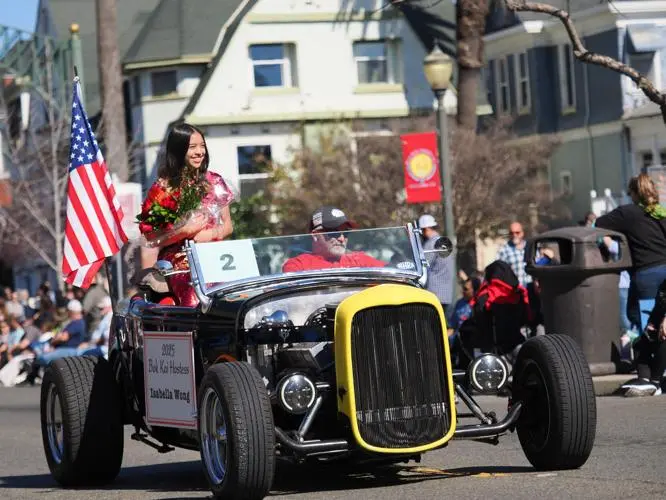
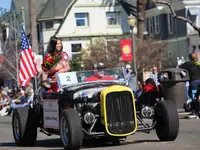
At eleven o’clock on parade Saturday, at the corner of Sixth and D streets in Marysville, Al Wong strikes a gong. “Al has been doing it for quite a while now,” Jon Lim, president of the Marysville Chinese Community, said before the 146th Bok Kai Parade on March 21, 2026. “When you hear the gong, that will be the official start of the parade.” Floats, school groups, lion dancers and businesses then move down D Street toward the Yuba River levee, reach First and C near the Bok Kai Temple, and turn up C Street into the old Chinatown. Earlier editions placed a grandstand at Second and C. For 2026 Lim expected five to ten thousand people. The parade committee says visitors have come from San Francisco, Seattle, Oregon and Hong Kong.
The weekend honors Bok Eye, the water god at the center of the temple’s altar. Legend has it that the celebrations protect Marysville from flooding and bring good rain for crops. His birthday falls on the second day of the second month of the lunar calendar. The parade committee holds the parade on the weekend closest to that date; Lim, in 2023, described it as the weekend after.
Firecrackers and a dragon on C Street
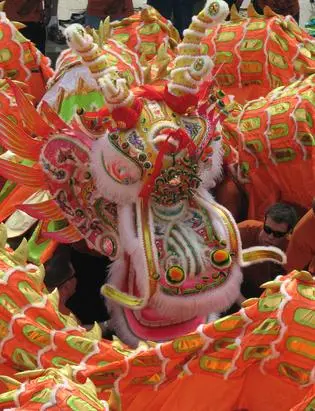
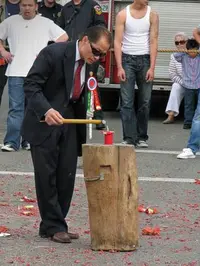
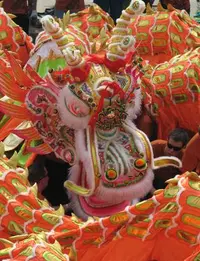
Firecrackers are usually shot off at intersections along the route to keep evil spirits from entering the parade. At Second and C a string of 100,000 firecrackers is fired while the large dragon that closes the procession performs its dance. The parade committee describes that dragon as 175 feet long, golden, and named Hong Wan Lung. Lim said in 2023 that the parade was on its fifth dragon, assembled in Hong Kong. Organizers have advised ear protection for children because of the firecrackers.
Each year’s parade takes the animal of the lunar year. For the Year of the Horse in 2026, children at the Marysville Chinese Community’s story, tour and mask workshop watched a puppet show of the folk tale “Good Luck Bad Luck.” They made horse masks, toured the old Chinese School and the temple, and tossed lucky charms into the Bok Kai horse for a lucky necklace. Every mask maker was invited to ride the Royal Horse Float in the parade. The Yuba County Office of Education won Best of Parade with a fire horse float that, in the community’s words, “moved, it stood tall, and it brought the crowd to life.” Hallwood 4-H won Best Parade Theme. The 2026 ambassador was Taegen Jung, a 17-year-old senior at Marysville High School whose sister, Meah, had been Bok Kai Hostess in 2022. The grand marshal was Despina “Peppie” Schrader, who had led the parade and festival committee for twelve years.
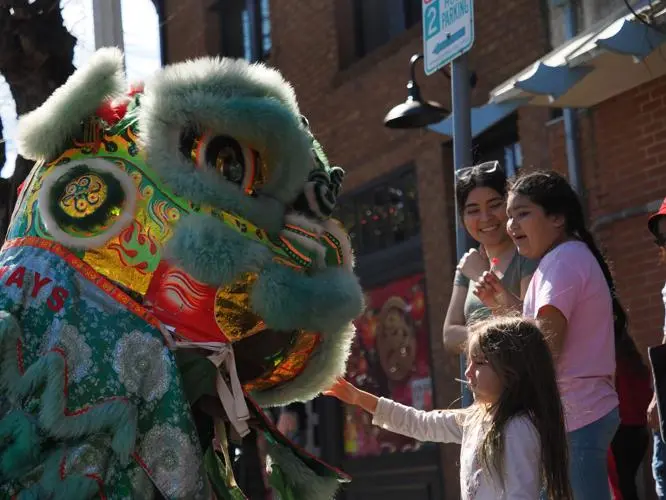
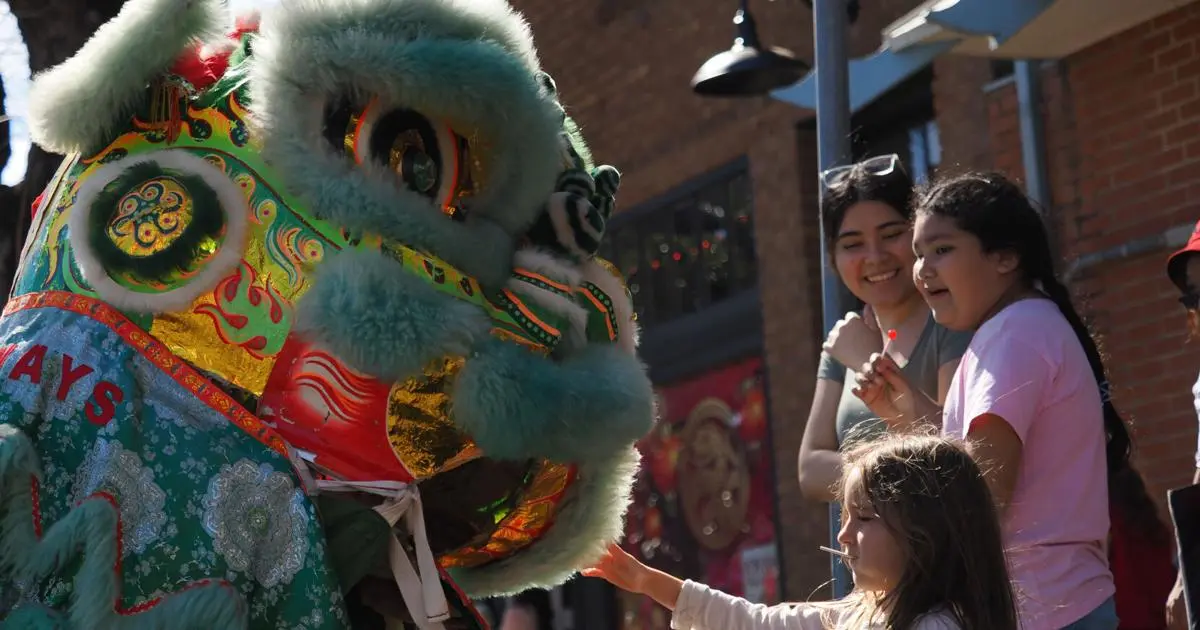
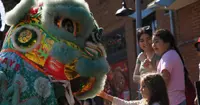
After the parade, lion dancers go door to door through downtown blessing businesses. Before the 2026 weekend, the Marysville Chinese Community explained the custom of giving to a performing lion: “don’t worry if you do not have an envelope, I am sure that if a Lion sees you with money they will come to investigate.” Vendors set up between B and D streets, and the temple stands open. A free concert ran at The Woodbutcher, C and Fourth streets, from Joe Moye at 2 p.m. to The Swankmasters at 10. A music talent show hosted by the Institute of Rock filled the First and C Street stage until 8.
Rings fired at First and C
Sunday is Bomb Day, in Chinese Yee Yeut Yee. Festivities begin mid-morning on C Street between First and Third, in the historic Chinatown. A rib cook-off starts at 9 a.m., with judging and sales at noon, and the day also brings a car show and cultural performances and demonstrations. The cook-off was added in 2023. “What’s better than old cars and the smell of BBQ ribs?” Lim said that year.
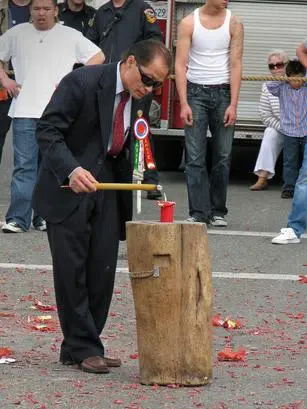
At 4 p.m., at First and C, the bombs are fired. The 2026 schedule listed the event both as the firing of the bombs and as the “Firing of the Rings.” Each bomb contains a “good fortune” ring, and people, usually young Chinese men, catch the rings out of the air. “Each ring has an attached number,” Lim explained in 2023. “Once the rings were collected, they would take the rings to the temple to claim their assigned prize based on the number, or they could also sell them to someone else who wanted a specific number. Number four is supposed to be the luckiest.”
A state survey of Chinese American historic sites, Five Views, describes the holiday as two days that begin quietly with religious observances and end with the bombs. It states that in the nineteenth century Bomb Day was celebrated at temples from Grass Valley to Yreka, and that Marysville’s temple is the only one in the United States that still celebrates it. “It’s been going on well over 150 years,” Lim said in 2026. “You can only see it in the United States in Marysville, otherwise you have to go to China to see it.”
Organizers and attendees say it rarely rains on the parade. The parade committee goes further: Bok Eye oversees waterways, irrigation and rain, “this could be why it has never rained during the Bok Kai parade.” Lim gives a closer count: “It may rain after, and it may rain before, but I believe there’s only been two times where it actually rains on the parade.”
The temple on the levee
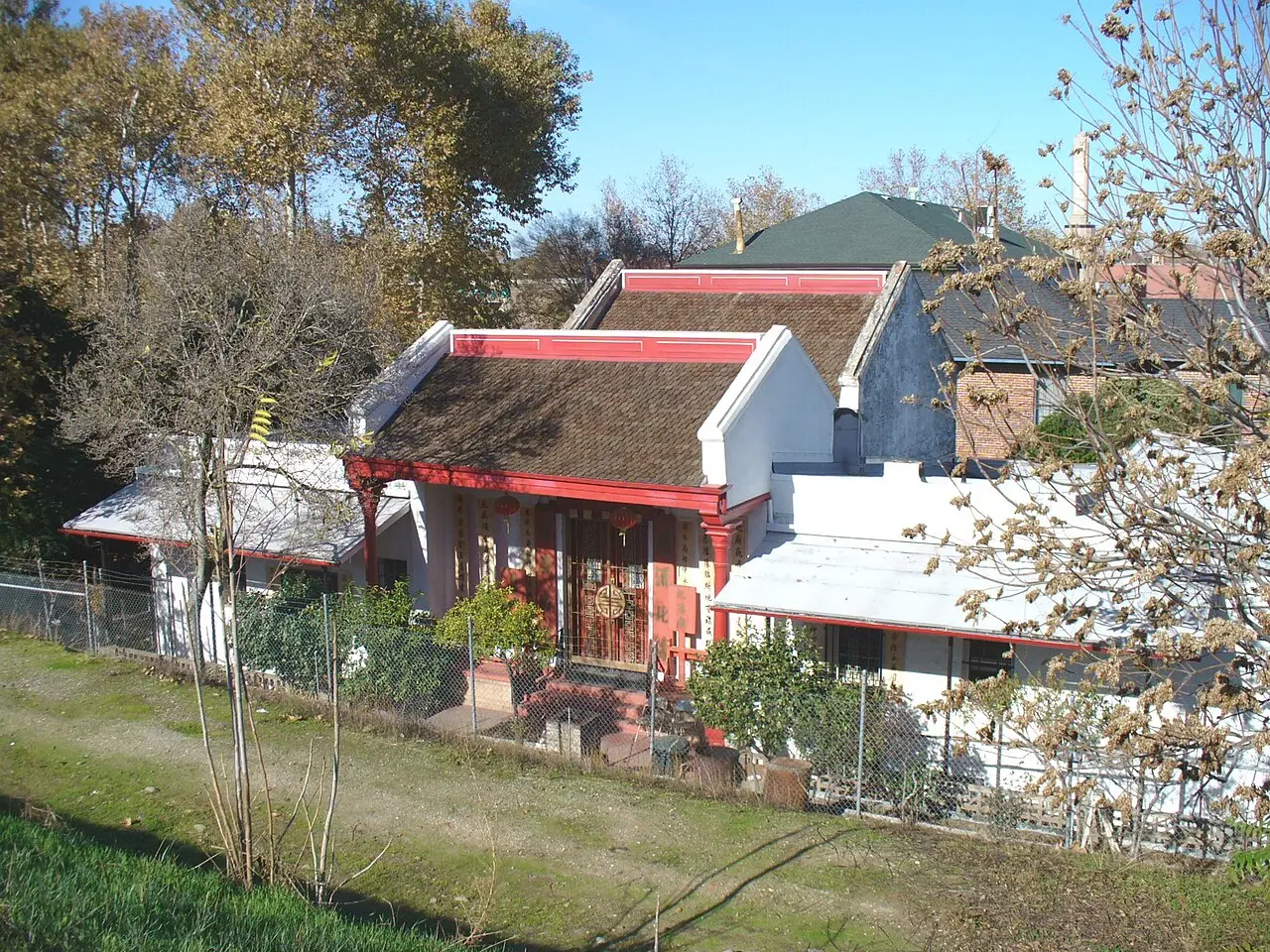
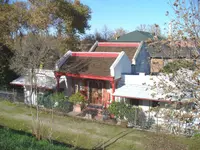
The Bok Kai Temple stands at the southwest corner of First and D streets, on the north bank of the Yuba River. It is a brick building, plastered white, with a mission tile roof, and it faces south. It sits so close to the levee that the main approach is down a flight of steps from the levee top, and the levee is nearly as tall as the temple. The parade committee says the main altar was built facing the river so that Bok Eye could ward off evil and protect the town from flooding.
The central door is painted red. Two turned wooden columns, also red, hold up the porch roof above a traditional Chinese wooden railing. Carved inscriptions, gold on red, flank the door. Across the upper wall of the front entrance runs a painted mural of Chinese scenes. Leslie H. Rainier, a painting conservator from the Getty Conservation Institute, examined it and found “the quality and execution of the scenes equal to the few Taoist paintings in American museum collections.” Two foo dogs sit at the gate. Lim has said it is rumored that Beale Air Force Base, which his grandparents cultivated as a friend of the festival, helped “smuggle” them from Taiwan.
One of the temple’s standards reads “Palace of Several Saints.” Seven deities are housed inside. Five stand on the main altar, with Bok Eye at the center. The 1975 National Register nomination places Quan Ying, the goddess of mercy, and Quan Gung on his right, and Yuk Fung and Sing Moo on his left. Sing Moo watches over seafarers, and her place on the altar is believed to give thanks for the thousands of Chinese who crossed the Pacific safely. Tablets name Gum Far, the Gold Flower Lady, a midwife whom expectant mothers seek out, and Tai Sui, who governs time, construction and destruction. On a long table before the altar are a brass tablet, incense burners, divination sticks and oracle books. The west wing is a council room and the east a storeroom. A wood-frame kitchen and dwelling room on the northeast corner still holds its brick and clay oven.
The temple is ordinarily open by appointment, and the festival is generally the best chance to see it without one. Graduate students from San José State’s anthropology department helped identify 500 artifacts for a museum within the temple, a project funded by a 2016 Kickstarter campaign. Pixar has credited the temple as its primary inspiration for a temple in the 2022 film “Turning Red.” Two blocks away, at 226 First Street, the Chinese School Museum occupies the school that opened in 1940 and ran into the mid-1970s. The Marysville Chinese Community says it holds the body of the first parade dragon, Moo Lung, and of the second, Kim Lung. Lim, in 2023, placed Moo Lung in a glass case inside the temple.
A bathhouse lot and a dedication in 1880
Chinese came to Marysville during the Gold Rush. As railroad building and mining slowed, more of them settled in the town as gardeners, canal diggers, farm hands, cooks and launderers. Marysville’s Chinatown, supplied by riverboat and stagecoach, served the camps to the north and east. On weekends and holidays it drew between 500 and 2,000 Chinese, with the Suey Sing and Hop Sing lodges, a Chinese school and two opera houses. By 1854 they had built a temple near the corner of First and B streets and named it Bok Kai Mui, the temple of the north side of the stream. Five Views says it was said to have been made of wood and furnished with appointments made in China.
Most Chinese temples in early California set Kuan Kung, a military hero, at the center, as the temple at Weaverville still does. According to Five Views, he was replaced in Marysville because the town flooded. Discriminatory laws barred Chinese pioneers from citizenship and from owning land. They lived on land no one else wanted, on the lowlands at the bend of the Yuba.
What became of the first temple is told several ways. Wells, in Chinese Temples in California, says it was probably destroyed by the 1866 flood, which drove most of the town to the Sutter Buttes. Other sources say it fell slowly into disrepair, the parade committee says flooding destroyed it, and a 2019 Appeal-Democrat profile says fire. The Chinese community bought a former public bathhouse lot at Front and D streets. On March 3, 1880, the Marysville Appeal reported that a temple built there by Messrs. Swain & Hudson, from plans drawn by Chinese draftsmen, would be dedicated on Sunday, March 21. Leading Chinese merchants were preparing so large a display that the handbills warned people to “look out for pick pockets.” The state landmark record also gives March 21; Five Views gives March 28.
No record fixes the first Bomb Day. The parade committee believes the parade goes back to the 1850s. The 1975 nomination says most local Chinese assumed it began in the 1860s. Temple researchers look instead to the 1880 dedication and to a management committee that included Yee Wood Gung, Chow You, Lung Sing and Wong Ting Oy. The festival counts its editions from 1880.
From a Chinese holiday to the town’s parade
Through the anti-Chinese movements of the late 1870s and early 1880s, the region’s Chinese kept the festival quietly. Between 1890 and 1911, as racial tensions eased, Bomb Day came to include the whole of Marysville. In 1930, by the nomination’s account, the Chinese community and the City of Marysville observed it together for the first time. The first dragon was said to be the first brought to the country, sometime before the turn of the century. It was more than 150 feet long, took about 100 men to carry, and had been exhibited at the World’s Fair in New York. It was last used in the 1937 parade and replaced by a shorter wire-frame dragon. Longtime residents recalled lapses during the First World War, during the early revolutionary war in China, and during the Second World War. Bomb Day was renewed in 1947, the year the whole town began restoring the temple.
By 1975 the Chinese community and the Marysville-Yuba County Chamber of Commerce were staging the two days together. The program then included a fashion show, a dance and banquets, and worshipers came from across the United States, Canada and Mexico. That year the temple was listed in the National Register of Historic Places and registered as California Historical Landmark No. 889. During high water on the Yuba in 1955, 1986, 1997 and 2017, the temple’s caretakers prayed to Bok Eye to spare the city.
In the 1990s a Marysville marketing firm run by Linda Plummer began calling Bok Kai “California’s Oldest Parade.” Columnist Chuck Smith recalled one postman who insisted some city’s St. Patrick’s Day parade had to be older. In 2019, walking-tour leader Gordon Tom, who grew up in Chinatown, took visitors upstairs in the Suey Sing Association Building, closed for about ten years. Chef Don Lee cooked the food of Chinese railroad workers. In 2022 the parade returned after a pandemic year of modified traditions. Derrick Shiu, dancing with the West Coast Lion Dance Troupe for the first time, said, “Seeing all the people, that’s always the best part.”
By 2023 interest had waned. Lim and his team brought in the Yuba-Sutter Chamber of Commerce and the city to return the festival to “how they used to be.” He remembered weekends that began as early as Wednesday. “My earliest memories of the festival are of my grandma and grandpa going around and talking to everybody,” he said.
Notable Events
- 1854The first Bok Kai Miu was built in Marysville about 1854, near the corner of First and B streets; it was said to have been made of wood and furnished with elaborate temple appointments made in China. npshistory.com
- 1866According to Wells, Chinese Temples in California, the first temple was probably destroyed by the 1866 flood; other sources say it gradually fell into a state of disrepair. npshistory.com
- 1866It has been a Chinese community project since 1866, serving as a meeting hall, court, school, and place of worship. ohp.parks.ca.gov
- 1870sChinese in the region celebrated the festival and New Year's quietly during anti-Chinese movements. npgallery.nps.gov
- 1880sThe celebration of Bomb Day, also know as Bok Eye's birthday, is a tradition that began in the 1880s. bokkaiparade.com
- 1880Temple researchers look to the present temple's dedication as the start of Marysville Bomb Day celebrations, citing a Weekly Appeal dedication report; the exact first year remains unrecorded. npgallery.nps.gov
- 1880The present Bok Kai Miu was built early in 1880, and dedication ceremonies were held March 28, 1880; since that date it has been in continuous operation. npshistory.com
- 1890As racial tensions eased, Lucky Bomb Day included the entire Marysville community; by the end of World War II it attracted people of many ethnic backgrounds from the United States and abroad. npgallery.nps.gov
- 1930The Chinese observed Bomb Day jointly with the City of Marysville for the first time; the earlier nomination section says the Chinese community previously commemorated it by itself. npgallery.nps.gov
- 1930sLongtime Chinese residents recalled lapses during the First World War, the early revolutionary-war period in China, and the Second World War. npgallery.nps.gov
- 1937The original dragon, exhibited at the New York World's Fair, was retired in favor of a modern, shorter wire dragon frame. npgallery.nps.gov
- 1947Bomb Day was renewed after World War II and the nomination says it had been annual since then. npgallery.nps.gov
- 1975Registered as a California Historical Landmark; Registration Date: 12/29/1975, Location: Marysville, County: Yuba. ohp.parks.ca.gov
- 1975The temple was listed in the National Register of Historic Places on 5/21/75. ohp.parks.ca.gov
- 1990sA Marysville marketing company operated by Linda Plummer applied the term California's Oldest Parade to Bok Kai; the column says the assertion was not universally accepted. appeal-democrat.com
- 2022The event returned after traditions were adjusted and the parade modified under COVID-19 protocols the previous year. mynspr.org
- 2023After interest had waned, Lim and his team partnered with the chamber, city and other community leaders to bring the festival back to how it used to be. appeal-democrat.com
People
- Candice Young Fresquez, Bok Kai Parade chair.
- Debbie Hopking, Bok Kai committee treasurer; joined through Marysville Kiwanis (six years on the parade committee).
- Don Lee, Chef giving Chinese railroad workers cooking demonstrations during the festival.
- Gordon Tom, Festival walking-tour leader who grew up in Marysville's Chinatown.
- Jeanette Young, Candice Young Fresquez's parent; plays a vital role in the annual tradition.
- John Young, Candice Young Fresquez's parent; plays a vital role in the annual tradition.
- Jon Lim, Fourth-generation Chinese-American and Marysville Chinese Community president who shared memories of the festival and led new partnerships.
- LINDA PLUMMER, Operated the Marysville marketing company that applied California's Oldest Parade branding (1990s).
- Derrick Shiu, West Coast Lion Dance Troupe member performing at the festival for the first time.
- Deyanna Mendoza, Festival attendee and event volunteer.
- Chow You, Member of the temple-dedication management committee (1880).
- Lung Sing, Member of the temple-dedication management committee (1880).
- Paul G. Chace, Author of Returning Thanks, described as the most authoritative work on the temple, festival and Marysville.
- Wong Ting Oy, Member of the temple-dedication management committee (1880).
- Yee Wood Gung, Member of the temple-dedication management committee linked by researchers to Bomb Day's start (1880).
Sources
- bokkaitemple.com/bokkai-weekend
- appeal-democrat.com/news/146th-annual-bok-kai-parade-and-festival-offers-chinese-culture-in-marysville-this-coming-weekend/article_8ed7a232-cf1b-45d7-939b-e914919ed246.html
- commons.wikimedia.org/wiki/Category:Bok_Kai_Temple
- bokkaiparade.com/history.html
- bokkaiparade.com
- bokkaiparade.com/events.html
- bokkaiparade.com/contact-us.html
- bokkaitemple.com
- bokkaitemple.com/bokkai-temple
- bokkaitemple.com/contact
- bokkaitemple.com/marysville-chinese-community
- bokkaitemple.com/bokkai-museum
- bokkaitemple.com/chinese-school-museum
- bokkaitemple.com/news
- facebook.com/bokkaimuseum
- facebook.com/100095193759638