Boggsville Days
Las Animas, Bent County, Colorado. Annual Boggsville Days celebration.
Details

- Where
- 28210 Hwy 101, Las Animas, CO 28210. Directions
- When
- First weekend of October.
- Getting there
- Take Highway 101 South from Las Animas and follow the signs.
- Fees
- Free admission.
- Hours
- 10:00 a.m.-4:00 p.m.
- Access
- Host site grounds and self-guided trails open year-round; house guided tours last week in April through mid-October.
- Phone
- (719) 456-1358
- Website
- bentcountyheritage.org
- Managed by
- Bent County Historical Society; official page managed by Linda Bourne.
Boggsville Historic Site lies two miles south of the Las Animas courthouse on Highway 101. Its grounds hold the restored adobe houses of Thomas Boggs and John Prowers, the wagon tracks of the Santa Fe Trail, and stands of cottonwood. Each year the guided-tour season at the houses closes with Boggsville Days. The Bent County Historical Society owns and manages the site and puts on the celebration. Admission is free, and the society states that all proceeds go to the preservation of the site.
Gunfighters and tortillas at the two adobes
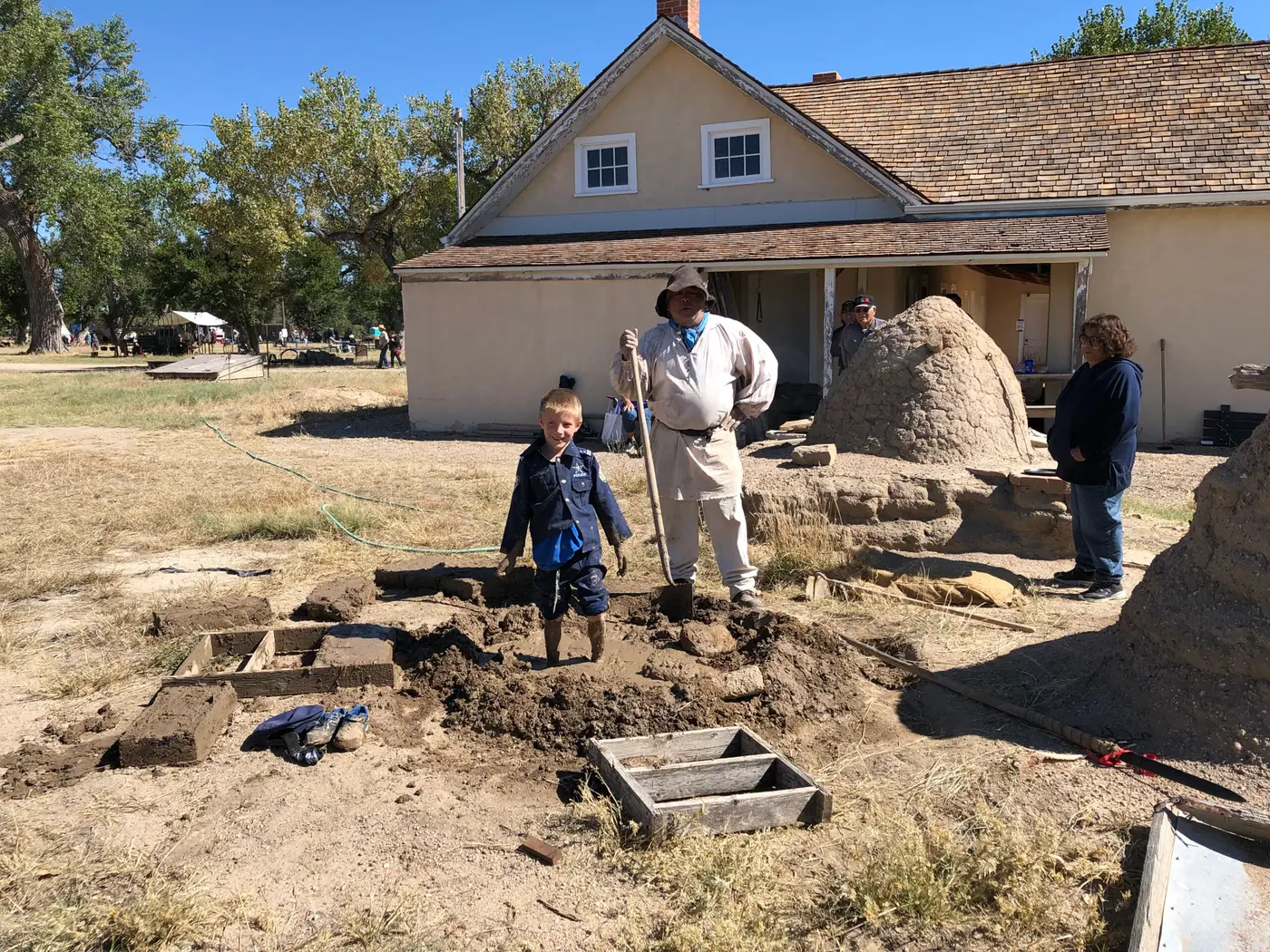
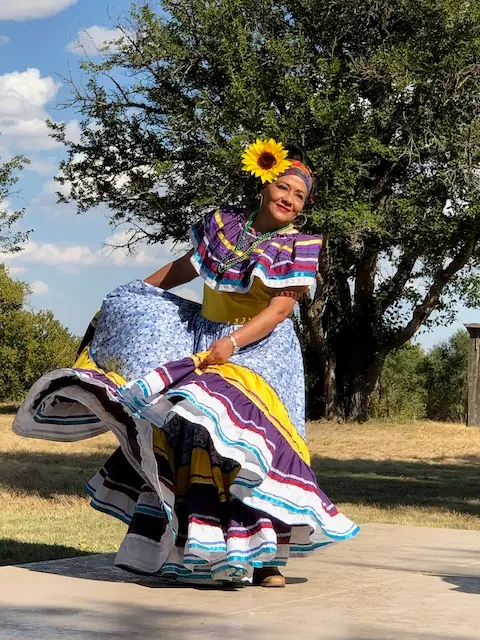
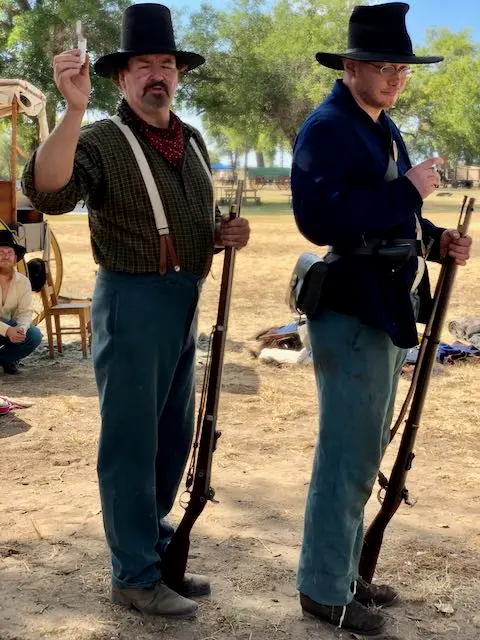
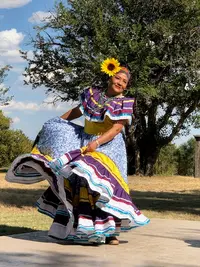
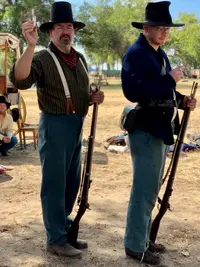
The 2026 festival was held October 3, from 10:00 a.m. to 4:00 p.m. The society’s calendar listed historic re-enactors, wagon rides, multi-cultural dancers, buffalo soldiers, games for the children, and piñatas. Photographs on the society’s pages show Mexican dancers performing at Boggsville Days, the Santa Fe Stage Company on the grounds, a race under way, and visitors making adobe bricks. The site page adds blacksmithing, trapping and farming demonstrations, gunfights, and food.
The 2025 festival, billed as the 11th annual, ran three days, October 3rd through 5th. On Friday evening there was dancing to CappTon Reid and a beer garden. Saturday brought gunfighters, wagon rides, re-enactors, dancers, piñatas, demonstrations of tortilla and butter making, and a pulled pork lunch. Sunday offered guided tours, more re-enactors, and a brunch of burritos with green chili.
The date has shifted over the years. A 2021 SECO News report placed Boggsville Days on the last Saturday of September. The society’s site page now gives the first weekend of October, the point at which the house tours that began in the last week of April end for the year.
A stagecoach and two cowboy poets
The fifth annual Boggsville Days was held Saturday, October 12, 2019, beginning at 9 a.m. Priscilla Waggoner of the Kiowa County Independent set out its program in advance:
- Cowboy poets Randy Huston and Danny McCurry, both nationally known.
- Gunfights by re-enactors from the Burlington Old Town Museum, and the Buffalo Soldiers out of Kansas.
- Horse-drawn farming demonstrations, mountain men, a wheelwright, trappers, a blacksmith, and storytellers.
- Adobe brick making, a pie-eating contest, and a 150-year-old stagecoach on display.
- Descendants of Josefa Carson and of the Boggs family in attendance.
At 7 p.m. six chuckwagon cooks served supper, frontier style, at $30 a ticket, to the hundreds expected.
The Buffalo Soldiers who appear at the festival have a precedent on the ground. The society writes that the soldiers were stationed at nearby Fort Lyon and visited the settlement frequently. The outlaw William Coe, Buffalo Bill Cody, and Charles Goodnight also passed through, and William Bent’s ranch lay next door.
Rumalda’s land on the Purgatoire
The Arkansas Valley was known to the Cheyenne and Arapahoe long before the settlement, and the Apache, Comanche, Kiowa, and Navajo came there too. Legend, the society says, holds that conquistadors, likely of Coronado’s expedition, became lost there and died without last rites. Las animas que son perdidas en purgatorio, “the souls who are lost in Purgatory,” named both the Purgatoire River and the town of Las Animas.
Thomas Oliver Boggs was the son of Missouri’s fifth governor and a great-grandson of Daniel Boone. The society dates his arrival in the Arkansas Valley to 1844. Larry Bourne, president of the historical society in 2019, put it at 1840. Boggs traded for six years for his uncles, William and Charles Bent, and learned Spanish and the languages of eleven tribes. According to Bourne, “William Bent said Boggs was the most useful and trustworthy plainsman of the time.”
The land belonged to his wife. In 1846 Boggs married Rumalda Luna, the stepdaughter of Charles Bent, first territorial governor of New Mexico. Bourne told the Independent that during the Taos Uprising she was “no more than thirteen or fourteen years old” and “held his head as he lay dying.” Rumalda was a descendant of Cornelio Vigil and part heiress to the Vigil and St. Vrain grant. She inherited 2,040 acres along the Purgatoire, just south of where it meets the Arkansas.
The second founding family also stood on a woman’s land. John Wesley Prowers, a Missouri-born merchant and rancher, married Amache Ochinee in 1861. She was the daughter of the Cheyenne sub-chief Ochinee, or Lone Bear. Her family was at Sand Creek on the morning Colonel John Chivington’s soldiers attacked. Her mother escaped, and her father and other relatives were killed. As reparation, the government gave survivors 640-acre parcels, and Amache, her mother, and the Prowers’ two oldest daughters received tracts along the Arkansas.
The houses follow the two women’s customs, according to the society. The Boggs house is a large adobe whose south-facing courtyard caught the winter sun, a tradition of Rumalda’s Hispanic heritage. The Prowers house has fourteen rooms on two stories in a U, and it faces east, after Amache’s Cheyenne custom of honoring the rising sun. Besides the family quarters, it served as business offices, a stage stop, a mercantile, and a schoolroom.
The site page gives 1866 as the founding year. A third heiress arrived in 1867. Josefa Jaramillo Carson came from a Taos merchant family and also held a share of the Vigil and St. Vrain grant, and she and Kit Carson moved to Boggsville to make a ranch of her land. Both died in 1868 within a month of each other, Josefa of complications in childbirth and Kit of an aneurism. Bourne gives the months as April and May.
Herefords, a hand-dug ditch, and a county seat
The residents dug the Tarbox Ditch, seven miles long, by hand, according to Bourne. It watered more than a thousand acres, including the farms of Boggs, Prowers, and William Bent’s son Robert. Prowers brought in Hereford, Angus, and Shorthorn cattle and crossbred them for the climate. His herd reached about 10,000 head by the 1880s, and the Boggs sheep numbered around 30,000.
In 1867 the army moved Fort Lyon to a site a few miles northeast of present Las Animas. The society writes that the army bought nearly everything Boggsville’s farmers could produce.
Bent County was created in 1870 and covered more than 9,000 square miles. Boggsville served as county seat, with offices in the Prowers house and 97 voting residents. The site page gives the term as 1870 to 1872. The society’s longer history says from the fall of 1870 until 1873. Thomas Boggs became the first sheriff and was elected to the territorial legislature the following year. A school opened in 1871 just north of the Prowers house, and the society calls it the first public school in southeastern Colorado. The society counts more than twenty structures at the peak, including a mercantile, a blacksmith shop, and a stage stop. Waggoner’s account counts thirty by 1870.
The railhead two miles north
The rails reached the Arkansas Valley in 1873, with a railhead at the new town two miles north. “The town pretty much died out after that,” Bourne said. Prowers moved to West Las Animas, where he built a new house, opened a mercantile, and founded the freight firm of Prowers and Hough.
Boggs stayed until 1877, when Rumalda’s grant was challenged, and the family left for Clayton, New Mexico. The grant was re-confirmed in 1883, and soon after the Boggses sold their Boggsville ranch to John Lee for $1,200.
The site joined the National Register of Historic Places in 1986, and its listing was raised to National Significance status in 2022. Waggoner reported that the two houses were restored in 1993. On November 25, 2014, the National Trust for Historic Preservation named Boggsville a National Treasure. In 2019 Waggoner wrote that History Colorado had announced plans to buy the property once the houses were restored.
By 2021 a first phase of conservation was complete: a new roof on the Boggs house and regraded ground around both buildings to carry water away. The second phase, slated for late summer 2021, called for a new roof on the Prowers house and restored windows in the Boggs house.
People
- Danny McCurry, Nationally known cowboy poet in the Boggsville Days program.
- Randy Huston, Nationally known cowboy poet in the Boggsville Days program.
Sources
- bentcountyheritage.org/2026-event-calendar
- bentcountyheritage.org/boggsville
- bentcountyheritage.org/boggsville-days
- bentcountyheritage.org/getting-here
- bentcountyheritage.org/contact-us
- bentcountyheritage.org
- bentcountyheritage.org/more-about-boggsville
- facebook.com/profile.php?id=100069548657364
- facebook.com/profile.php?id=100064691590848
- kiowacountyindependent.com/news/1677-boggsville-days-a-celebration-150-years-in-the-making
- seconews.org/article/1344