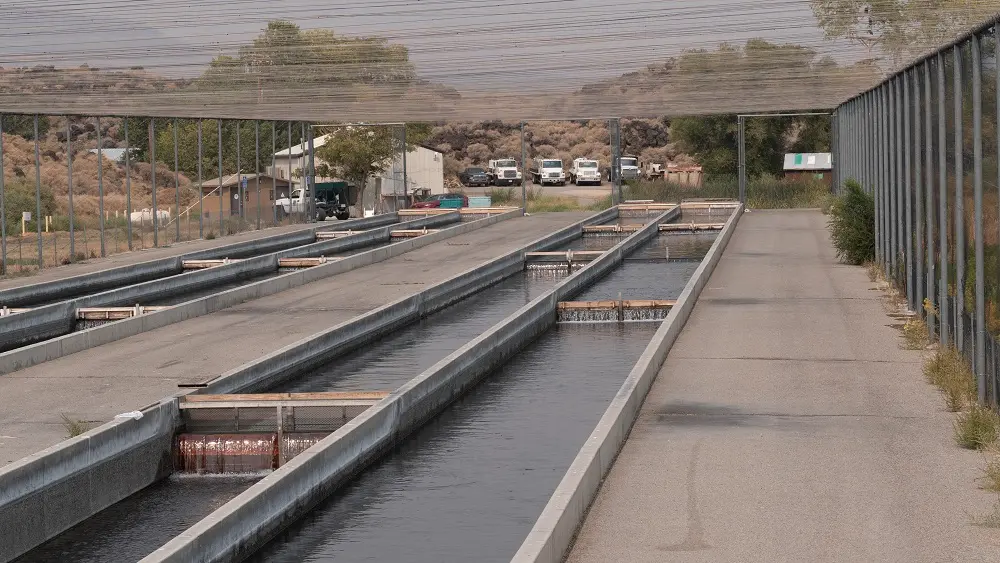
Black Rock Trout Hatchery
Independence, Inyo County, California. Trout hatchery.
Details

- Where
- 1 East Black Rock Road, Independence, CA 93526. Directions
- When
- Open 8:00 a.m. to 3:00 p.m.
- Getting there
- From the Division Creek Caltrans Rest Area, head south on US 395 about 5 miles; the hatchery is on the eastern side of 395.
- Access
- No reliable bathroom facilities at the hatchery; the nearest public facilities are a few miles south in Independence.
- Phone
- (760) 878-2131
- Website
- wildlife.ca.gov
- Managed by
- California Department of Fish and Wildlife.
- Established
- 1941.
Four concrete raceways run side by side on the east side of US 395 in the Owens Valley of Inyo County. They lie about five miles south of the Division Creek Caltrans rest area and a few miles north of Independence. Each raceway is 500 feet long and is divided into five ponds in series, each 100 feet long, 10 feet wide, and 30 inches deep, for twenty ponds in all, according to the hatchery’s 2012 water-quality permit. Rainbow trout fill them. This is Black Rock Trout Hatchery. The California Department of Fish and Wildlife runs it on 40 acres leased from the Los Angeles Department of Water and Power, and it is open from 8:00 a.m. to 3:00 p.m.
The parking area and the ground leading to the fish runways are uneven. The hatchery has no reliable public restrooms. Terry Mitchell led a Maturango Museum field trip from Ridgecrest to the hatchery on April 13, 2024, and had her group stop at the rest area first. “I guess they are always having issues with the plumbing,” she wrote. The museum’s notice for that trip said CDFW personnel would be on hand. Of an earlier spring visit, Mitchell wrote that she “saw some of the most beautiful (and big) rainbows I’ve ever seen in my life.”
Wells, aeration towers, and a creek diversion
The 2012 permit describes how the place works. Water for the raceways and the hatchery building comes from two LADWP wells on the grounds, numbers 351 and 356, and only one runs at a time. The primary well averages 10.7 million gallons a day. The water passes through three packed aeration towers and is pumped into the head flume of the raceways.
Pond #1 is the flow-through broodstock pond. It takes its water from Division Creek through an LADWP diversion about 500 yards above the pond’s north end, and in drought years well water is added. Water leaving the raceways and Pond #1 runs through two wetland settling ponds, #2 and #3. From the last of these it flows into the Los Angeles Aqueduct, which carries it toward Haiwee Reservoir. The unlined ponds also seep into the groundwater of the Owens Valley basin.
Feeding peaks in May, when the fish receive up to 70,000 pounds of food. In a report filed in 2010, the hatchery listed its yearly output as 190,000 pounds of rainbow trout, about 2,300,000 Kamloop rainbow trout eggs, and 2,000,000 Whitney rainbow trout eggs. The eggs went straight to the department’s Fish Springs Hatchery for incubation. The 2012 permit names Matthew Norris as hatchery manager.
Rainbows for anglers, goldens from Cottonwood Lakes
The rainbows raised here stock waters in the surrounding country, where, the department notes, many blue-ribbon trout streams lie close by. The fish provided for anglers are now sterile triploids. The Mt. Whitney Fish Hatchery, built of local granite in 1917, closed in 2008 after heavy rain and fire damage. Since then, the Los Angeles Times reported in 2023, Black Rock has been responsible for stocking the surrounding lakes and the eastern Sierra Nevada.
Black Rock staff also spawn California Golden Trout, the state fish and a Heritage Trout Species, from broodstock kept in Cottonwood Lakes in the Sierra Nevada. The fertilized eggs go to other CDFW hatcheries, and the resulting fish are planted in approved waters around the state.
Ponds below a Los Angeles dam
The hatchery is named for Black Rock Springs. The sources do not say how the springs got their name. The City of Los Angeles built a diversion dam near the source of the springs, and the dam created the Black Rock Rearing Ponds. According to the department’s history, the springs normally flow 12 to 15 cubic feet per second at a temperature of 59 degrees. The same history says some of the department’s hatchery personnel at first frowned on the plan to rear large numbers of fish in such large ponds.
The ponds were first used in the fall of 1941, when 450,000 rainbow fingerlings were placed in them. In the spring of 1942, 274,385 trout were planted from the ponds. They averaged over five inches long and together weighed over 36,000 pounds. In the department’s words, “This production removed any doubt regarding their fish rearing possibilities.”
The concrete raceways, 2,000 feet of them, were built in 1976. Mitchell’s trip notes say the raceways increased capacity and made loading, cleaning, and care of the trout easier. The old rearing ponds became the broodstock ponds.
When Black Rock Springs was a spring
“Do you remember Black Rock Springs when it was still a spring?” Daniel Pritchett asked this in a column titled “Who remembers?” in the November/December 2002 newsletter of the Bristlecone Chapter of the California Native Plant Society. He traced the loss of such places to groundwater pumping that began about 30 years earlier to fill the second barrel of the Los Angeles Aqueduct.
Pritchett also wrote about wells exempted from the on/off provisions of the Inyo-Los Angeles Long Term Water Agreement. As an example of the damage, he pointed to the Thibault-Sawmill wellfield, “where alkali meadow is now turning into shrubland due to pumping of the exempt wells for the Black Rock fish hatchery.”
The broodstock years ended in 2012. The department’s history says only that the hatchery ceased spawning that year. Lahontan Regional Water Quality Control Board permit materials from 2018 give the cause as an infestation of New Zealand mud snails, an invasive species, in Pond 1.
In 2020 an outbreak of the bacterium Lactococcus garvieae struck Black Rock and Fish Springs. About 3.2 million fish were euthanized to stop the spread. Before that outbreak, the bacterium had never been detected in fish in California, and three facilities were quarantined for more than a month while pathologists and hatchery staff treated the fish.
In April 2022 a molecularly similar bacterium, Lactococcus petauri, appeared in all four Black Rock raceways holding catchable fish. Those raceways held about 120,000 trout that would normally have been stocked through the fishing season, which opened April 30. “This is unfortunate timing, as it affects our planting efforts in the weeks before the opener, but all is not lost,” said CDFW Director Charlton H. Bonham.
By June, about 350,000 infected catchable rainbows at Black Rock and Fish Springs were showing signs of disease and had to be euthanized. In response, the department arranged for fish from an outside vendor, drew on other CDFW hatcheries, and used vaccines developed at the University of California, Davis. It also planned backup generators for Black Rock. Infected fish can show bulging eyes and lethargic or erratic swimming. The department’s pathologists believe birds carried the bacterium into the hatcheries. The 2022 strain was identical to one found in fish farms in central Mexico, which supported their view that birds on the Pacific flyway were the likely carriers.
Notable Events
- 1941The ponds were created when the Los Angeles Department of Water & Power built a dam for diversion purposes near the source of Black Rock Springs. maturango.org
- 1941Ponds stocked with 450,000 rainbow fingerlings; though some doubted success, in the following spring 274,385 trout averaging 5 inches in length were planted from the ponds. maturango.org
- 1976A system of concrete raceways was constructed, increasing the capacity and ease of loading, cleaning and care of the trout. maturango.org
- 1976The hatchery was expanded by addition 2,000 feet of concrete raceways. wildlife.ca.gov
- 2008After the Mt. Whitney Fish Hatchery closed in 2008 due to heavy rain and fire damage, Black Rock Hatchery in nearby Independence is now responsible for stocking trout in the surrounding lakes and eastern Sierra Nevada range. latimes.com
- 2012All broodstock operations were halted since 2012 due to an infestation of New Zealand Mud Snails, an invasive species, in Pond one. waterboards.ca.gov
- 2012The old rearing ponds were utilized as broodstock ponds until 2012 when the hatchery ceased spawning activities. wildlife.ca.gov
- 2020Black Rock and Fish Springs hatcheries experienced a Lactococcus garvieae outbreak that led to the euthanization of approximately 3.2 million fish in order to stop the spread of disease. wildlife.ca.gov
- 2022The four raceways of catchable fish at Black Rock Hatchery tested positive for the Lactococcus bacteria, accounting for approximately 120,000 trout that would normally be stocked throughout the fishing season. wildlife.ca.gov
People
- Matthew Norris, Hatchery Manager.
Sources
- wildlife.ca.gov/Fishing/Hatcheries/Black-Rock
- wildlife.ca.gov/News/Archive/cdfw-to-supplement-fish-stocks-for-anglers-as-bacterial-outbreak-leads-to-further-losses-at-two-eastern-sierra-trout-hatcheries
- wildlife.ca.gov/Fishing/Hatcheries/Black-Rock/History
- maturango.org/wp-content/uploads/2024/03/20240413_Owens-Valley-Fish-Hatchery-Field-Trip.pdf
- latimes.com/california/story/2023-12-08/40-acres-to-be-returned-to-indigenous-paiute-people-in-inyo-county
- wildlife.ca.gov/News/Archive/new-bacterial-outbreak-confirmed-at-two-eastern-sierra-fish-hatcheries
- waterboards.ca.gov/rwqcb6/board_decisions/adopted_orders/2012/docs/r6v_2012_0038.pdf
- bristleconecnps.org/newsletters/archives/cnv226.pdf
- waterboards.ca.gov/lahontan/docs/black_rock_fish_hatchery_notice_and_tentative_order.pdf