Black Diamond Labor Days
Black Diamond, King County, Washington. Festival; Labor Day Weekend.
Details

- Where
- 25314 Baker St, Black Diamond, WA 25314. Directions
- When
- Last held September 6–7, 2026; next year’s date not yet stated.
- Getting there
- Black Diamond is a historical coal mining town located between Maple Valley and Enumclaw on Highway 169, thirty minutes from I-405 in Renton.
- Hours
- Parade starts promptly at 10 am.
- Phone
- (360) 886-2142
- Website
- blackdiamondlabordays.org
- Managed by
- Black Diamond Labor Days committee.
- Established
- Before WWII as a Fourth of July celebration for miners' families; became a Labor Day celebration after the war.
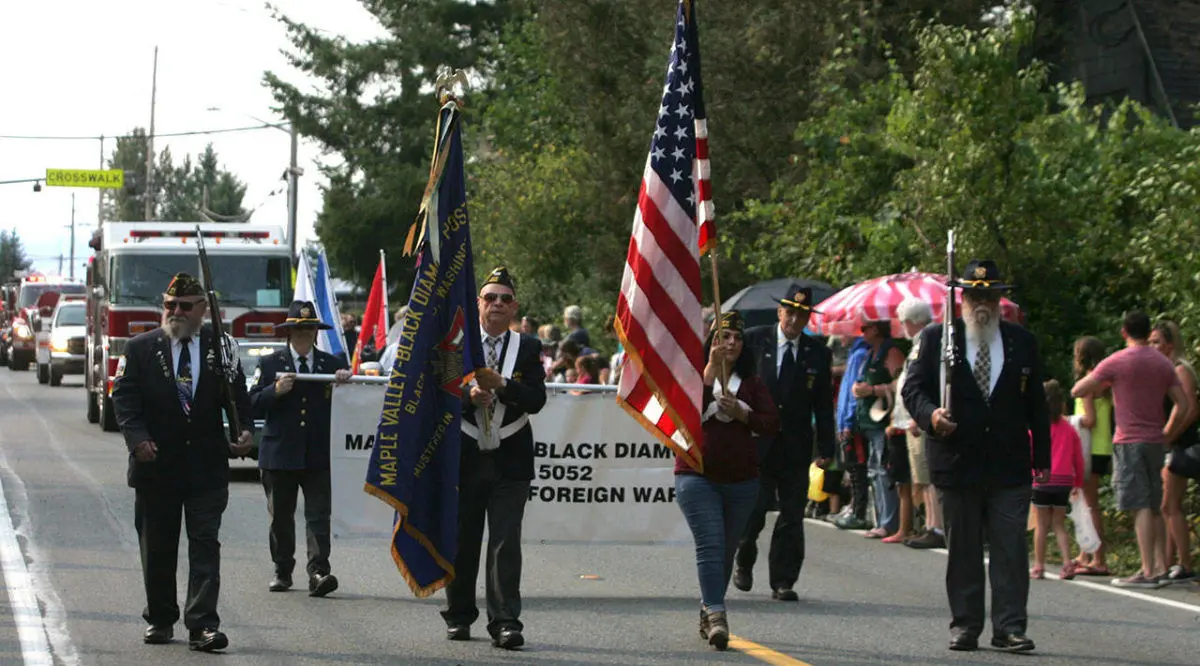
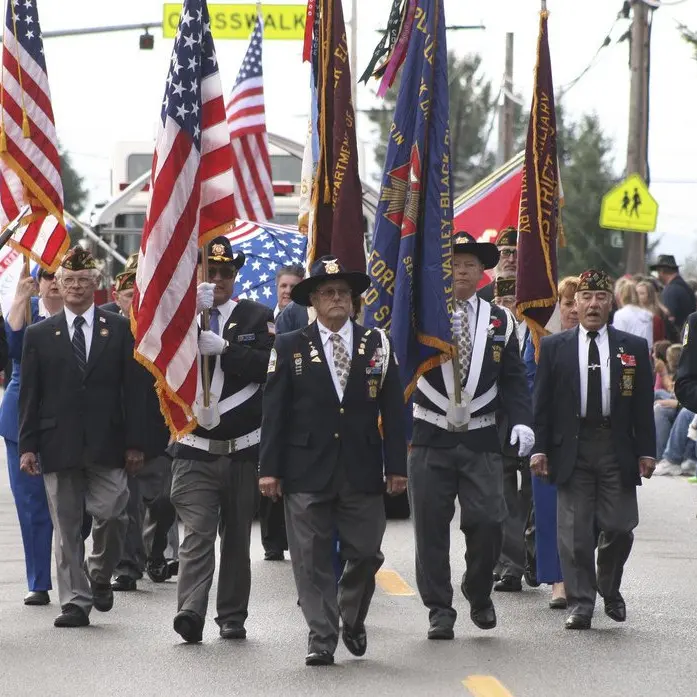
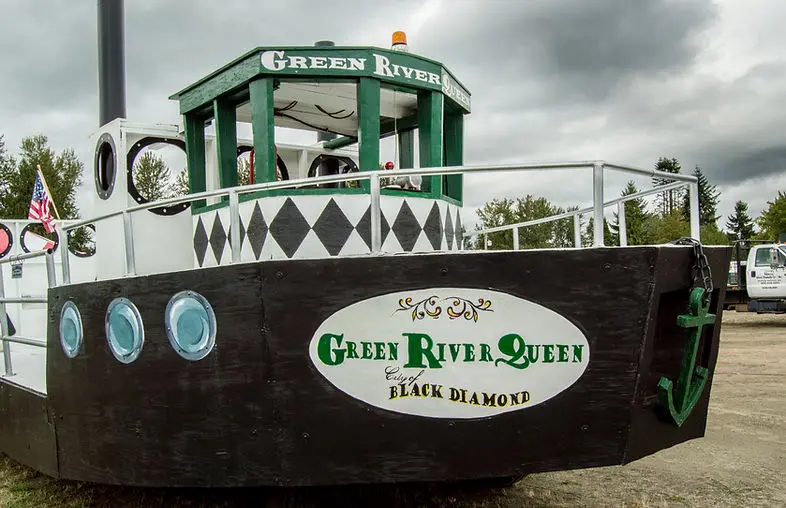
At ten o’clock on Labor Day morning the parade comes down Highway 169, which through the middle of Black Diamond is also Third Avenue. People line the road with folding chairs and bags for candy. For the crowd’s safety, the committee asks that candy be handed out by someone walking the sideline. As each entry passes the judge’s stand, an announcer reads a short description of the group, written for people who know nothing about it. In 2026 the parade fell on Monday, September 7, the second day of Black Diamond Labor Days.
Black Diamond is an old coal mining town on Highway 169 between Maple Valley and Enumclaw, thirty minutes from I-405 in Renton. The festival spreads around town, through the ballpark and onto the elementary school play field. The 2026 Monday program opened at 7 a.m. with the community breakfast at the Masonic Hall. The Black Diamond Eagles held their 34th annual car show from 8 to 3. After the parade came the parade awards, then free ice cream, free peanuts, and bags of candy. Field games for children and adults began at one. Vendors and food trucks lined the grounds, a bouncy house stood in the children’s zone, and the police and fire departments parked fire trucks, an ambulance, a police car, and a boat on the school field.
Pies, dogs, and a movie at Civic Park
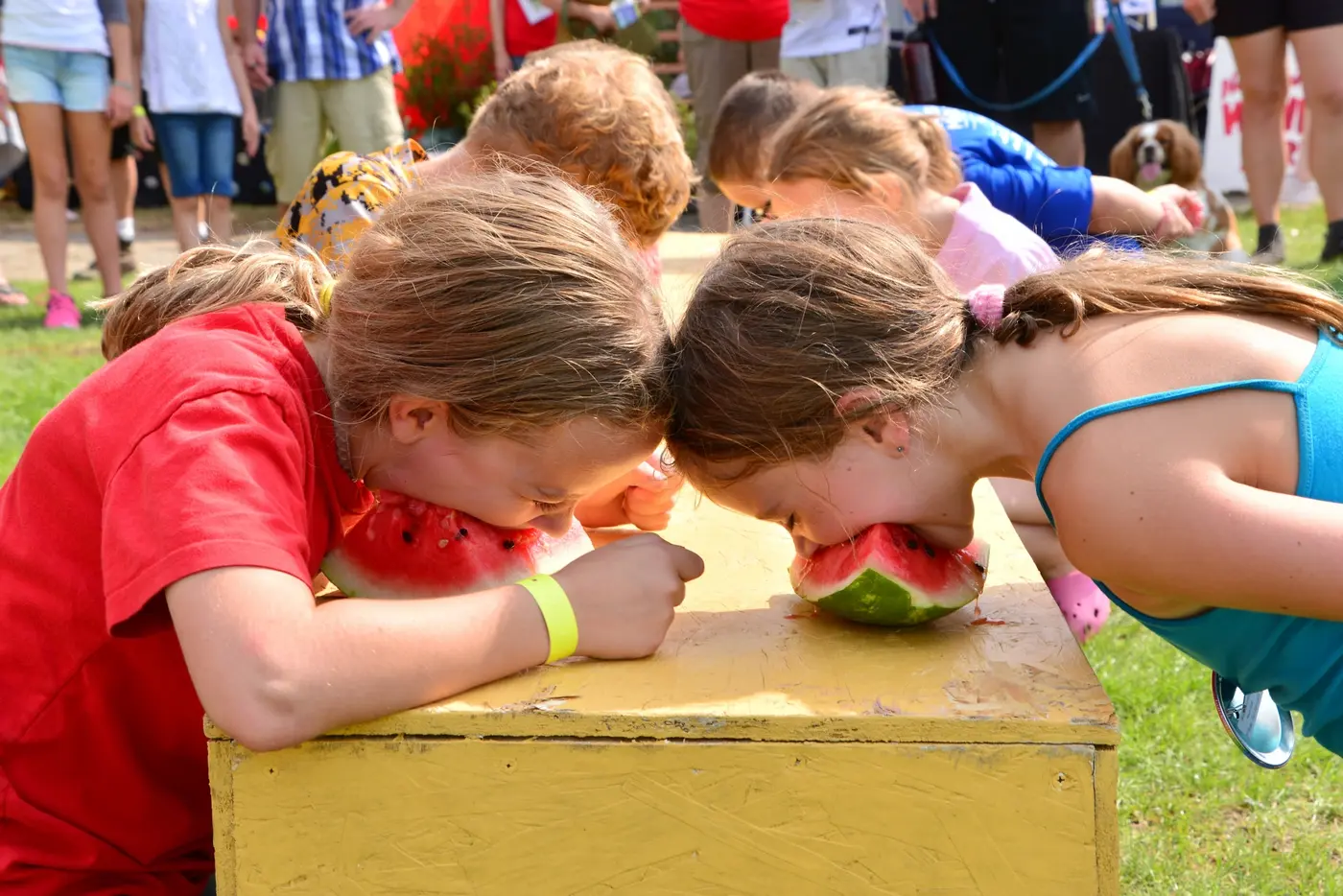
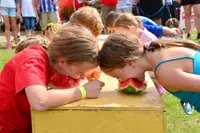
The first day of the 2026 festival, Sunday, began at 10 a.m. with Doggy Day, booths, and live music. Pie, jam, and jelly entries were due by 10:30. At noon the committee announced its Citizen Awards, scholarship recipients, button winners, and the pie, jam, and jelly winners. Mariah Deady’s apple pie took Best Overall and first place in her division. Women’s and kids’ games followed at one. The committee wrote that the watermelon eating contest and the money hay scramble “are always favorites at Labor Day.” The day ended at about 8:30 p.m. with a free movie at Civic Park.
Each year has its own design for the custom Labor Day button, a collectible sold at the Black Diamond museum and at several businesses around town. The museum occupies the town’s old railroad depot.
A committee of volunteers runs the weekend. In 2026 Leih Mulvihill served as chairman and also handled vendors, the program, and the emcee’s duties. Alexa Dubus ran Doggy Day. Jeannette Carroll and Elaine Parks ran the pie baking and jam contest, Tamie Deady and Judy Goodwin ran movie night, and Becky Fortna and Tamie Deady ran the parade.
Marching miners and a company picnic
The committee and the Black Diamond Historical Society tell the beginning the same way. Before the Second World War the celebration fell on the Fourth of July, and it began as a way for miners’ families to mark the holiday. Because the company owned all the property in town, the miners had to go to the bosses and ask to hold it. The bosses agreed, but the miners had to pay for it themselves.
Bill Kombol, who writes the “When Coal Was King” column for the Voice of the Valley, gives another account. In 2016 he dated Black Diamond’s Labor Day celebrations to the holiday’s establishment by federal law in 1894, and he illustrated the column with a 1907 photograph taken at the depot. In 2020 he wrote that the Fourth of July was the big community summer bash in the town’s early years. By his account, by the 1920s Labor Day festivities were jointly funded by the union and the coal company.
His columns describe two early Labor Days. In 1911, 60 miners from Burnett marched behind the Enumclaw band. Several hundred more members of the United Mine Workers of America marched with them for the coal towns of Renton, Ravensdale, and Franklin. The afternoon brought boxing, wrestling, and foot races, and then the big event of the day, a 4 p.m. baseball game in which the Diamond team beat Renton 12 to 6.
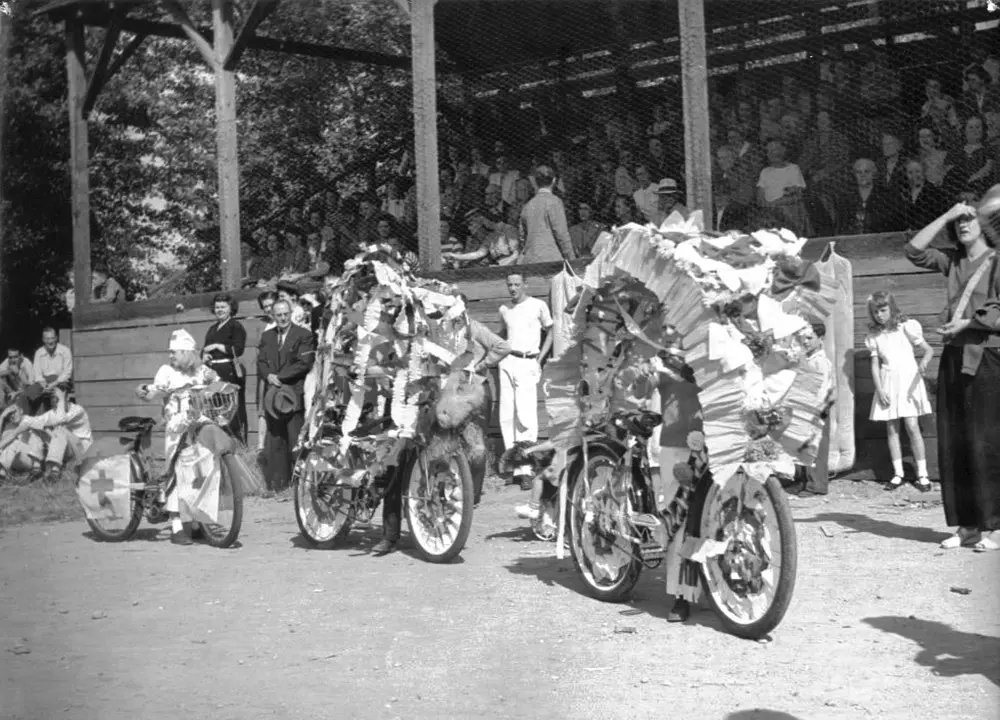
By 1930 the union’s Central Council and the Pacific Coast Coal Company sponsored a joint Labor Day picnic. Children ran foot races at 10. Dinner was served at the Company Hotel at noon, and a band concert followed at 1. At 2, Black Diamond played Carbonado at baseball for a $100 cash prize. A second concert began at 5, and at 6 boxers fought at the ball park in front of a wooden grandstand that held hundreds. The show hall ran a free double feature. The night ended with a dance and Grand Ball at the Masonic hall, where men paid 75 cents and ladies entered free.
During World War II, Kombol writes, both the Independence Day and Labor Day ceremonies dried up.
Five men and fifty dollars
In June 1947 the celebration was reorganized. An album that Helen Manowski donated to the historical society records that it began “when Peter Dearden, first Chairman, Lew McCauley, Willie Franchini, Bill Hawthorne, and Frank Manowski threw $10.00 each into the pot to start it off.” The men first met at the Pool Hall, and later meetings were held in the Show Hall. According to Jules Dal Santo, as Kombol reports, they said, “Let’s have another Labor Day Parade.” That year Bernice (Gibson) Kochevar was crowned Queen, and Betty (Johnson) Blakeney and Joyce (Dearden) Gripp were named princesses. The candidates were between 16 and 18, and the girl who sold the most Labor Day buttons became Queen. Vivian Petchnik recalled that in the early days the girls competed by selling dance tickets.
The sources give different dates for the move to September. The committee says that after the war families started to travel, so the Fourth of July celebration became a Labor Day celebration. Tani Hawkins, born and raised in town, told the Voice in 1978 that the celebration first centered on the Fourth, with games for the kids and a parade, and that by the 1950s it had moved to Labor Day weekend.
By 1950 it was large. The Seattle Post-Intelligencer reported that merchants and townspeople had given so freely that about $600 remained in the “kitty.” That was after the fund had paid for “7,200 ice cream bars, 350 gallons of orangeade, and 1,200 bags of peanuts, popcorn, and candy to be handed out free to all the kids from miles around.” Sam Downey, a native of Belfast and a resident of Black Diamond for a quarter-century, marshaled the parade from the infield in an Irish derby. His daughter Barbara Jean, 14, was Queen that year. “This is for the kids,” he said. “There’ll be nary a bottle o’beer on this field today.” Mrs. Frank Manowski reported that several thousand people attended, among them Senator Warren G. Magnuson and Ed Weston, president of the state American Federation of Labor.
The rest of town kept its own customs. Through the 1950s, 60s, and 70s, Kombol writes, drinking beer at one of four taverns was part of the weekend: Morganville, Boots, Kings, and Boondockers, which stood just south of town. In a 1974 interview with the Seattle Times, Sgt. Ernie Richardson of the local police called it “an old-fashioned civic celebration in the midst of a mammoth beer bust. They come from all over and really get warmed up.” Only Boots Tavern remains. Four years after that interview, Sgt. Kaufman of the same department asked visitors: “Please, leave your booze at home. Have a good time with good, old-fashioned fun.”
The games changed over the decades. At the 1952 Soap Box Derby, the wheels of cars driven by Cliff Johnson, 12, and Birl Pierotti, 13, tangled and threw the boys into the crowd. A spectator, Mrs. Mary Paolucci, was treated for bruises at the Community Memorial Hospital in Enumclaw. Noni Coby believed she was the first to win the greased pig contest, at 10 or 11. She waited two hours before going home, afraid of her mother, because the family had no place to keep a pig. Once a pen was built, the pig was bred and produced 13 piglets. Joe Kaufman said that when the acting police chief sat in the dunk tank in 1975, he was first in line. In 1978 Seattle Times photographer Greg Gilbert photographed the three-legged race. That year soapbox cars also raced down Lawson Street, and firemen played “water-ball” with hoses. In a 2020 comment, Chuck Metcalf remembered the kids’ parade down Lawson Hill to the ballpark, where the judges gave everyone something on arrival.
Race walkers came for many years. In 1970, about 45 members of the International Walking Team were scheduled to walk from the ball park to Lake Twelve and back. In 1971 the course was 18.6 miles, and the field included Ron Laird of California, a member of the American Olympic team in 1960, ‘64, and ‘68. His race appeared on that year’s button. In 1986 Laird returned and won the four-mile AAU walk in 30.58.
In 1975 the Voice reported that the town’s population of 1,000 swelled to many times that number over the weekend. That year the bicentennial was folded into a silver anniversary marking 25 years of Labor Day. Marlene Bergstrom was crowned Queen at noon on Sunday on the school grounds, and Sid Bergstrom chaired the committee. In 1978 the chairman was Evan Morris, whom the committee credits, with Ann and Carl Steiert, for making the festival what it is today.
A queen at King’s Tavern
Kombol counts Labor Day observances every year since 1947 except two. In 1993 interest lagged, and the Black Diamond Eagles provided other entertainment. The pandemic added a third gap in 2020. The first came in 1976, when the historical society was formed and the town held its celebration on the Fourth of July. “It was really disappointing when there was no ‘Labor Day’ in 1976,” Debbie Capponi said.
Naomi Givens wrote down what happened instead for the 2008 program. A few people went to the play field anyway, and others gathered at King’s Tavern for its annual Labor Day bash. Duane, the owner, had met Givens’s sister Ella the year before, on her 75th birthday. He decided she personified Black Diamond Labor Days, and with the help of Naomi and their sister Hazel Williams he arranged a surprise. At 7:30 p.m. he crowned 76-year-old Ella (Horner) Stellpflue Queen of Black Diamond. “She was absolutely flabbergasted!” Duane said. “She wouldn’t stop dancing. It was such a great adventure. The kind of thing that could only happen on a Labor Day in Black Diamond.”
Notable Events
- 1911The 1911 event featured 60 miners from Burnett led by the Enumclaw band, with several hundred other marching mine workers of the United Mine Workers of America representing the coal mining towns of Renton, Ravensdale, and Franklin. voiceofthevalley.com
- 1930By 1930, the union's Central Council and Pacific Coast Coal Company sponsored a joint Labor Day picnic. voiceofthevalley.com
- 1947An album donated to the Black Diamond Historical Society by Helen Manowski records that Labor Day celebrations were reorganized when Peter Dearden, first Chairman, and four others threw $10.00 each into the pot to start it off. blackdiamondhistory.wordpress.com
- 1950sAs Tani Hawkins recalled, by the 1950s the festivities were rescheduled from the 4th of July to the Labor Day weekend. blackdiamondhistory.wordpress.com
- 1971The 18.6 mile course brought racers of international caliber, including Ron Laird from Pamona, Calif., as reported on the front page of the VOICE on August 25, 1971. blackdiamondhistory.wordpress.com
- 1975Combined bicentennial festivities with the silver anniversary marking 25 years of Labor Day happenings. blackdiamondhistory.wordpress.com
- 1976The News Journal reported in its September 9th issue that there was no Labor Day Celebration, but that didn't stop Black Diamond from having fun. blackdiamondhistory.wordpress.com
- 1976When the historical society was formed, the town's celebration was held on the Fourth of July. voiceofthevalley.com
- 1993Lack of interest led the Black Diamond Eagles to provide alternate entertainment. voiceofthevalley.com
- 2020The column says Labor Day was not celebrated that year due to Covid-19. voiceofthevalley.com
- After the war, families started to travel and the Fourth of July celebration became a Labor Day celebration. blackdiamondlabordays.org
- During World War II both the Independence and Labor Day ceremonies dried up. voiceofthevalley.com
People
- Arlene Parkin, Labor Day committee advertising.
- Bill Parkin, Labor Day committee member.
- Bob Kaye, Labor Day committee member.
- Chuck Capponi, Labor Day committee member.
- Elfie Parkin, Labor Day committee member.
- Francis Pitman, Labor Day committee member.
- Jim Manowski, Master of ceremonies.
- John Bukosky, Labor Day committee member.
- Kari Sawyer, Labor Day committee member.
- Marlene Bergstrom, Labor Day Queen.
- Sid Bergstrom, Labor Day committee chairman.
- Sue Capponi, Labor Day committee member.
- Peter Dearden, first Chairman (June 1947).
- Ron Laird, Olympic athlete who competed in the Labor Days walking race.
- ALEXA DUBUS, Doggy Day volunteer.
- BECKY FORTNA, Parade volunteer.
- CAROL BENSON, Secretary.
- CAROL MORGAN, Finance volunteer.
- CHANON BOVEE, Website volunteer.
- ELAINE PARKS, Pie Baking and Jam volunteer.
- JEANNETTE CARROLL, Pie Baking and Jam volunteer.
- JUDY GOODWIN, Movie Night volunteer.
- LEIH MULVIHILL, Chairman.
- TAMIE DEADY, Sponsorship volunteer.
- Ann Steiert, through her efforts the Labor Day celebration became the old fashioned, family orientated festival it is today.
- Carl Steiert, through his efforts the Labor Day celebration became the old fashioned, family orientated festival it is today.
- Evan Morris, through his efforts the Labor Day celebration became the old fashioned, family orientated festival it is today.
- Ella (Horner) Stellpflue, Honorary Queen at King's Tavern during bicentennial cancellation.
- Hazel (Horner) Williams, Sister accompanying honorary Queen Ella at King's Tavern.
- Naomi (Horner) Barnes Givens, Sister accompanying honorary Queen Ella at King's Tavern.
- Bill Hawthorne, one of five men who each slapped down $10 to start the modern Labor Day tradition (1947).
- Frank Manowski, one of five men who each slapped down $10 to start the modern Labor Day tradition (1947).
- Lew McCauley, one of five men who each slapped down $10 to start the modern Labor Day tradition (1947).
- Willie Franchini, one of five men who each slapped down $10 to start the modern Labor Day tradition (1947).
Sources
- blackdiamondlabordays.org
- blackdiamondlabordays.org/schedule
- blackdiamondlabordays.org/parade
- blackdiamondlabordays.org/about
- blackdiamondmuseum.org/events/labor-days
- facebook.com/BlackDiamondLaborDays/?ref=bookmarks
- blackdiamondhistory.wordpress.com/2020/08/23/black-diamond-labor-days-a-look-back-in-time
- blackdiamondhistory.wordpress.com/2023/08/22/memories-of-labor-days-past-recalled-by-residents
- voiceofthevalley.com/2020/08/25/1978-black-diamond-labor-day
- voiceofthevalley.com/2023/08/28/when-coal-was-king-black-diamond-labor-day-1947-bicycles