

Bishop Castle
Rye, Pueblo County, Colorado. World's largest one-man project, a castle; Every day of the year.
Details

- Where
- 12705 Highway 165, Rye, CO 12705. Directions
- When
- Sun-up to sun-down, every day of the year.
- Fees
- Visits and tours without fees or dues.
- Access
- A few porta-potties on site and electricity in the castle; no running water.
- Walk-in or reserve
- None required; visitors welcome every day of the year at their own risk.
- Phone
- 719-994-4361
- Managed by
- Daniel Bishop, Castle Caretaker.
- Established
- 1969.
Signs, stairs, and a dragon on the roof
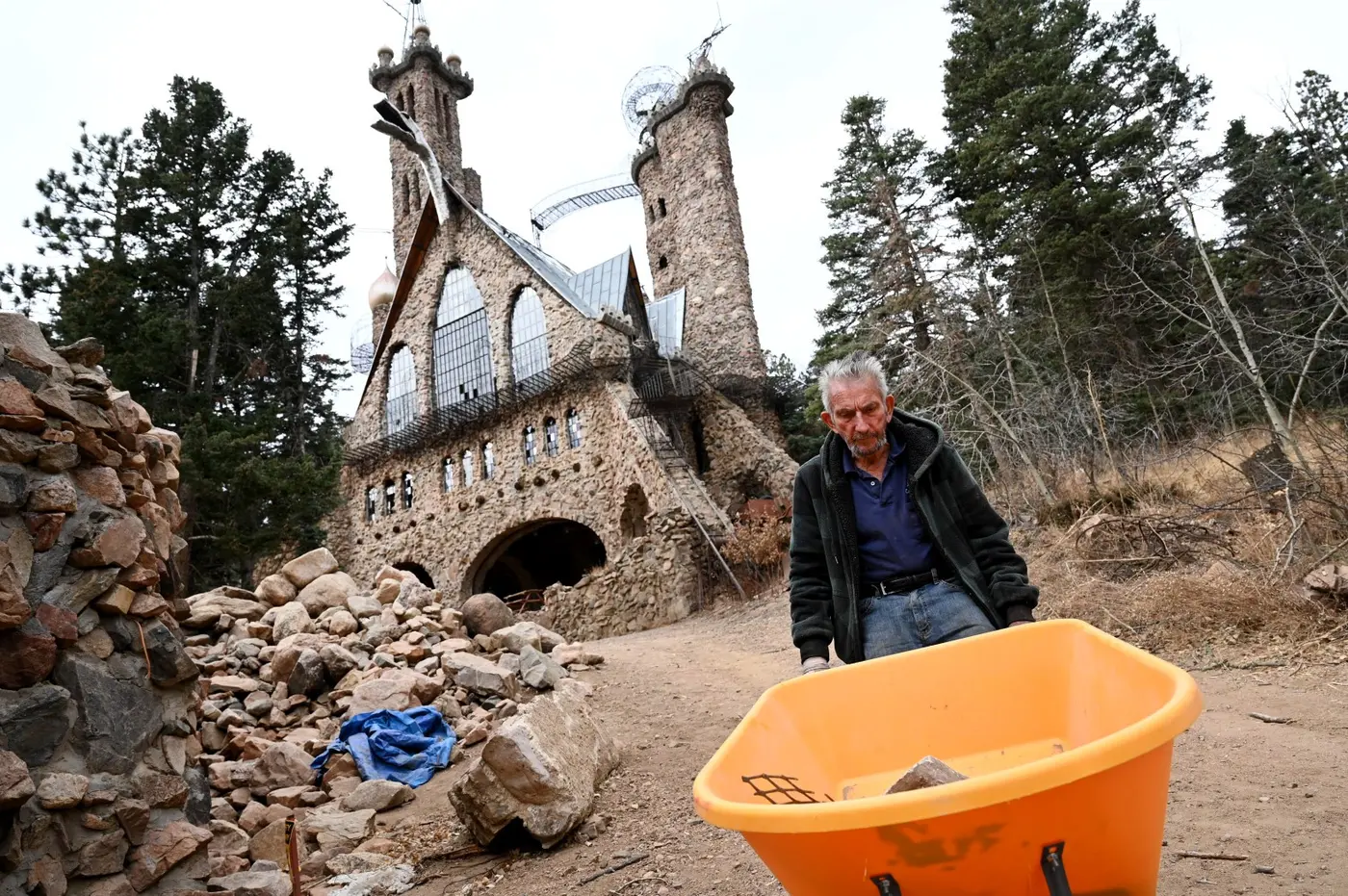
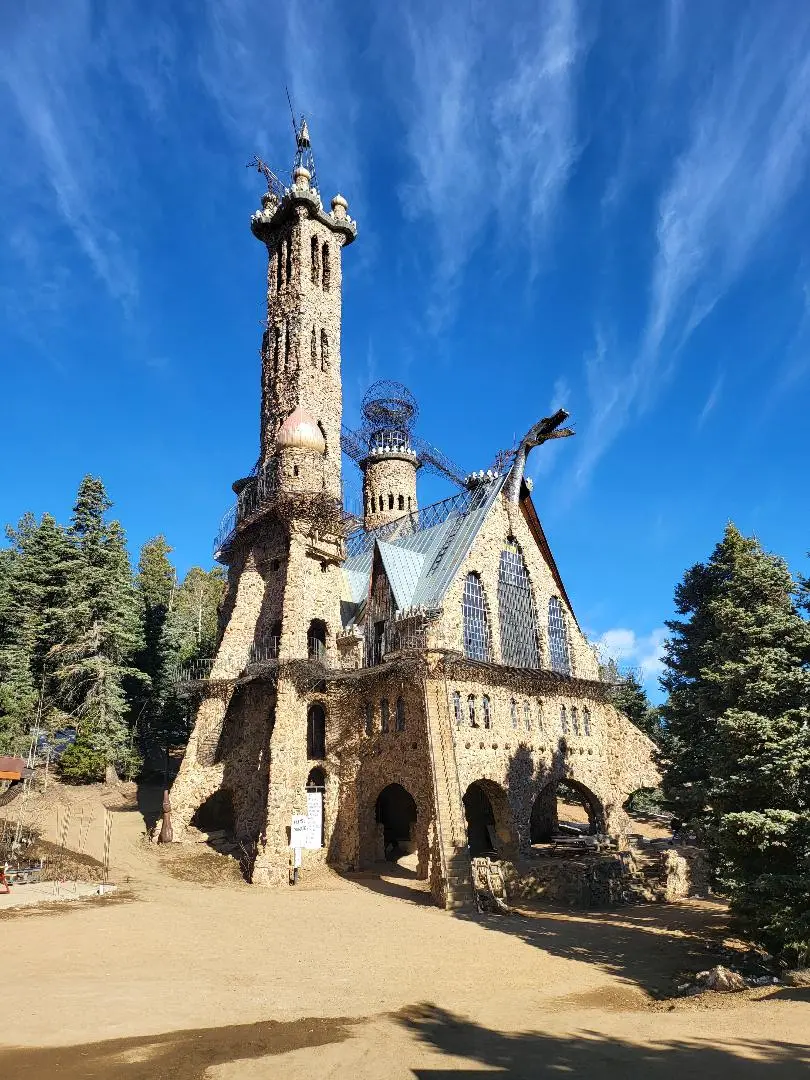
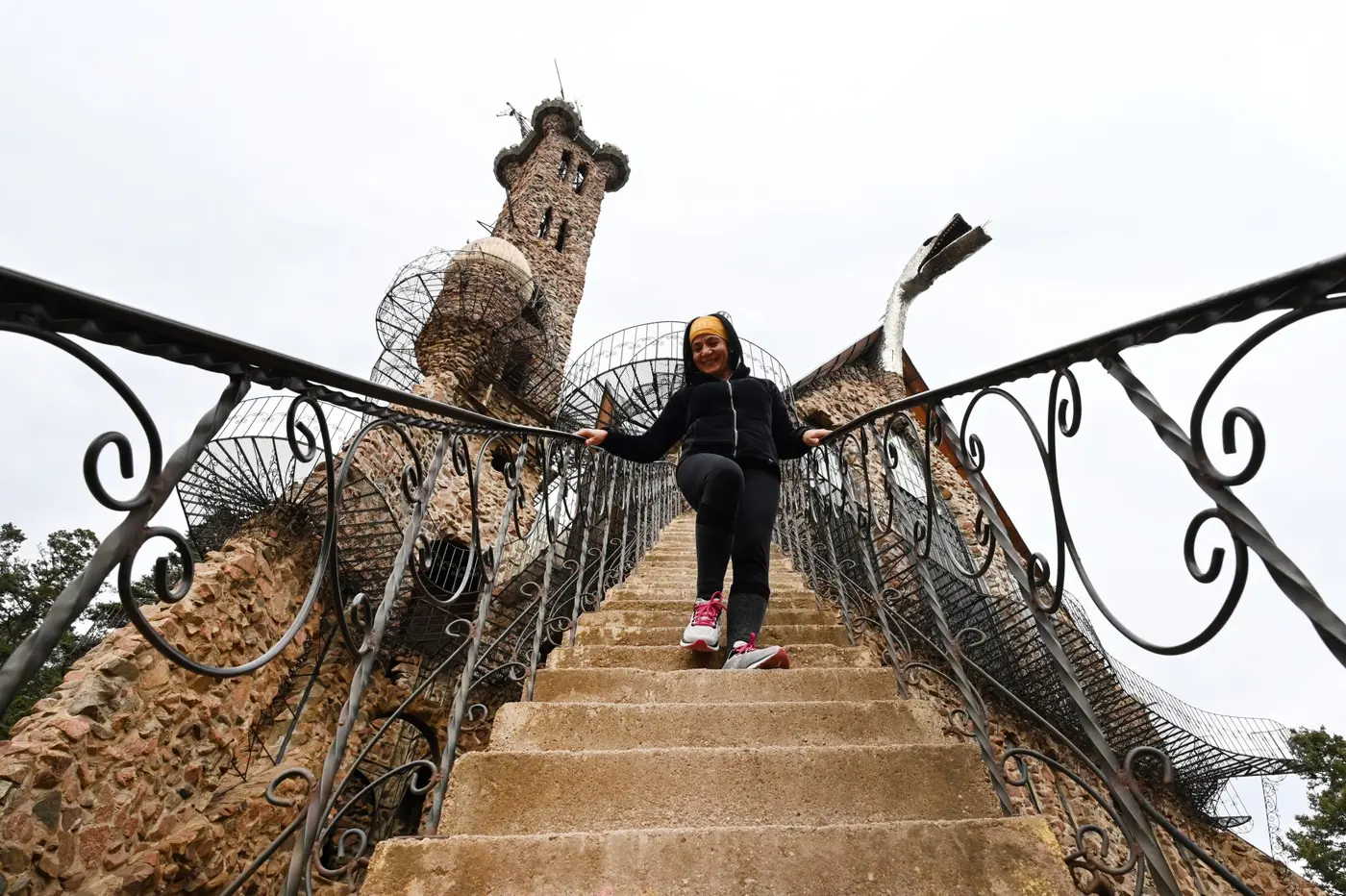
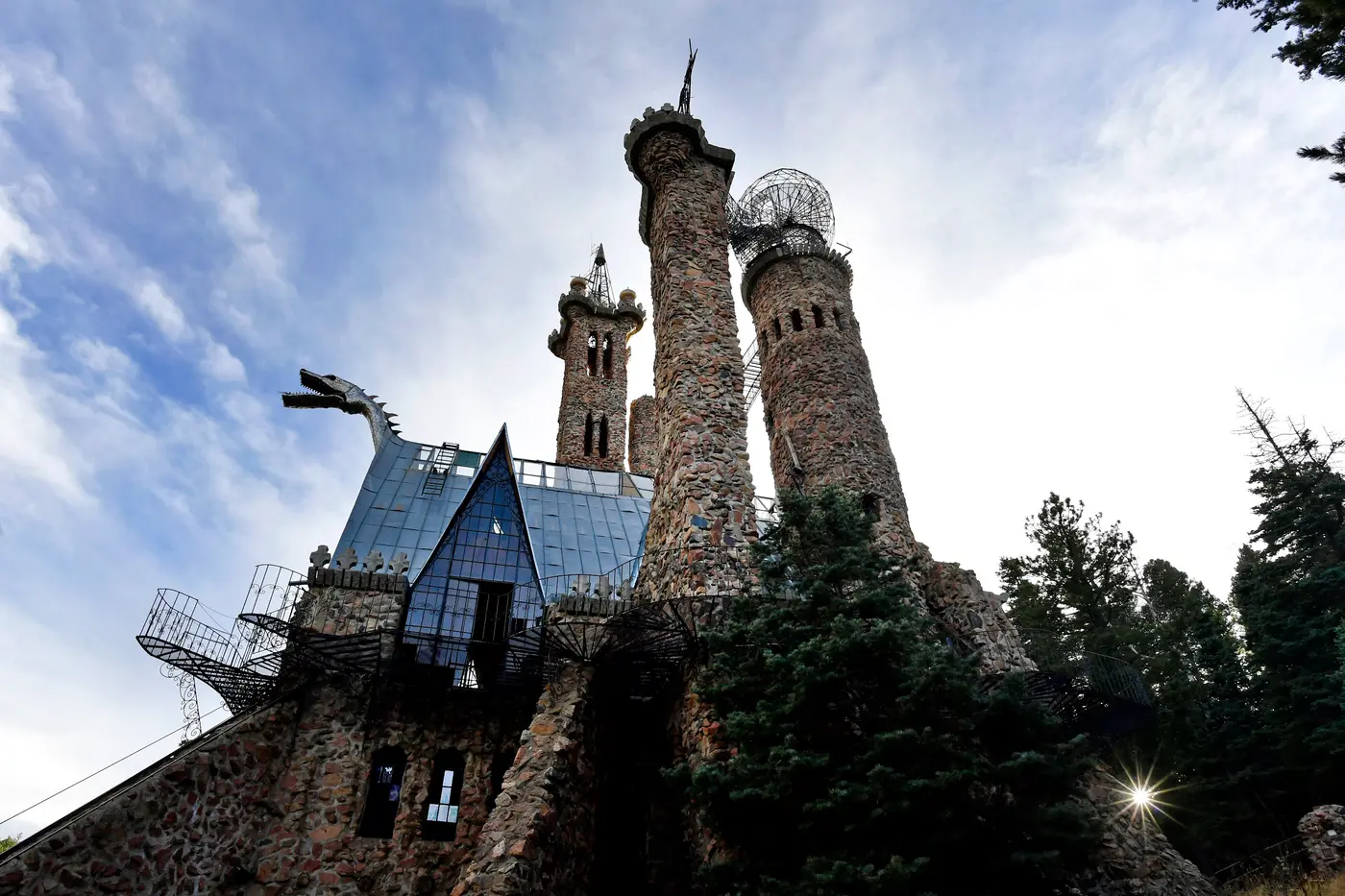
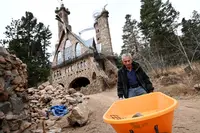
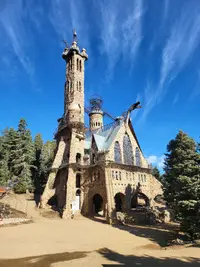
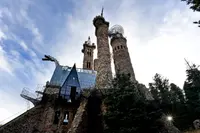
The approach from Colorado 165 is a short trail lined with handmade signs. Some ask for donations to be dropped in a box. Another tells visitors they enter at their own risk. Others, as the Denver Post reported in 2021, warn of the builder himself: “You might experience foul language!” and “You might experience strongly expressive behavior!” At the top of the trail stands a castle of rough granite boulders and concrete, just above 9,000 feet in the Wet Mountains, with the San Isabel National Forest on three sides of the lot. It has arches, flying buttresses, onion domes, and spires. Its tallest tower stands over 160 feet by the Post’s and the Colorado Springs Gazette’s count, and about 165 feet by Colorado Public Radio’s.
At the apex of the roof is a dragon’s head 25 feet long, its hinged jaw open and a long silver tongue thrust out. The 1994 radio documentary that described it called it stainless steel scrap. The Post is more particular: discarded hospital trays from St. Mary Corwin Hospital in Pueblo. The nose is a chimney, and CPR reports that the dragon can breathe smoke from a woodstove inside. On Halloween 2024 it let out a burst of fire.
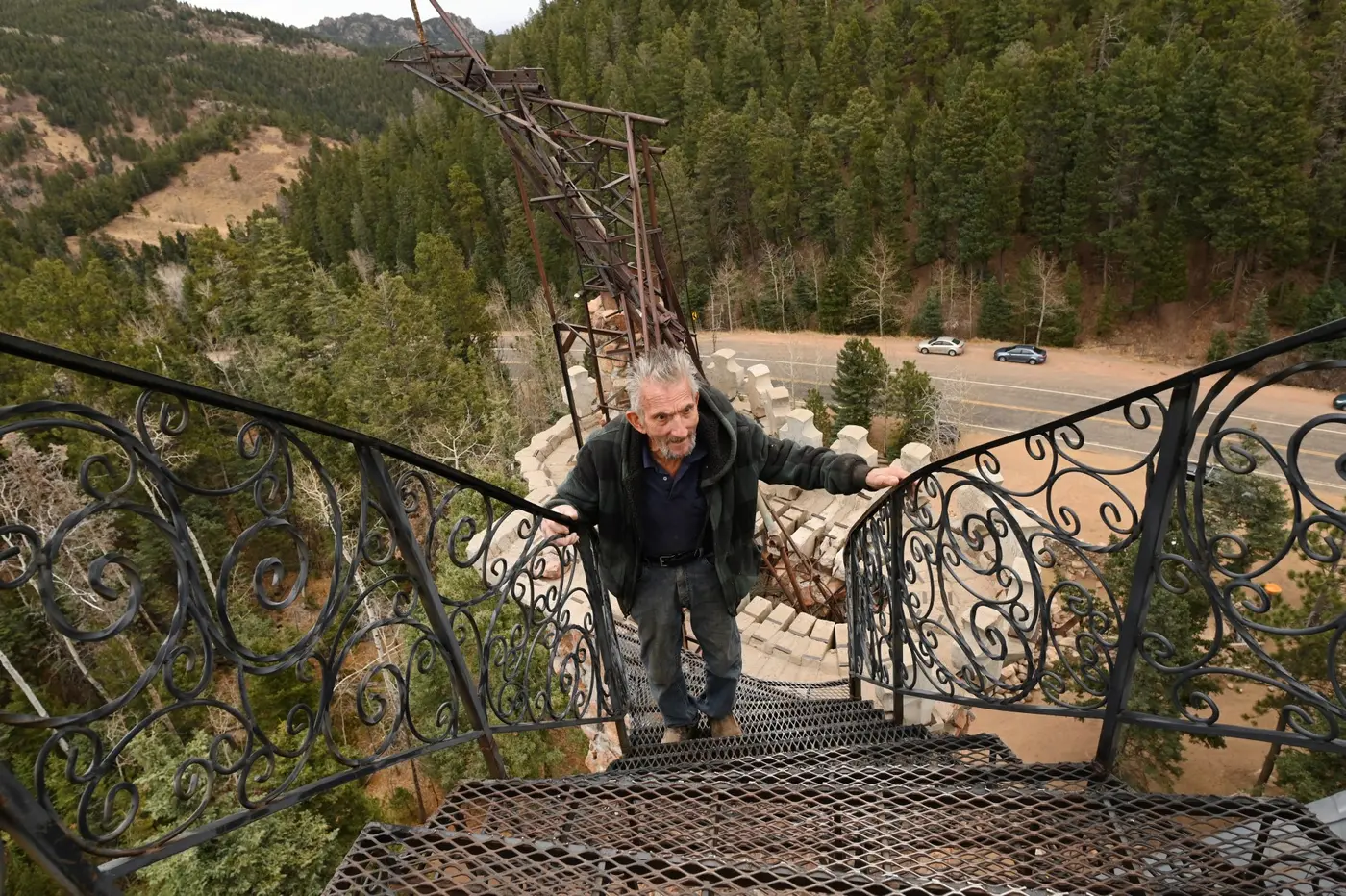
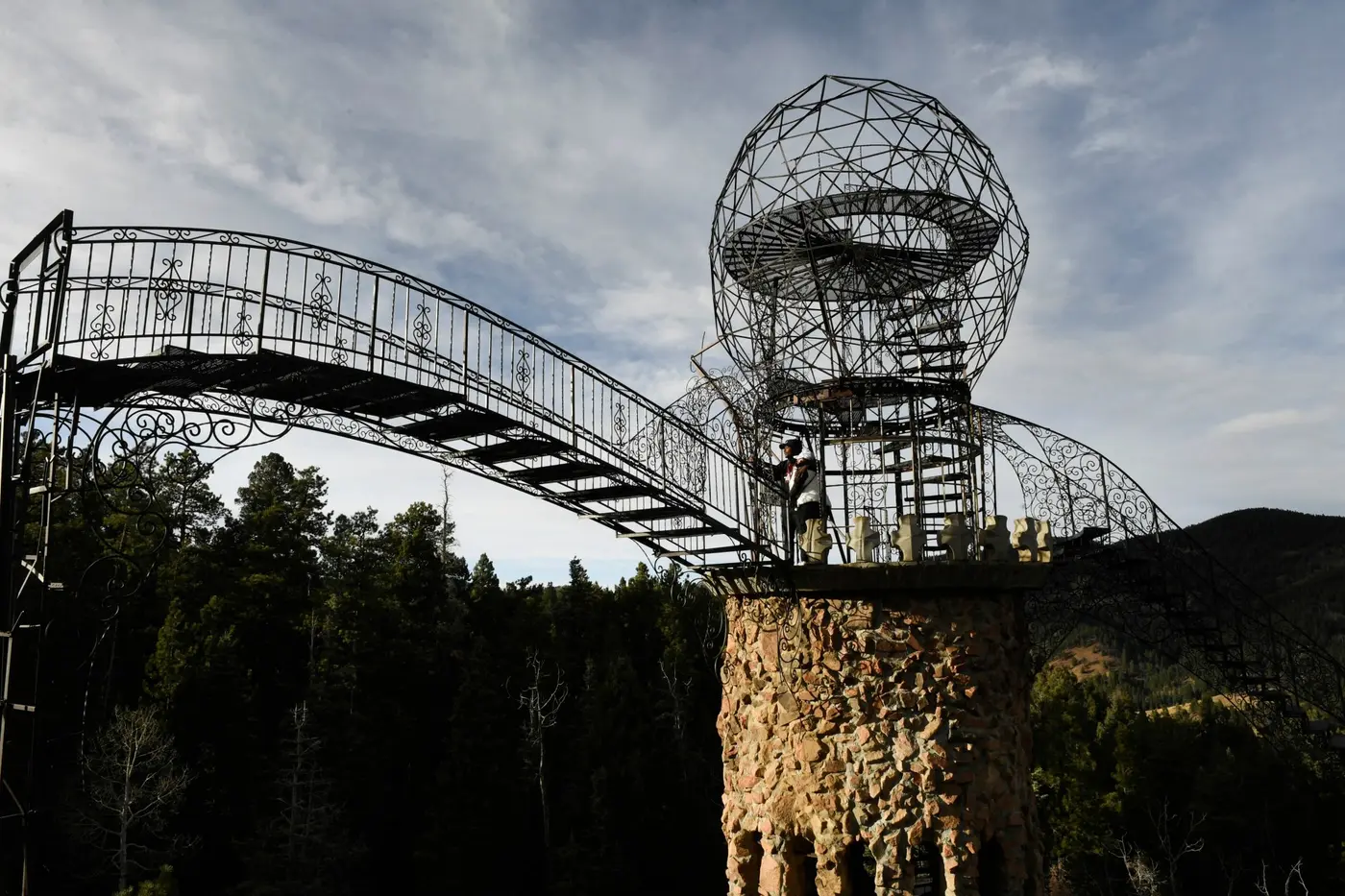
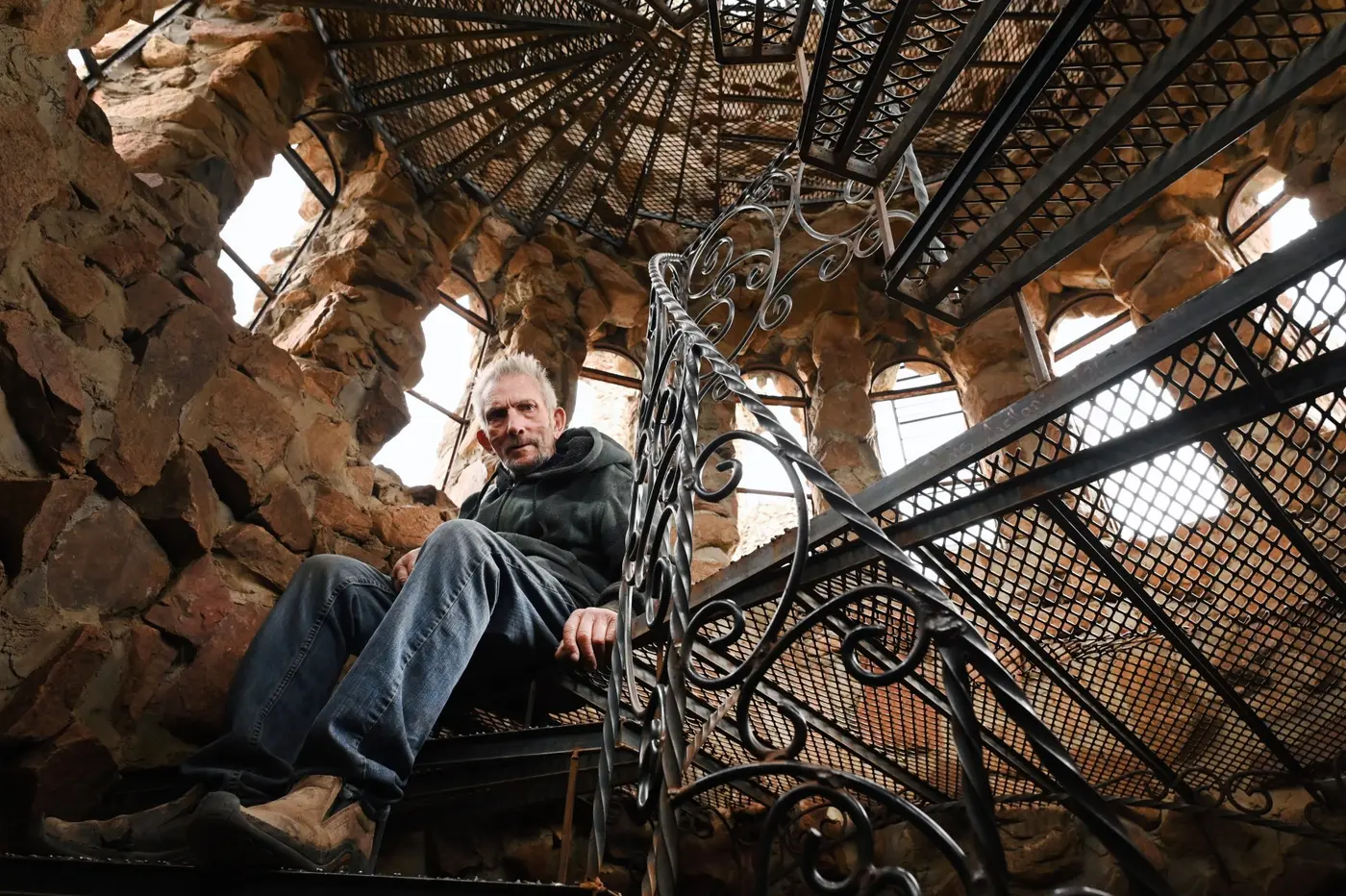
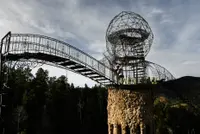
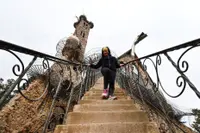
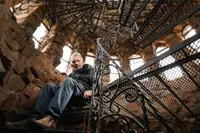
Inside, uneven stairs climb into dark turrets, and a winding staircase of stone and iron drops several floors. One whole floor is a cathedral room of ironwork, stone, wood, and stained glass, where weddings are held. Jim Bishop guessed the number at some 350 over the years. Above it, ironwork bridges and hollow iron spheres let visitors climb out over the castle for a view of the castle and the mountains. One walkway, called the bridge to nowhere, ends in open air. Metal hangs low through the arched entrances, and small ropes mark places where a misstep means a fall of dozens of feet. More than one visitor has called the place “authentically dangerous.” The Bishops told the Post there had been no serious injuries, though one woman died of a heart attack on a buttress near the base. Admission has always been free, partly out of kindness and partly, the Post reported, because the building cannot be insured.
The castle has electricity, a few porta-potties, and no running water. A gift shop stands beside it, rebuilt after the first one burned to the ground in March 2018. In September 2024 it was selling photographs of the builder.
Roy’s Tower and the caretaker
Daniel Bishop, the builder’s son, has been Castle Caretaker since about 2018, when his mother died and his father’s health began to fail faster. Like his father, he does not accept volunteer labor; he says he does not want anyone hurt at the castle and that he works best alone. What he asks for is materials, equipment, and money. His list includes tires for the skid steer, fuel, cement, gravel, and a mini excavator.
His plans follow his father’s. He means to finish Roy’s Tower and connect the bridge to nowhere to its top, and to raise the shortest tower another 30 feet. He also hopes to build the wall his father imagined around the whole property: three stories high, with massive corner towers, a gatehouse and drawbridge, and rooms for a Renaissance-style market of vendors and entertainers. Daniel has vowed never to sell the land, and he worries about altering work that is not his. “If someone picked up a Picasso and started painting on it,” he told the Post, “then it’s not a Picasso anymore.”
Donations also support the Bishop Castle Foundation, which helps families of newborns needing heart surgery. Phoebe Bishop, Jim’s wife, started it after a friend’s newborn was born with a defective heart. The castle paid on that family’s mortgage, bought them a cart of groceries, and covered six months of utility bills.
Ten summers on Highway 165
Jim Bishop was born in 1944, the oldest son of Willard and Pauline Bishop of Pueblo. His daughter Donita said he was not expected to live past the age of five. She also told of a family trip to Seven Falls, a paid attraction in Colorado Springs, when he was about ten. Someone saw him climbing and called, “Little boy, get down from there!” The family, who had little money, were embarrassed. His castle would let anyone climb.
In 1959, at fifteen, he left Pueblo South High School in his junior year after an argument with a teacher. By his own account, the teacher yelled, “You’ll never amount to anything, Jim Bishop!” That same year, riding bicycles with friends along Highway 165, he found a parcel of mountain land for sale at 9,000 feet. The accounts of the purchase differ. The castle’s own history says the lot was 2½ acres and that his parents bought it for him with the $450 he had saved from mowing lawns, delivering newspapers, and working in his father Willard’s ornamental iron business. Cheryl Johnson Huban, writing in the Greenhorn Valley View, cites Custer County Assessor’s records showing 1.25 acres. She says his parents cosigned, and that the $450 was either the whole price or a payment toward $1,250. For ten summers Jim and Willard camped on the land and cleared the heavily wooded lot for a family cabin. Jim found he liked swinging an axe.
The castle’s history says father and son began a rock cottage in June 1969. Huban writes that Jim had married Phoebe Marie in 1967 and that the two of them started the one-room cottage two years later, with free rock from the mountains. She adds that Jim and Willard traded weeks, one running the iron shop in Pueblo and one building on the mountain. She also notes, without explaining it, that the assessor’s office recorded a one-bedroom, one-bath structure on the site in 1962. In the spring of 1971 the family needed water. Willard salvaged a 40-foot metal tank from the Sacred Heart Orphanage in Pueblo for a gravity-fed cistern, then began walling it in stone, with a staircase up its side.
How the cottage became a castle is told two ways. Huban writes that friends and neighbors said the stone-wrapped tank looked like a turret. The castle’s history says friends and family remarked on the arched windows, and that by 1972 rumors of a castle had spread. That year a couple caught in a storm stopped to ask directions to it, and they were overjoyed to find they had arrived. In the spring of 1973 Jim began digging down to bedrock in front of the cottage. When Willard asked what he was doing, Jim answered, “The people want a castle and I’m gonna’ build them a castle!” Willard threw up his hands: “That’s just too much work! We came to the mountains to get away from people, and now you want to build them a castle?” He would have nothing to do with it.
Granite by pulley
There were never blueprints. Jim worked from books and pictures, moving from one part of the building to the next. He renewed a Forest Service permit to haul rock every year and trucked cement up from Pueblo or sometimes Cañon City. He was an ironworker by trade and built on weekends. By Huban’s count he found, hauled, and set more than 1,000 tons of rock. In 1978 a fire burned over Greenhorn Mountain. Already worried that his walls might fall outward, he added buttresses on the Notre Dame pattern. After setting his first square windows he swore off square shapes unless truly necessary, and every window, wall, and doorway after that was arched. On July 14, 1983, he and Phoebe received non-profit status from the State of Colorado. The Post reports that he also said he drew on the castles of his mother’s home, Ljubljana, Slovenia.
In early 1994 the radio producer Dave Isay found him backing a green Dodge truck. A cable from the truck ran to a pulley that was hoisting about 1,000 pounds of granite up the side of a hundred-foot tower. “Without cranes, without money, without a rich daddy, by hand, high school dropout,” Bishop said. “No bankers, no loans, no blueprints, no building permit, no inspectors.” He walked Isay through an interior then full of rock piles and lumber. He described the wishing wells and creeks to come, a wrought-iron-and-glass scenic elevator, and a gravity-belt escalator down a buttress, where “the weight of the people will turn automotive alternators, charging batteries.” He called the place “a poor man’s Disneyland.” In summer it drew hundreds of visitors a day, yet he could not get the state to put it on its travel map. “And here you guys are,” he told Isay, “after 24 years, you’re here.” The piece aired on All Things Considered on February 24, 1994.
Raves, a shotgun, and a jury
The hardest years came in pieces. In 1988, by the Gazette’s date, his four-year-old son Roy was killed in a tree-felling accident across the highway from the castle. The tower Daniel means to finish bears his name. In the late 1990s, Dan Bishop told the Post, his parents brought the nightclub scene up the mountain. Three-day raves of up to 1,500 people ran from Friday night to Sunday afternoon, and mosh pits formed on the castle’s third level. “Tourists would come Saturday morning and find these drunk and high partiers littering the landscape,” Dan said. Neighbors complained to the county of trespassing, drug use, and noise, and the county won an injunction. In 2002 ravers staged a wedding to get around it. The party would not stop, and Dan said it “turned into a gunfight”; he “made a noise with a shotgun.” Jim and Dan were charged with felony menacing. A Custer County jury found Jim not guilty on all charges. Dan was acquitted on 16 of 17 counts and served 30 days for reckless endangerment. In 2016 Jim was charged with bias-motivated crimes after a confrontation with Black tourists, and a jury acquitted him on all counts.
In April 2015 he was diagnosed with a rare and aggressive cancer, and an associate tried to take ownership of the land. By 2016 radiation had shrunk the former bodybuilder, who once curled 150-pound dumbbells, but he was back hauling rock. “Carcinoma means incurable,” he said. “Incurable my ass!” Phoebe, his wife of fifty years, died of cancer in 2018. Parkinson’s disease followed.
In November 2021 he shuffled out onto the bridge to nowhere, gripped the iron rail, and shook it, his slight frame swaying. “If I built it,” he said, “I can sure walk on it.” His last work had come in 2019. Too weak to mix mortar and carry it in buckets, he set small rocks along parts of the Great Wall without concrete. In 2023 he moved to a care facility, where he drew castles almost every day and gave the drawings to visitors. He died in Pueblo on November 21, 2024, at 80. In his last interview with CPR he spoke of the castle as his gift: “Them walls. Them buttresses, arches, towers, if there wasn’t somebody to climb on them, be inspired by them, get married up there and use them and have fun screaming and hollering and climbing, there’d be no point in doing it.”
Notable Events
- 1959Jim talked his parents into cosigning for him to purchase a 1.25 acre parcel of land bordered on three sides by the San Isabel National Forest. greenhornvalleyview.com
- 1962The Custer County Assessor's office recorded a one-bedroom, one-bath structure being built on the site in 1962. greenhornvalleyview.com
- 1969Jim and his father began building a rock cottage with a water tank surrounded by a rock wall and some arched windows; visitors remarked that it looked like a castle. thebishopcastle.com
- 1971Needing a water source, Willard salvaged a large metal tank from the Sacred Heart Orphanage in Pueblo to become a gravity fed cistern. greenhornvalleyview.com
- 1973Daniel Bishop, later the castle's caretaker, was born around the time his father finished the castle after days and nights of hauling rock. gazette.com
- 1973Jim began digging a hole down to bedrock out in front of the cottage-to-be. thebishopcastle.com
- 1978A fire burned over the top of Greenhorn Mountain; worried about the walls falling outward, Jim decided to construct Notre Dame type buttresses. greenhornvalleyview.com
- 1983Jim and Phoebe received non-profit status from the State of Colorado. greenhornvalleyview.com
- 1988Bishop never stopped building despite the tragic death of his four-year-old son, a hardship the Gazette lists with his cancer diagnosis and his disputes with authorities and a legal ownership challenge over the land. gazette.com
- 1994A Sound Portraits interview with Jim Bishop at the castle, recorded in Rye, premiered on All Things Considered. storycorps.org
- 1998Raves at the castle drew complaints of trespassing, public urination, drug use and noise to county commissioners and law enforcement. denverpost.com
- 2002Ravers threw a wedding at the castle to get around the county's injunction; Jim and Dan Bishop were charged with felony menacing counts and a Custer County jury found Jim not guilty on all charges. denverpost.com
- 2016Bishop survived cancer and brutal rounds of radiation that shrank him, and came back to the castle to keep hauling rock. gazette.com
- 2018A fire destroyed the gift shop, which has since been rebuilt. cpr.org
- 2018Jim Bishop's wife died of cancer. gazette.com
- 2019Jim Bishop unknowingly did the last work on his monument, setting small rocks into place along parts of the Great Wall without using any concrete. thebishopcastle.com
- 2024His family announced his death early on the morning of Nov. 21, 2024; Bishop was 80 years old. cpr.org
- 2024Jim Bishop passed away surrounded by loved ones. thebishopcastle.com
People
- Roy Bishop, Jim Bishop's young son, killed in a tree-felling accident on the castle land, for whom Roy's Tower is named.
- Phoebe Bishop, Jim Bishop's wife of fifty years, whose photographs he showed visitors at the castle (died 2018).
- Valerie Bishop Moore, Jim Bishop's daughter, who cared for him in his last years and calls the castle's legacy freedom.
- James R. 'Jim' Bishop, builder of the castle (Born in 1944).
- Phoebe Marie, Jim's wife; with him started the one-room stone cottage (married 1967).
- Willard, Jim's father; camped on the land ten summers doing groundwork for a family cabin, and surrounded the water tank with stone.
- Daniel Bishop, Castle Caretaker, cares for his father's work (since about 2018).
- James Roland Bishop, builder, Jim Bishop, the Castle Builder (1969 until 2019).
- Jim Bishop, Built the castle single-handed, one stone, one log, one weld at a time; known as Jim Bishop, the Castle Builder (1969 until 2019).
- Willard Bishop, Jim's father; ran the family ornamental iron business and began the rock cottage with Jim (June of 1969).
Sources
- thebishopcastle.com
- thebishopcastle.com/wedding-ceremonies
- thebishopcastle.com/we-need-your-support
- thebishopcastle.com/our-charity
- denverpost.com/2021/11/25/bishop-castle-colorado
- gazette.com/2024/11/24/jim-bishops-castle-a-towering-legacy-forged-through-sickness-and-tragedy-60059798-a844-11ef-aa2e-774a672d0ef0
- storycorps.org/stories/jim-bishop-castle-builder
- gazette.com/2024/11/21/jim-bishop-one-man-builder-of-colorado-landmark-bishop-castle-has-died
- greenhornvalleyview.com/history/bishop-castle-part-1-4
- cpr.org/2024/11/21/james-bishop-builder-of-bishop-castle-dies-at-80
- greenhornvalleyview.com/history/bishop-castle-part-3-4
- greenhornvalleyview.com/index.php/history/bishop-castle-part-4-4