



Big Springs Cabin Site
Fredonia, Coconino County, Arizona. Cabin site; 2026: May 22 - October 13.
Details

- Where
- 430 S Main St, Fredonia, AZ 86022. Directions
- Getting there
- From Fredonia, AZ: 1.2 miles south of Fredonia on US 89A turn south onto FS 22. Stay on FS 22 for 27.3 miles until you see the Big Springs Cabins on your left. Pavement on FS 22 ends after 20.7 miles. Trip distance is about 28.5 miles.
- Fees
- $65 per night plus recreation.gov reservation fee; all bookings subject to a one-time $8 reservation fee.
- Access
- Restrictions are posted. RVs and tent camping are prohibited. Pets not permitted, except for service animals. Parking is limited to two vehicles per cabin. RVs aren't permitted to park inside cabin area.
- Walk-in or reserve
- Reservation through recreation.gov or 877-444-6777.
- Phone
- (928) 643-7395
- Website
- recreation.gov
- Managed by
- Kaibab National Forest.
- Established
- 1800s.
- Coordinates
- 36.601465, -112.349865.
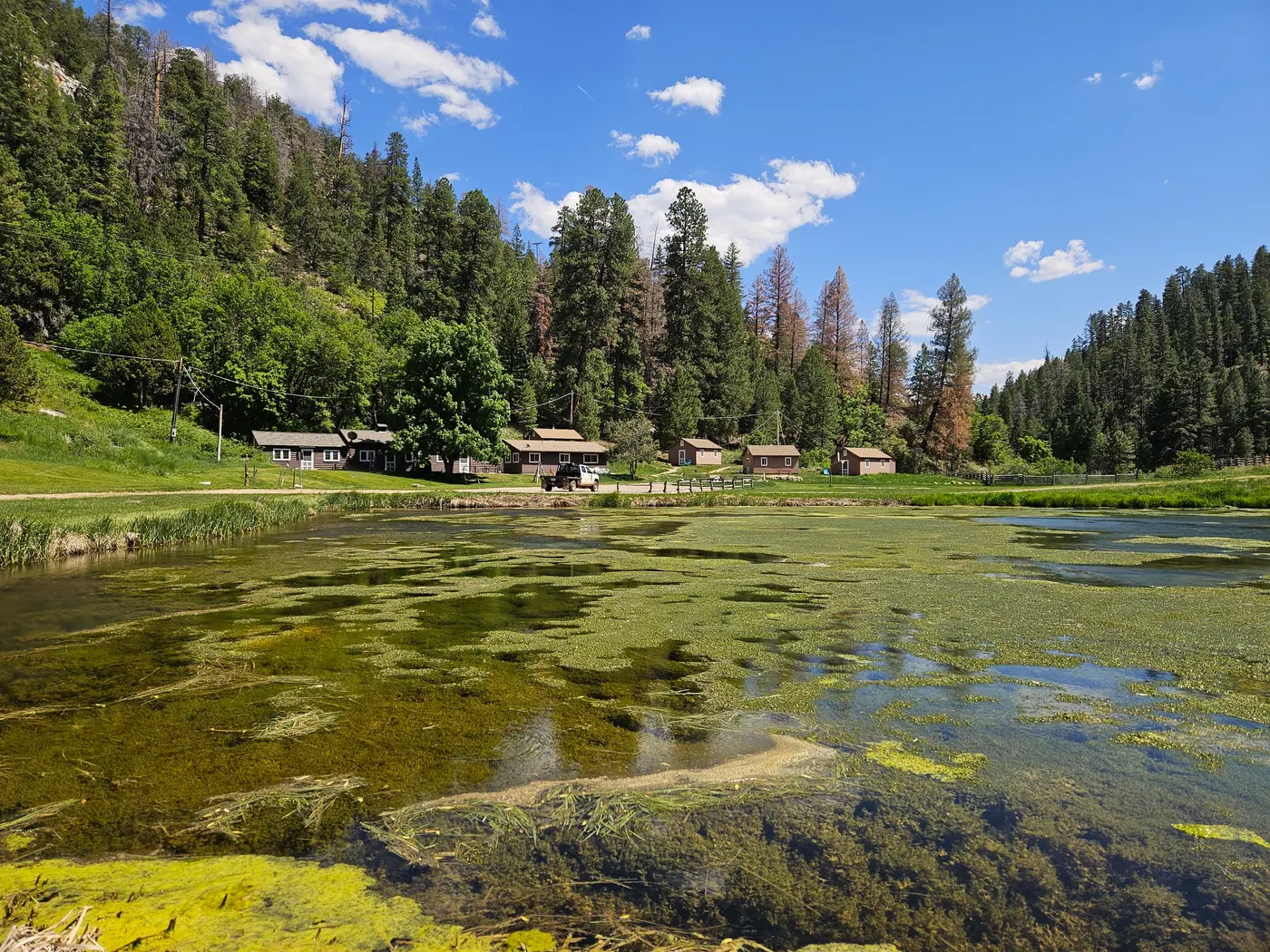
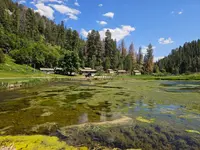
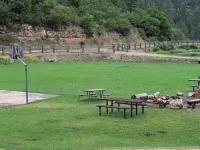
Forest Road 22 leaves US 89A just south of Fredonia and runs south onto the Kaibab Plateau. The pavement ends after 20.7 miles. About six and a half miles farther on, the Big Springs Cabins stand on the left. The station sits at about 7,000 feet at the foot of a limestone cliff. Water from Big Springs comes down the cliff face and flows into two ponds on the site. Ponderosa pine, gambel oak, and aspen grow here naturally. Green ash and willow were brought in from southern Utah, and together with a watered lawn they give the grounds the lush appearance the 1989 National Register nomination recorded.
Seven cabins and a shared kitchen
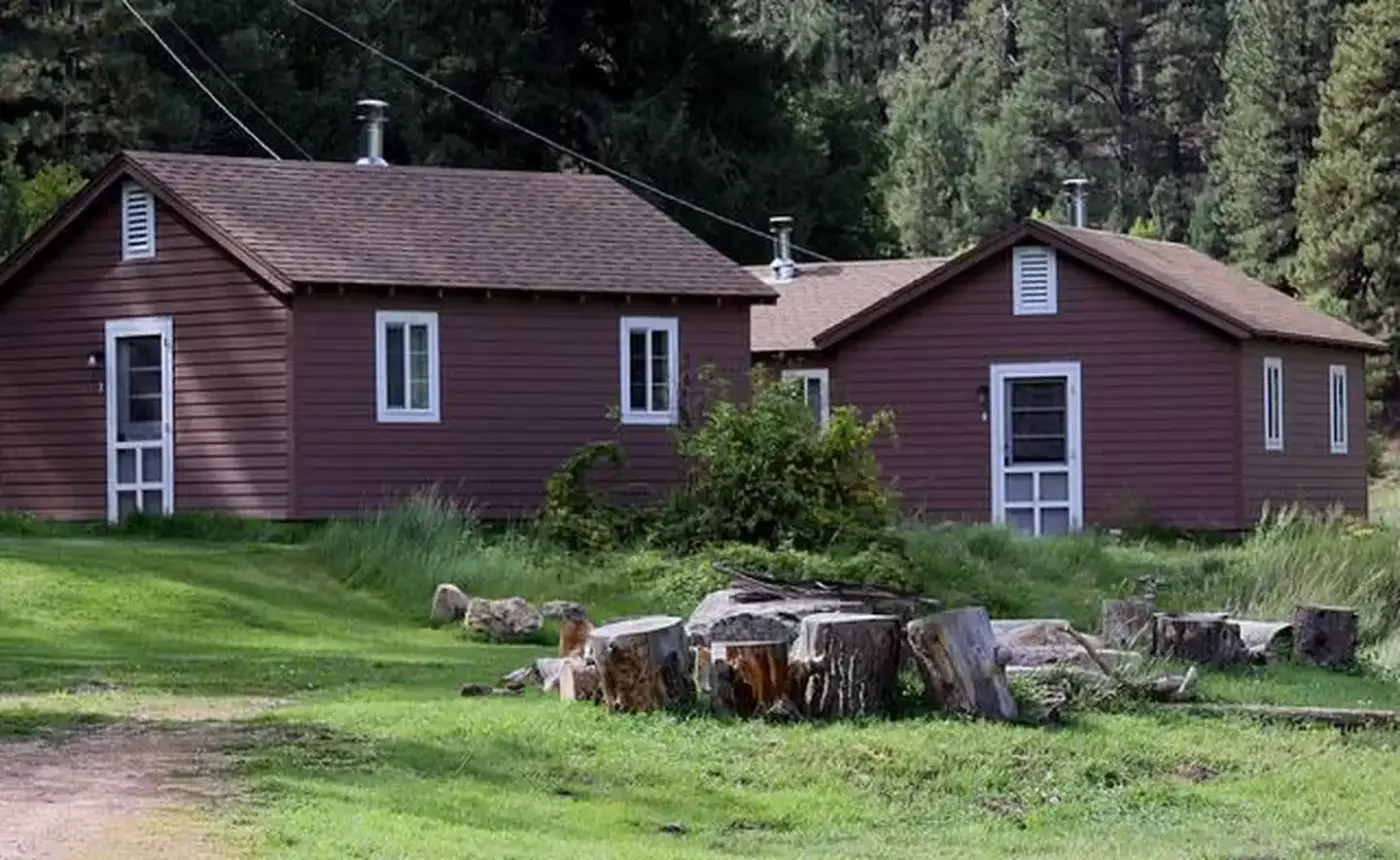
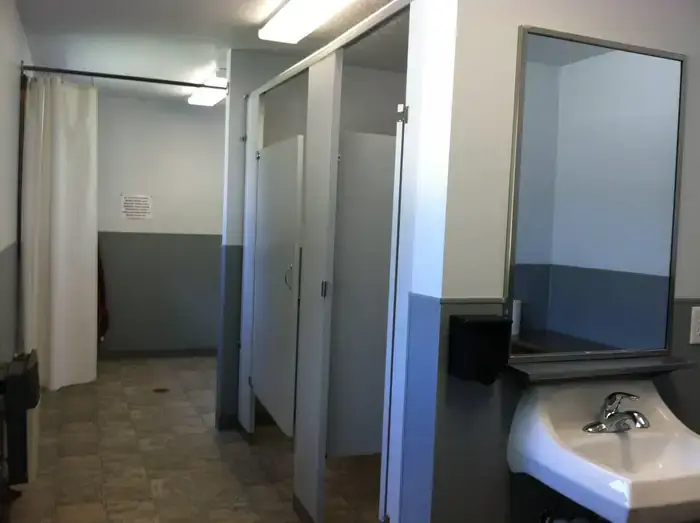
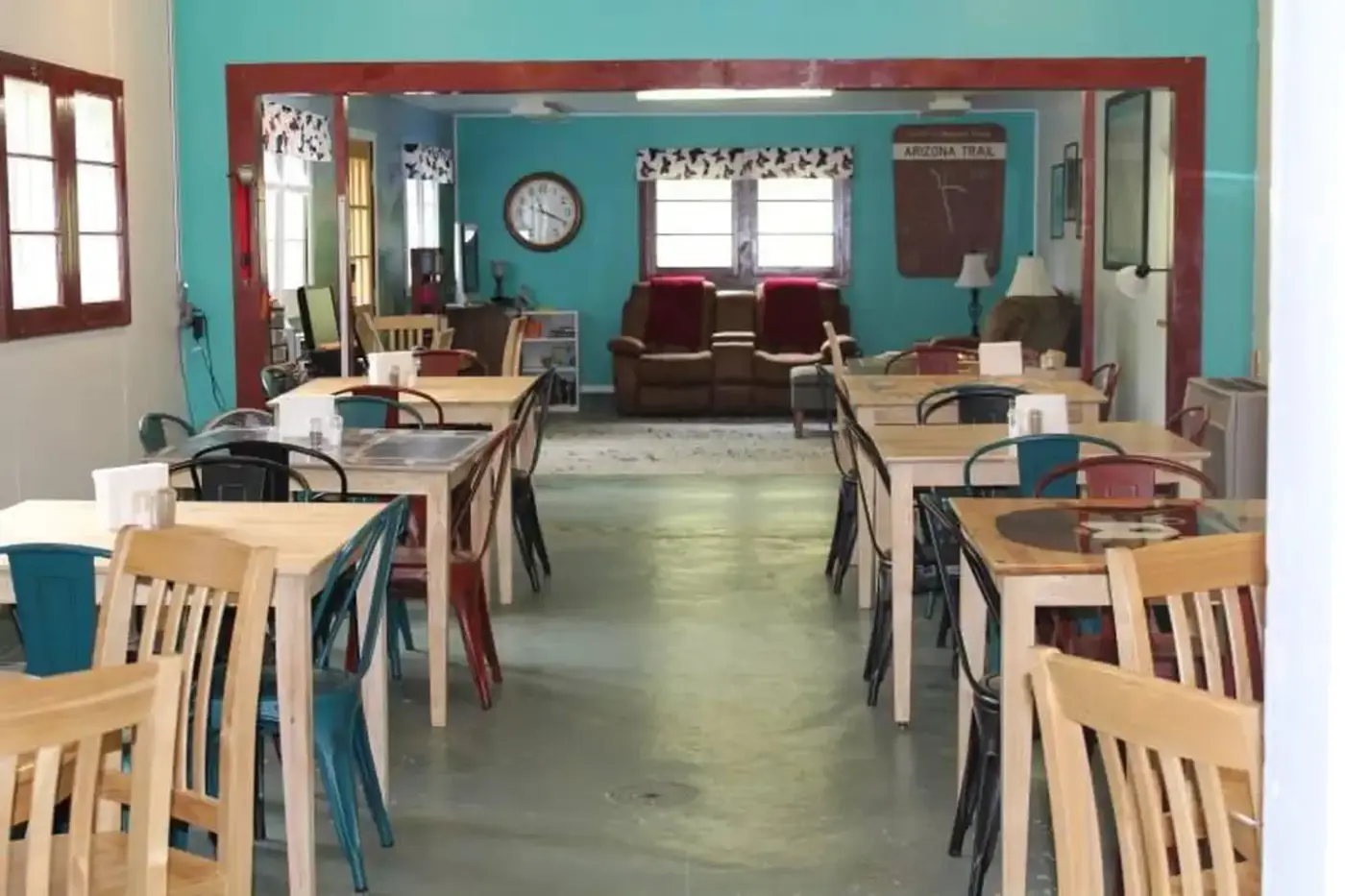
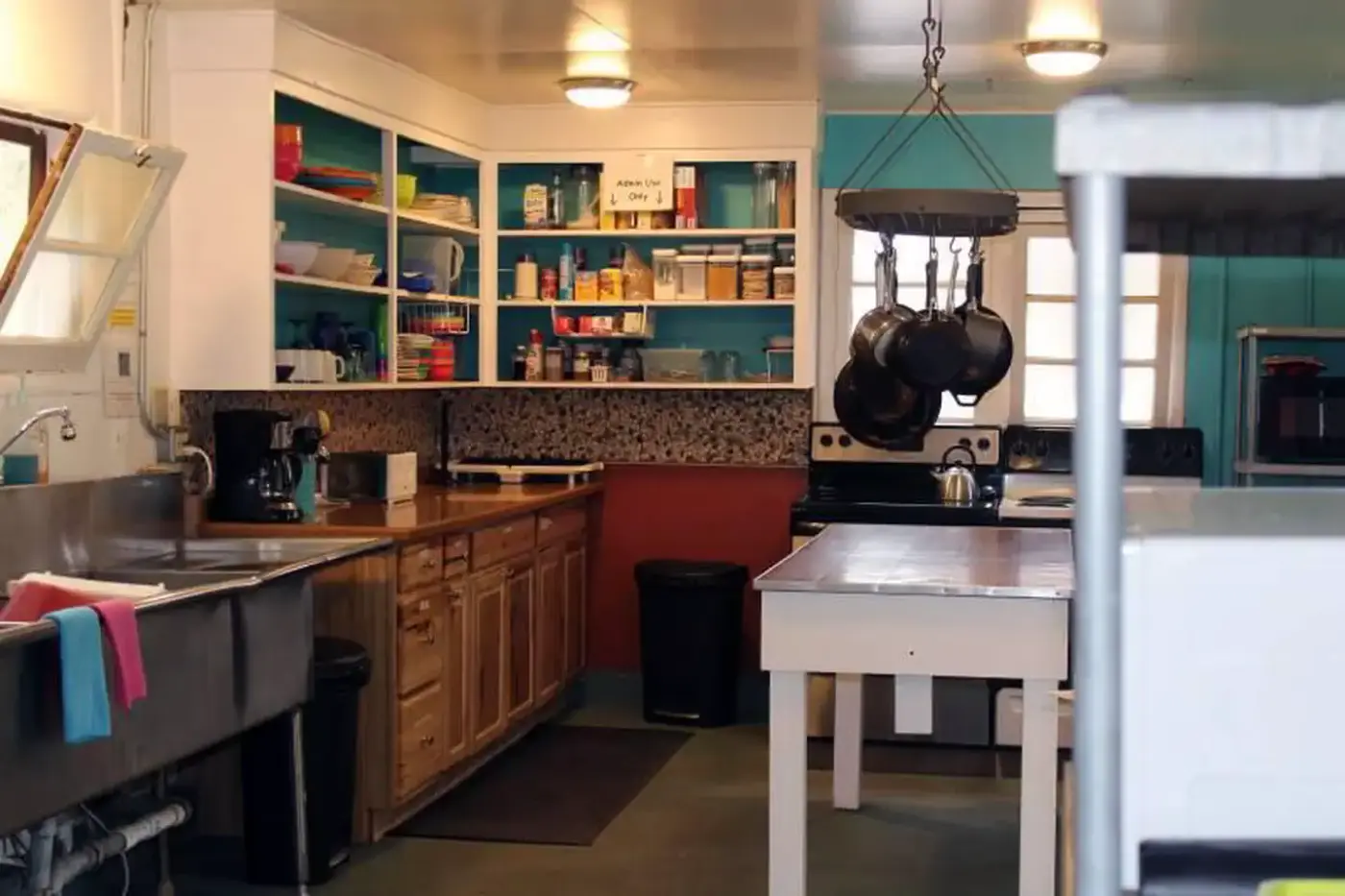
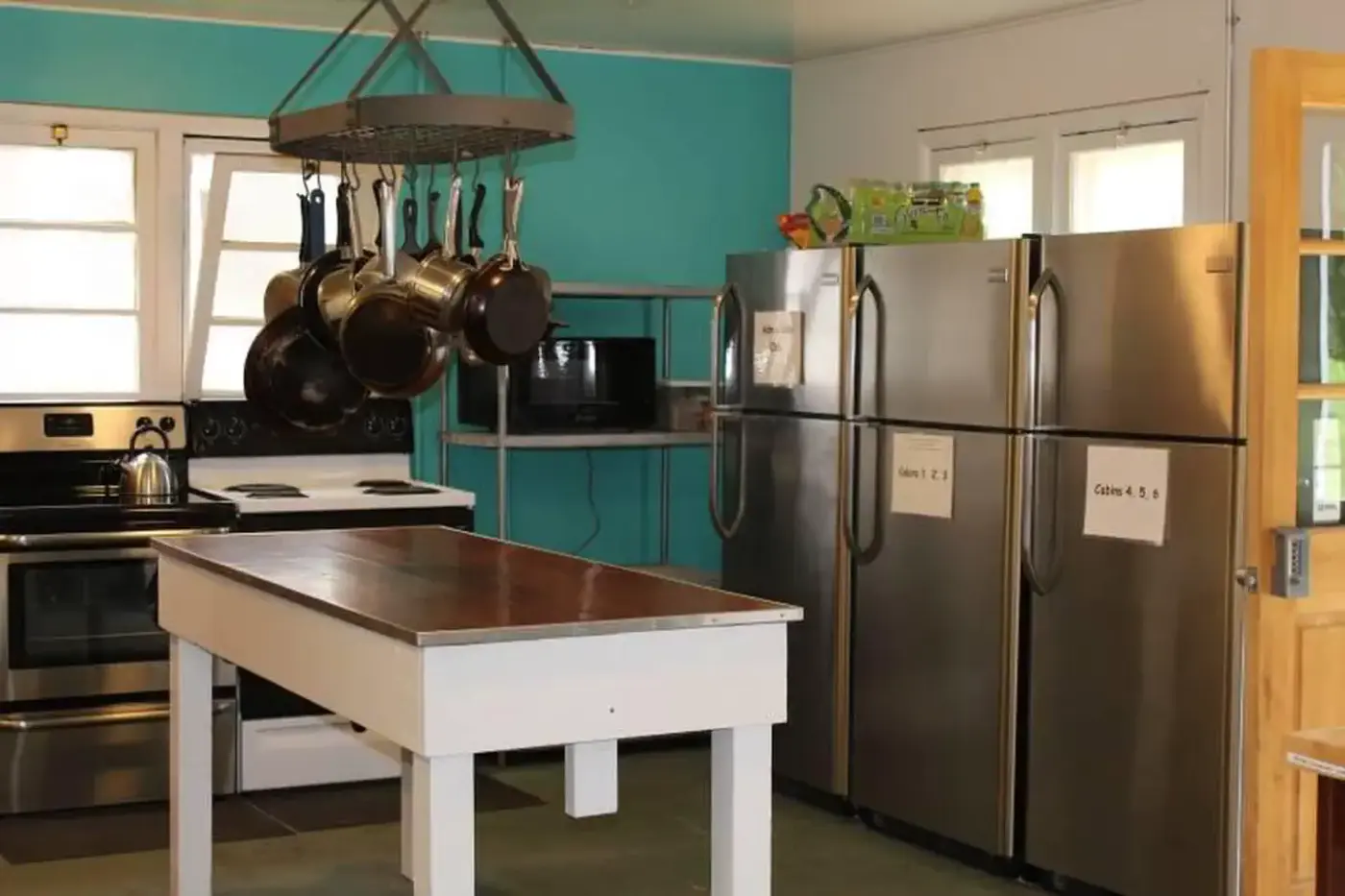
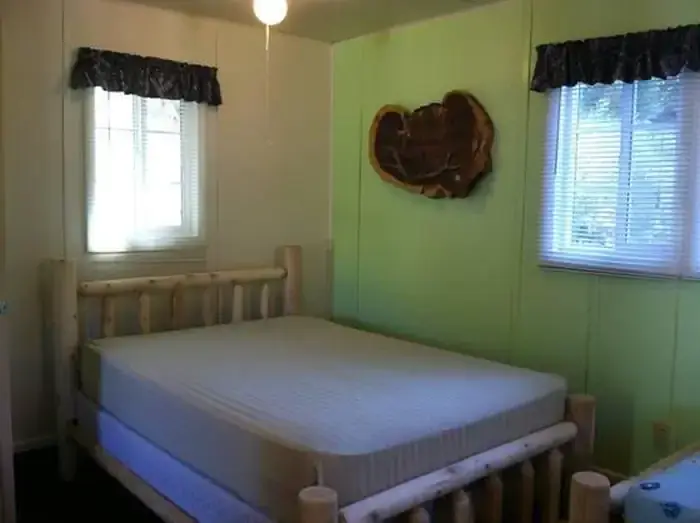
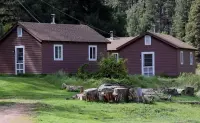
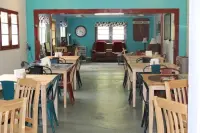
The Forest Service rents seven cabins here through Arizona’s Rooms with a View program. Cabins 1 through 6 each hold two twin beds and a full bed. Cabin 7 has a single queen. All seven are dry. Toilets and showers are in a shared shower house, and guests share a fully furnished kitchen, dining room, and living room. A cabin manual is kept in the main dining hall.
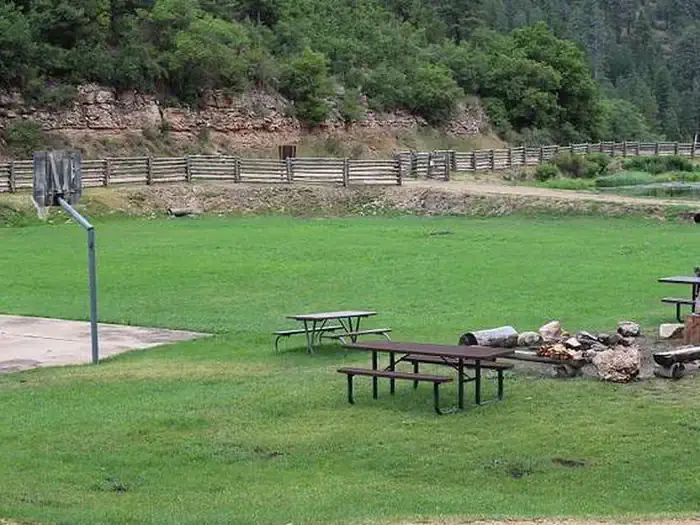
Guests bring their own linens, blankets, pillows, towels, toiletries, and food. Non-perishable supplies left by earlier guests stay for later ones, with no promise the same things will be there next time. There is a propane grill, though propane may not always be on hand. There is no cell service and no guest internet, and water and electricity sometimes go out for a while. A host lives on site, and the host’s RV is the only one allowed on the grounds. Fishing in the pond is prohibited.
The cabins stand apart from an active Forest Service administrative site. Its office, dwelling, and barn are the oldest buildings at Big Springs, and they are closed to the public.
The 2026 season runs May 22 to October 13. The Dragon Bravo and White Sage fires burned across the North Kaibab Ranger District and the Grand Canyon’s North Rim in 2025, and parts of the district remain under a temporary closure order, last updated April 17, 2026. In open country, the North Rim is about an hour’s drive from the cabins. The Rainbow Rim Trail is about 35 minutes away. It runs 18 miles along the north rim of the Grand Canyon past five overlooks.
A spring on a dry plateau
Running water is scarce on the Kaibab. Most rain and snowmelt sinks into the top three rock layers, the Kaibab, Toroweap, and Coconino formations, and flowing, perennial streams exist only just below springs. The geologist Clarence Dutton, writing in 1882, found something to admire in that: “the very absence of these traces of running water constitutes one of the greatest charms of the Kaibab, for every ravine is smooth as a lawn and carpeted with a turf of mountain grass, richly decked with flowers of rare beauty and luxuriance.”
Settlers came to the spring early. Recreation.gov says Big Springs has been used since the 1800s, first by homesteaders. The National Register nomination names one of them: Levi Stewart, who ran a portable lumber mill and lived at the site. His ranch is mentioned in Frederick Dellenbaugh’s diary of John Wesley Powell’s 1872 survey expedition.
The water also travelled. In 1901 the Petoskey Mining Company built a small smelter seven miles north of Big Springs and piped water to it from the spring. The smelter burned charcoal. According to a 2016 account in the Arizona Daily Star, it failed because the copper ore was highly siliceous.
The ranger station of 1908
The Forest Service was formed in 1905. Three years later, in 1908, the site was withdrawn from public use for a ranger station, chosen, the nomination says, for its nearness to “a rare and prolific water source.” Soon after, the Forest Service built a board-and-batten frame house with a hipped roof for the ranger, and it served for two decades. By 1911 the Kaibab Forest had ranger stations at six places: Ryan, DeMotte Park, Dry Park, Big Springs, Bright Angel, and Jacob Lake.
For years the country around was little used, with small lumbering and ranching operations the main business. In the 1920s Big Springs had a part in managing the Kaibab deer herd. Rangers set traps for fawns here and shipped the excess deer elsewhere to relieve the overcrowded range. About 1925 a one-bedroom board-and-batten residence went up beside the station. An addition around 1957 doubled its size and cost it its eligibility for the National Register.
Built in 1934 with recovery money
By the early 1930s the station needed new buildings. The Forest Service tore down the old ranger’s house, and in 1934 it built a dwelling, an office, and a barn with National Industrial Recovery Act funds, hiring local workers. Cecil Cram of Kanab, Utah, interviewed by Stephen Carr in November 1988, remembered helping “a Casey Jones” build the dwelling.
The three buildings follow standard plans drawn in the 1930s by Forest Service regional architects. The dwelling is an A-1N two-bedroom bungalow. It has narrow clapboard siding and low cross-gabled roofs, and an outside stone chimney stands between two six-light casement windows. Its porch rests on square posts, where the plan called for stone or cement piers. The office is a B-2 bungalow with two front doors opening off a gabled porch. The nomination counts it as one of only two B-2 offices left in Arizona; the other is at Crown King on the Prescott National Forest. The barn is a C-1 plan with board-and-batten siding and its original swing-out doors, and a corral is attached to it.
A trail once led from the station up the cliff to a fire lookout tower. Rangers here oversaw the ranching, homesteading, lumbering, and mining across their district. Large-scale logging came only after World War II, when the housing boom and trucks made it pay. By the 1950s, logging was extensive on the North Kaibab, and the Forest Service put up more cabins at Big Springs to house crews preparing timber sales. Eleven buildings from the mid-1950s stand mostly east of the historic core. They are wood-framed with beveled siding, built to match the older buildings. In 1989 the nomination noted that the crew cabins still served their original purpose.
Teri A. Cleeland, assistant forest archeologist, photographed the station in October 1988 and prepared the nomination on September 19, 1989. It was listed as Big Springs Ranger Station, NRIS 93000519, and evaluated at the statewide level. The district is a rectangle 470 feet north to south and 150 feet east to west. It holds the dwelling, office, barn, and corral, and the pond in front of the office and residence, which dates to the historic period.
The record of the district run from the 1934 office is not consistent. The nomination says the Big Springs Ranger District merged with the Jacob Lake Ranger District to form the North Kaibab Ranger District in 1974. The Kaibab National Forest ranger roll call instead lists a combined Big Springs-Jacob Lake District, based at Fredonia, from 1933 to 1971, consolidated with the North Kaibab in 1971, with the North Kaibab’s own list starting in 1974. The roll call names seventeen rangers for that district. The first is Robert Park, 1933 to 1937. Raymond Housley, Thomas Jones, and William Finley all held the post in 1958. The last is Horace Morgan, 1971 to 1971.
Notable Events
- 1872Local settler Levi Stewart, who operated a portable lumber mill, had lived at the site; his ranch is mentioned in Fredrick Dellenbaugh's diary of the 1872 John Wesley Powell Survey expedition. npgallery.nps.gov
- 1901The Petoskey Mine's small smelter, built in 1901, used charcoal as fuel and water piped in from Big Springs, 7 miles to the south. tucson.com
- 1908The site was withdrawn from public use in 1908; soon after, the Forest Service built a board-and-batten frame building with hipped roof to house the ranger. npgallery.nps.gov
- 1911By 1911 the Kaibab Forest had Ranger Stations in six locations: Ryan, DeMotte Park, Dry Park, Big Springs, Bright Angel, and Jacob Lake. npgallery.nps.gov
- 1920sBig Springs played an important role in the 1920s management of the famous Kaibab deer herd; rangers set traps for fawns at Big Springs and shipped the excess deer elsewhere. npgallery.nps.gov
- 1925An adjacent one bedroom board-and-batten residence was built in about 1925; a circa 1957 addition doubled its size. npgallery.nps.gov
- 1933The Big Springs-Jacob Lake District is dated 1933 to 1971 in the Kaibab National Forest roll call, with Robert Park its first listed ranger. ppolinks.com
- 1934The Forest Service tore down the old residence; the dwelling, office, and barn were constructed in 1934 using National Industrial Recovery Act funds to employ local workers. npgallery.nps.gov
- 1950sWith logging extensive on the North Kaibab Ranger District by the 1950s, the Forest Service built additional cabins at Big Springs to house crews preparing timber sales. npgallery.nps.gov
- 1971The roll call states the Big Springs-Jacob Lake District was consolidated with the North Kaibab R.D. in 1971; Horace Morgan is listed for 1971. ppolinks.com
- 1974The office was headquarters for the Big Springs Ranger District, which merged with the Jacob Lake Ranger District to form the North Kaibab Ranger District in 1974. npgallery.nps.gov
People
- Casey Jones, builder of the dwelling, as Cecil Cram remembered it.
- Cecil Cram, old timer from Kanab, Utah who remembered assisting in construction of the dwelling.
- Levi Stewart, local settler who previously lived at the site and operated a portable lumber mill.
- Arthur Riggs, Ranger listed for the Big Springs-Jacob Lake District of the Kaibab National Forest (1937 – 1941).
- Dennis Jenson, Ranger listed for the Big Springs-Jacob Lake District of the Kaibab National Forest (1965 – 1966).
- Frank Jackson, Ranger listed for the Big Springs-Jacob Lake District of the Kaibab National Forest (1945 – 1946).
- Franz Menninghaus, Ranger listed for the Big Springs-Jacob Lake District of the Kaibab National Forest (1966 – 1968).
- Fred Arbogast, Ranger listed for the Big Springs-Jacob Lake District of the Kaibab National Forest (1968 – 1971).
- Gordon Gray, Ranger listed for the Big Springs-Jacob Lake District of the Kaibab National Forest (1941 – 1945).
- Horace Morgan, Ranger listed for the Big Springs-Jacob Lake District of the Kaibab National Forest in the year it was consolidated (1971 – 1971).
- Ivin Murray, Ranger listed for the Big Springs-Jacob Lake District of the Kaibab National Forest (1949 – 1950).
- Jay Cravens, Ranger listed for the Big Springs-Jacob Lake District of the Kaibab National Forest (1954 – 1957).
- Joy Baldwin, Ranger listed for the Big Springs-Jacob Lake District of the Kaibab National Forest (1950 – 1954).
- Merle Gee, Ranger listed for the Big Springs-Jacob Lake District of the Kaibab National Forest (1946 – 1949).
- Paul Senteney, Ranger listed for the Big Springs-Jacob Lake District of the Kaibab National Forest (1959 – 1963).
- Raymond Housley, Ranger listed for the Big Springs-Jacob Lake District of the Kaibab National Forest (1957 – 1958).
- Robert Park, Ranger listed for the Big Springs-Jacob Lake District of the Kaibab National Forest (1933 – 1937).
- Thomas Jones, Ranger listed for the Big Springs-Jacob Lake District of the Kaibab National Forest (1958 – 1958).
- William Finley, Ranger listed for the Big Springs-Jacob Lake District of the Kaibab National Forest (1958 – 1959).
- William Pint, Ranger listed for the Big Springs-Jacob Lake District of the Kaibab National Forest (1963 – 1965).
Sources
- recreation.gov/camping/campgrounds/121740
- fs.usda.gov/r03/recreation/cabin-rentals-rooms-view
- fs.usda.gov/r03/kaibab/recreation/big-springs-cabins
- tucson.com/news/local/kaibab-national-forest-area-has-history-of-mining/article_88b2d58d-ef1a-5bcd-97dc-db781a547277.html
- npgallery.nps.gov/NRHP/GetAsset/NRHP/87001151_text
- ppolinks.com/forestservicemuseum/2021_1_25.pdf
- scholarsarchive.byu.edu/cgi/viewcontent.cgi?article=1106&context=mwnan