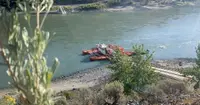
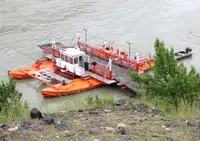
Big Bar Reaction Ferry
Big Bar Creek, British Columbia. Reaction ferry.
Details
- Where
- Big Bar Creek, BC. No street address stated. Directions
- When
- On demand; 7:00 am – noon; 1:00 pm – 5:00 pm; 6:00 pm – 7:00 pm.
- Getting there
- Across the Fraser River, 72 km west of Clinton.
- Fees
- free of charge to users.
- Access
- Ferry capacity is 10 tonnes GVW and 12 passengers, including drivers. Vehicle combination cannot exceed 12 metres.
- Phone
- 1 800 842 4122
- Website
- www2.gov.bc.ca
- Managed by
- Dawson Road Maintenance.
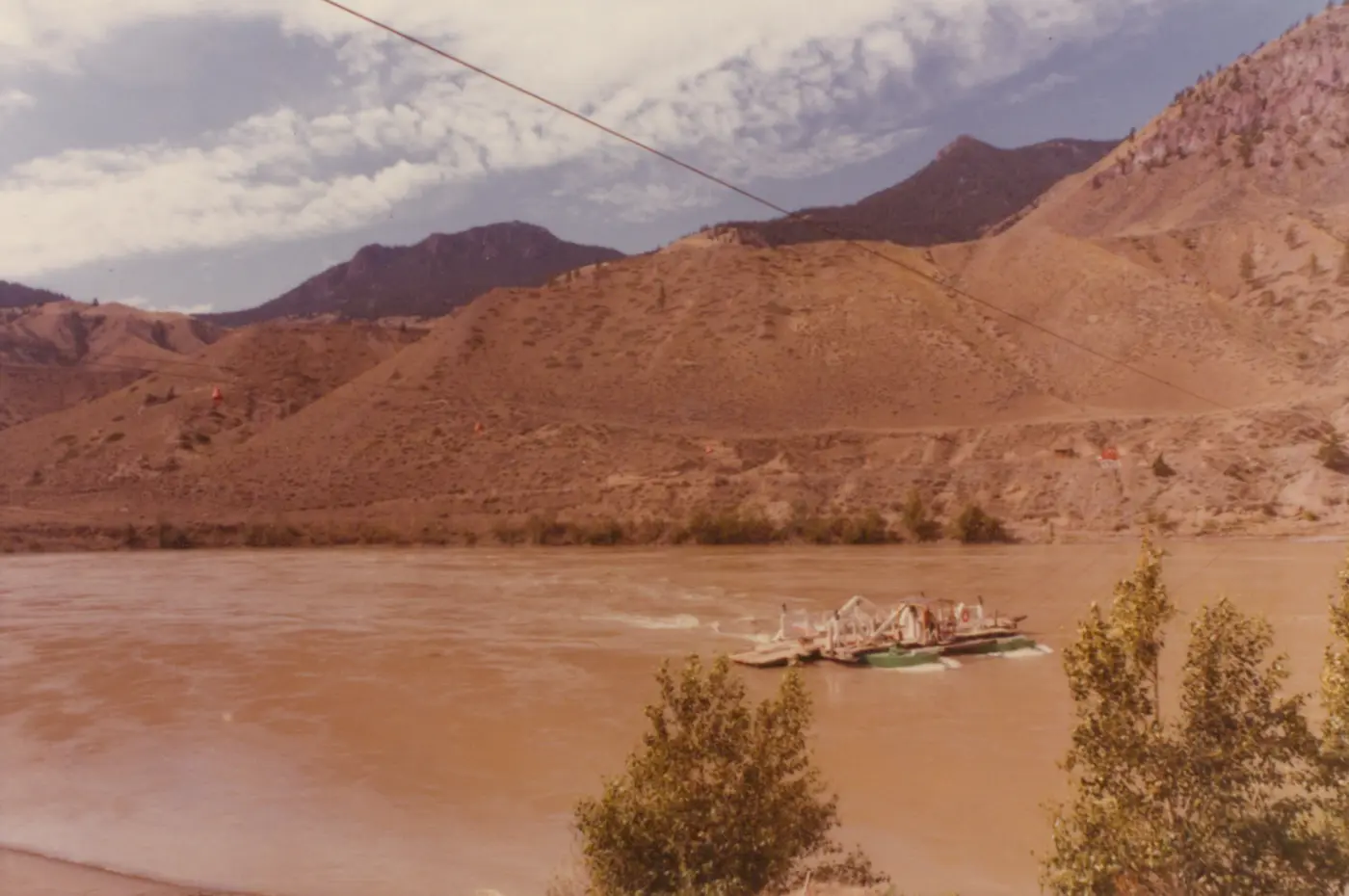
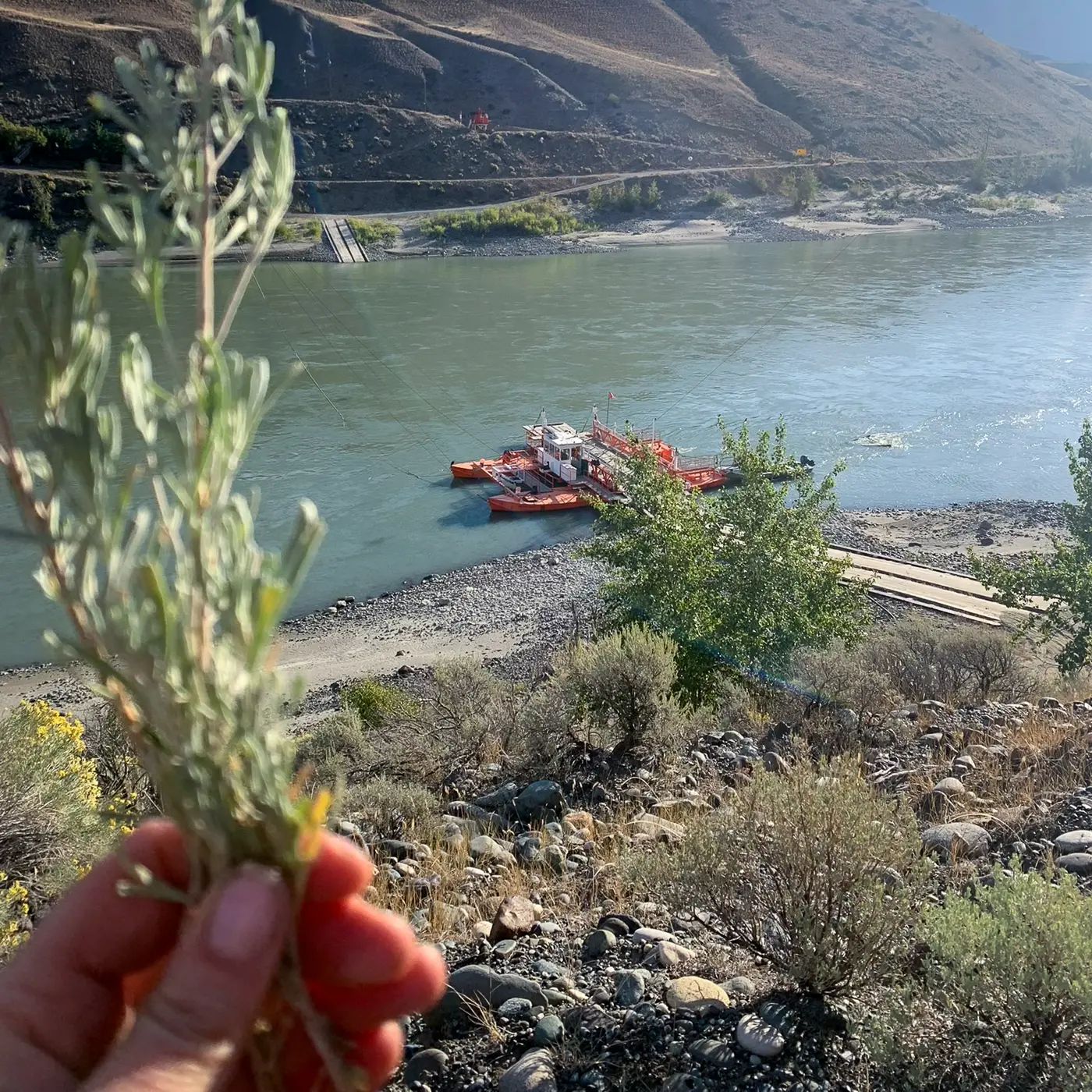
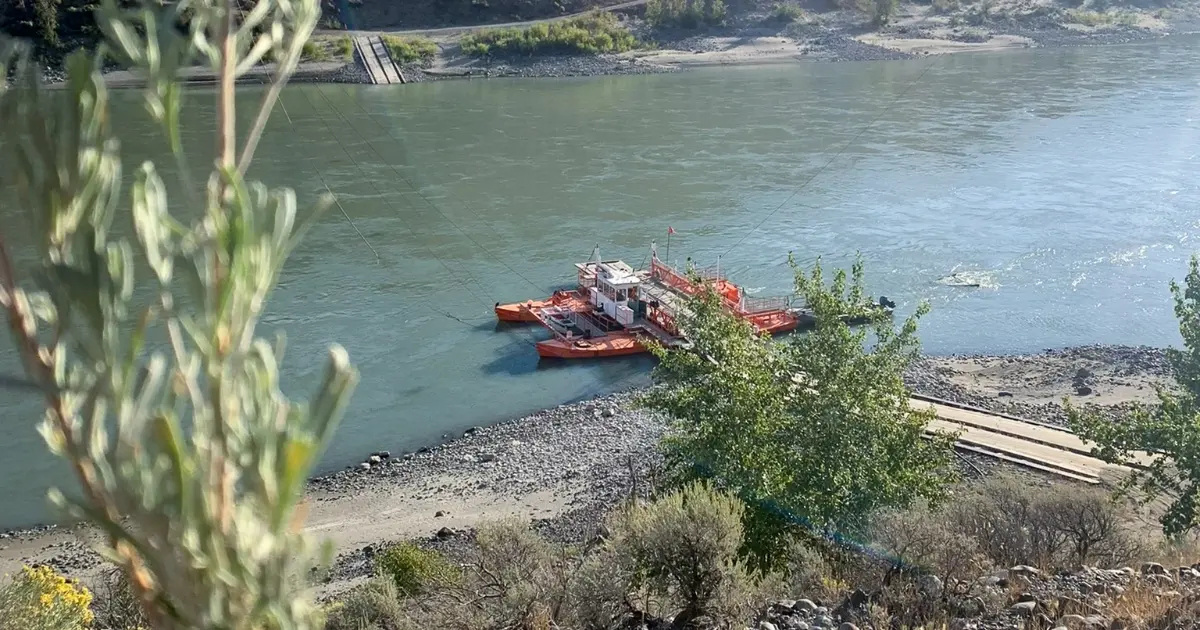
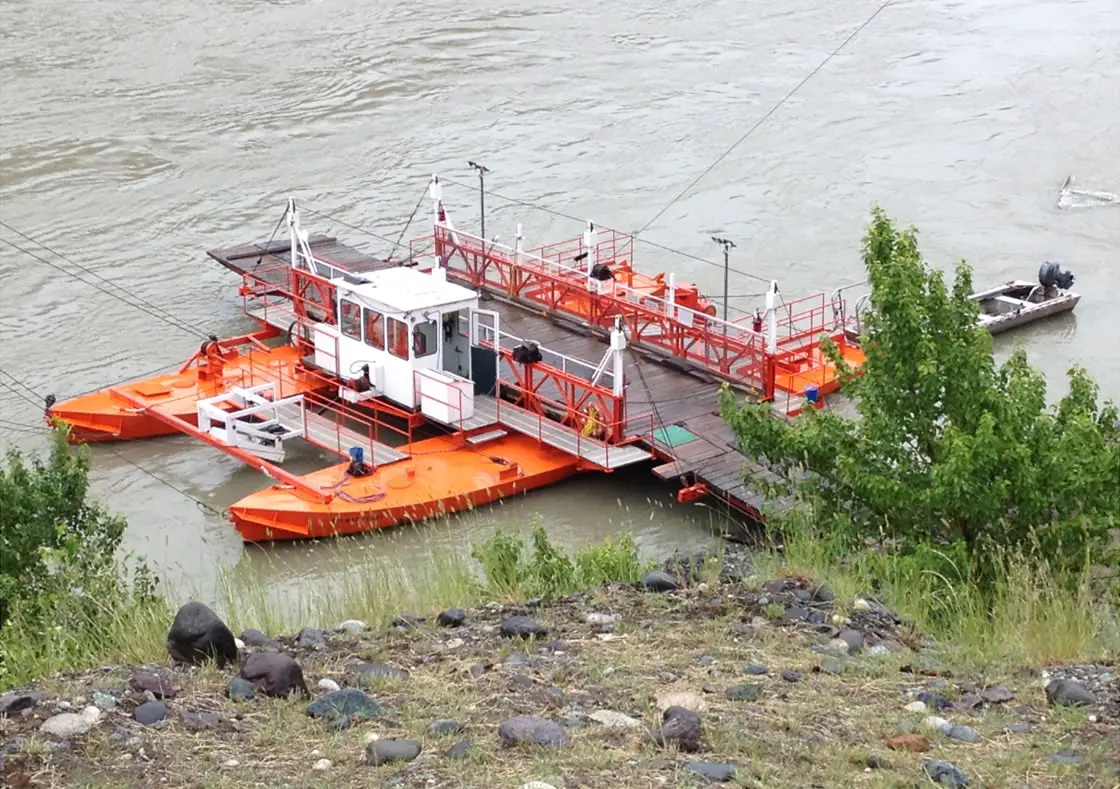
A barge rides an overhead cable across the Fraser River where Big Bar Creek comes in from the east, 72 kilometres west of Clinton. It has no motor. The river’s current, the cable and a set of rudders carry it from bank to bank in about ten minutes. It holds 10,000 kilograms gross vehicle weight and 12 people, drivers included: two vehicles, or one vehicle combination no longer than 12 metres. The ferry runs on demand from 7 a.m. to noon, from 1 to 5 p.m., and from 6 to 7 p.m. It is free, as are all of the province’s inland ferries.
When the water is low or icy, the barge gives way to an aerial tramway that carries passengers only. Through the quieter winter months that cable car serves the local families and workers who use the crossing year-round. Dawson Road Maintenance runs the ferry under private contract with the Ministry of Transportation and Transit, and the crew spends its downtime on maintenance.
The barge and the current
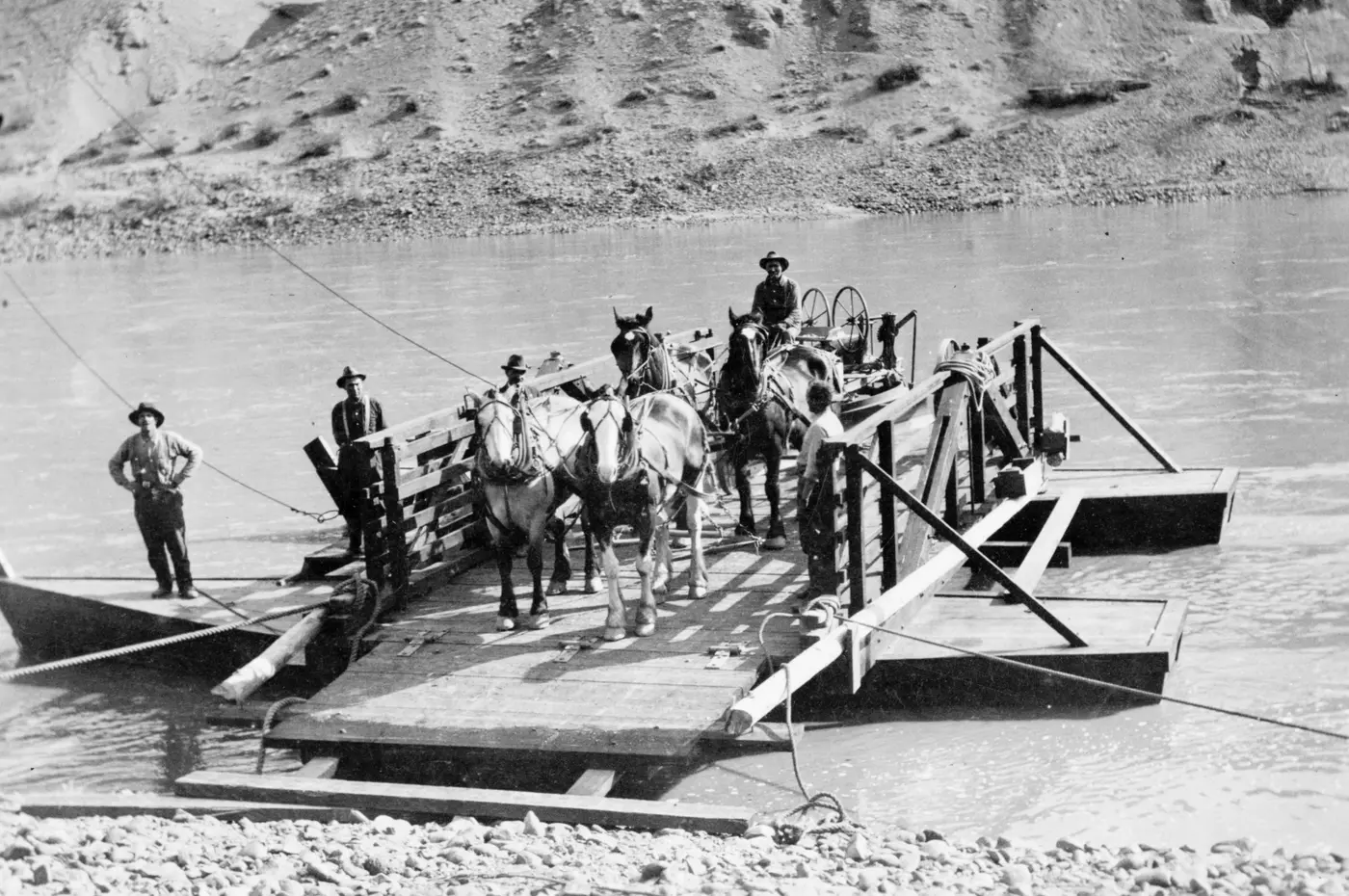
Reaction ferries, as the Prince George Citizen described them in 2017, are large barges mounted on pontoons, their route fixed to overhead cables. The wheelhouse “reacted” to the force of the river and worked the barge back and forth across the span. Trelle Morrow, the Prince George architect and historian who wrote Silent Passage about these ferries, told the paper why they spread: “It was easy to build the things, they were cheap, too, because they didn’t have engines, but it was tricky to learn how to operate them. You had to know how to read the currents and gauge momentum and so on.” One pilot he interviewed, Ted Brown, said he needed extensive training before he was given control by himself. Morrow added: “He told me it was all of about two hours of instruction.”
Bec Sturm and Rick Booker
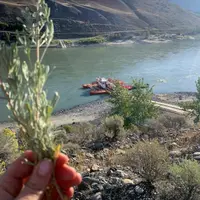
Rebecca Sturm, known as Bec, began operating the Big Bar Ferry in May 2025. She had first crossed seven years earlier as a tourist. “It was sentimental for me,” she told Dawson Road Maintenance. “We crossed through Gang Ranch and into Farwell Canyon, visiting the sand dunes that no one expects to find in Canada.” She later moved up from Chilliwack with a background in agriculture. She works 14 days on and 14 days off and spends her days off at home in Clinton, haying, riding her horse and walking her border collie, Bear. Her favourite season at the crossing is when the “sagebrush is in bloom.”
She was trained by Richard Booker, called Rick, who spent 28 years with Dawson Road Maintenance, eight of them running Big Bar. “He was so knowledgeable, an active historian,” she says. “Rick instilled the confidence in me to safely handle whatever the Fraser River and the elements might bring, from high water and debris to strong winds.” Tourists still ask after him, having heard about him from earlier travellers. Most of the people who cross are tourists. On long weekends the crew can make as many as 30 trips in a day, and Sturm answers questions about the region for those who ask. She is assembling a scrapbook on the ferry going back to the early 1900s, and she has set herself the goal of crossing every reaction ferry in the province.
With her arrival, Big Bar became the first inland ferry in British Columbia with an all-female crew. “There’s nothing better than seeing a young girl watching me operate the ferry with excitement,” she says. Asked about her own future there, she says: “I see myself following in Rick’s footsteps and retiring here one day.”
Seventy-five crossings, then five
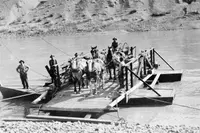
Following in Booker’s footsteps means joining a short list. By the research of Morrow and the historian Frank Clapp, about 75 reaction ferry sites operated in British Columbia. They started in the late 1800s and peaked around 1910. By the 1960s most had gone as bridges replaced them. Five were still running as of 2016: Usk, Big Bar, Lytton, Little Fort and McLure. The Marguerite ferry, south of Quesnel, closed in 2002. The province’s inland ferry list for 2026 still names all five.
The Encyclopedia of British Columbia dates a ferry at the mouth of Big Bar Creek to 1894. The present current-driven model, with its backup aerial tramway, is the latest form of that crossing.
A roadhouse and a gravel bar
The ferry is older than the provincial name it sits beside, though the settlement around it is older still. The Encyclopedia describes Big Bar Creek as a ranching area on the east shore of the Fraser, northwest of Clinton, in the south Chilcotin. In about 1862, Joseph Haller opened a roadhouse there known as the Red Dog Saloon. The Grinder and Kostering families were among the other early settlers, and the OK Ranch came later. The regional tourism body, Gold Country, calls the OK one of the oldest working ranches in the area and places it next to the Big Bar Guest Ranch. The same source tells of the roadhouse at nearby Jesmond, reportedly known as “Mountain House.” It is thought to have been settled in 1913 by a family from Jesmond, in Newcastle-upon-Tyne, England. That roadhouse burned in 1926, and the family rebuilt it.
The place takes its name from the river itself. The Williams Lake Tribune defines a river bar as a ridge or a run of ridges of sand and gravel, often lying across the mouth of a tributary stream. Hundreds of them line the 270 kilometres of canyon between Yale and the mouth of the Chilcotin River, and they lie submerged for several weeks at high water. More than 80 were named during the gold rush of 1858 to 1860. Some took the name of the first man to find gold on them. Others were named for their size or shape, among them Big Bar, Little Big Bar, High Bar and Cantilever Bar. The BC Geographical Names Office lists Big Bar Creek as an unincorporated rural community in the Lillooet Land District. Its name was adopted as official with a decision date of December 31, 1977.
Notable Events
- 1862Joseph Haller opened a roadhouse known as the Red Dog Saloon in the Big Bar Creek area; other early settlers included the Grinder and Kostering families, and in later years the well-known OK Ranch was located there. knowbc.com
- 1977The geographical-names record for Big Bar Creek carries a decision date of 1977-12-31. apps.gov.bc.ca
People
- Rebecca (Bec) Sturm, Big Bar Ferry operator; part of the first all-female crew at Big Bar Ferry (since May 2025).
- Richard (Rick) Booker, Ferry operator who trained his successor; spent 28 years with Dawson Road Maintenance, including eight years operating Big Bar Ferry (eight years operating Big Bar Ferry).
- Joseph Haller, opened a roadhouse known as the Red Dog Saloon in the Big Bar Creek ranching area on the east shore of the Fraser River northwest of Clinton (about 1862).
- Trelle Morrow, Prince George architect and local historian whose book Silent Passage documents the region's reaction ferry story, counting Big Bar among the last reaction ferry crossings in operation.
Sources
- www2.gov.bc.ca/gov/content/transportation/passenger-travel/water-travel/inland-ferries/big-bar-reaction-ferry
- www2.gov.bc.ca/assets/gov/driving-and-transportation/passenger/inland-ferries/pdf/inlandferryservices_brochure.pdf
- drivebc.ca/?type=ferry&id=8
- exploregoldcountry.ca/destinations-big-bar
- dawsonroadmaintenance.ca/news/2026/bec-sturms-big-bar-ferry-journey
- princegeorgecitizen.com/local-arts/book-looks-at-river-ferry-history-3727560
- www2.gov.bc.ca/gov/content/transportation/passenger-travel/water-travel/inland-ferries
- drivebc.ca/?start=null&end=null&type=ferry&id=8
- knowbc.com/limited/Books/Encyclopedia-of-BC/B/Big-Bar-Creek