

Berlin-Ichthyosaur State Park
Gabbs, Nye County, Nevada. State park; Open seven days a week, 365 days a year.
Details

- Where
- 20 Miles East of Gabbs on State Route 844, Gabbs, NV 89409. Directions
- When
- Fossil House Tours 2026: April 18th to Memorial Day at 10am and 2pm on Saturdays and Sundays; Memorial Day to Labor Day daily at 10am and 2pm; Labor Day to November 1st at 10am and 2pm on Saturdays and Sundays.
- Getting there
- 20 Miles East of Gabbs on State Route 844.
- Fees
- $5 for Nevada residents and $10 for out-of-state vehicles; campsites $15 per local vehicle per night (includes entry fee) and $20 for out-of-state vehicles.
- Hours
- Open 24 hours a day, seven days a week.
- Access
- Removing, disturbing or damaging any historic structure, artifact, rock, plant life, fossil or other feature is prohibited; metal detecting is prohibited.
- Walk-in or reserve
- Campsite reservations can be made in advance but aren't required.
- Phone
- 775-427-9332
- Managed by
- Nevada State Parks, a division of the Department of Conservation and Natural Resources.
- Established
- 1957.
- Coordinates
- 38.87472, -117.58972.
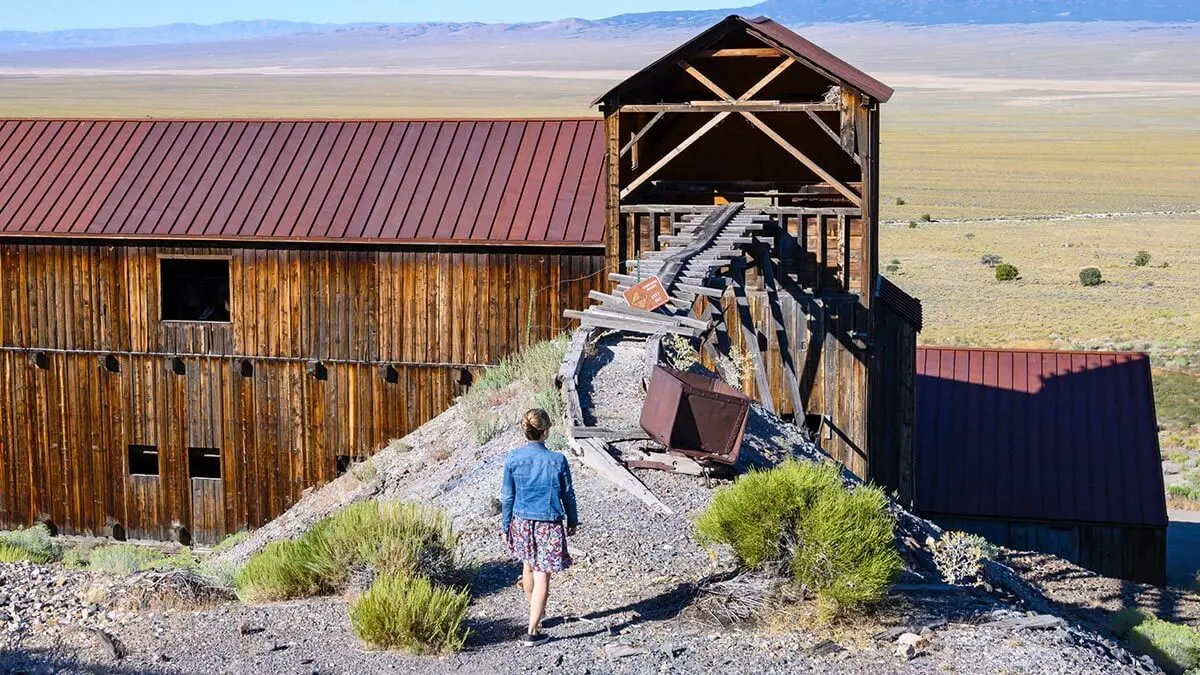
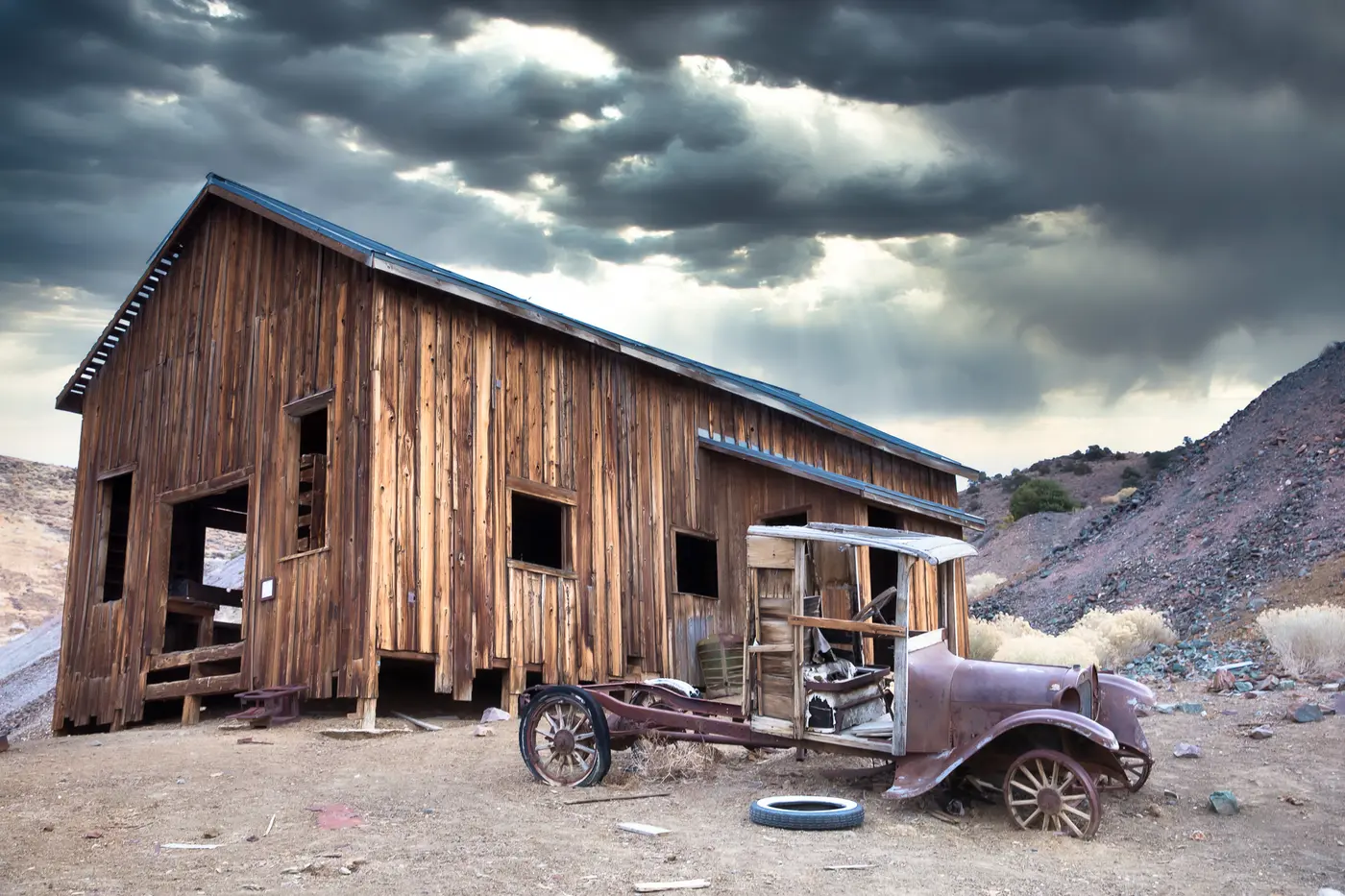
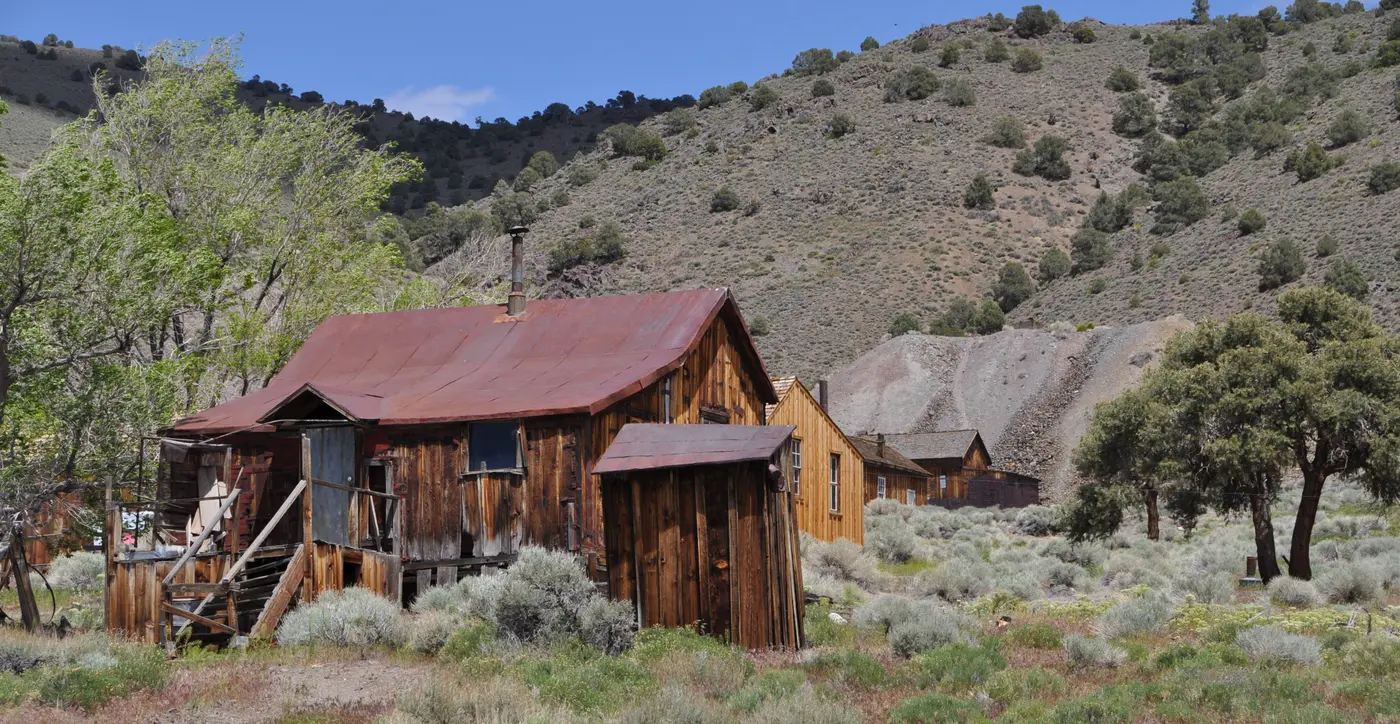
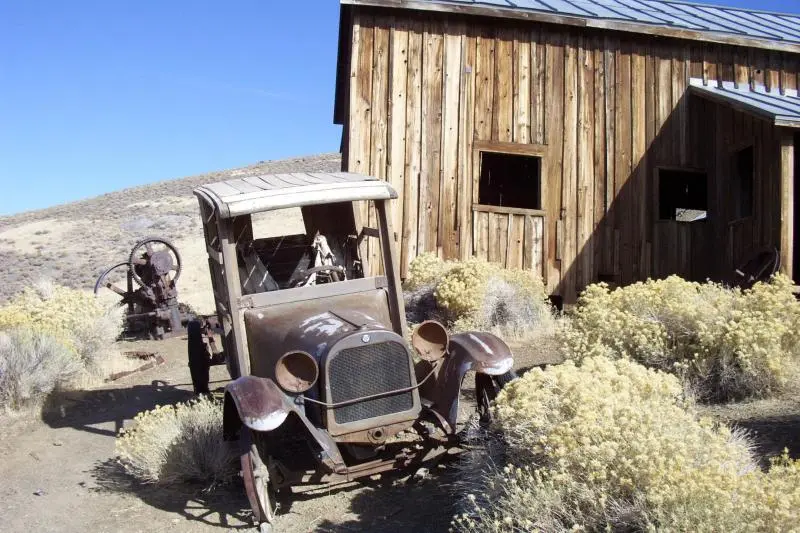
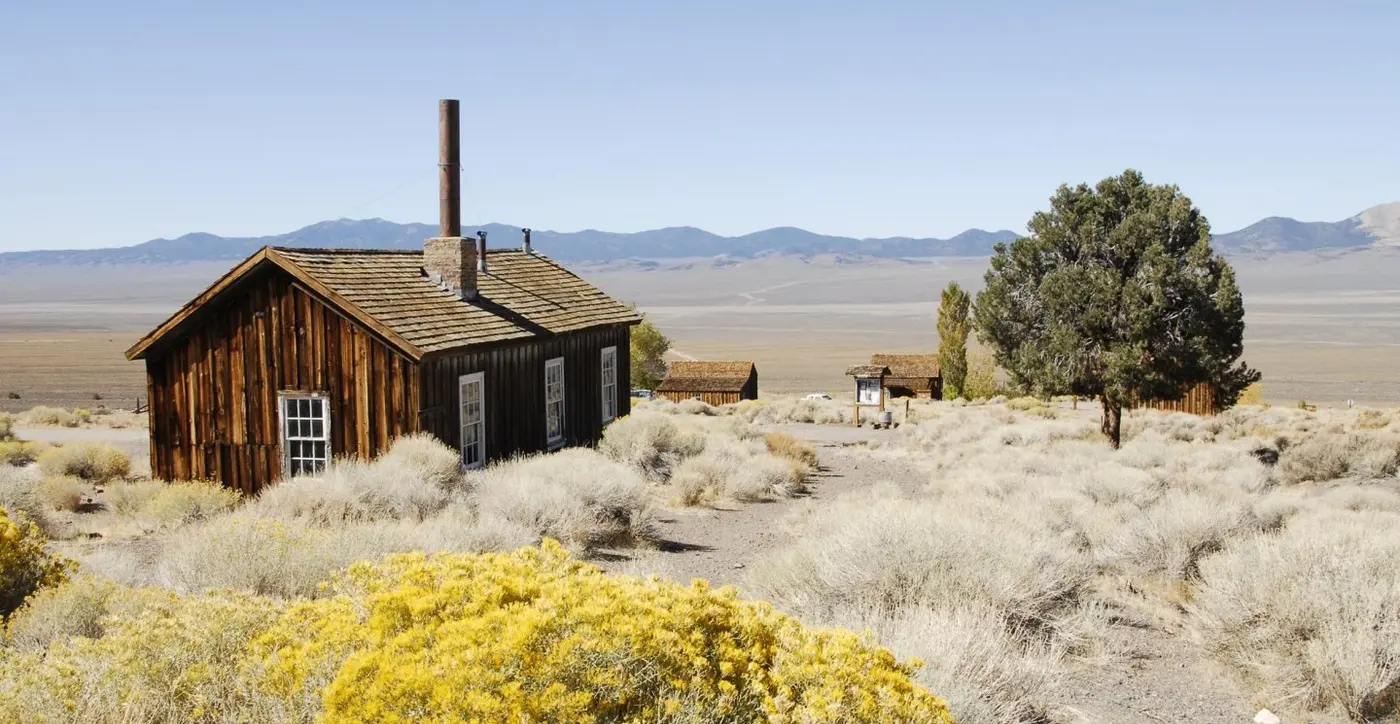
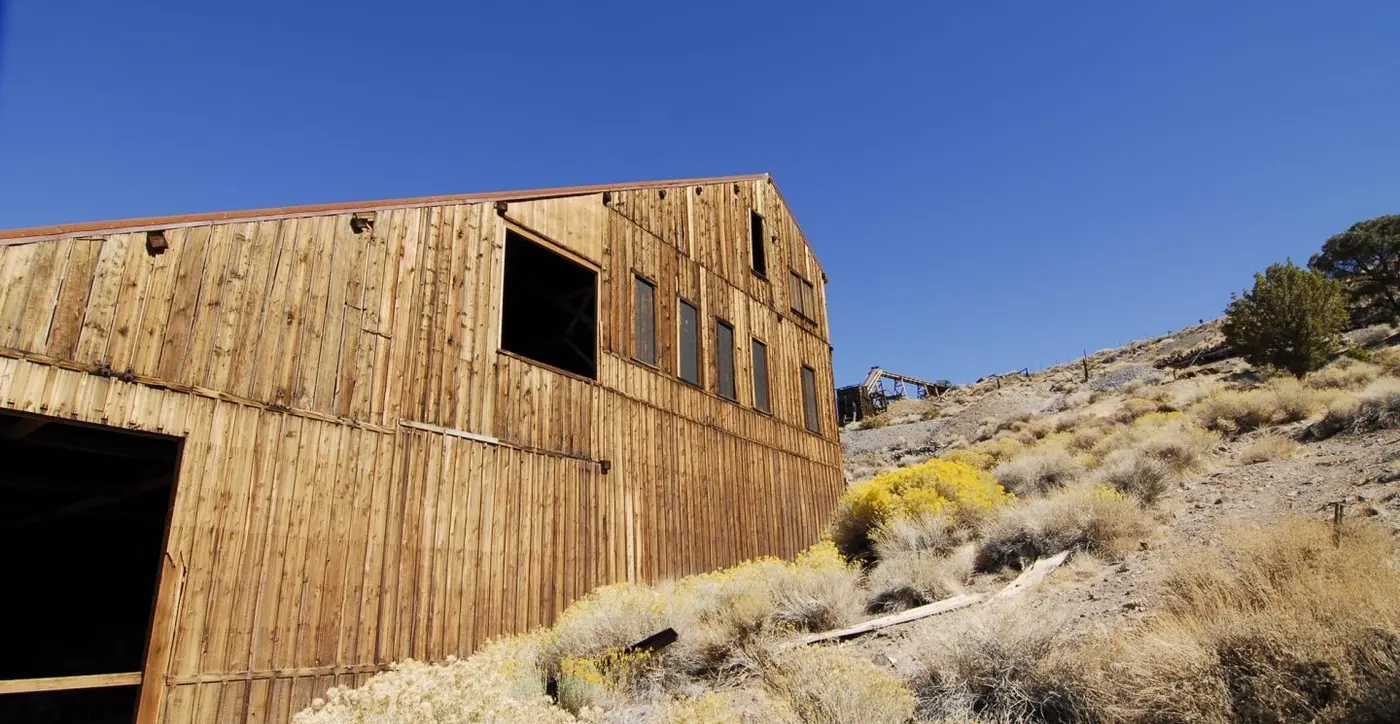
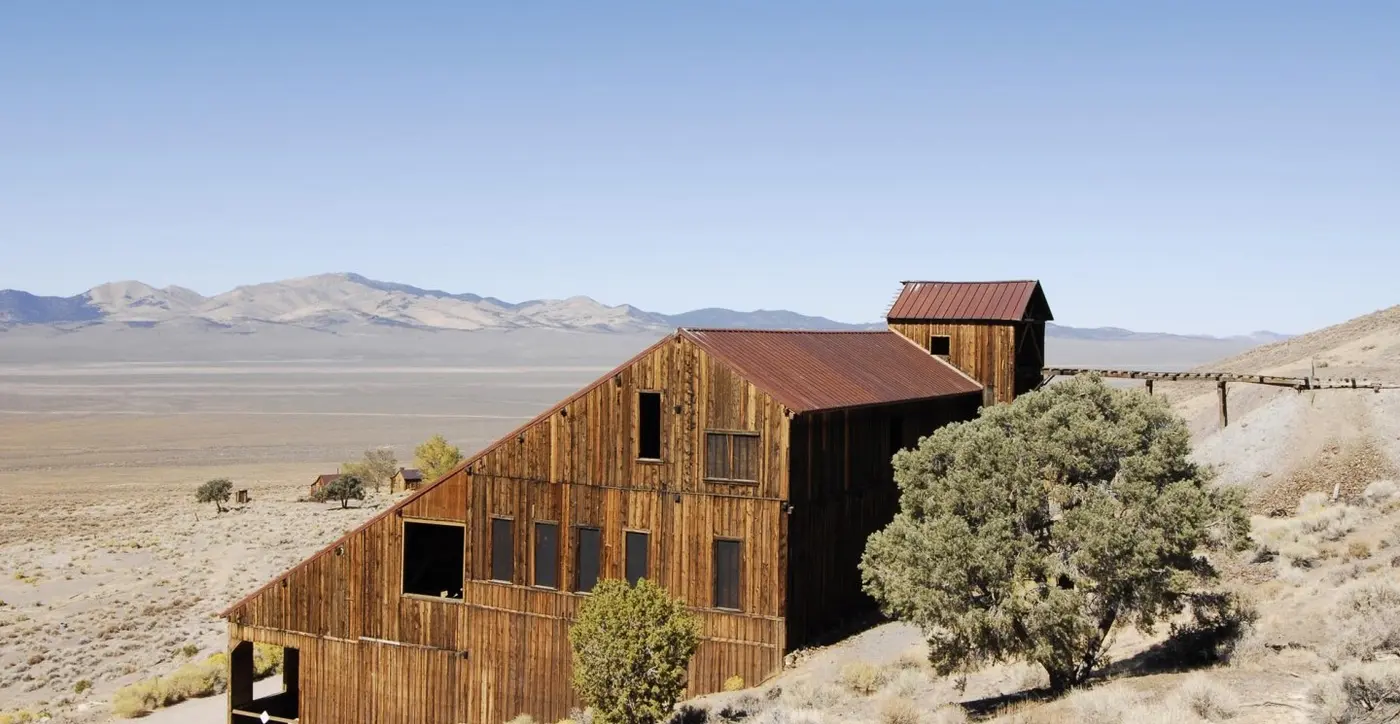
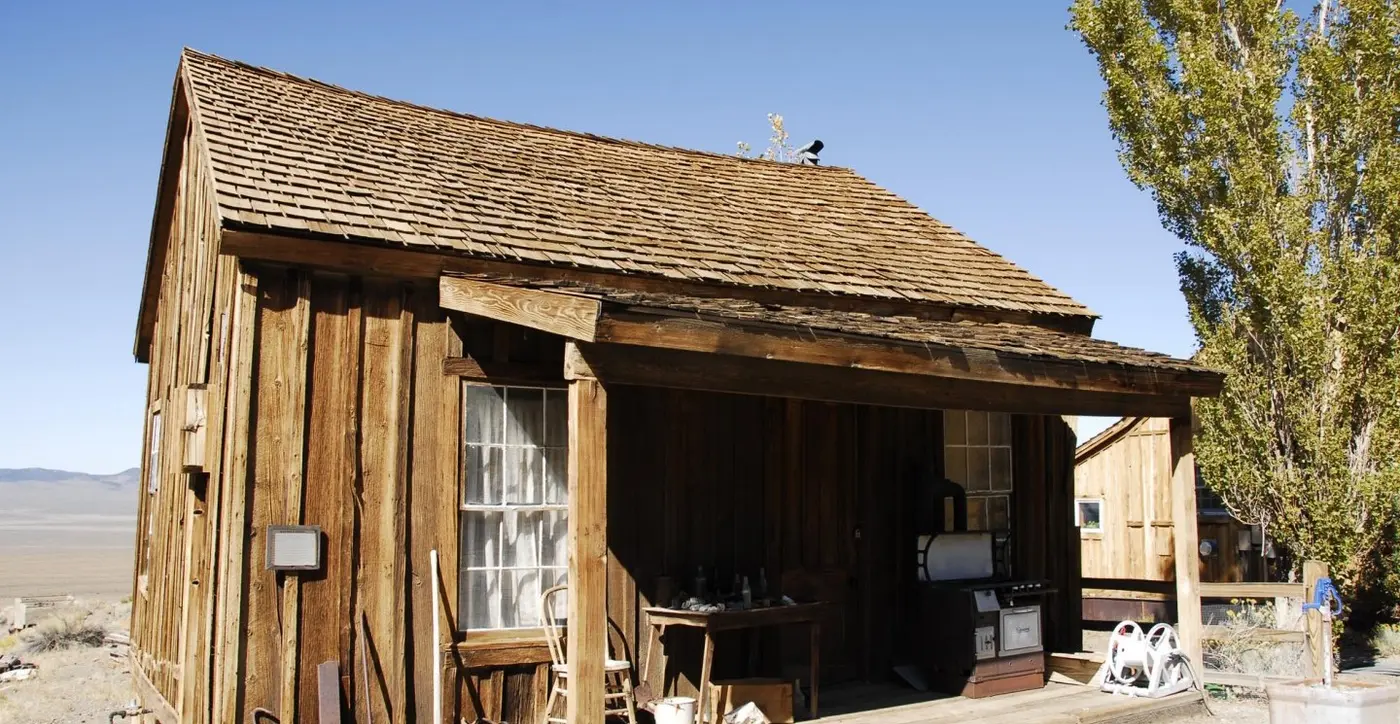
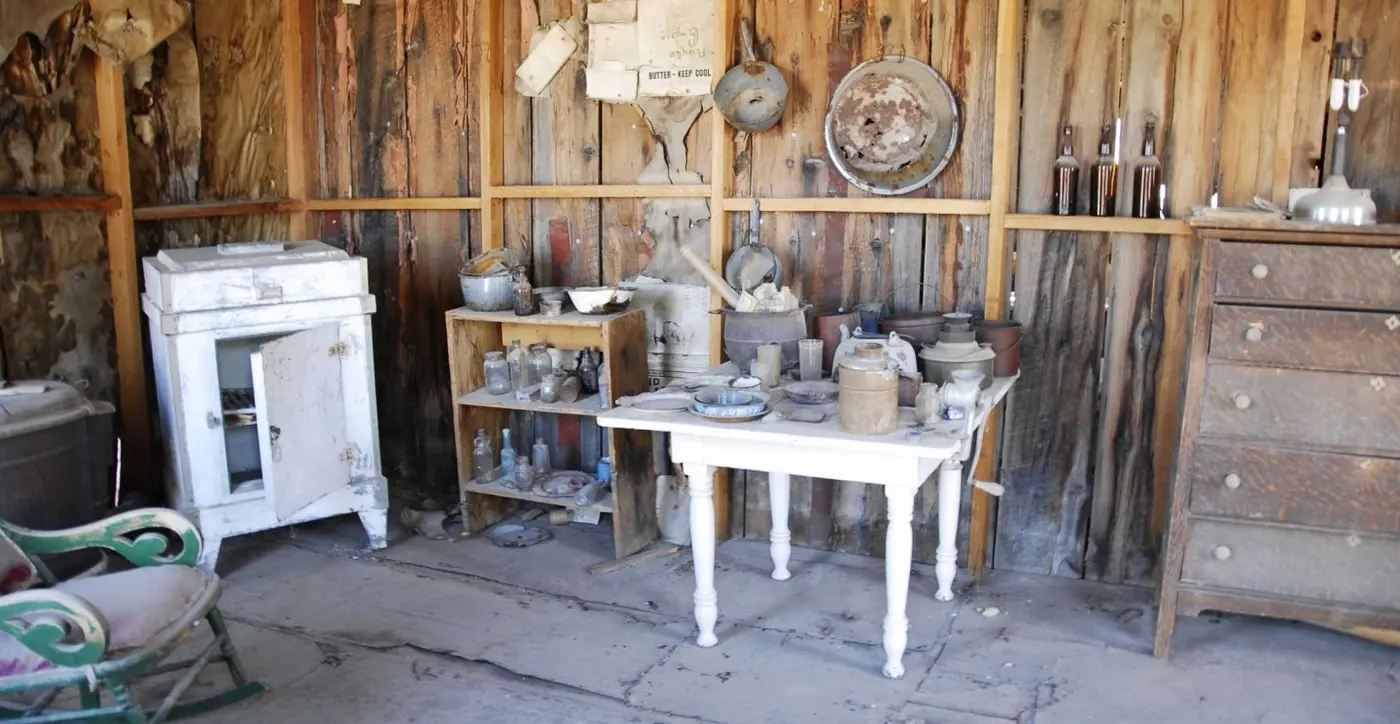
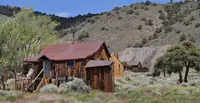
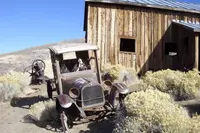
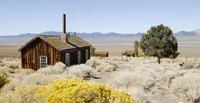
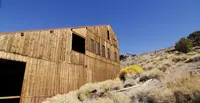
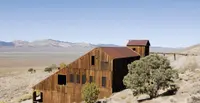
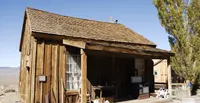
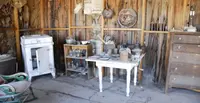
At Berlin the ore mill still stands on the western slope of the Shoshone Mountains. Inside, the stamps and the mercury float tables that worked gold out of the rock can still be seen. Around the mill stand homes, a blacksmith shop, a stage-coach shop and stable, a machine shop, and an assay office. Visitors can enter some of the buildings and can only look through the windows of others. Headworks stand over some of the mine shafts. The town cemetery holds some of Berlin’s original residents. Nevada State Parks keeps the whole town in what it calls a state of arrested decay.
The park lies east of Gabbs on State Route 844. Travel Nevada puts the distance at 20 miles and Wikipedia at 23. According to the park, elevations run from 6,840 feet to 7,880. Big sagebrush covers the hillsides, and pinyon pine and Utah juniper take over higher up. Common animals include mule deer, black-tailed jackrabbits, cottontails, chukar, pinyon jays, western bluebirds, whiptail lizards and western fence lizards. Gas and food are available in Gabbs. The park notes that Ione has no services.
Firmin’s signs
More than 80 interpretive signs lead through Berlin and the nearby camp of Union. Their text came from a man who grew up in both places. Firmin Bruner was born Firmin Ascargorta in Spain in 1899. His father herded sheep at Cherry Creek for a short time, then moved the family to Union and later to Berlin. In 1921 Firmin applied for American citizenship and took his boss’s last name, Bruner. He helped Nevada State Parks write the town’s history, and from 1974 to 1990 he led tours of it as a volunteer.
In 1979 the Division of State Parks and the Nevada Natural History Association put up a marker to him a few steps from the Charcoal Yard sign. The signs for the Assay Office, the Clubhouse, the Company Store, the Company Boardinghouse, and the Stage Station are all within shouting distance. The marker thanks him “for sharing his memories of history as he lived them here in Berlin, West Union Canyon, and other parts of Central Nevada during the early years of the twentieth century.”
Guided mine tours go about 500 feet into a tunnel that connects with the Berlin Mine. All other entry to the underground works is prohibited as too dangerous. The American Discovery Trail, a coast-to-coast route of more than 6,800 miles, passes through the park. A nature trail leads from the campground, which has fourteen sites open year-round, to the Fossil House.
The barn on the hill
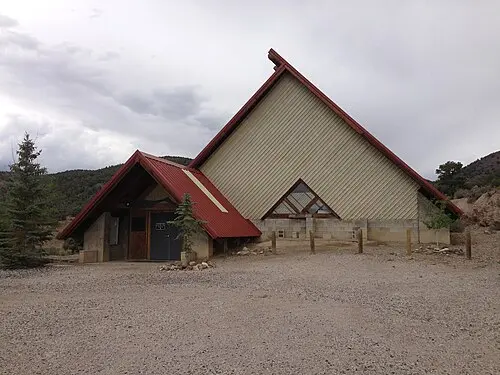
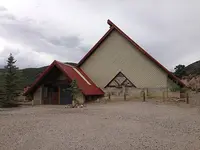
The Fossil House stands about two miles from the town, which Wikipedia puts at a ten-minute drive. It is a large barn-like building over an exposed bedrock surface. Smithsonian researchers call the surface Quarry 2. It holds partial skeletons of an estimated seven ichthyosaurs, which all appear to have died around the same time and were left embedded in the stone. The bone and the rock around it are the same color. In a photograph on the University of California Museum of Paleontology’s page, a visitor points to a femur with a series of disc-shaped vertebrae lying just to its left. The site also has a 60-foot-long relief of the animal by William Huff, a sculptor and long-time friend of the paleontologist Charles Camp.
In the 2026 season, guided Fossil House tours ran at 10 a.m. and 2 p.m. They ran daily between Memorial Day and Labor Day and on Saturdays and Sundays before and after, with the last tours on November 1. When no tour is running, a viewing window and interpretive signs give an overview of the dig.
The animals are Shonisaurus popularis, Nevada’s state fossil since 1977. Camp recorded that some were more than 15 meters long, about 49 feet. They remained the largest ichthyosaurs known until 2004, when a 21-meter species of Shonisaurus was described from British Columbia. Sources give their age differently. Nevada State Parks says they swam in a warm ocean that covered central Nevada 225 million years ago. The UCMP page, written by Dave Smith, says they died and were buried about 217 million years ago, in the upper Carnian of the Triassic. At that time an arm of what is now the Pacific Ocean covered present-day Nevada, and their bones lie in rocks of the Luning Formation.
Gold for a New York company
Prospectors were in these canyons long before Berlin. In May 1863 a small party found silver in Union Canyon and settled the camp of Union. The next year the Union Mining District was formed, taking in Union, Ione, Grantsville, and later Berlin. Travel Nevada dates Berlin itself to 1863. Assessor’s records show that the Berlin mine produced four tons of ore in 1869. Even so, claims in Union, Knickerbocker, and Berlin canyons were not filed until the late 1880s. The park dates the Berlin Mine to 1896, the year Wikipedia says substantial gold veins were found nearby.
The Nevada Company, run by the Stokes family of New York City, built the town. The two main sources date its arrival differently:
- The park says the company bought the mine and many surrounding claims in 1898.
- The 1971 National Register nomination says the company acquired the Berlin group of claims in 1902–03 and then built the townsite.
Graham Stokes built and ran the 30-stamp mill, which the nomination describes as massive stone and drywall construction with heavy timbers. The post office operated from 1900 to 1918. In 1908 the town had a doctor, a barber, a general store, and three saloons, and at its peak about 75 frame buildings. The park counts 200 to 250 people in Berlin and its Union suburbs during the heyday: miners, woodcutters, charcoal makers, a doctor, a nurse, a forest ranger, and a prostitute.
Accounts of the decline also differ. The park says Berlin was at its height until 1908 and dead by 1911. Wikipedia says the mine became unprofitable by 1911 and the town emptied shortly after. The nomination puts the peak years between 1906 and 1918. The mine’s three miles of tunnels produced an estimated $849,000 when gold sold at $20 an ounce. Wikipedia gives the yield as 42,000 troy ounces.
Berlin stayed a company town from its construction until the Park System acquired it in 1970. The company kept a property maintainer living there the whole time, and the nomination credits this for sparing the town from vandals. W. E. Wieprecht, a recreation park planner, wrote the nomination in March 1971. He found twelve wood frame buildings arranged in a U that opens to the east. Miners had planted Lombardy poplar, black locust, and “a fruit tree or two” in a place that gets barely 12 inches of rain a year. The resident park manager lived in one building year-round, and across town a part-time miner lived in the converted stage stop. The nomination was plain about the town: “The mines were never great producers, the town was never the scene of any spectacular historical event.” Berlin was listed on the National Register on November 5, 1971.
Mrs. Wheat’s broom
Ammonites and marine bivalves were probably the first fossils found here. It is believed that early miners were the first to notice the ichthyosaur bones, and apparently they used some of them to build their fire hearths. In 1928 Siemon W. Muller of Stanford University recognized the bones as giant ichthyosaurs. In 1952 Margaret Wheat of Fallon collected some of them and brought them to the attention of Charles Camp of the UC Museum of Paleontology. She brought him to the site a year later.
After his first day there, Camp wrote in his field notes: “Si Muller says he found these ichthyosaur remains in 1929 and 30 and tried to sell the idea to us then and subsequently.” Wheat had told him the vertebrae were up to a foot in diameter and weighed 21 pounds. On the south-facing slope Camp examined “the material exposed by Mrs. Wheat’s broom” and wrote: “These are monster vertebrae — larger than any ichthyosaur vertebrae hitherto known.”
Within a few days Camp and Wheat began pressing to make the site a state park. “This is a thing that should be preserved in situ for all to see,” he wrote. “It will probably not be duplicated again in this world.” Wheat worked with the Max C. Fleischmann Foundation, which funded the work, and with the governor. In less than two years the Nevada Legislature established the Ichthyosaur Paleontological State Monument, and in 1957 the site became part of the State Park System.
Students under Camp and Sam Welles excavated during the summers of 1954 to 1957, helped by friends, family members, and visitors. In 1955 workers built a low wall around the exposed bonebed. Camp found nearly 40 individuals and returned to work between 1963 and 1965. He removed only four partial specimens for study and left the rest in place, reburying many of them. Those four partial skeletons have been at the Nevada State Museum in Las Vegas since 1999. The site was designated a National Natural Landmark in 1973. Welles came back in 1984 with University Research Expedition Program volunteers to preserve and map the exposed skeletons further.
Why so many died in one place
Camp believed the animals had been stranded during unusually low tides, and Huff drew the scene. Later sedimentology work by Jennifer Hogler, a UCMP graduate student, pointed instead to deep water. Neil Kelley of Vanderbilt University first visited in 2014. “My first thought was that the best way to study it would be to create a full-color, high-resolution 3D model,” he said.
Kelley worked with Nicholas Pyenson, the Smithsonian’s curator of fossil marine mammals, and with Jon Blundell and Holly Little, who used cameras and a spherical laser scanner to build the model. The team also ran several tests:
- Rock samples showed no rise in mercury and no sign of an oxygen crash.
- The geology showed that the bones had sunk to the sea floor rather than settling along a shoreline.
- The team counted at least 37 adults. The beds held almost no fish or other prey, and no juveniles.
- Among new finds and in old museum drawers, the team identified tiny embryonic and newborn Shonisaurus.
- The separate bone beds turned out to be at least hundreds of thousands of years apart, possibly millions.
The study appeared in Current Biology on December 19, 2022. “Once it became clear that there was nothing for them to eat here, and there were large adult Shonisaurus along with embryos and newborns but no juveniles, we started to seriously consider whether this might have been a birthing ground,” Kelley said. Pyenson called it a place the animals returned to for generations to give birth, much as whales do today. “Now we have evidence that this sort of behavior is 230 million years old.”
Notable Events
- 1863A small group of prospectors discovered silver in Union Canyon and the small mining camp of Union was settled. parks.nv.gov
- 1869Assessor's records show the Berlin mine produced four tons of ore. npgallery.nps.gov
- 1880Claims were filed in and around Union Canyon, Knickerbocker and Berlin Canyons. npgallery.nps.gov
- 1896The first assay report in Berlin Canyon was in 1869, but it was not until 1896 that the Berlin Mine was established. parks.nv.gov
- 1898With the purchase of the mine and numerous surrounding mining claims by the Nevada Company in 1898, the town of Berlin was soon at its height of popularity, which continued until 1908. parks.nv.gov
- 1900Berlin's post office existed over this period. npgallery.nps.gov
- 1902The company acquired the Berlin group of claims and built the townsite. npgallery.nps.gov
- 1911After its height of popularity lasted until 1908, the town declined to its death by 1911; the Berlin Mine's total production from three miles of tunnels is estimated at $849,000. parks.nv.gov
- 1928The first person to recognize the bones as belonging to giant ichthyosaurs was Siemon W. Muller of Stanford University. ucmp.berkeley.edu
- 1952Mrs. Margaret Wheat of Fallon collected some of the ichthyosaur bones and brought them to the attention of UCMP's Charles Camp, and brought Camp out to the site a year later. ucmp.berkeley.edu
- 1954Extensive excavation was carried out by groups of students under the direction of Camp and Sam Welles in the summers of 1954 to 1957. ucmp.berkeley.edu
- 1957The park was established to protect and display North America's most abundant concentration and largest ichthyosaur fossils known at the time. nps.gov
- 1957The Nevada Legislature established the Ichthyosaur Paleontological State Monument, and in 1957 the site was incorporated into the State Park System. ucmp.berkeley.edu
- 1970The company-owned Berlin town was acquired by the Park System. npgallery.nps.gov
- 1977The Legislature designated Shonisaurus popularis the state fossil of Nevada. ucmp.berkeley.edu
- 1979Nevada State Parks and the Nevada Natural History Association erected the appreciation marker. hmdb.org
- 1984Sam Welles returned to Berlin-Ichthyosaur with a group of University Research Expedition Program volunteers to do further preservation and mapping of the exposed skeletons. ucmp.berkeley.edu
- 2014Kelley's first visit inspired the idea of a full-color, high-resolution model to study the fossils. si.edu
- 2022Research published in Current Biology offers a plausible explanation for the fossil concentration at Berlin-Ichthyosaur State Park. si.edu
- After the silver discovery and settlement of Union in May 1863, the Union Mining District was formed, including Union, Ione, Grantsville and later Berlin. parks.nv.gov
People
- Firmin Bruner, Grew up in Berlin and Union, supplied interpretive-sign text, and gave volunteer town tours (1974-1990).
- Graham Stokes, Constructed and operated Berlin's stamp mill.
- Holly Little, Museum paleobiology informatics manager collaborating on the fossil-bed model.
- Jon Blundell, Smithsonian digitization collaborator on the fossil-bed model.
- Neil Kelley, Vanderbilt University scientist leading the park fossil-bed study.
- Nicholas Pyenson, Smithsonian curator of fossil marine mammals and co-author of the park fossil-bed study.
- Charles Camp, UCMP paleontologist; named Shonisaurus popularis, directed the excavations, and pushed for the state park (1954 to 1957; 1963 and 1965).
- Margaret Wheat, of Fallon; collected the bones, brought Camp to the site, and with him drove to make it a state park (1952).
- Sam Welles, co-directed the excavations and later returned for preservation and mapping (1984).
- Siemon W. Muller, Stanford University geologist; first to recognize the bones as giant ichthyosaurs (1928).
- William Huff, sculptor of the 60-foot-long relief of Shonisaurus; long-time friend of Charles Camp.