Benitoite Mining Company gem hunts
Coalinga, Fresno County, California. Gem hunt.
Details

- Where
- The Historic Old Road Camp, 48242 Los Gatos Rd, Coalinga, CA 48242. Directions
- When
- On open days, 9AM to 3PM.
- Season
- Normally open weekends and certain holidays; open days can change depending on the season, with the accurate list on the reservation tickets page.
- Getting there
- From the westernmost stoplight in Coalinga, head west on Polk/Jayne Avenue for one mile; turn left on Los Gatos Road; continue west exactly fifteen miles; turn in just before the white buffalo.
- Fees
- Adult - $140; child 12 & younger - $75.
- Access
- Caution: the Highway 25/Coalinga Rd route is not well maintained.
- Walk-in or reserve
- Special Reservations can open days the mine would normally be closed; minimum 3 adult tickets; confirm the date at least 3 days beforehand by phone.
- Phone
- (833) 436-4868
The screening field on Los Gatos Road
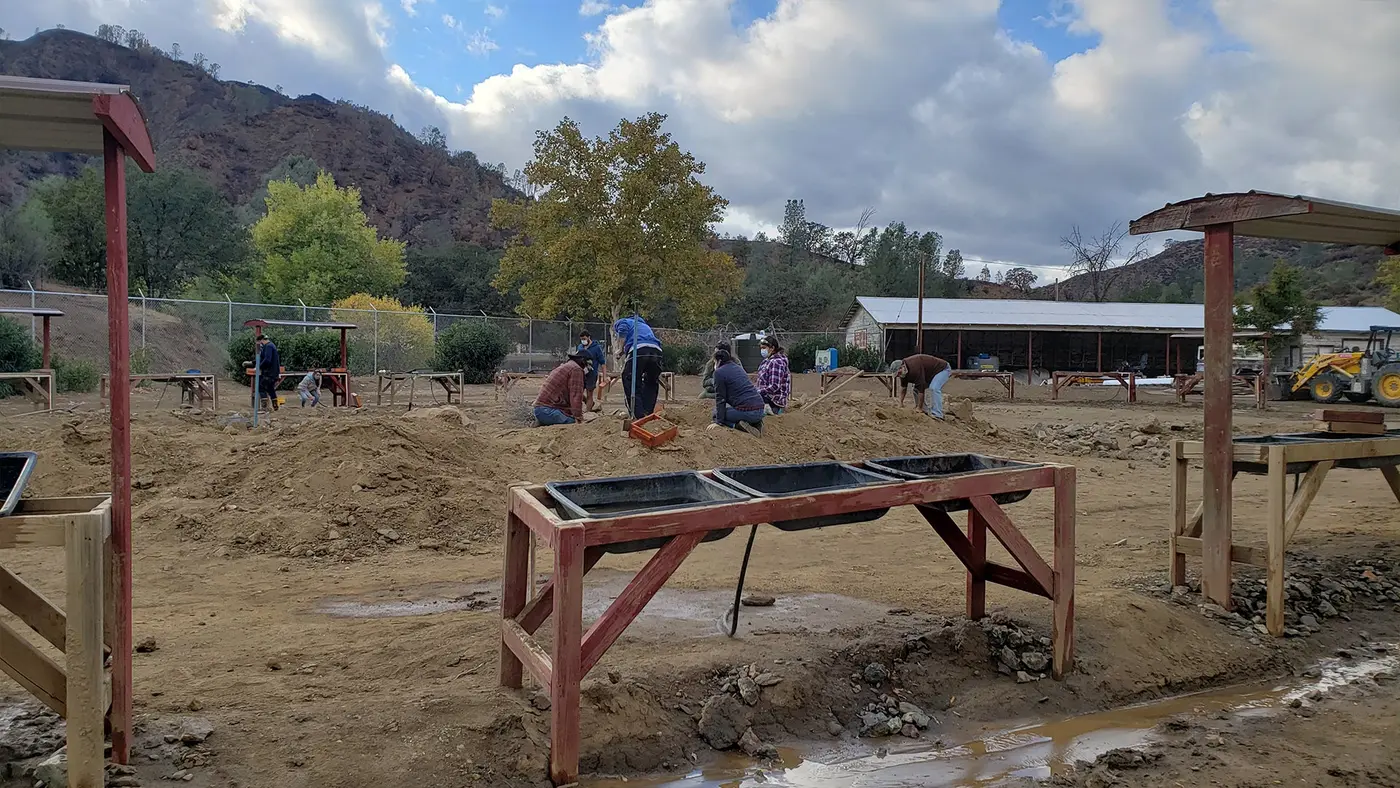
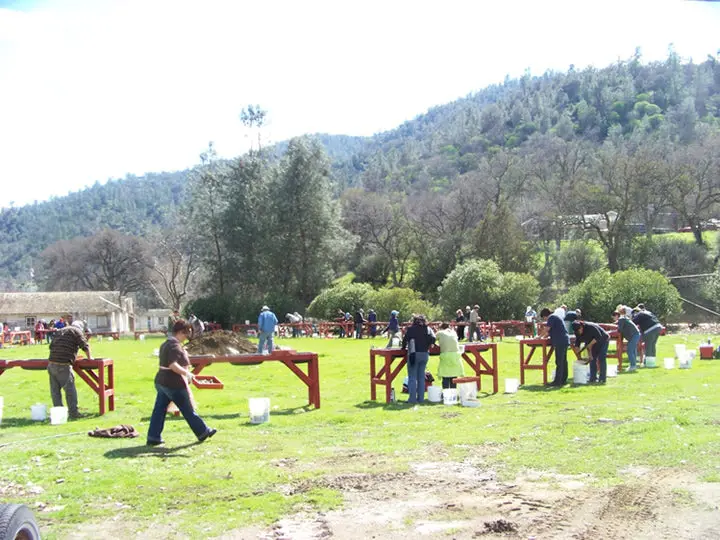
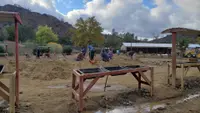
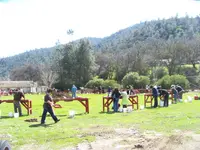
A white buffalo stands in the parking lot at the Historic Old Road Camp, fifteen miles out Los Gatos Road west of Coalinga. The company tells drivers to watch for it and to turn in just before it. It also warns that the other approach, by Highway 25 and Coalinga Road, is not well maintained. Beyond the lot is the screening field. Ore from the Benitoite Gem mine in San Benito County is dumped there for visitors to sort. Nobody goes into the mine. The company’s FAQ puts it this way: “It’s nice and easy, no spelunking required!”
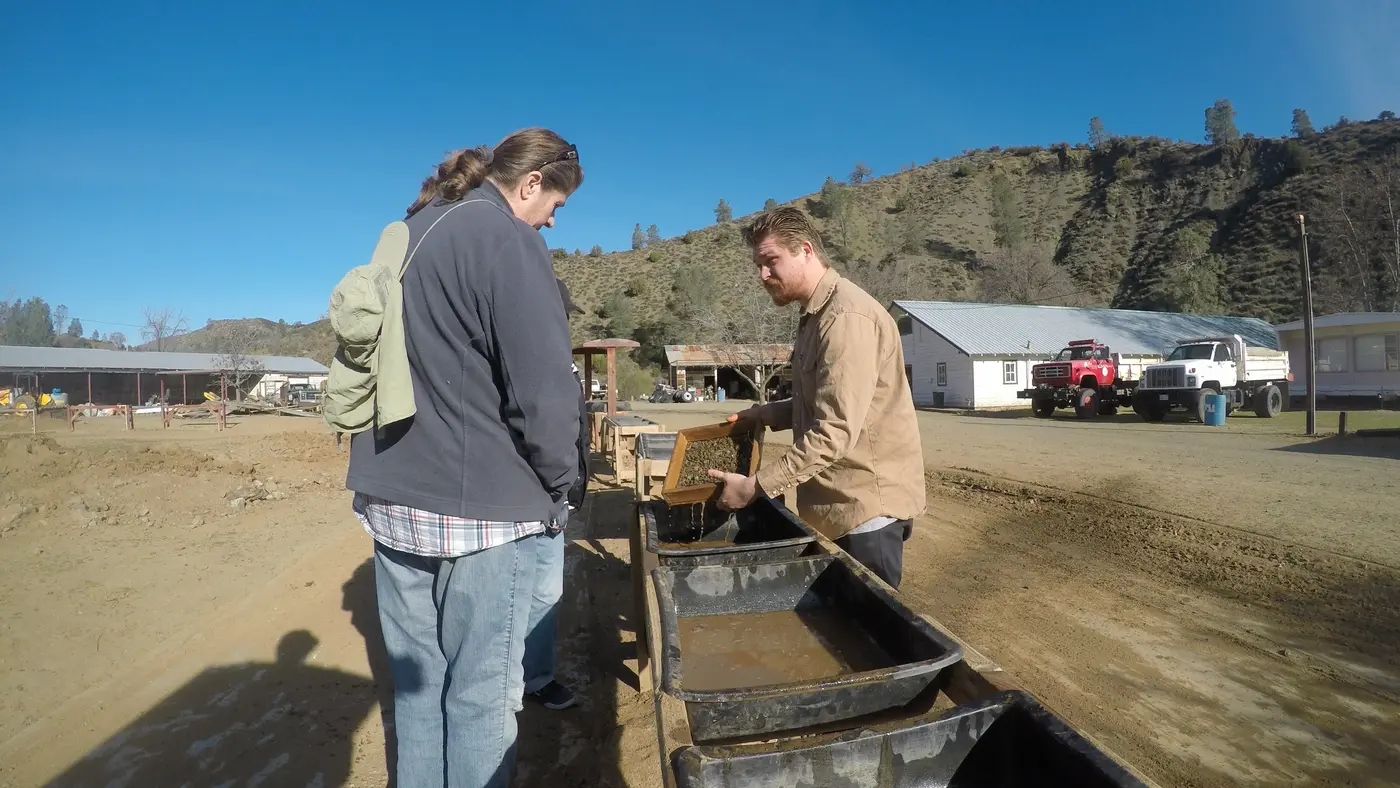
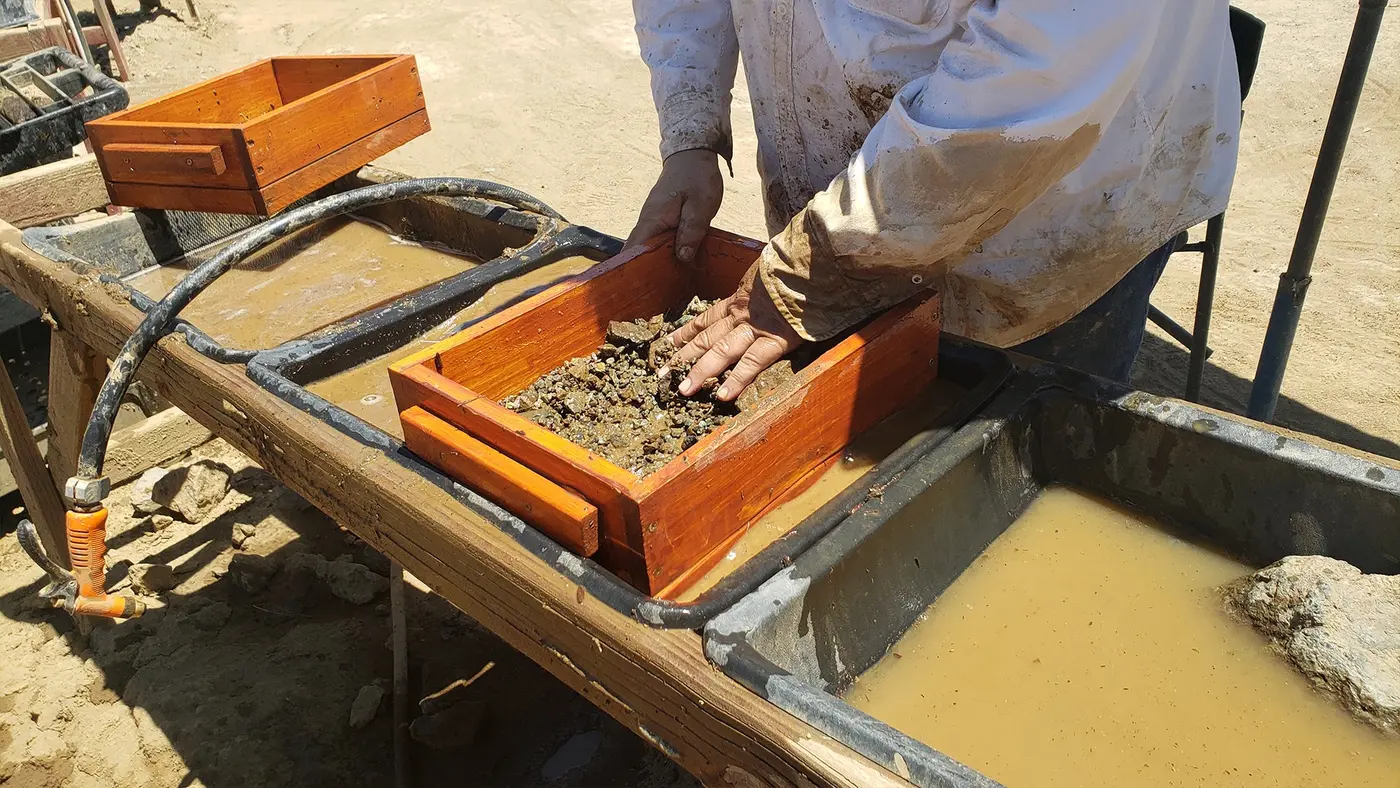
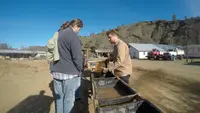
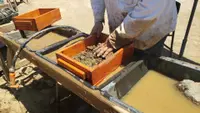
The camp supplies screens, shovels, washing tables, safety gloves, and clear UV-protective glasses. Staff show newcomers what to do and what to look for, and they identify finds through the day. Visitors bring their own lunches, drinks, and lawn chairs. In summer they bring hats, sunblock, and pop-up canopies. In winter they bring warm clothes and mud boots. Rock hammers and pets are not allowed. Diggers stay between the screening field and the parking lot, and children may play freely nearby. A day runs from 9 a.m. to 3 p.m., and there is no limit on how much material a person may wash. Each admission allows one quart-sized bag of finds to take home. A notice warns that serpentine is present in the digging material and invites diggers to bring masks.
The company names four minerals as specific to the site: benitoite, neptunite, joaquinite, and natrolite. Benitoite, the FAQ says, is “a small gemstone, think diamond size.” Diggers carry their concentrate into the UV room. Under short-wave ultraviolet light, benitoite fluoresces bright blue to bluish white. The rarer clear and white crystals glow red or pink under long-wave light. “Most people find something, but the trick is finding something good,” the FAQ says. It puts the odds of leaving with a stone of value at about 1 in 20.
Dave Schreiner owns the mine. In 2021 he told BenitoLink that trespassers had forced him to lock the entrance and put up security cameras. He added that the ground is also home to rattlesnakes and poisonous scorpions. Because the public cannot enter the mine, he opened the camp in 2015, across the Fresno County line. “We have people who come every weekend,” he said, “and it has really turned into a fun community event.” He also warned that the work “is pretty demanding.”
Blue crystals on a San Benito hillside
Most accounts agree on the core of the discovery. A prospector, staked by a Coalinga oil man, found blue crystals near the headwaters of the San Benito River in 1907 and took them for sapphires. The details vary from source to source.
The company’s history is by Leza Junnila, who grew up at the New Idria Mines. She gives the prospector’s name as James Couch, a rancher near Coalinga who raised produce and chickens. When the economy slowed in 1907, he went prospecting south of New Idria. R.W. Dallas grubstaked him. Couch rode up the Los Gatos Creek canyon road and made camp at nightfall on the headwaters of the San Benito, where there was grass and water. Morning light showed a small rocky exposure on the north side of the canyon. In it was an eroded pocket of white rock with bright blue crystals sticking out all over. “Blue crystals were lying all over the ground,” Couch said. He went straight back to Coalinga to show Dallas. Later that week he rode three days each way on horseback to Hollister, the county seat, to file a federal mining claim. Local miners Frank Nunez and Joe Larios, Junnila writes, always spoke fondly of him.
The other sources differ:
- Collector’s Edge Minerals dates the find to February 1907. A stock certificate for the Dallas Mining Company bears the same month.
- BenitoLink names the prospector James Marshall Crouch. It says mining speculators Roderick Dallas and Thomas Sanders staked him $25 to explore the Diablo Range.
- One museum account places the find in December 1907. It calls the discovery claims complex, and its most widely accepted version begins with Couch as a failed melon farmer.
- Another source gives 1906.
- George Louderback, by another account, first credited L. B. Hawkins and T. E. Sanders as discoverers.
- Oscar Couch, the prospector’s eldest son, published The Benitoite Story in 1961, arguing that his father deserved sole credit.
Junnila’s history describes what happened next. Once the stone proved to be a new species, Dallas took tighter control, and Couch “was manipulated out of the mine and became nothing more than a hired hand.” A photograph of the cabin built at the Dallas Gem mine in 1907 shows Couch second from the left.
A professor from Berkeley and a man from Tiffany’s
The crystals went to George D. Louderback, a mineralogy professor at the University of California at Berkeley. He saw that they were neither sapphire nor spinel. On July 19, 1907, he visited the mine with G. Eacret and confirmed the find. On July 31 he wrote in the university’s Bulletin of the Department of Geology that “the progress of the investigation has shown that it is a new mineral species.” He named it benitoite, after San Benito County, according to Collector’s Edge. Other sources say he named it for the river, the county, and the nearby mountain range, or for the river that runs through the claim. The California State Capitol Museum says the name came two years after the discovery.
Louderback called the black mineral found with the benitoite “carlosite,” after nearby San Carlos peak. He later learned it was neptunite, first described in Greenland in 1893. He came back that October to study the geology. On August 12, 1908, he returned with Eacret and took the first photographs of benitoite for his full article.
The news ran in papers across the country. BenitoLink reports that Tiffany & Co. placed one of the first large orders. Collector’s Edge tells it differently. George Kunz of Tiffany’s in New York was among those who rushed to the site seeking exclusive marketing rights, and Eacret, of Shreve and Company in San Francisco, won them.
According to the Dallas Mining Company diary, active mining began in July 1907. Dallas built a camp and worked an open cut and a short tunnel driven into the blueschist outcrop. For about five years the vein yielded thousands of gemstones. Junnila adds that miners of the time did not know how to etch away the natrolite to free the benitoite, so thousands of stones were broken in recovery.
Rock gardens, bulldozers, and a fire hose
In 1912 the market slackened, and Dallas, in financial trouble, closed the mine. The equipment was auctioned in October 1913 and the property vacated. Mineral patent papers were issued in 1917. The old county road passed right by the workings. Junnila writes that collectors hauled off natrolite boulders studded with broken crystals for their rock gardens. Frank Nunez’s grandmother kept one at Sawmill Creek. A forest fire burned her cabin, and the garden was forgotten until benitoite grew expensive, by which time the spot was lost and overgrown. Another fire took the log cabin and corrals at the mine.
After 1920 B. Suit of the San Benito Gem Company leased the ground, but little work was done. In 1933 M. Dunn reopened the property and removed a lot of material. Junnila records that Dunn’s Packard touring car went off the road one bad winter, and that she and her brothers later recovered its brass radiator from a canyon near San Benito Mountain. Mineral collector Art Pawson visited in 1937, while the mine was idle. His daughter, geology teacher Suzie Harlow, still shows the specimens he brought home. “The most joy I get from my dad’s collection is letting people see this stone they have never seen before,” she told BenitoLink.
The Dallas family leased the mine to a succession of operators. Miller Hotchkiss of Firebaugh bulldozed the open cuts, in the 1940s by one account and the early 1950s by Junnila’s. About 1952 Clarence Cole, an Oakland mineral dealer, took the lease and reopened the original pit with bulldozer and dynamite. Cole kept big plates of benitoite crystals in his shop windows. He sold faceted stones to miners at New Idria, among them store manager Virginia Shadduck. Junnila writes that her family learned of the mine by talking with Cole at that store. Josephine Scripps, a mineral collector, leased the mine for a year. In 1957 Francis Jones found a mineral there that was identified in 1977 as a new species, jonesite.
Cole died in 1967, and the lease passed to Bill Forrest and Elvis “Buzz” Gray. In 1970 they began washing the old dumps with water pumped uphill through a fire hose. They brought in mechanized recovery in 1982. Collector’s Edge says they bought the property from the Dallas family in 1987, and Junnila says it was about ten years after the lease. On October 1, 1985, the California Legislature designated benitoite the state gem. In the mid-1990s Kennecott Corporation leased the mine, drilled cores, and sampled the surrounding country, but its board chose a mica mine in Arizona instead. In the spring of 1997 Forrest and Gray, working with larger machinery, found a productive area downslope of the open pit.
In 2000 Benitoite Mining Inc., affiliated with Collector’s Edge Minerals of Golden, Colorado, bought the property. Brian Lees brought in a mining crew for five winters. In the spring of 2002 the company installed a processing plant with a hopper, conveyor, washing screens, and jigs, where crews hand-picked specimens off the belt. Old tunnels were opened and dug out to about 9 meters, where the benitoite gave way to bare natrolite.
Schreiner bought the mine in 2005. The camp opened in 2015 as the California State Gem Mine and took the name Benitoite Mining Company in 2020. “The mine is still active,” Schreiner told BenitoLink in 2021, “but we really have no idea how much benitoite is left.”
Notable Events
- 1907Dallas worked the mine from 1907 to 1912, digging a tunnel to intersect the outcrop. benitoitemining.com
- 1907Louderback published his findings in the university's Bulletin of the Department of Geology, and the gemstone made newspapers across the country; one of the first large orders came from Tiffany & Co. benitolink.com
- 1907Grubstaked by Roderick Dallas, James Couch found blue crystals he thought might be sapphires. collectorsedge.com
- 1907Louderback visited the mine with Eacret and confirmed the discovery. gia.edu
- 1907According to the Dallas Mining Company diary, active mining began in July 1907. gia.edu
- 1908Louderback returned with Eacret and took the first benitoite photographs for his full-length article. gia.edu
- 1912From 1912 to 1920 all mining ceased at the property. benitoitemining.com
- 1912The benitoite market slackened; Dallas closed the mine amid financial difficulty. collectorsedge.com
- 1913The mining equipment was auctioned and the property vacated. gia.edu
- 1917The mine was issued mineral patent papers, five years after active mining ceased. gia.edu
- 1933After 1920 B. Suit of the San Benito Gem Company leased the location, but little work occurred until 1933 when M. Dunn reopened the property and removed a lot of material. benitoitemining.com
- 1940M. Hotchkiss used a bulldozer to enlarge the open cuts at the hilltop. collectorsedge.com
- 1952About 1952 Mr. C.L. Cole of Oakland acquired the lease and reopened the original pit. benitoitemining.com
- 1952C. Cole used a bulldozer and dynamite to continue the open-cut work. collectorsedge.com
- 1957Jonesite was discovered by Francis Jones in 1957. collectorsedge.com
- 1961Couch's eldest son published The Benitoite Story, arguing his father deserved sole discovery credit. gia.edu
- 1966Cole granted a sublease to Gerold Bosley of San Diego. gia.edu
- 1967In 1967 Bill Forrest and Buss Gray acquired the lease and about ten years later purchased the property. benitoitemining.com
- 1970Forrest and Gray began washing dump material by pumping water uphill through a fire hose. gia.edu
- 1977Jonesite was identified as a new species. collectorsedge.com
- 1982The owners began a more systematic and mechanized recovery method. gia.edu
- 1985Benitoite became California's State Gemstone. collectorsedge.com
- 1987Grey and Forrest purchased the mine from the Dallas family. collectorsedge.com
- 1990sKennecott Corporation took a lease on the mine, did some core drilling and sampled the surrounding countryside, but its board opted for a mica mine in Arizona. benitoitemining.com
- 1996By the end of the mining season, colluvium and eluvium were largely exhausted. gia.edu
- 1997Using larger machinery, Forrest and Gray found a productive area downslope of the open pit. gia.edu
- 2000Brian Lees of Colorado purchased the site from Forrest and Gray and worked the mine with a mining crew for five winters. benitoitemining.com
- 2000A company affiliated with Collector's Edge Minerals purchased the property. collectorsedge.com
- 2002Collector's Edge Minerals installed a new processing plant at the mine. collectorsedge.com
- 2004Reclamation by Benitoite Mining Inc was underway circa 2004. collectorsedge.com
- 2005Dave Schreiner bought the mine from Lees in 2005, with a vision to open the mine to collectors. benitoitemining.com
- 2015In 2015 the mining camp was opened to make it easier on the public to enjoy hunting gems. benitoitemining.com
- 2020The company was called the California State Gem Mine, but in 2020 it was transitioned to the Benitoite Mining Company. benitoitemining.com
- He revisited that year to study the geology. gia.edu
People
- B. Suit, San Benito Gem Company; leased the location after 1920.
- Bill Forrest, Secured the property lease with Elvis Buzz Grey.
- Brian Lees, of Colorado; purchased the site and worked the mine for five winters (2000).
- Buss Gray, acquired the lease with Bill Forrest and later purchased the property (1967).
- C.L. Cole, of Oakland; acquired the lease and reopened the original pit (About 1952).
- Dave Schreiner, Bought the mine from BMI (2005).
- James Couch, Prospector grubstaked by Roderick Dallas; found the blue crystals (February, 1907).
- Josie Scripps, leased the mine for one year.
- M. Dunn, reopened the property and removed a lot of material (1933).
- M.F. Hotchkiss, leased the mine and bulldozed the old dumps for veined blue schist (early 50's).
- R.W. Dallas, Mine owner who built the mine camp and expanded mining.
- James Marshall Crouch, prospector who discovered benitoite (1907).
- Thomas Sanders, mining speculator who, with Roderick Dallas, staked the prospector (1907).
- Bryan Lees, Looked for gem rough and specimens on the processing conveyor.
- C. Cole, Continued open-cut work with bulldozer and dynamite (1952 and 1967).
- Elvis “Buzz” Grey, Secured the property lease with Bill Forrest.
- Francis Jones, Discovered jonesite at its type locality (1957).
- G. Eacret, Shreve and Company representative who won marketing rights.
- George Kunz, Tiffany's representative who sought exclusive marketing rights.
- George Louderback, UC Berkeley mineralogy professor provided with the stones.
- M. Hotchkiss, Used a bulldozer to enlarge the open cuts (1940’s).
- Roderick Dallas, Grubstaked James Couch (February, 1907).
- George D. Louderback, University of California at Berkeley mineralogy professor who identified and named benitoite (1907).
- Clarence Cole, Oakland mineral dealer who held the lease (1952 to 1967).
- Edward Swoboda, Teenager involved in occasional unauthorized mining (1920 and 1940).
- Elvis “Buzz” Gray, Received the mine lease after Cole died (1967).
- Gerold Bosley, Received a sublease from Cole (1966).
- Josephine Scripps, Mineral collector backing Bosley's open-pit work.
- Michael Gray, Faceted stones from the Benitoite Gem mine.
- Miller Hotchkiss, Firebaugh resident who leased the mine (1940s).
- Oscar, Couch's eldest son; published a case for his father's sole discovery credit (1961).
- Peter Bancroft, Teenager involved in occasional unauthorized mining (1920 and 1940).
- William “Bill” Forrest, Received the mine lease after Cole died (1967).
Sources
- benitoitemining.com/pages/dig-gems
- benitoitemining.com/pages/directions
- benitoitemining.com/pages/faq
- benitoitemining.com/collections/fee-dig/products/special-reservations
- santacruzmuseum.org/beautiful-benitoite
- collectorsedge.com/benitoite-gem-mine-san-benito-county-california
- gia.edu/dam/migrated-assets/docs/doc1/benitoite-from-the-new-idria-district.pdf
- benitoitemining.com/pages/history
- benitoitemining.com/pages/about
- conservation.ca.gov/cgs/Pages/Publications/Note_11.aspx
- capitolmuseum.ca.gov/state-symbols/gemstone-benitoite
- benitolink.com/how-san-benito-county-became-ground-zero-for-a-rare-gemstone