Bend Guard Station
Thompson Falls, Sanders County, Montana. Forest Service rental cabin; Open year round.
Details

- Where
- Thompson Falls, Sanders County, MT. No street address stated. Directions
- Getting there
- Approximately 32 miles up the Thompson River Road (County Road 556), from its junction with Montana Highway 200, five miles east of Thompson Falls, Montana.
- Fees
- $90 per night for up to 16 people.
- Access
- After leaving Highway 2 or 200, area roads are low standard gravel or dirt and are often rough. Area roads also serve logging trucks and should be driven with care.
- Walk-in or reserve
- Reservations required through Recreation.gov.
- Phone
- 406-826-3821
- Website
- fs.usda.gov
- Managed by
- Lolo National Forest.
- Established
- Original log ranger cabin constructed in 1911.
- Coordinates
- 47.900255, -115.043097.
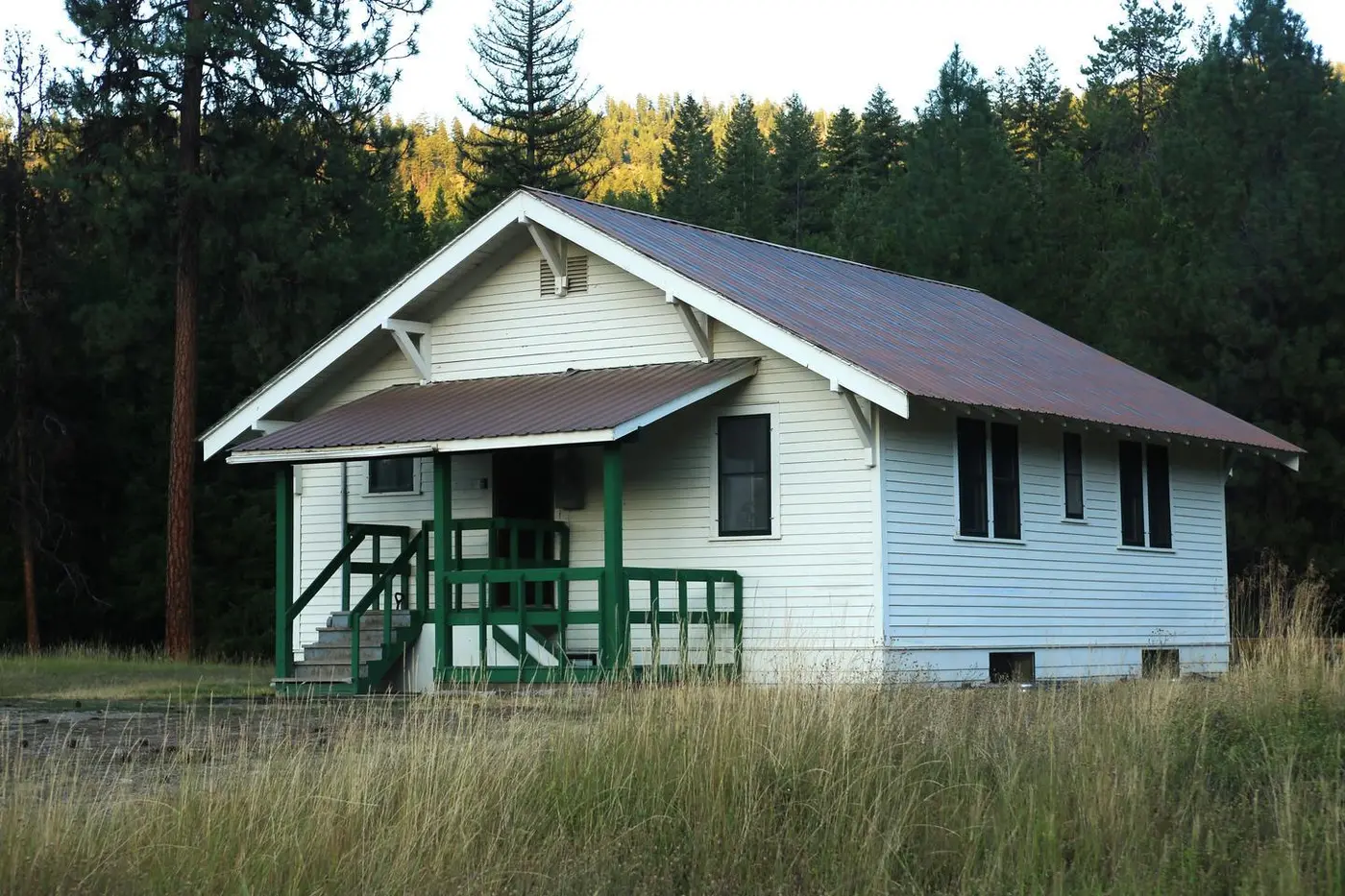
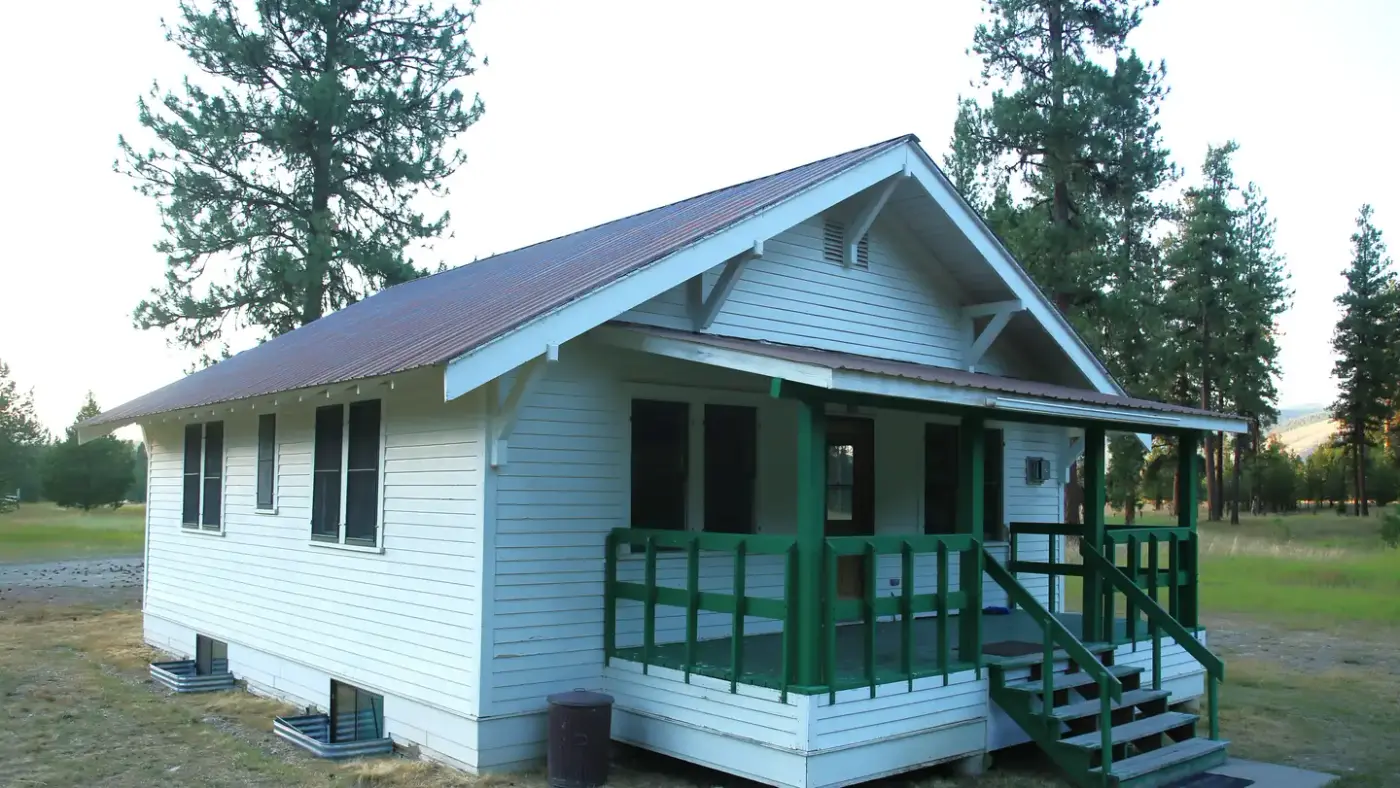
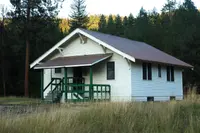
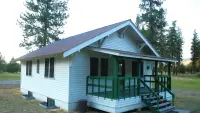
The building a renter unlocks at the Bend is the combined bunkhouse and cookhouse, two stories of Forest Service housing built in 1923 for work crews and rangers. It stands at 3,200 feet in an open meadow ringed by evergreen forest in the Lolo National Forest, north of Thompson Falls. Several structures share the site, but this is the only one the Forest Service rents. A key code sent with the reservation opens the entry gate and a lock box, and the lock box holds the cabin key.
The bunkhouse in the meadow
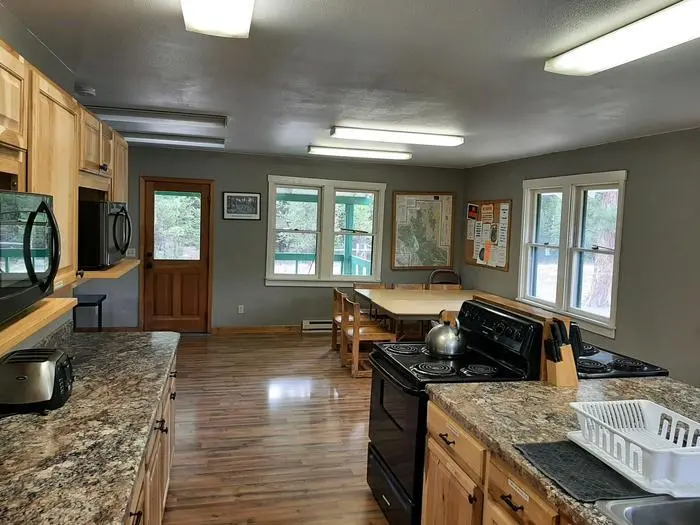
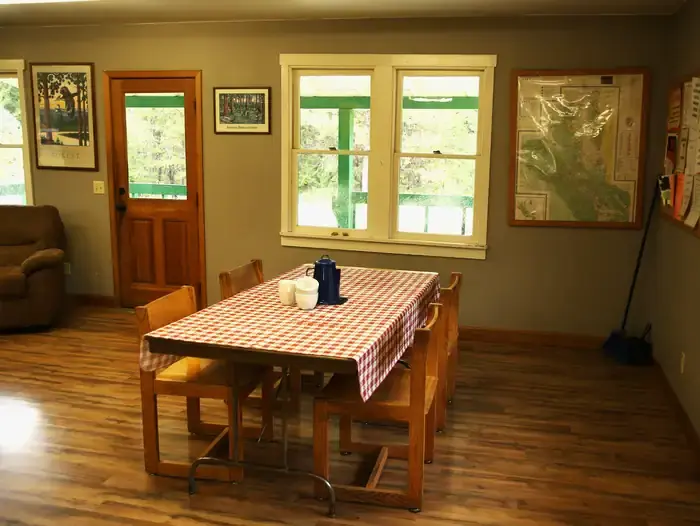
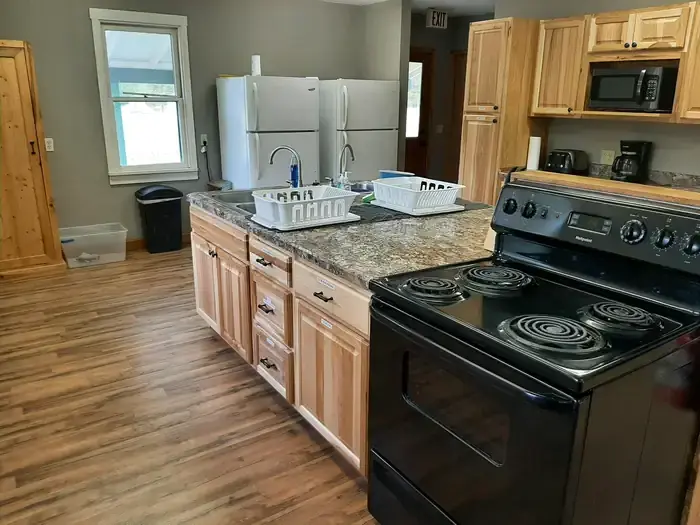
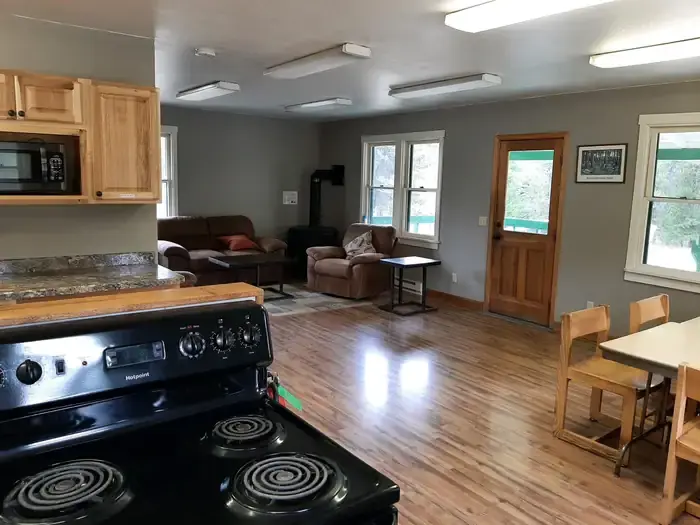
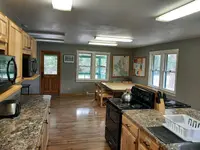
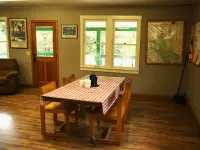
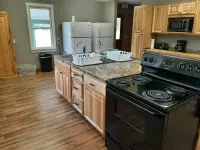
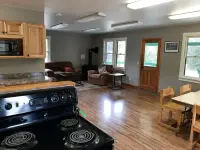
The main floor holds a large kitchen, a living and dining area, and two bathrooms with flush toilets and hot showers. The kitchen has two electric ranges, two refrigerators, and two sinks with running hot and cold water, along with pots, pans, dishes, and basic utensils. Electric heaters keep the building warm in winter. Renters bring their own bedding, food, toilet paper, and garbage bags, and they clean the place before they leave.
The four bedrooms are in the basement, fitted with bunk beds and mattresses, and together they sleep up to 16 people. A photographer who posts on Flickr as Musgrove spent five nights there in March 2018 with Woody the dog. He reported that the basement is reached by going outside and down a flight of stairs. He called it “jail-like” and slept on the main floor after he could not stop sneezing below. He also wrote that the fluorescent tube lights “are really noisy, especially at night. Plus, they’re just too damn bright.”
Outside he found a campfire area with four benches and a picnic table, and a porch for bad weather. No firewood is supplied. There is a horse corral on the property, served by a frost-free water hydrant. Pets are not allowed inside the buildings.
The Thompson River is a short walk from the cabin, and anglers there may see several kinds of trout and mountain whitefish. Trails run around the site and through the forest, and several start near the cabin. Musgrove cautioned that some cross private property or timber company land. The Forest Service lists hiking, mountain biking, cross-country skiing, snowshoeing, snowmobiling, and berry picking in season. Thompson and McGregor Lakes are each about a 30-minute drive away.
The surrounding forest covers about 2 million acres. It is home to mountain goats, bighorn sheep, elk, moose, deer, and grizzly and black bears, as well as bald and golden eagles, trumpeter swans, herons, and dozens of kinds of duck. The forest’s food and wildlife attractant storage order applies here. Everything brought in must be packed out.
Thirty-two miles of gravel
The Bend lies about 32 miles up the Thompson River Road from its junction with Montana Highway 200, five miles east of Thompson Falls. Maps label the road County Road 56, and the signs on the ground read 556. The road can also be reached from U.S. Highway 2, between McGregor Lake and Lower Thompson Lake, about 40 miles west of Kalispell. Visit Montana places the station about two miles off the Thompson River Road itself.
Beyond either highway the roads are low-standard gravel or dirt and are often rough, and logging trucks use them. There is no cell service and no land line at Bend; the nearest cell signal is a few miles away.
Winter driving calls for a high-clearance vehicle with tire chains, and four-wheel drive is strongly recommended. Plowing is irregular, and the sources give different distances for the walk in. Visit Montana says a quarter-mile walk from the gate is often required, and that when plowing lags it can take up to a mile and a half by foot, ski, or snowmobile to reach the gate. Recreation.gov says it may take at least a mile.
The cabin rents year-round except for one week in May, according to Recreation.gov. A listing on Reserve Nature gives the whole month of May. That week is held for administrative and educational use.
Sixth grade at the Bend
The educational use has a long record. In 1989 Jean Nemeth, a teacher at the Plains grade school, began taking sixth graders to the Bend for an outdoor, hands-on outing. Bernice Ende, a long-distance horseback rider from Trego, rode up to the station in May 2017 and wrote that the trip was then in its twenty-eighth year.
That spring two sixth-grade classes, 30-plus students, spent two days at the station. Ende put the station “25 miles or so north of Plains.” The children learned survival skills and ecology, packed a horse, did beading, and roasted wild game around a large fire pit. They played a Native American game called the “screaming warrior.” Native American storyteller Dennis Burt told them a story, and his wife, Cheryl Burt, gave a horsemanship demonstration.
A full moon rose over the camp. Ende wrote of “a classroom of blue skies and tall evergreen trees,” and of the students afterward: “They quietly boarded the yellow school bus exhausted.” She credited Jean Nemeth, Sandra Jirasko, and a third teacher she named only as Lisa. On the ride out she made “a 20 plus mile descent off the long winding road from historical Bend Ranger Station, the snow covered Cabinet Mountain’s rising at my back.”
A ranger cabin of 1911
The Cabinet Mountains named the forest the station first served. In 1911 a log cabin was built at the Bend as a remote ranger station in what was then the Cabinet National Forest. Horses were the main means of travel, so, by Musgrove’s account, a corral and a barn followed.
By the 1920s logging, cattle, and recreation had grown enough to warrant a garage and the bunkhouse and cookhouse. Over the following decades the site was known as the Bend Work Station or Bend Work Center, and also as a guard station. The Forest Service divided the Cabinet National Forest in 1954, and the land around the Bend became part of the Lolo.
By the 1950s, Musgrove writes, the log cabin had outlived its usefulness, and the bunkhouse became the guard station. In 1984 the bunkhouse was remodeled and modernized for Forest Service crews. By the 1980s the site was no longer needed for administration and was retired, apart from occasional fire-season work crews.
Members of the Passport In Time program and the Forest Service did further extensive remodeling, and the bunkhouse then entered the Forest Service rental program. Musgrove paid $45 a night in 2018. The Forest Service now lists $90 a night for up to 16 people. Visit Montana describes the site as eligible for listing on the National Register of Historic Places.
During Musgrove’s stay the old garage was unlocked and held mostly lumber and fencing. The 1911 cabin was unlocked too. Inside were a living room, a bedroom with four beds, a wood stove, electric lights, an electric refrigerator, and a full-size cooking stove. The electricity was disconnected.
Notable Events
- 1920sBy the 1920s activity from logging, cattle and recreation grew to a level that warranted construction of a garage and a combined bunkhouse and cookhouse. flickr.com
- 1923The combined bunkhouse and cookhouse was built to house Forest Service work crews and rangers working in the area. recreation.gov
- 1950sBy the 1950s, the old log cabin had outlived its usefulness and the bunkhouse became the new guard station. flickr.com
- 1954The Forest Service divided the old Cabinet National Forest. recreation.gov
- 1980sBy the 1980s the site was no longer needed as an administrative site, so it was retired, except for occasional work crews during the fire season. flickr.com
- 1984The combined bunkhouse and cookhouse was remodeled. recreation.gov
- 1989In 1989 Jean Nemeth a teacher, forged ahead with her idea of taking the children on an outdoor hands-on experience. Now twenty-eight years later the 6th grade class continues making this yearly trek into the National Forest discovering, learning and growing in a classroom of blue skies and tall evergreen trees. endeofthetrail.com
People
- Jean Nemeth, Plains grade school teacher who started the 6th grade class outing at Bend Guard Station in 1989 (started the outing in 1989).