Battle Days
Rosalia, Whitman County, Washington. Town day celebration; First Saturday in June.
Details

- Where
- N. Whitman Avenue, Rosalia, WA 99170. Directions
- When
- Last held June 6, 2026; next year’s date not yet stated.
- Getting there
- Parade lineup begins at the corner of 1st and Whitman Ave.
- Fees
- Fun run: $10/single runner; $5/person for groups over 5; $25/family; $25/sports teams; active duty members free.
- Hours
- Fun run check-in/registration at 7:00am by the Rosalia Fire Station garage doors; run begins at 8:00 am.
- Access
- Vendors are on the sidewalks between 5th and 7th street.
- Walk-in or reserve
- Fun run registration is available the morning of the run at Rosalia Fire Station.
- Website
- rosaliabattledays.info
- Managed by
- Battle Days Association.
At eight o’clock on the first Saturday in June, the Rosalia FFA serves breakfast at the fire station, 607 S. Whitman Ave.: sausage, pancakes, and coffee or juice. Fun-run entrants have been signing in at the station’s garage doors since seven, and at eight the 5k starts. It is open to all ages, with prizes for the top youth and adult finishers and for best costume. The 2026 run was held June 6, and its dress-up theme was red, white and blue. The association marked that edition for the 250th year since the signing of the Declaration of Independence. Active duty members ran free.
This is Battle Days, the annual celebration of Rosalia, an agricultural town in Whitman County on the Palouse, at 2,238 feet. The Battle Days Association, a volunteer board, runs it, and admission is free. The association states its mission as commemorating the 1858 Battle of Pine Creek and raising money for the Rosalia Museum and local service organizations.
Pancakes, then a parade down Whitman Avenue
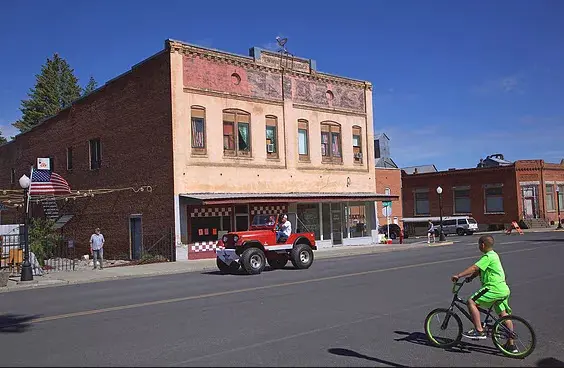
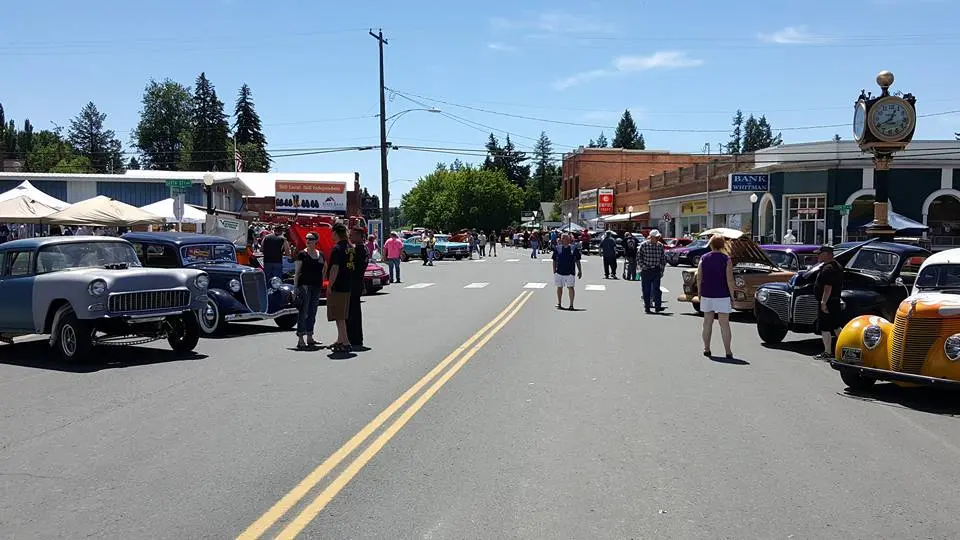
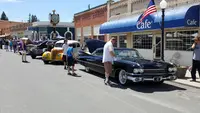
The day takes place on Whitman Avenue, the main street, where brick buildings went up in the town’s first decades. At nine the Garden Club opens a plant sale at the old Texaco station, 534 Whitman Ave. Charles Hall built that service station in 1923, and the Hall family ran it until 1980. They gave it to the Rosalia Chamber of Commerce in 2000, and it is now the town’s visitor center. Vendors set up on the sidewalks between Fifth and Seventh streets. The 2026 list included the Rosalia 4-H and a Waffle Wagon.
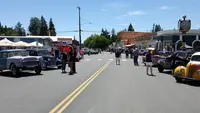
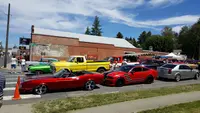
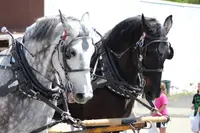
The Kid’s Parade goes at 10:30. The association gave the 2026 children’s theme as red, white and blue and invited motorized vehicles, bicycles, tricycles, and scooters. The Whitman County Gazette reported the theme as Our American Roots. The Grand Parade follows at 11. It lines up at First and Whitman and marches through downtown on Whitman Avenue. New in 2026 was the association’s own display, a bridge on wheels: a model of the Milwaukee Bridge with Pine Creek and the roadway running beneath its arches. By mid-May it had already traveled in two other parades.
The 2026 grand marshals were Elton and Diane Hill. Elton came to Rosalia from Spangle in the 1940s. His father was the school custodian, and his mother was a telephone operator and later a school cook. Diane grew up in Malden, where her father was a fireman and engineer on the Milwaukee Railroad. The two graduated from Rosalia High School together in 1954 and married at Rosalia Catholic Church on November 10, 1955. Elton spent 26 years on the Rosalia Volunteer Fire Department. Diane helped form the Rosalia Gifted Granny’s. The couple said the biggest change in Rosalia was the construction of the highway bypass.
After the parade comes an egg toss on Whitman Avenue, open to all ages, and then a pie-eating contest. Rosalia High School sophomores sell lunch at noon: pulled-pork sandwiches, potato salad, baked beans, chips, and a drink. Around town there is baked-goods bingo at the fire station, a dunk tank, bicycle repair, and a firefighters’ 50/50 raffle. “Mr. Rosalia” Mike Day runs a raffle at the Texaco for the town’s municipal pool and park. The association’s own 2026 drawing was for a 70-inch television, at 1 p.m.
Games for children and teenagers begin at 1:30 near the post office: ring toss, cup pong, giant Jenga, and pop pong. A cornhole tournament runs from 1 to 3 near the fire station to benefit the track team. At 4 the Timberwolves baseball team hosts softball at Rosalia Park, with a hot dog, chips, a cookie, and water included in the entry. A festival listing adds barrel racing, pickleball, and a bicycle rodeo. The Gazette expected thousands downtown for the 2026 edition, while the same listing gives attendance as 500.
A museum in the old fire bay
A museum is the reason the day exists. The association writes that a town museum had been talked about for more than a decade. Plans went forward only when community leaders decided to hold an annual celebration and made raising money for a museum its primary mission. They called it Battle Days. The first, in 1970, raised $500, and the second earned $1,700.
About then the town built a new fire station, which emptied the space in city hall where the fire trucks had stood. The city council gave that space to the museum, and volunteers renovated it. The glass display cases were bought as leftovers from Spokane’s World Exposition in 1974, and surrounding communities donated objects of local history. The museum opened its doors during Battle Days 1976. It covers Rosalia, Malden, and Thornton: homemakers, merchants, the railroad, agriculture, and the tools of everyday life on the Palouse.
In 1997 volunteers carried every item out to repaint and reorganize. In 2002 they cleaned, painted, and carpeted the second floor of city hall, once used for community social events, so the collection could fill both levels. The association also keeps a historical cookbook of recipes from women who cooked on wood stoves. Dori Weldon told its compiler that her mother often cooked for 35 to 40 men during harvest.
The association counts its celebrations from 1970. A photograph in the Whitman County Library archive, dated 1958, shows John Lautenslager and friends in the Battle Days Parade, advertising the family garage in St. John. Wally Lautenslager played saxophone in that parade, though he does not appear in the frame. The caption describes the parade as held every year on the first weekend in June.
Tohotonimme, May 17, 1858
The association’s history page gives the fight three names: the Battle of Pine Creek, the Steptoe Battle, or the Battle of Tohotonimme. Washington State Parks gives this account.
Lieutenant Colonel Edward J. Steptoe left Fort Walla Walla on May 6, 1858, to investigate reported deaths of miners travelling to Colville. His correspondence shows he expected a diplomatic mission. His seven officers, 152 mounted soldiers, and 30 civilians were lightly armed. Most carried the Springfield Model 1847 Musketoon, a weapon not well regarded for range or accuracy, and the only ammunition was the 40 rounds each soldier carried. Testimony taken afterward suggested that reserve ammunition had been removed from the baggage and replaced with extra rations of whiskey.
Two months earlier the Army had received authorization to build a military road through the area, connecting Fort Benton with Fort Walla Walla. Indigenous leaders saw it as an existential threat to their traditional life, and many joined an alliance under Chief Kamiakin (Yakama/Palús) and others. On May 15 Steptoe camped above Pine Creek, or Tohotonimme. The next day the soldiers became aware that hundreds of mounted warriors were watching the column. They were also told that no one would help them cross the Spokane River. Steptoe halted and turned back on May 17.
A running battle followed for ten hours, and officers, soldiers, and warriors were killed or seriously injured. In the afternoon the column reached a hill overlooking a bend in Pine Creek from the east. The soldiers formed a circle about 250 yards across, built barricades, and dug firing positions. The warriors charged twice. Nightfall brought a cease-fire.
Each soldier had fewer than three rounds left, and Steptoe ordered a retreat under darkness and a drizzling rain. Light-colored horses were covered with blankets and noisy equipment was muffled, and the soldiers slipped away. Descendants of the Indigenous warriors have suggested that Kamiakin and other leaders allowed them to pass, since the retreat proved the allied tribes had won a clear victory. The association’s pages name the tribes as the Coeur d’Alene, Palouse, and Spokanes.
Colonel George Wright was then ordered to “attack All the hostile Indians you meet, with vigor; make their punishment severe and persevere until the submission of all is complete.” His force of more than 700, armed with new, highly accurate rifles, defeated the allied tribes at the Battle of Spokane Plains on September 5, 1858. In the days after, Wright ordered the destruction of food stores, dwellings, and nearly 1,000 horses. The Yakama leader Qualchan was summarily executed on September 24.
Wright also sent a detachment under Brevet Major W. N. Grier back to the Pine Creek hill. It was to recover the soldiers’ bodies and two cannon buried there before the retreat. Lieutenant David Gregg and Assistant Surgeon John Randolph, both veterans of the fight, went with it.
The obelisk above Pine Creek
Battle Days visitors can also walk to the Steptoe Battlefield State Park Heritage Site, on the hill where the soldiers made their stand. Washington State Parks acquired the ground from Whitman County in 1950. State Parks gives its size as three acres, and the Washington State Parks Foundation gives four. The site holds a picnic table, interpretive panels, and the monument.
Rosalia itself was first settled in 1872 and named for the wife of its founder, John Favorite. Government surveys of the area were completed in 1874. In 1888 Peter Proff took the battlefield land into private ownership under the Homestead Act. On May 10, 1907, the Inland Empire Historical Society met in Spokane to discuss a memorial at the spot. On June 14 of that year, four Army veterans who had served with Steptoe or Wright walked the site with members of the Daughters of the American Revolution. On February 5, 1910, the DAR conveyed three acres to Whitman County to hold in trust for a monument.
The Esther Reed Chapter’s 25-foot granite obelisk was dedicated on June 15, 1914, before nearly 7,000 people. They included three Army veterans of the battle, Governor Ernest Lister, 50 members of the DAR, and 500 soldiers from Fort George Wright. State Parks now says some of the text on the monument is incorrect. There is no record of Indigenous warriors who had fought there attending the dedication.
Notable Events
- 1858With less than three rounds remaining for each soldier, Steptoe gave orders to retreat under the cover of darkness and a drizzling rainfall. parks.wa.gov
- 1888After government surveys in 1874, the land in today's heritage site passed into private ownership by Peter Proff under the Homestead Act. parks.wa.gov
- 1907The Inland Empire Historical Society met in Spokane on May 10, 1907 to discuss a memorial where the warriors had pinned Steptoe's troops near Pine Creek. parks.wa.gov
- 1910On February 5, 1910 the Daughters of the American Revolution conveyed three acres to Whitman County to hold in trust for the monument. parks.wa.gov
- 1914The 25-foot obelisk was dedicated on June 15, 1914 before nearly 7,000 people, including three US Army veterans of the fight, Governor Ernest Lister, 50 DAR members and 500 soldiers from Fort George Wright. parks.wa.gov
- 1914A 25-foot granite memorial was erected that year by the Esther Reed Chapter of the Daughters of the Revolution to mark the authentic site. waparks.org
- 1950The Washington State Parks and Recreation Commission acquired the three acres around the monument from Whitman County for addition to the state park system. parks.wa.gov
- 1958A Whitman County Library archive photograph shows John Lautenslager and friends in the Battle Days Parade, described as held every year on the first weekend in June, promoting the family garage in St. John. washingtonruralheritage.org
- 1970The first Battle Days raised money for the museum, and the second year earned more for it. rosaliabattledays.info
- 1974The town built a new fire station, the city council gave the vacated city hall space to the museum, volunteers renovated it, and the glass display cases were bought as leftovers from Spokane's World Exposition in 1974. rosaliabattledays.info
- 1976The museum's doors opened during Battle Days 1976, after surrounding communities donated items of local historical significance. rosaliabattledays.info
- 1997Volunteers removed every item from the museum to repaint and reorganize. rosaliabattledays.info
- 2002The city hall second floor, once used for community social events, was cleaned, painted and carpeted so both levels could display the collection. rosaliabattledays.info
People
- Diane Hill, Battle Days grand marshal, a Rosalia High School classmate of Elton Hill who helped form the Rosalia Gifted Granny’s (1954).
- Elton Hill, Battle Days grand marshal who moved to Rosalia from Spangle as a child, the son of the school custodian (1940s).
- Chief Kamiakin, led the allied Indigenous warriors at the running battle (1858).
- David Gregg, Lieutenant who had been at the battle and went back to the site with the recovery party.
- Edward J. Steptoe, Lieutenant Colonel in command of the US Army soldiers in the running battle Battle Days commemorates (1858).
- Ernest Lister, Washington Governor who attended the dedication of the battlefield obelisk (1914).
- George Wright, Colonel ordered to return to the area and punish the hostile Indians after the battle (1858).
- John Randolph, Assistant Surgeon at the battle who returned to the site with the recovery party.
- Peter Proff, settler who took the battlefield land into private ownership under the Homestead Act (1888).
- W. N. Grier, Brevet Major whose detachment was sent back to the site to recover the soldiers' bodies and buried cannon.
- John Favorite, founder of Rosalia, the town that holds Battle Days; the town was named for his wife (1872).
- John Lautenslager, took part in the Battle Days Parade at Rosalia with friends, advertising the Lautenslager Garage (1910-1976).
- Wally Lautenslager, played a sax in the Battle Days Parade, though not visible in the photograph.
Sources
- rosaliabattledays.info/home
- rosaliabattledays.info/home/fun-run
- rosaliabattledays.info/home/games
- rosaliabattledays.info/home/parade-vendor-forms
- rosaliabattledays.info/home/battle-days-association-meeting-minutes
- rosaliabattledays.info/home/local-town-history
- rosaliabattledays.info/home/volunteer-forms
- rosaliabattledays.info/home/sponsors-donors-forms
- facebook.com/profile.php?id=61558775360351
- townofrosalia.net/battle-days
- rosaliabattledays.info/home/rosalia-museum
- parks.wa.gov/about/news-center/field-guide-blog/steptoe-battlefield-state-park-heritage-site-history
- washingtonruralheritage.org/digital/collection/whitman/id/6240
- cheneyfreepress.com/story/2026/06/04/news/rosalia-to-host-battle-days/44270.html
- spokanehistorical.org/items/show/373