Bale Grist Mill State Historic Park
Saint Helena, Napa County, California. State historic park.
Details

- Where
- 3369 Saint Helena Hwy N, Saint Helena, CA 94574. Directions
- When
- Old Mill Days, Saturday, October 10, 2026, 10:00 AM-2:00 PM at the park.
- Getting there
- The historic park is three miles north of St. Helena (3369 N St.) on Highway 29.
- Fees
- Adults $8/Children 6-17 $3/Children under 6 are free.
- Hours
- Open Saturday & Sunday 10:00am - 4:00pm (last tour begins at 3 pm).
- Access
- Historic siding and flume restoration project underway; fundraising in progress; the mill continues to function.
- Walk-in or reserve
- School tours by reservation on Wednesdays and Thursdays at $150.00 per class via info@napavalleystateparks.org.
- Phone
- 707-963-2236
- Website
- napaoutdoors.org
- Managed by
- Napa Open Space in partnership with the Napa Valley State Parks Association.
- Established
- 1846.
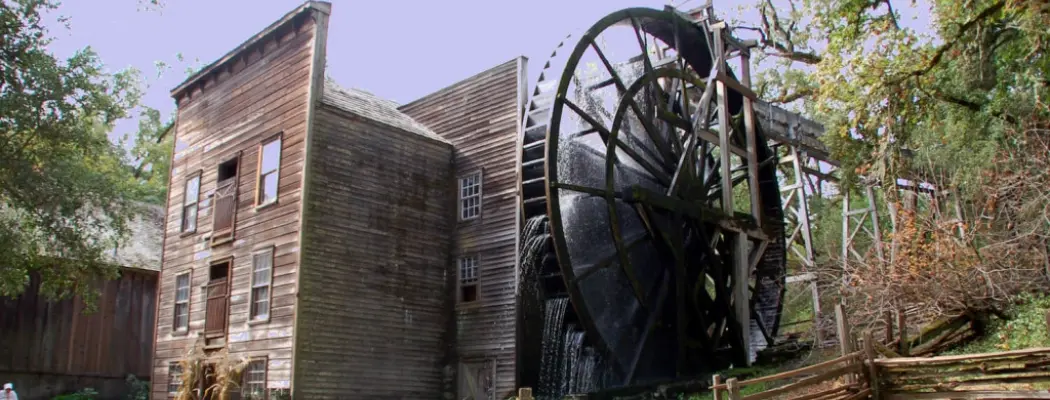
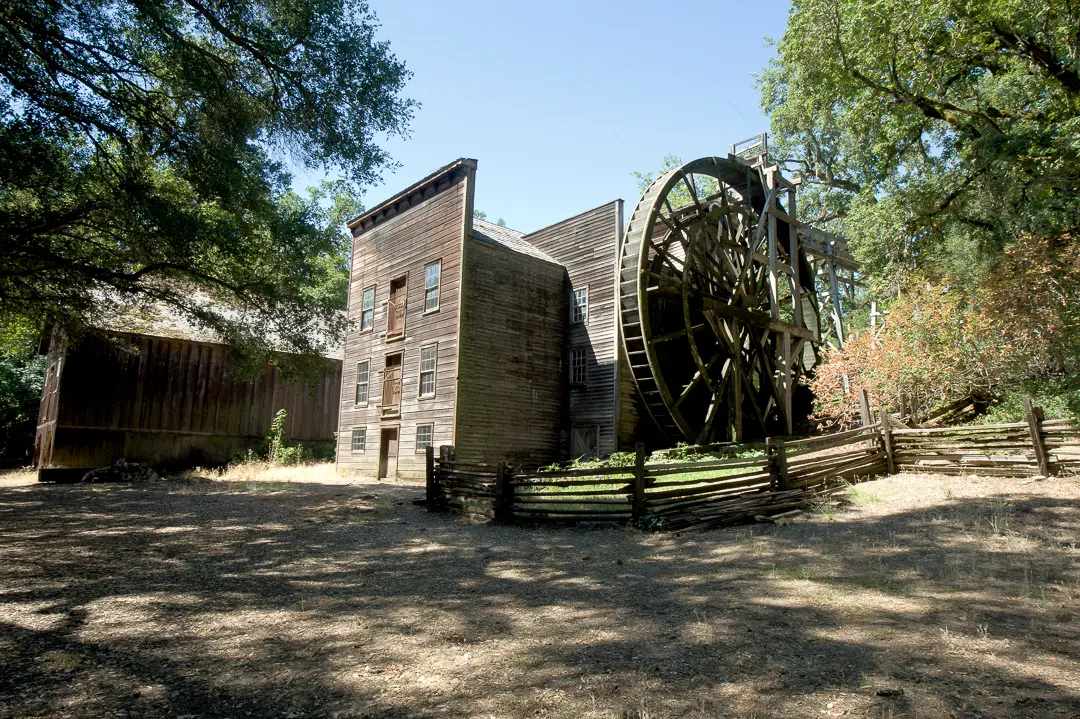
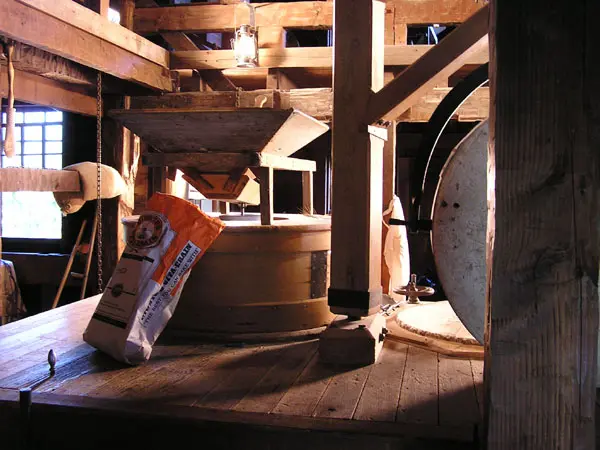
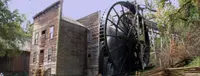
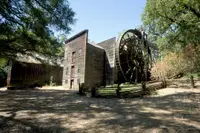
The wheel stands against the uphill end of the mill, wooden and 36 feet across. On Saturdays and Sundays it turns. The overhead flume carries water onto the top of the wheel, and inside the building the miller sets a set of French Buhr millstones grinding grain into what the park calls Bale Mill flours and meals. A 2021 report in the Napa Valley Register wrote that the wheel “steadily creaks with its surefooted rotation, just as it did when it was completed in 1846.” The mill sits just off Highway 29, between St. Helena and Calistoga in Napa County. It is the centerpiece of Bale Grist Mill State Historic Park, which California State Parks owns and the Napa County Regional Park and Open Space District runs with the Napa Valley State Parks Association.
The wheel, the stones, and the granary
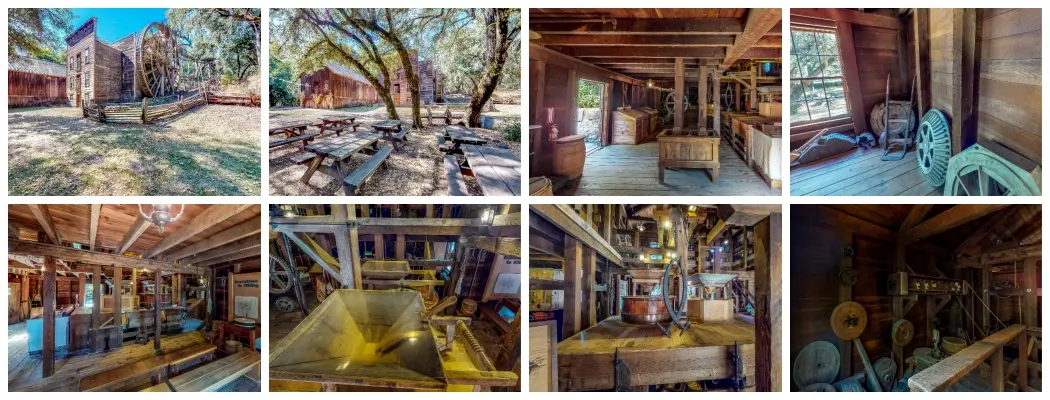
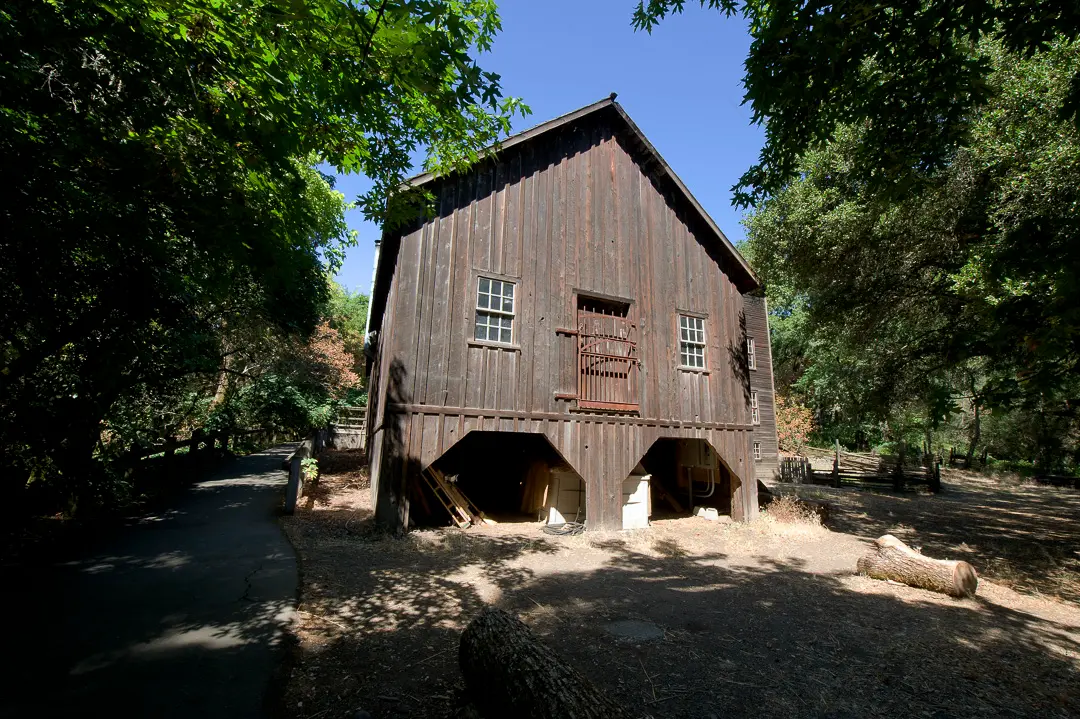
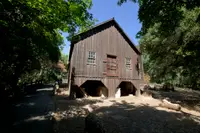
The building stands on a slope. A 1970 National Register nomination recorded three stories on the downhill side and two on the uphill side, each level about 1,000 square feet, with wood siding and a corrugated iron roof that had replaced the original shakes. According to State Parks, the mill and its granary were framed from local Douglas fir and coast redwood. Some timbers were cut to length with the bark left on and others were roughed out with hand tools, then notched and held with wooden pegs as well as nails and screws. The foundation is native stone. Water was diverted from nearby Mill Creek, run by ditch from a millpond to a wooden flume, and dropped onto the top of the wheel. The first wheel did not give enough power in dry summers and was replaced with a larger one, similar to the one there now.
The sources do not agree on that wheel’s size. The park and its partners give 36 feet. The 1970 nomination gives an overshot wheel 45 feet in diameter with wooden gearing, and an old postcard of the “Old Bale Mill” also gives 45 feet and calls the wheel “now idle.” The stones are also described in two ways. The district calls them the mill’s original set of French Buhr millstones. The 1970 form says the millstones were made locally of native stone, and that the flume was built of halved and hollowed-out redwood logs, with a rubble stone tailrace carrying the water away.
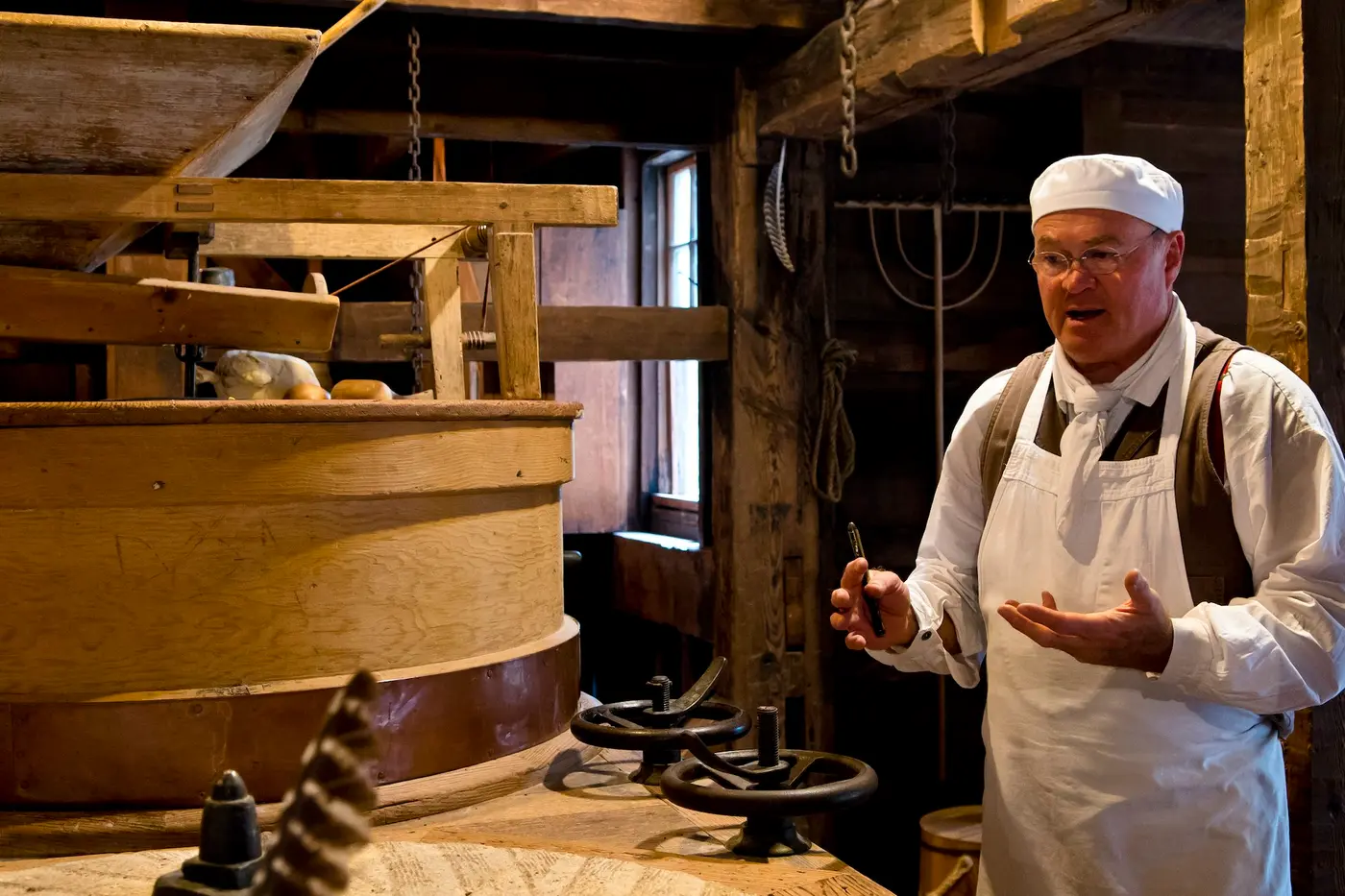
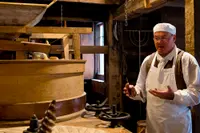
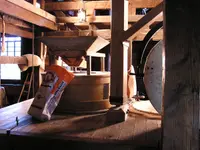
The miller’s tour follows the grain. Farmers’ grain was placed into the boot of an elevator, carried mechanically upstairs, and cleaned and sifted by a series of machines. According to State Parks, the slow turning of the stones and the dampness of the site gave the meal a quality suited to cornbread, yellowbread, shortening bread, and spoon bread. The park repeats a saying it credits to old timers: “When meal comes to you that way, like the heated underside of a settin’ hen, it bakes bread that makes city bread taste like cardboard.”
The granary now holds a museum of the mill’s early records and artifacts, along with a gift shop. For a small donation a visitor can carry away a bag of freshly milled cornmeal, polenta, or flour: rye, oat, buckwheat, barley, or the traditional Sonora wheat. The last tour begins at 3 p.m. There are picnic grounds at the mill. On weekdays, when the mill is closed, the park association suggests parking at Bothe-Napa Valley State Park and walking in on the History Trail, past the old millpond site, to see the wheel at rest.
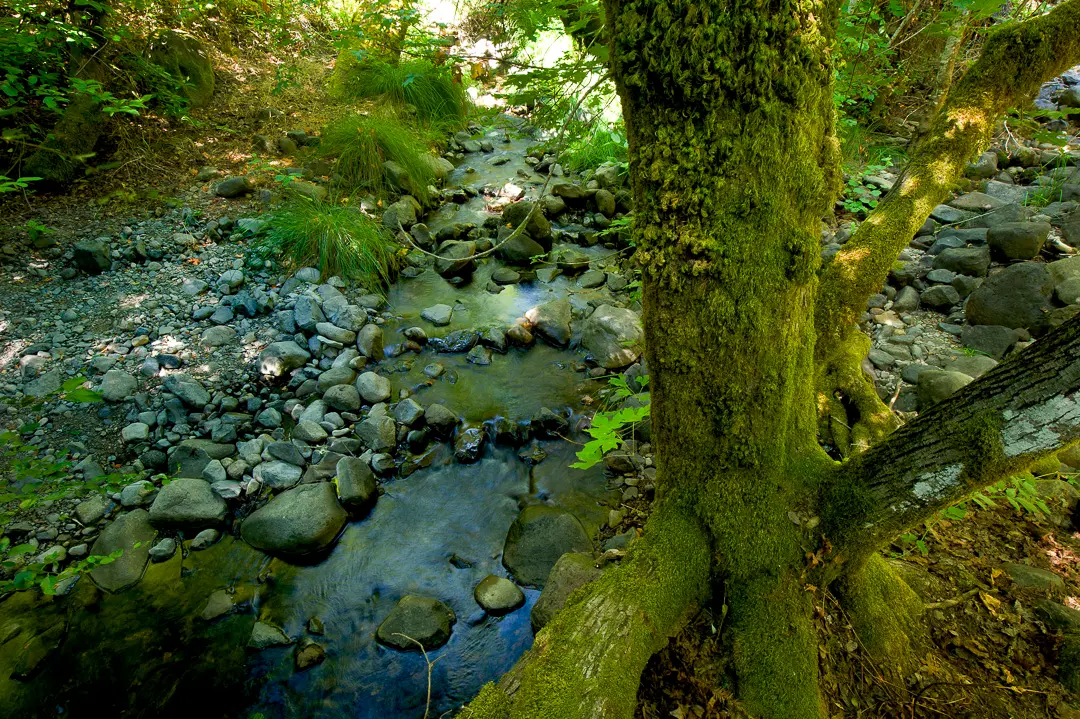
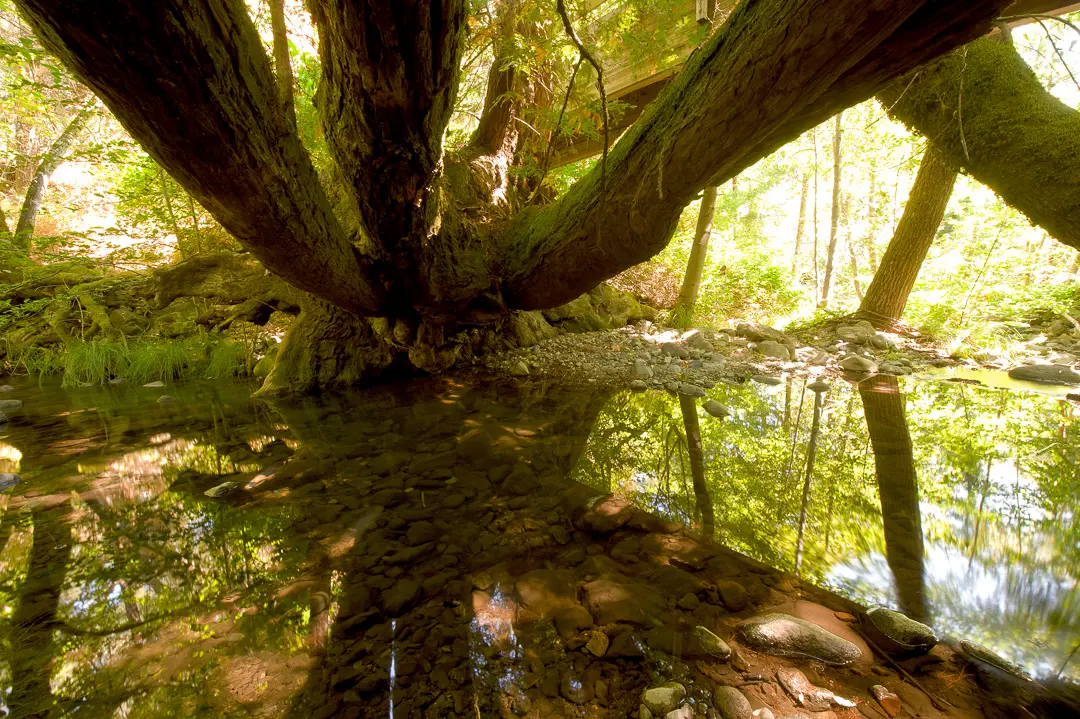
That trail is single-track and moderate. It is 2.4 miles round trip by the district’s count and about two miles by State Parks’. It passes through dense forest, chaparral clearings, and a riparian corridor along Mill Creek. Along it are the Pioneer Cemetery, where several early Napa Valley pioneers are buried, and the site of the White Church, the first church in the Napa Valley, named for its founding minister, Asa White.
The miller bunch
The district’s millers wear period clothing on duty and, in the district’s words, must be willing “to get some flour spillage” on it. A May 2025 district newsletter introduced several of them.
Rob Grassi is a park maintenance specialist for the district. He spent 14 years as head millwright at Hanford Mills Museum in New York, a water- and steam-powered mill from the 1840s, and as a teenager he apprenticed with a fifth-generation miller. Every couple of years he goes to the mill at Mount Vernon to true, reband, and balance its millstones, “really the same kinds of things we do here at the Bale Mill.” His favorite garment is the vest, because in the early to mid-19th century “a man wasn’t considered dressed unless he had his vest on.”
Mario Scalise retired from a career in information technology in San Francisco. His grandfather was a grist miller in Calabria, and his great-grandfather built six mills. He calls the Bale Mill high technology, and when visitors look doubtful he asks them to bring the smartphone in their pocket back to the mill in ten years “and we will discuss what an antique it has become.” He first came to the mill more than 60 years before the interview, for family picnics with his grandfather: “It was completely closed up in those days and there was a horseshoe entrance off highway 29 and a few picnic tables.” In August, at around 100 degrees, he trades period dress for shorts and a Bale Mill T-shirt.
Christin Tanner came to milling after 20 years of guiding tours. She tells visitors that Sarah Graves Fosdick, a survivor of the Donner party, was the first teacher at the first school in the Napa Valley, across from the mill. Once, while she was telling that story, a guest said her own ancestor was Mary Graves, Sarah’s younger sister and another survivor. Martin Podell is head baker at The Model Bakery in Napa. He took the Bale Mill tour after milling small batches of local grain for the bakery, and he has since learned to dress millstones by hand. The district’s restoration accounts also name Steve Harle as a miller at the mill.
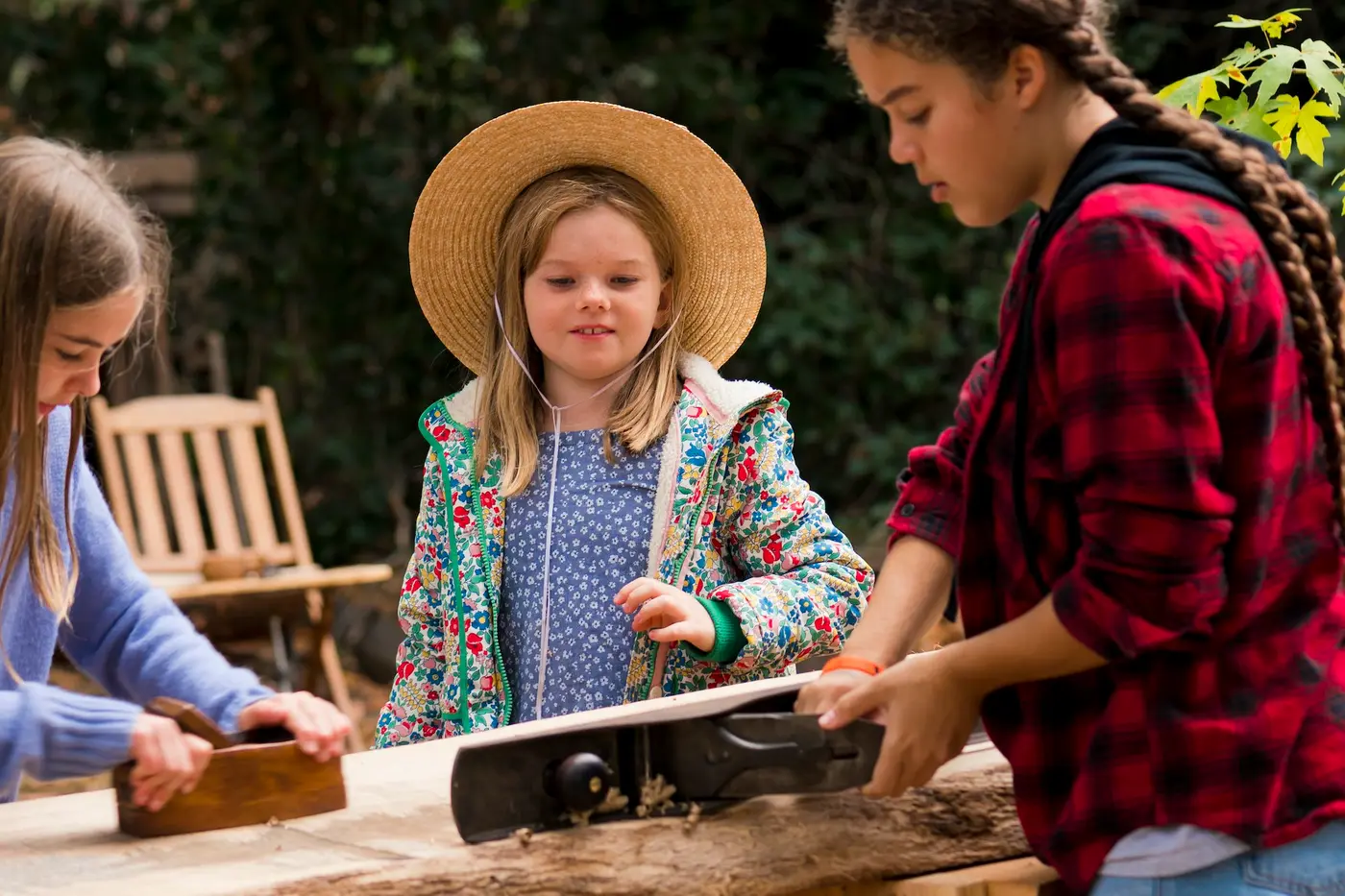
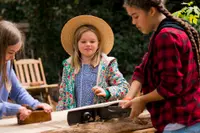
The mill’s calendar follows the farm year. Old Mill Days falls on the second weekend of October. The 2026 dates are Saturday and Sunday, October 10 and 11, from 10 a.m. to 2 p.m., with corn husking, wheat threshing, butter making, and apple pressing, blacksmiths and lace makers at work, and reenactors in period dress. Old Mill Holidays is set for Saturday, December 5, 2026. Carols play, cider simmers on the wood-burning stove, children write letters to Santa with quill pens and seal them with wax, and families make wreaths of rosemary, fir, and toyon berries along with woven wheat ornaments. The district also lists a Harvest Dinner, a Pioneer Christmas, and Fiesta en el Molino Bale, which marks Mexican Independence. The St. Helena Star names a pancake breakfast held in May.
Dr. Bale, Señora Bale, and a mortgage
Edward Turner Bale was a British surgeon. By one account he sailed from England to California in the 1830s and settled in Monterey, where General Mariano Vallejo named him surgeon-in-chief of the Mexican army. He married Vallejo’s niece. The sources spell her name several ways: Maria Ygnacia Soberanes, Maria Soberanes, Maria Sobrantes, and Maria Sobranes Vallejo Bale. According to the St. Helena Historical Society, Bale converted to Catholicism and became a Mexican citizen, which allowed him to receive a land grant of 17,962 acres in the Napa Valley, the Rancho Carne Humana. One account dates the grant to 1841. The couple moved to their home on what is now Whitehall Lane in 1843 and raised six children. Cattle were raised on the rancho for hides and tallow, and wheat was planted along the river. Bale built a sawmill to cut boards for the valley’s first frame buildings, and in 1846 he built the gristmill to grind the valley’s grain.
The marker and the older records credit the mill to Dr. Bale. State Parks and the park association credit it to Edward Turner Bale and Maria together. In 2008 the Weekly Calistogan put the question in a headline: “Should it be Maria’s Mill?”
Bale died in 1849 at the age of 38. According to an interpretive panel in the granary museum, Maria inherited the rancho, two mills, and difficult debts. Perhaps to raise cash, Bale had sold several plots of land and even mortgaged the gristmill. She redeemed the mortgage, settled the other obligations, and contracted with local men to manage the rancho. One agreement bound her attorneys to “render every personal assistance in their power in the raising and educating her children.” She sent the children to school in Sonoma, in Santa Clara, and as far away as Boston. The district calls her a savvy businesswoman who became one of the wealthiest people in the Napa Valley of her time. In 1854 she sold 126 acres to Henry Still and Charles Walters. Lots on that land were given to anyone who would start a business, and that is how St. Helena began.
The mill had other owners in those years. The 1970 nomination says that “while the ‘49ers were searching for gold in the hills and ravines of the Sierra Nevada, the mill was daily grinding flour for the settlers.” Farmers who came to have their grain ground stayed to visit with their neighbors. Ralph Ellis, Edward Irwin, and William Sayward owned the mill from 1860. The Lyman family owned it from 1871: the Rev. Theodore Benedict Lyman, William Whittingham Lyman, and Sarah Amis Lyman. William Lyman built the neighboring El Molino Winery and named it “the mill” after the Bale mill beside it. The district and State Parks say the mill stayed in use until the early 1900s. The Napa Valley Register puts the end of heavy use at about 1905. The postcard says the mill furnished flour to the valley for over thirty-five years.
Native Sons, a closed door, and a broken flume
Mrs. W. W. Lyman deeded the mill and the land around it to the Native Sons of the Golden West. The Native Son parlors of Napa County restored the mill under past Grand President Bismark Bruck, a grandson of Dr. Bale, and dedicated it on June 21, 1925. Their bronze tablet stands on the path between the parking area and the mill. The state designated the site California Registered Historical Landmark No. 359 on October 9, 1939.
By the mid-1950s the mill was closed to visitors as unsafe. Napa County wanted it made sound enough to admit the public, and Howard Wright of Napa, father of the St. Helena baker Jimmy Wright, rebuilt much of the interior structure. A man who worked under him for several weeks as a “gofer” later remembered that the stones and gears were mostly intact and that the wheel would turn but needed much repair. “Howard did not ‘restore’ the mill,” he wrote, “but he did revive it.”
In 1972 the mill became the first property in Napa County listed on the National Register of Historic Places. California State Parks took ownership in 1974, and the Napa Valley State Parks Association began its support in 1978. The wheel and the siding were restored in the mid-1980s. The Native Sons rededicated the “Old Bale Mill” on October 1, 1988, with Frank Compani as Grand President. Another renovation followed in 2000. In 2012 the state turned day-to-day management over to the county district. The St. Helena Star’s editorial board described this as the state walking away from the mill and two neighboring parks. The district operates them on gate receipts of around $900,000 a year.
In the fall of 2015, Park Ranger Sandy Jones agreed, with some hesitation, to allow a wedding at the mill. The wheel was chained still so that children would not climb on it. The day was going well until the overhead flume broke “with a tremendous crash.” That failure began the next restoration. Some arms of the wheel had already been replaced in 2014. Grassi, working with district staff members Tyler Beach and Jacob Cull, built and installed more arms and finished that phase in January 2020. Ben Hassett, a millwright, fabricated other components in Kentucky. They replaced the wheel piece by piece in custom-cut redwood while the mill kept working, and they finished by December 1, 2020. The work cost about $140,000, most of it from the parks association. Dario Sattui gave money, and so did Holbrook Mitchell, who had been so taken with the mill that he built a miniature of it on his property in Yountville. Napa County Landmarks named Grassi its 2020 Preservationist of the Year.
On July 10, 2021, the community gathered at the mill for its 175th anniversary and the finished wheel. Jones had died by then. Calistoga Mayor Chris Canning recalled her barging into his office at the chamber of commerce to ask why Calistoga was not sending more visitors to the mill: “We sent more visitors to the mill.” Tyler Beach said of her: “She was a huge force. Period.”
The siding and flume came next. LiDAR scans of the building were made first to guide the work, and the plan is to replace rotted wood with materials that match the original construction. In 2025 the Star reported that the association needed $400,000 to replace the redwood siding and the wooden flume in time for the mill’s 180th birthday in 2026. The historically accurate square nails alone were expected to cost $7,000.
Notable Events
- 1841Bale was granted a large rancho in the upper Napa Valley; cattle were raised for hides and tallow, wheat was planted along the river, and Bale constructed a gristmill at this site to process the locally grown grain. noehill.com
- 1843Dr. Edward Turner Bale holds the mill. napavalleyregister.com
- 1846The water-powered grist mill was built in 1846 and was once the center of social activity as Napa Valley settlers gathered to have their corn and wheat ground into meal or flour. parks.ca.gov
- 1849After Dr. Bale's death, his wife Maria Soberanes (niece of General Mariano Guadalupe Vallejo) assumed control of the mill's operation and became one of the most wealthy people in the Napa Valley at that time. napaoutdoors.org
- 1849Dr. Edward Turner Bale received the property in a land grant from the Mexican government and lived near the site until his death in 1849; the mill remained in use until the early 1900s. parks.ca.gov
- 1860Ralph Ellis, Edward Irwin and William Sayward own the mill. napavalleyregister.com
- 1871The Rev. Theodore Benedict Lyman, William Whittingham Lyman and Sarah Amis Lyman own the mill. napavalleyregister.com
- 1900sThe mill eventually changed hands, but remained in active use until the early 1900's. napaoutdoors.org
- 1905The mill was heavily utilized by members of the community who came to grind their grain into flour and share the news of the day. napavalleyregister.com
- 1923Native Sons of the Golden West and Napa County serve as owners/caretakers. napavalleyregister.com
- 1939This site was designated as California Registered Historical Landmark No.359 on October 9, 1939. hmdb.org
- 1948Maria Bale, Isadora Bale Bruck and Louis Bruck own the mill. napavalleyregister.com
- 1950sThe mill was shuttered to public visit because of its delapadated and unsafe condition; Howard Wright performed substantial structural remediation to internal areas of the mill. hmdb.org
- 1972The Old Bale Grist Mill was listed on the National Register of Historic Places; it was the first property in Napa County to be listed. noehill.com
- 1974Owned by California State Parks. napavalleyregister.com
- 1978Supported by Napa Valley State Parks Association. napavalleyregister.com
- 1980sThe waterwheel which drives the mill stones and other equipment was last restored in the 1980's and was at the end of its life. napaoutdoors.org
- 1988The Old Bale Mill was rededicated by Napa Valley Parlors and the Grand Parlor Native Sons of the Golden West, with Frank Compani as Grand President. hmdb.org
- 2000Another renovation took place in 2000. napavalleyregister.com
- 2012Managed by Napa County Regional Park and Open Space District. napavalleyregister.com
- 2014Some arms of the waterwheel were replaced, with further restoration needed. napavalleyregister.com
- 2015In preparation for a wedding the wheel was chained so it would not turn, and the overhead flume, which carries water to the wheel, broke with a tremendous crash. napavalleyregister.com
- 2020Rob Grassi, millwright at Bale Grist Mill State Historic Park in St. Helena, was awarded the 2020 Preservationist of the Year Award of Merit from Napa County Landmarks for restoring the mill wheel using traditional methods and materials. napavalleyregister.com
- 2020Rob and his team finished the entire waterwheel project by Dec. 1, clearing the way for the mill to once again host tours and school field trips. napavalleyregister.com
- 2020Rob, Tyler and Jake began the restoration of the 36-foot waterwheel by fabricating and installing additional arms themselves, completing this phase in January 2020. napavalleyregister.com
- 2021The mill was once again a gathering place for the community to celebrate the mill's anniversary and the restoration of its water wheel. napavalleyregister.com
- The water wheel was restored in 2020, but the mill's siding hadn't been restored since the mid-'80s. napavalleyregister.com
People
- Bismark Bruck, past Grand President of the Native Sons of the Golden West who led the mill's restoration; a grandson of Dr. Bale.
- Frank Compani, Grand President of the Native Sons of the Golden West who rededicated the mill (1988).
- Howard Wright, performed substantial structural remediation to internal areas of the mill (mid 1950's).
- Mrs. W.W. Lyman, deeded the mill with its surrounding land to the Native Sons of the Golden West.
- Asa White, founding minister for whom the White Church at the park, the first church in Napa Valley, was named.
- Maria Soberanes, wife of Dr. Edward Turner Bale who assumed control of the mill's operation; niece of General Mariano Guadalupe Vallejo.
- Ben Hassett, millwright who fabricated the waterwheel components in Kentucky while the district team completed site work.
- Jacob Cull, Napa Open Space District staff member who assisted Grassi's wheel restoration.
- Rob Grassi, millwright at Bale Grist Mill State Historic Park; awarded the 2020 Preservationist of the Year Award of Merit from Napa County Landmarks for restoring the mill wheel using traditional methods and materials.
- Steve Harle, miller at the Bale Grist Mill.
- Tyler Beach, Napa Open Space District staff member who assisted Grassi's wheel restoration.
- Dario Sattui, individual donor to the water wheel restoration.
- Holbrook Mitchell, individual donor to the water wheel restoration who was so taken with the mill that he had a miniature version of it created on his property in Yountville.
- Sandy Jones, Park Ranger whose passion for the park was contagious; her wedding-era flume break led to the restoration.
- Bill Dyer, grape grower, winemaker and naturalist; Napa Valley State Parks Association board member honored with the Bill Dyer Napa State Parks Fund (died April 18).
- Cathie Bennett Warner, chair of the Napa Valley State Parks Association, which has helped save the mill numerous times.
- Edward Irwin, mill owner (1860-1871).
- Isadora Bale Bruck, mill owner (1948-1860 as printed).
- Louis Bruck, mill owner (1948-1860 as printed).
- Ralph Ellis, mill owner (1860-1871).
- Sarah Amis Lyman, mill owner (1871-1923).
- The Rev. Theodore Benedict Lyman, mill owner (1871-1923).
- William Sayward, mill owner (1860-1871).
- William Whittingham Lyman, mill owner (1871-1923).
- Dr. Edward Turner Bale, owner of the mill; received the property in a land grant from the Mexican government (lived near the site until his death in 1849).
- Mrs. W. W. Lyman, deeded the mill, with surrounding land, to the Native Sons of the Golden West.
- Maria Sobranes Vallejo Bale, builder, with Edward Turner Bale (1846).
- William Lyman, of the family that owned the Grist Mill at one time and built the neighboring El Molino Winery, named 'the mill' for the Bale Grist Mill beside it.