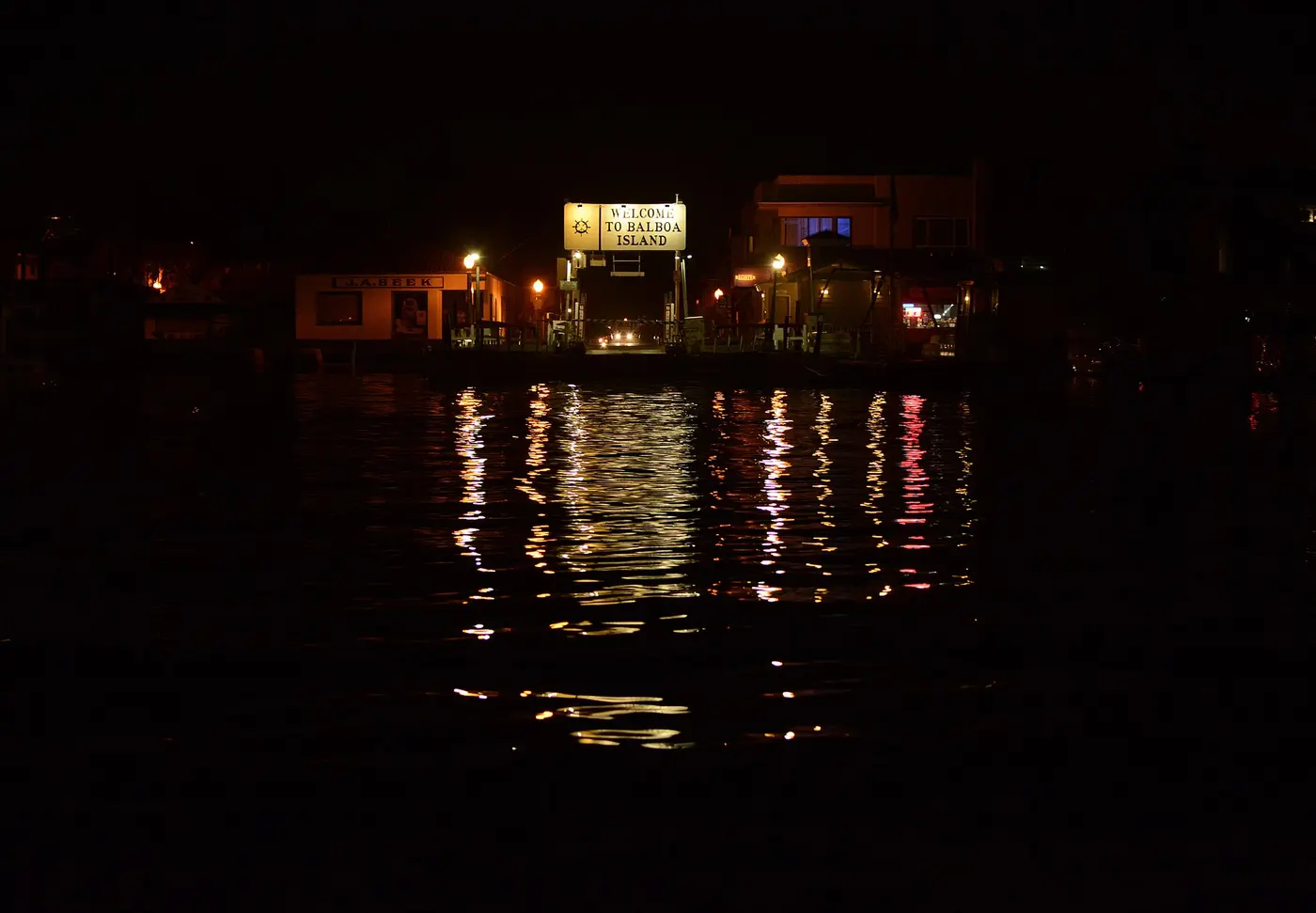
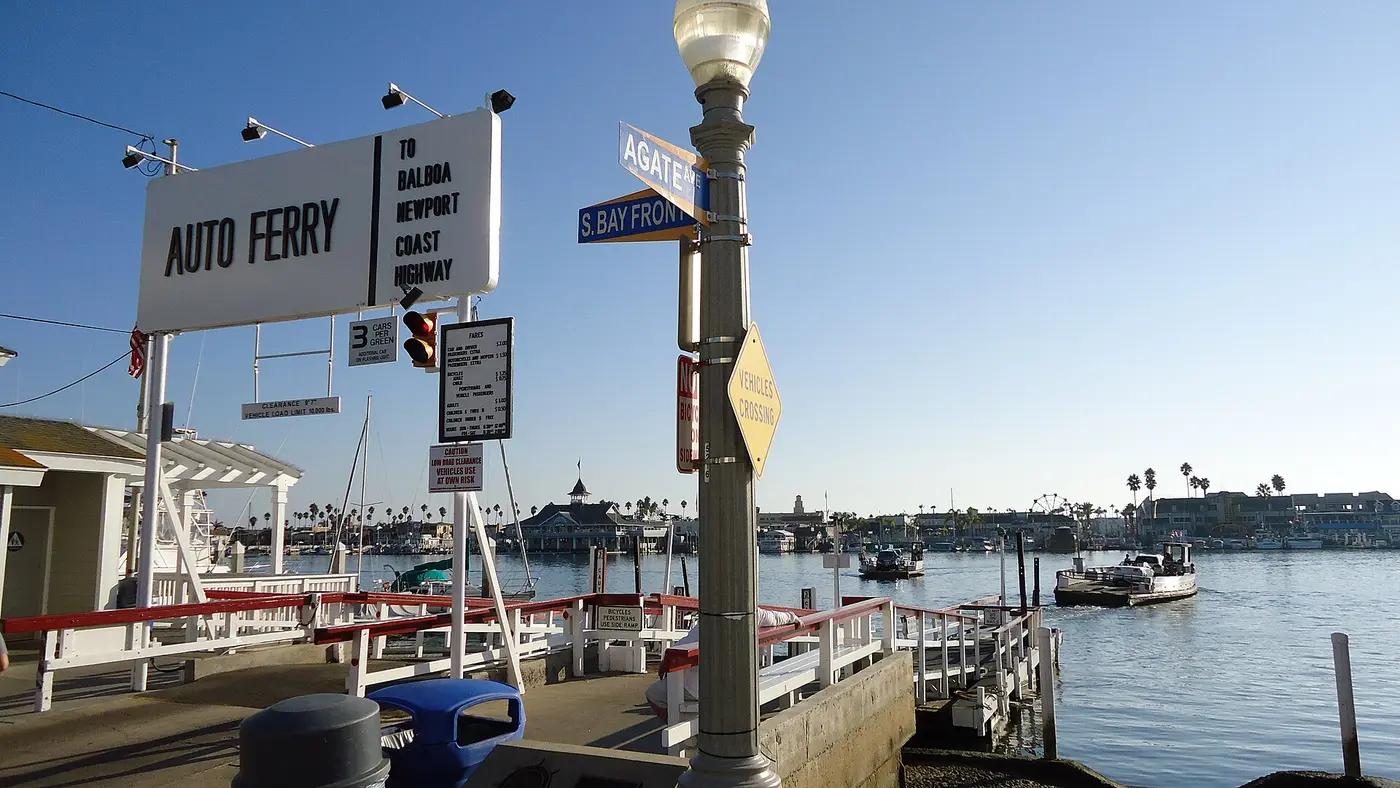


Balboa Island Ferry
Newport Beach, Orange County, California. Boat/Ferry Company; 365 days a year.
Details

- Where
- 410 S Bayfront, Newport Beach, CA 92662. Directions
- When
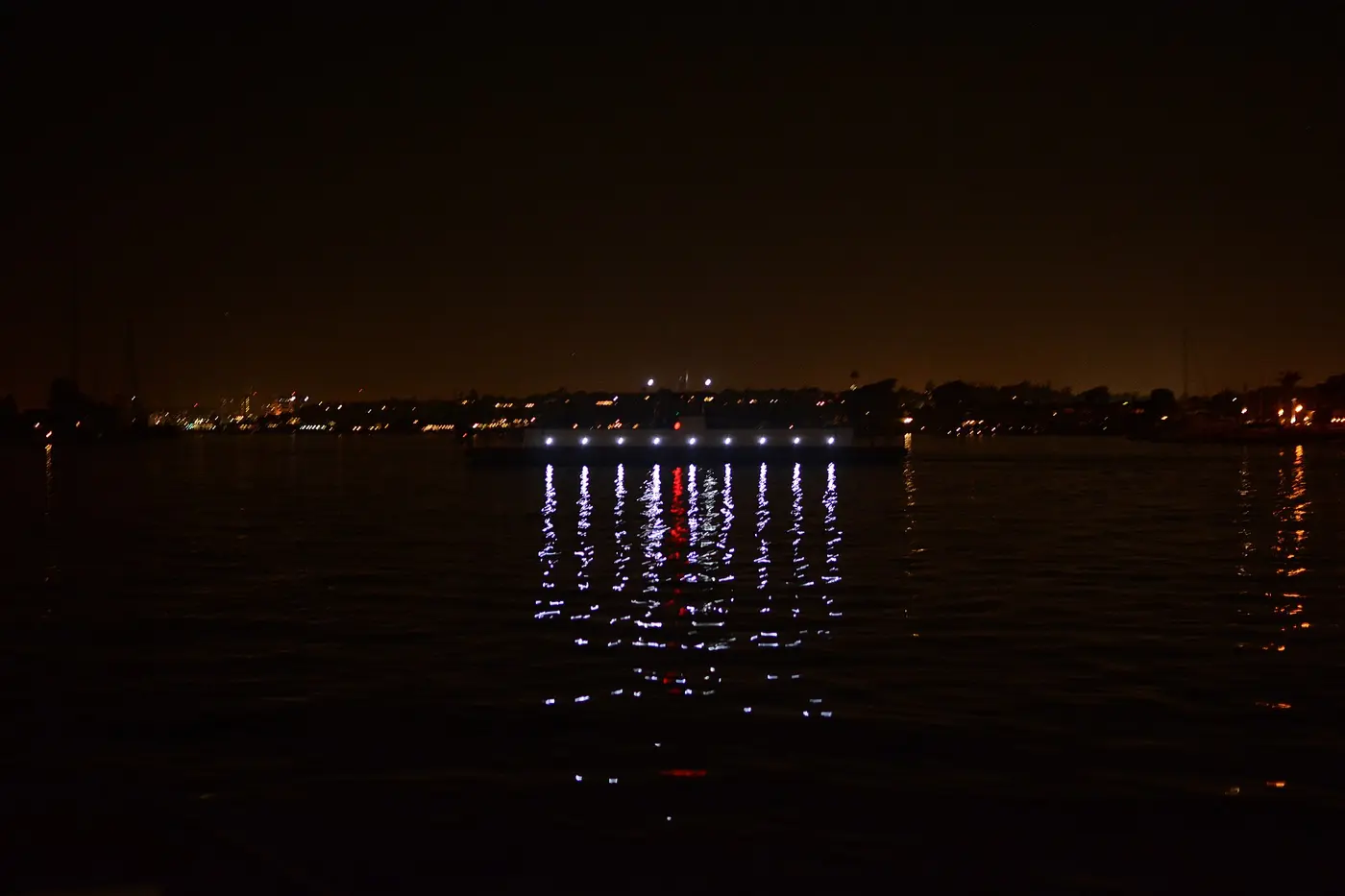
- We open at 630am, 365 days a year. The Ferry closes at Midnight. Typically the last Island departure is at 11:50 PM, and the last Peninsula Departure is at 11:55 PM.
- Getting there
- From the 405 Freeway: Take Jamboree South towards PCH. After going over PCH you will cross a bridge onto Balboa Island. Continue until you reach Park Ave, then turn right. Follow Park Ave until Agate Ave, then turn left.
- Fees
- At this time the Ferry is cash only.
- Access
- Service operating with intermittent pauses for harbor dredging. Brief delays of 10-15 minutes during off-peak commute times while dredging work is in progress near the Balboa Island dock.
- Walk-in or reserve
- No, you'll just pay the deckhand as the Ferry is crossing.
- Phone
- (949) 673-1070
- Website
- balboaislandferry.com
- Established
- 1919.
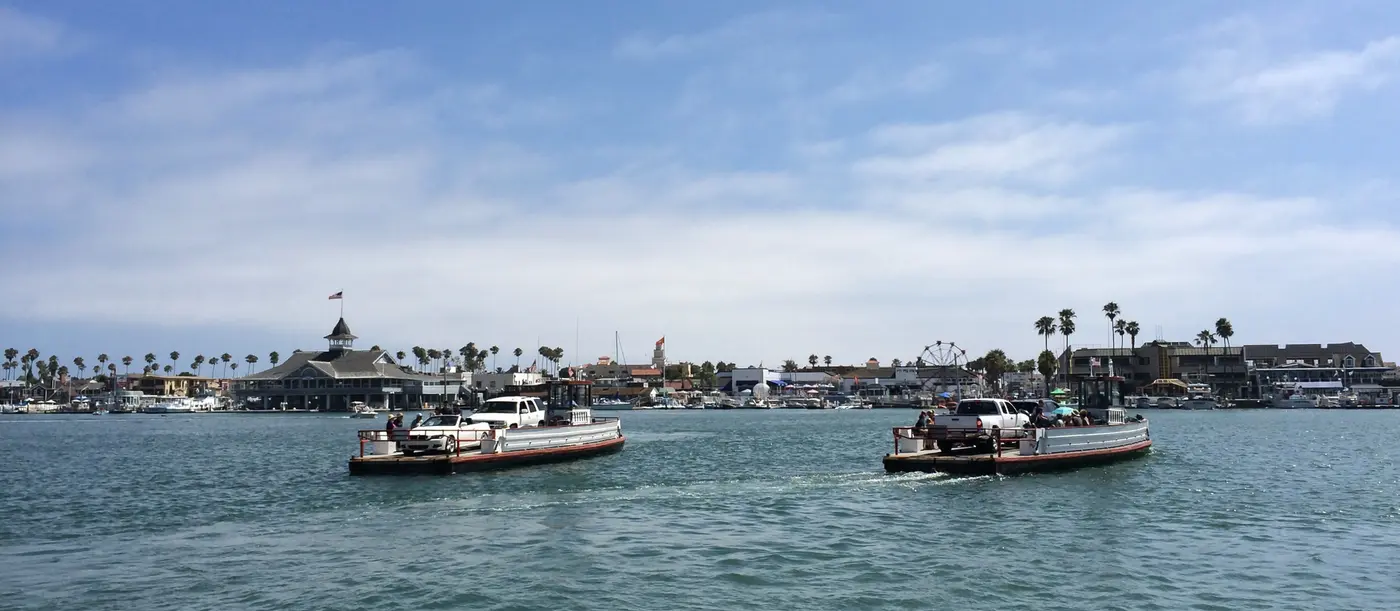
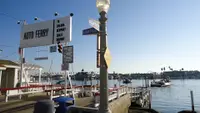
The line for the ferry forms on Agate Avenue. A driver who comes over the Jamboree Road bridge onto Balboa Island turns right on Park Avenue, then left on Agate, and is in it. “Sometimes the line will be all the way down the street,” Christina Strangio, owner of the Balboa Island Market a few steps from the dock, told CBS Los Angeles in February 2026. “It’s filled with people trying to cross because it only takes three cars at a time. They’ll have a couple of ferries running back and forth. They come in and get their stuff while they’re waiting.”
Three cars and the foot passengers
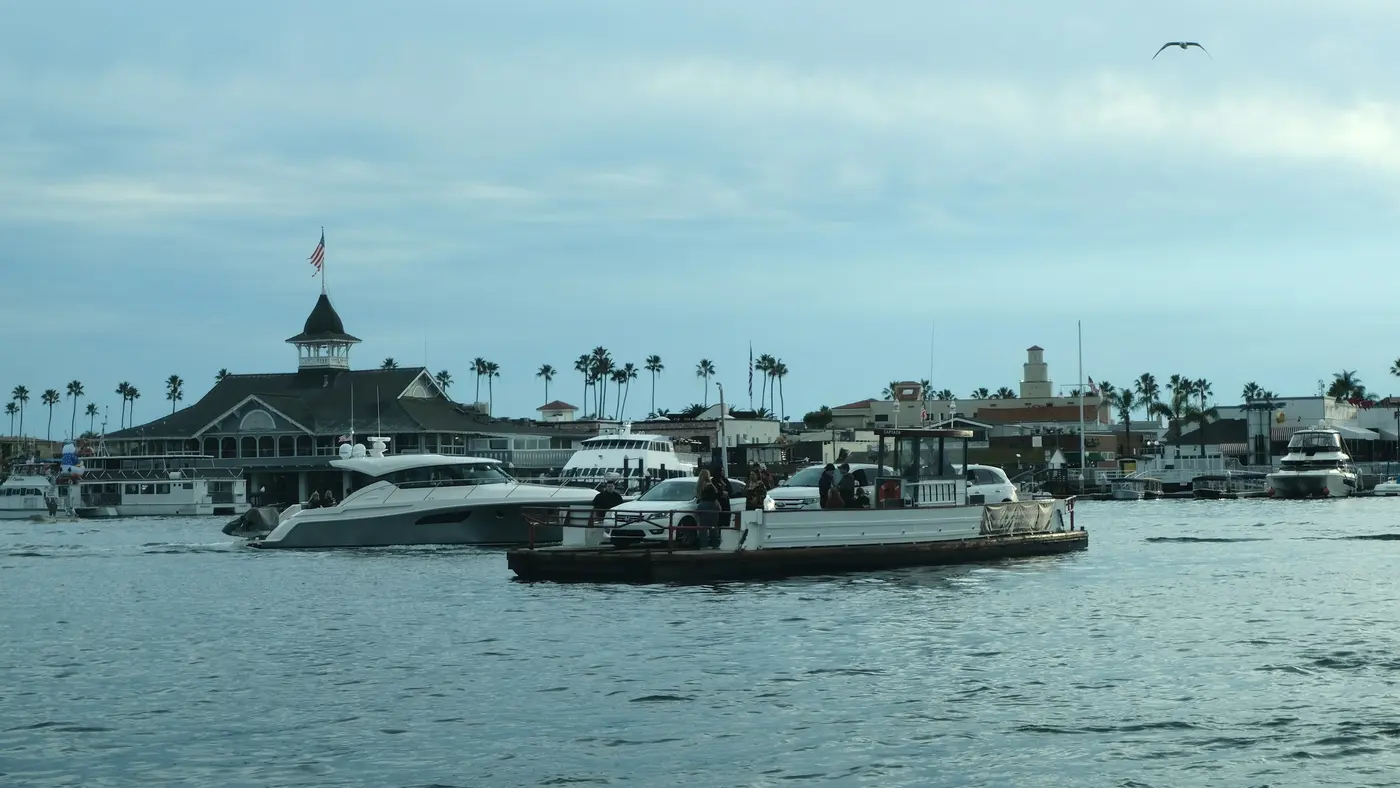
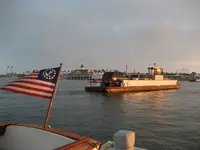
The crossing to the Balboa Peninsula is about 800 feet by the company’s measure, though some newspaper accounts give 900. It takes just under five minutes. The far landing sits beside the Balboa Fun Zone at Palm Street and Balboa Boulevard, where the Ferris wheel looks down on the boats. By road, around through the bridges, the same trip runs up to six miles.
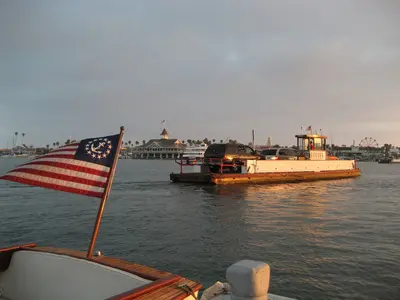
Three boats work the route: the Admiral, the Commodore, and the Captain. They are wooden, double-ended, and 64 feet long, and each carries three cars and up to 75 passengers. The hulls have been in service since the early 1950s, but in 2019 Seymour Beek said the “guts” were all less than 10 years old. In the same year he counted about six crossings an hour for each boat and more than 100,000 crossings a year for the fleet. In 2018 the boats carried about 1.7 million passengers.
Loading follows a fixed order. Cars come off first while walkers and cyclists stay seated along the sides. The foot passengers leave by the two side ramps. Two cars drive on, and the third waits on the ramp until the walkers and bicycles are aboard. Then it rolls on.
Nobody buys a ticket ahead. A deckhand collects cash during the crossing. In September 2025 the Orange County Register listed the fares as $1 for children, $2 for adults, and $3 with a vehicle. The company’s notice on tipping reads: “The wind and seas may tip the ship, but only you can tip the crew!” Dogs ride on a leash. The captain decides at the ramp what comes aboard. Campers, trailers, dually trucks, stretch limousines, and anything taller than 9 feet 7 inches stay ashore, and the company warns of low road clearance when the tides vary. Heavier powered wheelchairs use the vehicle ramp.
The boats run every day of the year. They keep running through the Christmas Boat Parade, when Parade Control opens gaps in the procession so the crew can get in and out of the docks. On May 3, 2026, the island bridge closed for the OC Marathon, and the ferry opened at 5 a.m. to carry the traffic. Through the summer of 2026 the company posted pictures of sea lions sunning themselves in its slips. “Mr. Sea Lion, this slip is not big enough for the both of us,” one caption read.
The harbor is narrow, and the ferries share it with every other boat under the same rules of the road. Beek said in 2019 that there had been virtually no accidents. “Most of our collisions have been with rented electric boats, and that’s been while our ferries have been docked,” he said. The busiest day in the service’s history was not a Fourth of July. It was a midweek day in 2012, when news reports of giant surf at the Wedge drew crowds from inland onto the island and the peninsula. “It was also the most profitable day we ever had,” Beek recalled.
A dredger, a mud flat, and John Watts
The island at the north end of the crossing was made by hand and machine. In 1902 William S. Collins bought James McFadden’s Newport townsite and about half of the peninsula. According to the Visit Newport Beach history, in 1908 and 1909 Collins moved his small dredge onto a mud flat called Snipe Island, cut a channel along the north side of the bay, and piled the sand and silt on the flat. The Balboa Island Museum dates the dredging from 1905 to 1913 and says horses pulled heavy rakes to level the sand. Salesmen carried the lots up the Red Car line to Pasadena.
A boat crossed the water early. On June 27, 1909, the Los Angeles Times printed the company’s description of its new ferry, which “will easily carry four large automobiles in addition to 30 passengers. The inside trimmings are mahogany. A fine large observation deck is a particularly desirable feature.” The trip, a distance of 680 feet, took four minutes. According to the museum, in 1910 Collins received the first city contract to run a ferry from Balboa to his island. His boatman was John Watts, whom the museum calls “a loud, loveable man.” Collins left the area around 1914; PBS SoCal says he sold all his island holdings in 1915 to J. Elrod of Portland. After that, the island resident Joe Fergusun paid Watts to keep the boat running for four more years.
The island did not prosper at first. Water and gas lines laid on the bay floor were snagged by passing boats, and sewer pipes drained onto the beaches. In 1916 the island was annexed to Newport Beach, and lots abandoned for taxes sold for $25 to $50. In 1919 the mayor of Newport complained, “The island is a dump. It was sold by a lot of damn crooks to a lot of damn fools.”
Accounts give different dates for the ferry’s beginning. The Beek family and most sources count from 1919. A 2011 Los Angeles Times story said the ferry had been around, changing owners and ships a few times, since 1906. A Register photo caption the same year said it was founded in 1909.
The Ark, the Fat Fairy, and the Joker
Joseph Allan Beek, spelled Allen in some accounts, was born in Maine and came to California in 1907. While a student at Pasadena City College he sold island lots for Collins. In 1919 the city wanted a ferry with a regular operator. PBS SoCal says Beek was the only bidder. The Register says he told the city he could be running in a day, and he got the contract.
His first boat was the Ark, a giant rowboat with an outboard motor. Because engines of that age were unreliable, he fitted it with backup oars. A rider who wanted to cross telephoned Beek, and the fare was 5 cents. Seymour Beek has said that in those early years there were days when nobody needed the service.
In 1920 the Fat Fairy went into service, carrying up to 20 passengers at 5 cents each. It was built on the island, as every Balboa ferryboat since has been. A year later a barge was lashed to it so that it could carry one automobile. Accounts of the car fare differ: the Visit Newport Beach history says the first car was pushed across in 1920 for 10 cents, and the Register gives the rate as $5 per car.
In 1922 Beek built the Joker, which held two cars and their owners, and won a 15-year franchise. According to PBS SoCal, the Joker was crewed by young, handsome men and became a tourist attraction, with an unspoken rule that pretty ladies rode free. The Commodore was launched in 1930. Roads into the harbor were still poor, and in the early 1920s many visitors came by rail to the peninsula and took the ferry over. The Register credits Beek with building a bridge to the island in 1922. The Visit Newport Beach history says the first mainland bridge, built in 1912, could not carry automobiles until it was rebuilt in 1929.
Beek served as secretary of the California State Senate from 1919 until his death in 1968, the longest tenure in that office.
Fares paid back at the marker
In the 1950s Beek gave his son Seymour a summer job running the boats while Seymour attended Pomona College. “I took the ferry on hundreds of dates and I still do,” Seymour Beek said in 2011. Another skipper of the 1950s, Norm Miller, later became mayor of Newport Beach. In 1970 a peninsula resident named Ed Lee began piloting the ferries to pay his college tuition, and on one crossing he met the island student he later married. He decided “it was no living for a married man” and spent 32 years in banking. A year after he retired he asked to come back. By 2019 he was the senior captain, working five days a week from 6 a.m. to 2 p.m. and giving riders a 90-to-120-second history of the harbor. “I’ll keep doing this ‘til it’s not fun anymore,” he said.
Local residents placed a historical marker at the island landing in 1970. On March 10, 2011, about two dozen people gathered there while the Newport Beach Historical Society rededicated it with a new metal plaque and honored Seymour Beek, then 77. Gay Wassall-Kelly, 71, brought $2. “I figured it was a good time to pay back my fares,” she said. “As a girl, we’d cheat by jumping off the ferry midway.” She added that it was an “easy swim.” Don Dickey, 81, remembered the fare collector: “He’d get so upset, he’d just come undone. We did it just to tease him, mainly.”
John Fitzgerald recalled packing about four friends into the trunk of his 1947 Ford convertible and riding across to the drive-in. Don Russell had met his wife, Martha, on the ferry during Easter week in 1945. Historical society president Gordy Grundy called a summer crossing “poetry on water.” While the stories went around, dozens of cars waited in line for the peninsula.
The service has stopped only briefly. The boats were off the water for two weeks in 2008 while the auto ramps were rebuilt. For the centennial in September 2019, Seymour Beek took the crews out on an evening harbor cruise with champagne and dancing.
A smokestack on an electric boat
In 2023 the company said it could not meet a California Air Resources Board rule requiring short-run ferries to convert to electric engines by December 2025. It called the conversion financially unfeasible for a small business. In 2024 the family received a $7.9 million grant from the board toward the work, and in 2025 the Register reported that they hoped to convert all three boats by the end of 2026.
In February 2026 Seymour Beek, president of the company, put the cost above $10 million. He said the state was letting the diesel boats keep running while the company made a good-faith effort to electrify, and that designers in San Diego had begun work on an all-electric boat. “We can’t live in the past forever,” he said. The new ferries will carry three cars, keep benches for passengers, and keep a smokestack. The company’s Instagram page still reads “SAVE THE FERRY!”
In early October 2026 a dredging crew worked close to the island dock. The company warned of pauses of 10 to 15 minutes, scheduled outside commute hours, and invited riders to come down and watch.
“It’s going to be a continuous operation whether it’s diesel-powered or electric,” Beek said. “Most people, they aren’t going to know the difference.”
Notable Events
- 1908Developer William S. Collins undertook an ambitious dredging project to convert the muddy flats of Newport Bay into a residential paradise. newportbeachlivingmagazine.com
- 1909The Register's photo caption states that the ferry was founded in 1909 and that the Beek family purchased the transportation service in 1919. ocregister.com
- 1909The Los Angeles Times reported on June 27, 1909 that the ferry trip from the island to the mainland, a distance of 680 feet, was made in 4 minutes. pbssocal.org
- 1910W.S. Collins received the first city contract to run a ferry from Balboa to his new development, Balboa Island. nbmuseum.org
- 1914After Collins left the area, Balboa Island resident Joe Fergusun paid John Watts to continue the service for the next four years. nbmuseum.org
- 1919The city ferry contract was awarded to Joe Beek. nbmuseum.org
- 1920sThe 1920s brought better times: the island finally got sewers, streets, lights, water, gas, and a reliable ferry service. nbmuseum.org
- 1920The 20-person, all-passenger Fat Fairy was built on the island; all Balboa ferryboats starting with it were built there. newportbeachindy.com
- 1920The Fat Fairy went into service carrying up to 20 passengers for 5 cents each. pbssocal.org
- 1920The first car was pushed across the bay for 10 cents. visitnewportbeach.com
- 1922The elder Beek built The Joker, which could carry both cars and their owners. newportbeachindy.com
- 1922As Balboa Island grew in popularity, Beek decided other ways of reaching the island were needed and built a bridge. ocregister.com
- 1933A file photo shows the Commodore, one of the earliest versions of the Balboa Island Ferry that carried vehicles. newportbeachindy.com
- 1950sThe current hulls, christened Admiral, Commodore and Captain, have been operating since the early 1950s. newportbeachindy.com
- 1950sBeek built three double-ended wooden boats that remain in service today. socallandmarks.com
- 1968Beek later served as Secretary of the California State Senate until his death in 1968. visitnewportbeach.com
- 1970The Balboa Island Ferry's historic marker was first dedicated in 1970 by the Newport Beach Historical Society. latimes.com
- 2008The business ran continuously except for a two week period when the auto ramps were rebuilt. socallandmarks.com
- 2011Two dozen local residents met at the ferry's Balboa Island landing to re-dedicate the marker with a new metal plaque and to honor the ferry's owner and former operator, Seymour Beek, then 77. latimes.com
- 2024The ferry's fate was declared no longer in jeopardy after it received a $7.9 million grant to convert from diesel to zero-emissions operations by 2025. newportharborfoundation.org
- 2025California Air Resources Board regulations require all short run ferries in the state, mostly small privately held businesses, to convert to electric engines by that date, which the ferry company calls financially unfeasible. newportbeachindy.com
- 2026Designers in San Diego are starting to create an all-electric boat to replace the diesel-powered vessels; the service will not be interrupted. cbsnews.com
- The Newport Beach Historical Society rededicated the historical marker commemorating the first ferry service between Balboa and Balboa Island. ocregister.com
- A year after the Fat Fairy entered service, a barge was lashed to it so it could also transport an automobile. pbssocal.org
People
- Gordy Grundy, Newport Beach Historical Society president who spoke at the marker re-dedication and likened a summer trip on the ferry to poetry on water.
- Seymour Beek, Operator of the Balboa Island Ferry at the historical marker rededication ceremony; his family has owned the transportation service since 1919.
- Joe Beek, awarded the ferry contract (1919).
- Joe Fergusun, Balboa Island resident who paid Watts to continue the service.
- John Watts, Collins's boatman, a loud, loveable man; kept the service running after Collins left.
- W.S. Collins, received the first city contract to run a ferry to his development, Balboa Island (1910 to around 1914).
- Joseph Allen Beek, Worked to give Balboa Island every advantage, won the ferry contract as the only bidder, and was the future Secretary of the California State Senate.
- Norm Miller, ferry skipper in the 1950s who went on to become mayor (1950s).
- Joseph Allan Beek, partner with William Collins on the Balboa Island project.
- William Collins, wealthy businessman who made Collins Island and Balboa Island; ran a row boat service for prospective land buyers.
Sources
- balboaislandferry.com
- balboaislandferry.com/fares.html
- balboaislandferry.com/accessibility.html
- balboaislandferry.com/directions.html
- balboaislandferry.com/gallery.html
- instagram.com/balboaislandferry
- distinct-tail-e87.notion.site/Balboa-Island-Ferry-F-A-Q-2e192e53f9d94cc4bba6d65eb79f699f
- latimes.com/socal/daily-pilot/news/tn-dpt-0311-ferry-20110310-story.html
- pbssocal.org/shows/california-coastal-trail/the-little-island-that-could-balboa-island-now-and-then
- visitnewportbeach.com/history-of-balboa-island
- ocregister.com/2011/04/07/historical-society-rededicates-balboa-island-ferry-marker
- nbmuseum.org/the-beeks
- nbmuseum.org/balboa-island-ferry
- ocregister.com/2025/09/24/oc-history-how-the-balboa-island-ferry-changed-newport-beach
- newportbeachindy.com/balboa-ferry-tale-a-century-of-back-and-forth
- newportbeachindy.com/fun-ferry-stories-remembered-at-ceremony