

Artesian Well Park
Salt Lake City, Salt Lake County, Utah. Park.
Details

- Where
- 500 East and 800 South, Salt Lake City, UT 84102. Directions
- Getting there
- On 500 East and 800 South.
- Access
- Water quality contact 801.483.6900; the well is not part of the SLCDPU drinking water system but is monitored by SLCDPU water quality staff; meets federal and state drinking water requirements, with low perchlorate below EPA concern and unregulated in Utah.
- Phone
- 801.483.6900
- Website
- slc.gov
- Managed by
- Public Lands Department.
- Established
- 1980.
- Coordinates
- 40.751676, -111.877137.
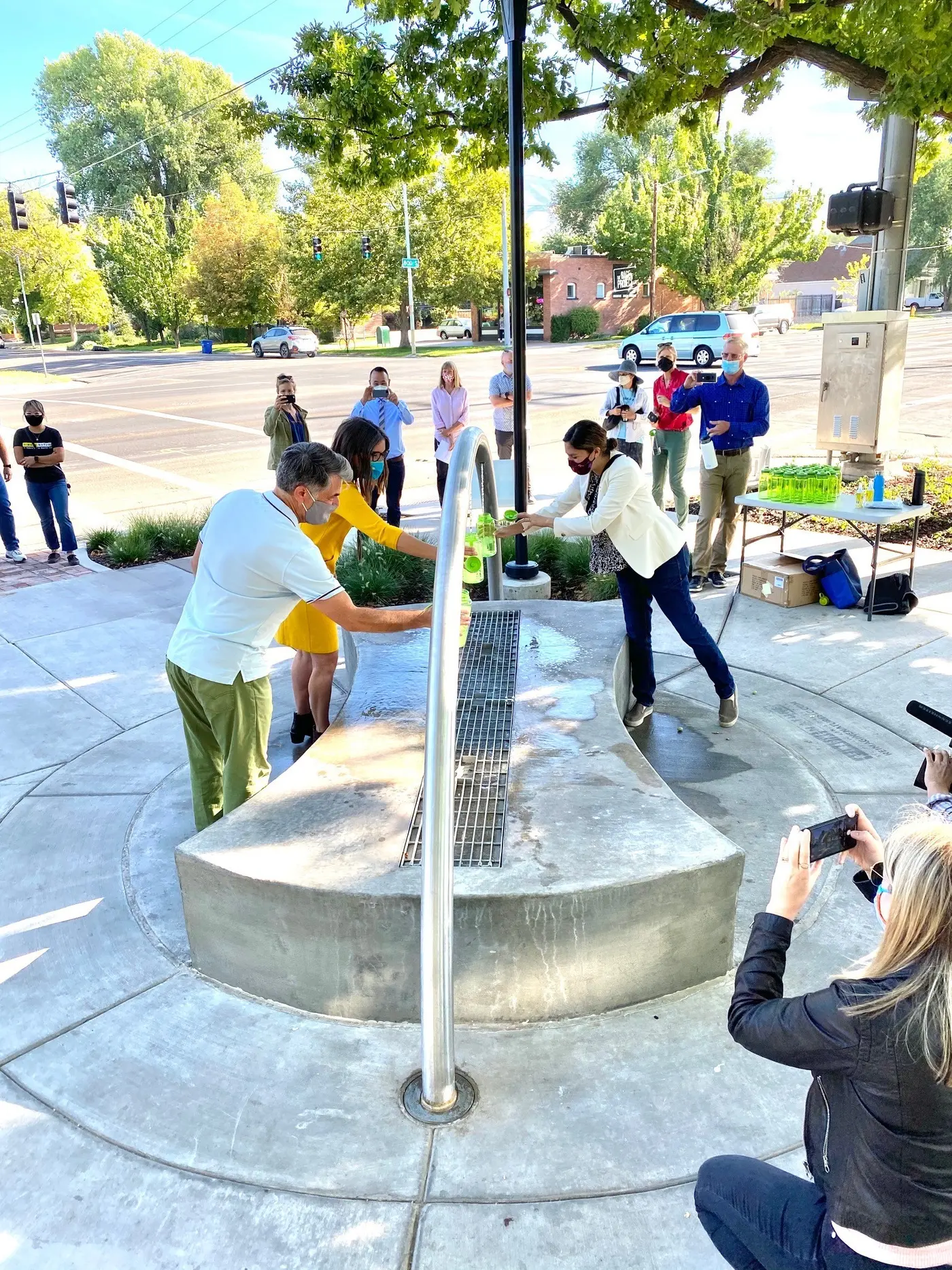
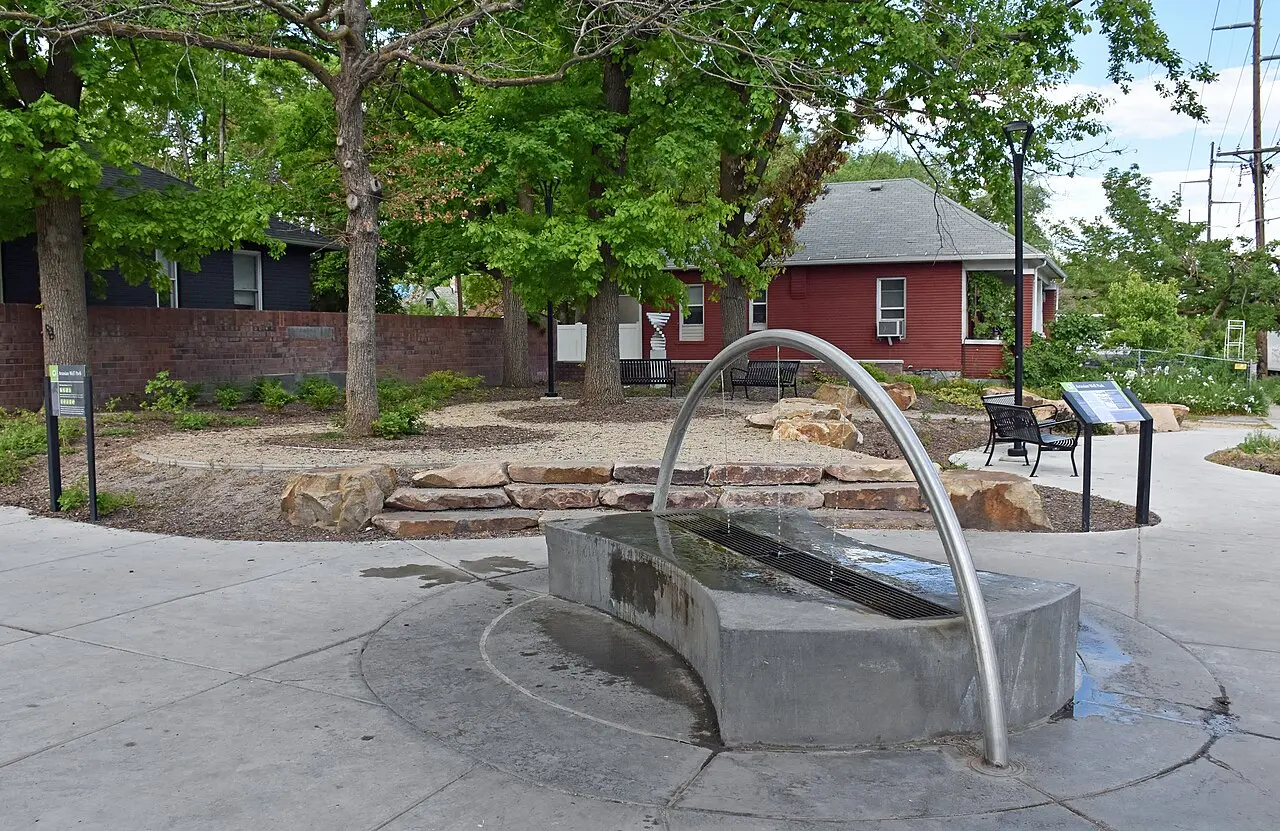
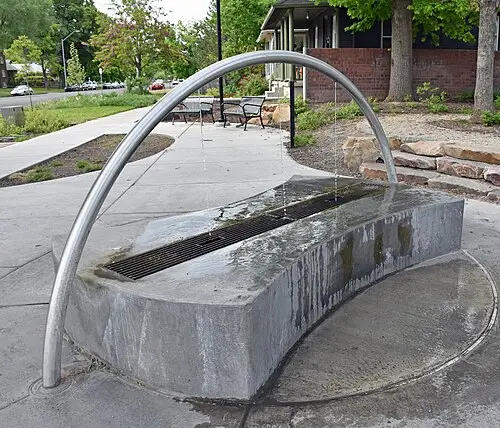
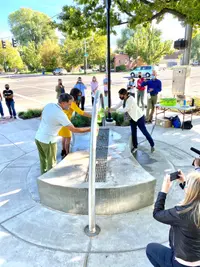
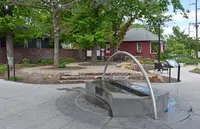
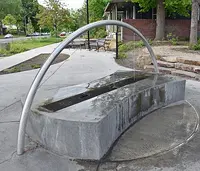
At the southwest corner of 800 South and 500 East, water runs from spigots set into an arch at the center of a small square of plantings. It comes up on its own. The well is artesian, and the aquifer beneath it holds enough pressure to bring water to the surface without a pump. Since the 2019 redesign, people can approach the well from any side. There are several spigots, a high-capacity outlet for five-gallon jugs, and a drinking fountain for cups and bottles. ParkMagnet counts three separate streams and warns that wind can blow the spray onto whoever is filling. Wikipedia puts the park at a quarter acre. The Salt Lake Tribune measured it at 0.10 acre. It has no playground. The ground around the arch is planted with regionally appropriate vegetation and laid with permeable pavement, and ParkMagnet notes a few benches in the shade. The park is open around the clock, and street parking holds about three cars.
The city’s Department of Public Utilities wrote in 2006 that hundreds of people stop every day to fill their jugs, and that the department had taken calls from users living as far away as Ogden. A 2017 city survey drew 220 responses. Nearly 80 percent of those who answered lived outside the park’s 84102 ZIP code, and almost a quarter had been coming for more than ten years. “It feels different than the other waters and even the taste is different,” Jessica Perez, a West Valley resident, told Fox 13. “I use the water for drinking and cooking.”
From Red Butte Creek, slowly
The city’s Public Lands Department traces the aquifer to a large recharge area that begins at Red Butte Creek, beneath the University of Utah. Earlier Public Utilities reporting estimated that water five blocks east of the well takes about three years to arrive, and that water near the university can need more than a decade to work through the ground. A 2019 hydrogeologic study of springs in the northeast Salt Lake Valley found them fed mainly by young recharge from the valley rather than by deeper groundwater from the mountains. It identified Red Butte Creek as a likely source.
The water is hard. An independent test by Good4Utah found calcium, magnesium, and iron, and no pesticides, chlorine, fluoride, bacteria, arsenic, or lead. The well is not part of the city’s drinking water system, but Public Utilities staff test it weekly for coliform bacteria, monthly for perchlorate, and yearly for metals and other chemicals. Perchlorate measured 4.6 parts per billion in 2007, below the EPA guideline of 24.5, and the city reported 2 to 4 parts per billion for 2015–2016. The city states the levels are below what the EPA considers a concern, and Utah does not regulate the compound. “The water quality is very good,” said Laura Briefer, the department’s director. “It meets all federal and state regulatory requirements that would be applied to a drinking water source if it were a public system.”
Oxen, a water claim, and a private lot
According to a Salt Lake Tribune article from June 30, 1991, legend has it that the “City Well” was used by the valley’s first Latter-day Saint pioneers in 1847. The city’s own history calls the site a stock watering hole. It is said that oxen hauling granite from the quarry in Little Cottonwood Canyon to the Salt Lake Temple construction site stopped there to drink and rest.
No record says who drilled the well or when. The city’s water claim lists a priority date of 1890. City documents cited by Wikipedia suggest the well may date from the 1890s, when drought pushed Salt Lake City to look for water beyond the yearly snowmelt. On March 14, 1936, the city filed an underground water claim with the State Engineer for a natural flow of 2 to 20 gallons a minute from a 2-inch well. The claim listed the water as used for domestic and culinary purposes and as the supply for a public drinking fountain. Under the claim the water belonged to the people of Utah, but the land around it stayed private. County tax records name Edna D. Openshaw as the earliest owner, and Don W. and Helen D. Layton held the lot by 1970. For much of the century the city kept up the well as a public courtesy on someone else’s corner.
In 1965 a major underground leak was reported to have slowed the flow considerably. Wet, slippery sidewalks, parking congestion, and upkeep pushed the city toward building a park. In 1975 the Central City Neighborhood Council Park Committee and the city took up the question of improving the site. Construction began on July 31, 1979, under a contract with the Ralph L. Wadsworth Construction Company, and the filling structure went up that fall. The park was dedicated on October 18, 1980, after about $79,450 had been spent on the water feature and access. The city’s utilities history says the well casing and plumbing were upgraded in 1983. Wikipedia gives 1984.
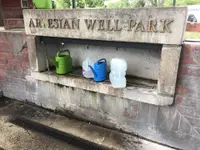
In 1987 a “Name-the-Park” contest for the city’s mini-parks gave the corner its name. Bernice Neeley, a Salt Lake Valley resident, submitted “Artesian Well Park.” Mayor Palmer DePaulis noted that “Barberi Park,” the entry of disc jockey and columnist Tom Barberi, was “running a close second,” since “both the well and the person run on freely.” At the time it was described as the only city park with an artesian well.
“Brick Oven Park”
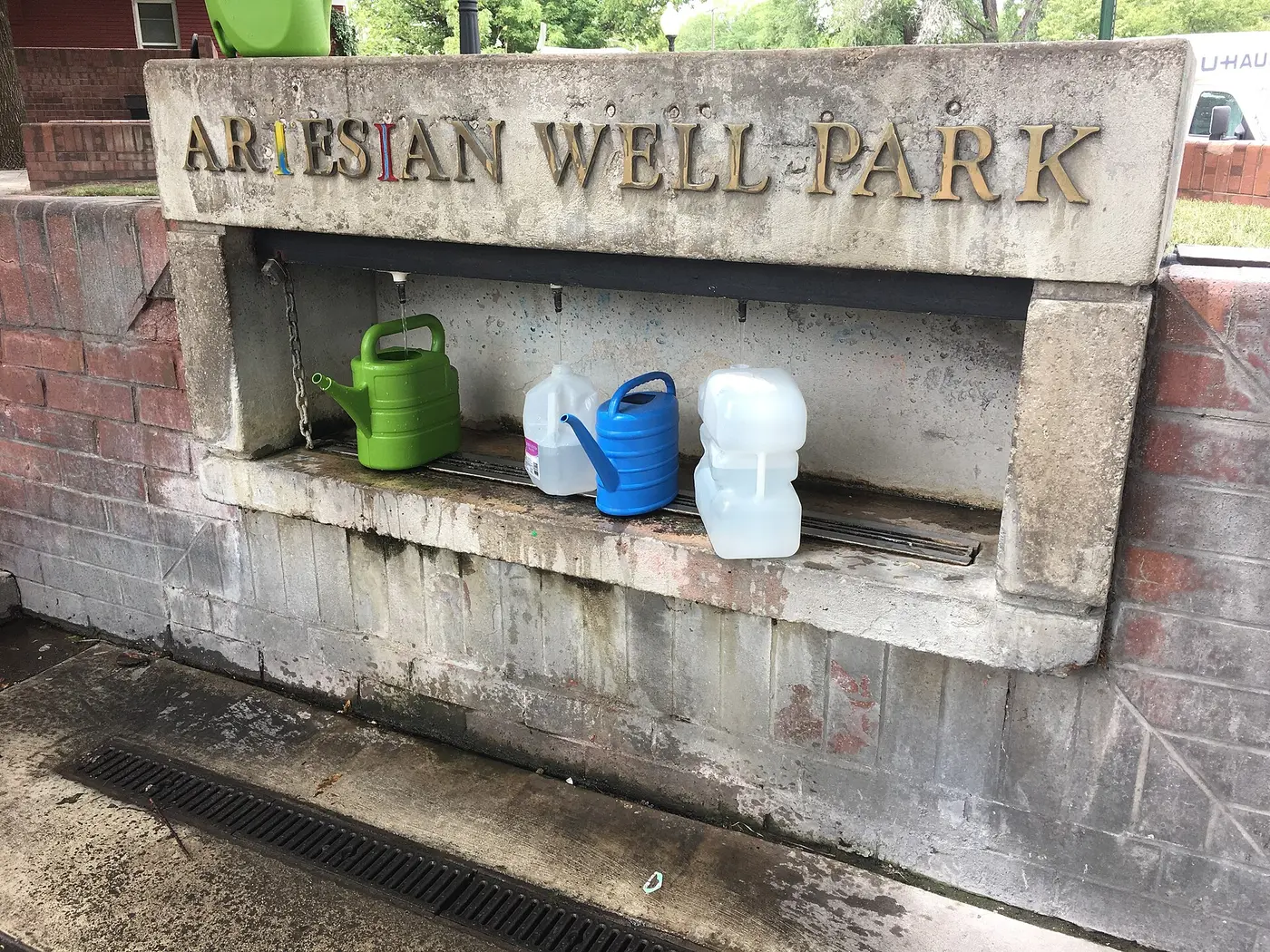
The 1979 design was mostly brick. Ethel C. Hale and W. Paul Wharton lived nearby and were married more than fifty years. They helped found the listener-supported radio station KRCL-FM, and they called the place “Brick Oven Park.” Luke Garrott, a former city councilman who lived near the well for nearly 15 years, said its layout made it “really dysfunctional as a public place, except for the well, which brings hundreds and thousands of people every month.”
On Monday, December 30, 2019, a Tribune photographer recorded Carl Mayer filling bottles at the spigots. Construction barriers went up the next day. The $355,000 renovation had been developed with members of the Central City Community Council and the consulting firm IBI Group. It stripped away brick, added spigots and lighting, and opened the corner to the street. “So here’s this teeny little park with this incredible regional draw,” said Nancy Monteith, the city’s project manager. “And these are people coming to collect water.” While the work went on, the city sent people to an artesian spigot at Liberty Park.
Garrott proposed renaming the renovated park for Hale, who died in 2016, and Wharton, who died in 2019. According to their obituaries, the couple loved gardening and feeding birds and had named their Central City property Singing Waters. The proposal was not adopted. The park reopened in September 2020 under the name Bernice Neeley gave it.
Notable Events
- 1890The City's water claim listed the priority date as 1890. slcdocs.com
- 1936The City filed an underwater ground claim for the well with the State Engineer for domestic and culinary purposes; the water was defined as publicly owned by the people of Utah while the land stayed private. slcdocs.com
- 1965Reports in 1965 of a major underground leak slowing the flow considerably. slcdocs.com
- 1975In 1975 the Central City Neighborhood Council Park Committee and Salt Lake City recognized and discussed the need to improve the well's site. slcdocs.com
- 1979Construction of the pocket park began on July 31, 1979 and was completed soon after. slcdocs.com
- 1979Park improvements were made in the fall of 1979, at that time the filling structure was constructed. slcdocs.com
- 1983In 1983 the well casing and plumbing were upgraded. slcdocs.com
- 2019The park that Salt Lake residents know today was redesigned in 2019. fox13now.com
- 2019The city temporarily closed the popular artesian spring for a renovation and landscaping upgrade to make the small park more appealing. sltrib.com
- Public Lands is excited to announce that Artesian Well Park is now open. slc.gov
People
- Laura Briefer, director of Salt Lake City's Department of Public Utilities, which monitors the well's water quality.
- Don W. and Helen D. Layton, property owners, residents of Salt Lake City (by 1970).
- Edna D. Openshaw, earliest property owner in county tax assessment documents.
- Ethel C. Hale, community activist proposed as a namesake for the renamed park (died in 2016).
- Nancy Monteith, Salt Lake City Public Services Department project manager for the park renovation.
- W. Paul Wharton, community activist proposed as a namesake for the renamed park (died in February).
Sources
- slc.gov/parks/parks-division/artesian-well-park
- en.wikipedia.org/wiki/Artesian_Well_Park
- slcdocs.com/utilities/NewsEvents/news2006/news3292006.htm
- slcdocs.com/parks/Artesian%20Well/Artesian%20Well%20Pocket%20Park%20-%20FINAL%20COMPILED.pdf
- fox13now.com/news/local-news/northern-utah/filling-cups-and-bottles-for-over-a-century-how-did-the-artesian-well-in-slc-come-to-be