Arkansas Valley Fair
Rocky Ford, Otero County, Colorado. Fair; Third week of August each year.
Details

- Where
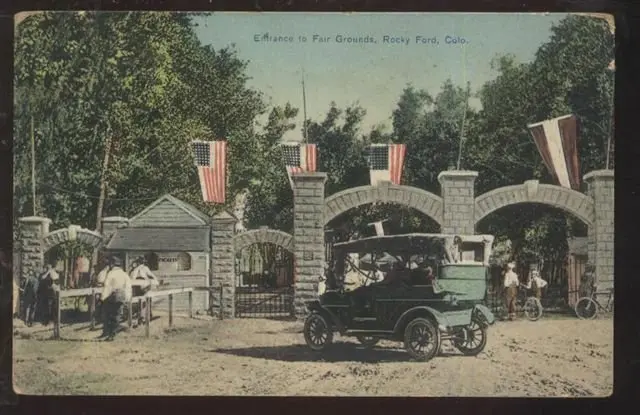
- Fairgrounds, 800 North Main, Rocky Ford, CO 81067. Directions
- When
- Last held August 19–22, 2026; next year’s date not yet stated.
- Getting there
- Rocky Ford is in southeastern Colorado beside the historic Santa Fe Trail on U.S. Highway 50.
- Fees
- Front gate admission and exhibits free; grandstand events ticketed.
- Hours
- Ticket box office opens daily at noon during the fair.
- Access
- No dogs, cats and other pets are permitted on Fairgrounds during Fair Week unless they are necessary aids to people with disabilities.
- Walk-in or reserve
- Grandstand events ticketed at the box office at the west end of the grandstand, opens daily at noon.
- Phone
- 719-254-7723
- Website
- arkvalleyfair.com
- Managed by
- Arkansas Valley Fair & Exposition Association.
- Established
- 1878.
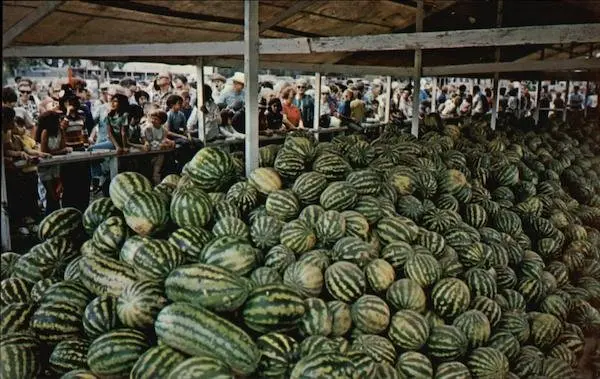
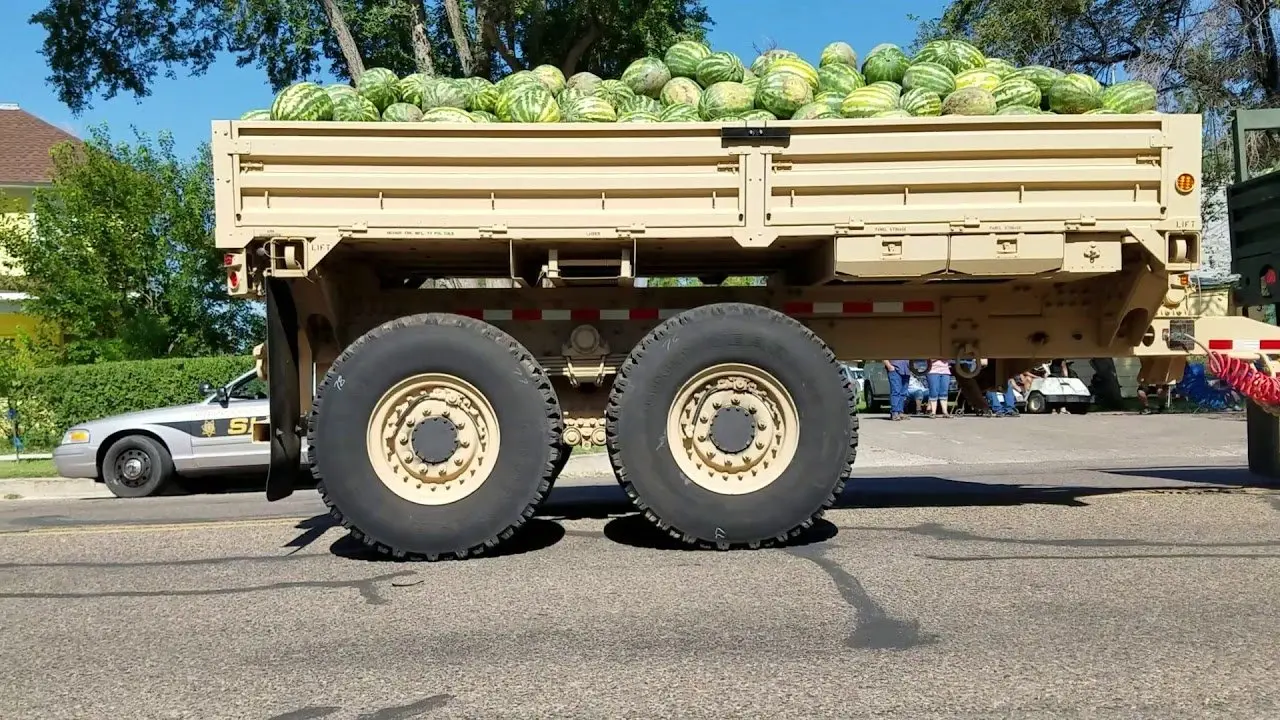
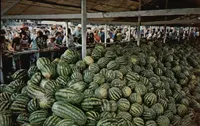
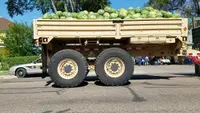
On the Saturday of fair week in Rocky Ford, members of the Rocky Ford Rotary Club give watermelons away to all comers. The City of Rocky Ford puts the pile at 30,000 pounds of Rocky Ford melons, provided by the local business community. The fair calls the day Watermelon Day, and in 2021 the giveaway was posted for 11 a.m. The town lies in southeastern Colorado on U.S. Highway 50, beside the historic Santa Fe Trail, in watermelon and cantaloupe country.
The Arkansas Valley Fair runs the third week of August on the Arkansas Valley Fairgrounds at 800 North Main, about 70 acres. Front gate admission is free, and so are the exhibits. The fair bills itself as the oldest continuous fair in Colorado. A 2023 planning document on its website says it draws 17,000 people. The 149th fair ran August 19 through 22, 2026, under the theme “Stars, stripes and summer nights.”
Four named days on North Main
Each day of the fair has a name. Wednesday is Silver Day. In 2021 it opened with a 6:45 a.m. wake-up breakfast, held a Silver King & Queen Contest at 11, and closed with a pie social at 6:30. The 2026 program credits the Silver King & Queen Contest to Pioneer Health Care Center. In 2026 the A.M.P. Carnival opened its rides on the midway at 6 p.m. that Wednesday, and The Bragg Family played a free show in the grandstand at 7.
Thursday is Kids Day. From noon to 6 the carnival sells a $25 wristband, against the regular $35. That evening the figure 8 jump race runs at 7, after a Calcutta at 6.
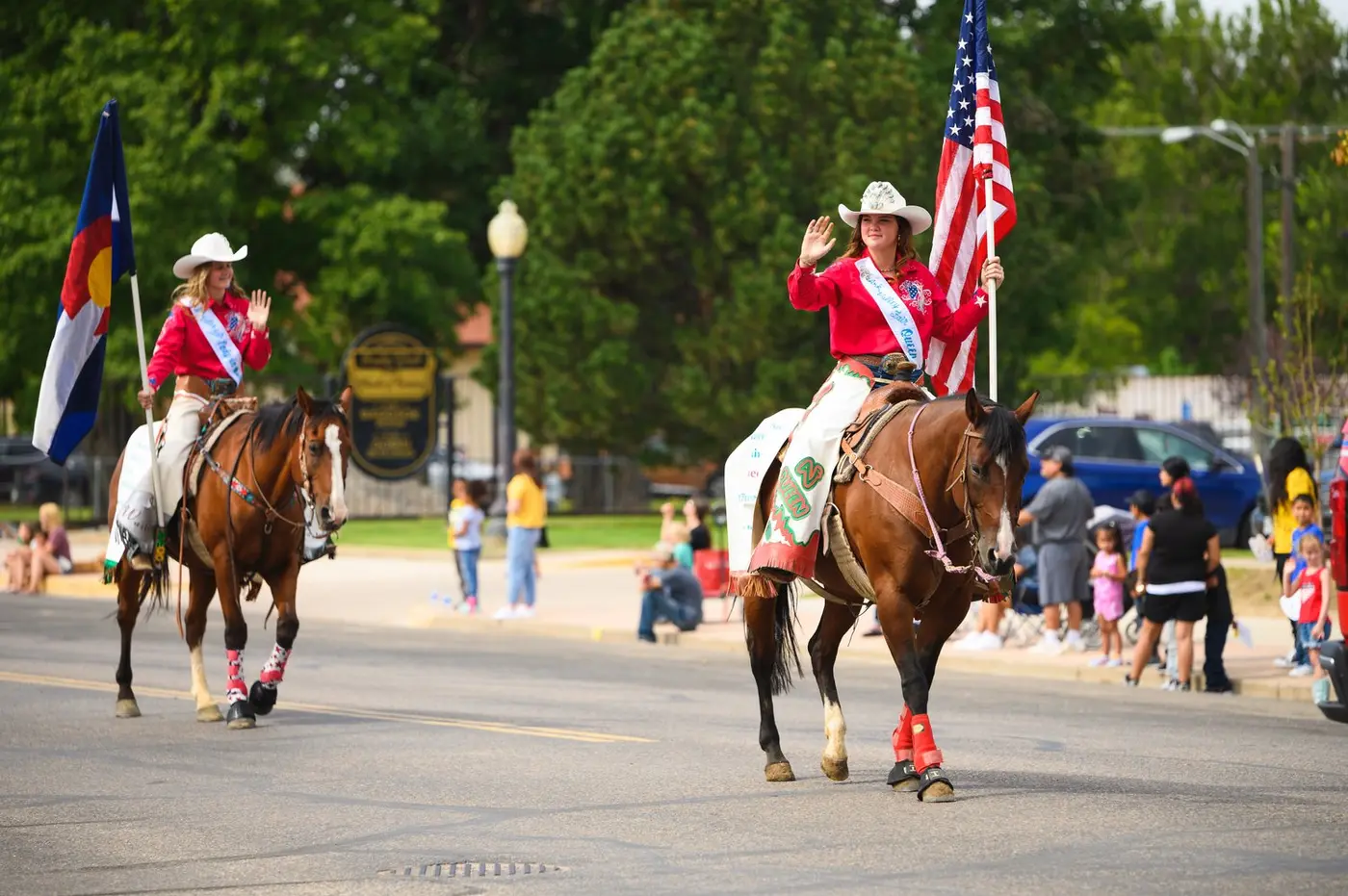
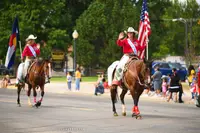
Friday is Parade Day. The parade steps off at 10 a.m. Tami Thomas directs it with the Rocky Ford Lions Club, and the 4-H and FFA champions ride in it as the Parade of Champions. At 1 p.m. the arena holds its grand entry, followed by a ranch rodeo, open bronc riding, and a horse race meet. At 7 comes the AVF Rodeo, a CPRA rodeo. In 2026 it carried the 17th annual “HorseBite” mutton bustin, open to the first 30 entries.
Saturday, after the melons, brings a 12:30 grand entry. In 2026 it included the coronation of the 2027 AVF Queen. The 2026 royalty were Queen Larkin Anderson, Lady in Waiting Allie Whitney, and Senior Princess Laurie Whitney. The AVF Rodeo and another horse race meet follow at 1. The fair ends that night with the demolition derby at 7:30, all seats general admission. Grandstand tickets are sold from a box office at the west end of the grandstand, which opens at noon each day. The carnival does not run on Sunday.
The 2021 poster listed what runs every day: bingo, a beer garden, an entertainment pavilion, concessions and craft vendors, and evening dances. In 2026 the program listed William Lebya of Familia Pueblo for the Entertainment Pavilion, and also listed a car show and a LEGO building contest. The Arkansas Valley Fair & Exposition Association puts the fair on. In 2026 Darren Garcia was president of its board and Sally Cope was manager.
Weigh-ins, the sale ring, and the open class
The 4-H and FFA barns fill before the gates open. On the Tuesday of fair week in 2026, the market animals were weighed one species at a time: swine at 9 a.m., goats and sheep at 11, rabbits and poultry at 2, and beef at 3. The swine show followed that evening. Wednesday brought dairy goats and goats in the morning, poultry in the afternoon in the poultry area, and sheep at 6:30. Thursday brought dairy cattle, breeding beef, bucket calves, market beef, and rabbits, and each species had a Tiny Tots class. The Round Robin showmanship contest ran at 6 that evening. Friday after the parade, buyers sat down to dinner, and at 6:30 the Fat Stock Sale and Foods Sale began. By Saturday morning the animals were going home.
Open-class entries fill the exhibit halls. There are classes for foods, crops, flowers, needlework, crafts, fine arts, and photography, and one class is called One Yard or Less. The fair also holds a watermelon carving contest and a melon run-walk at 10K, 5K, and 3K, with a 1600-meter race for children.
A grain door and a Santa Fe caboose
The fair’s own history page reprints an account by “the late Senator G. W. Swink, the originator of the celebration.” Swink writes that watermelon raising in the Arkansas Valley began in 1877 with about a quarter acre, which “produced all that could be sold in the local markets that year.” The next summer the crop was large:
“The first Watermelon Day was in 1878. My crop for this year being very bountiful, I decided to invite all the people in the surrounding territory to partake in my crop. The country then being thinly settled the crowd was quite small, not more than 25 persons being present, and they being mostly from La Junta coming in a Santa Fe Caboose. I cut the melons on the grain door of a boxcar. Only one wagonload was required to feed the crowd and give all they wanted to carry home.”
The fair’s event page tells it a little differently: in 1878 Swink shared his crop with passengers at the Rocky Ford Depot.
Swink repeated the invitation in 1879. About fifty came, mostly from La Junta, and ate and carried home one large wagonload. He again carved on a grain door and did all the cutting himself. In 1880 a hundred people went through two wagonloads. In 1881 two coach loads came from La Junta, and a twelve-foot table was built. For those years, Swink writes, the feast was served in the old Swink Store beside the Santa Fe track.
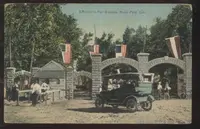
In 1883 the melon table moved to a grove north of town. The grove was part of Swink’s timber claim, which he says “had the distinction of being the first culture claim proved upon the United States.” A basket picnic joined the melons that year, on a separate table where “the ladies spread a most excellent dinner for the visitors.” Plums, grapes, and apples were set out on display, and the fruit was given to the crowd before the day ended. Farm products were added to the display in 1885. In 1886 the crowd was so large that “the ladies had to ‘put the big pot on,’” and for the first time Swink called in help to cut and serve the melons.
Up to 1886, by Swink’s account, he raised all the melons grown in that part of the county. That year he began sending them to eastern markets. The first two years of shipping lost money, because the proceeds did not cover the express charges. Then “the better hotels and restaurants began to sell and call for ‘Rocky Ford Melons,’” and the melons went by the carload to Kansas City and Saint Louis.
Colorado Preservation, Inc. describes George Swink as a state senator and agriculturalist. It dates his free watermelons on Watermelon Day “as early as 1878” and says the fair was formally established in 1892. The fair counts its editions from 1878, so 2026 was the 149th.
Sixty thousand adobe bricks
Several of the buildings date from the fair’s early decades. History Colorado lists an Art Building from 1901 and ties it to the fair’s development and social history. Colorado Preservation notes that horse racing, along with watermelons, is a long local tradition at the fair. The rodeo arena has been rebuilt piece by piece. New bucking chutes, back pens, and buildings around the arena went in during 2024. In 2026 the fair added grandstand seating east of the chutes and portable bleachers on the west slab, put down a new grandstand floor, and repainted the seats. The fair says it raised ticket prices to meet the cash matches that its grants require. A larger plan with the City of Rocky Ford covers the fairgrounds and Crystal Lake, 35 acres of holding ponds left behind by the sugar industry. The plan aims to put the grounds to use year-round.
The Adobe Stables are the largest piece of the old fairgrounds still standing. In 1938 the local school district bought the fairgrounds, and within days it applied to the Works Progress Administration to build the stables. Construction had begun by March 1938 and was finished on November 25 of that year. Colorado Preservation estimates the job took 60,000 large adobe bricks. History Colorado counts the stables as one of several WPA projects on the grounds that gave people work during the Great Depression.
The stables stayed in use until about 2000. By then they were too fragile and deteriorated to keep, and they were emptied. Some people called for tearing them down. Local advocates opposed demolition and arranged a Historic Structure Assessment, but its estimate for rehabilitation was high, and the effort stalled. In 2007 the stables were named one of Colorado’s Most Endangered Places. The same year they were added to the National Register of Historic Places, for their tie to New Deal building programs, for the fairgrounds’ part in the growth of Rocky Ford, and for their distinctive construction.
In 2009 the Endangered Places Weekend Workshops were held at the stables, and volunteers rehabilitated 25 of them. City of Rocky Ford employees learned to make and repair adobe at the workshops. The city has since drawn up a Preservation Maintenance Plan for the stables, which includes buying an adobe mixer for volunteer work weekends. The Boy Scouts, the FFA chapter, the 4-H club, and the rodeo club have joined the work. The stables board horses, and the plan calls for their doors, now too weak to hold animals safely, to be repaired and secured so more stalls can be used.
Notable Events
- 1878G. W. Swink invited people from the surrounding territory to share his bountiful crop; no more than 25 attended, mostly arriving from La Junta in a Santa Fe caboose. arkvalleyfair.com
- 1883The melon table moved to George Swink's grove north of town, and the feast added a basket picnic and a display of plums, grapes, and apples. arkvalleyfair.com
- 1886After producing all the melons raised in that part of the county through 1886, Swink began introducing them in eastern markets. arkvalleyfair.com
- 1901The Art Building is associated with the fair's development and social history. historycolorado.org
- 1938The local school district bought the fairgrounds, applied to the Works Progress Administration for the Adobe Stables, and completed them on November 25, 1938. coloradopreservation.org
- 2000The fragile and deteriorated stables had to be vacated. coloradopreservation.org
- 2007High rehabilitation costs led to listing as one of Colorado's Most Endangered Places. coloradopreservation.org
- 2009Volunteer workshops rehabilitated 25 stables. coloradopreservation.org
- 2023GOCO planning and design development grant submitted. arkvalleyfair.com
People
- Senator George Swink, originator of the fair's continuing watermelon tradition (1878).
- Alan Garrett, Demolition Derby Director.
- Alan Lewis, Horse Racing Director.
- Allie Whitney, Lady In Waiting.
- Amber Barratt, Arena Gates Director.
- April Gibson, Queen Contest committee.
- Ashley Venem, Secretary.
- Austin Kuhn, Fair Board Vice President.
- Brooke Matthew, 4-H & FFA committee.
- Catalina Morris, Open Class Fine Arts, Crafts & Photography Director.
- Catlin Carman, Calcutta Director.
- Chelsey Muth Grover, Mutton Bustin coordinator.
- Cody Downare, Auctioneer Co-Director.
- Darren Garcia, Fair Board President.
- Dayla Elliot, Treasurer.
- Dayla Elliott, Queen Contest Director.
- Dayla Pearl, Open Class Crops & Foods Director.
- Gordon French, Car Show Director.
- Heath Proctor, Grounds C0-Director.
- Jaclyn Sharon, Calcutta Co-Director.
- Jason Crouch, Arkansas Valley Livestock Show Director.
- Jason Stites, Horse Racing Gates.
- Jimmy Cope, Thanked for fair assistance and support.
- Josh Barratt, Ranch Sorting coordinator.
- Judy Brown, Open Class Crops & Foods Director.
- Kelly Yutterman, Figure 8 Jump Race Director.
- Larkin Anderson, AVF Queen.
- Laurie Whitney, Senior Princess.
- Linda Fenter, Flower Show Director.
- Marlena Griesse, 4-H & FFA committee.
- Matthew Wallace, Police Chief, Safety & Security.
- Nick Knapp, Demolition Derby committee.
- Ray Gonzales, Fire Chief, Safety & Security.
- Rhett Proctor, Grounds Director.
- Rick Dannar, Colorado National Guard; thanked for fair assistance and support.
- Ricky Aragon, Beer Garden committee.
- Ron Shepherd, Race coordinator.
- Ryon Sallee, Auctioneer Director.
- Sally Cope, Manager.
- Sarah Dillon, LEGO Building Contest coordinator.
- Schuyler Totten, Demolition Derby Director.
- Tami Thomas, Fair Board 2nd Vice President.
- Tammy Encinias, Kids Day Director.
- Tiffany French, Car Show committee.
- Tommy Valencia, Sound System Director.
- William Lebya, Entertainment Pavilion, Familia Pueblo.
- Senator G. W. Swink, Originator of the celebration and author of its history.
- George Swink, State Senator and agriculturalist whose free watermelons were the fair's roots (as early as 1878).